

When it comes to link building for ecommerce, the game is all about earning high-quality backlinks from websites that matter. Think of these links as trusted referrals. They signal to search engines that your store is a credible, valuable resource, which in turn gives your product and category pages a serious ranking boost.
This isn't a numbers game about getting thousands of random links. It’s about being strategic and acquiring the right links—the ones that actually drive relevant traffic and, ultimately, revenue.
Why Quality Backlinks Are Your Ecommerce Superpower
Let's cut through the noise. In the cutthroat world of online retail, visibility is everything. You could have amazing products and a stunning website, but if shoppers can't find you on Google, you're practically invisible. This is where a smart link building strategy becomes an absolute must-have.
High-quality backlinks are essentially votes of confidence from other respected sites. When a popular industry blog or an influential product reviewer links to one of your products, they're vouching for you. They’re telling search engines, "Hey, this brand is the real deal."
This kind of endorsement has a direct impact on your bottom line:
- More Organic Traffic: Higher rankings mean more potential customers find you without you paying a cent for ads.
- Stronger Domain Authority: A powerful domain helps all your pages—from your homepage to the deepest product page—rank better.
- Greater Brand Credibility: Links from reputable sources build trust with real people, not just algorithms.
It’s a Quality Game, Not a Quantity Game
The old-school approach of piling on hundreds of cheap, low-effort links is dead. Thankfully. Today, it’s all about relevance and authority. A single, powerful link from a major voice in your niche will do more for your business than a hundred links from spammy directories ever could.
The competition is getting fiercer. Projections show that by 2025, an ecommerce store might need around 780 backlinks to even sniff a top-three spot on Google. This just hammers home the need for a quality-first mindset. It's about building real relationships with sites that your customers already trust, like a top-tier fashion blog linking to your clothing store.
A quality backlink is really just a form of earned media—a genuine, third-party stamp of approval for your brand. Consumers trust these endorsements far more than any paid ad, making them incredibly valuable.
That’s why understanding the true value of earned media is so important. It frames why backlinks are truly an ecommerce superpower, capable of boosting trust, engagement, and your overall ROI. This is the mindset that fuels every effective strategy you'll learn about.
Conducting a Backlink Audit You Can Actually Use
Before you start chasing new links, you have to know where you stand right now. This is where a backlink audit comes in. It’s not about getting bogged down in massive spreadsheets; it’s about getting a clear, practical snapshot of who links to your store and why.
Think of it as a health check for your store's online reputation. By digging into your existing backlink profile, you’ll quickly see what’s working, what’s not, and where your biggest opportunities are hiding. This first step really sets the stage for everything else you'll do.
Gathering Your Core Backlink Data
First things first, you'll need a solid SEO tool. I personally use Ahrefs, but Semrush and Moz are also industry-standard choices for pulling this kind of data. They give you a complete picture of your referring domains (the unique sites linking to you) and your total backlink count.
Once you plug your domain in, start by asking a few key questions:
- Who is actually linking to us? Are they high-authority blogs and industry publications, or just a bunch of low-quality directories?
- Which of our pages are getting the links? You'll probably find your homepage gets a lot of love. But ideally, you want to see links pointing directly to your valuable category and product pages, too.
- What's the quality of these links? Pay attention to metrics like Domain Rating (DR) or Domain Authority (DA). A handful of links from high-DR sites is worth far more than hundreds from junk ones.
If you’re just starting out, this can all feel a bit much. For a more foundational review of your site's overall health, our guide on how to run a Shopify SEO audit is the perfect place to begin.
This is the ideal flow you're aiming for: you create great content, that content earns quality backlinks, and those links drive authority and traffic back to your store.
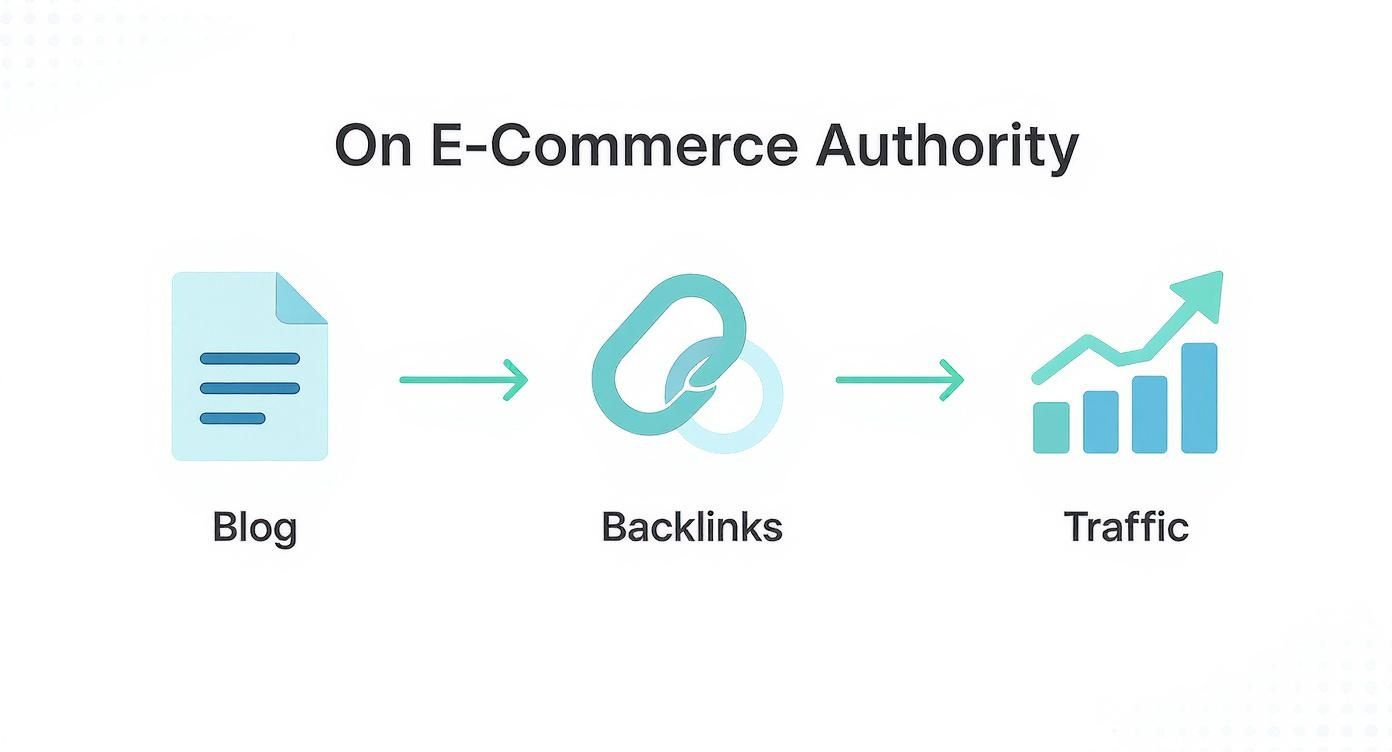
The real takeaway here is that creating "linkable assets" is what fuels the entire engine. Without them, you're just spinning your wheels.
Analyzing Competitor Strategies
Your own profile is only half the picture. The real goldmine is in what your competitors are doing. Run the same backlink report on two or three of your top competitors to reverse-engineer their strategies.
By dissecting your competitors' backlink profiles, you're essentially getting a free roadmap. You can see exactly which high-authority sites are willing to link to stores like yours, giving you a ready-made list of prospects for your own outreach.
Look for patterns. Are they consistently featured in holiday gift guides? Are they showing up in "best of" product roundups? Are they guest posting on certain blogs? Every link they've earned is a clue.
This is what’s often called a "link gap" analysis—finding the sites that link to your competitors but not to you. It's hands-down one of the most efficient ways to build an initial outreach list of warm targets who are already interested in your niche.
Creating Content That Earns Links Naturally
Let's be honest: the best link building strategies for ecommerce don't feel like link building at all. They happen organically when other websites want to link to you, often without you even asking.
This is all about creating what we call "linkable assets"—exceptional content that sets your store up as a genuine resource, not just another place to buy things. Instead of constantly hunting for individual links, you build something so valuable that it pulls them in naturally. It's a fundamental shift from short-term outreach to building long-term, valuable assets for your brand.
Go Beyond Standard Product Pages
Your product and category pages are built to convert, which is great. But they're rarely what a journalist or blogger is looking to cite in an article. To get those high-authority links, you need to create content that has a much broader appeal.
Think of these assets as magnets for backlinks. They draw in SEO authority that then flows throughout your entire site, giving a lift to the crucial pages that actually make you money. A single, data-rich guide can attract dozens of links, which in turn helps its related category pages rank higher in the search results.
The core idea is simple: stop just selling products and start becoming an authority in your niche. When your brand is synonymous with expertise, links will follow as a natural byproduct of your credibility.
Of course, for this to work, your content can't just be good; it has to be exceptional. You can't just rehash what's already out there. It needs to be more detailed, better researched, or more engaging than anything your competitors have published. A solid ecommerce content strategy is the blueprint for creating these powerful assets.
Develop Ultimate Buying Guides
A perfect place for any ecommerce store to start is by creating the definitive buying guide for one of your core product categories. I'm not talking about a simple blog post. This is a truly comprehensive resource that walks a potential customer through every single question they might have before they buy.
Take an online coffee retailer, for example. Instead of a generic "How to Brew Coffee" article, they could create "The Ultimate Guide to Pour-Over Coffee." A true asset like this would include:
- Detailed Comparisons: A visual breakdown of different pour-over devices like the V60 vs. a Chemex vs. a Kalita Wave.
- Step-by-Step Instructions: Clear, illustrated guides on grind size, water temperature, and pouring techniques.
- Expert Advice: Tips on which beans work best for this specific brewing method.
Suddenly, this one piece of content is the go-to resource for anyone researching pour-over coffee, making it a no-brainer for coffee bloggers and gear reviewers to link to.
Publish Original Data and Research
Want to get links from news sites and top-tier blogs? Publish original research. Journalists and writers are always on the hunt for compelling stats to back up their stories. If you are the source of that data, they have to link to you.
You don't need a massive research budget, either. A simple customer survey can uncover fascinating insights. A beauty brand could survey 1,000 of its customers about their skincare routines and publish "The 2025 Skincare Trends Report." That data becomes a primary source that others will cite for months, or even years, to come.
The results can be huge. We've seen an outdoor gear brand achieve a 78% traffic increase on key category pages just by creating linkable content around topics like solo female hiking. In another case, a toy retailer generated over 300 backlinks from 150 unique domains in a single year by using viral guides and contests. These examples show how investing in content directly fuels real SEO gains and attracts the right kind of traffic.
Create Interactive Tools and Calculators
Interactive content is a home run because it provides instant, personalized value. Tools like calculators, quizzes, or product configurators solve a specific problem for your audience, making them incredibly shareable and link-worthy.
The trick is to find a common challenge your customers face and build a simple tool to solve it.
Here are a few real-world ideas:
- A paint store could create a "Paint Calculator" that instantly tells users how much paint they need for a room.
- A jewelry store might build a "Ring Sizer" quiz to help customers find their perfect fit without leaving home.
- An outdoor gear retailer could offer an interactive "Backpack Finder" that recommends the ideal pack based on trip length and activity.
These tools are not only useful for shoppers but are prime linkable assets. A home improvement blog is far more likely to link to a genuinely helpful paint calculator than a standard product page, making this a smart and sustainable way to build links.
Running Digital PR Campaigns That Land Big Links

Even the most incredible content—a groundbreaking data study or a viral gift guide—won't earn links just by existing. You need to give it a promotional push, and that’s where strategic outreach and Digital PR come in. This is how you get your amazing assets in front of the people who can give them a megaphone.
Think of Digital PR as the bridge connecting your content to high-authority publications. It's the art of getting your brand, products, or expertise featured by journalists, influential bloggers, and industry editors. This isn't about blasting out generic emails; it's about building genuine relationships.
The impact is massive. It’s no surprise that 67.3% of SEO experts now consider Digital PR the single most effective link-building strategy. It just works, building the kind of brand authority and trust that actually convinces people to buy. You can dig into similar findings in the latest ecommerce link building trend reports.
Finding The Right People To Contact
Your outreach success depends entirely on who you contact. Pitching a story to the wrong journalist is like trying to sell snow gear in the desert. It’s a waste of everyone's time.
The real key is to find writers who have recently covered your niche or similar topics.
Tools like Ahrefs are great for this, as are more specialized media databases like Cision. Look for reporters who have linked to data studies, featured product roundups, or quoted experts in your field.
Your goal is a targeted list, not a massive one. I’d much rather have 20 highly relevant contacts than 200 generic ones. For each person, quickly note a few of their recent articles. This one simple step is what separates a personalized, effective pitch from spam.
Crafting Pitches That Actually Get Replies
Forget the copy-paste templates. Journalists get hundreds of pitches a day, so yours has to cut through the noise in a crowded inbox. The best pitches are short, relevant, and get straight to the point.
Here’s a simple structure that I’ve seen work time and time again:
- A Compelling Subject Line: Make it clear and intriguing. "Data: The Top 10 Sustainable Fabrics of 2025" is so much better than "Story Idea for You."
- A Quick, Personal Intro: Briefly mention a recent article they wrote that you genuinely enjoyed. It shows you’ve actually done your homework.
- The Core Pitch: In one or two sentences, explain what your content is and why their audience would care. Drop your most compelling statistic right up front.
- A Clear, Low-Friction Ask: End with a simple offer. Something like, "Does this sound like something your readers might find interesting?" opens the door for a conversation without being pushy.
This approach respects their time and clearly shows the value you're offering. Remember, a great pitch is about them and their audience, not just about you and your link.
The secret to successful outreach is empathy. Put yourself in the journalist's shoes. What problem can you solve for them? How can you make their job easier? When you frame your pitch as a solution, your reply rates will skyrocket.
A Realistic Look at Link Building Outreach Tactics
Not all outreach is created equal. Some methods are quick but yield low-quality links, while others require serious effort but can land you on major publications. Here's a quick breakdown to help you choose the right approach.
| Tactic | Potential Link Quality | Effort Level | Best For |
|---|---|---|---|
| Guest Posting | Medium-High | Medium | Building topical authority and getting in front of targeted audiences. |
| Broken Link Building | Low-Medium | Medium | Quick wins and building foundational links from relevant pages. |
| Resource Page Links | Medium | Low | Niche sites looking to build a base of relevant, evergreen links. |
| Digital PR / Data Studies | High | High | Brands aiming for top-tier media placements and high-authority links. |
| Influencer/Brand Collabs | Medium-High | Medium | Ecommerce stores with visual products that can partner for co-marketing. |
| Unlinked Mentions | Medium | Low | Established brands with some existing online buzz; an easy win. |
Choosing the right tactic depends on your resources and goals. For new stores, starting with resource pages and unlinked mentions is smart. For established brands ready to scale, nothing beats a well-executed Digital PR campaign.
Newsjacking: Jumping On Trending Stories
One of the most powerful (and honestly, fun) Digital PR tactics is newsjacking. This is all about tying your brand, product, or expertise to a current event or a story that's blowing up online. It lets you insert your store into conversations that are already happening.
For example, if a viral story breaks about the benefits of a specific skincare ingredient and you sell a product that features it, that's your moment. Reach out to journalists covering the trend and offer yourself as an expert source to comment on why that ingredient is so effective. This strategy works because it's timely and gives reporters on a tight deadline exactly what they need.
A well-run Digital PR campaign should be a core part of your overall marketing. To see how this fits into the bigger picture, check out our guide on building a multi-channel marketing strategy. And if you’re looking to fast-track your efforts, exploring dedicated Digital PR Link Building Packages for SEO Authority can provide a structured path to getting those big wins.
Building Links Through Strategic Partnerships

Not every backlink has to come from a cold pitch. Honestly, some of the absolute best, highest-authority links are probably sitting right under your nose, hiding within your existing network.
This isn't about chasing strangers; it's about building on the trust and mutual benefit you already have with people you work with. These are often the easiest wins you'll ever get, and they result in links that feel earned and look completely natural to search engines.
Tap Into Your Supplier and Manufacturer Network
Let's start with the most obvious (and often overlooked) opportunity: the brands you sell. Your suppliers and manufacturers almost always have a "Where to Buy" or "Stockists" page on their website. Getting your store listed there is a total no-brainer.
These links are SEO gold. Why? They come from ultra-relevant, authoritative sites in your exact niche. A link from a major brand you carry sends a huge signal to Google that you're a legitimate, trusted retailer of their products. It's an instant credibility boost.
The process is refreshingly simple:
- First, just make a list of every single brand you stock.
- Next, pop over to their websites and look for those dealer or retailer locator pages.
- If you're not on the list, shoot a quick, friendly email to your sales or marketing contact. Just remind them you're an official partner and ask to be added.
This is the warmest outreach you can possibly do. You're helping them by making it easier for customers to find their products, and in return, you get a quality backlink and some valuable referral traffic.
Launch Co-Marketing Campaigns With Complementary Brands
Now, think beyond your direct suppliers. What other brands do your customers absolutely love? They might not be direct competitors, but they serve the same type of person. These non-competing businesses are perfect candidates for co-marketing campaigns that generate links for everyone.
For instance, say you sell high-end kitchen knives. You could team up with a brand that makes beautiful artisanal cutting boards. A joint campaign could be anything from:
- A shared giveaway: Both of you promote a big prize on social media and to your email lists, with each site linking to a central giveaway page.
- A co-authored guide: Imagine creating "The Ultimate Charcuterie Board Guide." You'd contribute the content on slicing techniques, they'd cover wood types and care. Both of you would publish it and link to each other as the expert source.
- A product bundle: Create a special knife-and-board set. This gives both of you something new and exciting to promote—and a natural reason to link back and forth.
The best partnerships are always a win-win. When you team up to create something genuinely useful for your shared audience, the backlinks you get are just a natural byproduct of a great collaboration, not some forced SEO tactic.
These campaigns are brilliant because they get your store in front of a whole new, highly relevant audience while creating a completely legitimate reason for another trusted brand to link to your site.
Sponsor Local Events or Niche Communities
Another fantastic way to build links is by getting involved in the community, whether that's in your city or in an online niche. Sponsoring a local event, a kids' sports team, or even a podcast in your industry is a great way to build brand awareness and pick up a valuable link from the event's website.
The key is to find opportunities that actually align with your brand and what your customers care about. If you sell running shoes, sponsoring a local 5K is a perfect fit. If you're all about eco-friendly products, partnering with a local environmental charity makes total sense.
More often than not, you'll get a link from an "Our Sponsors" page. These links are often high-quality because they come from trusted community hubs, and they do double duty by showing your brand is invested in the causes your customers value.
Got Questions About Ecommerce Link Building? We've Got Answers
As you dive into building links for your store, some questions are bound to pop up. It's totally normal to wonder about timelines, the best tools for the job, and how to know if what you're doing is actually working.
Let's clear up some of the most common questions we hear from ecommerce store owners just like you.
How Long Until I Actually See SEO Results From This?
Let's be real: link building is a long game. It requires patience. While you might start to see some encouraging little bumps in your analytics within 2-3 months, the real, meaningful impact on your organic traffic and rankings usually takes a solid 6 to 12 months to materialize.
This timeline isn't set in stone, of course. It really hinges on where you're starting from, how tough your niche is, and how consistently you're putting in the work. Think of it less like a quick sprint and more like building a strong foundation for your business, brick by brick. The first real wins you'll likely see are an increase in your Domain Rating and better rankings for some of your more specific, long-tail keywords.
Your first backlinks are like the foundational stones of a castle. They don't look like much on their own, but every quality link you add makes your domain stronger, eventually building it into a fortress that can command authority in the search results.
It's that gradual build-up of momentum that makes sticking to a consistent plan so incredibly important.
What Are the Best Tools for an Ecommerce Link Building Campaign?
You don't need a massive, expensive tech stack, but a few key tools are non-negotiable if you want to be efficient and effective. The right tools make everything from finding opportunities to sending emails so much easier.
- For Analysis & Tracking: You can't fly blind. Tools like Ahrefs and Semrush are the gold standard here. They're essential for auditing your current backlinks, spying on what your competitors are doing, and tracking your own progress.
- For Outreach Management: Once you start sending more than a handful of emails, you need a system. Platforms like Hunter.io or Pitchbox are game-changers for finding contact info and managing your outreach campaigns without losing your mind.
- For Free Monitoring: Never underestimate Google Alerts. Seriously. Set it up to get an email anytime someone mentions your brand online. If they didn't link to you, a quick, friendly email is often all it takes to turn that mention into a brand new backlink. It's one of the easiest wins out there.
Is Guest Posting Still a Good Strategy for Ecommerce Stores?
Yes, absolutely—with one huge caveat. The game has changed. Quality over quantity is everything. The old-school method of blasting out generic articles to any site with a "write for us" page is dead. And for good reason.
Today, guest posting is about contributing genuinely helpful, well-crafted content to reputable blogs in your niche—places your ideal customers are actually hanging out. The main goal should be to provide real value and establish your expertise. The backlink is the natural, well-earned byproduct of that effort.
Stay far, far away from any site that openly sells links or looks like a "link farm." A bad link from one of those sites can hurt your SEO a lot more than a good link can help.
How Do I Know if My Link Building is Actually Paying Off?
Measuring the ROI of your link building goes way beyond just counting new links. You have to connect your efforts to the numbers that actually matter to your business.
Focus on tracking a few key performance indicators (KPIs):
- Referring Domains: How many unique, quality websites are linking to you? This is a far more insightful metric than your total backlink count. You want a diverse and growing portfolio.
- Keyword Rankings: Are you climbing the ranks for the keywords that matter? Use a rank tracker to monitor your target keywords for your most important category and product pages.
- Organic Traffic Growth: Pop open Google Analytics. Are you seeing a steady, upward trend in organic traffic to the pages you're actively building links to?
- Organic Revenue: This is the ultimate test. Can you attribute a direct increase in sales and revenue to your organic search channel?
When you connect your link-building activities to these bottom-line metrics, you can confidently show exactly how your work is driving real, financial growth for the store.
Ready to build a powerful backlink profile that drives real revenue? The team at E-commerce Dev Group specializes in creating custom SEO strategies that get results. Let's work together to turn your Shopify store into an industry authority. https://scaleshopify.com
