


Understanding Why Multi-Channel Marketing Strategy Actually Works
Think of a multi-channel marketing strategy like orchestrating a symphony. You wouldn't just have all instruments play the same note at the same volume, would you? Instead, you'd carefully arrange different sections, each playing its part to create a harmonious whole. Similarly, multi-channel marketing isn't about blasting the same message on every platform. It's about understanding which channels your audience prefers and crafting a unique experience for each.
Instead of a megaphone approach, imagine a carefully crafted conversation. You're engaging your audience where they feel most comfortable, speaking their language, and offering value tailored to their needs. This is the essence of a successful multi-channel marketing strategy.
Why Seamless Experiences Matter
Imagine walking into a store after seeing a dazzling window display, only to find the inside dusty and disorganized. That disconnect would likely leave you disappointed, right? The same principle applies to your customer's online journey. They expect a consistent and engaging experience, whether they're browsing your Instagram feed, reading reviews on Google, or finally purchasing on your website.
Each interaction is a brushstroke in the overall picture of your brand. A disjointed experience creates confusion and erodes trust. A well-executed multi-channel strategy, on the other hand, ensures a smooth and enjoyable journey, no matter how the customer chooses to interact. Think consistency, not cacophony.
This screenshot illustrates the interconnectedness of various marketing channels. It visually represents how a cohesive strategy weaves these platforms together to create a compelling customer journey. The key takeaway: integration, not isolation.
Storytelling, Not Broadcasting
Leading brands don't just broadcast; they tell stories. Each channel becomes a chapter, contributing to a richer and more engaging narrative. Think of how a movie uses different scenes and settings to build suspense and draw the audience in. Your marketing strategy can do the same.
For example, you might use Instagram to showcase your product's lifestyle appeal, while your website provides in-depth information and customer reviews. To improve conversion rates, insights from this article about multi-channel ads might be helpful. This targeted approach resonates more deeply than a generic marketing blast. It shows you understand your audience and value their individual preferences.
This targeted approach is increasingly effective. In fact, 86% of marketers agree that multi-channel marketing is becoming more effective, signaling a significant shift in customer engagement and sales strategies. Discover more insights here. This growing consensus highlights the importance of a well-defined multi-channel strategy in today's competitive market. By understanding how to integrate channels and cater to customer behavior, businesses can build lasting relationships, foster brand loyalty, and drive impressive growth.
The Real Psychology Behind Customer Channel Behavior

Think about your last big purchase. Did you just click "buy now" on the first site you saw? Unlikely. You probably shopped around, read reviews, and maybe even asked friends. This drive to gather information from multiple sources isn't random; it's human nature.
The Need For Validation
It's like checking out restaurant reviews online, then still asking a friend for their opinion. We crave validation. A multi-channel marketing strategy gives shoppers this reassurance through multiple touchpoints. Each interaction, whether it's on social media, email, or your website, builds confidence in their purchase decision. It’s not just about information; it's about trust.
Generational Channel Preferences
Different generations connect with channels in different ways. Gen Z might live on TikTok and Instagram, while Baby Boomers may prefer email and even direct mail. Understanding these nuances is key to tailoring your strategy. You wouldn't talk to a teenager the same way you talk to their grandparent, and the same principle applies to how you communicate on different channels.
Let's take a look at the following table to illustrate these differences:
Consumer Channel Preferences by Generation
Comparison of how different age groups interact with various marketing channels and their preferences
| Age Group | Primary Channels | Secondary Channels | Purchase Behavior |
|---|---|---|---|
| Gen Z | TikTok, Instagram, Snapchat, YouTube | Email, Online Forums, Influencer Recommendations | Value authenticity and peer reviews, quick to adopt new platforms |
| Millennials | Facebook, Instagram, Email, Podcasts | Online Reviews, Blogs, Direct Messaging | Research-driven, influenced by online content and user-generated reviews |
| Gen X | Facebook, Email, Websites, Online Reviews | YouTube, Television, Print Media | Value practicality and quality, influenced by expert opinions |
| Baby Boomers | Email, Direct Mail, Television, Websites | Word-of-mouth, Print Media, Radio | Value traditional advertising, trust established brands and recommendations |
The table above shows how generational preferences vary across channels. Understanding these preferences enables businesses to create more targeted and effective multi-channel marketing strategies. For example, a brand targeting Gen Z might prioritize influencer marketing on TikTok, while a brand targeting Baby Boomers might focus on email marketing and direct mail campaigns.
Channel Switching: Following The Customer Journey
Customer journeys are rarely a straight line. Someone might discover your product on Instagram, research it on your website, and then buy it in your store. This channel switching reflects their needs at each stage of the buying process. Visual platforms like Instagram are great for initial interest, while websites are perfect for detailed product information.
This is where understanding customer behavior becomes crucial. In fact, consumer behavior is a major factor in the success of multi-channel marketing. Roughly 73% of consumers prefer to shop across multiple channels, highlighting the importance of a varied approach. Learn more about these statistics here. Furthermore, omnichannel customers tend to spend more — a 10% increase online and 4% in-store. These numbers clearly demonstrate the value of engaging customers across multiple touchpoints.
Building Trust Across Touchpoints
Trust takes time and multiple interactions. Every touchpoint in your multi-channel strategy contributes to the overall brand experience. A consistent, helpful experience across channels builds trust and loyalty. On the flip side, a disjointed experience can quickly erode that trust. It's like building a house – each brick (channel interaction) contributes to the overall structure of customer trust.
From Valuable Customers To Loyal Advocates
Customers engaged across multiple channels become more than just buyers; they become advocates. They're more likely to recommend your brand, leave positive reviews, and buy from you again. This translates into higher customer lifetime value and stronger brand loyalty. By understanding the psychology behind multi-channel behavior, you can turn casual shoppers into passionate brand ambassadors. This proactive approach, anticipating customer needs, is key to long-term success.
Smart Channel Selection That Actually Fits Your Business
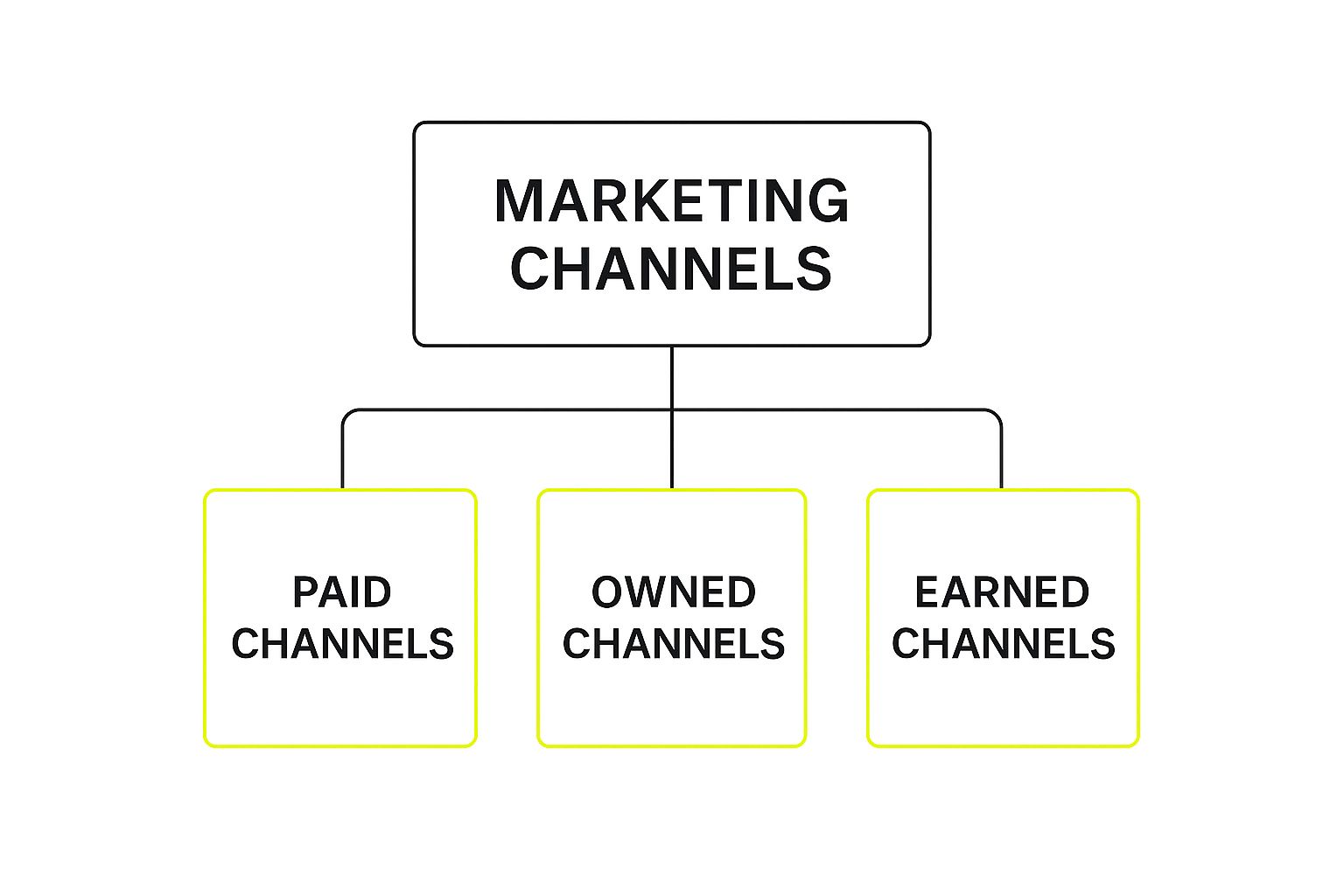
The infographic above shows the main categories of marketing channels available for a multi-channel marketing strategy: Paid, Owned, and Earned. Seeing these categories laid out helps us understand how they connect and the different roles each plays. A balanced approach is key here – using the strengths of each channel type to build a truly effective strategy.
Picking the right channels for your multi-channel marketing strategy shouldn’t feel like throwing darts blindfolded. Too many businesses choose based on what's trendy or what their competitors are doing, instead of really understanding their own customers. It's like buying a toolbox packed with specialized tools before you know what projects you'll be working on. You might end up with a fancy laser cutter when a simple hammer is all you need.
Knowing Your Customer: The Foundation of Channel Selection
Imagine trying to talk to someone who doesn't speak your language. Pretty frustrating, right? The same goes for marketing on channels your customers aren't using. You're talking, but no one's listening. Understanding customer behavior is essential, and for a deeper dive into this topic, check out this guide on Marketing Consumer Insights. Effective channel selection begins with knowing where your audience hangs out – both online and offline. This means doing some thorough customer research, looking at your website analytics, and even having actual conversations with your customers to understand what they prefer.
Building Your Channel Toolkit: Paid, Owned, and Earned Media
Think of your multi-channel marketing strategy as a custom-built toolkit. Each channel is a different tool, each with a specific job to do. These tools fall into three main categories:
-
Paid Channels: These are the channels you pay to use, like Google Ads, social media ads, and sponsored content. It's like renting a billboard – you're paying for visibility in a targeted location.
-
Owned Channels: These are the channels you control – your website, blog, email list, and social media profiles. Think of these like owning your own storefront. You decide how it looks and what message it sends.
-
Earned Channels: These are where visibility comes organically, like media mentions, customer reviews, and social media shares. It's similar to getting a great review in the local paper – you've earned that positive attention because of the quality of your product or service.
A successful multi-channel marketing strategy uses a mix of all three channel types. For example, you might use paid ads to get people to your website (owned channel), where they can sign up for your email list (owned channel) and then share your content on social media (earned channel).
Avoiding Channel Overload: Start Small, Scale Smart
Don’t try to be everywhere at once. Spreading yourself too thin across every channel can actually hurt your efforts. It's like trying to juggle too many balls – you're bound to drop a few. Start with a few key channels that match your customers' preferences and your business goals. As you start seeing results, you can gradually add more channels to the mix.
Measuring and Optimizing: Data-Driven Channel Selection
Choosing your channels isn’t a one-and-done deal. It’s a continuous process of testing, measuring, and improving. Keep an eye on key metrics for each channel, such as website traffic, conversion rates, and the cost of acquiring a new customer. These numbers will show you what’s working and what needs tweaking. Use this data to refine your strategy and get the most out of your marketing budget. A data-driven approach is essential for maximizing your return on investment.
To help you evaluate channels strategically, take a look at the Channel Selection Matrix below. This table provides a framework for comparing channels based on factors like reach, cost, and how well they align with your target audience.
Channel Selection Matrix
Framework for evaluating marketing channels based on reach potential, cost effectiveness, and alignment with target audience
| Channel Type | Reach Potential | Cost Level | Audience Fit | Implementation Complexity |
|---|---|---|---|---|
| Social Media (Organic) | High | Low | Varies greatly by platform | Medium |
| Social Media (Paid) | High | Medium to High | Highly Targetable | Medium |
| Email Marketing | Medium | Low | High (for existing customers) | Low to Medium |
| Search Engine Optimization (SEO) | High | Medium | Dependent on keyword strategy | High |
| Paid Search (PPC) | High | Medium to High | Highly Targetable | Medium to High |
| Content Marketing | Medium to High | Medium | Dependent on content quality and topic | High |
This matrix highlights the trade-offs inherent in each channel. For example, while social media boasts high reach potential, the actual audience fit depends heavily on the platform and your specific target demographic. Similarly, while email marketing is cost-effective and highly relevant for existing customers, it requires a robust email list and engaging content to be successful.
By carefully considering these factors, you can make informed decisions about which channels are most likely to deliver the best results for your unique business. Remember, it’s not about being on every channel, it's about being on the right channels.
Building Your Multi-Channel Marketing Strategy Blueprint

Creating a powerful multi-channel marketing strategy is a lot like conducting an orchestra. Each instrument (or channel, in our case) contributes something unique, but it’s the conductor’s skill that brings them together in a harmonious performance. Many businesses struggle with this. They might be great on Instagram, but their email marketing falls flat, creating a disjointed experience for customers.
Mapping the Customer Journey: Understanding the Score
Before you start composing your marketing masterpiece, you need to understand the music your audience wants to hear. This means mapping the customer journey. Imagine tracing the steps a concertgoer takes – from discovering the event, to buying a ticket, to finally enjoying the performance.
-
Awareness: Where do customers first encounter your brand? Is it through social media ads, a Google search, or a friend's recommendation?
-
Consideration: Once they know you exist, how do they explore your offerings? They might visit your website, read reviews on Trustpilot, or compare your products to competitors'.
-
Decision: What finally convinces them to buy? A special promotion, compelling testimonials, or a smooth checkout experience?
-
Action: What steps do they take to make a purchase? Adding items to a cart, entering payment details, and clicking "confirm."
-
Advocacy: After the purchase, how do they engage with your brand? Do they leave reviews, share your content, or tell their friends about you?
Understanding this journey allows you to tailor your message and channel selection to meet customer needs at each stage. Striking visuals on Instagram might grab attention in the awareness phase, while detailed product demos on YouTube cater to the consideration stage.
Creating a Messaging Framework: The Conductor's Baton
Just as a conductor guides the orchestra, your messaging framework keeps your communication consistent across all channels. This doesn't mean using the same message everywhere. Think of it like variations on a musical theme – each instrument offers its own interpretation, while contributing to the overall composition.
A solid messaging framework includes:
-
Core Message: Your central brand promise. What's the one thing you want people to remember about you?
-
Key Talking Points: These are the supporting arguments that reinforce your core message. What are the key benefits you offer?
-
Channel-Specific Adaptations: Tweaking your message to suit each platform. A tweet is different from an email, but they should both reflect your core brand identity.
For example, if your core message is about simplifying complex tasks, your website might feature in-depth case studies, while your social media posts offer quick tips and engaging visuals.
Resource Allocation: Investing in the Right Instruments
A symphony orchestra requires a variety of instruments, each playing its part. Your multi-channel marketing strategy is similar. You need to allocate resources strategically, not evenly. Prioritize the channels that best align with your customer journey and messaging framework.
Consider these factors:
-
Channel Effectiveness: Which channels have driven the most valuable results in the past?
-
Customer Preferences: Where do your target customers spend their time online?
-
Cost-Benefit Analysis: What’s the likely return on investment for each channel?
If your ideal customer lives on TikTok, it makes more sense to invest there than on a print ad campaign. Data is your friend. Track your channel performance metrics, analyze the results, and adjust your spending accordingly. Make sure you’re investing in the instruments that make the most impactful music.
Avoiding Common Planning Mistakes: Preventing a Discordant Performance
Even with the best intentions, strategies can go off-key without careful planning. Here are some common pitfalls to avoid:
-
Lack of Clear Goals: Before choosing channels or crafting messages, define your objectives. What do you want to achieve? Increased brand awareness? More sales?
-
Ignoring the Customer Journey: Don't just shout your message into the void. Adapt it to each stage of the customer journey.
-
Inconsistent Messaging: Maintain a consistent brand voice and overall theme across all channels. Conflicting messages create confusion.
-
Spreading Resources Too Thin: Focus your energy on a few key channels instead of trying to be everywhere at once.
-
Neglecting Measurement: Track your key performance indicators to see what’s working and what’s not. Use this data to refine your strategy.
By avoiding these mistakes, you can ensure your multi-channel marketing strategy performs like a well-rehearsed orchestra, delivering a cohesive and engaging customer experience. Careful planning is the key to creating a marketing symphony that resonates with your audience and drives real results.
Technology That Powers Multi-Channel Success Without the Headache

This screenshot shows HubSpot, a popular multi-channel marketing hub. Notice the clean dashboard and the variety of tools accessible from one place. This centralized approach makes managing different marketing activities much simpler, bringing everything from email and social media to your Customer Relationship Management (CRM) under one roof. The main takeaway? These platforms offer a simplified way to manage the complexities of a multi-channel marketing strategy.
Building a successful multi-channel marketing strategy isn't about collecting every new marketing tool on the market. It's about picking the right technology that fits seamlessly with your current systems and empowers your team—not creates more work for them. This means starting with the basics and adding specialized tools as your strategy develops.
Essential Tools for Multi-Channel Marketing
Imagine you're setting up a kitchen. You wouldn't buy a sous vide machine before you had a stove and a refrigerator, right? The same principle applies to your multi-channel marketing technology. Start with these core components:
-
CRM (Customer Relationship Management): This is your central hub for customer data. A good CRM, like Salesforce or HubSpot, tracks customer interactions across all channels, helping you understand customer behavior and personalize your messaging. Think of it as the refrigerator of your marketing kitchen—keeping all your ingredients (customer data) fresh and accessible.
-
Email Marketing Platform: Email is still a powerful way to connect with customers. A dedicated platform, like Mailchimp or Klaviyo, allows you to segment audiences, automate campaigns, and track results. This is your reliable stovetop, consistently delivering personalized messages to the right people.
-
Social Media Management Tool: Platforms like Hootsuite or Buffer make it easier to schedule posts, monitor conversations, and analyze social media performance. Consider it your trusty blender, mixing and serving engaging content across various social platforms.
-
Analytics Dashboard: Google Analytics is a free and powerful tool for understanding website traffic, user behavior, and conversion rates. It's the oven thermometer of your marketing kitchen, providing essential insights into what's working (cooking) and what's not.
These core tools form the base of a solid multi-channel strategy. As your business grows and your strategy evolves, you can add more specialized tools like marketing automation platforms or social listening software. For instance, if you're looking to improve your Shopify store, you might consider Shopify Store Optimization.
Budget-Friendly Approaches
You don't need a huge budget for effective multi-channel marketing. Many free or low-cost tools offer excellent features. Google Analytics, for example, provides valuable data without any cost, and several social media management tools have free plans for smaller businesses. The key is to choose tools that meet your specific needs and work well with your existing systems. This focused approach delivers results without breaking the bank.
Speaking of investments, the market for multi-channel marketing hubs is expanding rapidly. Valued at USD 6 Billion in 2024, the global market size is projected to grow at a CAGR of 17.7% between 2025 and 2034. This growth is fueled by strategic partnerships and acquisitions that aim to enhance platform capabilities with features like predictive analytics and cloud-based solutions. Learn more about this growing market here. This expansion reflects the rising need for tools that simplify and streamline multi-channel marketing.
By focusing on essential tools, integrating them efficiently, and making data-driven decisions, you can achieve multi-channel success without the headache of an overly complex tech stack. Remember, it's not about how many tools you have, but how effectively you use them.
Measuring What Actually Matters in Multi-Channel Marketing
Imagine a detective working a case. They don't just gather every piece of information; they search for the clues that tell a story. Measuring a multi-channel marketing strategy is similar. It's not about tracking every single click and impression. It's about finding the key performance indicators (KPIs) that reveal what's truly driving your business forward.
Beyond Vanity Metrics: Focusing on Actionable Insights
Many businesses fall into the trap of vanity metrics – numbers that look good on paper but don't translate to business growth. A large number of Instagram followers might seem impressive, but if those followers aren't converting into paying customers, it’s like a crowded concert venue with empty seats. Real success comes from measuring actions, not just awareness.
Attribution Models: Connecting the Dots
Let's say a customer first sees your product on Instagram, then clicks an ad on Google, and finally makes a purchase on your website. Which touchpoint gets the credit? This is where attribution models come into play. They help determine how credit is assigned to each interaction in the customer journey.
A simple last-click attribution model would give all the credit to the website visit. A more sophisticated multi-touch attribution model would distribute credit across all three touchpoints, recognizing the contribution of each interaction. Choosing the right model depends on your business and your customer's journey. There's no single right answer, but understanding the different models helps you accurately track what's influencing customer behavior. For further reading, check out this article on Shopify Analytics for Marketing ROI.
Customer Lifetime Value: Measuring Long-Term Impact
Think beyond the initial sale. How much revenue will a customer generate for your business over their entire relationship with you? This is customer lifetime value (CLTV), and it’s one of the most crucial metrics in multi-channel marketing. By tracking CLTV across different channels, you can identify which channels are not only attracting new customers but also nurturing long-term loyalty and repeat purchases.
Predictive Metrics: Anticipating Future Success
Think of predicting the weather. Meteorologists don't just look at the current temperature; they analyze patterns and trends. Similarly, predictive metrics anticipate future success based on past data. For example, if customers who download a particular guide are more likely to purchase, that download becomes a strong predictor of future conversions. Identifying these predictive metrics allows you to proactively adjust your strategy for better results.
Tackling Measurement Challenges
Measuring multi-channel marketing has its hurdles. Data integration can be complex, attribution models can be confusing, and the marketing landscape is constantly changing. However, these challenges can be overcome.
To help you get started, here’s a breakdown of some essential metrics:
Key Multi-Channel Marketing Metrics
Essential metrics for measuring multi-channel marketing performance with calculation methods and benchmarks
| Metric | Calculation Method | Industry Benchmark | Optimization Focus |
|---|---|---|---|
| Conversion Rate | (Number of Conversions / Number of Visitors) * 100 | Varies by industry and channel | Improve website design, streamline checkout process, personalize messaging |
| Customer Acquisition Cost (CAC) | Total Marketing Spend / Number of New Customers Acquired | Varies by industry and customer segment | Optimize ad targeting, improve conversion rates, explore cost-effective channels |
| Customer Lifetime Value (CLTV) | Average Purchase Value * Average Purchase Frequency * Average Customer Lifespan | Varies by industry and customer behavior | Increase customer retention, enhance customer loyalty programs, personalize customer experience |
| Return on Investment (ROI) | (Net Profit / Cost of Investment) * 100 | Varies by industry and campaign objectives | Optimize channel allocation, improve conversion rates, reduce marketing costs |
This table provides a solid foundation for measuring what truly matters in multi-channel marketing. By concentrating on actionable insights, understanding attribution models, tracking CLTV, and identifying predictive metrics, you can move past surface-level data and unlock the true potential of your multi-channel strategy. Remember, it's not about collecting every single data point, but about finding the clues that unlock sustainable growth.
From Strategy to Execution: Making It Actually Work
A great multi-channel marketing strategy is like a well-composed symphony. On paper, the notes look perfect, promising a beautiful melody. But the real magic happens in the performance – the actual execution. That's where many strategies, even the most promising, hit a sour note.
Planning is one thing, but navigating the real world of marketing can be like conducting an orchestra during an earthquake.
Coordinating Teams and Maintaining Consistency
Think of a restaurant kitchen during a busy lunch rush. Different cooks handle different parts of the meal, yet they all work in concert to deliver a delicious and cohesive dining experience. Your marketing teams – whether managing email, social media, or paid ads – need that same harmony.
Maintaining consistent messaging doesn't mean scripting every single post and email. It's about defining a clear brand voice and a core message that everyone understands. It's like giving all the cooks the same high-quality ingredients and a shared understanding of the restaurant's style. They can then add their own flair within those guidelines. Shopify marketing automation can help streamline this orchestration.
Handling the Unexpected
Even the most meticulous strategy can't predict every real-world hurdle. Unexpected events, competitors’ actions, or even shifting customer tastes can throw your plans off course. Imagine a key ingredient suddenly becoming unavailable in that busy kitchen – the cooks need to adapt quickly and improvise.
That’s where adaptability is crucial. Be ready to adjust your strategy on the fly, learn from missteps, and celebrate the small wins. Real-world execution is a constant process of learning and refining.
Real-World Implementation Stories: Learning From Experience
Learning from others' journeys can be incredibly valuable. One company might have found success by gradually rolling out their channels, starting small and then expanding. Another might have learned a tough lesson about overextending their resources by trying to be everywhere at once. These real-world stories offer valuable lessons and practical advice for managing the complexities of multi-channel marketing.
This screenshot shows the Shopify homepage, a central hub for many online businesses. Its simple design and focus on key features show how a platform can simplify managing different aspects of an online store. Shopify’s streamlined approach is vital for businesses implementing a multi-channel strategy.
When measuring your progress, a critical concept to understand is Multi Channel Attribution. Knowing how various touchpoints contribute to conversions is essential for optimizing your strategy.
Practical Tools for Managing the Rollout
Managing a multi-channel rollout requires the right tools. Project management software, communication platforms, and analytics dashboards can help keep teams coordinated, track progress, and measure results. These tools are like the essential equipment in a well-functioning kitchen – they enable efficient execution and smooth operation.
Ready to grow your Shopify business with expert multi-channel marketing strategies? Visit E-commerce Dev Group today for customized solutions and support.
