

An SEO company is essentially your website's personal trainer, strategist, and promoter all rolled into one. Their job is to get your website into peak condition so it can compete for the top spots on search engines like Google. They focus on three critical areas: making sure your site is technically flawless, filled with genuinely helpful content, and recognized as a trusted authority in your field.
So, What Does an SEO Company Actually Do?
Think of it this way: an SEO agency is hired to make your website more valuable by increasing its visibility to the right people. The end goal is simple: drive more organic (non-paid) traffic to your site from people who are actively searching for what you offer. More of the right traffic means more potential customers, more sales, and a healthier bottom line.
This isn't about finding magic loopholes. It's a strategic, long-term process that blends deep analysis, technical know-how, and smart marketing. To get a real edge, agencies often dig deep into competitor strategies and market trends using advanced SERP data collection techniques to uncover hidden opportunities.
This infographic gives a great visual breakdown of the core services and how they all work together.
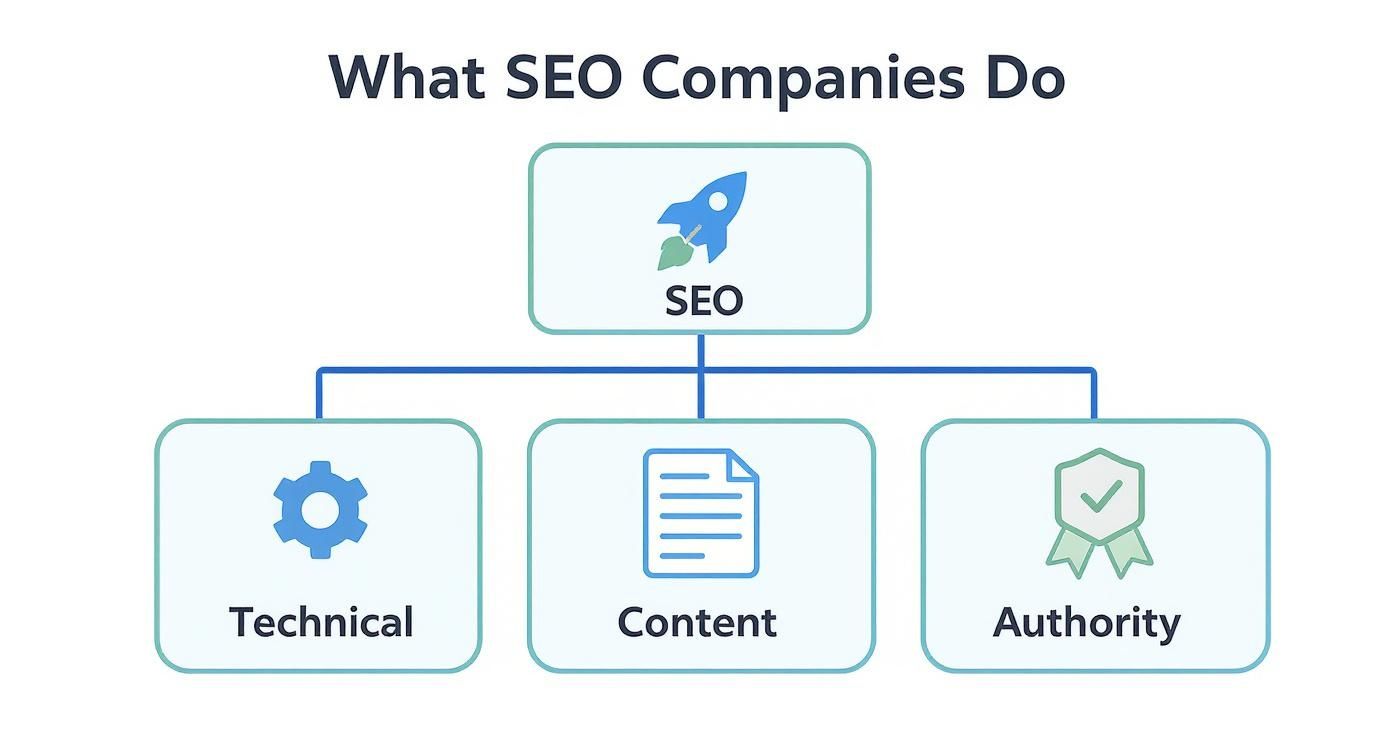
As you can see, a solid technical foundation is the launchpad for great content, and great content is what earns you authority and trust online. One can't really succeed without the others.
To truly understand what an SEO partner brings to the table, it helps to see their work broken down into core service areas. Each one plays a unique role, but they all work together toward the same goal: getting your business found online.
Core Services Offered by SEO Companies at a Glance
| Service Area | Primary Goal | Key Business Benefit |
|---|---|---|
| Technical SEO | Ensure search engines can easily find, crawl, and index your site's content. | A faster, more reliable website that provides a better user experience and ranks higher. |
| On-Page SEO | Optimize individual page content to be highly relevant for specific search terms. | Attracts highly-qualified traffic by directly answering user search queries. |
| Content Strategy | Create and manage valuable content (blogs, guides) that attracts and engages the target audience. | Builds brand trust, establishes expertise, and generates organic traffic over the long term. |
| Off-Page SEO | Build your website's reputation and authority across the web, primarily through backlinks. | Increases your site's credibility in the eyes of search engines, leading to better rankings. |
Ultimately, a comprehensive SEO strategy integrates all of these elements. A technically sound site with great content that earns authority is the winning formula for sustainable growth.
Building a Strong Foundation with Technical SEO Audits
The very first thing a good SEO agency will do is a deep-dive technical audit. Think of it like a home inspector checking out the foundation, wiring, and plumbing before you start knocking down walls. If the base isn't solid, all the fancy paint and new furniture won't matter—the house will have problems.
This process is all about uncovering the hidden issues that stop search engines like Google from properly crawling, understanding, and ultimately ranking your website. The agency will systematically go through every technical element to make sure your site is healthy and easy for search engines to access.
Uncovering Hidden Technical Issues
The goal here is to flag any structural problems that might be secretly sabotaging your rankings. It's a careful process that goes way beyond just the words on your pages. Some of the most common culprits they find are:
- Slow Page Speeds: A site that drags its feet frustrates visitors and gets penalized by search engines. Even a one-second delay can have a surprisingly big impact.
- Poor Mobile Performance: Most people search on their phones now. If your site is a mess on mobile, you’re essentially invisible to a massive chunk of your audience.
- Confusing Site Structure: If search engine bots can't easily find their way around your site, some of your best content might never even get indexed.
- Broken Links and Errors: These are dead ends for both people and search engine crawlers, hurting the user experience and chipping away at your site's credibility.
A proper site audit, even for a relatively simple website, can easily take 10-15 hours to do right. For bigger, more complex sites, that number climbs fast. If you want to really get into the weeds, check out this in-depth guide on technical SEO.
From Audit Findings to Actionable Fixes
Once the audit is done, the agency switches from inspector to repair crew. They'll put together a prioritized to-do list of fixes aimed at shoring up your website's technical core. This work is what really sets the stage for any future growth and marketing.
A technical audit isn't just about finding problems; it’s about creating a clear roadmap for success. It ensures that every other SEO effort—from content creation to link building—is built on a stable and reliable platform.
The fixes that come out of an audit usually involve:
- Improving Site Speed: This could mean compressing images, cleaning up code, or even upgrading your hosting so pages load in a snap.
- Implementing a Mobile-First Design: Making sure the website looks and works flawlessly on every device, from a giant desktop monitor to the smallest smartphone.
- Strengthening Site Security: Moving the site to HTTPS is a must-do. It protects your visitors' data and is a small but important ranking factor for Google.
- Fixing Crawlability and Indexing Problems: This involves using tools like sitemaps and a robots.txt file to give search engines a clear map of your site, making sure no important pages get left behind.
This foundational work is absolutely critical. For example, a thorough Shopify SEO audit can pinpoint platform-specific issues that are directly hurting product visibility and sales. By knocking out these technical roadblocks first, an SEO agency makes sure every dollar you invest in marketing later on has the best possible chance to succeed.
2. Crafting Your Message with On-Page SEO and Content

With a solid technical foundation in place, the real storytelling begins. This is where an SEO agency rolls up its sleeves and dives into what your audience actually sees and reads: your on-page SEO and content.
Think of it like setting up a storefront. You wouldn't just throw products on shelves randomly. You’d create clear signs, organize aisles logically, and make sure the window display grabs attention. On-page SEO does the same for your website, ensuring every page is perfectly set up to attract and guide your ideal customer.
It all starts with in-depth keyword research. This isn’t about guessing what people might type into Google. It's a data-driven process using powerful tools to find the exact words and phrases your customers are using right now. This often uncovers hidden gems called long-tail keywords—longer, more specific phrases that signal someone is much closer to buying.
Optimizing Every Page Element
Once the right keywords are identified, the agency gets to work weaving them into the DNA of your website. This is a careful, deliberate process, not just "stuffing" keywords everywhere. The goal is to place them where they matter most to both Google and your human readers.
Some of the key on-page tasks include:
- Title Tags: Writing that all-important blue link you see in search results. It has to be compelling enough to make someone click.
- Meta Descriptions: Crafting the short snippet of text under the title. It's your 160-character elevator pitch to win the click.
- Header Tags (H1, H2, H3): Using headers to structure your content like a good outline. This makes it easy for readers to scan and helps search engines grasp the page's main ideas.
- Image Alt Text: Adding simple descriptions to your images. This helps search engines "see" what's in the picture and makes your site accessible to everyone.
These seemingly small tweaks send powerful signals to search algorithms, making it crystal clear what each page is about and who it’s for.
Building Authority with a Content Strategy
While on-page SEO fine-tunes your existing pages, a real content strategy turns your website into a magnet for your ideal audience. A good SEO agency won't just churn out random blog posts. They'll build a roadmap for creating valuable articles, guides, and resources that solve your customers' biggest problems.
This is about proving your expertise, not just claiming it. The more you help people, the more they’ll trust you and see you as a leader in your field. This builds a loyal following and attracts a steady stream of organic traffic.
A well-executed content strategy transforms your website from a simple digital brochure into a dynamic hub of expertise. It's the difference between telling people you're an expert and proving it with every article you publish.
The agency will map out a content calendar based on their keyword research, ensuring every piece you publish is laser-focused on a specific user need. By consistently creating helpful content, you build what’s called topical authority. This tells Google you're the go-to source in your niche, making it easier for all of your pages to rank higher over time. It's a powerful feedback loop for growth.
Building Your Website's Reputation with Off-Page SEO

Once your website's technical foundation is solid and the on-page content is dialed in, a good SEO agency starts looking outward. This next phase is all about off-page SEO—the work done away from your website to build its authority and credibility across the internet.
Think of it like building a great professional reputation in the real world. You can be brilliant at what you do, but if no one is talking about you or citing your work, it’s hard to be seen as a leader. Off-page SEO is the digital equivalent of earning positive word-of-mouth and influential endorsements.
The biggest piece of this puzzle is acquiring high-quality backlinks. In simple terms, a backlink is just a link from another website pointing to yours. Google and other search engines see these links as "votes of confidence." A link from a well-respected, authoritative site is like a glowing recommendation from an industry expert, carrying far more weight than a nod from an unknown blog.
The Art of Earning Powerful Links
Any experienced SEO professional will tell you that when it comes to backlinks, quality trumps quantity every single time. A few strategic links from trusted industry publications can boost your rankings far more than hundreds of low-quality links from irrelevant sites.
So, how do agencies earn these valuable endorsements? It’s not about quick tricks; it’s about sustainable, ethical tactics.
- Digital PR: This is where SEO meets public relations. An agency might create a compelling story, a unique data study, or an insightful piece of content and then pitch it to journalists and bloggers. The aim is to get your brand featured in reputable online publications, earning both a link and valuable exposure.
- Creating "Linkable Assets": This involves developing genuinely useful resources that people in your industry can't help but link to. Think ultimate guides, original research reports, or free tools that solve a common problem.
- Guest Blogging: This classic technique involves writing and publishing articles on other high-authority websites in your niche. Not only does this earn a backlink, but it also puts your brand in front of a brand-new, highly relevant audience.
These strategies are fundamental to proving your website's value to search engines. For anyone running a Shopify store, this is especially crucial. You can dive deeper into this topic in our guide on link building for ecommerce websites.
Off-page SEO is about more than just links; it's about building a digital footprint that signals trust and authority. Every high-quality backlink and brand mention acts as a third-party validation of your expertise.
Beyond Backlinks: Brand Mentions and Local Signals
While backlinks get most of the attention, other off-page signals also build your site’s reputation. For instance, unlinked brand mentions—where another site names your company without a direct link—can still be noticed by search engines and contribute to your overall authority.
For businesses targeting local customers, getting listed accurately in relevant online directories (like Yelp or industry-specific sites) is another key signal. A consistent and positive presence across the web tells search engines you're a legitimate, trustworthy entity in your field.
This kind of long-term effort pays off. The return on investment from SEO is consistently strong. Looking ahead, organic leads in 2025 are projected to convert at 2.4%, easily beating most traditional marketing channels. In some sectors like real estate, the SEO ROI can be as high as an incredible 1,389%.
Measuring Success with SEO Analytics and Reporting

Any good relationship with an SEO agency is built on transparency and real, measurable results. Let's be clear: SEO isn't magic. It's a data-backed strategy where every move should lead to a trackable outcome. Analytics and reporting are the tools that make this happen—they’re the dashboard for your website's entire journey.
Without solid reporting, you're just flying blind. A great agency makes sure you know exactly how their efforts are fueling your business growth. They'll use powerful, standard tools like Google Analytics and Google Search Console to keep an eye on your site's vital signs and prove you're getting a clear return on your investment.
Turning Data into Actionable Insights
A good report does way more than just throw numbers at you; it tells a story. It should explain why certain metrics went up or down and lay out a clear plan to build on wins or tackle new challenges. You shouldn't just get a list of data points—you should get the whole narrative of your website's performance.
Some of the most important metrics you’ll see are:
- Organic Traffic Growth: This is the pure increase in visitors who find your site through search engines, not ads.
- Keyword Ranking Improvements: This tracks your website's climb up the search results for the keywords that matter most to your business.
- Conversion Rate: A critical business metric. It measures the percentage of visitors who actually do what you want them to do, like buy a product or fill out a form.
- Backlink Acquisition: This shows the growth of quality links pointing to your site from other reputable websites, which is a huge factor in building authority.
If you want to get a better handle on what these figures mean, check out our guide on how to analyze website traffic to understand what the numbers are really saying about your business.
The real purpose of an SEO report isn't to bury you in data, but to give you clarity. It turns complicated analytics into a straightforward progress report that shows you where you’ve been, where you are now, and where you're going next.
So, what are SEO companies really doing in this phase? They're drawing a direct line from their strategic work to your bottom line. Consistent, insightful reporting creates the accountability and direction needed for a successful long-term partnership, making sure every decision is informed by data and aimed right at your business goals.
How to Choose the Right SEO Company
https://www.youtube.com/embed/g-UuWvyOb1w
Picking a partner to handle your SEO is a big deal. The right agency can feel like an extension of your own team, driving real growth. But the wrong one? They can burn through your budget and leave you with nothing to show for it. The key is to find a team that genuinely gets your business goals, not just one making flashy promises.
A good starting point is to look for transparency. A trustworthy agency won't hide behind jargon; they’ll be open about their methods and happy to explain their strategies in a way that makes sense to you. If a potential partner gets cagey about how they build links or what their on-page SEO process looks like, that’s a major red flag.
Questions to Ask Potential Agencies
Before you even think about signing a contract, you need to go in armed with the right questions. The way they answer will tell you everything you need to know about their expertise, how they communicate, and whether they're actually a good fit.
Here are a few essential questions to get you started:
- What does your reporting look like? Ask for a sample report. You want to see if it’s easy to understand and focuses on the metrics that actually move the needle, like organic traffic and, most importantly, conversions.
- Can you show me a case study from a client in my industry? This is crucial. It proves they have relevant experience and a track record of getting results for businesses like yours.
- How will we stay in touch about progress? A good partner will have a clear system for communication, whether that means scheduled weekly calls or detailed monthly updates via email.
- How do you approach link building? Listen closely here. You want to hear about strategies that focus on quality and relevance—things like digital PR or creating amazing content that people want to link to. If they just talk about getting a high number of links, be cautious.
The global SEO market was valued at an incredible $82.3 billion in 2023, and it's only getting bigger. This just highlights how important it is to make the right choice. You can dig into more industry stats and learn about SEO market trends on Exploding Topics. The best agencies stand out with high client retention rates, industry certifications, and a wide range of skills that go beyond just the basics of SEO.
A word of warning: if any company guarantees you a #1 ranking on Google, run the other way. No one can ethically make that promise. It's often a sign they use risky tactics that could get your site penalized down the road.
At the end of the day, you're not just hiring a service; you're looking for a collaborator. You want a partner who will take the time to understand your unique business, not just slap a generic, one-size-fits-all template onto your website.
Still Have Questions? Let's Clear Things Up
Even after you've got a good handle on what SEO agencies do, it's completely normal to have a few more questions rattling around before you sign on the dotted line. Making a smart choice is crucial, so let's tackle the most common things business owners ask when they're thinking about bringing in an SEO partner.
How Long Until I Actually See Results?
Here’s the honest truth: SEO is a marathon, not a sprint. You might see some small wins and a bit of movement in the first few months, but the real, game-changing results—like a steady flow of organic traffic and top rankings for your most important keywords—typically start showing up within 6 to 12 months.
Why so long? Well, the timeline really depends on a few things: your website's current health, how fierce the competition is in your niche, and how aggressively we can implement the strategy. A good agency will never promise you the moon overnight. Instead, they'll give you a realistic roadmap with clear milestones so you know exactly what to expect.
What’s the Real Difference Between SEO and SEM?
This one trips a lot of people up, but it's pretty simple when you break it down. Think of it like this:
-
SEO (Search Engine Optimization): This is all about earning your spot in the search results naturally. You're not paying Google for clicks; you're building a great website with valuable content that deserves to rank on its own. It's the long game.
-
SEM (Search Engine Marketing): This is the bigger picture. It includes organic SEO plus paid advertising, like the Pay-Per-Click (PPC) ads you see at the very top of the search results.
Many of the best marketing plans use both. SEO builds a foundation of trust and authority that pays off for years, while SEM can get you traffic right now. It's a powerful combination.
SEO is like buying a house—you're building an asset that grows in value over time. SEM is more like renting an apartment at the best address in town. A solid digital strategy often involves doing both.
How Much Is This Going to Cost Me?
SEO pricing isn't one-size-fits-all. The cost can swing quite a bit depending on your goals, how tough your industry is, and the amount of work needed. Most agencies work on a monthly retainer, which can range anywhere from $1,500 to $5,000+ per month. You might also see project-based pricing for specific jobs, like a deep-dive technical audit.
The best way to think about it is this: SEO isn't an expense. It's a long-term investment in your business's ability to grow, attract customers, and be profitable online for years to come.
Ready to turn your website into a powerful growth engine? The experts at E-commerce Dev Group build high-performing Shopify stores designed to dominate search results and drive conversions. Explore our Shopify SEO and development services today!
