

Choosing the right ecommerce platform really boils down to one thing: finding the perfect match for your specific business model, budget, and technical skills. Are you a brand-new startup that just needs something simple to get going, or are you a growing business that needs serious horsepower for customization? Nailing this down first is the secret to making a choice you won't regret later.
Starting Your Search Without Getting Overwhelmed
Picking an ecommerce platform can feel like a massive, stressful decision—because it is. This is the foundation of your entire online operation. It dictates how customers experience your brand, how efficiently you can run things behind the scenes, and, most importantly, how easily you can grow. With so many options out there, all screaming that they're the best, it's easy to get stuck in "analysis paralysis."
But here’s a pro tip: don't start by comparing platforms. Start by looking inward. Before you even glance at a single feature list, you need a rock-solid understanding of what you actually need. This step isn't about them; it's all about you.
Define Your Core Requirements
Let's get back to basics. What are you actually selling? A straightforward catalog of t-shirts has wildly different requirements than a monthly subscription box or a shop that sells digital art. Who are you selling to? A direct-to-consumer (B2C) brand will need different marketing bells and whistles than a B2B wholesaler that needs custom pricing for different clients.
Then, be brutally honest about your team. Do you have a developer on standby, ready to write custom code? Or do you need a simple drag-and-drop interface that a non-technical person can manage? There's no right or wrong answer, but getting this straight from the start will save you a world of headaches.
This infographic breaks down those initial questions into the three big areas you need to think about.
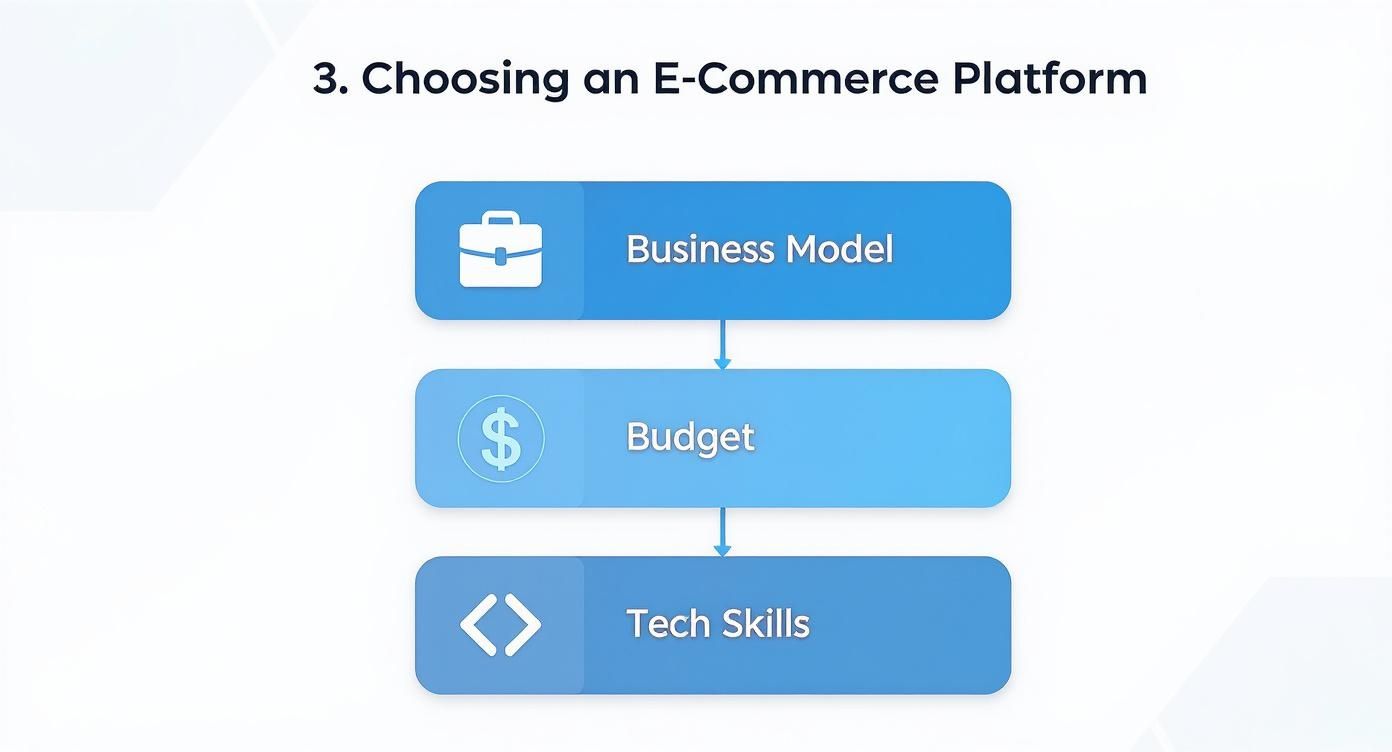
As you can see, your business model, budget, and tech skills are the first major filters. Get clear on these, and your long list of potential platforms will shrink to a much more manageable size.
The goal isn't to find a platform with the most features, but the one with the right features for your specific situation. Overpaying for capabilities you'll never use is just as detrimental as choosing a platform you quickly outgrow. This initial self-assessment saves you time and prevents costly mistakes down the road. It ensures you’re evaluating platforms based on your reality, not their marketing hype.
Getting a Feel for the Ecommerce Platform Landscape
Before you can pick the right ecommerce platform, you need to get the lay of the land. It’s about more than just recognizing a few big names; it’s about understanding why certain platforms are so popular and what that means for your store. Think of it this way: the ecosystem you plug into can make or break your business, influencing everything from finding good developers to getting the apps you need.

The market is dominated by a handful of heavy hitters, and each one brings something different to the table. For instance, when you see giants like Shopify and WooCommerce at the top of the charts, it tells you they have enormous communities and sprawling app marketplaces. For you, that translates directly into better resources and more available support.
Why a Platform's Popularity Is a Big Deal
The popularity of a platform isn't just a number to brag about—it's a real, practical advantage for merchants. A platform with a huge user base almost always comes with:
- A bigger talent pool: It's so much easier (and usually more affordable) to find developers, designers, and marketers who already know their way around a mainstream system like Shopify.
- Massive app stores: Popular platforms are a magnet for third-party developers. This gives you a massive library of plugins for pretty much anything you can imagine, from sophisticated email marketing tools to complex inventory management systems.
- Proven reliability: A platform that’s been adopted by millions has been put through its paces. Its core features are generally stable, secure, and ready for the real world.
On the flip side, a niche platform might have that one perfect feature for your industry, but you could end up scrambling to find expert help or compatible tools down the road. Weighing this trade-off is a critical part of picking a platform that aligns with your long-term goals. For a deeper dive, check out our https://scaleshopify.com/2025/07/05/ecommerce-platform-comparison/ where we break down the top options.
A Quick Look at the Market Leaders
Globally, it's pretty much the Shopify and WooCommerce show. Shopify is the engine behind roughly 4.65 million websites, capturing 26.2% of the market share for ecommerce sites. WooCommerce isn't far behind, powering over 3.5 million stores and holding a 20.1% share. These aren't just stats; they show you how much influence these two have on the entire industry.
What’s really interesting is where each one flexes its muscle. Shopify, for example, is the clear favorite for high-traffic websites, owning 28.8% of the top one million sites, while WooCommerce has 18.2%. This tells me that businesses expecting fast growth or handling a high volume of sales often lean on Shopify's all-in-one, hosted setup.
Choosing a platform is like picking a neighborhood for your business. A bustling, well-developed area offers more services and opportunities, while a smaller, specialized district provides a unique environment. Neither is inherently better—it all depends on what your business needs to thrive.
Ultimately, understanding this landscape is crucial because it dictates the resources you'll have at your fingertips. To really get a handle on your options, it's worth learning about the different types of e-commerce CMS platforms. This foundational knowledge ensures you’re not just picking a piece of software, but investing in an entire ecosystem that will support your vision for years to come.
Aligning Platform Features With Your Business Reality
Once you've mapped out your business model, it's time to dive into the nitty-gritty of platform features. This is where the real work begins—separating the flashy marketing promises from the practical tools you’ll actually use day in and day out. Don't get distracted by a platform that boasts the longest feature list. The goal is to find the one that solves your specific problems and supports your growth.
Think of it like buying a professional camera. It might have a hundred dials and settings, but if you only ever use the "auto" mode, you've just paid a premium for complexity you'll never touch. The trick is to match features to your real-world needs.
What are Your Non-Negotiable Features?
Every platform will let you add products and take money—that's table stakes. The real difference is in how they handle the details unique to your business. A store selling custom-printed t-shirts, for instance, needs bulletproof product variant management. A business offering subscription boxes absolutely requires powerful recurring billing and a simple customer portal.
Your first move should be to create a "must-have" feature checklist. Here are some categories to get you started:
- Product Management: How well does it handle product variations like size and color? Can it manage digital downloads or bundled products if that's your thing?
- Inventory Control: If you have multiple warehouses or use a third-party fulfillment service, does the platform offer multi-location inventory tracking? This is a deal-breaker for many growing businesses.
- Payment Gateways: Does it easily integrate with the payment methods your customers actually use? Think beyond credit cards to things like Apple Pay, Google Pay, and "Buy Now, Pay Later" services like Klarna or Afterpay.
- Shipping & Fulfillment: Can you connect it to your preferred shipping carriers without a major headache? How easy is it to set up custom shipping rules based on order weight, customer location, or total value?
This is the kind of dashboard where you'll spend most of your time managing these core functions.
Having a clean, intuitive interface like this is crucial. It becomes your command center for everything from managing orders to launching marketing campaigns.
To help you visualize this, I've put together a quick comparison of how some of the big players stack up on essential features.
Feature Comparison Checklist for Top Platforms
This table isn't exhaustive, but it gives you a solid starting point for comparing how platforms like Shopify, WooCommerce, and BigCommerce handle key functionalities.
| Feature Category | Shopify | WooCommerce | BigCommerce |
|---|---|---|---|
| Ease of Use | High (All-in-one) | Moderate (Requires hosting) | High (All-in-one) |
| Product Variants | Built-in, up to 100 variants | Unlimited (with plugins) | Built-in, up to 600 variants |
| Payment Gateways | 100+ gateways, plus Shopify Payments | 100+ gateways via extensions | 65+ gateways, no transaction fees |
| Multi-Location Inventory | Native in most plans | Requires paid extensions | Native in most plans |
| SEO Tools | Strong built-in tools | Excellent (via plugins like Yoast) | Strong built-in tools |
| App Ecosystem | 8,000+ apps | 50,000+ plugins (WordPress) | 1,000+ apps |
Use this as a template for your own research. Dig into the specifics that matter most to your business.
How Much Creative Control Do You Need?
Your website's design is your digital storefront, and first impressions are everything. A clunky, generic-looking site can send potential customers running before they even browse your products. You have to figure out how much control a platform gives you over the look and feel of your store without needing to call a developer for every tiny tweak.
Most platforms rely on a theme-based system, which is great for getting started quickly. But some themes can feel like a straitjacket. Ask yourself: can you easily change the colors, fonts, and page layouts? Crucially, how much can you customize the checkout page? A confusing or rigid checkout process is a primary reason for cart abandonment, so don't overlook this.
My Advice: The best platform isn't the one with the most features; it's the one with the right features that your team can actually manage. Prioritize tools that remove friction from your daily work and make buying from you a breeze for your customers.
Looking Beyond the Shopping Cart: Marketing and Integrations
Finally, a top-tier e-commerce platform should be a partner in your growth, helping you attract and keep customers. Look for strong, built-in SEO tools that give you control over page titles, meta descriptions, and URLs. Does it connect smoothly with your email marketing platform and social media channels?
This is also where third-party apps and integrations become a game-changer. For example, great tools like the best chatbots for ecommerce can dramatically improve customer service, but only if your platform can support them. A healthy app store is a sign of a vibrant, adaptable ecosystem. It means you can add specialized functions as your needs evolve.
If you want to go deeper on how to connect all these moving parts, our guide on ecommerce platform integration is the perfect next read. It breaks down how to build a tech stack that works for you, not against you.
Decoding Pricing and the Total Cost of Ownership
The advertised price on an e-commerce platform? That’s just the starting line. What often looks like a simple monthly fee can quickly morph into a much bigger financial commitment. To pick a platform that actually works for your budget, you have to look past the sticker price and figure out the total cost of ownership (TCO).

I've seen so many merchants fall into the "free" trap with open-source platforms like WooCommerce. Sure, the software itself doesn't cost a dime, but you're on the hook for everything else. We're talking web hosting, security certificates, and—more often than not—hiring a developer for the initial setup and any ongoing tweaks. Those costs can balloon quickly, often blowing past what you'd pay for a hosted solution.
Beyond the Monthly Subscription
Hosted platforms like Shopify make things seem simpler with one monthly fee, but even that isn't the full picture. As your store starts to take off, you'll inevitably want to add more features. That’s when you head to the app marketplace, and those small monthly app fees start to add up faster than you’d think.
Here are a few common costs you’ll run into, no matter which platform you choose:
- Transaction Fees: Some platforms skim a small percentage off every sale, especially on their cheaper plans. If you don’t use their in-house payment processor, you might get hit with extra fees on top of what the credit card companies already charge.
- Credit Card Processing Rates: This is the cost of doing business online. Expect to pay around 2.9% + 30¢ per transaction. It’s unavoidable, but some platforms will give you a better rate if you upgrade to a more expensive plan.
- Essential Apps and Plugins: Want to offer subscriptions, run a loyalty program, or gather customer reviews? These almost always require a paid app. Budget anywhere from $10 to $100+ per month for these add-ons.
- Theme Costs: You can start with a free theme, but a premium one will make your store look more polished and unique. A good one will set you back $150 to $350 for a one-time purchase.
Here's my advice: Take that list of "must-have" features you made earlier and price out what it would cost to get them on each of your top platform choices. Add up the monthly subscription, what you expect to pay in transaction fees, and the cost of all those essential apps. This will give you a realistic one-year forecast for each option.
Calculating Your True Cost
Let's run a quick, back-of-the-napkin calculation. Imagine you're launching a new store and aiming for $5,000 in sales each month.
| Cost Component | Hosted Platform (e.g., Shopify) | Open-Source (e.g., WooCommerce) |
|---|---|---|
| Monthly Subscription | $39 (Basic Plan) | $0 |
| Hosting | Included | $30 |
| Transaction Fees (1%) | $50 | $0 |
| Essential Plugins | $40 (e.g., reviews, subscriptions) | $70 (e.g., security, payment gateway) |
| Developer Help | $0 (Initially) | $100+ (Setup/Maintenance Estimate) |
| Estimated Monthly Total | $129 | $200+ |
This simple breakdown shows how the "free" option can easily end up costing you more. By thinking through these hidden expenses upfront, you can make a much smarter financial decision and pick a platform that will actually help you stay profitable as you grow.
Choosing a Platform That Can Scale with You
The business you launch today is not the one you'll be running in three years. When you're picking an ecommerce platform, this forward-thinking mindset is your single greatest asset. So many businesses fall into the trap of choosing a solution that perfectly fits their current size, only to find themselves cornered and out of options when it's time to grow.

True scalability is about so much more than just weathering a traffic surge during a Black Friday sale. It's about having the deep-down, structural flexibility to evolve your entire business model without hitting a technical wall.
Looking Beyond Traffic Spikes
A truly scalable platform should be a launchpad for your ambitions, not a cage. Think about the strategic moves you might make in the next few years. Will you need to:
- Explode your product catalog from 50 SKUs to 5,000?
- Go global and start selling internationally, which demands multi-currency and multi-language support?
- Integrate heavy-duty systems like an Enterprise Resource Planning (ERP) or a Customer Relationship Management (CRM) tool?
- Launch a B2B wholesale channel with its own unique pricing tiers for different customer groups?
Answering these questions gets to the heart of what scalability really means. It's not just about capacity; it's about capability. The platform's API (Application Programming Interface) is your golden ticket here. A flexible and well-documented API is the gateway to custom integrations and building the unique functionalities that will set you apart from the competition.
With global eCommerce sales projected to rocket to $7.5 trillion in 2025—up from $5.7 trillion in 2023—your platform has to be ready for this rising tide. This boom is fueled by nearly 2.77 billion shoppers worldwide, a number that underscores the need for a rock-solid foundation. You can find more data on this incredible growth at linkmybooks.com.
Preparing for Future Demands
Your platform’s architecture is what will either enable or inhibit your ability to adapt. For instance, as you grow, just managing a high volume of orders becomes a huge operational headache. A platform like Shopify Plus is specifically engineered to handle thousands of transactions per minute without even breaking a sweat.
If you see that kind of growth on your horizon, you absolutely need to understand the differences between standard and enterprise-level plans. Our guide on Shopify Plus vs Shopify can help you figure out which tier actually matches your growth trajectory.
My Tip: Don't just ask a sales rep, "Is your platform scalable?" That's a softball question. Instead, hit them with specific, scenario-based questions. "How does your platform handle 10,000 simultaneous checkouts?" or "What are the API rate limits when we try to integrate our custom inventory system?" The quality and confidence of their answers will tell you everything you need to know.
Ultimately, choosing a scalable platform is a direct investment in your company's future. It’s the difference between expanding your operations smoothly and staring down a costly, disruptive, and incredibly stressful re-platforming project in a few years. Plan for the business you want to become, and you'll ensure your technology is a catalyst for growth, not a roadblock.
Evaluating Support Systems and Community
https://www.youtube.com/embed/LvnfiR1lpUc
Picture this: It's the middle of your biggest flash sale of the year, and your website suddenly goes down. Who do you call? This is where a platform's support system becomes your business's lifeline, yet it’s a detail so many merchants don't think about until they're in full-blown crisis mode. The quality of that support can literally make or break your revenue during a critical moment.
Hosted platforms like Shopify usually have a huge advantage here. They typically offer 24/7 support through chat, email, and phone, giving you a direct line to someone who can help, fast. This is a game-changer for teams that don't have a developer on standby.
On the flip side, open-source solutions like WooCommerce are a different beast. You're mostly relying on community forums or paying third-party developers for help, which means you need to be a bit more self-sufficient.
The Power of a Strong Ecosystem
Beyond the official support channels, you need to look at the platform's wider ecosystem. A platform with a thriving community gives you access to a massive pool of talent and resources.
Think of it this way:
- Skilled Developers: A popular platform is a magnet for great developers. This makes it far easier—and often cheaper—to find an expert when you need custom work or a tricky bug fixed.
- Agency Partners: Top-tier marketing and design agencies tend to specialize in the major platforms. You’ll have a much wider choice of professional services to help you grow.
- Third-Party Apps: A bustling app marketplace is a sign of a healthy, innovative ecosystem. It's where you'll find all the tools you need to add new features to your store without custom coding.
The platform’s popularity in your specific region matters, too. In the United States, for example, Shopify holds 27% of the market share, with Wix at 21% and WooCommerce at 16%. This kind of dominance usually means you'll find better localized support, more apps tailored to your market, and a bigger network of local experts who understand regional business nuances. You can dive deeper into these numbers with this eCommerce platform market share report.
Your choice of an ecommerce platform isn't just about software; it's about joining a community. A platform with a robust ecosystem provides the developers, apps, and expert guidance necessary to solve problems quickly and seize growth opportunities. Don't underestimate the value of this network.
Your Questions Answered
What's the single most important thing to look for in an e-commerce platform?
Honestly, it’s not about finding the platform with the most bells and whistles. The absolute most critical factor is how well the platform's core features align with your specific business model, your team's technical comfort level, and your budget.
Think of it this way: a startup just getting its footing needs a simple, get-it-done solution. Their needs are worlds away from a massive enterprise that requires a whole suite of complex, custom integrations. The goal is to find the right features for you, not just the most features.
How much should I actually budget for this?
This is a great question because the sticker price is just the beginning. To get a real sense of the cost, you need to think about the Total Cost of Ownership (TCO). Don't just look at the monthly subscription fee.
Be sure to factor in all the other costs that will inevitably pop up:
- Transaction fees and credit card processing rates that platforms charge on each sale.
- The cost of a professional theme, which is often a one-time purchase.
- Monthly fees for any essential apps or plugins you'll need to run your store effectively.
- Potential costs for a developer to help with initial setup or any custom tweaks.
For a smaller business, the true monthly cost can easily land somewhere between $100 and over $500.
A quick heads-up: those "free" open-source platforms like WooCommerce aren't really free. You're on the hook for your own hosting, security, and maintenance. Those costs can add up fast, often costing more than a straightforward subscription to a hosted platform like Shopify.
Can I just switch platforms later if I pick the wrong one?
You can, but I wouldn't recommend it unless you absolutely have to. Moving your entire store—all your products, customer data, and order history—to a new platform is a massive headache. It’s a complicated, time-intensive, and often expensive project.
It’s always a better bet to invest a little more time and thought upfront. Choose a platform that you believe can scale with you as your business grows. It will save you from a very painful migration project down the line.
Ready to build a powerful Shopify store that grows with you? The experts at E-commerce Dev Group specialize in custom design, development, and ongoing support to help you get it right from day one. Get in touch with us today and let's start building a better online business together.
