


Here’s the simplest way to think about it: the standard Shopify plans are built for startups and growing small-to-medium businesses. On the other hand, Shopify Plus is an enterprise-grade solution designed for high-volume merchants who need more power and control.
So, the real question is whether you need a fantastic, easy-to-use platform that just works, or a deeply customizable system with dedicated support to handle serious scale.
Understanding Your Starting Point
Before we get into the nitty-gritty feature differences, let's figure out where your business stands right now. For most merchants, the decision comes down to a few key things: your annual revenue, how much you need to customize your checkout, and the overall complexity of your business operations.
This quick decision tree gives you a great visual for when Shopify Plus should be on your radar.
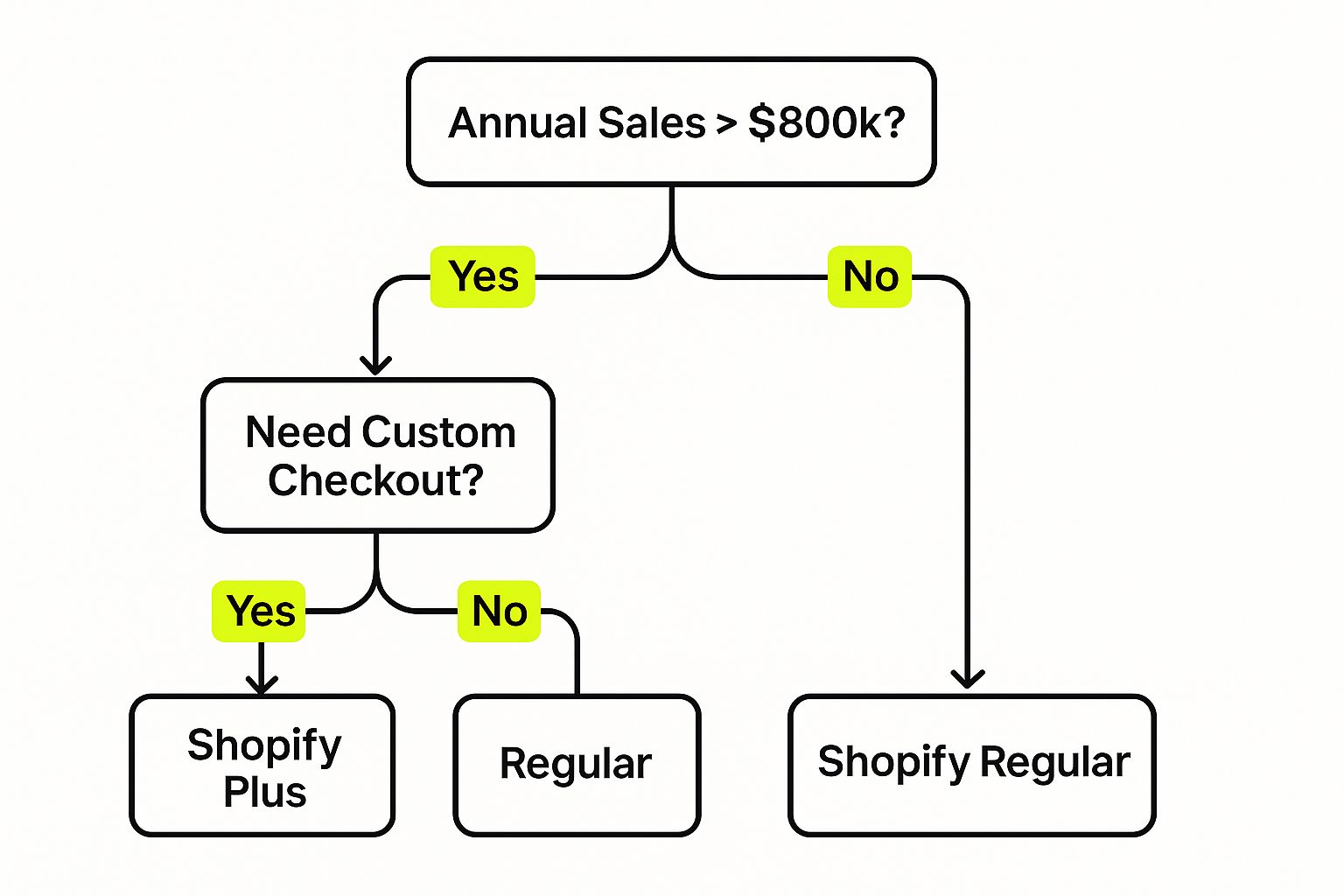
As you can see, crossing that $800K-$1M annual revenue threshold is usually the first sign it's time to start looking into an upgrade. This is especially true if you're also feeling limited by the standard checkout and need more advanced options.
At-a-Glance Comparison
To make the distinction even clearer, this table breaks down the core differences between Shopify and Shopify Plus. Use this as a quick guide to see which platform aligns with your business goals at a high level.
| Aspect | Shopify | Shopify Plus | Recommendation |
|---|---|---|---|
| Target Business | Startups, small businesses, and growing brands (under $1M/year). | High-volume merchants and large enterprises (over $1M/year). | Match the platform to your current and near-future revenue. |
| Pricing Model | Fixed monthly fees ($39-$399/month) + standard transaction fees. | Custom pricing starting around $2,500/month or a revenue-based percentage. | Plus becomes more cost-effective as your transaction volume skyrockets. |
| Customization | Theme-based customization with app integrations. | Full storefront and checkout customization (Shopify Scripts, checkout.liquid). | If you need to fundamentally change the checkout experience, Plus is your only option. |
| Support | Standard 24/7 email, chat, and phone support. | Dedicated Merchant Success Manager and priority support. | Businesses that need strategic, hands-on guidance will get immense value from Plus. |
Ultimately, the choice often comes down to the numbers.
As your sales volume increases, the significantly lower transaction fees on Shopify Plus can actually make it cheaper than a standard plan, even with its higher monthly price. That's the financial tipping point where the upgrade just makes sense.
Shopify itself lays out the progression clearly on its own plan comparison pages. The standard plans are designed as clear stepping stones, with Shopify Plus positioned as the destination for businesses that have simply outgrown them. This initial overview should give you a solid footing as we dive into a more detailed comparison.
Understanding The Two Shopify Platforms

Before we can really dig into a Shopify vs. Shopify Plus comparison, it’s important to understand what each platform is actually for. They aren't rivals; they're two different tools for businesses at completely different points in their journey. While they share the same core engine, they’re built to handle very different levels of operational complexity and scale.
The standard Shopify plans (Basic, Shopify, and Advanced) are the starting point for most online sellers. These plans are brilliant for entrepreneurs just getting started, small businesses, and even established mid-sized companies. They give you a robust, easy-to-use platform to build a great-looking store, manage your products, and take payments without needing to be a developer. It's all about getting you up and running quickly.
The Standard Shopify Experience
Think of the standard Shopify plans as an all-in-one package. You pay a monthly subscription, pick a theme, upload your products, set up your payment options, and you're ready to sell. It’s designed to be a complete "out-of-the-box" solution.
Its real power is in its simplicity and the massive Shopify App Store. Need to add email marketing, a loyalty program, or advanced reviews? There’s an app for that, usually just a click away. This plug-and-play approach is fantastic, but it does have its limits, especially when it comes to deep-level customization of the backend or the checkout process.
The Leap to Shopify Plus
Shopify Plus isn't just a bigger plan—it's Shopify’s enterprise-grade solution. It's built for merchants who are hitting the ceiling of the standard plans. We're talking about businesses handling thousands of orders a day, juggling complex international sales, or needing total control to build one-of-a-kind shopping experiences.
This is where Shopify hands you the keys to the kingdom. It takes everything great about the core platform and adds a layer of exclusive tools, resources, and power. Shopify Plus is all about removing the guardrails.
It gives merchants direct control over things that were previously locked down, with a huge boost in performance and dedicated support to help you strategize. It’s less of a product and more of a flexible foundation for building a massive, custom-tailored commerce machine. This is where you unlock tools like Shopify Scripts and the ability to fully customize your checkout—things that are absolute game-changers for big brands.
This two-tiered approach is a massive reason for the company's success. Shopify's total annual revenue recently hit an impressive $8.88 billion, a 26% jump from the year before. Shopify Plus is a huge piece of that puzzle, bringing in about 31% of the platform's monthly recurring revenue and proving how vital it is for high-growth merchants.
Once you see this clear split—standard Shopify for getting started and growing, and Shopify Plus for scaling and deep customization—it’s much easier to weigh the specific features we're about to compare. If you're already thinking about this next level, our look at custom Shopify Plus solutions can give you a better feel for what's possible. Getting this distinction right is the most important part of the Shopify vs. Shopify Plus decision.
Core Features And Customization Compared
When you move past the price tag, the real difference between Shopify and Shopify Plus comes down to one thing: control. Both platforms share the same powerful foundation, but Plus is built for businesses that need to bend the rules, customize core functions, and integrate deeply with their existing tech stack.
Standard Shopify plans give you an incredible amount of power right out of the box. You can build a stunning, high-converting store using a massive ecosystem of themes and apps. But you're operating within a well-defined framework. Certain critical pieces, like the checkout, are intentionally locked down to ensure everything stays secure and simple for everyone.
To make the differences crystal clear, let's break down the capabilities side-by-side.
Feature And Capability Breakdown
This table highlights the key areas where Shopify Plus opens up new possibilities that are simply not available on the standard plans.
| Feature | Shopify | Shopify Plus |
|---|---|---|
| Theme Customization | Full access to theme code (Liquid, CSS, JS) via the theme editor. | Same as standard, but with exclusive apps and higher API limits for more complex builds. |
| Checkout Process | Standard, secure checkout. You can only customize colors and add a logo. | Full control with Checkout Extensibility to add custom UI, fields, and apps. |
| Custom Logic | Limited to standard discount codes and app-based rules. | Shopify Scripts enable dynamic, server-side logic for custom pricing, shipping, and payments. |
| API Call Limits | Standard rate limits, sufficient for most businesses. | Up to a 500% increase in API call limits for heavy-duty integrations. |
| Headless Commerce | Possible, but constrained by standard API limits. | Fully supported with high-volume APIs, enabling custom storefronts (web, mobile, etc.). |
| Expansion Stores | Each new store is a separate account and subscription. | Manage up to 9 expansion stores for different regions or currencies from one dashboard. |
| B2B / Wholesale | Requires third-party apps with potential workarounds. | Includes a built-in B2B channel with custom price lists, net terms, and a dedicated storefront. |
As you can see, the "Plus" in Shopify Plus is all about adding layers of control and customization where it matters most for scaling businesses.
The All-Important Checkout Experience
This is where the two platforms truly diverge. With a standard Shopify plan, the checkout is a masterclass in optimization—but it's a black box. You can't change the layout or the process.
Shopify Plus blows the doors wide open. It gives you two powerful tools:
- Checkout Extensibility: This is the modern, secure way to add custom features directly onto the checkout page. Think custom delivery options, identity verification fields, or unique upsell widgets that feel native to the experience.
- Shopify Scripts: This is where the magic happens for backend logic. Scripts are small pieces of code that run on Shopify's servers, letting you create incredibly specific rules for shipping, payments, and discounts that go way beyond what standard Shopify can do.
Here's a real-world example: A Plus merchant could run a script that offers free two-day shipping only to customers with a "VIP" tag, or one that automatically applies a 10%, 15%, or 20% discount as the cart total crosses certain thresholds. That kind of dynamic, real-time logic is impossible on standard plans.
API Limits And The Leap To Headless Commerce
While both platforms have great APIs, Shopify Plus essentially gives you an express lane. Plus merchants get up to a 500% increase in API calls. For a growing business, this is huge. It means your ERP, PIM, or other systems can sync data much more frequently without ever hitting a wall.
This massive API capacity is what makes headless commerce a practical reality. With Plus, you can completely detach the Shopify backend (where you manage products, orders, and inventory) from the frontend (what the customer sees). This lets you build a lightning-fast, completely custom storefront using modern frameworks or power a native mobile app, all while Shopify’s rock-solid commerce engine runs silently in the background.
Of course, building these advanced setups requires specialized expertise. You'll want to work with experienced Shopify Plus developers who live and breathe this stuff.
Being ready for the future also means having a platform that can adapt to new technologies. For instance, understanding Shopify's cryptocurrency integration capabilities can be a factor. Ultimately, your choice comes down to this: Do you need a fantastic, streamlined solution, or do you need a powerful, open-ended platform to build your commerce empire?
Analyzing Performance and Scalability
When you're just starting out, both Shopify and Shopify Plus will feel lightning-fast. They're built on the same rock-solid infrastructure, so even a standard Shopify store can handle a ton of traffic without skipping a beat. The real separation in the Shopify vs. Shopify Plus conversation happens when your brand starts dealing with massive, unpredictable traffic spikes.
Standard Shopify plans run on a shared environment. For the vast majority of stores, this is perfectly fine. But it does mean you’re sharing server resources with thousands of other businesses. If you're a fast-growing brand known for viral marketing moments or huge seasonal sales, that shared setup can become a performance risk right when you need it most.
Handling High-Traffic Events
This is where Shopify Plus truly earns its keep. Once you're on Plus, you're moved to a dedicated slice of Shopify's infrastructure with far more server resources at your disposal. This isn't just a nice-to-have feature; it’s essential for any brand that lives and dies by flash sales, product drops, or events like Black Friday.
Shopify Plus is engineered to handle an incredible amount of activity, processing thousands of orders per minute without slowing down. The platform as a whole can manage over 10,000 checkouts per minute, and Plus merchants get the priority lane, ensuring their customers get a smooth, fast checkout experience even during the most chaotic sales events.
Think of it this way: a standard Shopify store might slow down slightly if another store on the same server has a massive, unrelated sale. A Shopify Plus store, however, is shielded from this "noisy neighbor" problem, guaranteeing top performance when it matters most.
API Limits and Integration Capacity
Scalability isn't just about handling traffic—it's also about how well your store "talks" to your other business tools. Your inventory management system, ERP, and marketing automation platforms all depend on API calls to keep data synced with Shopify.
Standard Shopify plans come with API rate limits that are generous for most businesses. But as your operations get more complex, you can slam into that ceiling pretty quickly, leading to data sync errors and operational headaches.
Shopify Plus blows past this limitation by offering a significantly higher API call limit—up to 500% more than the standard Advanced plan. This opens the door for near real-time data synchronization across all your systems, which is crucial for maintaining accurate inventory, fulfillment, and customer data at an enterprise scale. To really dig into your store's performance, understanding the relationship between Shopify reporting and Google Analytics for ad tracking is a great place to start.
The Growth Ceiling
At the end of the day, this all comes down to your growth ceiling. Standard Shopify plans offer a very high ceiling, but it’s there. Shopify Plus is designed to essentially remove that ceiling altogether. It's built for brands that have pushed past the limits of the standard environment and simply can't afford any compromises on performance.
The numbers back this up. Merchants on Shopify Plus typically report annual sales anywhere from $1 million to over $500 million, cementing its status as the go-to platform for large-scale commerce. In fact, Plus merchants make up about 31% of Shopify's total monthly recurring revenue, highlighting just how critical this tier is for high-volume sellers. You can find more details on these Shopify Plus statistics on uptek.com.
When performance and scalability become absolutely non-negotiable, Shopify Plus is the clear next step.
Breaking Down The Total Cost of Ownership
When you're weighing Shopify against Shopify Plus, just looking at the monthly price is a rookie mistake. It’s like picking a car based on its color without ever checking what's under the hood. The real story is in the Total Cost of Ownership (TCO)—a figure that pulls in everything from transaction fees to app subscriptions and developer costs.
The sticker price is definitely the first thing you'll notice. Standard Shopify plans run from $39 to $399 per month. Shopify Plus, by contrast, kicks off at $2,500 per month and goes up from there depending on your sales volume. Based on that alone, the choice seems simple for any brand that isn't pulling in millions.
But the math starts to get a lot more interesting when you dig into the transaction fees. This is where you’ll find the financial "tipping point" that makes the decision for you. As your store grows, the significantly lower transaction fees on Plus can easily cancel out its higher monthly price, often making it the smarter financial move.
The Hidden Impact of Transaction Fees
The single biggest variable in your TCO is the cut Shopify takes on every sale you make through a third-party payment gateway. On the standard plans, this fee can be as high as 2.0% of the order value. Shopify Plus drops this all the way down to just 0.25%.
Let’s run the numbers to see how this plays out in the real world.
-
Business A (on Shopify Advanced): You're doing $1,000,000 in annual sales and use a third-party gateway.
- Annual Plan Cost: Around $4,788 ($399/mo).
- Transaction Fees: A painful $20,000 (that’s 2.0% of your $1M).
- Total Cost (before apps): Roughly $24,788.
-
Business B (on Shopify Plus): You're also at $1,000,000 in annual sales with the same gateway.
- Annual Plan Cost: Around $30,000 ($2,500/mo).
- Transaction Fees: A much more manageable $2,500 (0.25% of your $1M).
- Total Cost (before apps): Roughly $32,500.
At the one-million-dollar mark, the Advanced plan still looks cheaper on paper. But don't stop there. Watch what happens when your business scales.
Finding The Financial Tipping Point
Let's see what happens when your revenue doubles to $2,000,000 a year.
- Business A (Shopify Advanced): Your total cost jumps to $44,788 ($4,788 for the plan + $40,000 in fees).
- Business B (Shopify Plus): Your total cost is now $35,000 ($30,000 for the plan + $5,000 in fees).
All of a sudden, Shopify Plus is almost $10,000 cheaper annually. And that’s just on fees alone—this simple calculation doesn't even account for the immense value you get from Plus-exclusive features and the dedicated support team.
The total cost of ownership reveals a crucial truth: Shopify Plus isn't just an expense; it's a strategic investment that becomes more cost-effective as you scale. Your transaction volume is the single biggest factor in determining when the upgrade makes financial sense.
Of course, your monthly plan and transaction fees are only part of the picture. You also have to budget for apps and potential development work. While both platforms share the same Shopify App Store, Plus merchants tend to invest more heavily in custom integrations and agency partners to truly max out the platform’s capabilities, adding to the overall TCO.
It’s clear that Plus is built for a different class of merchant. In fact, Shopify Plus users make up about 30-33% of Shopify’s total monthly recurring revenue, even though they represent a small fraction of the merchant base. You can dig into more of these market share insights on edesk.com to see how the platform is dominated by high-volume sellers.
When to Choose Shopify vs Shopify Plus

So, how do you make the final call between Shopify and Shopify Plus? It really boils down to an honest look at where your business is today and where you genuinely see it going. This isn't about picking the "best" platform in a vacuum. It’s about choosing the right tool for the job you have right now.
To make this tangible, let's walk through a few common business scenarios. This isn't just about hitting a certain revenue number; it's about operational headaches, how fast you're growing, and what your long-term goals are. Seeing where you fit can take a lot of the guesswork out of the decision.
The Fast-Growing Startup
Picture a brand that just went viral on TikTok. Sales are through the roof, the website is getting hammered with traffic, and the team is barely keeping up. They're on the Shopify Advanced plan and pulling in around $800,000 a year, but they're projecting that to triple in the next 12 months. Their number one fear? The site crashing during a Black Friday sale.
Recommendation: Start planning for Shopify Plus.
For this business, it's all about performance and stability. While their current plan got them through the initial spike, viral traffic is unpredictable. Upgrading to Shopify Plus gives them access to dedicated infrastructure that can handle those massive, sudden surges. It's about buying peace of mind and protecting future revenue. They might not need every single Plus feature on day one, but the upgrade is a smart, protective move to support their explosive growth.
The Established Retailer Expanding Globally
Now think about a more established retailer doing $5 million in annual sales, mostly in North America. Their next big move is to launch dedicated storefronts for customers in the UK, Germany, and Australia. To do this right, they need to handle different currencies, languages, and regional sales—all from one central backend.
Recommendation: Shopify Plus is essential.
This is the exact problem Shopify Plus was designed to solve. Its ability to manage up to nine expansion stores from a single dashboard is a complete game-changer. The brand can create truly localized shopping experiences for each new market without the administrative nightmare of juggling separate Shopify accounts.
Trying to do this with multiple standard Shopify plans would be a mess. You'd be fighting inventory sync problems and piecing together reports. For any serious international growth, Shopify Plus isn't just a nice-to-have; it's a must.
This is also a point where the move itself can be complex. A guided https://scaleshopify.com/shopify-store-migration/ is often the safest bet to ensure a smooth transition without losing sales momentum.
The Large Enterprise with Complex B2B Needs
Finally, let's look at a large brand. They have a strong direct-to-consumer website but also want to build out a serious wholesale channel. They need to offer tiered pricing for different B2B customers, handle purchase orders, and give their wholesale partners a private, password-protected portal to place orders.
Recommendation: Shopify Plus is the only choice.
You can try to patch together a simple wholesale system on a standard Shopify plan with third-party apps, but it gets clunky fast. For complex B2B operations, it just won’t cut it. Shopify Plus comes with a built-in B2B channel that handles all of this natively. It lets you create company profiles, assign custom price lists, and set net payment terms right out of the box. Anything less would be a frustrating and inadequate workaround.
As businesses map out their futures, they should also look at the broader ecosystem. Opportunities like Shopify's affiliate program can play a role in long-term marketing strategies. Each of these scenarios shows a clear tipping point where Shopify Plus stops being a luxury and becomes a strategic necessity.
Your Top Questions, Answered
Alright, let's cut to the chase. When you're weighing Shopify against Shopify Plus, a few key questions always come up. Here are the straight-up answers you need to make the final call with confidence.
How Hard Is It to Move to Shopify Plus?
If you're already on a standard Shopify plan, moving to Plus is less of a migration and more of a simple upgrade. It's surprisingly seamless. Because you're staying on the same core platform, all your products, customer data, and order history stay right where they are.
The real "work" is actually the fun part—figuring out how to use all the new tools. This is where you’ll start planning things like custom checkouts or launching expansion stores, and your Merchant Success Manager will be there to guide you.
Coming from another platform like Magento or BigCommerce? That's a different story and requires a more hands-on approach. Our team specializes in smooth, zero-downtime Shopify store migrations to get you set up correctly from day one.
What Are the Real Hidden Costs?
The platform fee for Plus is clear, but the "hidden" costs aren't really hidden—they're the investments you'll want to make to get your money's worth. Be prepared to budget for:
- Development Work: You'll likely want to hire an agency or developer to build out those custom checkout features or unique integrations you couldn't do before.
- Higher-Tier Apps: Many of the apps you already use probably have an "enterprise" plan with more robust features that are now within reach.
- Strategy & Optimization: To truly maximize your return, you’ll probably work with experts who can help you squeeze every drop of value out of Plus-exclusive tools.
Is the Shopify Plus Support Team Really Worth It?
This is one of the most misunderstood perks of Shopify Plus. You don’t just get a faster support line; you get a Merchant Success Manager (MSM). Think of this person less as a support agent and more as a strategic partner. They're there to offer proactive advice for growth, help you prep for Black Friday, and introduce you to the right people in the Shopify ecosystem.
Your MSM is your advocate inside Shopify. They help you navigate the platform and use its most powerful features to hit your business goals. For many brands, that strategic guidance alone is worth the price tag.
What Can I Actually Do on Plus That I Can’t on Standard Shopify?
Besides the better transaction rates, the biggest difference is the power to deeply customize your store's logic. Here are a couple of real-world examples of things you can only do on Plus:
- Custom Wholesale Tiers: With a simple script, you can automatically show different prices to B2B customers the moment they log in, based on tags like "Gold Tier" or "Silver Tier."
- Exclusive Product Access: You could launch a "members-only" collection that is completely invisible and unavailable to regular shoppers. Only customers with a specific tag can see and buy from it, creating a genuine VIP experience.
At E-commerce Dev Group, we live and breathe this stuff. We know how to get the most out of both Shopify and Shopify Plus. Whether you're looking to fine-tune your current store or you're ready to make the leap to Plus, our team has the design, development, and strategic know-how to help you win. Learn more about our custom Shopify solutions.
