

When you hear "ecommerce custom development," what comes to mind? Think of it this way: you could rent a standard storefront in a mall, or you could hire an architect to design and build a flagship store from the ground up. That’s the difference. Custom development means building a unique online store, crafted piece-by-piece to fit your specific business needs.
It gives you complete control over the design, the features, and how your store grows over time.
What Is Ecommerce Custom Development, Really?
Platforms like Shopify are incredible for getting started quickly, but they come with a pre-built framework. You're essentially working within their walls. Custom development lets you knock those walls down and build something truly your own. It's about creating a digital storefront that solves your specific business problems and delivers a customer experience that no template can match.
This goes way beyond just a unique look. We're talking about unique functionality—features built to give you a real competitive edge.
Going Beyond the Template
A custom-built site means you build the platform around your business, not the other way around. Instead of trying to force your operations into a pre-made box, you create a solution that works exactly how you need it to.
For instance, this could mean developing:
- A specialized product configurator for things like custom furniture or personalized jewelry.
- Deep integration that connects seamlessly with your company's existing Enterprise Resource Planning (ERP) system.
- A unique checkout process crafted from the ground up to minimize cart abandonment.
- A sophisticated B2B portal with complex, customer-specific pricing tiers.
The need for these tailored solutions is exploding as online retail continues to boom. In fact, global ecommerce sales are on track to hit a staggering $8.3 trillion by 2025, which is a 55.3% jump from 2021. As the online marketplace gets more crowded, a generic storefront just doesn't cut it anymore. Shoppers expect more—more convenience, more personalization, and more security. For more stats on this growth, you can check out the data at ClearlyPayments.com.
Total Control and Ownership
Perhaps the biggest advantage is gaining absolute control and ownership over your digital property. You own the code. You own the design. You own the data. You aren't at the mercy of a third-party platform's monthly fees or sudden policy changes.
This level of ownership is crucial for long-term scalability. As your business grows, your platform can evolve with it, ensuring you never hit a functional ceiling imposed by a third-party provider.
Ultimately, custom ecommerce development is an investment. You're building a future-proof asset that’s perfectly aligned with your brand and your way of doing business, creating a solid foundation for sustainable growth.
When to Choose Custom Over a Platform
Ready-made platforms are fantastic for getting a business off the ground. But what happens when you’re too successful? Many brands eventually hit a wall where the very features that made things easy at the start become frustrating limitations. Knowing when to make the leap to ecommerce custom development isn't just a technical choice; it's a strategic move that can set the stage for your next chapter of growth.
The most common sign you’re ready for a change is when your team starts saying, "If only we could…" on a regular basis. You might need a one-of-a-kind customer journey, an intricate product configurator, or a sophisticated B2B portal with pricing tiers that no off-the-shelf app can handle. When your ambitions outgrow the box, it's time to think about building your own. For ambitious companies, exploring different strategies to scale an ecommerce business often shines a bright light on these exact platform constraints.
Deep Integration and Scalability Demands
Another huge factor is the need to connect your ecommerce site seamlessly with the rest of your business. Standard plugins for your ERP or CRM often feel clunky and inflexible. With custom development, you can build a flawless, two-way data sync that automates tedious tasks, cuts down on human error, and creates a single, reliable source of truth for your entire operation. This is non-negotiable for managing complex inventory and customer data at scale.
True scalability isn't just about handling more traffic; it’s about your technology stack’s ability to support increasing operational complexity without breaking. Custom solutions are built for this from the ground up.
The journey from outgrowing a platform to embracing a custom solution is a common one. This infographic breaks down what that path usually looks like.
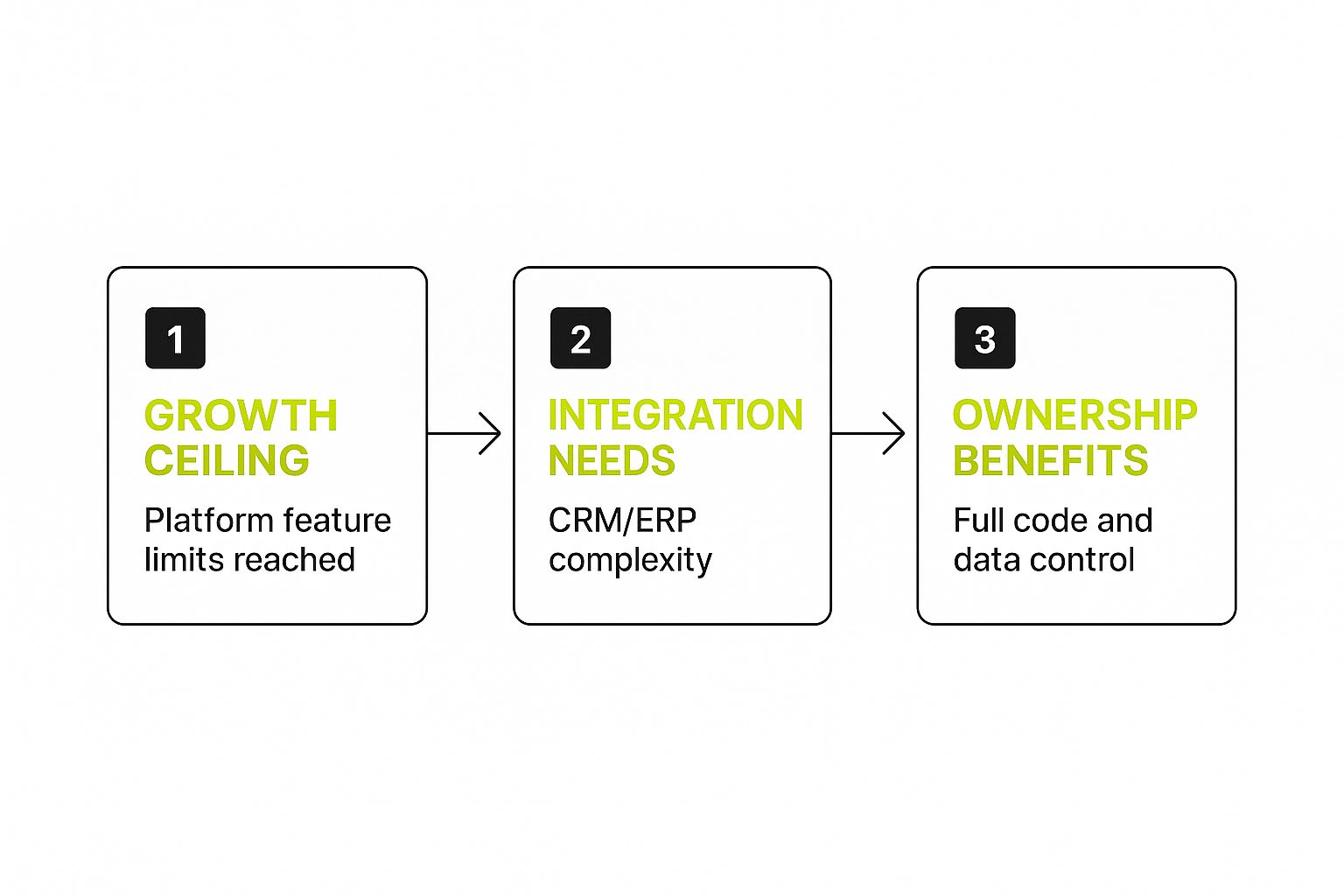
As you can see, the need for a custom build isn't a failure of the old platform—it's a natural result of your success and growing operational needs.
To make the differences even clearer, here's a side-by-side comparison of the two approaches.
Custom Development vs Off-the-Shelf Platforms at a Glance
| Feature | Custom Development | Off-the-Shelf Platform |
|---|---|---|
| Flexibility & Features | Unlimited. Built to your exact specifications. | Limited to available features, themes, and apps. |
| Initial Cost | Higher upfront investment. | Lower initial cost with monthly subscription fees. |
| Time to Launch | Longer development timeline (months). | Faster setup (days or weeks). |
| Ownership | You own the code and all intellectual property. | You license the software; the platform owns the core code. |
| Scalability | Designed to scale with your specific business needs. | Can handle high traffic but may be limited by app integrations. |
| Integrations | Can be deeply and seamlessly integrated with any system. | Relies on pre-built connectors and APIs, which can be rigid. |
| Maintenance | Your responsibility (or your agency's). | Handled by the platform provider. |
| Support | Direct access to your dedicated development team. | General customer support channels (email, chat, phone). |
This table highlights the core trade-offs: platforms offer speed and convenience, while custom solutions provide freedom and control.
Taking Full Ownership of Your Digital Asset
At the end of the day, it all comes down to ownership. A custom-built site means you own the code, the customer data, and your future. You're free from platform transaction fees, endless app subscriptions, and the anxiety that a platform might suddenly change its rules and upend your business. This freedom lets you innovate on your own terms and build a proprietary digital asset that actually increases in value over time. Our ecommerce platform comparison guide breaks these differences down even further.
This move toward building unique digital experiences is a major market trend. The web development services market is expected to grow from $55.12 billion in 2024 to $101.54 billion by 2034. This growth shows that more and more businesses are demanding the kind of power, flexibility, and security that pre-built solutions can't always deliver.
Your Custom Development Journey, Step by Step
Jumping into a custom ecommerce project can feel like a massive undertaking, but it’s really just a logical, step-by-step process. Once you understand the roadmap, the whole thing feels much less intimidating and a lot more predictable.
Think of it like building a custom home. You wouldn't just show up with a pile of bricks and hope for the best. You'd start with a detailed blueprint and a solid plan, and the same goes for your website.
The entire build is a team effort, neatly broken down into phases. Each stage builds on the one before it, taking your project from a handful of ideas to a real, working storefront.
The Discovery and Planning Phase
This first stage is, without a doubt, the most important part of any ecommerce custom development project. This is where your development partner really gets to know your business—your daily operations, your biggest pain points, and your wildest growth ambitions.
The discovery team will dig into your target audience, your business model, and all the technical nitty-gritty. It’s more than a simple Q&A; it's a deep dive to nail down the project's scope, goals, and what success actually looks like for you. The result is a rock-solid project plan that becomes the foundation for everything that follows.
A thorough discovery phase is your best defense against scope creep. It gets everyone on the same page, sharing the same vision, before anyone writes a single line of code.
Design and Development Sprints
With a clear plan in hand, the real building begins. This work is usually broken down into smaller, focused cycles called "sprints"—a key part of how modern, agile teams operate.
- UI/UX Design: Designers start by creating wireframes and mockups, which are essentially the visual blueprints of your site. The goal here is to map out a user journey that feels natural and guides customers from the homepage to checkout without any friction.
- Frontend & Backend Development: Next, developers turn those static designs into a living, breathing website. Frontend developers build everything the customer sees and clicks on. At the same time, backend developers build the powerful engine under the hood—the database, server logic, and all the integrations that make your store run.
- Quality Assurance (QA): As features are built, a dedicated QA team puts them through the wringer. They hunt for bugs, test on different devices and browsers, and make sure every button and link works exactly as it should.
Keeping all these moving parts in sync requires skill and constant communication. This is where strong ecommerce project management becomes the glue that holds the project together, making sure everything stays on track and on budget.
Launch and Ongoing Support
Finally, it’s time to go live. The launch is always carefully planned to happen with minimal disruption, ensuring a seamless switch for you and your customers.
But the work doesn't stop when the site is live. After launch, the focus shifts to support, monitoring how the site is performing, and planning for future updates and new features. A true development partner sticks with you long after the initial build, acting as a strategic resource to help your business continue to grow.
Building Blocks of a Custom Ecommerce Site
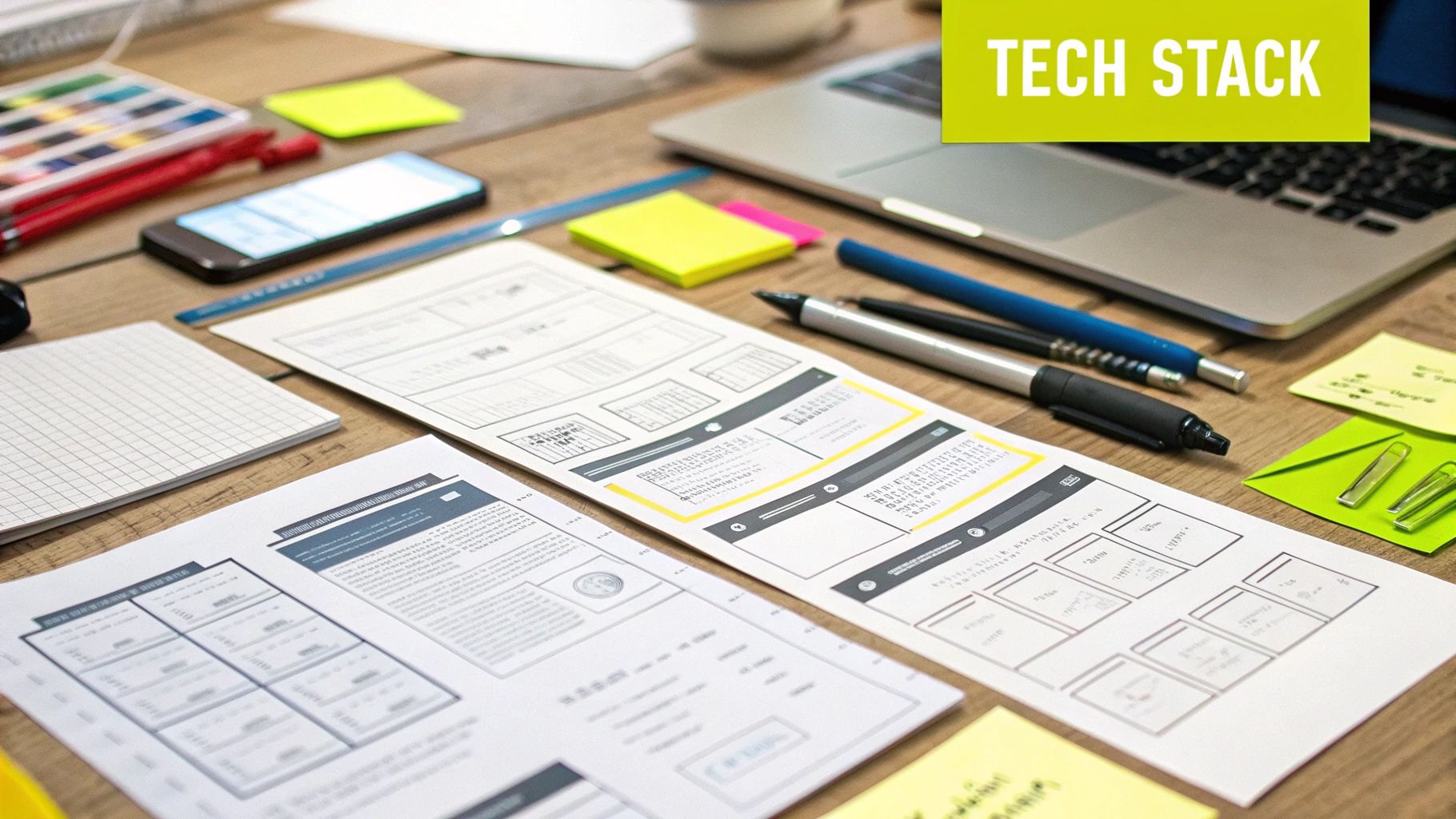
You don't need to be a coding expert to grasp what makes your online store tick. Every custom ecommerce site is built with a "tech stack"—a set of different technologies all working in concert. Think of it like building a car: you have the sleek body and user-friendly interior that everyone sees, and then you have the powerful engine under the hood that actually makes it go.
In the world of web development, we call these two parts the frontend and the backend. Getting a handle on how they differ is crucial to understanding how ecommerce custom development creates a truly seamless shopping experience from the first click to the final "thank you" page.
The Frontend: What Your Customers See
The frontend is everything your customers see and touch. It’s the product photos, the layout, the "Add to Cart" button, and the form they fill out at checkout. The goal here is to build an interface that isn't just nice to look at, but also fast, intuitive, and easy to use.
Modern frontends are often built using powerful frameworks like React or Vue.js. These tools help create dynamic, app-like experiences without your browser even breaking a sweat. For instance, when a shopper clicks a filter to sort products by price and the page updates instantly without a full reload? That's a modern frontend framework doing its job.
Key Takeaway: The frontend is your digital storefront. Its mission is to make the shopping journey so smooth and pleasant that visitors don't just buy—they come back.
The Backend: The Engine Room
If the frontend is the shiny storefront, the backend is the entire warehouse, back office, and logistics hub all rolled into one. It’s the invisible powerhouse that runs everything behind the curtain, from handling payments and tracking inventory to keeping customer data safe and sound.
This is where all your critical business rules live. Backend systems are responsible for:
- Securely managing user accounts and personal information.
- Processing transactions through payment gateways.
- Keeping inventory counts accurate in real-time.
- Calculating complex shipping rates and taxes automatically.
Tying It All Together With Headless Commerce
One of the most powerful approaches today is headless commerce. This architecture effectively separates the frontend (the "head") from the backend commerce platform. Why does this matter? This separation gives you incredible freedom to deliver your product content and shopping experience to any device—a website, a mobile app, an in-store kiosk, you name it—all powered by the same central backend.
To really get into the weeds on this, you can learn more about what headless commerce is in our detailed guide. This flexible structure is the gold standard in custom development, setting your business up to sell on any channel that comes along, now or in the future.
How Custom Solutions Drive Real Business Growth
It's one thing to talk theory, but what really matters is seeing how custom ecommerce development translates into real-world results. When you move beyond a one-size-fits-all template, you can solve unique business problems and build a powerful competitive edge that directly hits your bottom line.
Let's look at a B2C brand that sells personalized gifts. On their old, standard platform, they had a clunky product customizer that drove customers crazy. The result? A sky-high cart abandonment rate.
They decided to invest in a custom-built tool that offered a smooth, real-time preview of the personalized product. This single change boosted their conversion rate by a massive 30% and made them stand out in a very crowded market.
Another great example comes from the B2B world. A parts supplier was struggling to manage a complex, tiered pricing system for thousands of different clients. Off-the-shelf software simply couldn't talk to their old-school inventory system, leading to constant pricing mistakes and headaches.
Tailoring Technology to Your Business
The solution was a custom integration that finally bridged the gap between their website and their internal ERP. This new connection automated the entire pricing and inventory workflow. It wiped out manual errors, saved hundreds of hours of admin work, and made their clients much happier.
These stories show what custom development does best:
- Solving Specific Problems: It tackles the unique challenges that generic software just can't handle.
- Creating Unique User Experiences: It helps you build something special that delights customers and keeps them coming back.
- Automating Complex Workflows: It makes your business more efficient and cuts down on operational costs.
The real return on investment from custom development isn't just a better website. It's a more efficient, profitable, and scalable business built for the long haul.
The B2B ecommerce market in the U.S. is exploding, with sales expected to hit $2.08 trillion by 2030. This boom is happening because more businesses are moving online and they're demanding the same intuitive, easy-to-use experience they get as consumers.
Custom software is the key to delivering the personalized catalogs and advanced analytics that 86% of B2B sellers are already using to compete. You can dive deeper into this trend and its effect on the U.S. ecommerce market on Mordor Intelligence. Beyond just features, custom solutions are also perfect for fine-tuning every aspect of the user experience, including the impact of accessibility in e-commerce on improving user experience and sales.
Finding the Right Ecommerce Development Partner
Your project's success really boils down to one make-or-break decision: picking the right team. The perfect partner for your ecommerce custom development isn't just a group of coders. They’re strategic allies who will be in the trenches with you, guiding the project from a rough idea all the way to long-term growth.
Get this choice wrong, and you could be looking at blown budgets, missed deadlines, and a final product that just doesn’t deliver.
Think of it like hiring a general contractor to build your dream house. You wouldn't just hire the first person you talk to. You’d want to see their previous work, talk to their past clients, and make sure you understand their entire process. The same rigor applies here. A great partner should feel like a natural extension of your own team, genuinely invested in seeing your business win.
Vetting Potential Development Teams
Before you even think about signing a contract, you have to do your homework and properly evaluate potential partners. A flashy sales pitch is one thing, but you need to see real, tangible proof that they know their stuff and can be relied upon.
Here's a quick checklist to guide your vetting process:
- A Strong Ecommerce Portfolio: Don't just ask if they've built ecommerce sites—ask to see them. Do the sites they show you actually perform well? Are any of them in a similar industry to yours?
- Transparent Project Management: How will they keep you in the loop? They should be able to walk you through their communication and project tracking methods, leaving you confident that you'll always know what's going on.
- Deep Technical Expertise: Dig into their experience with the specific technologies your project needs. A good sign is when they can clearly explain why a certain tech stack is the right fit for your unique business goals, not just because it's what they always use.
The best conversations move beyond "what can you build for us?" and into "how will you help our business succeed?" A true partner is just as interested in your business model as they are in your feature wishlist.
Key Questions to Ask During Consultation
To really understand how a team works, you need to come to the table with a few pointed questions. The way they answer will speak volumes about what it would actually be like to partner with them.
Make sure you ask about their approach to post-launch support and, critically, who owns the code. You need to know what the plan is after the site goes live and get confirmation that you will retain 100% of the intellectual property.
Finding a team that offers ongoing maintenance is a huge plus. It means your new digital asset will stay secure, up-to-date, and ready to grow right alongside your business for years to come.
Answering Your Top Questions About Custom Development
Even after mapping out the process, it's totally normal to have a few big questions swirling around before you dive into a custom ecommerce project. Let's tackle the most common ones head-on so you can move forward with confidence.
What’s the Real Cost of Custom Development?
This is the big one, and the honest answer is: it depends. For a smaller project, maybe with some unique branding and a few custom tweaks but fairly standard features, you could be looking at a starting point around $25,000.
But for a full-blown enterprise site with complex inventory systems, custom product builders, or deep integrations into your other business software? That can easily climb past $250,000. The final number really comes down to the complexity, the feature list, and who you hire to build it. Always get a detailed quote based on a crystal-clear scope of work—it’s the best way to avoid sticker shock later.
How Long Will a Custom Build Take?
Building from scratch isn't a weekend project. A realistic timeline for most custom ecommerce sites is anywhere from 3 to 9 months.
This window can stretch or shrink based on a few key things: how complex the design is, how many unique features need to be coded from the ground up, and how many other systems we need to connect to. Having a solid plan and a team that works in an agile way is crucial for keeping things on track.
Can I Move Off a Platform Like Shopify?
Yes, and it’s a path many growing businesses take. Migrating from a platform like Shopify to a completely custom solution is a common rite of passage. Any experienced development partner will create a detailed migration plan to make it happen.
The whole point is to move all your vital data—products, customer profiles, order history, you name it—over to your new site seamlessly. A successful migration means your customers barely notice a thing, with little to no downtime.
What About Ongoing Maintenance?
Think of your custom website like a high-performance car; it needs regular tune-ups to keep running smoothly. Ongoing maintenance isn't just a nice-to-have, it's a must for security and performance.
You'll need to plan for things like:
- Regular software updates and security patches to keep threats out.
- Constant monitoring for performance issues and uptime.
- Squashing any little bugs that pop up after you go live.
Most agencies offer support packages or retainers to take care of all this for you. It's a small investment to make sure your powerful new site stays that way for years to come.
Ready to build an ecommerce experience that breaks the mold? The team at E-commerce Dev Group specializes in creating high-performance, custom Shopify solutions that drive growth and set you apart from the competition. Let's build your future-proof storefront together.
