

Headless commerce is a way of building an online store where the customer-facing part (the frontend, or “head”) is completely separate from the behind-the-scenes machinery (the backend, or “body”). This separation, often called a decoupled architecture, lets you design and build custom user experiences without being limited by your backend commerce platform.
Think of it this way: a single, powerful backend can manage all your core functions—inventory, pricing, promotions, and order processing. Meanwhile, your creative and development teams are free to build completely unique storefronts on websites, mobile apps, smart devices, or anywhere else you want to sell.
Understanding Headless Commerce in Simple Terms
Let's use an analogy. A traditional, all-in-one ecommerce platform is like a standard restaurant where the kitchen and the dining area are a single, fixed unit. You can swap out the tables and change the paint color, but you can't easily change the fundamental layout or move the kitchen without tearing the whole place down and starting over.
Headless commerce completely changes that. The kitchen (your backend) becomes a standalone powerhouse, focused only on what it does best: preparing orders, managing supplies, and handling payments. It doesn't dictate what the dining room (your frontend) looks like. This freedom is the real game-changer.
You Have the Freedom to Build Any Experience
Once your backend is decoupled, you can design any "dining room" you can dream up and simply connect it to your central kitchen. This opens up a world of possibilities. For example, you could:
- Create a blazingly fast, visually stunning website.
- Develop a native mobile app with features your competitors can't match.
- Sell your products through a smart mirror in a fitting room.
- Allow customers to order using voice commands on an Alexa device.
- Embed a shopping experience directly into a video game.
Each of these frontends, or "heads," talks to the backend using APIs (Application Programming Interfaces). APIs are like waiters, ferrying requests like "add this to cart" or "how many are in stock?" from the customer to the kitchen and bringing the information back.
The core idea of headless commerce is simple: separating the visual frontend from the functional backend using APIs. This model is quickly becoming the standard for brands that need to be agile and innovative.
This agility is more important than ever. With global ecommerce revenue projected to hit US$6.8 trillion in 2025 and an estimated 2.77 billion people shopping online, standing out is critical. To learn more about this incredible growth, you can explore future of online retail insights on crystallize.com. A headless setup gives you the foundation to build the unique experiences that modern shoppers expect, all without getting trapped by a rigid, one-size-fits-all system.
To see the differences more clearly, let's compare the two approaches side-by-side.
Traditional Commerce vs Headless Commerce at a Glance
This table breaks down the fundamental differences between a classic monolithic setup and a modern headless architecture.
| Feature | Traditional Commerce (Monolithic) | Headless Commerce (Decoupled) |
|---|---|---|
| Architecture | Tightly coupled; frontend and backend are a single unit. | Decoupled; frontend and backend are separate systems connected by APIs. |
| Flexibility | Limited. Customizations are constrained by the platform's templates/themes. | Extremely high. Developers can build any frontend experience from scratch. |
| Frontend Control | Controlled by the platform. You work within its predefined structure. | Total control. Use any programming language, framework, or technology you want. |
| Speed & Performance | Can be slower due to bloated, all-in-one codebases. | Often much faster, as frontends are built with modern, lightweight technologies. |
| Multi-Channel | Difficult. New channels often require separate systems or clunky workarounds. | Seamless. A single backend can power countless frontends (web, mobile, IoT, etc.). |
| Development | Simpler for basic stores, but complex customizations can be difficult. | Requires more initial development expertise but is easier to scale and adapt later. |
As you can see, the headless model offers a significant leap in freedom and adaptability, empowering brands to build for the future of commerce, not just the present.
How the Headless Architecture Actually Works
So, how do all these separate pieces talk to each other? The magic ingredient is the API, which stands for Application Programming Interface. The easiest way to think of an API is as a waiter in a restaurant. Your frontend (the "head," like a website or app) is the customer at the table, and your backend (the "body") is the kitchen. The API is the waiter that takes your order, brings it to the kitchen, and returns with your food.
Let's say a customer taps the ‘add to cart’ button on your mobile app. The app itself doesn't actually process that request. Instead, it sends an API call—a quick message—to the backend. That message essentially says, "Customer Jane Doe wants to add product #54321 to her cart." The backend system receives this, checks the inventory, updates the cart data in its database, and sends a confirmation message back to the app, all through the API.
This quick, back-and-forth dialogue happens for literally every interaction, from loading a product page to applying a discount code. It's a constant conversation that keeps the entire customer experience running smoothly.
The Central Role of APIs
In a headless system, APIs are the glue holding everything together. They are what allow a single backend to communicate with and power a potentially limitless number of frontends. This is precisely why headless is such a game-changer for businesses selling across multiple channels.
Think about it:
- Your main website can pull product descriptions and images via an API.
- Your mobile app can use the exact same API to fetch a customer's order history.
- An in-store kiosk can make another API call to check real-time stock levels for a product.
This setup gives your development teams the freedom to build completely unique, optimized experiences for any platform or device you can dream of. The backend's job is simply to serve up the data and functionality when asked. When you dig into how the headless architecture actually works, you see incredible flexibility, especially when utilizing no-code APIs with tools like Flutterflow.
This decoupled structure isn't just a technical detail; it directly leads to better performance and, as the infographic below shows, higher conversion rates.
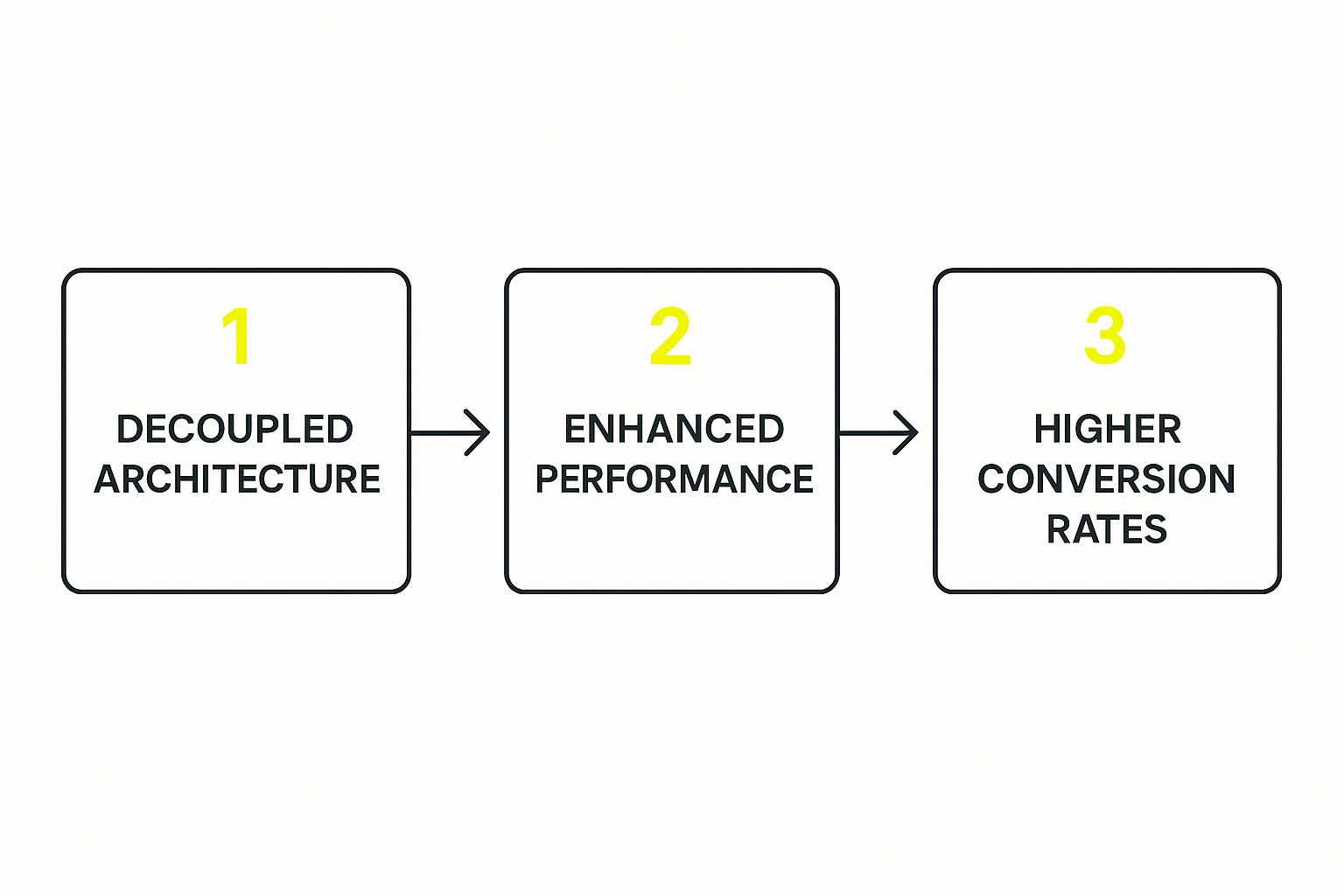
As you can see, separating the front and back ends is the first step toward real, tangible business improvements.
A Step-by-Step Customer Journey
Let’s trace a simple customer journey to make this even clearer.
- Product Discovery: A shopper lands on a product page on your website. The frontend has already made an API call to your backend to pull all the necessary product info: the name, photos, price, and description.
- Checking Availability: The shopper chooses a size and color. The frontend instantly sends another API request to the backend, asking, "Is this specific variant in stock?" The backend replies with a simple "yes" or "no."
- Adding to Cart: The customer clicks the "Add to Cart" button. You guessed it—another API call goes to the backend to add that item to the customer's cart.
- Checkout: The checkout process is a flurry of API calls. One verifies the shipping address, another applies a discount code, and a final one securely processes the payment through an integrated payment gateway.
At every single point in this journey, the frontend is only concerned with how things look and feel to the user. All the heavy lifting—the logic, the data, the security—is handled by the backend. This clean separation of duties is what makes headless commerce so incredibly fast and adaptable.
What Are The Real-World Benefits Of Going Headless?
It’s easy to get lost in the technical jargon, but what does going headless actually do for your business? This isn't just about swapping out one technology for another; it's about gaining a serious competitive advantage. Let's look at the tangible benefits that have so many ambitious brands making the switch.
One of the first things you'll notice is a huge boost in site speed. By separating the customer-facing frontend from the heavy backend systems, you can build a storefront that's incredibly fast and light. A website that loads in two seconds or less can enjoy a 15% bump in conversion rates on mobile. Speed directly impacts user experience and SEO, which means more visitors are likely to stick around and become customers.
This setup also makes it much easier to implement advanced strategies to improve website conversion rates and fine-tune your sales funnel.
Unmatched Creative Freedom And Agility
Traditional ecommerce platforms often box you in with pre-made themes and rigid templates. If you've ever felt constrained by your platform's design limitations, you know the frustration. Headless commerce throws those chains away. It gives your designers and developers the freedom to build the exact customer experience you’ve imagined, without the backend getting in the way.
This creative freedom leads to incredible business agility. You can react to market trends, test new ideas, and launch campaigns much faster than you could on a traditional, monolithic system. Want to learn more? Check out our complete guide for a deeper dive: https://scaleshopify.com/2025/06/01/headless-commerce-advantages/
A headless architecture future-proofs your business. It allows you to adopt new technologies and sales channels as they emerge without needing to re-platform your entire ecommerce operation, saving immense time and resources down the line.
The numbers really tell the story. Companies that have gone headless report a 25% increase in conversion rates. They've also been able to slash the time it takes to launch new digital experiences in half. On top of that, 54% of businesses see a jump in productivity because developers can work on the frontend and backend simultaneously.
True Omnichannel Experiences
This might be the most powerful benefit of all: the ability to create a truly consistent experience everywhere your customers interact with your brand. With one backend powering every frontend, you can deliver a seamless journey across all your channels.
Think about what that actually looks like:
- Website: A blazing-fast storefront designed to convert visitors.
- Mobile App: A native app that uses the same product and customer data but offers a unique, mobile-first experience.
- In-Store Kiosks: Interactive displays where shoppers can browse products or check inventory in real-time.
- IoT & Wearables: Shopping experiences built for smart mirrors, watches, or even voice-activated devices.
Each of these touchpoints pulls from the same central hub. This means your inventory is always synced, customer profiles are up-to-date, and your brand feels the same everywhere. Being able to meet your customers wherever they are with a consistently excellent experience is what separates the leaders from the pack.
How Top Brands Use Headless Commerce to Win
It's one thing to talk about theory, but it’s another to see headless commerce working in the wild. Let's look at how some of the biggest names in retail use a decoupled architecture to build the kind of standout customer experiences that are nearly impossible on a traditional platform. This is where the real power of headless becomes crystal clear.
Take Nike, for instance. Think about the incredibly polished and consistent feel you get, whether you're on their website, scrolling through the SNKRS app, or even looking at a digital display in one of their stores. That's no accident. It’s all powered by a single, robust backend that handles the heavy lifting—product info, inventory, customer accounts—and serves it up to any custom-built frontend they can dream up.
Powering Unique and Demanding Experiences
This separation of front and back gives Nike the freedom to solve specific business problems with perfectly tailored solutions. When they want to launch a huge, content-heavy marketing campaign or build an immersive story around a new shoe drop, they aren't boxed in by some rigid, cookie-cutter page template. Their creative team can design the exact experience they envision, and the developers can build it, knowing the backend will feed them all the data they need through an API.
What you're seeing here is a brand experience driven by storytelling and stunning visuals, not a generic product grid. That's the flexibility of headless in a nutshell.
It also unlocks the door to seriously innovative features, like the augmented reality (AR) “try-on” tools in their mobile app. A classic, all-in-one platform would choke trying to support something that custom and resource-heavy. With a headless setup, Nike’s mobile team can build the AR feature on its own terms and just pull the necessary product data from the backend. The result is a truly memorable shopping moment.
A headless setup is the engine behind true omnichannel retail. It lets a brand keep a single source of truth for all its commerce operations while delivering perfectly optimized, context-aware experiences on any channel a customer decides to use.
The Headless Advantage in Action
By splitting the customer-facing "head" from the operational "body," these top brands gain the agility to move fast and innovate. They don't have to sit around and wait for their ecommerce platform to release a new feature; they can just build it themselves.
In the real world, this translates into some serious competitive advantages:
- Faster to Market: Companies that go headless have reported a 50% reduction in the time it takes to get new digital experiences out the door.
- Superior Performance: Custom frontends are almost always lighter and faster. When websites that load in two seconds or less see a 15% increase in mobile conversion rates, that speed turns directly into revenue.
- A True Omnichannel Presence: Customers can browse on their laptop, add to their cart on their phone, and complete the purchase in a store, all without a single hiccup. It’s one seamless, connected journey.
At the end of the day, these brands aren't just using headless commerce as a piece of tech; they're using it as a strategic weapon. It’s what allows them to solve real business challenges, build lasting customer relationships, and stay miles ahead of the competition by delivering experiences that are uniquely their own.
Is Headless Commerce the Right Move for Your Business?
A headless setup is a powerful tool, but let's be honest—it’s not a one-size-fits-all solution. The real trick is figuring out if the investment makes sense for your specific goals, budget, and technical capabilities. Making the right call here is the difference between a game-changing investment and a costly headache.
So, who really benefits from going headless? It’s typically the best fit for ambitious, fast-growing brands that see their digital storefront as more than just a place to sell things. If your main objective is to craft a customer experience that's completely unique and sets you apart from the competition, headless gives you the keys to the kingdom.
Scenarios Where Headless Truly Shines
Think about making the switch to headless if your business fits into any of these molds:
- You Have Big Omnichannel Dreams: You're not just selling on a website. You want to be everywhere your customers are—mobile apps, in-store kiosks, social media, maybe even smart mirrors one day. Headless lets you run all of these from a single, unified backend.
- Content and Commerce Are a Package Deal: Your brand is built on storytelling. You use rich blog posts, lookbooks, and immersive digital experiences to sell your products, not just plain old product grids.
- Speed Is Your Top Priority: You know that a slow site kills conversions and hurts your SEO. Because the front end is separate, it can be hyper-optimized for speed. We're talking about the kind of speed that can lead to a 15% increase in conversion rates on mobile sites that load in two seconds or less.
- You're Expanding Globally: You need to manage multiple storefronts for different countries, each with its own language, currency, and marketing. Headless simplifies this, letting you control everything from one central hub.
Headless commerce is really an investment in future flexibility. It’s for brands that refuse to be boxed in by a template and are ready to build an experience that is 100% their own.
When a Traditional Platform Is a Smarter Choice
On the flip side, going headless is a bigger commitment. It requires a dedicated team of skilled developers, a larger upfront budget, and a very clear roadmap of what you intend to build.
A simpler, all-in-one platform is probably the more practical route if you're:
- A Startup Just Getting Off the Ground: If your main goal is to launch a functional, good-looking store quickly and without breaking the bank, a traditional platform is your best bet.
- Working with a Tight Budget: The initial cost of custom front-end development is no small thing. If you don't have the funds for an in-house team or an agency, headless might be out of reach. For a clearer picture of platform costs, our Shopify Plus vs Shopify comparison offers some great perspective.
- Short on Technical Staff: Without developers who are comfortable working with APIs and modern JavaScript frameworks, maintaining a headless site will become a constant struggle.
At the end of the day, the choice is yours. You have to weigh the incredible freedom and performance of a headless architecture against the real-world costs and resources needed to make it happen.
The Future Is Composable and Headless
As we look at where e-commerce is headed, it's clear that headless isn't just a passing fad. It's actually a foundational piece of a much bigger and more powerful idea: composable commerce.
So, what is composable commerce? Imagine building a custom online store with a set of high-end LEGOs. Instead of being stuck with one giant, pre-built castle, you get to pick the absolute best individual bricks for each part of your creation. You choose your favorite payment processor, the most powerful search tool, and a content management system you love, then snap them all together. This approach relies on solid microservices architecture design patterns, where each component runs independently but communicates seamlessly with the others.
Preparing for Tomorrow’s Technology
Going headless today is the smartest way to prepare for this composable future. Its API-driven design gives you the flexibility to plug in new technologies as they emerge—think AI-powered personalization or shopping through IoT devices—without having to tear down your entire setup and start over.
This isn't just about chasing the latest tech. It's about keeping up with what your customers already expect: a smooth, personal, and instant experience no matter where they shop. A composable, headless setup is how you deliver on that promise.
The numbers back this up. The global headless commerce market is expected to balloon from US$ 1.74 billion in 2025 to US$ 7.16 billion by 2032, driven by this demand for flexible, customer-first experiences. By adopting a headless approach now, you're not just updating your site; you're building a business that's ready for whatever comes next. If you're considering this path, working with seasoned https://scaleshopify.com/2024/11/12/shopify-plus-developers/ is a great first step.
Got Questions About Headless Commerce? We've Got Answers.
As you start digging into headless commerce, it's natural for a few questions to pop up. This is a big departure from the old way of doing things, so a little uncertainty is completely normal. Let's walk through the most common questions to give you some straight answers.
We'll clear up everything from the fundamental differences to what it really costs and who you need on your team to make it work.
What’s the Real Difference Between Headless and Traditional Ecommerce?
The biggest difference comes down to one thing: separating your storefront from your back-office operations. In a traditional setup, the customer-facing part (the "head") and the business logic part (the "body") are stuck together. Think of it like an all-in-one TV/DVD combo unit—if one part breaks or becomes outdated, you have to replace the whole thing. This makes big design changes a huge, risky project.
Headless commerce completely disconnects them.
The core idea is that the frontend (what customers see) and the backend (where you manage products, orders, etc.) are two separate systems. They talk to each other through APIs, giving you total freedom to design the frontend without ever messing with the backend.
This means your creative team can build any customer experience they can dream up, for any device, while your backend chugs along reliably, handling all the important stuff like inventory and payments.
Is Going Headless Just More Expensive?
Let's be upfront: the initial build for a headless site can cost more than picking a theme on a traditional platform. You're building a custom frontend from the ground up, and that requires a real investment.
But that's only looking at the initial price tag. The real story is about long-term value. Businesses that make the switch often see that initial investment pay for itself, and then some. The returns come from very real, measurable improvements:
- Higher Conversion Rates: A faster, smoother site simply sells more. It’s a direct line to more revenue.
- Quicker to Market: Got a new idea or want to sell on a new device? You can get there faster than the competition.
- Better Team Efficiency: Your developers can work on the frontend and backend at the same time, and your marketing team can launch new pages and campaigns without waiting on developers.
When you add up these benefits over time, the ROI on a headless architecture often blows traditional setups out of the water.
Do I Need a Huge Development Team to Go Headless?
Not necessarily a huge one, but you definitely need the right one. The key is having developers who know their way around modern frontend technologies (like React, Vue.js, or Svelte) and are pros at working with APIs.
You can handle this with a lean, skilled in-house team. Or, you could partner with a specialized agency that lives and breathes this stuff. The good news is that the people running your business day-to-day—managing products, shipping orders, and creating marketing content—won't need to be developers. They’ll still use the same friendly backend interfaces they're used to.
Ready to build an e-commerce experience that sets you apart? The expert team at E-commerce Dev Group specializes in creating high-performance Shopify stores using headless and composable architectures. We provide the design, development, and support you need to dominate your market. Visit us at scaleshopify.com to start your project.
