


Unlocking the Power of Headless Commerce
Want to boost your Shopify store's performance, flexibility, and scalability? This listicle reveals seven key headless commerce advantages, empowering you to make informed decisions about your e-commerce future. Discover how a headless approach can improve everything from frontend customization and omnichannel experiences to security, cost efficiency, and future-proof integrations. Understanding these headless commerce advantages is crucial for staying competitive and achieving sustainable growth.
1. Enhanced Frontend Flexibility and Customization
One of the most compelling headless commerce advantages is the unparalleled flexibility and customization it offers for your storefront. Traditional ecommerce platforms often restrict design options within pre-built templates, limiting your ability to create truly unique and engaging brand experiences. Headless commerce breaks free from these constraints by decoupling the frontend presentation layer (what your customers see) from the backend commerce engine (the underlying functionality like inventory management and checkout). This separation empowers developers to craft bespoke user interfaces tailored precisely to your brand's vision and your customers' needs, using any frontend technology they choose. Imagine having the freedom to design and build an online store that perfectly reflects your brand identity, unburdened by the limitations of a templated platform. That's the power of headless commerce.

This architectural approach relies on APIs (Application Programming Interfaces) to connect the frontend and backend. These APIs act as messengers, allowing the two systems to communicate seamlessly and exchange data. This API-driven structure means developers can utilize modern frontend frameworks like React, Vue.js, Angular, or even build progressive web apps (PWAs) to create highly optimized and responsive interfaces. This opens doors to dynamic user experiences with advanced interactions, animations, and personalized content delivery. Think of customizing every detail of your storefront, from product displays and navigation to checkout flows and user accounts – all tailored to create a frictionless and engaging customer journey.
Several successful brands have already leveraged headless commerce to achieve remarkable results. Nike's mobile app, for instance, features custom product configurators that allow customers to personalize their sneakers. Casper utilizes a headless architecture to power their mattress customization interface, providing a seamless and interactive shopping experience. Allbirds leverages this approach for their sustainable product storytelling, connecting with customers on an emotional level. Glossier even integrated their shopping experience directly into Instagram, showcasing the versatility of headless commerce.
For established Shopify merchants, business owners, and enterprise clients looking for a truly differentiated online presence, headless commerce provides the tools to achieve just that. The benefits are substantial: unlimited design possibilities for powerful brand expression, modern user experiences with advanced interactions, better performance optimization opportunities leading to faster load times and improved SEO, easier A/B testing for continuous improvement, and a developer-friendly environment that allows teams to work with their preferred tools.
However, it’s essential to acknowledge the potential drawbacks. Headless commerce typically requires significant development expertise and a larger upfront investment. The initial setup can be more complex than traditional platforms, and basic implementations might have a longer time-to-market. Ongoing maintenance and updates also require dedicated resources.
If you’re considering headless commerce, these tips will set you up for success: start with a well-defined design system and component library, invest in skilled frontend developers familiar with modern frameworks, prioritize responsive design across all devices from the outset, create thorough API documentation for seamless frontend-backend communication, and implement robust error handling and fallback experiences.
Platforms like Shopify Plus with its Hydrogen framework, BigCommerce with its Stencil theme engine, and Contentful's headless CMS platform have further popularized this approach, demonstrating its increasing relevance in the ecommerce landscape. While headless commerce might not be the right solution for every business, its ability to unlock unparalleled frontend flexibility and customization makes it a game-changer for those seeking to create truly unique and engaging online experiences that stand out in a crowded market.
2. Omnichannel Commerce Capabilities
One of the most compelling headless commerce advantages is its ability to unlock true omnichannel commerce capabilities. This means delivering a consistent and integrated brand experience to customers across every touchpoint they interact with, from browsing your website on their laptop to making a purchase through a voice assistant or interacting with a kiosk in your physical store. Headless commerce achieves this by decoupling the frontend presentation layer (the “head”) from the backend commerce functionality. This separation allows businesses to use a single backend system, exposing its functionalities via APIs, to power commerce experiences on a wide range of devices and platforms.

This API-first architecture is the key to seamless omnichannel integration. Instead of building separate systems for each channel, you can leverage the same APIs to manage inventory, process orders, handle customer data, and apply pricing and promotions consistently across all touchpoints. This creates a single source of truth for all commerce data, eliminating data silos and ensuring a unified view of the customer journey. Features such as synchronized inventory across all touchpoints, unified customer profiles and purchase history, and consistent pricing and promotions management become possible, even across disparate channels. Imagine a customer adding an item to their cart on their mobile phone during their commute, then completing the purchase later that day on their desktop computer. With headless commerce, this experience becomes seamless and frictionless.
Several brands have successfully implemented omnichannel strategies powered by headless commerce. Disney, for example, provides a unified commerce experience across its theme parks, online stores, and mobile apps. Guests can purchase park tickets, reserve dining experiences, and even buy merchandise through any of these channels, enjoying a consistent and integrated experience. Sephora offers another compelling example, seamlessly connecting its website, mobile app, and in-store kiosks to provide personalized product recommendations and a unified shopping experience. Tesla integrates its website, mobile app, and vehicle interfaces, allowing customers to configure, purchase, and manage their vehicles through a cohesive digital ecosystem. Even Amazon utilizes headless commerce for its voice commerce capabilities through Alexa, allowing customers to add items to their carts and make purchases using voice commands.
For Shopify merchants, especially those considering Shopify Plus, omnichannel capabilities are crucial for growth. This approach deserves a prominent place in any list of headless commerce advantages because it directly addresses the increasingly fragmented customer journey. The ability to reach customers wherever they are, with a consistent brand experience and personalized offers, is no longer a luxury, but a necessity in today's competitive landscape.
Pros of adopting an omnichannel approach with headless commerce:
- Seamless customer experience across all channels: Create a truly unified brand experience, increasing customer satisfaction and loyalty.
- Reduced operational complexity with centralized management: Manage all your commerce operations from a single platform, streamlining workflows and reducing overhead.
- Faster time-to-market for new channels: Quickly integrate new touchpoints and expand your reach without extensive development efforts.
- Better customer data collection and insights: Gather comprehensive data from all channels to gain a deeper understanding of customer behavior and preferences.
- Increased sales opportunities through channel expansion: Reach new customers and increase sales by expanding your presence across multiple touchpoints.
Cons to consider:
- Complex integration requirements for each new channel: Integrating with new channels still requires development work, albeit simplified by the API-first approach.
- Higher infrastructure and maintenance costs: Maintaining a headless commerce infrastructure can be more complex and costly than traditional monolithic platforms.
- Need for sophisticated order management systems: Managing orders across multiple channels requires robust order management capabilities.
- Potential data synchronization challenges: Ensuring consistent data synchronization across all touchpoints can be complex.
Tips for successful omnichannel implementation:
- Map customer journeys across all intended channels before implementation: Understand how customers interact with your brand across different channels to design seamless and personalized experiences.
- Invest in robust API management and monitoring tools: Ensure reliable API performance and monitor for any issues that may impact the customer experience.
- Ensure real-time inventory synchronization capabilities: Avoid overselling and frustration by implementing real-time inventory synchronization across all channels.
- Implement unified customer authentication across channels: Allow customers to seamlessly log in and access their account information regardless of the channel they are using.
- Plan for channel-specific optimizations while maintaining consistency: Tailor the experience for each channel while adhering to your overall brand guidelines.
By carefully considering these pros, cons, and tips, you can effectively leverage the omnichannel capabilities of headless commerce to enhance customer experiences, streamline operations, and drive growth for your business.
3. Superior Performance and Speed Optimization
In the fast-paced world of e-commerce, speed is paramount. A slow website can be the difference between a converted customer and a lost sale. Headless commerce offers a significant advantage in this arena: superior performance and speed optimization. Unlike traditional monolithic platforms where the frontend and backend are tightly coupled, headless commerce decouples these elements, allowing for greater flexibility and significantly faster loading times. This separation empowers businesses to leverage modern development techniques that dramatically improve page speed, directly impacting conversion rates, SEO rankings, and user satisfaction.
One of the core benefits of this decoupled architecture is the ability to utilize static site generation (SSG). SSG pre-builds web pages into static HTML files, eliminating the need for server-side processing for each user request. This drastically reduces page load times, delivering a near-instantaneous browsing experience. Further enhancing speed are advanced caching strategies that can be implemented at multiple levels – CDN, server, and browser – ensuring content is delivered rapidly to users worldwide. Content Delivery Networks (CDNs) store copies of your website's assets on servers distributed globally, minimizing latency and providing faster access for users regardless of their location. Techniques like lazy loading and progressive enhancement further optimize the user experience by prioritizing the loading of critical content first, while less important elements load in the background. This ensures users see something quickly, improving perceived performance and reducing bounce rates.
Features such as static site generation capabilities, advanced caching strategies at multiple levels, CDN optimization for global content delivery, lazy loading, and minimal server-side processing for frontend requests all contribute to blazing-fast performance. This translates into tangible benefits, including page load times under two seconds, improved SEO rankings due to better Core Web Vitals, higher conversion rates, better mobile performance and a superior user experience, and even reduced server costs through efficient resource usage.
But this performance boost doesn't come without its challenges. Implementing a headless architecture for optimal performance requires careful planning and expertise. Complex caching strategies need ongoing management, and API response times become critical bottlenecks if not optimized properly. Initial setup often requires performance optimization expertise to ensure everything is configured correctly. However, the potential rewards far outweigh the initial investment.
The following infographic visualizes the key performance metrics achievable with headless commerce: average page load time, Pagespeed score, and conversion uplift.
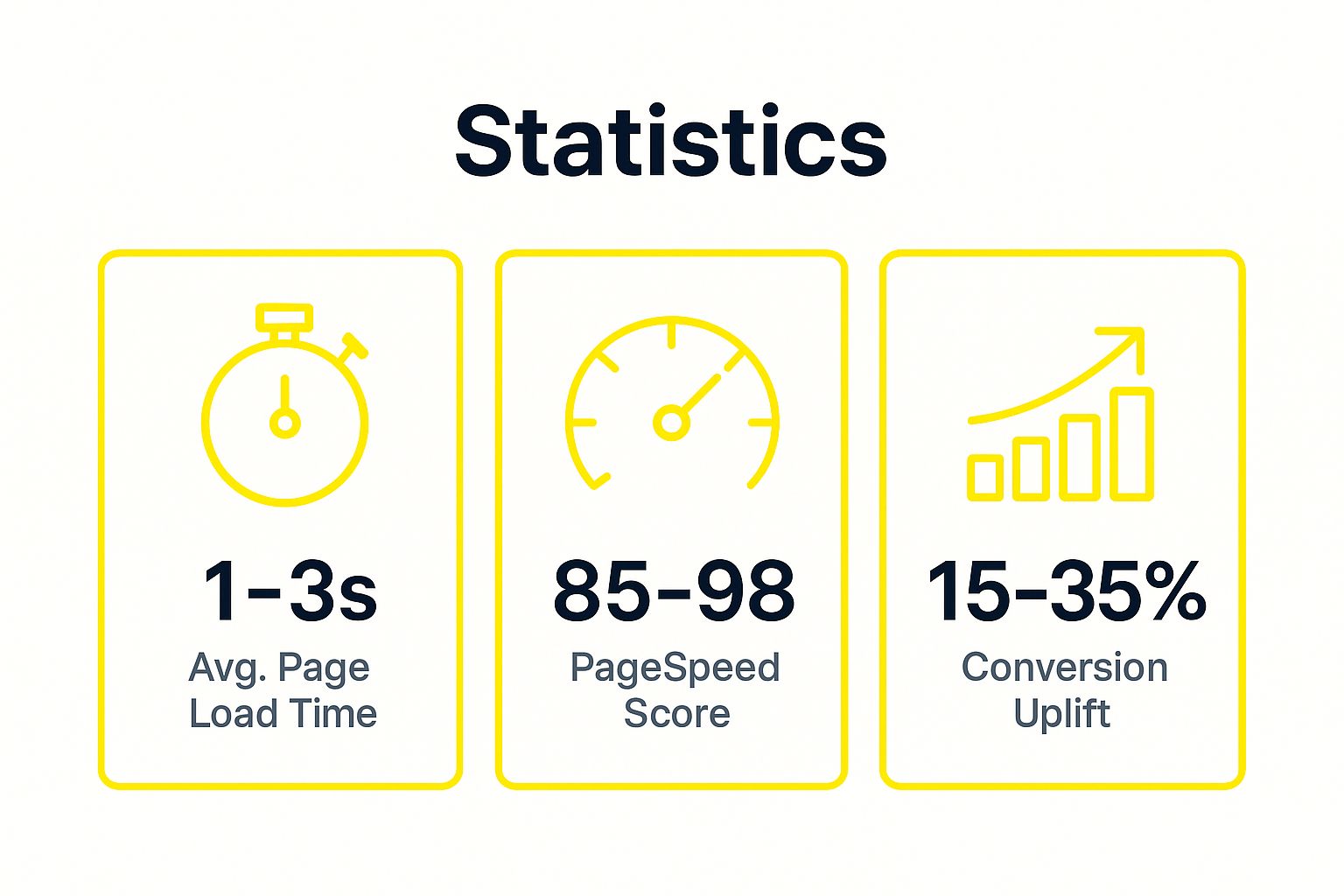
This infographic highlights the dramatic impact of headless commerce, showing average page load times of 1-3 seconds, Pagespeed scores between 85 and 98, and conversion uplifts ranging from 15% to 35%. These numbers underscore the potential for significant improvements in user experience and business outcomes.
Many successful brands have already embraced the power of headless commerce for performance gains. Gymshark achieved 90+ PageSpeed scores, MVMT Watches reduced load times by 60%, Kotn improved mobile performance by 40%, and Princess Polly achieved sub-2-second load times globally. These examples demonstrate the real-world impact of headless commerce on speed and performance. Learn more about Superior Performance and Speed Optimization.
So, when should you consider a headless approach for your Shopify store? If you're experiencing slow page load times, struggling with mobile performance, or seeing high bounce rates, then headless commerce could be the solution. It's particularly relevant for businesses with high traffic volumes or those looking to provide a truly exceptional user experience.
To maximize the performance benefits of headless commerce, implement comprehensive caching at the API, CDN, and browser levels. Utilize image optimization and next-gen formats like WebP and AVIF. Minimize JavaScript bundle sizes and implement code splitting. Optimize API responses with efficient data structures. And finally, continuously monitor Core Web Vitals and other performance metrics to identify areas for further improvement. Frameworks like Gatsby for static site generation, Next.js for performance-optimized React applications, and platforms like Vercel and Netlify for edge computing have popularized and simplified the implementation of these performance-enhancing strategies. Headless commerce provides a clear path to superior performance, offering a competitive edge in the demanding world of online retail.
4. Independent Scalability and Development Cycles
One of the most compelling headless commerce advantages is the decoupling of the frontend (customer-facing elements like your website or app) from the backend (the underlying commerce engine handling product data, orders, etc.). This separation creates independent scalability and development cycles, enabling businesses to optimize each layer according to its specific needs and timelines. Imagine revamping your website's design without touching the core checkout process – that's the power of headless.

This decoupling allows frontend and backend teams to work autonomously, using separate development, testing, and deployment cycles. For instance, your frontend team could be A/B testing a new user interface on a weekly basis, while the backend team focuses on a quarterly release cycle for major platform updates. This flexibility streamlines workflows and ensures that frontend innovations don't get bogged down by backend dependencies. This also allows for specialized team development, as backend teams can focus on the core commerce functions while frontend teams focus on the user experience. This separation is a key headless commerce advantage, particularly for businesses seeking agility and rapid innovation.
Several features enable this independent operation. Decoupled development and deployment processes mean teams can work in parallel, reducing bottlenecks and accelerating time-to-market for new features. Independent scaling of resources ensures optimal performance and cost efficiency. If you're expecting a surge in traffic during a flash sale, you can scale up your frontend servers without unnecessarily increasing backend capacity. Separate version control and release management further contribute to stability and minimize the risk of conflicts. As development teams grow and projects become more complex, streamlining development workflows with tools like pull request automation becomes essential for efficient code reviews and deployments. Automation can streamline many aspects of development, including pull requests. Revolutionize Workflow with Pull Request Automation from Mergify.
The benefits of this independent approach are numerous. Faster feature development and deployment cycles allow businesses to respond quickly to market trends and customer demands. Reduced risk of system-wide failures during updates ensures a stable and reliable online experience. Better resource allocation and team productivity contribute to overall efficiency and cost savings. Finally, the ability to experiment with frontend changes safely empowers innovation without jeopardizing the stability of the core commerce platform.
However, there are some challenges to consider. Managing independent teams requires careful coordination and communication. More complex project management is necessary to keep all moving parts in sync. Potential API versioning and compatibility issues need to be addressed proactively. Finally, maintaining separate environments for frontend and backend development adds overhead.
Several real-world examples showcase the power of independent scalability and development cycles. Spotify regularly updates its web player interface without affecting the backend API that delivers music. Netflix experiments with different user interface elements without altering its core video streaming infrastructure. Airbnb maintains independent development cycles for its mobile and web platforms. Shopify itself uses this approach, allowing merchants to customize their storefront themes without impacting the backend merchant admin panel. This independence offers a significant headless commerce advantage, empowering businesses to tailor their customer-facing experiences with unparalleled flexibility.
To successfully implement independent development cycles in your headless commerce architecture, consider these tips. Establish clear API contracts and versioning strategies to ensure smooth communication between frontend and backend systems. Implement comprehensive automated testing for API interactions to identify and resolve issues early. Use feature flags for controlled rollouts and quick rollbacks of new frontend features. Set up separate staging environments for each layer to test changes in isolation. Finally, create detailed documentation for cross-team communication and knowledge sharing. These strategies, combined with the inherent headless commerce advantages of decoupling, will empower your business to adapt, innovate, and thrive in today's dynamic e-commerce landscape.
This approach, popularized by microservices architecture pioneers like Netflix and API-first companies like Stripe and Twilio, has become a cornerstone of modern web development, and especially within the JAMstack movement. It represents a powerful shift towards greater agility, scalability, and resilience in e-commerce.
5. Future-Proof Technology Integration
One of the most compelling headless commerce advantages is its inherent ability to adapt to the ever-evolving technological landscape. Traditional commerce platforms often struggle to keep pace with new innovations, requiring costly and time-consuming overhauls to integrate emerging technologies. Headless commerce, however, embraces future-proofing through its flexible, API-first architecture, allowing businesses to seamlessly integrate new functionalities and maintain a competitive edge.
This approach fundamentally changes how you interact with technology. Instead of being locked into a monolithic platform with pre-defined capabilities, you have the freedom to choose best-of-breed solutions and connect them via APIs. This modularity allows for selective upgrades and targeted improvements without requiring a complete system rebuild. Imagine swapping out your payment gateway for a new provider offering lower transaction fees or integrating a cutting-edge AI-powered personalization engine – with headless commerce, these changes become significantly less disruptive.
The secret lies in the API-first architecture. APIs (Application Programming Interfaces) act as messengers, allowing different software systems to communicate and exchange data seamlessly. This vendor-agnostic approach liberates you from the constraints of a single vendor's ecosystem, giving you the flexibility to integrate virtually any technology that offers an API. Standardized data exchange protocols ensure consistent communication between different systems, streamlining the integration process.
Several benefits arise from this future-proof approach. The most obvious is the speed and ease of integrating new technologies and services. Want to offer Buy Now, Pay Later options? Integrate a BNPL provider through their API. Looking to enhance customer service with an AI chatbot? Connect your chosen chatbot platform with minimal development effort. This agility ensures you can capitalize on emerging trends and offer customers the latest and greatest experiences.
Furthermore, headless commerce provides protection against vendor lock-in. You're no longer at the mercy of a single vendor's roadmap and pricing strategies. If a vendor's services no longer meet your needs, you can easily switch to a competitor without rebuilding your entire platform. This empowers you to leverage the best-of-breed solutions available in the market, constantly optimizing your technology stack for maximum efficiency and performance.
Learn more about Future-Proof Technology Integration
Of course, no system is without its complexities. Headless commerce requires ongoing evaluation of integration options and the potential complexity of managing multiple vendor relationships. You'll need technical expertise to evaluate new technologies and ensure seamless integration. Additionally, integration costs can accumulate over time, particularly if you're frequently adding new services.
Despite these challenges, the long-term benefits of future-proofing your technology stack far outweigh the potential drawbacks. Imagine seamlessly integrating AI chatbots and recommendation engines to personalize the customer journey, quickly adopting new payment methods like Buy Now, Pay Later to increase conversions, or even creating immersive AR/VR shopping experiences to engage customers in innovative ways. Headless commerce makes all of this possible and sets the stage for future innovations like voice commerce integration with smart speakers or blockchain-based loyalty programs and NFT marketplaces.
For Shopify merchants, particularly those operating at an enterprise level, this flexibility is crucial. The ability to quickly adapt to changing consumer demands and integrate cutting-edge technologies can be the difference between thriving and merely surviving in the competitive e-commerce landscape. For brands looking to implement personalized experiences, leverage advanced analytics, or integrate unique marketing tools, the future-proof nature of headless commerce is invaluable.
To effectively leverage this powerful advantage, consider these tips: Maintain comprehensive API documentation and standards, evaluate integration partners based on API quality and reliability, plan for data migration and integration testing procedures, keep your technology stack current to ensure compatibility, and build internal expertise in API management and integration.
The success of platforms like Zapier, with its integration-first approach, Stripe, with its developer-friendly payment APIs, and Contentful, with its headless CMS ecosystem, demonstrates the power and potential of this approach. By embracing the principles of headless commerce, you can ensure your business is not only prepared for the future but is also equipped to shape it.
6. Enhanced Security and Compliance Management
Security and compliance are paramount concerns for any online business, especially those handling sensitive customer data. Headless commerce offers a significant advantage in this area, bolstering your security posture and simplifying compliance efforts. This approach provides a more robust and adaptable security framework compared to traditional monolithic systems. This enhanced security is a major reason why headless commerce deserves its place on the list of advantages, especially for enterprise-level businesses and those in heavily regulated industries.
Traditional e-commerce platforms often suffer from a larger attack surface because all components are tightly interconnected. A vulnerability in one area can potentially compromise the entire system. Headless commerce, on the other hand, decouples the frontend presentation layer from the backend commerce functionalities. This separation of concerns limits the impact of potential breaches. By isolating the customer-facing frontend from the sensitive backend operations, you create a layered security approach that minimizes the risk of a single point of failure bringing down the entire system. Think of it like a castle with multiple layers of defense: if one wall is breached, the attackers still have more fortifications to overcome.
This architectural advantage allows for specialized security implementations at each level. For instance, the API layer connecting the frontend and backend can employ robust token-based authentication (like OAuth 2.0 and JWT) and authorization mechanisms, while the backend databases can be fortified with encryption and strict access controls. This granular control over security is significantly more difficult to achieve in a monolithic system. Furthermore, reducing the amount of sensitive data exposed in the frontend applications minimizes the potential damage from client-side attacks like cross-site scripting (XSS).
The benefits extend to compliance management as well. Meeting the stringent requirements of regulations like PCI DSS (for payment card information), HIPAA (for healthcare data), and GDPR (for user privacy) becomes easier with the isolated and controlled nature of a headless architecture. For example, financial services companies can isolate the payment processing component and apply PCI DSS compliant security measures specifically to that area, without impacting other parts of the system. Similarly, healthcare e-commerce platforms can ensure HIPAA compliance by meticulously controlling access to protected health information within the backend system. Learn more about Enhanced Security and Compliance Management for specific examples relating to data localization and compliance.
This advantage is particularly relevant for established Shopify merchants scaling their businesses, Shopify Plus users, and enterprise clients seeking robust solutions. International retailers managing GDPR requirements also benefit significantly from the granular control over data access and processing offered by headless commerce. B2B platforms with stringent enterprise security standards can implement tailored security protocols for each component, ensuring compliance with internal policies and industry best practices.
While headless commerce provides robust security advantages, it’s important to acknowledge the potential complexities. Managing a more intricate security architecture requires specialized expertise. Potential security gaps can arise between the separated system components if not properly addressed. This necessitates more advanced security tools, continuous monitoring, and regular security audits and penetration testing. Investing in robust API security with proper authentication and authorization mechanisms, employing HTTPS throughout the system with meticulous certificate management, encrypting data both in transit and at rest, and implementing API usage monitoring with rate limiting and abuse prevention are all crucial.
Here are some actionable tips for implementing robust security in a headless commerce architecture:
- Implement comprehensive API security: Leverage OAuth 2.0 and JWT tokens for robust authentication and authorization.
- HTTPS Everywhere: Ensure all communication channels use HTTPS and maintain proper certificate management.
- Regular Security Audits: Conduct regular security audits and penetration testing across all system components.
- Data Encryption: Implement proper data encryption at rest and in transit.
- API Monitoring: Monitor API usage and implement rate limiting and abuse prevention mechanisms.
Enterprise security companies like Okta and Auth0, along with cloud security platforms like AWS IAM, offer specialized tools and services to help you build and manage a secure headless commerce environment. By understanding and addressing the potential complexities, businesses can leverage the significant security and compliance benefits of headless commerce to protect their data, maintain customer trust, and achieve a competitive advantage.
7. Cost Optimization and Resource Efficiency
One of the most compelling headless commerce advantages is its potential for significant cost optimization and improved resource efficiency. Traditional monolithic ecommerce platforms often come with hefty licensing fees, rigid infrastructure requirements, and escalating costs as your business grows. Headless commerce, on the other hand, offers a more modular and flexible approach, allowing you to optimize spending across various components and only pay for the resources you actually use. This makes it a particularly attractive option for established Shopify merchants looking to scale, enterprise clients seeking Shopify Plus solutions, and business owners eager to maximize their ROI.
The core of this cost-saving potential lies in the decoupled architecture of headless commerce. By separating the frontend presentation layer from the backend commerce functionality, you gain the freedom to choose best-of-breed solutions for each, optimizing both performance and cost. This allows you to leverage cost-effective technologies like serverless computing, edge networks, and static site generation, which can drastically reduce your hosting and infrastructure expenses. Instead of being locked into a single vendor's ecosystem, you can select services based on your specific needs and budget. This flexibility is particularly beneficial for Shopify Plus users who often require complex integrations and customizations.
Features Driving Cost Optimization:
- Independent Scaling: With headless commerce, you can scale different parts of your system independently. If you experience a surge in traffic, you can scale up your frontend hosting without necessarily scaling up your backend database. This eliminates over-provisioning and reduces unnecessary costs.
- Serverless and Edge Computing: Serverless functions and edge networks allow you to deploy and run code without managing servers. You only pay for the compute time you consume, leading to significant cost savings, especially for variable workloads. Platforms like AWS Lambda and Vercel exemplify the power of this approach.
- Reduced Hosting Requirements: Using static site generators, much of your website's content can be pre-built and served directly from a CDN. This drastically reduces the need for dynamic server-side rendering, lowering hosting costs and improving site speed. JAMstack architecture advocates have popularized this strategy.
- Elimination of Expensive Monolithic Platform Licenses: Headless commerce frees you from expensive, all-in-one platform licensing fees. You can choose open-source solutions or pay-as-you-go services, giving you more control over your budget. This is a crucial benefit for businesses looking to escape the rising costs of proprietary platforms.
- Pay-per-Use Pricing Models: Many services used in a headless architecture, such as APIs and cloud hosting, operate on a pay-per-use model. This means you only pay for what you use, making it easier to control and predict your expenses.
Pros and Cons of Cost Optimization with Headless Commerce:
Pros:
- 30-50% Reduction in Hosting and Infrastructure Costs: This is a realistic expectation for many businesses migrating to a well-optimized headless architecture.
- Lower Total Cost of Ownership Over Time: While initial development costs might be higher, the long-term operational costs are generally lower with headless commerce.
- Flexible Pricing Based on Actual Usage: Pay-as-you-go models provide greater budget control and scalability.
- Reduced Dependency on Expensive Enterprise Platforms: You're not locked into a single vendor's pricing structure.
- Better ROI through Performance Improvements: Faster page load times and improved user experience can lead to increased conversions and revenue.
Cons:
- Higher Initial Development and Setup Costs: Building a headless system requires more upfront investment compared to using a pre-built platform.
- Ongoing Costs for Multiple Service Providers: Managing multiple vendors can add complexity and potentially increase administrative overhead.
- Need for Technical Expertise: Implementing and maintaining a headless system requires a higher level of technical expertise, potentially increasing labor costs.
- Potential Cost Complexity Managing Multiple Vendors: Keeping track of billing and usage across multiple providers can be challenging.
Examples of Successful Implementation:
- Startups: By avoiding hefty enterprise platform fees, startups can allocate more resources to product development and marketing.
- Mid-size Retailers: Reducing hosting costs by leveraging static site generation and CDNs. Some retailers have seen reductions as high as 60%.
- International Brands: Optimizing regional hosting costs by using geographically distributed CDNs and edge servers.
- B2B Companies: Reducing per-user licensing fees by adopting a headless approach and utilizing custom-built user interfaces.
Actionable Tips for Cost Optimization:
- Conduct Thorough Cost Analysis: Compare the total cost of ownership for your current platform versus a headless solution.
- Leverage Serverless Functions: Use serverless functions for variable workload components like image processing or email notifications.
- Use CDNs and Edge Computing: Reduce server costs and improve performance by serving static content from a CDN.
- Implement Effective Caching Strategies: Minimize API calls and reduce backend load by implementing robust caching.
- Monitor and Optimize Resource Usage Continuously: Track your spending across all services and identify areas for optimization.
By carefully planning and implementing a headless commerce architecture, businesses can unlock significant cost savings and improve resource efficiency, ultimately driving better ROI and fueling growth. This approach empowers E-commerce and IT managers, marketing and brand managers, and business owners to make strategic technology decisions that align with their budget and long-term goals.
7 Key Advantages of Headless Commerce
| Advantage | 🔄 Implementation Complexity | ⚡ Resource Requirements | 📊 Expected Outcomes | 💡 Ideal Use Cases | ⭐ Key Advantages |
|---|---|---|---|---|---|
| Enhanced Frontend Flexibility and Customization | High: requires advanced JS, APIs, frameworks | High: skilled frontend developers needed | Medium-term: 3-6 months development | Custom UX, brand differentiation, responsive design | Unlimited design possibilities, modern UX, easy A/B testing |
| Omnichannel Commerce Capabilities | High: complex multi-channel integration | High: infrastructure, order management | Long-term: 12-18 months ROI | Unified shopping across web, app, IoT, kiosks | Consistent experience, centralized data, faster new channel launch |
| Superior Performance and Speed Optimization | Medium-High: caching, CDN, optimization expertise | Medium: CDN, monitoring tools required | Short-term: page loads 1-3s, 15-35% conv. uplift | SEO improvement, mobile UX, high traffic sites | Very fast load times, better SEO, reduced server costs |
| Independent Scalability and Development Cycles | Medium: needs API coordination, team sync | Medium: parallel environments and tools | Ongoing: daily to weekly deployments | Agile teams, frequent releases, parallel development | Faster deployments, reduced update risks, specialized teams |
| Future-Proof Technology Integration | Medium: ongoing integration evaluation | Medium: technical expertise in APIs | Fast: days to weeks for new tech adoption | Businesses needing rapid tech adoption and innovation | Quick integration, vendor flexibility, continuous innovation |
| Enhanced Security and Compliance Management | Medium-High: complex security architecture | High: advanced security tools/expertise | Medium: faster compliance, reduced breach impact | Regulated sectors (finance, healthcare, global retail) | Reduced breach risk, faster compliance, specialized security |
| Cost Optimization and Resource Efficiency | Medium: initial dev and setup costs | Medium: multiple vendor management | Medium-long: 30-50% hosting cost reduction | Cost-conscious scaling, startups, mid-size retailers | Lower infrastructure costs, elimination of license fees, better ROI |
Embrace the Future of eCommerce with E-commerce Dev Group
The headless commerce advantages discussed in this article paint a clear picture of its transformative power. From enhanced frontend flexibility and customization, allowing you to craft unique brand experiences, to the superior performance and speed optimization that drives conversions, headless commerce empowers businesses to truly excel. Key takeaways include the ability to seamlessly integrate with various omnichannel platforms, achieve independent scalability for future growth, and ensure robust security and compliance. Mastering these concepts is crucial for staying ahead of the curve in today's dynamic digital landscape and unlocking unprecedented levels of control and agility for your online store. By embracing headless commerce, you're not just adopting a technology; you're investing in a future-proof strategy for sustainable growth and enhanced customer engagement.
Ready to harness the power of headless commerce and elevate your online store? E-commerce Dev Group specializes in crafting bespoke headless commerce solutions on Shopify Plus for businesses like yours, leveraging the advantages discussed above. Visit us at E-commerce Dev Group to explore how we can tailor a solution that perfectly aligns with your unique business needs and helps you dominate the competitive e-commerce landscape.
