

Think of it this way: when you need a new storefront, you have two basic options. You can lease a pre-built space in a shopping mall, or you can buy a plot of land and build your own custom flagship store.
Leasing is fast and easy, but you're stuck with the existing floor plan. Building from scratch takes more effort, but every single detail—from the window displays to the stockroom layout—is designed to fit your exact business needs.
Custom ecommerce development is the digital equivalent of building that flagship store. It’s about creating an online business from the ground up, perfectly tailored to your brand, your customers, and your unique way of operating. It gives you a level of control and flexibility that you just can't get from a template.
What Is Custom Ecommerce Development?
When most people hear "custom website," they immediately think about a unique visual design. While that’s part of it, true custom development goes much, much deeper. It’s less about the paint color and more about the foundation, the wiring, and the plumbing.
It's about engineering the backend logic and operational workflows that give your business a real competitive edge. You're not just picking a theme; you're building a business asset designed to solve your specific challenges and unlock new opportunities.
It’s Much More Than a Pretty Design
A unique look is great, but the real power of custom development lies in creating functionality that off-the-shelf platforms simply can't support. You're no longer limited by what a plugin can do.
Instead, you can build features tailored to how you actually sell.
- Advanced Product Configurators: Imagine letting customers build their own bicycle piece-by-piece or design a custom-engraved ring right on your website.
- Complex Pricing Engines: You can create sophisticated pricing rules for B2B accounts, offer tiered discounts to wholesalers, or even implement dynamic pricing based on inventory levels.
- Seamless System Integration: This is a big one. You can create a perfect, two-way sync between your website and your ERP or CRM, automating everything from inventory updates to customer service logs.
- Proprietary Business Models: Want to launch a subscription box with complicated rules? Or a specialized rental service? A custom build lets you code that logic directly into your platform.
A custom ecommerce website isn’t chained to a single platform’s limitations, so you can modify it any way you want. This empowers a brand to stand apart from a crowded field of generic-looking websites and build a truly unique digital experience.
You Own the Foundation
At its core, custom ecommerce development is about ownership. When you use a platform like Shopify or BigCommerce, you're essentially renting. You have to play by their rules and work within their technological limits.
With a custom solution, you own everything—the code, the data, the entire architecture. This freedom is what allows you to scale and adapt without ever hitting a wall. As your business evolves, your website can evolve with it.
That control is the real game-changer. It’s what makes a bespoke solution the right choice for any business with a vision that won't fit inside a pre-built box.
Why Invest in a Custom Ecommerce Platform?

Moving away from a familiar, plug-and-play storefront is a big decision for any business. It takes a real investment of time and money, so what's the actual payoff? A custom platform isn't just about looking different; it's about building a powerful business engine designed for serious growth, efficiency, and a customer experience that nobody else can offer.
The benefits go way beyond a unique homepage. When you invest in custom ecommerce development, you're really laying a foundation that can support your most ambitious goals. It gives you the freedom to outmaneuver competitors who are stuck within the rigid walls of their off-the-shelf software.
Off-the-Shelf vs Custom Ecommerce Development
To really grasp the difference, it helps to see a direct comparison. On one side, you have ready-made platforms like Shopify—powerful and convenient, but with inherent limits. On the other, you have a solution built from the ground up just for you.
| Feature | Off-the-Shelf Platform (e.g., Shopify) | Custom Ecommerce Development |
|---|---|---|
| Flexibility & Design | Limited by pre-built themes and templates. Customization is possible but restricted. | Complete creative freedom. The design and user experience are built to your exact brand specifications. |
| Functionality | Relies on third-party apps and plugins, which can slow down the site and cause conflicts. | Features are built directly into the platform, ensuring seamless integration and optimal performance. |
| Scalability | Can handle growth to a point, but may struggle with very high traffic or complex catalogs. | Engineered to handle your specific growth projections from the start. Scales smoothly without performance hits. |
| Performance | Often bloated with unnecessary code from apps, leading to slower load times. | Lean, clean code written for one purpose: speed. Results in faster loading pages and better conversions. |
| Ownership & Cost | Lower initial cost, but ongoing monthly fees and app subscriptions add up. You're "renting." | Higher upfront investment, but you own the asset. No ongoing platform fees and a better long-term TCO. |
Ultimately, the choice comes down to your vision. Off-the-shelf platforms are fantastic for getting started, but a custom build is for businesses that are planning to lead their market, not just participate in it.
Future-Proof Your Business with True Scalability
Many template-based platforms talk a big game about being "scalable," but they often have hidden ceilings. As your business really starts to take off, you might notice that a spike in traffic grinds your site to a halt. Or maybe adding more products and features creates a tangled mess of plugins that are constantly breaking each other.
A custom-built platform is engineered specifically for your growth plan. The entire architecture is designed from day one to handle the traffic, product catalog, and order volume you expect to have in the future. This means you won’t face a disruptive and expensive "replatforming" project every few years. You build it right, once, and it grows right alongside you.
Express Your Brand Identity Authentically
In a crowded market, your brand is everything. A custom solution lets you weave your brand’s DNA into every pixel and every single interaction. You're no longer boxed in by a theme's pre-made layouts or limited functions.
This level of control creates an experience that’s truly unique and memorable.
- Custom User Experience: Design a checkout process that perfectly matches your customers' buying habits. Or create an interactive product discovery tool that no competitor can even dream of replicating.
- Unique Features: Build your own tools that offer genuine value, like a custom product builder or a personalized subscription portal that just works.
- Total Design Freedom: Your site's look and feel becomes a direct reflection of your brand—not just a slightly tweaked version of a popular template everyone else is using.
A custom platform transforms your website from a simple sales channel into a powerful brand experience. It ensures that every click, every page, and every interaction reinforces what makes your business unique.
Personalization is a huge part of this. With custom ecommerce development, you can implement sophisticated personalization engines that go way beyond showing "related products." By truly tailoring content and recommendations to individual users, businesses see a massive impact on their bottom line. In fact, these highly personalized ecommerce experiences can boost sales by 10% to 30% by making the shopping journey more relevant and engaging. You can discover more insights about the power of ecommerce personalization.
Achieve Peak Performance and Speed
Let's be blunt: website speed is a conversion factor, not just a tech metric. Slow pages lead directly to abandoned carts and lost revenue. Template-based sites often get bogged down by the unnecessary code from dozens of apps and plugins, but a custom build is lean and mean.
Every single line of code serves a purpose. The result? Lightning-fast load times. This boost in performance has a direct, measurable impact on your business by improving search engine rankings, keeping users engaged, and driving up conversion rates.
Fortify Security with Tailored Protocols
In ecommerce, security is non-negotiable. A single data breach can shatter customer trust and result in massive financial penalties. While big platforms do a decent job with general security, a custom solution lets you build a fortress designed for your specific risks.
You can implement advanced fraud detection, create custom access controls for your team, and integrate specialized compliance protocols for your industry. This proactive approach gives both you and your customers peace of mind, protecting your data and your hard-earned reputation.
The Custom Development Project Roadmap
Jumping into a custom e-commerce project can feel like a huge undertaking, but it's really a journey with a clear and logical path. When you understand this roadmap, the whole process becomes less intimidating, transforming what seems like a massive task into a series of manageable steps. Each stage builds on the last, making sure the final store is a perfect match for your business goals.
The real work starts long before anyone writes a single line of code. It begins with a deep dive into your vision, your customers, and the unique way your business operates. A well-thought-out roadmap keeps you from making expensive wrong turns and ensures everyone—your team and your development partner—is on the same page from start to finish.
The entire process, from that first spark of an idea to a fully functioning online store, can be mapped out in a few key phases. This infographic gives you a high-level look at the journey.
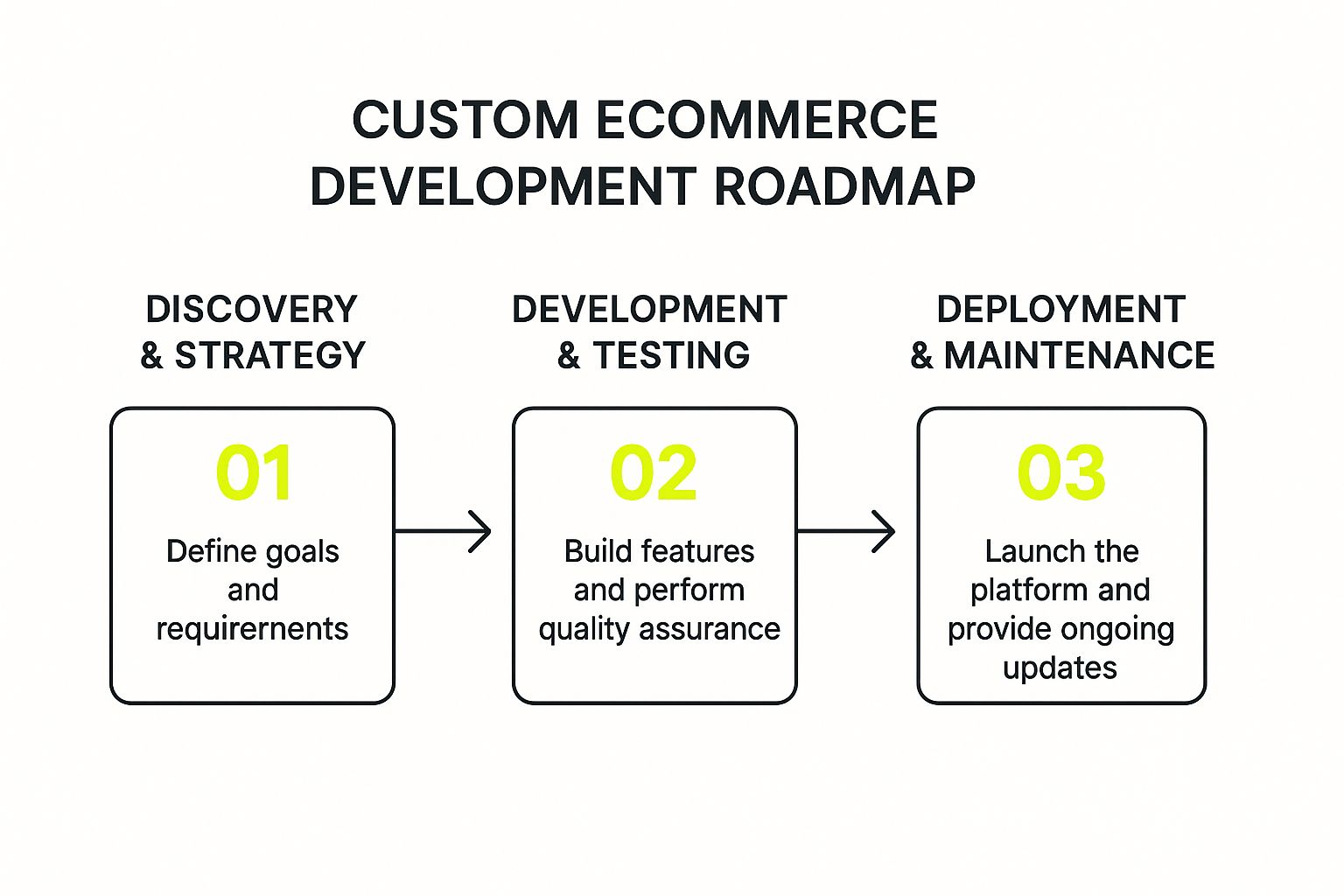
As you can see, a solid foundation in strategy and planning directly shapes how the platform is built and launched. Each step flows logically into the next. Let's break down what actually happens in each of these crucial phases.
Phase 1: Discovery And Strategy
Honestly, this is the most critical part of the entire project. Think of it as creating the architectural blueprint for your flagship store before you even think about laying a single brick. During this discovery phase, the development team gets to know your business inside and out.
This isn't just about tech; it's about aligning your business goals with a technical plan. The aim is to turn your objectives into a detailed project plan that everyone can follow.
Here’s what typically happens:
- Stakeholder Interviews: We talk to the key people in your company to understand their daily challenges, goals, and workflows.
- Requirement Gathering: We document every single feature the platform needs, from how products are categorized to complex inventory rules.
- Technical Audit: Your existing systems (like an ERP or CRM) are analyzed to figure out how they’ll connect seamlessly with the new site.
- Defining Success Metrics: We establish clear KPIs to measure how well the project succeeds after it goes live.
The Discovery and Strategy phase is where 90% of the critical thinking happens. A thorough discovery process is the single greatest predictor of a successful custom ecommerce project, preventing scope creep and ensuring the final product solves real business problems.
Phase 2: UX And UI Design
With a solid strategy locked in, the focus shifts to the most important person: your customer. The User Experience (UX) and User Interface (UI) design phase is where your brand's personality and the customer journey truly come to life. The goal is simple: create an intuitive, engaging, and beautiful storefront that guides users from browsing to checkout without any friction.
First, UX designers map out the entire customer journey, creating wireframes—think of them as simple skeletal layouts—to structure every page. This ensures the site is easy to navigate. Once the structure feels right, the UI designers step in to apply your brand's visual identity—colors, fonts, and imagery—to create a polished and professional look.
Phase 3: Development And Technology Selection
This is where the magic happens and the blueprint becomes a reality. Developers start writing the code that will power your custom store. This work is usually broken down into "sprints"—short, focused periods where specific features are built, reviewed, and improved.
It's also during this time that final decisions are made about the technology stack. This means choosing the right programming languages, frameworks, and databases that will give you the best performance and allow your site to grow with your business. Regular check-ins and demos mean you can see progress and give feedback every step of the way.
Managing a build of this size requires careful coordination. If you're curious about how these complex projects stay on track, you can learn more in our guide to effective web development project management.
Phase 4: Testing And Quality Assurance
Before your new store can open its doors, it has to go through some serious testing. The Quality Assurance (QA) team essentially becomes your first customer, clicking every button, filling out every form, and testing every feature to find and squash any bugs.
Testing is a multi-layered process that covers all the bases:
- Functional Testing: Does every single button, link, and form work exactly as it should?
- Compatibility Testing: Does the site look and function perfectly on different browsers (like Chrome, Safari) and devices (desktops, tablets, phones)?
- Performance Testing: Can the site handle a rush of holiday traffic without slowing to a crawl?
- Security Testing: Are there any weak spots that could be exploited by attackers?
This exhaustive process ensures a smooth, secure, and reliable shopping experience for your customers right from day one.
Phase 5: Deployment And Ongoing Maintenance
After the site has passed every test with flying colors, it’s time to go live. Deployment is the process of moving the finished website from a private development server to a live one where the public can find it. A well-planned launch minimizes downtime and ensures a seamless transition for your customers.
But the work isn’t over when the site is live. In fact, it’s just beginning. Ongoing maintenance is absolutely essential for long-term success. This includes regular security updates, performance monitoring, fixing any new bugs that pop up, and planning for future features to keep your platform running at its best and evolving with your business.
Choosing Your Tech Stack and Architecture
Under the hood of every great custom store is a carefully chosen technology stack. This is the engine that runs your entire operation, and while it sounds intimidating, you don't need to be a developer to understand the basics. Getting a handle on these concepts will help you work effectively with your technical team.
Think of it like building a house. You need a solid foundation (the back-end), a beautiful and functional design (the front-end), and a sturdy frame holding it all together. Choosing the right "materials" from the start ensures your store is fast, secure, and ready to grow with you.
Understanding Front-End and Back-End Technologies
Your e-commerce platform is really two halves of a whole. The front-end is everything the customer sees and touches—the design, the buttons, the product pages. The back-end is the behind-the-scenes brain that handles inventory, processes orders, and keeps the business logic running smoothly.
-
Front-End Technologies: These are all about creating a snappy and engaging user experience. Frameworks like React, Vue.js, or Angular are popular choices for building the dynamic, interactive interfaces that feel modern and work perfectly on any device.
-
Back-End Technologies: This is where the heavy lifting gets done. Your developers will use a programming language (like Python or PHP) and a database (like MySQL) to manage everything from product data to secure payments.
A smart back-end design can also integrate powerful tools. For instance, you can build in real-time e-commerce analytics solutions to get deep, immediate insights into your business, not just process transactions.
The Big Decision: Monolithic vs. Headless Architecture
Beyond the individual technologies, the single biggest decision you'll make is the overall architecture. This choice dictates how your store will operate—and scale—for years. The two main paths are Monolithic and Headless.
A Monolithic architecture is the traditional, all-in-one approach. The front-end and back-end are woven together into a single system. It's like buying a TV with a built-in DVD player; it’s convenient and simple, but you’re stuck with both components, for better or worse.
On the other hand, a Headless architecture separates the front-end (the "head") from the back-end commerce engine. This is like buying the best 4K TV, a high-end soundbar, and an Apple TV all separately. Each piece is best-in-class, and you can upgrade one without having to replace the others.
A Headless approach gives you ultimate flexibility. You can send product information to any front-end you can dream of—a website, a mobile app, an in-store kiosk, or even a smart mirror—all powered by the same back-end.
This isn't just a technical detail; it's a strategic business decision. The global e-commerce market is projected to top $3.66 trillion, and you need agility to stand out. With mobile commerce expected to account for 59% of all sales, being able to create unique experiences on different platforms is a massive advantage.
Why Your Architectural Choice Matters
A monolithic build can be faster and more straightforward for simple projects. It’s a proven model that works perfectly well for many online stores. The downside? It can become rigid and difficult to update as your business grows and technology evolves.
A headless approach, in contrast, is built for the future. It delivers faster performance, makes updates easier, and gives you the creative freedom to design one-of-a-kind customer experiences. While the initial setup might be a bit more involved, the long-term payoff in scalability and flexibility is huge.
If you want to dive deeper into this modern strategy, our guide explaining what headless commerce is is a great place to start. Making the right choice here ensures your investment pays off for years to come.
Calculating the True ROI of Your Investment
https://www.youtube.com/embed/hpsnyFgI7CA
Let's get right to the big question: what's this going to cost? It's true that a custom ecommerce development project has a bigger price tag upfront compared to a theme you buy off the shelf. But thinking of it purely as an expense is the wrong way to look at it.
The real conversation is about Return on Investment (ROI). This simple shift in thinking changes everything. You stop asking, "What does it cost?" and start asking, "What is it worth to my business?" A custom-built platform isn't just another line item on a budget; it's a strategic asset designed to make you money and save you time.
Moving Beyond Upfront Costs
The initial price of a custom build depends on a few things: how complex the features are, how many other systems you need to connect with, and the overall size of the project. But that's only half the story.
To really understand the value, you have to look at the financial benefits your new site will bring in over its lifetime. We're talking about measurable improvements that directly impact your bottom line.
Quantifying Your Gains
So, where does the return actually come from? A custom build creates value in several key areas, and each one helps pay back that initial investment, often much faster than you’d think.
Here are the big ones:
- Increased Conversion Rates: A better user experience, faster pages, and a checkout process that just works will turn more of your visitors into buyers. It's that simple.
- Improved Operational Efficiency: Think about all the manual tasks your team does. Custom automation can handle things like syncing inventory or entering customer data, saving thousands of dollars in labor costs.
- Reduced Platform Fees: You get to say goodbye to those creeping monthly subscription fees and the cost of a dozen different third-party apps that nickel-and-dime you every month.
- Higher Customer Lifetime Value (LTV): When you can create unique features and truly personal shopping experiences, you build loyalty. Loyal customers come back again and again, and they spend more when they do.
Thinking about custom ecommerce development as a strategic investment is crucial for future growth. The global market for custom software reflects this shift, valued at approximately $43.16 billion in 2024 and projected to hit $146.18 billion by 2030, showing how businesses are moving toward bespoke solutions for a competitive edge.
Building Your Business Case
To get buy-in for a project like this, you need to connect these benefits to real numbers. Start by looking at your current metrics and then project some realistic improvements. If you're not sure where to start, check out our guide to the most essential ecommerce performance metrics.
Let's run a quick example. Say your site currently converts at 2%. Could a custom-designed UX and a faster checkout realistically push that to 2.5%? If you're doing $1 million a year in revenue, that little 0.5% bump is an extra $25,000 in your pocket.
Now, think about your team's time. If you can automate tasks and save 20 hours of manual work a week, and your average staff cost is $25/hour, that’s another $26,000 in savings every year.
Once you start adding up these gains, the ROI picture becomes crystal clear. To dig deeper into this, it helps to know how to measure marketing ROI the right way.
Common Questions About Custom Ecommerce
Thinking about a custom ecommerce project always sparks some big questions. How long will it take? Is it really better than a platform like Shopify Plus? What are the real costs after launch?
Getting straight answers is crucial before you commit. This section cuts through the noise to tackle these common questions head-on, giving you the practical insights you need to make the right call for your business.
How Long Does Custom Ecommerce Development Take?
Let's start with the big one: the timeline. Unlike a template site you can spin up in a few weeks, a custom build is a marathon, not a sprint. The timeline is a direct reflection of how complex and unique your vision is.
For a relatively straightforward custom store—think unique branding and core e-commerce functions—you're typically looking at about 3 to 6 months from kickoff to launch.
But for more ambitious projects, the timeline stretches. Expect a build to take 6 to 12 months or even longer if it includes things like:
- Complex Integrations: We're talking deep, two-way syncs with your ERP, CRM, or a specialized inventory system that needs to work flawlessly.
- Advanced Features: Building something truly unique from the ground up, like an AI-powered product recommender, a detailed product configurator, or a full-blown multi-vendor marketplace.
- Multiple Front-Ends: Developing not just a website but also native mobile apps, all powered by a single headless backend.
The entire timeline is built from distinct phases. A typical project might break down into discovery and strategy (4-6 weeks), UX/UI design (4-8 weeks), core development (12-24+ weeks), and a whole lot of testing (4-6 weeks). A detailed roadmap is your best friend here—it manages expectations and keeps everyone focused on quality.
Trying to rush any of these steps, especially the initial discovery phase, almost always ends in compromises you'll regret later. Patience and a methodical approach are the keys to getting it right.
Is Custom Development Better Than Shopify Plus?
This is a great question because it's a genuine dilemma for many growing brands. The honest answer? Neither is universally "better." The right choice comes down to your business model, operational needs, and where you want to be in five years.
Shopify Plus is a powerhouse for businesses that fit neatly into its ecosystem. It’s fast to market, incredibly reliable, and has an app for just about everything. If your main goals are speed and leveraging a vast array of proven, pre-built tools, it’s an excellent choice.
Custom ecommerce development becomes the smarter move when your competitive edge lies in something a platform simply can't do out of the box.
A custom build is probably the right path if your business depends on:
- Unique Operational Workflows: You have a one-of-a-kind process for fulfillment, inventory, or customer service that needs to be hard-coded into your site’s DNA.
- Deep System Integrations: Your business relies on a perfect, real-time data flow with other core systems that goes far beyond what a standard API can handle.
- Proprietary Customer Experiences: You want to create a feature that is your brand—like a specialized subscription model or a visual product builder—that can't be patched together with third-party apps.
- Absolute Control and Ownership: You need to own your entire tech stack and all your data, free from a platform's rules, feature updates, or transaction fees.
So, if your vision fits within the Shopify Plus framework, it's a fantastic and efficient option. But if your success hinges on breaking out of that framework, a custom build is a necessary investment.
What Are the Ongoing Costs of a Custom Site?
A custom site means no more monthly platform subscription fees, but it comes with its own set of operating costs. It’s best to think of these not as just "keeping the lights on," but as the budget that gives you the freedom to secure, maintain, and continuously improve your most valuable business asset.
Generally, these costs fall into three buckets.
- Hosting: This is where your website lives online. Depending on your traffic, security, and performance needs, this can range from a few hundred to several thousand dollars per month.
- Maintenance and Support: This is probably the most critical ongoing expense. It's usually a monthly retainer with your development partner that covers essential security patches, bug fixes, performance monitoring, and software updates. It keeps your site fast, safe, and running smoothly.
- Enhancements and New Features: Your business isn't static, and your website shouldn't be either. This is your budget for rolling out new features, improving the user experience, and adapting to market changes. It’s what ensures your platform stays a competitive advantage, not a relic.
When you view these costs as an ongoing investment in your platform’s health and growth, you'll be positioned to get the most value out of it for years to come.
Ready to build an e-commerce platform that grows with you? The team at E-commerce Dev Group specializes in creating high-performance, custom Shopify solutions designed to drive real business results. Get in touch with our experts today to discuss your vision and see how we can bring it to life.
