


So, what is agile development methodology? At its heart, it's a way of managing projects that's built for flexibility, teamwork, and getting things done in small, usable chunks. It’s less about following a rigid, unchanging plan and more about adapting as you go.
Think of it like building a custom house. Instead of creating a massive blueprint and not showing the client anything until the very end, Agile is like building one room at a time. After each room is finished, you get feedback, make adjustments, and then move on to the next.
A Mindset for Modern Development
Agile isn't just one specific set of rules. It’s an approach—an iterative one—perfect for tackling complex projects, especially in software and web development. The big idea is to deliver real value to the customer much faster and with fewer surprises along the way.
To do this, projects are broken down into small, focused cycles called sprints or iterations. These typically last anywhere from one to four weeks.
At the end of every single cycle, the team delivers a working piece of the project. This is huge because it allows for constant feedback from everyone involved, making sure the final product is exactly what people actually need. It’s a world away from older methods where you might wait months or even years for the final delivery, only to find out requirements changed six months ago.
The Shift from Rigidity to Flexibility
The real game-changer with Agile is its ability to adapt. Traditional methods, often called "Waterfall," follow a strict, linear path. You have to finish one phase completely before you can even think about starting the next—like a waterfall, where water only flows one way. Going back to make a change is a nightmare that can wreck the timeline and budget. In a fast-moving industry, that kind of inflexibility just doesn't work.
Agile, on the other hand, treats change as an opportunity. When a client has a new idea or the market shifts, an Agile team doesn't see it as a roadblock. They see it as a chance to build something even better.
Understanding the differences between Agile and Waterfall is crucial for anyone working on modern projects, including complex tasks like Shopify theme development. This table breaks down the core distinctions.
Agile vs Waterfall: A Quick Comparison
This quick comparison highlights just how different the two philosophies really are, from planning and structure to how they handle feedback.
| Aspect | Agile Methodology | Waterfall Methodology |
|---|---|---|
| Structure | Iterative and cyclical | Linear and sequential |
| Flexibility | Welcomes changes at any stage | Changes are difficult and costly |
| Customer Feedback | Continuous throughout the project | Primarily at the beginning and end |
| Delivery | Small, frequent working releases | One final product delivery |
| Planning | Adaptive and ongoing | Upfront and extensive |
Ultimately, Agile’s iterative nature means teams can learn and improve on the fly, leading to a much more relevant and successful final product.
The Story Behind the Agile Manifesto
To really get what Agile is all about, you have to rewind to the software world of the 1990s. For many developers, it was a mess. Projects were constantly bogged down by rigid, waterfall-style processes that felt like building software with your hands tied behind your back.
Think of it like this: you're building a house, but the architect demands you finalize every single detail—from the exact placement of every light switch to the color of the bathroom tiles—before a single nail is hammered. Once the blueprint is signed, that’s it. No changes. If the family realizes halfway through they need a nursery instead of a home office, it's too late. That’s how software was often built.
These old-school approaches, sometimes called heavyweight methods, forced teams to map out the entire project from start to finish. Everything was locked into a strict sequence: planning, designing, building, testing, and finally, launching. If you discovered a flaw or a better idea midway through, turning back was a nightmare of paperwork and delays. It was slow, inflexible, and completely out of touch with how creative work actually happens.
A Meeting in the Mountains
This widespread frustration was the spark that lit the Agile fire. In February 2001, 17 software developers—some of the brightest minds in the industry—got together at a ski resort in Snowbird, Utah. They were there to figure out a better way to build software. You can dive deeper into the detailed history of Agile's origins to see how it all came together.
They weren't looking to create another complicated, top-down methodology. They were there to share war stories about failed projects and the constant struggle to deliver products that customers actually wanted. They knew there had to be a more effective, human-centered approach.
Their goal wasn't to write a new rulebook. It was to outline a new philosophy—one that put people, collaboration, and working software ahead of rigid plans and endless documentation.
The Manifesto for Agile Software Development
What came out of that weekend retreat was a short, powerful document that changed everything: the Manifesto for Agile Software Development. It’s not a thick manual; it’s a simple declaration of four core values and twelve guiding principles.
This manifesto was a clear signal for a major shift. It championed a new mindset focused on:
- Adaptability: Being ready and willing to embrace change.
- Collaboration: Keeping customers and team members in constant conversation.
- Delivery: Shipping functional software often, not just at the very end.
- Simplicity: Doing the work that matters and cutting out the rest.
At its heart, the Agile Manifesto was born from the real-world headaches of building software. It gave teams a shared language for a smarter way of working—one that accepts that projects are unpredictable and gives people the freedom to navigate that uncertainty successfully.
What Are the Four Core Agile Values?
Think of the Agile Manifesto less like a rigid instruction manual and more like a compass. It was created to point development teams in a better, more human-focused direction. It’s all built on four core values that are less about choosing one thing over another, and more about knowing what to prioritize.
Getting a handle on these values is the first real step to understanding what Agile is all about. They represent a major departure from the old-school, rigid ways of managing projects.
Individuals and Interactions Over Processes and Tools
This first value puts people front and center. Sure, processes and tools are important, but Agile argues that the real magic happens when smart people talk to each other. A project management app can keep track of tasks, but it can’t replace the creative energy of two developers hashing out a problem on a whiteboard.
It’s like a world-class kitchen. The chefs have the best ovens and sharpest knives (the tools), but what makes the food incredible is how they communicate and work together during a chaotic dinner rush. A quick conversation solves a problem far faster than a dozen automated status reports ever could.
Agile is all about leaning into that human element. It’s about encouraging face-to-face chats, collaborative problem-solving, and building teams that genuinely trust each other. When you focus on interaction, problems get solved faster, ideas flow freely, and the whole team is more invested in the outcome.
Working Software Over Comprehensive Documentation
Remember those projects that started with months of writing thick, detailed documents before a single line of code was even touched? The second Agile value directly challenges that tradition. Too often, those massive spec documents were already obsolete by the time development actually started.
Agile flips that on its head by prioritizing one thing above all: a product that actually works.
Imagine you’re buying a new car. You could read a 300-page manual detailing every single part, or you could just take it for a test drive. The experience of driving a "working" car tells you way more about whether it's right for you than any document ever could.
This isn’t to say documentation has no place; it just means the main goal is to build something tangible that provides real value. Agile teams concentrate on shipping usable pieces of the product early and often.
This value is about showing progress, not just talking about it. A working feature gives stakeholders something they can see and touch, which generates the kind of feedback that truly guides a project—something a static document can never do.
Customer Collaboration Over Contract Negotiation
In the old way of doing things, the customer relationship was often defined by a rigid contract signed at the very beginning. If anything needed to change, it meant digging in for a long and painful negotiation. Agile suggests a much smarter, more collaborative partnership.
This value is all about bringing the customer into the fold throughout the entire development journey. They aren't just an outsider who shows up at the end to sign off; they're an active team member, giving constant feedback that helps shape the project.
Think about it like this: you could hire a builder with a fixed blueprint and see the finished house six months later, or you could work with an architect who walks you through the site every week, asking for your input as it takes shape. The second approach ensures the final product is what you really wanted, not just what was written down in a contract ages ago. This kind of partnership builds trust and dramatically lowers the risk of building the wrong thing.
Responding to Change Over Following a Plan
The final value accepts a simple truth: in any complex project, things will change. Customer needs shift, markets evolve, and new ideas pop up. A rigid plan that can’t bend will eventually break.
Traditional methods, like Waterfall, treat change as an enemy to be avoided at all costs. Agile, on the other hand, welcomes change. It sees the ability to pivot quickly not as a failure, but as a major competitive advantage.
An Agile team is like the captain of a sailboat. They have a destination in mind (the plan), but they are constantly adjusting the sails to react to shifting winds and currents (new information and feedback). It would be foolish to just point the boat in one direction and ignore a coming storm. Agile gives teams the freedom to make those necessary adjustments, ensuring they’re always sailing toward the most valuable destination.
Putting the Twelve Agile Principles into Practice
If the four core values are the heart of Agile, then the twelve principles are the brain—the practical, day-to-day thinking that guides how a team actually works. Think of them as the "how-to" manual for turning those high-level values into real-world results. They aren't just a long list of rules; they're the DNA of a successful, adaptive team.
Let's break down these principles into a few key areas to see how they fit together. This is where we move from theory to action.
Focus on Delivering Value to the Customer
At the end of the day, Agile is all about the customer. Several principles are dedicated to making sure the team is building something people actually want and will use.
- Our highest priority is to satisfy the customer through early and continuous delivery of valuable software. This means getting working pieces of the product into the customer's hands as soon as possible, and then doing it again and again. This loop creates constant feedback and keeps everyone on the right track.
- Welcome changing requirements, even late in development. The business world moves fast, and great ideas don’t always arrive on schedule. Agile embraces this reality, seeing change not as a disruption but as an opportunity to build a better, more competitive product.
- Deliver working software frequently, from a couple of weeks to a couple of months, with a preference to the shorter timescale. Long projects are risky. By shipping in short cycles, we dramatically lower the risk of building the wrong thing and can course-correct quickly.
Build Quality In and Keep a Sustainable Pace
Agile isn't about burning the midnight oil to hit a deadline. It’s about working smarter, not harder. A huge part of that is creating a rhythm that the team can maintain forever without burning out, while never compromising on quality.
Agile processes promote sustainable development. The sponsors, developers, and users should be able to maintain a constant pace indefinitely.
This is a direct shot at the "crunch time" culture that plagues so many projects. A tired team is a team that makes mistakes. Agile's goal is a steady, predictable pace that produces consistently great work.
And on that note, technical quality is everything.
- Continuous attention to technical excellence and good design enhances agility. Writing clean, solid code isn't just about being a good developer—it's what makes the software easy to change later. Cutting corners creates "technical debt" that will slow you down to a crawl.
- Working software is the primary measure of progress. Forget long status reports and vanity metrics. The only thing that truly matters is a product that works. This keeps the team grounded and focused on tangible results.
This commitment to quality isn't just a nice-to-have. To make it happen, especially with fast delivery cycles, it's essential to implement modern development techniques. It's impossible to talk about this without mentioning CI/CD best practices for Agile delivery.
Empower the Team and Simplify the Work
The final set of principles is all about the people and the process. Agile is built on the belief that the best work comes from motivated, trusted teams who are given the freedom to figure things out.
- Build projects around motivated individuals. Give them the environment and support they need, and trust them to get the job done. This is about leadership, not micromanagement. Hire good people, give them what they need, and get out of their way.
- The most efficient and effective method of conveying information to and within a development team is face-to-face conversation. Tools are great, but nothing beats a real conversation for sorting out complex problems quickly.
- The best architectures, requirements, and designs emerge from self-organizing teams. The people closest to the code are the ones who best understand how to build it. Good ideas flow up from the team, not just down from management.
- Simplicity—the art of maximizing the amount of work not done—is essential. This is one of the most powerful but overlooked principles. It's about being ruthless in cutting out anything that doesn't add direct value to the customer.
Finally, no team is perfect. The key is to always be improving. That's why teams must, at regular intervals, reflect on how to become more effective, then tune and adjust their behavior accordingly. This built-in feedback loop, often done through retrospectives, is a core part of an organization's overall quality assurance best practices and ensures the team never stops learning.
Choosing Your Agile Framework: Scrum vs. Kanban
If you think of Agile as the overall philosophy—the "why" behind how you build things—then a framework is the playbook that tells you "how." It’s the practical system of rules, roles, and routines that brings those Agile values to life. While plenty of frameworks are out there, two have really taken over the industry.
This chart shows just how popular Scrum and Kanban have become.
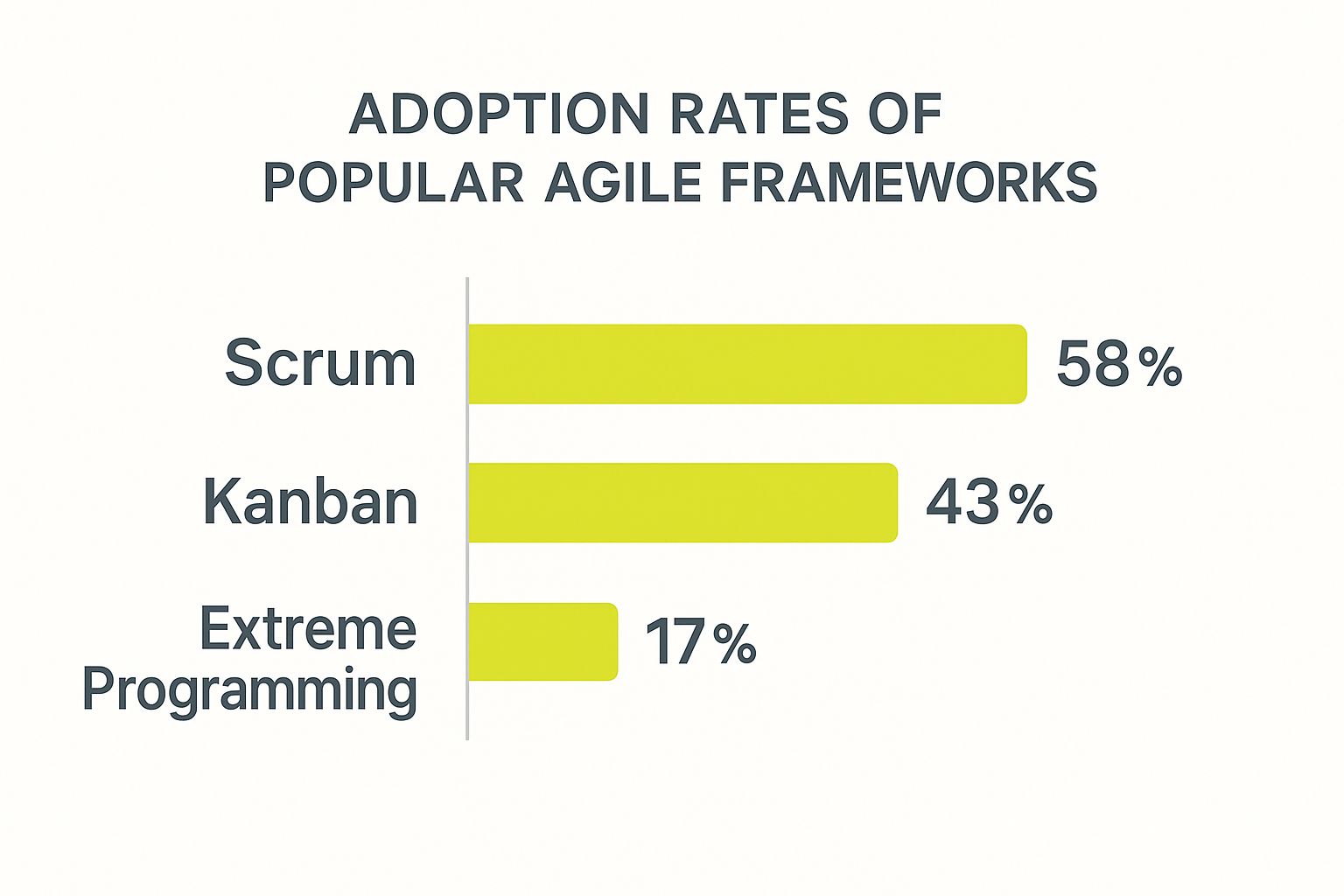
As you can see, for most teams, the big decision really comes down to these two. Let's dig into what makes each one tick so you can figure out which is the right fit for your team.
Scrum: A Structured Approach To Complex Problems
Scrum is easily the most popular Agile framework, and for good reason. It’s a highly structured system that excels at breaking down big, complex projects into small, manageable chunks of work.
Think of it like training for a marathon. You don't just run 26.2 miles on day one. You follow a strict plan of shorter, focused runs, building up your endurance over time. That's Scrum in a nutshell. It organizes all work into fixed-length cycles called sprints.
These 2-4 week sprints are the heartbeat of Scrum, forcing teams to deliver a working piece of the product on a regular, predictable schedule. This is a world away from the old-school waterfall method, where you might wait months or even years to see a finished product. In fact, studies show Agile teams can slash their cycle times by up to 50%, which means getting value to customers much faster.
Scrum keeps everyone on the same page with a clear set of roles and ceremonies:
- Roles: It defines specific jobs like the Product Owner (the voice of the customer), the Scrum Master (the coach who keeps the process on track), and the Development Team (the ones who do the building).
- Events: It runs on a rhythm of regular meetings, like Sprint Planning, Daily Scrums, Sprint Reviews, and Retrospectives, to ensure constant alignment and improvement.
- Artifacts: It uses simple tools like a Product Backlog and Sprint Backlog to keep all the work visible and prioritized.
Scrum's structure is its superpower. It creates a predictable pulse for the project, instills discipline, and guarantees that the team is consistently producing something tangible and valuable.
Kanban: A Visual System For Continuous Flow
If Scrum is a series of structured sprints, Kanban is more like a continuous river. It's a visual way to manage work as it moves through a process, with the main goal of keeping everything flowing smoothly and spotting any logjams.
Picture a busy coffee shop. Orders come in, get written on a cup, and move down the line—from the espresso machine to the milk frother to the final hand-off. The manager isn’t running a "two-week drink sprint"; they're focused on making sure every single order moves through the system as efficiently as possible. That’s the core idea of Kanban.
Kanban is built on a few simple but powerful principles:
- Visualize the Workflow: All tasks are laid out on a Kanban board, usually with columns like "To Do," "In Progress," and "Done." This makes the entire process transparent to everyone.
- Limit Work in Progress (WIP): This is the secret sauce. By putting a cap on how many tasks can be in any single column, teams are forced to finish what they start before pulling in new work. It prevents burnout and keeps things moving.
- Focus on Flow: The team constantly looks at how long it takes for a task to get from start to finish (its cycle time) and works to make that process faster and more predictable.
This highly visual and adaptable system is a key part of modern web development project management, particularly for teams that juggle a constant stream of incoming requests.
Scrum vs Kanban: Key Differences
So, how do you choose? It’s not about which one is "better" but which one is better for your situation. The table below breaks down the fundamental differences between these two Agile powerhouses.
| Feature | Scrum | Kanban |
|---|---|---|
| Cadence | Time-boxed sprints (e.g., 2 weeks) | Continuous flow |
| Roles | Prescribed roles (Product Owner, Scrum Master) | No prescribed roles |
| Meetings | Formal ceremonies (Sprint Planning, Daily Scrum) | Flexible; meetings as needed |
| Changes | Changes are typically not made mid-sprint | Changes can be made at any time |
| Best For | Complex product development with clear goals | Ongoing support, maintenance, or service tasks |
Ultimately, the choice depends on the nature of your work. Scrum excels when you're building something new from the ground up and need to deliver major features in predictable chunks. On the other hand, Kanban shines when you’re managing an ongoing stream of tasks like bug fixes, support tickets, or content updates, where priorities can and do change on a dime.
The Real-World Benefits of Going Agile
So, why do companies actually make the switch to Agile? It’s not just about adopting the latest buzzword. The move from theory to practice is where you see the real magic happen, with concrete results that impact everything from your bottom line to your team’s happiness. Adopting Agile is a strategic choice with very real rewards.
Right away, one of the biggest wins is a huge jump in product quality. Instead of finding massive, project-killing bugs at the very end, teams catch them early. By working in short cycles, issues get spotted when they're still small and easy to fix, preventing them from snowballing into disasters later on.
Delivering Value Faster and More Reliably
One of the most compelling reasons to go Agile is the drastically improved time-to-market. The old way meant waiting months or even years for one big, dramatic launch. Agile flips that on its head by delivering a steady stream of valuable features. Each sprint ends with a working piece of the product, which means you can start seeing a return on your investment almost immediately.
But this speed doesn't mean you're sacrificing stability. In fact, Agile is fantastic at reducing project risk.
- Financial Safety: You're building and testing in small increments, so you avoid sinking a massive budget into an idea that might not even work.
- Customer Alignment: With constant feedback, you're building what the customer actually wants, not just what was written down in a requirements document six months ago.
- Adaptability: The market changed? Customer needs shifted? No problem. An Agile project can pivot on a dime without having to scrap everything and start over.
This flexible approach just makes for a smarter, more resilient way to build things.
At its heart, the promise of Agile is simple: reduce the risk of building the wrong thing. By keeping the customer in the loop and delivering value piece by piece, you ensure every dollar you spend goes toward creating a product people will actually love and use.
Boosting Team Morale and Customer Satisfaction
Beyond the code and the cash flow, Agile has a surprisingly human impact. When you empower a team to manage their own work and give them a real sense of ownership, their morale and engagement go through the roof. And as we all know, a happy, motivated team is a productive team.
Ultimately, it all comes back to the customer. By making them a part of the process, you’re not just managing their expectations—you’re building the solution with them. This creates a powerful sense of partnership and trust, leading to much higher customer satisfaction. When your customers feel heard, they don’t just buy your product; they become its biggest fans.
Answering Your Questions About Agile
It's one thing to read about Agile values and frameworks, but another thing entirely to see how it works in the real world. A lot of practical questions tend to pop up, so let's tackle some of the most common ones.
Think of this as the "no silly questions" zone. My goal is to clear up any confusion and help you feel confident about what Agile actually means for you and your team.
Can You Use Agile for Things Other Than Software?
Absolutely. While Agile’s roots are firmly in the software world, its core ideas—making incremental progress, listening to feedback, and staying flexible—are incredibly useful for just about any complex project.
We're seeing Agile principles pop up in all sorts of fields:
- Marketing: Teams often run short campaigns (think of them as sprints) to test different ads or messages. They use the data they get back to quickly figure out what works and what doesn't.
- Product Design: Instead of spending months on a "perfect" design, teams will build and test prototypes in short cycles. This lets them get real user feedback early and often, making the final product much better.
- Construction: Even in a field as linear as construction, the planning and design phases can be very Agile. It allows for better collaboration with clients and makes it easier to adapt to changes before the concrete gets poured.
The real trick is to stay focused on delivering value in small, manageable chunks and being ready to pivot when you need to.
Is Agile Just Another Name for Scrum?
This is probably the most common mix-up I see. It's a great question, and the distinction is actually pretty simple.
Think of it this way: Agile is the mindset, while Scrum is a specific recipe for following that mindset.
Agile is the "why." It's the philosophy built on values like collaboration, flexibility, and responding to change. Scrum is the "how." It's a structured framework with specific roles (like a Scrum Master), events (like daily stand-ups and sprints), and artifacts (like a product backlog) to actually get the work done.
It’s a bit like deciding to get fit. "Being healthy" is your overall philosophy (Agile). A specific workout routine like CrossFit or P90X is the framework you use to achieve that goal (Scrum). Scrum is definitely a form of Agile, but Agile is a much bigger concept that also includes other frameworks, like Kanban.
How Long Does It Take for a Team to Really "Get" Agile?
There’s no simple answer here—it really depends on your team's size, your current company culture, and how complex your projects are. But generally, the transition happens in phases.
Most teams can get the basics down—like holding daily stand-ups and running their first sprint—within a few weeks. But to really master it and develop a true Agile mindset? That usually takes a good three to six months of consistent practice.
The most important part isn't getting it perfect overnight. It's about committing to getting a little better all the time. That's what retrospectives are for—they give your team a chance to reflect on what’s working and what isn’t, so you can keep improving your process together.
Ready to see what a truly agile development process can do for your Shopify store? The experts at E-commerce Dev Group build high-performance e-commerce sites using flexible, collaborative methods that deliver real results, faster. Contact us today to scale your Shopify project.
