


In the hyper-competitive world of e-commerce, a single bug in the checkout process or a slow-loading product page can mean the difference between a sale and a lost customer. For Shopify and other e-commerce platforms, quality is not just a feature; it is the foundation of trust, customer satisfaction, and revenue.
While most development teams test their code, implementing a structured approach with proven quality assurance best practices elevates your store from merely functional to exceptionally reliable and performant. Adopting these methods helps you prevent defects before they happen, streamline development, and protect your brand’s reputation.
This guide moves beyond generic advice to provide a clear roadmap. You will learn nine actionable strategies that top e-commerce teams use to build robust and successful online stores. We will cover specific, practical steps for implementing concepts like Shift-Left Testing, the Test Automation Pyramid, and Risk-Based Testing. These are the same principles elite teams use to refine their development lifecycle, mitigate risks, and consistently deliver a superior customer experience that drives growth. Get ready to explore how to integrate these powerful practices into your own workflow.
1. Shift-Left Testing
Shift-left testing is a proactive approach where quality assurance activities are moved earlier in the development lifecycle. Instead of waiting until the end to find bugs, teams integrate testing from the very beginning, starting with the requirements and design phases. This philosophy emphasizes preventing defects rather than just finding them later.

For a Shopify store, this means developers write unit tests for a new custom feature, or a QA engineer reviews the technical brief for a new checkout extension before a single line of code is written. The core idea is simple: the earlier you catch an issue, the cheaper and easier it is to fix.
Why It's a Top QA Practice
Adopting shift-left testing is one of the most impactful quality assurance best practices because it fundamentally changes how teams view responsibility for quality. It transforms QA from a final gatekeeper into a collaborative partner throughout the development process. This leads to faster feedback loops, reduced costs, and higher-quality releases. Tech giants like Google and Amazon have famously built their continuous deployment pipelines on the back of extensive, early-stage automated testing.
How to Implement Shift-Left Testing
Getting started with shift-left testing is an incremental process. Here are some actionable steps for your e-commerce team:
- Empower Developers: Train developers to write their own unit and integration tests. Provide them with the right tools and embed testing into their daily workflow.
- Automate Early Checks: Implement static code analysis tools that automatically scan code for potential bugs, style issues, and security vulnerabilities with every commit.
- Involve QA in Planning: Have QA professionals participate in requirements gathering and design review meetings. They can identify potential issues, ambiguities, and edge cases that developers might miss.
- Use Feature Flags: Test new features with a small segment of live traffic using feature flags. This allows you to gather real-world data safely before a full rollout.
2. Risk-Based Testing
Risk-based testing is a strategic approach that prioritizes testing efforts based on the likelihood and potential impact of failures. Instead of trying to test everything equally, teams identify and analyze risks associated with different features or user scenarios, then allocate testing resources to the areas that matter most. It’s about being smart with your time and focusing on what could cause the most damage if it breaks.

For an e-commerce platform, this means dedicating the most rigorous testing to the checkout process, payment gateway integrations, and inventory management systems. A minor visual glitch on a blog page is a low risk, but a bug that prevents customers from completing a purchase is a critical business risk that needs immediate and thorough attention.
Why It's a Top QA Practice
Adopting risk-based testing is one of the most effective quality assurance best practices because it directly aligns testing with business objectives. Pioneered by thought leaders like Dorothy Graham, this methodology ensures that limited resources are spent protecting the most valuable functions. It provides a logical, defensible framework for deciding what to test, how much to test, and in what order, maximizing return on investment and minimizing business exposure.
How to Implement Risk-Based Testing
Integrating risk-based testing helps your team focus its energy where it counts. Here are some practical steps to get started:
- Involve Business Stakeholders: Collaborate with product owners, marketing, and customer support to identify what features are most critical to revenue and user satisfaction. Their input is vital for accurate risk assessment.
- Create a Risk Matrix: Analyze features based on two factors: the probability of a failure occurring and the business impact if it does. Use this to create a "risk heatmap" that visually prioritizes testing efforts.
- Use Historical Data: Analyze past bug reports, support tickets, and performance metrics. This data can reveal which parts of your Shopify store are historically prone to issues.
- Document and Revisit: Keep a record of your risk assessments and the testing decisions made. As the product evolves, regularly update this risk analysis to reflect new features and changing priorities.
3. Test Automation Pyramid
The test automation pyramid is a strategic framework, popularized by experts like Mike Cohn and Martin Fowler, that guides teams on how to balance their automated tests. It advocates for a large foundation of fast, low-level unit tests, a smaller middle layer of integration tests, and a very small top layer of slow, end-to-end (E2E) UI tests. This structure ensures you get fast feedback and keep test maintenance manageable.
In an e-commerce context, this means your team would write many unit tests for individual functions, like a price calculation utility. Fewer integration tests would verify that the shopping cart service correctly communicates with the inventory service. Finally, only a handful of E2E tests would simulate a full user journey from adding a product to the cart to completing a checkout.
The following infographic illustrates the ideal distribution of tests within this framework.
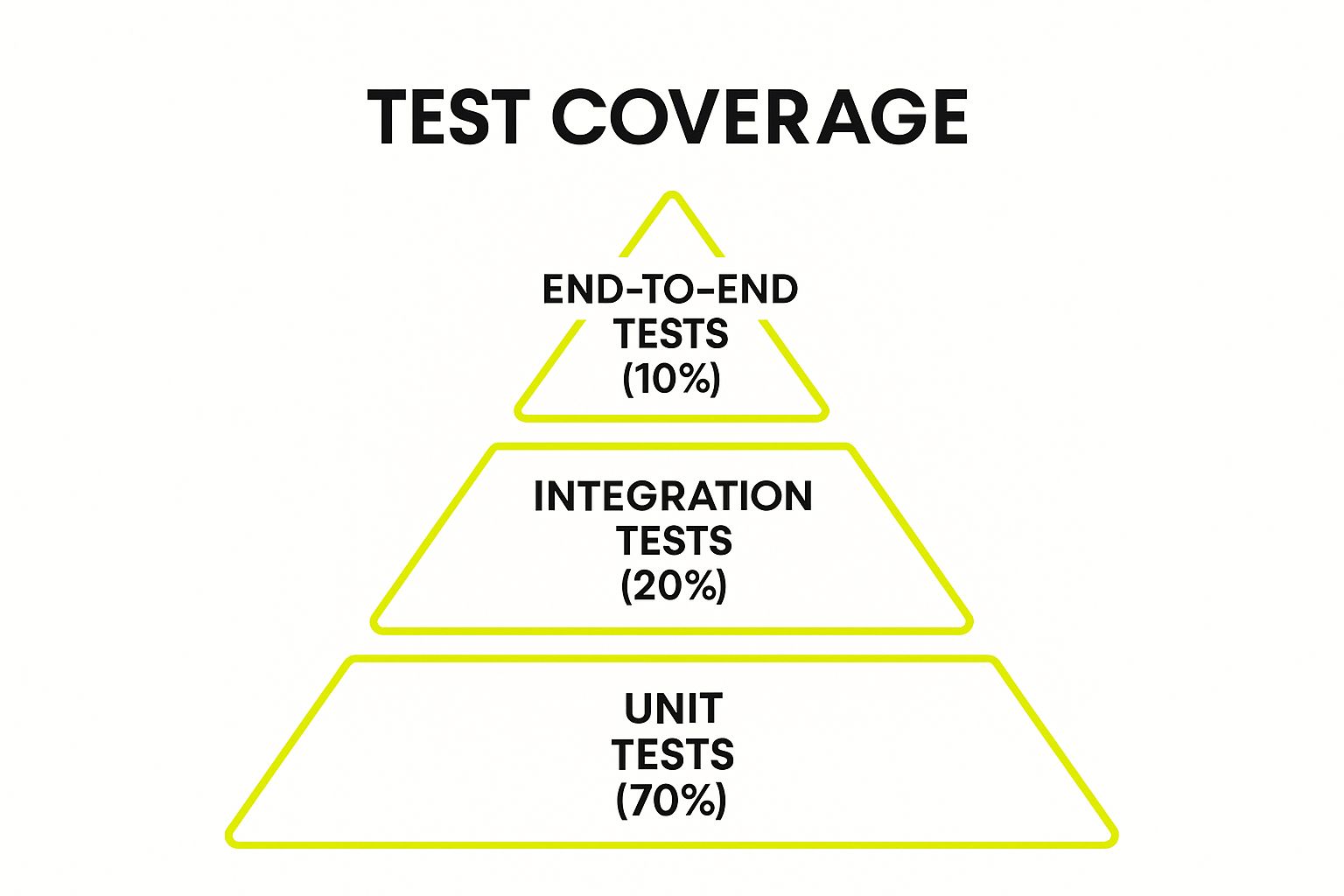
This hierarchical model emphasizes building a stable testing foundation with unit tests, which are faster and more reliable, while minimizing dependency on slower, more brittle E2E tests.
Why It's a Top QA Practice
Adhering to the test automation pyramid is one of the most effective quality assurance best practices because it directly combats slow, flaky, and expensive test suites. An inverted pyramid, heavy with E2E tests, leads to long feedback cycles and high maintenance costs. By building a strong base of unit tests, teams can catch most bugs quickly and cheaply. This approach, used by tech leaders like Google and Atlassian, creates a scalable and efficient testing strategy that supports rapid development and deployment.
How to Implement the Test Automation Pyramid
Balancing your test suite is a gradual but critical process. Here are some actionable steps for your team:
- Follow the 70/20/10 Guideline: Aim for a test distribution of roughly 70% unit tests, 20% integration tests, and 10% E2E tests. This ratio provides a healthy balance between coverage and speed.
- Prioritize Unit Tests: Empower developers to own unit testing. Ensure they write tests for all new logic, covering both happy paths and edge cases, before merging their code.
- Use Service Virtualization: For integration tests, use tools to simulate dependencies like third-party payment gateways or shipping APIs. This isolates the component under test and makes tests faster and more reliable.
- Be Selective with E2E Tests: Reserve end-to-end tests for critical user journeys only, such as the full purchase flow or user registration. Don't try to cover every possible scenario at this level.
4. Continuous Integration/Continuous Testing
Continuous Integration/Continuous Testing (CI/CT) is a DevOps practice where developers frequently merge their code changes into a central repository. After each merge, an automated build and a suite of tests are run. This process ensures that new code integrates correctly with the existing codebase and doesn't introduce regressions, keeping the application in a constantly testable and deployable state.
For a Shopify Plus merchant, a CI/CT pipeline might automatically run a series of tests every time a developer commits a change to a custom theme. This could include checking for broken links, verifying JavaScript functionality, and ensuring mobile responsiveness, all before the change ever reaches a staging environment. This practice catches integration bugs immediately, when they are simplest to resolve.
Why It's a Top QA Practice
CI/CT is one of the most vital quality assurance best practices because it acts as a safety net for development, enabling teams to move faster with confidence. It automates the repetitive and error-prone task of manual integration testing, providing rapid feedback on every change. This speed and reliability are cornerstones of how companies like Netflix and Etsy deploy updates dozens or even hundreds of times per day without disrupting the user experience.
How to Implement Continuous Integration/Continuous Testing
Integrating a CI/CT pipeline can be done incrementally. Here are some actionable steps for your team:
- Start with a Simple Pipeline: Begin by automating the build process and running a small set of critical unit tests. You can use tools like GitHub Actions, Jenkins, or CircleCI to get started.
- Implement Fast-Failing Tests First: Structure your pipeline so that the quickest tests (e.g., static analysis, unit tests) run first. This provides the fastest possible feedback if a simple error is detected.
- Use Parallel Execution: As your test suite grows, configure your pipeline to run tests in parallel. This dramatically reduces the overall time it takes to get feedback, keeping your development velocity high.
- Monitor and Optimize: Regularly review your pipeline's performance. Identify bottlenecks or flaky tests and continuously refine them to ensure the process remains fast and reliable.
5. Defect Prevention
Defect prevention is a systematic quality philosophy focused on eliminating the root causes of bugs before they are ever introduced into the codebase. Instead of just finding and fixing issues, this approach analyzes past failures to improve development processes, team skills, and overall project workflows, making it fundamentally harder for defects to occur in the first place.

For an e-commerce brand, this could mean analyzing why a recent promotional code feature was so buggy and then creating a standardized development checklist for all future discount-related work. Inspired by pioneers like W. Edwards Deming, the goal is to build quality into the process, not inspect it in at the end.
Why It's a Top QA Practice
Adopting defect prevention is one of the most mature quality assurance best practices because it moves beyond reactive bug hunting to a proactive state of continuous improvement. It forces a team to ask "Why did this happen?" instead of just "How do we fix it?" This leads to a compounding effect on quality, where each project cycle makes the next one stronger, more predictable, and more efficient. Companies like Toyota built their manufacturing empires on this very principle.
How to Implement Defect Prevention
Implementing defect prevention involves creating tight feedback loops between development, QA, and project management. Here are a few ways to get started:
- Conduct Root Cause Analysis (RCA): For every significant bug found, hold a brief, blame-free meeting to identify its true origin. Was it a vague requirement, a gap in technical knowledge, or a flawed process?
- Implement Peer Reviews: Formalize code reviews and design document reviews. A second set of eyes is one of the most effective, low-cost ways to prevent simple mistakes from becoming production issues.
- Use Standardized Checklists: Create and maintain checklists for common, repetitive tasks like launching a new landing page or setting up a new app integration. For more comprehensive guidance, you can learn more about building a website quality assurance checklist.
- Track and Analyze Defect Data: Monitor metrics like defect density (bugs per feature) and defect origin (which phase they were introduced in). Use this data to pinpoint weak spots in your development lifecycle.
6. Test-Driven Development (TDD)
Test-Driven Development (TDD) is a development methodology that inverts the traditional coding process. Instead of writing code and then testing it, TDD requires developers to write a failing automated test before writing the production code to satisfy that test. The process follows a simple, repetitive cycle known as Red-Green-Refactor.
First, you write a test for a new function and watch it fail (Red). Next, you write the absolute minimum amount of code required to make that test pass (Green). Finally, you clean up and improve the code you just wrote without changing its behavior (Refactor). For a Shopify theme developer, this could mean writing a failing test for a new image lazy-loading function, then writing the simplest possible JavaScript to pass it, and finally refining the code for performance.
Why It's a Top QA Practice
TDD is one of the most powerful quality assurance best practices because it builds quality directly into the codebase from the ground up. This discipline forces developers to think critically about requirements before coding, resulting in a comprehensive suite of regression tests as a natural byproduct. Organizations like Pivotal Labs and thoughtbot have built their reputations on using TDD to deliver highly reliable and maintainable software, ensuring every piece of code is validated by a corresponding test.
How to Implement Test-Driven Development
Adopting TDD requires discipline, but your team can start with small, focused efforts. Here are some practical steps:
- Start Small: Begin with a simple, non-critical feature. Focus on mastering the Red-Green-Refactor cycle on a small scale before applying it to complex logic.
- Pair Program: Have two developers work together at one workstation. This is an effective way to learn the TDD discipline, as one developer can focus on writing a test while the other thinks about the implementation.
- Write Descriptive Tests: Name your tests clearly to describe the intended behavior. A good test name acts as living documentation for what the code is supposed to do.
- Stick to the Cycle: The magic of TDD is in the discipline. Resist the temptation to write production code before a failing test or to skip the refactoring step.
7. Performance Testing Integration
Performance testing integration is the practice of embedding performance validation directly into the development lifecycle, rather than saving it for a final, pre-launch phase. It involves defining performance metrics from the start and continuously testing against them. This ensures that an application remains fast, scalable, and reliable under various load conditions.
For a Shopify Plus store, this means running automated load tests on a new feature within a CI/CD pipeline every time code is merged. This proactive approach prevents a situation where a new app launch or a flash sale grinds the entire site to a halt, protecting revenue and brand reputation.
Why It's a Top QA Practice
Integrating performance testing is one of the most critical quality assurance best practices because slow performance directly translates to lost sales and poor user experience. E-commerce success hinges on speed. By making performance a shared, continuous responsibility, teams can proactively identify and fix bottlenecks before they impact customers. Shopify's own massive-scale preparations for Black Friday are a testament to the power of continuous, integrated performance testing.
How to Implement Performance Testing Integration
Making performance testing a continuous habit requires a shift in tools and mindset. Here are actionable steps to get started:
- Define Performance Criteria Early: Work with stakeholders to establish clear, measurable acceptance criteria for performance. For example, specify that "all product pages must load in under 2 seconds with 500 concurrent users."
- Automate in Your Pipeline: Integrate performance testing tools like k6, JMeter, or Gatling into your CI/CD pipeline. Configure them to run automatically on every build or deployment to a staging environment.
- Monitor Key Metrics: Use Application Performance Monitoring (APM) tools to continuously track key indicators like response time, server CPU usage, and database query performance in both testing and production environments.
- Test with Production-Like Data: Ensure your performance tests use a realistic amount of data. Testing a new product filter with 10 products is not the same as testing it with 10,000, so mimic your live catalog's scale.
8. Exploratory Testing
Exploratory testing is an unscripted, dynamic approach where test design and execution happen simultaneously. Instead of following a rigid set of test cases, QA professionals use their creativity, intuition, and experience to actively explore the application. This method emphasizes learning, investigation, and discovery to uncover defects that automated or scripted tests might miss.
For an e-commerce site, this could involve a tester trying to break a new "bundle and save" feature by adding and removing items in an unusual order, applying multiple discount codes, and then proceeding to checkout on an older mobile browser. This human-led approach is excellent for finding complex, user-centric bugs.
Why It's a Top QA Practice
While automation is crucial, it can only find what it's told to look for. Exploratory testing is one of the essential quality assurance best practices because it covers the gaps left by automation. It leverages human intelligence to find edge cases, usability problems, and workflow defects that automated scripts would overlook. Pioneers like James Bach and Cem Kaner championed this method, which is now widely used by companies like Microsoft and Google to test complex products like Windows and Chrome.
How to Implement Exploratory Testing
Integrating exploratory testing doesn't have to be chaotic. You can add structure and maximize its value with these steps:
- Use Session-Based Management: Structure your exploratory sessions with a clear charter or mission. For example, a 90-minute session could focus solely on testing the customer account creation and login process across different devices.
- Document on the Fly: Encourage testers to immediately document their thought processes, test ideas, and any bugs they find using simple tools or notes. This creates valuable assets for future testing.
- Combine with Automation: Use exploratory testing to find new areas of risk that can then be covered by new automated regression tests. This creates a powerful feedback loop between human insight and machine efficiency.
- Focus on User Workflows: Center your sessions around critical user journeys, such as searching for a product, adding it to the cart, and completing a purchase. This aligns testing with real-world customer behavior. Learn more about usability testing techniques on scaleshopify.com.
9. Quality Metrics and KPI Tracking
Quality metrics and Key Performance Indicator (KPI) tracking involves systematically measuring and analyzing key indicators of software quality. This data-driven approach moves quality assurance beyond subjective feelings into the realm of objective evidence. It helps teams make informed decisions, identify trends, and demonstrate the value of QA efforts to stakeholders.
For a Shopify store, this could mean tracking the number of critical bugs reported by customers after a new theme deployment or measuring the average time it takes to resolve a high-priority issue in your custom app. It's about answering the question, "Is our quality getting better?" with hard data, not just intuition.
Why It's a Top QA Practice
Using metrics is one of the most essential quality assurance best practices because what gets measured gets improved. It provides clear visibility into the health of your development process and the stability of your e-commerce platform. Companies like Google, with their DORA metrics, and Microsoft have proven that tracking performance indicators is crucial for achieving high-performing, reliable systems. This practice helps justify investments in QA by connecting testing activities directly to business outcomes like improved customer satisfaction and reduced operational costs.
How to Implement Quality Metrics and KPI Tracking
Introducing metrics should be a gradual process focused on driving positive change, not just creating reports. Here are some actionable steps:
- Focus on Actionable Metrics: Track metrics that lead to action. Examples include Defect Escape Rate (bugs found by users), Mean Time to Resolution (MTTR), and test automation coverage.
- Balance Leading and Lagging Indicators: Use leading indicators like code complexity to predict future issues, and lagging indicators like customer-reported defects to measure past performance.
- Align with Business Goals: Ensure your QA metrics connect to broader business objectives. To effectively measure and report on the success of your QA initiatives, understanding a complete guide to SaaS KPIs can provide a valuable framework.
- Automate Data Collection: Use tools within your CI/CD pipeline (like Jenkins, GitHub Actions) and project management software (like Jira) to automatically gather and display metrics on a dashboard, saving time and ensuring accuracy. For more information on what to track, check out our guide to e-commerce performance metrics.
Quality Assurance Best Practices Comparison
| Aspect | Shift-Left Testing | Risk-Based Testing | Test Automation Pyramid | Continuous Integration/Continuous Testing | Defect Prevention | Test-Driven Development (TDD) | Performance Testing Integration | Exploratory Testing | Quality Metrics and KPI Tracking |
|---|---|---|---|---|---|---|---|---|---|
| Implementation Complexity 🔄 | Medium-high: requires cultural shift, tooling setup | Medium: upfront risk analysis, frameworks needed | Medium: requires discipline, layering tests properly | High: complex pipelines, infrastructure needed | High: needs process changes, training | Medium-high: mindset shift, testing discipline | High: specialized tools, complex environments | Low-medium: depends on tester skill and practice | Medium-high: significant setup, data management |
| Resource Requirements ⚡ | Moderate: developer time, test tools | Moderate: business & QA collaboration | Moderate: automated test frameworks | High: infrastructure, automated test suites | Moderate-high: training, process controls | Moderate: developer time, test maintenance | High: performance tools, environments | Low: skilled testers, exploratory tools | Moderate: analytics tools, dashboards |
| Expected Outcomes 📊 | Early defect detection, improved quality | Optimized testing with risk focus | Fast feedback, balanced coverage | Rapid integration issue detection | Reduced defects, better long-term quality | High test coverage, better code design | Proactive performance issue prevention | Discovery of unknown defects | Data-driven quality insight and improvement |
| Ideal Use Cases 💡 | Agile/DevOps teams emphasizing early testing | Projects with critical business risks | Teams aiming for balanced automated tests | Continuous delivery, frequent code commits | Organizations seeking long-term quality gains | Development teams focused on quality and design | Apps with strict performance requirements | Exploratory or usability-focused testing | Teams focused on quality measurement and reporting |
| Key Advantages ⭐ | Cost-effective defect fixing, faster feedback | Focus on critical areas, ROI improvement | Fast tests, cost-effective maintenance | Continuous validation, stable deployable builds | Tackles root causes, sustainable quality | Supports refactoring, living documentation | Improves user experience, scalability | Flexible, uncovers hidden issues | Objective quality tracking, stakeholder clarity |
Build Your Foundation of Quality
Navigating the complexities of e-commerce requires more than just a great product; it demands a flawless customer experience. The quality assurance best practices we've explored are not isolated tactics but interconnected pillars that support a robust and reliable Shopify store. From implementing shift-left testing to catch issues early, to using a risk-based approach to focus your efforts where they matter most, each practice contributes to a culture of quality.
Embracing these principles means moving from a reactive "bug-fixing" model to a proactive "defect-prevention" mindset. This shift is fundamental. Integrating performance testing, adopting a strategic Test Automation Pyramid, and empowering your team with exploratory testing transforms QA from a final gatekeeper into an integral part of your development lifecycle.
Your Action Plan for QA Excellence
Mastering these quality assurance best practices is a marathon, not a sprint. The key is to start small, build momentum, and iterate continuously.
- Start with an Audit: Begin by evaluating your current processes. Identify your biggest pain points. Are you constantly fighting fires post-launch? Is your test coverage a mystery? Your answer will point you to the right starting practice, whether it's tracking clear KPIs or implementing a CI/CT pipeline.
- Pick One or Two Practices: Don't try to boil the ocean. Choose one or two strategies that offer the most immediate value. For instance, if release cycles are slow and bug-ridden, focus on shift-left testing and Test-Driven Development (TDD) to build quality in from the start.
- Commit to Continuous Improvement: Quality is not a destination; it's an ongoing commitment. Regularly review your quality metrics and KPIs to understand what’s working and where you can improve. For deeper insights on how to refine your approach over time, you can explore various strategies for quality assurance process improvement.
By building this solid foundation of quality, you do more than just reduce bugs. You accelerate your time-to-market, enhance customer trust, and create a resilient platform that can scale with your ambitions. The ultimate reward is a seamless, frustration-free shopping experience that turns first-time visitors into loyal customers.
Ready to elevate your Shopify store with an expert-led QA strategy? The team at E-commerce Dev Group specializes in implementing these advanced quality assurance best practices to ensure your platform is fast, reliable, and secure. Contact E-commerce Dev Group today to build the flawless digital experience your customers deserve.
