

If you really want to boost your store's customer lifetime value, you need to stop thinking about one-time sales and start building long-term relationships. It’s all about prioritizing customer retention, making their experience feel personal, and giving them value long after that first purchase. Get this right, and you'll build a business that's more predictable, profitable, and built to last.
Why Customer Lifetime Value Matters More Than Sales

It’s easy to get caught up in the chase for new customers. That constant hunt for the next sale feels productive, but it’s a costly and often exhausting way to grow a business. The real key to sustainable success is found in maximizing the value of the customers you already have.
This is where Customer Lifetime Value (CLV) comes in. It’s the single most important metric you’re probably not tracking closely enough. Simply put, CLV is the total amount of money you can realistically expect to earn from a customer throughout their entire time with your brand.
Thinking in terms of CLV changes the whole game.
A Mindset Shift From Acquisition to Retention
Focusing on CLV forces a fundamental shift in perspective. Instead of throwing your entire budget at expensive ads to attract new faces, you start investing in the experience of your current customers. The question changes from, "How do we make this sale?" to, "How can we keep this person happy and coming back for years?"
This isn't just about warm fuzzies; it's a financial strategy with a massive impact on your bottom line.
- Better Marketing ROI: Once you know how much a customer is actually worth over their lifetime, you can make much smarter calls on what you're willing to spend to acquire them.
- Higher Profitability: It's a well-known fact that keeping a customer is far cheaper than finding a new one. On top of that, loyal customers tend to spend more over time and are more open to higher-margin products.
- A More Resilient Business: A store built on a foundation of repeat business is far more stable and can weather market storms much better than one that’s always scrambling for new leads.
Shifting your focus to CLV isn't just another marketing tactic; it's a core business strategy. It turns your store from a short-term sales machine into a long-term relationship-building engine that creates a more predictable and profitable future.
The Power of a Personalized Journey
One of the best ways to drive up CLV is by creating a truly personalized experience. When customers feel like you "get" them, their loyalty skyrockets. In fact, companies that nail personalization can generate up to 40% more revenue than their more generic competitors.
Every strategy we'll cover in this guide comes back to this central idea. If you want to dive even deeper into this topic, you can find a ton of proven strategies for improving customer lifetime value.
Ultimately, looking at your business through the lens of CLV gives you the clarity to build a brand that people not only buy from but truly love.
Establishing Your CLV Baseline
Before you can even think about growing your customer lifetime value, you need a clear picture of where you stand right now. This isn't about getting lost in complex spreadsheets; it's about setting a simple starting line so you can actually track your progress later.
Think of it like this: you can't get directions to your destination without first telling your GPS where you are. Calculating your baseline CLV is that first, essential pin-drop for your business growth. Thankfully, all the data you need is already waiting for you in your Shopify dashboard.
Finding Your Core Metrics in Shopify
Don't overcomplicate this. A perfect, to-the-penny CLV calculation isn't the goal here. A solid estimate is all you need to start making smarter decisions. We're just looking for three key numbers.
You can find them by popping into your Analytics > Reports section in Shopify.
- Average Order Value (AOV): This is simply how much a customer spends in a typical transaction. To get it, just divide your total sales by your total number of orders over a set period, like the last year.
- Purchase Frequency: How often does the average customer come back to buy from you? Find this by dividing the total number of orders by the total number of unique customers from that same timeframe.
- Customer Value: Now, just multiply your AOV by your Purchase Frequency. This gives you the average revenue you can expect from each customer over that period.
Once you have these numbers, you can start to see how even small improvements can have a huge impact on your bottom line.
The real power isn't in a single, perfect CLV number. It's in understanding the components—AOV and purchase frequency—and recognizing that improving either one will directly boost the lifetime value of every customer.
Before we move on, let's break down exactly what you'll be looking for in your Shopify account.
Key Metrics for Calculating CLV in Shopify
This table breaks down the essential metrics needed to estimate Customer Lifetime Value directly from your Shopify analytics and how each one contributes to the overall calculation.
| Metric | What It Measures | Where to Find It in Shopify | Why It Matters for CLV |
|---|---|---|---|
| Average Order Value (AOV) | The average amount spent per order. | Analytics > Reports. Divide Total Sales by Total Orders. | A higher AOV directly increases the value of each transaction. |
| Purchase Frequency | How often a customer buys from you in a given period. | Analytics > Reports. Divide Total Orders by Customers. | Higher frequency means more repeat business and a stickier customer base. |
| Customer Value | The average revenue generated per customer over a period. | Calculated: AOV x Purchase Frequency. | This is a snapshot of what an average customer is worth right now. |
| Customer Lifetime Span | The average time a customer remains active before they churn. | This is an estimate based on your order history. | The longer you keep a customer, the more they contribute to your CLV. |
Having these metrics handy gives you the raw materials to not only calculate your baseline but also identify which levers to pull to increase it.
Segmenting to Find Your VIPs
Let's be honest: not all customers are created equal. A small, dedicated group of your customers—your VIPs—are probably driving a massive chunk of your revenue. Figuring out who they are is one of the most powerful moves you can make.
Shopify’s customer reports are perfect for this. You can slice and dice your customer list to create specific segments. Try building a few of these:
- High Spenders: Customers who have spent over a certain amount (e.g., more than $500).
- Repeat Buyers: Customers who have made 3+ orders.
- Recent Shoppers: Anyone who bought something in the last 30 days.
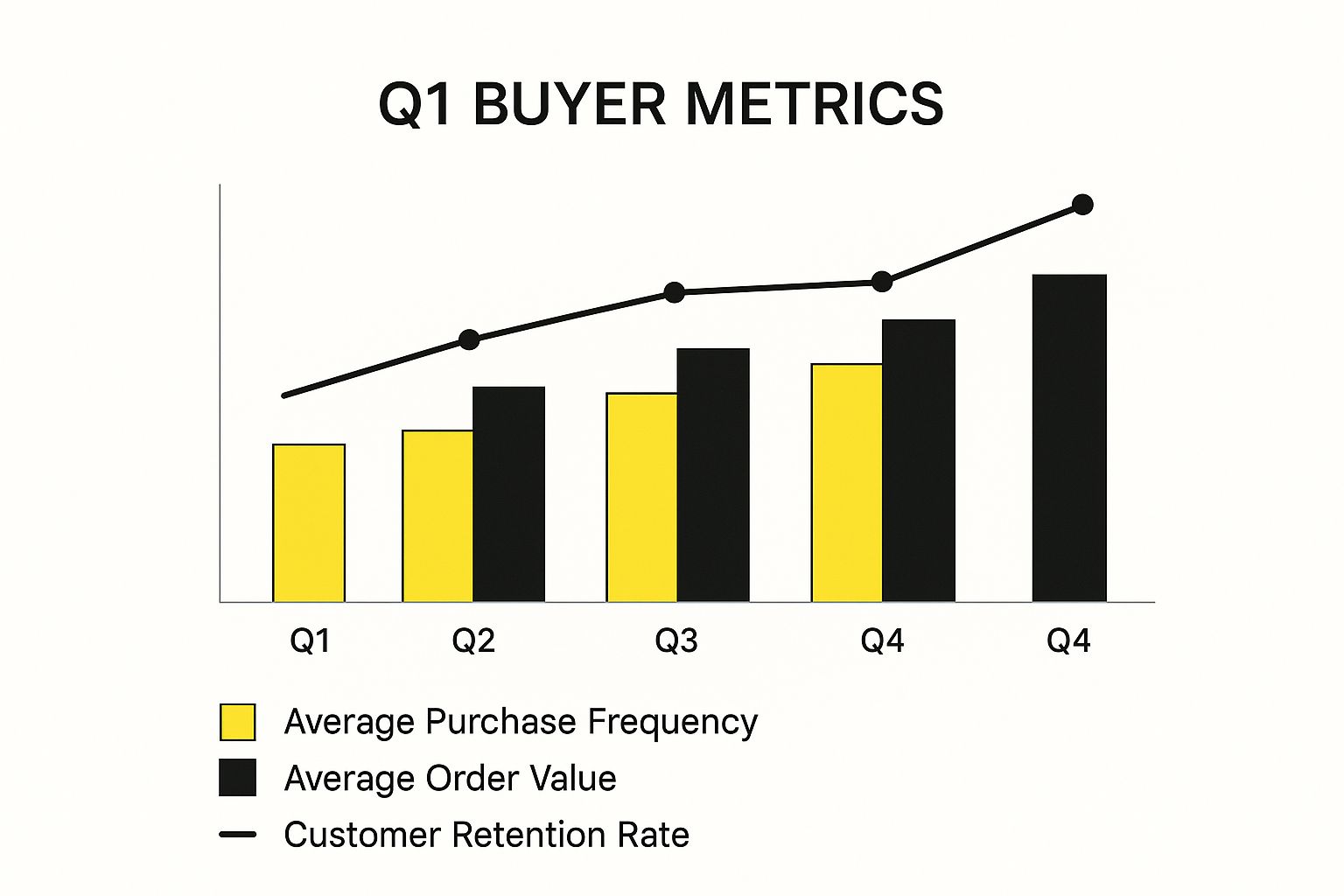
This chart gives you a great visual for how these different metrics can change over time. When you see your AOV or retention rate tick up, you know your strategies are working.
By digging into these segments, you stop guessing and start knowing who your best customers are. This insight is gold. It lets you fine-tune your marketing, shape your loyalty program, and deliver a customer experience that keeps your most valuable people coming back for more. This is the real first step to growing your CLV on purpose.
Building a Customer Experience That Breeds Loyalty
It costs a lot to get a new customer through the door, but keeping them is where the real money is made. This is the heart of increasing customer lifetime value. The moment someone clicks "buy" isn't the finish line; it's the start of what you hope will be a long, happy relationship.
Focusing on retention is all about creating an experience that makes people feel seen, appreciated, and genuinely valued. It's the small, intentional things you do that turn a first-time buyer into someone who raves about your brand. This isn't just about feeling good—it's a rock-solid financial strategy.
Your existing customers are your single biggest asset. Research from Adobe and Invesp has shown that repeat buyers spend, on average, a whopping 67% more than new ones. The proof is in the numbers: investing in their experience pays off, big time.
Crafting a Memorable Post-Purchase Journey
That window of time right after a purchase? It's your golden hour. The customer is excited, they're anticipating their order, and you have their full attention. This is your chance to make an impression that sticks. Don't just fire off a generic order confirmation and shipping update.
Instead, think about building a thoughtful email sequence that actually gives them something valuable. This is where you can stand out from the sea of forgettable online stores.
- A Truly Personal Thank-You: Ditch the robotic "Thanks for your order." Use their name. Mention what they bought. Something as simple as, "Hey Sarah, we know you're going to love the new messenger bag!" feels a world apart.
- Product Care & How-To's: Help them get the most from their new purchase. If they bought a special skincare product, send a quick guide on how to incorporate it into their routine. It shows you care about their experience long after you've made the sale.
- A Peek Behind the Curtain: Share a little story about how their product came to be or introduce them to the people on your team. You're not just a faceless brand; you're building a real human connection.
This kind of follow-up nurtures the relationship when their excitement is highest. It makes them feel like they're part of your world, not just another order number.
The post-purchase experience is your first, best chance to prove that you value the customer, not just their money. A thoughtful follow-up sequence transforms a simple transaction into the foundation of a loyal relationship.
Launching a Simple and Effective Loyalty Program
Loyalty programs don't have to be complicated to work. The goal is simple: reward people for coming back. Give them a real, tangible reason to choose you again. For most Shopify stores, a simple points-based system is the perfect place to start.
The trick is to make it dead simple to understand and genuinely rewarding to use.
A tiered system can work wonders here, offering better perks as customers become more loyal. For example:
- Bronze Tier (1-3 Purchases): Earn points, get early access to sales.
- Silver Tier (4-9 Purchases): All the Bronze perks, plus free shipping on every order.
- Gold Tier (10+ Purchases): Everything from Silver, plus a special annual gift and exclusive access to new products.
Apps like Smile.io or Yotpo plug right into Shopify and make setting this up a breeze. When you reward loyalty, you create a powerful cycle that keeps people coming back, which directly boosts retention and CLV. For a deeper dive, check out our guide on powerful ecommerce customer retention strategies.
Turning Problems into Loyalty-Building Moments
Good customer service is table stakes. But it's how you handle the screw-ups that can turn a frustrated customer into your biggest fan. A problem isn't a crisis; it's a golden opportunity to show you care.
Think about it: a customer gets a damaged item in the mail. The standard playbook involves asking for photos, waiting on approvals, and then processing a replacement. It's slow, and it puts the burden on the customer.
A retention-first approach looks totally different.
Scenario: A customer emails you because the ceramic mug they ordered arrived in pieces.
- The Old Way: "We're sorry. Please send photos of the damage and the shipping box so we can file a claim. We will process a replacement once approved."
- The Loyalty-Building Way: "Oh no, we are so sorry to hear that! We're shipping you a new one right now, no questions asked. We've also included a 15% off coupon for your next order to make up for the trouble."
See the difference? The second response instantly fixes the problem and goes above and beyond. You've turned a really negative moment into a surprisingly positive one, showing that you trust your customer and value their business more than the cost of one mug.
That one small act can create a customer who not only shops with you again but tells all their friends about the incredible service they received. That's how you build a brand people truly want to support.
Boosting Average Order Value with Smart Offers
Every extra dollar you can add to a customer's average order value (AOV) is pure profit that flows directly into their lifetime value. The trick isn't to be pushy; it's to be genuinely helpful. When you get this right, you’re not just making a bigger sale—you’re actually creating a better experience by anticipating what your customer needs next.
It all comes down to presenting the right offer at the perfect moment. By strategically using upsells, cross-sells, and bundles, you can guide customers toward a purchase that feels like a natural, helpful suggestion.
The Psychology of a Helpful Upsell
A great upsell never feels like a sales pitch. It should feel more like an expert recommendation from a trusted friend. You're simply showing the customer a better version of what they already want or something that makes their main purchase even better. It’s all about building trust and positioning your brand as a helpful guide.
Think of it this way: someone is buying a high-end camera from your store. Suggesting a premium lens isn’t just an upsell; you're giving them the tool to take better photos, which is their ultimate goal. Context is everything.
The most successful offers nail this by being:
- Relevant: The suggestion has to make perfect sense with what's already in their cart.
- Valuable: It needs to offer a clear benefit—better performance, more convenience, or a nice cost saving.
- Timely: You have to present it when the customer is deep in consideration, not too early and not too late.
This simple shift in mindset turns a transaction into a value-driven conversation.
Mastering the Art of Cross-Selling
Cross-selling is simply the art of suggesting complementary products. It’s the classic, "Would you like fries with that?" reimagined for ecommerce. Your job is to find logical product pairings that make the original item even better. If someone buys a new pair of leather boots, you can bet they’ll need some leather protector spray.
The secret is to make these suggestions feel completely organic. Ditch the generic "You might also like" section and frame it as a recommendation from people who truly know the product.
A great cross-sell is a problem solved before the customer even knew they had it. It anticipates their needs and offers a convenient solution, making their initial purchase more complete and satisfying.
For a Shopify store, this can be incredibly powerful. Imagine a customer adds a winter coat to their cart. You could automatically suggest matching gloves and a scarf. Not only does this bump up the order value, but you’ve also helped them build a complete outfit in one click.
To find these perfect pairings, just look at your own sales data. See which products are frequently bought together. That data is your treasure map for creating cross-sell offers that are almost guaranteed to work.
Creating Irresistible Product Bundles
Bundles are one of my favorite tools for increasing AOV because they package value and convenience into one easy "yes." When you group related items and offer them at a slight discount, you create an offer that’s just too good to pass up.
Here are a few bundling strategies I've seen work time and time again:
- The "Starter Kit" Bundle: Perfect for beginners. A coffee brand could bundle a bag of popular beans, a grinder, and filters.
- The "Complete the Look" Bundle: A must-have for fashion stores. Pair a best-selling dress with a recommended necklace and handbag.
- The "Bulk Savings" Bundle: Simple but effective. Offer a discount for buying multiples, like three pairs of your best-selling socks for a reduced price.
There are great Shopify apps out there like ReConvert or Frequently Bought Together that can automate this whole process, displaying bundles right on your product pages. The only rule is that the bundle has to offer real value. The customer needs to feel like they’re getting a smart deal, not just being pressured to buy more stuff.
Smart offers like these are absolutely critical for improving your store's performance. For more tips, check out our in-depth guide to increase your ecommerce conversion rate.
Timing Your Offers for Maximum Impact
The where and when of your offer are just as important as the what. You have three golden opportunities to upsell or cross-sell during the shopping journey.
- On the Product Page: This is your best shot for direct upsells ("Upgrade to the pro version") and bundles ("Frequently bought together"). The customer is actively focused on the product, so they're wide open to related suggestions.
- In the Cart: Once an item is in the cart, you know their intent to buy is high. This is the perfect spot for small, low-cost cross-sells. Think batteries for an electronic toy or a gift-wrapping option. It's an easy add-on.
- Post-Purchase: Don't assume the sale is over at checkout. A post-purchase upsell, usually on the thank-you page, can work wonders. The customer has already committed and their credit card is out. Offering a one-click add-on at a special price is a frictionless way to capture one last sale.
By placing these offers at the right touchpoints, you can seamlessly weave them into the shopping experience and watch your AOV—and customer lifetime value—climb.
Using Email and SMS to Nurture Relationships
Think of your email and SMS lists as your most valuable assets. Forget crowded social feeds and ever-rising ad costs for a moment. These are your direct lines to your customers—the people who have already raised their hands and shown interest in what you offer.
This is where you build real relationships that lead to repeat business. The whole idea is to stay top-of-mind by being genuinely helpful, not just another brand shouting into the void. Every message you send is a chance to make a customer feel seen, understood, and valued, gently guiding them back to your store when the time is right.
Must-Have Automated Campaigns for Any Store
Automation is a game-changer for building relationships at scale. By setting up a few key email and SMS flows, you can send the perfect message at the perfect time, triggered by what a customer actually does. These aren't just "set it and forget it" tasks; they're your 24/7 relationship-building engine.
If you don't have these running, you're leaving money on the table.
- The Welcome Series: This is your digital handshake. Someone just trusted you with their inbox—make a great first impression! A sequence of 3-5 emails is perfect for sharing your brand story, showing off your bestsellers, and maybe offering a little something to get them to that first purchase.
- The Abandoned Cart Flow: We all get distracted. A friendly, well-timed reminder can bring a shocking amount of that "lost" revenue back. It's a simple fact: abandoned cart emails have an average open rate of around 45%. That’s a huge opportunity.
- The Post-Purchase Follow-up: As we've covered, the moments after a sale are golden. This is your chance to send care instructions, ask for an honest review, or suggest a product that complements what they just bought. It keeps the conversation going and plants the seed for their next order.
For a deeper look at reclaiming lost sales, we've got a whole guide with proven techniques on how to reduce cart abandonment.
Winning Back Customers Who Have Gone Quiet
Sooner or later, some customers will drift away. It just happens. A win-back campaign is your plan to re-engage them before they're gone for good. But please, don't just send a desperate "We miss you!" email with a massive discount. That often just devalues your brand.
A smarter approach is a multi-step flow. First, identify customers who haven't bought from you in a while—say, 90 or 180 days.
- The Gentle Nudge: Start with a friendly check-in. Maybe show them what's new or simply ask for some feedback on their past experience. No hard sell.
- The Exclusive Offer: If that first message doesn't get a response, now you can bring out a compelling, time-sensitive offer. Frame it as a special gift just for them, a thank you for their past business.
- The Last Chance: A final, polite email letting them know you'll be removing them from your active mailing list can be surprisingly effective. It respects their inbox and helps keep your own list healthy.
A great win-back campaign isn't just about reclaiming a sale. It’s about showing a customer you noticed they were gone and that you still value them. That gesture alone can rebuild a connection.
The Power of Smart Segmentation
The era of blasting the same email to your entire list is over. To build genuine connections, your messages have to feel relevant. That’s where segmentation comes in. Using the customer data you already have in Shopify, you can group your audience into smaller, more focused lists.
This lets you send content that truly hits home because it’s based on their actual behavior and interests.
Examples of High-Impact Segments:
| Segment Name | Who They Are | How to Talk to Them |
|---|---|---|
| VIP Customers | Your ride-or-dies (e.g., 5+ orders or spent over $500). | Give them early access to new drops, exclusive offers, or a behind-the-scenes look. Make them feel like insiders. |
| One-Time Buyers | Customers who have bought just once and haven't returned. | Nurture them with a post-purchase flow designed to highlight your brand's value and encourage that second purchase. |
| Category Shoppers | People who always buy from one specific category (like "Skincare"). | Send them targeted news about new products, content, and deals specifically for that category. |
| Discount Shoppers | Those who have only ever bought something on sale. | Focus on your brand's value beyond price, or save your best deals just for them during major sale events. |
When you tailor your messaging this way, your emails and texts transform from generic ads into helpful, personal recommendations. That kind of relevance builds the trust and loyalty that will send your customer lifetime value soaring.
Your Top CLV Questions, Answered
As you start digging into customer lifetime value, you're bound to run into a few questions. It’s a metric with a lot of moving parts, but don't let that intimidate you. The core ideas are actually pretty simple. Let's break down some of the most common things Shopify merchants ask.
What’s a Good Customer Lifetime Value for My Shopify Store?
This is the big one, isn't it? But there's no magic number. A "good" CLV is completely relative to your industry, what you sell, and most importantly, your Customer Acquisition Cost (CAC).
Instead of getting hung up on a specific dollar amount, you should be laser-focused on the relationship between what a customer is worth and what you paid to get them.
A solid goal to shoot for is a CLV-to-CAC ratio of at least 3:1. In simple terms, if you spend $50 to bring in a new customer, you want them to be worth at least $150 over their lifetime. The real win isn't hitting some industry benchmark, but watching your own CLV climb steadily over time.
How Long Does It Take to Actually See CLV Go Up?
This is where you need to play the long game. While some tactics can give you a quick win, a major, sustainable increase in your store's CLV takes time and consistency.
- Quick Wins: You can definitely see an immediate jump in your Average Order Value (AOV). Smart upselling and cross-selling offers on your product pages or at checkout can boost that metric right away.
- The Real Growth: Lasting CLV growth comes from building real relationships. This means diving deep into retention strategies like loyalty programs, top-notch customer service, and building a genuine brand community. Because CLV is a measure of the entire customer journey, it can easily take several months to a year to see the full, powerful impact of these efforts.
Just stay consistent, trust the process, and keep your eye on leading indicators like your repeat purchase rate.
Think of CLV as a long-term investment, not a get-rich-quick scheme. Immediate AOV boosts are your early dividends, but the real wealth comes from compounding loyalty over months and years of consistent effort.
What Are the Best Shopify Apps for Increasing CLV?
The Shopify App Store is a goldmine for tools that can help boost CLV. The "best" one for you really boils down to what you want to tackle first. Here are a few of my go-to recommendations, broken down by goal:
- For Loyalty & Retention: You can't go wrong with apps like Smile.io or Yotpo. They make it incredibly easy to set up points-based loyalty programs, referral systems, and VIP tiers that give customers a real reason to stick around.
- For Upselling & Cross-Selling: Check out tools like ReConvert or Frequently Bought Together. They excel at adding post-purchase upsells and smart product recommendations that feel natural to the shopping experience.
- For Email & SMS Marketing: Klaviyo is an absolute powerhouse. It pulls in all your Shopify data, letting you build incredibly personal, automated campaigns that nurture relationships and drive repeat sales.
My advice? Pinpoint your biggest opportunity right now and then find the best-rated app for that specific job.
Can I Actually Improve CLV Without Constant Discounts?
Yes! And honestly, you should. Leaning on discounts too heavily just trains your customers to wait for a sale, which can cheapen your brand over time. A race to the bottom on price is a race you don't want to win.
Instead, focus on creating value that has nothing to do with price tags.
Provide an unforgettable customer experience from the moment they land on your site to the day their package arrives. Build a loyalty program with non-monetary perks, like early access to new collections or exclusive content. Send thoughtful, personalized product recommendations based on what they've bought before. Building a strong brand and delivering an amazing experience is a much more powerful (and profitable) path to a higher CLV.
Ready to transform your Shopify store into a high-performance sales machine? At E-commerce Dev Group, we specialize in designing and developing custom Shopify solutions that drive growth, boost conversions, and maximize customer lifetime value. Learn how our expert team can help you scale your business today.
