


In the competitive world of ecommerce, acquiring a new customer can be up to five times more expensive than retaining an existing one. While many merchants focus on attracting new traffic, the real key to sustainable growth lies in effective ecommerce customer retention. A strong retention strategy not only builds a loyal customer base but also increases customer lifetime value (LTV), creates predictable revenue, and turns satisfied shoppers into powerful brand advocates. This approach is fundamental for any brand looking to build a lasting presence and not just chase fleeting sales.
This article moves beyond generic advice to provide a practical, actionable guide for Shopify merchants. We will break down eight proven strategies, from loyalty programs and personalized email marketing to omnichannel experiences and targeted win-back campaigns. Each section offers specific implementation details and real-world examples to help you transform one-time buyers into lifelong fans. To dive deeper into the importance and various approaches, explore these eight powerful strategies to improve customer retention. By the end of this guide, you will have a clear roadmap to boost your retention rates, ensuring your business thrives for years to come.
1. Loyalty and Rewards Programs
A loyalty and rewards program is a powerful marketing strategy designed to encourage repeat business. It incentivizes customers to continue shopping with your brand by offering tangible benefits like points, discounts, or exclusive access based on their purchase history and engagement. This creates a compelling reason for them to return, directly boosting ecommerce customer retention.
Think of iconic examples like Sephora's Beauty Insider. This tiered program offers escalating rewards, from birthday gifts to exclusive products and events, making customers feel valued and encouraging them to spend more to reach the next level. Similarly, Starbucks Rewards uses a mobile-first approach with personalized offers that drive frequent, small purchases, turning a daily coffee run into a rewarding experience.
How to Implement a Successful Loyalty Program
To build a program that truly resonates with your customers and strengthens their loyalty, focus on a few key principles:
- Start Simple: Begin with a straightforward, point-based system. You can always add tiers, experiential rewards, and more complex features as you gather customer feedback and data.
- Ensure Attainable Rewards: Make sure the rewards are both desirable and achievable. If customers feel the goals are out of reach, they won't engage. The perceived value must be clear and compelling.
- Seamless Integration: Your program should be visible and accessible across all touchpoints, from your Shopify storefront and checkout process to email marketing and social media.
The following infographic highlights the typical investment and timeline for launching a loyalty program.
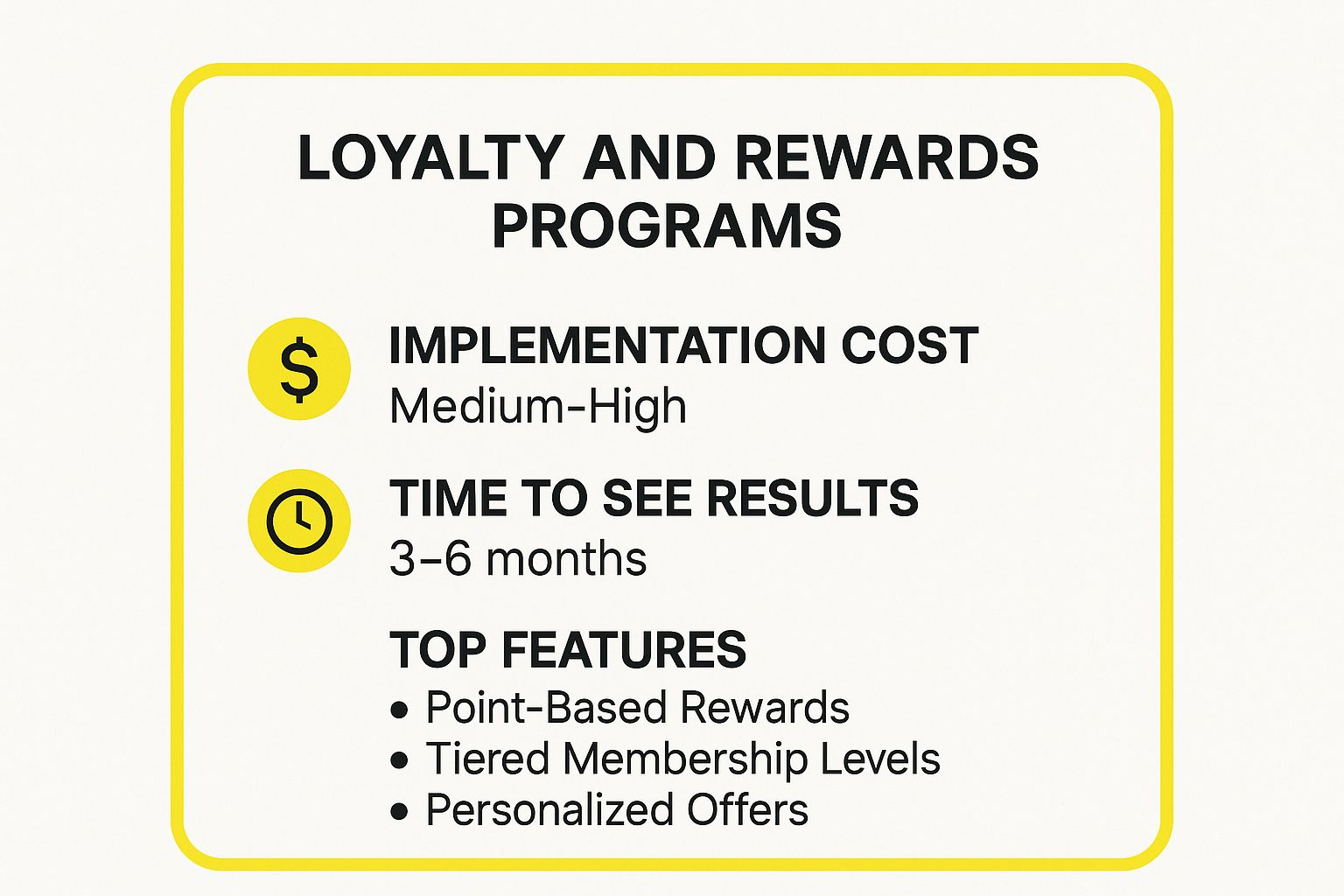
As the data shows, while a loyalty program requires a moderate investment and takes a few months to show results, its core features like point systems and tiered memberships are proven to drive engagement. These programs work because they tap into a fundamental human desire for recognition and reward, transforming transactional relationships into emotional connections.
2. Email Marketing and Automation
Email marketing and automation offer a systematic approach to ecommerce customer retention by nurturing relationships throughout the customer lifecycle. This strategy uses customer data to send personalized, timely messages, such as welcome series, abandoned cart reminders, and re-engagement campaigns. By delivering the right message at the right moment, you can keep your brand top-of-mind and encourage repeat purchases.
Consider how major brands leverage this. Spotify sends personalized playlist recommendations and concert alerts based on listening habits, keeping users engaged with the platform. Similarly, Casper mixes valuable sleep-tip content with product recommendations, building a relationship that goes beyond a simple transaction. These examples show how automated, relevant communication can transform one-time buyers into loyal advocates.
How to Implement a Successful Email Automation Strategy
To build an email strategy that enhances customer loyalty and drives sales, focus on delivering value and personalization at scale. A well-designed automation flow can work for you 24/7, strengthening customer bonds.
- Segment Your Audience: Group customers based on purchase history, browsing behavior, or engagement level. This allows you to send highly targeted messages that resonate far better than generic blasts.
- Focus on Value, Not Just Sales: Your emails should provide genuine value. Share useful content, exclusive tips, or community-focused stories. This builds trust and makes customers more receptive to promotional messages when you do send them. For a deeper dive, explore our guide on Shopify marketing automation.
- Optimize and Test Everything: Use data to determine the best times to send emails. Continuously A/B test subject lines, content, and calls-to-action to improve performance. Ensure every email is mobile-responsive, as a significant portion of your audience will read it on their phone.
Email automation is a cornerstone of modern ecommerce customer retention because it allows for personalized communication at a massive scale. By setting up triggers based on customer actions, you create a responsive and relevant experience that makes customers feel seen and valued. This proactive engagement is key to preventing customer churn and fostering long-term loyalty.
3. Exceptional Customer Service and Support
Exceptional customer service is a cornerstone of ecommerce customer retention, turning routine interactions into opportunities to build lasting loyalty. It involves a proactive approach to solving problems, exceeding expectations, and making customers feel genuinely valued. When a customer knows they can count on outstanding support, they are far more likely to forgive minor issues and continue shopping with your brand.

Think of Zappos, a company that built its empire on legendary service, offering 365-day returns and empowering agents to do whatever it takes to delight a customer. Similarly, Chewy earns fierce loyalty from pet owners through highly personalized support, including sending handwritten notes and even flowers when a customer's pet passes away. These actions transform a transactional relationship into a deeply personal one, making it difficult for competitors to lure those customers away.
How to Implement Exceptional Customer Service
Building a support system that fosters loyalty requires a dedicated, customer-first mindset. Here are a few key strategies to get started:
- Empower Your Team: Train your support staff thoroughly and then trust them. Give them the autonomy to solve problems on the spot, whether it's issuing a refund, offering a discount, or sending a replacement, without needing multiple levels of approval.
- Implement Feedback Loops: Actively seek out customer feedback through surveys, reviews, and direct conversations. More importantly, analyze this data and use the insights to make tangible improvements to your products, policies, and support processes.
- Leverage Technology Wisely: Use tools like chatbots and knowledge bases to provide instant answers to common questions, freeing up your human agents to handle more complex issues. For Shopify merchants, implementing one of the best live chat apps for Shopify can significantly enhance real-time support.
Exceptional service is more than just solving problems; it's about creating positive, memorable experiences. When a customer feels heard, respected, and cared for, they are not just a one-time buyer but a future advocate for your brand. This focus on the human element is a powerful, sustainable driver for ecommerce customer retention.
4. Personalization and Customization
Personalization is a data-driven retention strategy that tailors the shopping experience, product recommendations, and communications to individual customer preferences and behaviors. By leveraging purchase history and browsing data, you can make customers feel uniquely seen and valued. This approach enhances relevance at every touchpoint, directly strengthening ecommerce customer retention by creating a journey that feels like it was built just for them.
Consider the masters of this craft, like Amazon, whose recommendation engine ("Customers who bought this also bought") is a cornerstone of its success. Netflix takes this further, with personalized content suggestions that drive the vast majority of user viewing hours. Similarly, Spotify's "Discover Weekly" playlists create a powerful sense of individual connection, making users eager to return each week for their unique mix.
How to Implement Personalization Effectively
To create a personalized experience that resonates without being intrusive, focus on a data-informed, customer-centric approach:
- Start with Segmentation: Before diving into one-to-one personalization, group your customers into meaningful segments. You can start with basic criteria like purchase history, location, or browsing behavior. This foundational step is crucial for delivering relevant messages at scale.
- Collect Data Transparently: Be upfront about the data you collect and how you use it to improve the customer experience. A clear value exchange, such as better recommendations or exclusive offers, builds trust and encourages customers to share more information.
- Balance Automation and Human Touch: Use automation for tasks like product recommendations and triggered emails, but reserve a human touch for high-value interactions like customer service inquiries or feedback requests. This balance ensures efficiency without sacrificing genuine connection.
Personalization works because it shifts the shopping experience from a generic, one-size-fits-all model to a curated, individual conversation. When you show customers that you understand their needs and preferences, you build a powerful bond that encourages them to choose your brand again and again. For more detailed guidance, you can learn more about best practices for Shopify customer segmentation.
5. Subscription and Membership Models
A subscription and membership model is a business strategy that builds ongoing customer relationships through recurring payments. In exchange for regular fees, customers receive products, services, or exclusive benefits, transforming one-time buyers into committed, long-term patrons. This approach provides predictable revenue streams and is a cornerstone of effective ecommerce customer retention.
Think of how Dollar Shave Club disrupted the razor industry by offering convenience through a simple subscription. Similarly, Birchbox offers a sense of discovery with its monthly beauty sample boxes, creating an exciting experience that keeps customers engaged. These models lock in future purchases, guaranteeing repeat business and fostering a deeper connection than a single transaction ever could.
How to Implement a Successful Subscription Model
To build a subscription offering that creates lasting value and minimizes churn, focus on these core principles:
- Offer Flexibility: Provide various subscription options, such as different delivery frequencies or product choices. Make it simple for customers to pause, skip a delivery, or cancel their subscription directly from their account.
- Deliver Consistent Value: The key to retention is ensuring customers feel they are getting their money's worth with every single delivery. Focus on high-quality products, convenience, and a delightful unboxing experience to reinforce their decision to subscribe.
- Onboard and Communicate Clearly: Use an automated onboarding email sequence to welcome new subscribers and highlight the value of their membership. Always send clear, timely communications about upcoming charges and deliveries to build trust and prevent surprise cancellations.
Subscriptions work because they embed your brand into a customer's routine. By automating the repurchase process and consistently delivering value, you create a powerful system for sustained ecommerce customer retention. This model shifts the focus from winning a single sale to nurturing a long-term, profitable relationship.
6. Social Proof and Community Building
Social proof and community building is a strategy that leverages the power of customer testimonials, user-generated content (UGC), and social validation to foster belonging and trust. This approach turns passive customers into active brand advocates, creating an ecosystem where they feel connected to both the brand and each other. It’s a powerful method for improving ecommerce customer retention by building deep, emotional loyalty that goes beyond transactions.

Consider brands like Lululemon, which cultivates community through local events, yoga classes, and its ambassador program. This transforms the brand from a simple apparel retailer into a central part of a healthy lifestyle. Similarly, Sephora's Beauty Insider Community provides a forum where customers can share tips, tutorials, and product reviews, reinforcing trust and encouraging further engagement with the brand's extensive product line.
How to Implement Social Proof and Community Building
To build a thriving community that validates purchasing decisions and encourages repeat business, focus on authenticity and shared value:
- Encourage and Showcase UGC: Actively ask customers to share photos and videos of them using your products. Feature this user-generated content prominently on your product pages, social media, and in email campaigns.
- Create a Dedicated Space: Establish a forum, a private Facebook group, or a Slack channel where customers can connect, ask questions, and share experiences. This builds a sense of belonging and direct engagement.
- Develop an Ambassador Program: Identify your most passionate customers and invite them to an exclusive brand ambassador program. Offer them perks like early access to products and special discounts in exchange for promoting your brand authentically.
This strategy is highly effective because it taps into the basic human need for connection and validation. When customers see others like them enjoying a product, it reduces purchase anxiety and builds confidence. A strong community creates a powerful moat around your business, making it much harder for competitors to lure your customers away with simple discounts or promotions.
7. Omnichannel Experience Integration
Omnichannel experience integration is a holistic strategy that creates a seamless, unified customer journey across all touchpoints. Whether a customer is browsing on your Shopify store, engaging with a social media post, reading an email, or visiting a physical pop-up, their experience remains consistent and connected. This approach enhances ecommerce customer retention by allowing customers to interact with your brand on their own terms, without friction or repetition.
Think of how major brands master this. Disney’s MagicBand technology connects everything from park entry and ride photos to hotel room access and payments, creating one fluid experience. Starbucks lets you order and pay on their app and seamlessly pick up your drink in-store, remembering your favorites along the way. This level of convenience and personalization makes customers feel understood and builds deep, lasting loyalty.
How to Implement a Successful Omnichannel Strategy
To build a cohesive experience that bridges the digital and physical worlds, concentrate on unifying the customer journey from start to finish.
- Map the Customer Journey: Begin by mapping every potential interaction point a customer has with your brand. Identify where the experience is disjointed or could be improved.
- Invest in Unified Data: Use a Customer Data Platform (CDP) to create a single, unified profile for each customer. This allows you to personalize interactions regardless of the channel they use.
- Prioritize Mobile Integration: Your mobile experience is often the glue that holds an omnichannel strategy together. Ensure it's fully optimized and integrated with other channels, like in-store pickup or social commerce.
Integrating your channels removes friction and shows customers you value their time, making them far more likely to stick with your brand. It works by creating a single, continuous conversation that adapts to the customer's context, turning separate touchpoints into one cohesive brand relationship.
8. Win-Back and Re-engagement Campaigns
A win-back or re-engagement campaign is a targeted marketing strategy aimed at re-activating inactive or churned customers. This approach recognizes that it is far more cost-effective to bring back a past customer than to acquire a new one. By identifying lapsed shoppers and reaching out with personalized offers and compelling value propositions, you can reignite their interest and improve ecommerce customer retention.
Consider Netflix's classic "We miss you" campaigns. They don't just ask users to return; they showcase new, popular content tailored to the user's viewing history, reminding them of the value they're missing. Similarly, Grammarly sends productivity-focused emails with writing tips and insights, re-engaging users by providing immediate utility rather than just a sales pitch. These strategies effectively remind customers of your brand’s core benefits.
How to Implement a Successful Win-Back Campaign
To create a campaign that effectively brings customers back into the fold, focus on understanding their reasons for leaving and offering a genuine incentive to return.
- Segment Inactive Customers: Group lapsed customers based on their past purchase value, frequency, and how long they've been inactive. This allows for more personalized and relevant messaging.
- Offer Genuine Value: While a discount can be effective, consider offering something more, like exclusive access to a new product, a free gift with their next purchase, or helpful content that reinforces your brand’s value.
- Test and Learn: Experiment with different channels like email, SMS, or even social media ads. Use A/B testing on your messaging, subject lines, and offers to see what resonates most with your audience. Don't forget to include a feedback mechanism, such as a simple survey, to understand why they left.
Win-back campaigns are a critical tool for any retention strategy. They work by directly addressing customer churn and giving you a second chance to prove your value, turning a lost customer into a loyal, repeat shopper. This proactive effort is a cornerstone of sustainable growth and strong ecommerce customer retention.
8 Key Ecommerce Customer Retention Strategies Comparison
| Strategy | Implementation Complexity 🔄 | Resource Requirements ⚡ | Expected Outcomes 📊 | Ideal Use Cases 💡 | Key Advantages ⭐ |
|---|---|---|---|---|---|
| Loyalty and Rewards Programs | Medium to High 🔄🔄 | Medium to High ⚡ | Increased customer lifetime value, emotional connection 📊 | Brands aiming for long-term loyalty and repeat purchases 💡 | Boosts LTV, valuable customer data, word-of-mouth ⭐ |
| Email Marketing and Automation | Low to Medium 🔄 | Low to Medium ⚡ | High ROI, personalized communication at scale 📊 | Businesses needing scalable, cost-effective retention 💡 | High ROI, automation, detailed analytics ⭐ |
| Exceptional Customer Service | High 🔄🔄🔄 | High ⚡ | Strong emotional bonds, reduced churn 📊 | Brands prioritizing customer experience and differentiation 💡 | Builds loyalty, lowers churn, competitive edge ⭐ |
| Personalization and Customization | Medium to High 🔄🔄 | Medium to High ⚡ | Increased conversion, satisfaction, competitive advantage 📊 | Data-driven companies seeking tailored experiences 💡 | Higher conversions, improved satisfaction, relevance ⭐ |
| Subscription and Membership Models | Medium to High 🔄🔄 | Medium to High ⚡ | Predictable revenue, higher LTV 📊 | Businesses offering recurring services/products 💡 | Recurring revenue, retention through convenience ⭐ |
| Social Proof and Community Building | Low to Medium 🔄 | Low to Medium ⚡ | Builds trust, organic brand loyalty 📊 | Brands leveraging user-generated content and advocacy 💡 | Trust-building, reduced acquisition costs, organic content ⭐ |
| Omnichannel Experience Integration | High 🔄🔄🔄 | High ⚡ | Seamless experience, increased satisfaction and sales 📊 | Companies with multiple customer touchpoints 💡 | Superior experience, higher CLV, competitive advantage ⭐ |
| Win-Back and Re-engagement Campaigns | Low to Medium 🔄 | Low to Medium ⚡ | Recover lost customers, cost-effective retention 📊 | Brands focusing on dormant customer reactivation 💡 | Cost-effective, higher conversion than cold leads ⭐ |
Start Building Your Retention Engine Today
We've explored a wide array of powerful strategies designed to transform one-time buyers into lifelong advocates for your brand. From the structured incentives of loyalty programs and the recurring revenue of subscription models to the crucial human touch of exceptional customer service, the path to superior ecommerce customer retention is clear. It’s not about finding a single magic bullet; it’s about building a multi-faceted retention engine, piece by piece.
The journey starts by understanding that customer retention isn't a defensive tactic to prevent churn. Instead, it’s the most potent offensive strategy for sustainable, profitable growth. Loyal customers spend more, purchase more often, and become your most effective marketing channel through word-of-mouth recommendations. Mastering this discipline separates fleeting ecommerce stores from enduring brands.
Key Takeaways for Immediate Action
To turn these ideas into tangible results, focus on these core principles:
- Listen and Personalize: Use your customer data to move beyond generic communication. Implement personalized email flows, recommend relevant products, and acknowledge past purchases to make every customer feel seen and valued.
- Create Value Beyond the Transaction: Build a community around your brand, offer exclusive content, and provide stellar support. Give customers a reason to stick around even when they aren't actively shopping.
- Automate Intelligently: Leverage Shopify apps and marketing automation tools for your email campaigns, loyalty programs, and win-back efforts. This allows you to scale your retention efforts without overwhelming your team.
Your Next Steps
Don't let this list become just another saved article. The key is to start small, implement one or two new ideas, and measure the impact. Choose the strategy that most closely aligns with your brand's unique strengths and customer base. Perhaps you can launch a simple points-based loyalty program this quarter or set up an automated win-back email campaign this week.
To truly jumpstart your efforts in building a robust retention engine, explore comprehensive guides on finding and implementing effective client retention strategies. Continuously learning and refining your approach based on what resonates with your audience is the secret to long-term success. The most important step is the one you take today. Begin building those stronger relationships now and watch your business thrive on a foundation of genuine customer loyalty.
Ready to implement these advanced retention strategies but not sure where to start? The team at E-commerce Dev Group specializes in custom Shopify development and strategic app integrations that turn your retention goals into reality. Contact us today to build a powerful retention engine that fuels your growth.
