

In the crowded world of e-commerce, simply having great products isn't enough. To stand out, you need visibility, and that starts with search engine optimization (SEO). Mastering Shopify SEO can feel daunting, with constantly shifting algorithms and technical jargon. However, by focusing on a core set of proven strategies, you can transform your online store from a hidden gem into a top-ranking powerhouse. This guide breaks down the essential Shopify SEO best practices into 10 actionable steps, designed to give you a clear roadmap for boosting your organic traffic.
We will cover everything from technical setup and on-page optimization to advanced content and backlink strategies. To truly unlock your store's potential, a deep understanding of comprehensive Search Engine Optimization strategies is essential, laying the groundwork for all your specific Shopify efforts. This listicle moves beyond theory and focuses on practical application. You will learn precisely how to optimize title tags, structure your URLs, compress images, and write compelling product descriptions that both customers and search engines will love.
Whether you're just starting or looking to refine your existing approach, these insights will help you attract more qualified traffic, improve user experience, and ultimately, drive more sales. Let's dive into the practices that will define your e-commerce success.
1. Optimize Product Title Tags and Meta Descriptions
Your product title tags and meta descriptions are your digital storefront signs on the search engine results page (SERP). They are the first impression a potential customer has of your product, directly influencing whether they click on your link or a competitor's. Optimizing these HTML elements is a foundational step in any effective Shopify SEO strategy, as it tells both search engines and users exactly what your page is about.
A well-crafted title tag and meta description incorporate your primary keyword while also being compelling enough to encourage a click. Think of the title as the headline and the meta description as the short, persuasive ad copy underneath it. This is a critical practice because it directly impacts your click-through rate (CTR), a key signal to Google that your page is relevant to the search query.
How to Implement This Practice
Effective optimization goes beyond just stuffing keywords. For instance, instead of a generic title like "Blue T-Shirt," a better version would be "Men's Performance Crew T-Shirt – Ocean Blue | [Your Brand Name]." This includes the product type, key features, color, and your brand for recognition.
Follow these actionable tips for a powerful impact:
- Write Compelling Copy: Treat your meta description like a micro-advertisement. Mention key benefits, unique selling points like "free shipping" or "sustainably made," and include a clear call-to-action such as "Shop Now."
- Follow Length Guidelines: Keep title tags under 60 characters and meta descriptions under 160 characters to avoid them being cut off in search results.
- Incorporate Your Brand: Always include your brand name at the end of the title tag to build brand recognition and trust.
- Utilize SEO Apps: For stores with hundreds or thousands of products, manual updates are impractical. Use Shopify apps like TinyIMG or Plug in SEO to bulk-edit and create templates for your titles and descriptions, saving significant time.
2. Implement Strategic URL Structure and Navigation
Your site's structure acts as the road map for both search engines and customers. A well-organized URL and navigation system helps search engine crawlers understand the hierarchy of your content, while providing an intuitive experience for users. This foundational practice is a key part of Shopify SEO best practices because it improves crawlability and user engagement, signaling a high-quality, trustworthy site to Google.
A clean, logical structure makes it easier for everyone to find what they're looking for. Instead of confusing, parameter-filled URLs, you create descriptive paths that clearly indicate the page's content. This not only aids in keyword relevance but also enhances the overall user journey, reducing bounce rates and encouraging longer time on site. For example, a clear URL like yourstore.com/collections/womens-shoes/products/running-sneaker is far more effective than a generic or jumbled one.
The process flow diagram below illustrates the three core steps to building a strategic site structure.
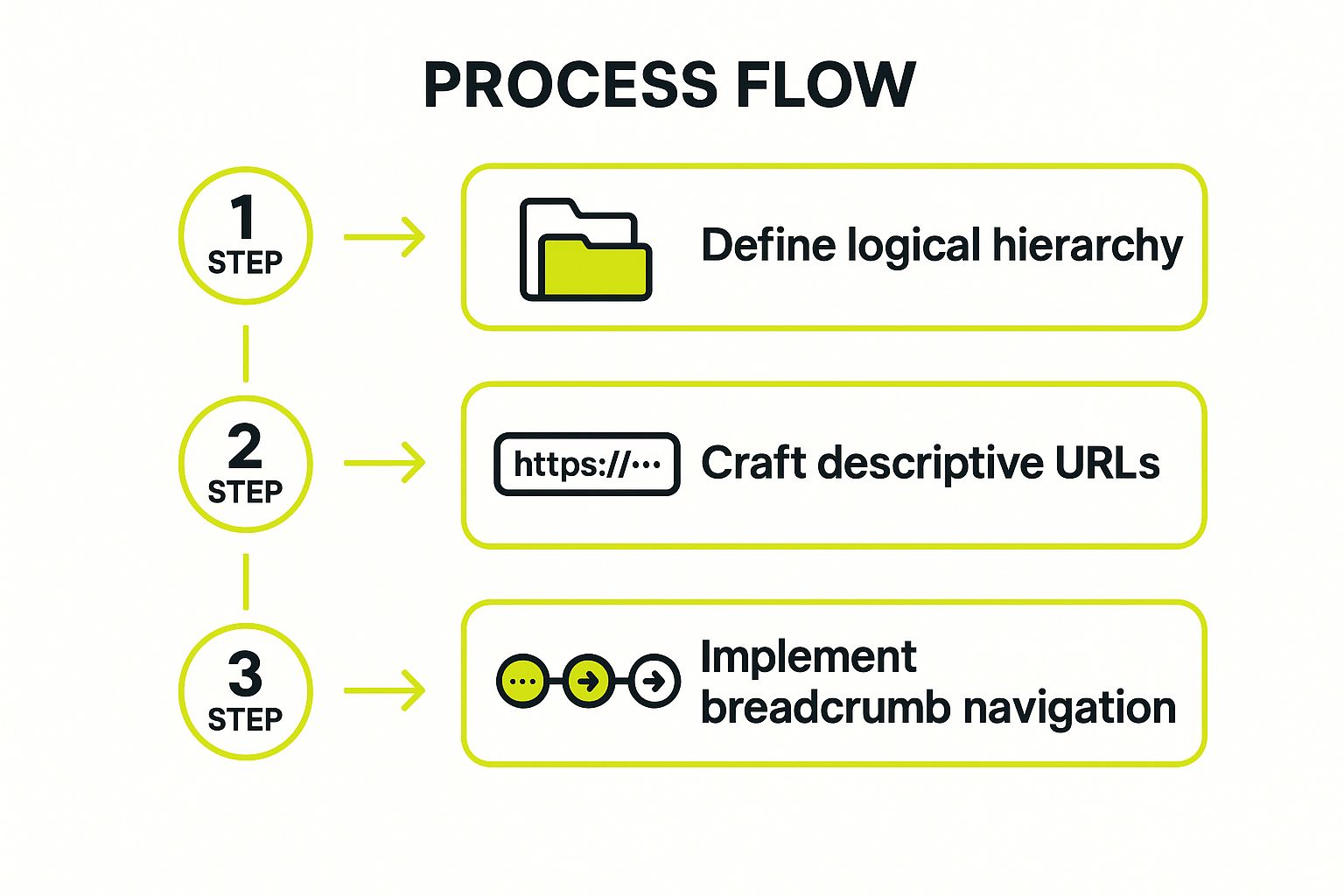
Following this sequence ensures you build a user-friendly and SEO-optimized foundation, from high-level categories down to specific product pages.
How to Implement This Practice
Effective implementation means thinking like a user. Organize your products into logical categories and subcategories that make sense for your inventory, ensuring no important page is more than three clicks away from the homepage. This keeps your structure shallow and accessible.
Follow these actionable tips for a powerful impact:
- Keep URLs Clean and Concise: Use your primary keyword in the URL slug and separate words with hyphens, not underscores. Aim to keep URLs short and descriptive.
- Create a Logical Hierarchy: Use Shopify’s built-in navigation menu to create a clear structure. For example: Homepage > Category (e.g., "Men's Clothing") > Subcategory (e.g., "Shirts").
- Implement Breadcrumb Navigation: Breadcrumbs show users their path on your site (e.g., Home > Shoes > Running). This improves user experience and helps search engines understand your site's layout.
- Use 301 Redirects: If you ever change a URL, set up a 301 redirect from the old URL to the new one. This passes link equity and prevents users from landing on a 404 error page.
3. Optimize Product Images and Alt Text
In e-commerce, high-quality images sell products. However, large, unoptimized images can drastically slow down your site's loading speed, harming user experience and search engine rankings. Image optimization is a critical Shopify SEO best practice that involves compressing image files for fast loading while maintaining visual quality and adding descriptive alt text to help search engines understand the image content. This dual-focus approach improves page speed and opens up a new traffic channel through Google Images.
Optimizing images directly impacts key SEO metrics. Faster load times reduce bounce rates, and well-written alt text improves accessibility for visually impaired users and provides context to search crawlers. This helps Google index your images correctly, making them appear in relevant image search results and driving highly qualified traffic to your product pages.
How to Implement This Practice
Effective image optimization balances file size and quality. For example, instead of uploading a raw, multi-megabyte product photo, compress it to under 100KB. For alt text, be descriptive; rather than "shirt," use "Men's slim-fit organic cotton shirt in navy blue." This level of detail provides valuable context for both accessibility and SEO.
Follow these actionable tips for a powerful impact:
- Compress Images: Use tools like TinyPNG or Shopify apps such as TinyIMG to automatically compress images in bulk without a noticeable loss in quality.
- Write Descriptive Alt Text: Describe the image accurately and include your target keyword where it feels natural. For instance, "Patagonia down sweater hoody jacket in black for men."
- Name Files Descriptively: Before uploading, rename your image files from generic names like "IMG_1234.jpg" to something descriptive like "blue-stripe-slim-fit-shirt.jpg."
- Leverage Lazy Loading: Implement lazy loading so that images below the fold only load when a user scrolls down to them. This dramatically improves initial page load speed.
- Choose the Right Format: Use JPEG for product photos with complex colors and PNG for images that require a transparent background, like logos.
4. Create SEO-Optimized Product Descriptions
Your product descriptions are much more than just sales copy; they are a critical component of your on-page SEO. Well-crafted descriptions serve a dual purpose: they provide search engines with rich, relevant content to index and rank, while also persuading potential customers by detailing the product's value and benefits. This practice is essential for capturing qualified traffic from users searching for specific product features.
An effective product description goes beyond listing features. It integrates target keywords naturally, answers common customer questions, and speaks in your unique brand voice. For example, instead of just saying "water-resistant jacket," a brand like Beardbrand might write a story about how the product solves a customer's problem, naturally weaving in keywords like "all-weather commuter jacket" or "lightweight waterproof shell." This approach is fundamental to a comprehensive Shopify SEO best practices strategy.
How to Implement This Practice
Writing for both search engines and humans requires a strategic balance. The goal is to create compelling, informative content that converts visitors into customers while signaling relevance to Google. A great description makes a product feel tangible and essential, moving beyond a simple list of specifications.
Follow these actionable tips for a powerful impact:
- Research Long-Tail Keywords: Use keyword research tools to find specific, less competitive phrases your customers are searching for, such as "organic cotton baby onesie with snaps" instead of just "baby onesie."
- Answer Customer Questions: Use tools like AnswerThePublic to find common questions related to your product. Incorporate these questions and their answers into your description to add value and capture relevant search queries.
- Focus on Benefits: Don't just list features; explain how they benefit the customer. Instead of "100% merino wool," write "Stay warm without the bulk with our ultra-soft, breathable 100% merino wool."
- Maintain Brand Voice: Write in a tone that is consistent with your brand. Whether you are playful, technical, or luxurious, your voice should shine through while still adhering to SEO principles. You can learn more about how to create SEO-optimized product descriptions that convert.
5. Improve Site Speed and Core Web Vitals
Your site's speed is a direct Google ranking factor and a critical component of user experience. Slow-loading pages lead to high bounce rates and lost sales, while Core Web Vitals measure the real-world experience users have, focusing on loading performance, interactivity, and visual stability. Optimizing these elements is non-negotiable for any Shopify store aiming to rank higher and convert more visitors.
A fast, responsive site tells search engines that you provide a quality user experience, which they reward with better visibility. For Shopify merchants, this means balancing a beautiful, feature-rich store with the technical performance needed for top rankings. This is a crucial practice because a mere one-second delay in page load time can significantly decrease conversions, making speed optimization a high-impact investment.
How to Implement This Practice
Improving site speed involves a multi-faceted approach, from managing your theme and apps to optimizing your media files. For instance, Kylie Cosmetics achieved sub-three-second load times by aggressively optimizing images and minimizing app usage, directly boosting their user engagement and sales.
Follow these actionable tips for a powerful impact:
- Audit Performance: Use free tools like Google PageSpeed Insights and GTmetrix to get a baseline score and receive specific recommendations for your store.
- Choose a Fast Theme: Start with a lightweight, speed-optimized Shopify theme. Themes built for performance have cleaner code and fewer unnecessary features that can slow your site down.
- Minimize and Vet Apps: Every app can add code that slows down your site. Regularly audit your installed apps and remove any that are unused or non-essential.
- Optimize Images: Use an image optimization app to compress images without sacrificing quality and enable lazy loading so images only load as users scroll down the page. Learn more about how to improve your Shopify site speed in our detailed guide.
6. Build High-Quality Backlinks and Authority
High-quality backlinks are like votes of confidence from other reputable websites. When an authoritative site links to your Shopify store, it signals to search engines that your content is credible and valuable, boosting your store's domain authority and search rankings. This practice is crucial for long-term SEO success, as it establishes your brand as a trusted resource in your industry.
Think of backlink building as digital public relations. It involves creating link-worthy assets and building genuine relationships with influencers, bloggers, and publications. For example, Dollar Shave Club gained massive authority by creating viral video content that earned them links from major outlets like Forbes and TechCrunch. This strategy proves that creative content can be a powerful tool for earning high-quality links and improving your Shopify SEO.
How to Implement This Practice
Effective backlink building focuses on quality over quantity. A single link from a high-authority, relevant website is far more valuable than dozens of links from low-quality, spammy sites. The goal is to earn links naturally by providing genuine value to the online community.
Follow these actionable tips to start building your store’s authority:
- Create Link-Worthy Content: Develop shareable assets such as comprehensive buying guides, original industry reports, or unique infographics that others in your niche will want to reference and link to.
- Encourage Product Reviews: Reach out to relevant bloggers and influencers in your space and offer them a free product in exchange for an honest review and a link back to the product page.
- Analyze Competitor Backlinks: Use tools like Ahrefs or Semrush to see which websites are linking to your competitors. This can reveal excellent link-building opportunities for your own outreach campaigns.
- Build Relationships: Engage with journalists, bloggers, and industry leaders on social media and at events. Building genuine connections can lead to natural link-building opportunities down the road. For more advanced tactics, you can learn more about strategic link building for e-commerce sites.
7. Implement Structured Data and Schema Markup
Structured data is a standardized format for providing information about a page and classifying its content. By using schema markup, a specific vocabulary of structured data, you can give search engines detailed context about your products, including price, availability, and customer reviews. This practice is crucial for helping your products stand out in search results with "rich snippets," like star ratings and pricing, which can dramatically improve your click-through rates.
Implementing structured data is one of the more advanced Shopify SEO best practices, but its impact is significant. It essentially translates your page's content into a language search engines understand perfectly, increasing your chances of appearing in enhanced search features like Google's Knowledge Panel. For example, a search for a product might show your store's listing with a star rating and price directly on the results page, making it far more appealing than a standard text-only link.
How to Implement This Practice
Effective implementation means ensuring your markup is accurate, comprehensive, and validated. A Shopify store like Sephora, for instance, uses review schema so that a product's star rating appears directly in the search results, instantly building trust and encouraging clicks.
Follow these actionable tips for a powerful impact:
- Focus on Key Schemas: Prioritize implementing Product, Review, and Breadcrumb schemas first. These provide the most immediate value for e-commerce sites.
- Use Shopify Apps: Simplify the process with apps designed for this purpose. JSON-LD for SEO automates the creation of crucial structured data, saving you from manual coding and potential errors.
- Validate Your Markup: Always use Google's Rich Results Test to check for errors in your schema implementation. This ensures your data is correctly interpreted by search engines.
- Monitor Performance: Keep an eye on the "Enhancements" reports in Google Search Console. This dashboard will show you which rich results Google has found on your site and flag any issues.
- Ensure Data Accuracy: The information in your schema markup must exactly match the content visible to users on the page. Discrepancies can lead to penalties.
8. Optimize for Mobile-First Indexing
Google now primarily uses the mobile version of a website for indexing and ranking, a policy known as mobile-first indexing. This means your site’s mobile experience is the baseline for how search engines judge its quality, relevance, and performance. For a Shopify store, neglecting mobile optimization is like closing your doors to the majority of online shoppers who browse and buy on their phones.
A seamless mobile experience is no longer optional; it is a fundamental component of any successful Shopify SEO best practices. It directly impacts user engagement, bounce rates, and ultimately, your search rankings. If your site is slow, difficult to navigate, or broken on a smartphone, both potential customers and Google will take notice, leading to lost traffic and sales.
How to Implement This Practice
Ensuring your store delivers a flawless mobile experience requires a multi-faceted approach. For instance, a brand like Glossier excels by providing large, touch-friendly product images and a simplified navigation menu that makes finding and purchasing products effortless on a small screen.
Follow these actionable tips for a powerful impact:
- Choose a Responsive Theme: Start with a mobile-optimized Shopify theme. Most modern themes are responsive by default, meaning they automatically adjust to fit any screen size.
- Test Your Site: Regularly use Google's Mobile-Friendly Test tool to analyze your pages. Also, manually test the entire user journey, from browsing to checkout, on various mobile devices.
- Optimize Tap Targets: Ensure all buttons and links are large enough to be easily tapped without accidental clicks. A minimum size of 44×44 pixels is a good standard.
- Monitor Mobile Usability: Keep a close eye on the "Mobile Usability" report in Google Search Console. It will flag specific pages with issues like text that is too small or content that is wider than the screen.
9. Create SEO-Focused Content Marketing Strategy
Content marketing for Shopify stores involves creating valuable, keyword-targeted content that attracts potential customers at different stages of their buying journey. This includes blog posts, buying guides, and tutorials that answer questions and solve problems, driving organic traffic while establishing your brand as a trusted authority. This practice is vital for capturing top-of-funnel traffic that isn't ready to buy yet but is researching solutions your products provide.
An effective content strategy supports product sales without being overly promotional. For example, a store selling skincare could create a blog post on "The Best Morning Skincare Routine for Oily Skin," linking to its relevant cleansers and moisturizers. This approach builds trust and keeps your brand top-of-mind, making it one of the most sustainable Shopify SEO best practices for long-term growth.
How to Implement This Practice
The goal is to create content that serves your audience's needs while subtly guiding them toward your products. For instance, a brand like REI creates extensive outdoor gear guides and adventure stories that not only rank for informational keywords but also drive highly qualified traffic directly to their product pages.
Follow these actionable tips for a powerful impact:
- Build Content Clusters: Use a tool like Ahrefs to identify a broad "pillar" topic (e.g., "Sustainable Living") and create "cluster" posts around more specific keywords (e.g., "zero-waste kitchen products," "how to reduce plastic use"). Link these cluster posts back to your main pillar page and relevant product collections.
- Optimize Blog Posts: Treat each blog post like a product page. Optimize its title tag, meta description, and URL for your target keyword. Use clear headings (H2, H3) and include relevant internal links to products.
- Capture Leads: Use your content to grow your email list by offering a valuable lead magnet, such as a downloadable checklist or an exclusive guide, in exchange for an email address.
- Repurpose Your Winners: Beyond creating new content, an effective SEO content strategy often involves repurposing existing material. Explore different content repurposing strategies to turn a successful blog post into an infographic, video, or social media series to maximize its reach.
10. Optimize Collection Pages and Category SEO
Collection pages are powerful SEO assets that often target broader, high-volume keywords, acting as primary landing pages for customers searching by category. They organize your products logically, guide user navigation, and consolidate link equity around a specific theme. Optimizing these pages is a cornerstone of any robust Shopify SEO strategy, as it helps you rank for competitive terms that individual product pages can't capture.
A well-optimized collection page tells search engines what a group of your products is about, improving your visibility for searches like "women's summer dresses" or "sustainable coffee beans." This is a critical practice because these pages serve as central hubs, helping users discover products and signaling a strong topical authority to Google, which directly boosts your store's overall search performance.
How to Implement This Practice
Effective collection page optimization involves more than just listing products. For example, a store like Brooklinen excels by adding comprehensive content to their collection pages, explaining the benefits of different materials like linen or classic percale right above the product grid. This educates the customer and provides valuable, keyword-rich content for search engines.
Follow these actionable tips for a powerful impact:
- Write Unique, Compelling Descriptions: Add a keyword-rich paragraph at the top or bottom of each collection page. Describe what makes the collection unique, offer styling tips, or explain the benefits of the products to add value beyond a simple product grid.
- Manage Pagination and Filters: Ensure your theme uses canonical tags correctly to prevent duplicate content issues caused by filters (e.g., for size or color). This tells Google which version of the collection page is the main one to index.
- Add Breadcrumb Navigation: Implement breadcrumbs on collection and product pages. This improves user experience and helps search engines understand your site structure, distributing link equity more effectively.
- Optimize Collection Images: Just like product images, your collection's main image needs a descriptive file name and alt text. Instead of
IMG_9876.jpg, use a name likewomens-linen-dresses-collection.jpg.
Shopify SEO Best Practices Comparison
| SEO Strategy | Implementation Complexity 🔄 | Resource Requirements ⚡ | Expected Outcomes 📊 | Ideal Use Cases 💡 | Key Advantages ⭐ |
|---|---|---|---|---|---|
| Optimize Product Title Tags and Meta Descriptions | Low to Medium – easy to implement but time-consuming for large catalogs | Moderate – requires ongoing updates | Improved search rankings and higher click-through rates | Product pages needing direct SEO impact | Direct ranking impact, improved CTR, quick visibility |
| Implement Strategic URL Structure and Navigation | Medium – planning and careful restructuring needed | Moderate to High – requires planning and redirects | Better crawlability, user experience, and shareable URLs | Large stores needing clear site hierarchy | Enhanced crawlability, user-friendly URLs |
| Optimize Product Images and Alt Text | Medium – requires image editing and naming conventions | Moderate – ongoing maintenance required | Faster loading, better accessibility, potential image search traffic | Visual-heavy product catalogs needing speed and SEO | Faster pages, accessibility, additional traffic sources |
| Create SEO-Optimized Product Descriptions | High – time-intensive content creation | High – skilled copywriting or outsourcing | Higher rankings, better conversions, reduced bounce rates | Stores wanting persuasive, unique content per product | Improved rankings, increased conversions |
| Improve Site Speed and Core Web Vitals | High – technical optimizations and continuous monitoring | High – may require developer expertise | Better rankings, higher conversions, enhanced mobile UX | All Shopify stores needing speed and usability improvements | Direct ranking factor, lower bounce rates, user satisfaction |
| Build High-Quality Backlinks and Authority | High – long-term, ongoing outreach and content creation | High – time and strategic effort | Significant ranking boosts and referral traffic | Stores focusing on domain authority and brand credibility | Long-term SEO value, credibility, increased traffic |
| Implement Structured Data and Schema Markup | Medium to High – technical knowledge required | Moderate – maintenance and updates needed | Enhanced search snippets and higher CTR | Stores wanting rich search features | Rich snippets, better search understanding |
| Optimize for Mobile-First Indexing | Medium to High – responsive design and testing needed | Moderate to High – potential theme changes | Better mobile rankings and higher mobile conversions | Stores with significant mobile traffic | Alignment with Google mobile-first, improved UX |
| Create SEO-Focused Content Marketing Strategy | High – ongoing content creation and optimization | High – continuous investment in resources | Increased organic traffic, brand authority, and backlinks | Stores investing in brand building and long-term SEO growth | Long-term traffic growth, customer education |
| Optimize Collection Pages and Category SEO | Medium – moderate technical and content work | Moderate – ongoing optimization effort | Rankings for competitive category keywords | Stores with large product assortments and categories | Better product discovery, improved site architecture |
From Best Practices to Best-in-Class Performance
You've just walked through a comprehensive roadmap of Shopify SEO best practices, from foundational technical setups to advanced content and authority-building strategies. The journey from a functional Shopify store to a dominant e-commerce powerhouse is paved with these deliberate, consistent optimizations. It's about transforming your digital storefront into a magnet for your ideal customers, one that Google loves to recommend.
Remember, SEO is not a "set it and forget it" activity. It's a dynamic, ongoing process of refinement. The most successful e-commerce brands treat it as a core business function, just like inventory management or customer service. They understand that a well-optimized site is a high-performing asset that generates organic traffic and revenue around the clock.
Your Actionable SEO Roadmap
To avoid feeling overwhelmed, focus on a systematic approach. Don't try to implement everything at once. Instead, turn these best practices into a tangible action plan.
- Start with a Technical Audit: Begin by addressing the foundational elements. Use Google's PageSpeed Insights to tackle site speed and Core Web Vitals. Ensure your structured data is correctly implemented and that your site is flawlessly mobile-responsive. A strong technical base makes all your other efforts more effective.
- Prioritize On-Page Wins: Next, focus on high-impact on-page optimizations. Refine your product and collection page title tags, meta descriptions, and image alt text. These are often the quickest changes you can make to improve click-through rates from search results.
- Commit to a Content and Link-Building Cadence: Finally, embrace the long-term strategies. Develop a content marketing plan that answers your customers' most pressing questions and establish a consistent outreach process for building high-quality backlinks. This is where you build lasting authority and competitive advantage.
The True Value of Mastering Shopify SEO
Implementing these Shopify SEO best practices does more than just improve rankings; it builds a resilient and sustainable business. By focusing on creating a better user experience, providing valuable content, and establishing technical excellence, you are directly investing in your brand's long-term growth and profitability. You reduce your reliance on paid advertising, increase your brand's visibility, and build trust with your audience.
Each optimized image, well-crafted title tag, and strategic internal link is a step toward dominating your niche. As you consistently apply these principles, you'll see the cumulative effect: more organic traffic, higher conversion rates, and a stronger bottom line. This is how you move from simply participating in the market to leading it.
Ready to transform your Shopify store's SEO but need expert technical guidance to get there? The team at E-commerce Dev Group specializes in optimizing the code, speed, and technical framework of Shopify Plus stores to achieve peak performance. Partner with us to build a powerful, scalable SEO foundation that drives sustainable growth.
