

In the noisy world of online retail, high-quality backlinks are your secret weapon. They're one of the clearest signals you can send to search engines that your ecommerce store is a legitimate, authoritative player in your niche. A solid link building strategy isn't just a box to check; it’s essential if you want to compete and actually win.
Why Backlinks Are Your Ecommerce Superpower
For an online store, a backlink is so much more than a simple hyperlink. Think of it as a vote of confidence from another site. When a respected blog, an industry publication, or a well-known brand links to your shop, they're essentially vouching for you. They're telling Google and your potential customers that your products and content are worth checking out.
This trust is the real currency of the internet, and it translates directly into better search rankings.
It's all about context. A powerful link from a major fashion blog pointing to your new sneaker collection is gold. It sends relevant traffic that's ready to buy. On the other hand, a random mention in some unrelated forum? That's usually just noise. Getting this right is the foundation of smart link building for any ecommerce business.
The Real-World Impact on Traffic and Revenue
The link between backlinks and business growth isn't just theory—I’ve seen it play out time and time again. The data backs it up, too. There's a clear line connecting the number of quality backlinks a site has to its organic traffic. Sites with more than 30 backlinks often see over 10,000 organic visits a month. And even though it can be a grind, more than 78% of marketers say their link building efforts are well worth the investment.
Every good link you earn makes your whole site stronger. It lifts everything, from your homepage to your most obscure product page, making it easier to rank for the keywords that matter. This creates a positive feedback loop:
- Higher Rankings: You show up more often for your key product searches.
- Increased Traffic: More potential buyers find their way to your store.
- Greater Trust: Your brand builds credibility and authority.
- More Sales: This is the end game, right? Turning that qualified traffic into revenue.
The real magic of link building is in its quality and relevance. I'd take one perfectly placed link from a top-tier site in my industry over a hundred junk links any day of the week.
Before we get into the nitty-gritty of how to build links, it's a good idea to get familiar with the core concepts. These are the building blocks of any successful strategy.
Core Link Building Concepts for Ecommerce
| Concept | Why It Matters for Ecommerce |
|---|---|
| Domain Authority (DA) | A score predicting how well your site will rank. Higher DA means your product and category pages have a better shot at hitting page one. |
| Anchor Text | The clickable text in a hyperlink. Using relevant anchor text (e.g., "blue running shoes") helps Google understand what your page is about. |
| Link Relevance | A link from a site in your niche (e.g., a fitness blog linking to your gym wear) is far more valuable than one from an unrelated site. |
| Follow vs. Nofollow | "Follow" links pass SEO value, while "nofollow" links typically don't. You need a healthy mix, but your focus should be on earning "follow" links. |
Understanding these terms is the first step. They'll guide your decisions as you start building a backlink profile that actually moves the needle.
Quality Over Quantity Is the Golden Rule
When we talk about backlinks, quality and relevance are everything. A guide on industry-relevant backlinks explains this perfectly. This is where so many ecommerce stores stumble—they get caught up chasing a high number of links instead of the right links.
Adopting a strategic mindset is key. You want to earn links that truly matter. For a much deeper look at the strategies to do this, check out our complete guide on link building for ecommerce websites: https://scaleshopify.com/2025/05/05/link-building-for-ecommerce-websites/. Making this mental shift is the first real step toward building a backlink profile that drives real, sustainable growth for your online business.
Building Your Foundation for Link Acquisition
Let's get one thing straight: successful e-commerce link building doesn't start with sending a bunch of emails. It starts with a hard look in the mirror. Before you can expect anyone to link to your store, you need to have something worth linking to.
Think of it this way. Your store isn't just a digital catalog; it’s a potential resource hub. The real goal is to create pages so genuinely useful that bloggers, journalists, and industry folks want to share them. These are your linkable assets.
A standard product page, while crucial for making sales, isn't going to get you very far. It's purely transactional. To earn links, you need to create content that serves a purpose beyond the "buy now" button by solving problems or answering your audience's toughest questions.
Create Your Linkable Assets
Linkable assets are the bedrock of any link building strategy that actually lasts. These are high-value pages on your site that attract backlinks naturally because they're genuinely good. Instead of begging for links, you're earning them on merit.
So, what do your customers struggle with before they're ready to buy? What are they searching for on Google? The answers to those questions are your roadmap to creating killer content.
Here are a few proven types of linkable assets I've seen work time and time again for e-commerce sites:
- In-Depth Buying Guides: Don’t just write a simple blog post. Create the definitive guide on choosing a product in your niche. For example, a store selling coffee gear could publish "The Ultimate Guide to Brewing Espresso at Home," packed with video tutorials, pro tips, and product comparisons.
- Interactive Tools: Tools are absolute link magnets because they offer immediate, personalized value. A paint store could build a "Room Paint Calculator" that tells a customer exactly how much paint they need. That’s a practical resource DIY bloggers would be thrilled to link to.
- Unique Data or Research: Got access to interesting sales data? Turn it into a story. A fashion retailer could analyze their own sales figures and publish a report on "This Year's Most Popular Colors by State." This is original, newsworthy content that publications love to pick up and cite.
The best linkable assets solve a specific, nagging problem for your ideal customer. When you become the solution, you become the resource everyone links back to.
Before you start creating, a critical first step is understanding the landscape. Learning how to do competitor research effectively is a must. Seeing what’s already earning links for others can give you a ton of great ideas for your own assets.
Strengthen Your Technical and Page-Level SEO
Even the most amazing buying guide won't earn links if it's on a slow, clunky website. Your technical foundation has to be solid. A site that’s fast, mobile-friendly, and easy to navigate isn't a "nice-to-have"—it's a requirement.
Page load speed is a huge deal. Study after study shows that conversion rates plummet with every extra second a page takes to load. A slow site just frustrates people and leaves a terrible impression on anyone you might ask for a link.
Once your site's technical health is in check, you can zoom in on your key pages, especially those shiny new linkable assets.
- Optimize for Readability: Use short paragraphs, clear headings (H2s, H3s), and bullet points. Make it easy for people to scan and find what they need.
- Incorporate Rich Media: Break up the text with high-quality images, custom graphics, or embedded videos. This makes your content far more engaging and shareable.
- Clear Calls-to-Action: Gently guide the user. Even on a resource page, you can add a subtle nudge directing them toward relevant product categories.
By focusing on creating these assets first and making sure your site is technically sound, you're doing more than just prepping for a link building campaign. You're building an authoritative brand that earns trust, traffic, and—most importantly—the valuable backlinks that drive real, sustainable growth.
Alright, let's get into the strategies that actually move the needle for an online store. We’ve laid the groundwork, and now it’s time for the proven link building plays that I’ve seen work time and time again for ecommerce sites. Forget the abstract theories—these are practical tactics you can start planning today.
This is all about actively hunting down and locking in high-value links. It’s the heart and soul of successful link building.
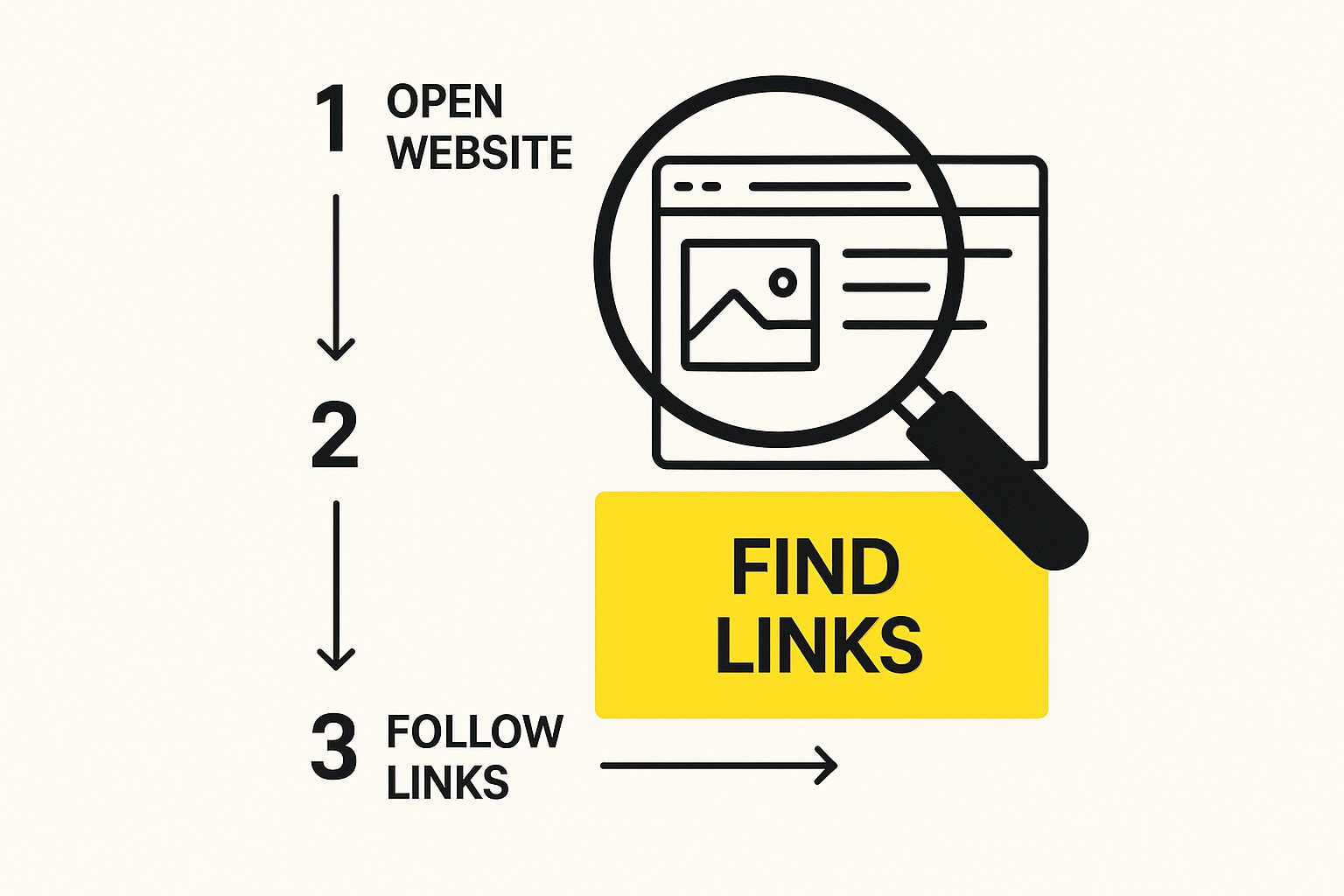
The image above really nails the first, critical step of any campaign: you have to spot promising link opportunities before you even think about outreach. A structured approach like this means your efforts are targeted and efficient. It stops you from wasting precious time on prospects that won't make a real difference to your bottom line.
Turn Your Internal Data into a Digital PR Goldmine
One of the most powerful, yet criminally underused, assets an ecommerce store has is its own sales data. Seriously. Journalists and bloggers are constantly searching for fresh, data-backed stories to share with their readers. You're sitting on a potential goldmine of headlines.
Just think about the unique trends hiding in your sales figures. A store selling home decor could dig into its data and publish a report on "The Hottest Interior Design Color Palettes by Region." This is original, newsworthy content that publications are hungry to cite and link back to.
Here’s how you can put this into action:
- Find the Story: Sift through your sales data for surprising trends, regional quirks, or interesting seasonal spikes. What story is your data telling you?
- Create the Asset: Package your findings into a compelling blog post, a sleek infographic, or even a simple press release. The key is making it easy for a busy journalist to grasp the main points.
- Target Your Outreach: Find journalists and bloggers who cover your industry. Shoot them a personalized email pitching your story, and be sure to highlight why their audience would care.
Master High-Value Guest Posting
Guest posting is still a cornerstone of link building, but you have to do it right. The goal isn't just to snag a backlink; it's to put your brand in front of a relevant, engaged audience that might actually buy from you. Forget about spammy, low-quality sites. You need to be targeting authoritative blogs in your niche.
For instance, if you sell high-end kitchen knives, a guest post on a popular culinary blog read by serious home cooks is invaluable. The link itself will carry SEO weight, and the referral traffic will be full of people who are genuinely interested in quality cooking tools.
Pro Tip: When you write a guest post, don't just drop a generic link to your homepage. Link contextually to a specific category page or, even better, a detailed buying guide on your site. This gives the reader more value and sends stronger signals to Google about that page's authority.
Tap Into Your Supplier and Manufacturer Relationships
This is one of the easiest and most overlooked wins in ecommerce link building. Your suppliers and manufacturers often have a "Where to Buy" or "Retailers" page on their websites. If you're an official seller of their products, you have every reason to be listed there.
These links are fantastic. They come from highly relevant, authoritative domains right within your industry. It’s a completely natural, symbiotic relationship.
Your outreach can be simple and direct:
- First, make a list of all your key suppliers and manufacturers.
- Then, check their websites for a page listing retailers, stockists, or partners.
- If they have one and you’re missing, just send a polite email to your contact person. Remind them you're a proud partner and ask to be added.
It’s a quick tactic that can land you several high-quality links with very little effort.
Reclaim Your Broken Links
Over time, other websites that have linked to your store might end up with broken links pointing to you. This happens if you've changed a URL, deleted a product, or restructured your site. These broken links represent lost SEO value just sitting there.
The process of broken link building is all about finding these dead links and asking the site owner to fix them. You can use a tool like Ahrefs to find broken backlinks pointing to your domain.
Once you spot one, reach out to the webmaster. Thank them for mentioning you in the first place and just provide them with the correct, updated link. It’s an easy fix on their end, and it instantly restores that flow of link equity back to your site.
Turn Brand Mentions into Powerful Links
It happens all the time: blogs, news sites, or forums will mention your brand name without actually linking to your website. These are what we call unlinked brand mentions, and they are golden opportunities. The hard part—getting mentioned—is already done. All you have to do is claim the link.
You can set up alerts using a tool like Google Alerts or Mention to track whenever your brand is discussed online. When you find an unlinked mention, send a friendly email to the author or editor. Thank them for featuring your brand and politely ask if they’d consider adding a link to your homepage so their readers can easily find you.
Today's ecommerce link building really blends these traditional methods with newer, more engagement-focused approaches. Influencer marketing and product reviews, for example, have become absolutely critical as customers rely on them for buying decisions. Inviting niche bloggers to create linked content like unboxing videos generates trustworthy backlinks. In the same way, digital PR campaigns that share your data-driven stories or brand milestones can secure high-authority links from major media outlets. You can find more details about these modern strategies for building your brand's online presence.
Creating Content That Naturally Attracts Links
While actively chasing down links is part of the game, the real magic happens when you create something so genuinely useful that other sites want to link to it. This is the holy grail of link building for any ecommerce store—turning your website into a "link magnet" that pulls in authority passively.
Think beyond the standard, run-of-the-mill blog posts. Your goal should be to create the single best, most definitive resource on the internet for a specific question your customers are wrestling with. When you own that topic, the links just start to show up. It’s a complete shift in mindset from asking for links to earning them.
This isn't just about SEO, either. It positions your brand as a trusted expert, building the kind of authority that pays off long after you hit publish. You’re not just writing a blog post; you're building a valuable asset that works for you 24/7.
Find Out What Your Customers Are Actually Asking
The path to link-worthy content starts with keyword research, but not the kind you might be used to. You need to dig deeper than commercial keywords like "buy hiking boots." The real gold is in the informational queries—the questions people ask before they’re even thinking about pulling out their credit card.
What are their sticking points? What do they need to understand to make a confident purchase?
Tools like AnswerThePublic or even Google's "People Also Ask" box are perfect for this. You'll quickly see that people aren't just searching for products. They're asking things like:
- "How do I choose hiking boots if I have wide feet?"
- "What's the real difference between waterproof and water-resistant boots?"
- "How can I break in new leather hiking boots without getting blisters?"
These questions are your content roadmap. Answering them with a truly comprehensive guide gives you a powerful asset that outdoor bloggers, hiking forums, and gear reviewers will happily link to as a trusted resource.
Key Takeaway: The best linkable content doesn't just try to sell a product. It solves the problem that makes someone need your product in the first place. This customer-first approach is the bedrock of any solid content strategy.
As you plan your content, it’s worth thinking about how AI writers are changing the SEO landscape. While AI can help speed up the writing process, the strategic thinking required to uncover these customer pain points is still a distinctly human skill.
Go All-In With Visuals and Rich Media
Let's be honest—in ecommerce, text alone is boring. Visuals aren't just decorative; they're powerful link-earning tools in their own right. People are far more likely to share and link back to content that’s visually appealing and easy to skim.
When you mix different types of media into one piece of content, its value skyrockets. The data backs this up, too. Blogs that feature three or more videos can earn 55% more backlinks, and a well-designed infographic can boost backlinks by an incredible 178%. Suddenly, that budget for a graphic designer or video editor looks like a pretty smart investment.
Here are a few visual assets that consistently attract links:
- Custom Infographics: Turn complex information or a step-by-step process into a beautiful, easy-to-share graphic.
- How-To Videos: Show, don't just tell. A video demonstrating how to use, style, or maintain one of your products is incredibly valuable.
- Unique Product Photography: Ditch the boring white backgrounds. Lifestyle photos that show your product in a real-world setting are often picked up by style guides and bloggers.
Weaving these elements together is a cornerstone of a smart ecommerce content strategy.
To help you brainstorm, here's a look at some of the most effective types of "linkable assets" for ecommerce brands.
Linkable Content Ideas for Ecommerce Sites
| Content Type | Primary Goal | Link Building Potential |
|---|---|---|
| Definitive Guides | Educate & Solve | High. Becomes the go-to resource for a topic. |
| Original Research/Data | Establish Authority | Very High. Journalists & bloggers love to cite unique data. |
| Free Tools/Calculators | Provide Utility | Very High. People link to useful tools they use repeatedly. |
| Infographics | Simplify & Visualize | High. Easily shareable and embeddable. |
| Expert Roundups | Leverage Influence | Medium-High. Experts often share and link to their contributions. |
| Video Tutorials | Demonstrate & Show | Medium. Great for embeds, often linked from forums. |
Ultimately, the goal is to create something more valuable than a simple blog post. By investing in these deeper, more comprehensive content formats, you create assets that naturally attract the kind of high-quality links that move the needle.
Here's How It Looks in the Real World
Let's say you sell high-end coffee brewing equipment online. Through your research, you discover a ton of confusion around the "pour-over" brewing method. This is your moment.
Instead of a quick blog post, you decide to create The Ultimate Guide to Perfect Pour-Over Coffee. This single webpage could include:
- In-Depth Article: A detailed breakdown of the science behind pour-over, from water temperature and grind size to the importance of the "bloom."
- Video Tutorial: A slick, embedded video showing the entire process, featuring your own grinders, kettles, and drippers in action.
- Printable Brew Guide: A downloadable PDF checklist for nailing the perfect brew every single time.
- Comparison Infographic: A sharp-looking graphic comparing the different pour-over drippers you sell, explaining the pros and cons of each.
Now, you've created the best resource on the internet for this topic. Coffee bloggers, home-brewing communities, and even other coffee shops will link directly to your guide whenever they talk about pour-over. That’s how you build authority and drive targeted traffic that’s already interested in what you sell.
How to Scale Your Link Building Efforts
Moving from occasional link building wins to a predictable, scalable program is how you win in the long run. One-off tactics are great for a quick boost, but a repeatable system is what truly builds lasting authority for your ecommerce site. This means you need to shift your focus from just getting links to building an efficient machine that generates them consistently.
The key to this shift is turning your link building into a real operation. You need clear processes, the right tools, and a sharp focus on metrics that actually move the needle. Without a system, you'll just burn yourself out chasing individual opportunities instead of creating a sustainable engine for growth.
Set KPIs That Actually Mean Something
First things first, you have to define what a "win" really looks like. In a scalable program, simply counting the number of new links is a vanity metric. It's easy to track, sure, but it tells you next to nothing about the real impact on your business. Instead, your Key Performance Indicators (KPIs) should be tied directly to quality and real-world results.
Try focusing on metrics like these:
- Links from relevant, high-authority domains: Are you getting links from sites that are actually in your niche and have a strong reputation?
- Referral traffic from new links: Are these links sending real, interested shoppers to your store? This is a huge signal of quality.
- Keyword ranking improvements for target pages: Are your efforts moving your money-making category and product pages up the SERPs?
By focusing on these KPIs, you ensure your team is chasing quality, not just quantity. This is how you avoid the common trap of acquiring low-value links that do little more than inflate a number on a spreadsheet. A great starting point is to conduct regular ecommerce SEO audits to pinpoint which pages would benefit most from a targeted link building push.
Find Gold in Your Competitor's Backyard
Your competitors have already done a lot of the heavy lifting for you. Their backlink profiles are essentially a public roadmap, showing you exactly which sites are willing to link to businesses just like yours. Firing up a tool like Ahrefs or Semrush to analyze their links is one of the most efficient ways to build your initial prospect list.
Look for the patterns. Are they getting tons of links from product reviews, gift guides, or industry blogs? Those are glaring signals about what's working in your niche. Don't just try to copy their links one-for-one; look for the "link gaps"—those authoritative sites that are linking to several of your competitors, but not to you. Those are often your warmest prospects.
My Personal Tip: Don't just look at your direct competitors. Analyze "shoulder niches" too. If you sell high-end cookware, for example, go look at the backlink profiles of popular food blogs. They are a prime source of high-quality, relevant link opportunities you might otherwise completely miss.
Master the Art of Personalized Outreach
As you scale, it's incredibly tempting to automate everything, especially your outreach emails. This is a massive mistake. A generic, templated email screams "I want something from you" and is destined for the trash folder. The real secret to scalable outreach is creating a system for personalization.
It's fine to develop a few core templates, but you must build in required personalization fields that force you or your team to do a bit of homework first.
- Mention a recent article they wrote: This instantly shows you've actually read their work.
- Compliment their site design or a recent social post: A little genuine flattery goes a long way.
- Explain why a link to your resource would specifically benefit their audience: This is the most crucial part. You have to frame your request as a value-add for them, not just for you.
This approach—what I call "systematized personalization"—allows you to increase your outreach volume without sacrificing the quality of your communication. You end up building genuine relationships, which often lead to more than just a single link. They can blossom into long-term partnerships that pay dividends for years.
In the cutthroat world of ecommerce, link building remains absolutely critical for SEO success. Recent data shows that ecommerce sites aiming for the top 3 Google search results need an average of around 780 backlinks. That number alone highlights how tough sustained link building is, especially since search engines like Google are cracking down hard on low-quality, spammy links. This is why quality-focused strategies like niche edits and creating genuinely valuable guides are becoming essential. You can see more data on ecommerce backlink benchmarks over at Prestigelinks.com.
Common Ecommerce Link Building Questions
When you start getting serious about link building, a lot of questions pop up. It makes sense—especially for an ecommerce store, you need to know your marketing dollars are going to the right place. Let's dig into some of the most common questions I hear about budgets, timelines, and what a "good" result actually looks like.
First up, the big one: how much does this cost? While you can absolutely earn some great links with standout content and a bit of digital PR, a competitive link building program requires a real investment. To put it bluntly, it's not cheap. The average price for a single paid backlink hovers around $361.44.
Many businesses set aside about 28% of their total marketing budget just for this, and nearly half (46%) of SEO pros spend at least $10,000 a year to keep up. If you want to see how you stack up, you can find more link building statistics to help figure out a realistic budget.
How Long Does It Take to See Results?
This is the classic "it depends" question in the world of SEO, but I can give you a rough idea of what to expect. Think of link building as a long game, not a quick win. You're building your website's reputation and trust with search engines, and that simply doesn't happen overnight.
Here’s a general timeline most of my projects follow:
- Months 1-3: This is all about laying the groundwork. We're doing outreach and landing those first few high-quality links. You probably won't see any major jumps in your rankings just yet.
- Months 4-6: Now we start to see some action. Those initial links get indexed and Google starts to take notice. You should see some positive movement for the keywords you’re targeting.
- Months 6-12+: This is when the magic really happens. The cumulative effect of all your hard work starts to pay off. As your backlink profile steadily grows with quality links, you’ll see significant, lasting improvements in your organic traffic and rankings.
A single link rarely moves the needle on its own. The real power is in the steady, consistent accumulation of authoritative links over a long period. Patience isn't just a virtue here; it's a requirement.
What Is a Good Link for an Ecommerce Site?
This is crucial: not all links are created equal. For an online store, a "good" link is way more valuable than just any old link from any old site. It needs to have a few key ingredients.
A genuinely great link is always:
- Contextually Relevant: It has to come from a website—and even better, a specific page—that’s directly related to what you sell. A link from a popular food blog to your store selling artisanal kitchen gadgets? That's gold. A random link from a financial news site? Not so much.
- From an Authoritative Domain: The site linking to you needs to have a strong reputation and a solid backlink profile of its own. That authority gets passed along to you.
- Likely to Drive Referral Traffic: The link should be placed where real people will actually see it and click on it, sending potential customers straight to your product pages.
If you focus on getting links that check these three boxes, you'll build a backlink profile that does more than just boost your SEO. It'll drive real business for your store.
Ready to stop guessing and start building a backlink profile that drives real revenue? The team at E-commerce Dev Group specializes in creating and executing data-driven SEO and link building strategies for Shopify stores. We build the authority that gets you seen. Learn how we can help you scale your online store.
