


Why Your Online Store Needs Regular SEO Health Checks
Let's be honest, many e-commerce owners treat SEO audits like dental checkups: necessary, but easily postponed. However, regular e-commerce SEO audits are crucial for maintaining online visibility and can be the difference between struggling and thriving in your market. Search engine algorithms, competitor strategies, and customer behavior are always changing. Without regular checks, your online store risks falling behind.
Imagine a physical store neglecting inventory management. Over time, dead stock accumulates, trending products are missed, and customers are lost. Similarly, an online store without regular SEO health checks can develop technical issues, miss keyword opportunities, and lose valuable organic traffic, leading to decreased sales and revenue. Regular audits help identify and fix these issues before they become major problems. You might be interested in: How to master Shopify store audits.
The Hidden Costs of Neglecting SEO
Hidden technical issues like broken links, slow loading speeds, or poor mobile responsiveness can cost you thousands in lost sales. Think of these glitches as virtual "out of stock" signs. Content gaps and outdated information negatively impact credibility and user experience. Potential customers might leave without purchasing, impacting your conversion rates. Ignoring competitor analysis means you're essentially navigating a competitive market without a map.
The Benefits of Regular Audits
Businesses conducting quarterly audits consistently outperform competitors. This proactive approach ensures they adapt to market changes and stay ahead of the curve. These reviews translate directly into increased organic traffic and conversion rates. For example, optimizing product pages for relevant keywords attracts more qualified traffic, leading to higher sales. E-commerce SEO audits are essential for maintaining online visibility.
As of 2025, the average e-commerce brand ranks for approximately 1,783 keywords in organic search results, leading to an estimated 9,625 organic monthly visits. This traffic level would cost nearly £11,800 through paid search advertising, highlighting the economic benefits of effective SEO. Find more detailed statistics here. Regular SEO audits empower data-driven decisions, optimize marketing spend, and achieve sustainable growth. By addressing SEO issues proactively, you create a robust online presence that attracts customers and drives revenue.

Technical Foundation: What To Audit First
Your website's technical health is the foundation of a successful online presence. While unseen, it's absolutely critical. This section covers the most impactful technical elements for ecommerce SEO audits, prioritizing those that deliver the quickest results. We'll explore site speed, mobile responsiveness, and crawl errors – all vital for improving search rankings.
Site Speed and Core Web Vitals
Site speed dramatically affects both user experience and search engine rankings. A slow website leads to frustrated customers and increased bounce rates. Search engines, especially Google, favor fast-loading sites, recognizing they offer a better user experience. Optimizing images, utilizing browser caching, and minimizing HTTP requests can dramatically improve site speed, directly impacting your rankings. Learn more about site speed optimization for Shopify: How to master Shopify performance optimization.
Mobile Responsiveness
In our mobile-first world, a responsive website is non-negotiable for ecommerce SEO. A responsive design adapts seamlessly to various screen sizes, creating a consistent user experience. Google primarily uses the mobile version of your website for indexing and ranking, making mobile responsiveness essential for search visibility. Use Google's Mobile-Friendly Test to assess your site and identify areas for improvement.
Crawl Errors and Indexing
Search engines use crawlers to discover and index your website's pages. Crawl errors hinder this process, effectively hiding your products from potential customers. Regularly checking for these errors is vital during ecommerce SEO audits. Google Search Console is a powerful tool for identifying and resolving crawl errors, ensuring search engines can access your important pages.
Schema Markup and Rich Snippets
Schema markup is code that clarifies your website's content for search engines. Implementing product schema lets your products appear in rich snippets, those enhanced search results displaying extra information like images, prices, and ratings. This boosts visibility and click-through rates. A solid online reputation management strategy complements this approach.
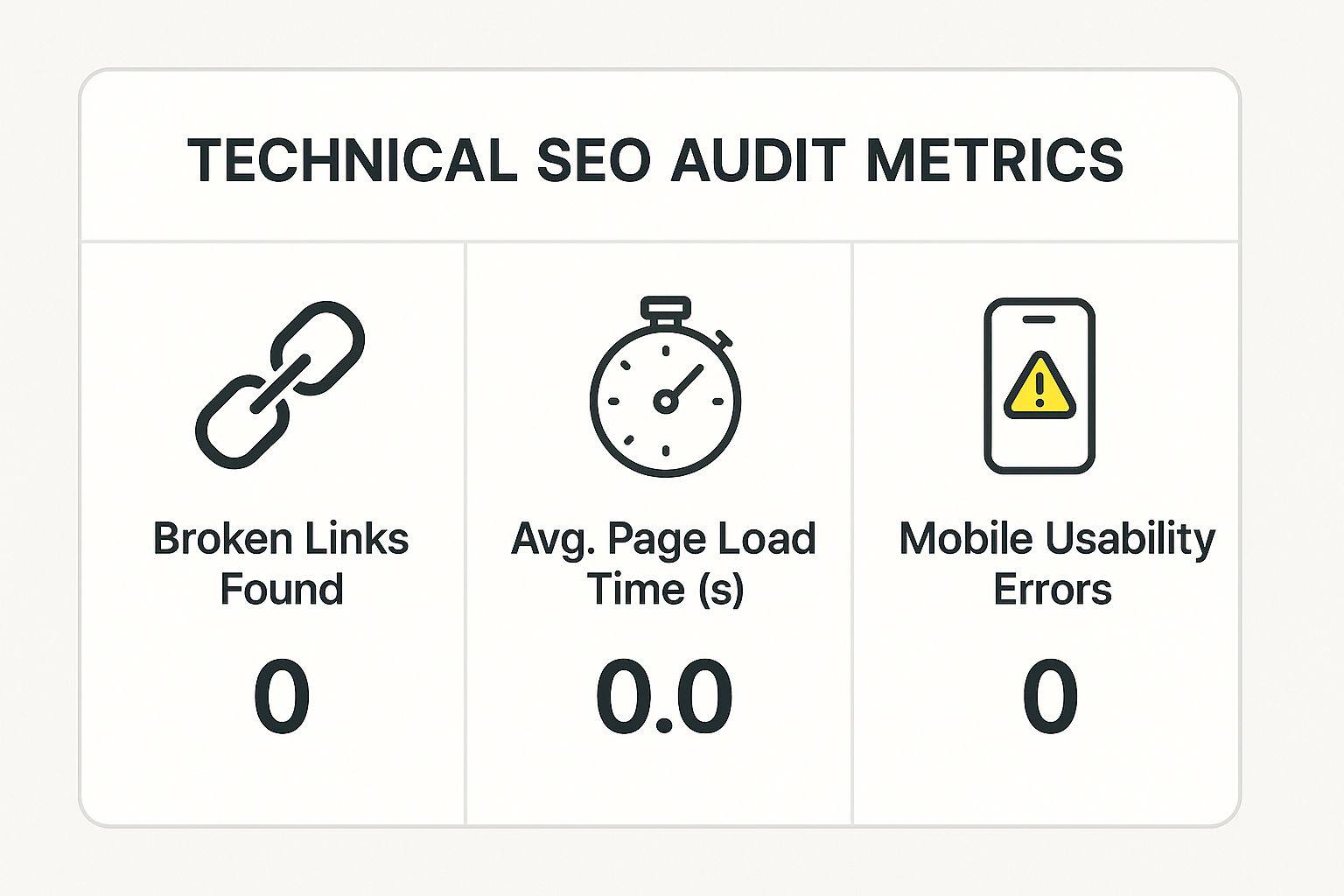
The infographic above illustrates key technical SEO audit metrics, including broken links, average page load time, and mobile usability errors. These offer a snapshot of your website’s technical health. For example, numerous broken links negatively impact your crawl budget, while a slow page load time hurts rankings and conversion rates.
The following table provides a more detailed checklist for conducting a thorough technical SEO audit. It outlines key elements, their impact, potential problems, and recommended tools for assessment.
Technical SEO Audit Checklist for Ecommerce Sites
A comprehensive comparison of critical technical elements to audit, their impact level, and recommended tools for assessment
| Technical Element | Impact Level | Common Issues | Recommended Tools |
|---|---|---|---|
| Site Speed | High | Slow loading times, large image files, unoptimized code | Google PageSpeed Insights, GTmetrix |
| Mobile Responsiveness | High | Poor rendering on mobile devices, unresponsive design | Google's Mobile-Friendly Test |
| Crawl Errors | High | Broken links, server errors, incorrect robots.txt | Google Search Console |
| Schema Markup | Medium | Missing or incorrect product schema, lack of rich snippets | Google's Rich Results Test |
| Indexing | High | Pages not indexed, duplicate content | Google Search Console |
This checklist highlights the interconnectedness of technical SEO elements. Addressing these technical issues establishes a solid base for enhanced SEO performance and user experience, ultimately increasing traffic and sales. Focusing on these fundamentals is key to successful ecommerce SEO audits.
Product Page Performance: Where Sales Actually Happen
Your product pages are the critical point where browsing turns into buying—or sends potential customers to your competitors. This part of your ecommerce SEO audit focuses on optimizing the pages that directly affect your bottom line. We'll explore how to find underperforming product listings and make changes that convert traffic into sales.
Keyword Targeting and Content Quality
Successful ecommerce stores know how to balance SEO requirements with engaging sales copy. Keyword targeting is important, but cramming keywords into product descriptions makes them hard to read and hurts the user experience. Focus on naturally incorporating relevant keywords within informative, benefit-driven content. For instance, instead of just listing features, explain how those features solve customer problems. This resonates with both search engines and shoppers.
Structuring for Conversions
Some product page structures consistently outperform others. A clear visual hierarchy, compelling product images, and easy-to-find calls to action are essential. Bullet points can highlight key features, while short paragraphs explain the benefits. This structured approach guides customers toward purchasing, boosting conversion rates. Think of a cluttered store versus a well-organized one—the organized store will almost always make more sales.
The image above shows a well-optimized product page with high-quality visuals and a structured layout. This supports a positive user experience, a key factor for conversions and a crucial element of any ecommerce SEO audit.
User Experience and Conversion Rate Optimization
Keywords and content quality are only part of the story. User experience significantly impacts search rankings and conversion rates. A fast-loading page, mobile-friendly design, and simple navigation create a positive experience. This can improve dwell time and reduce bounce rates, signaling to search engines that your page offers value.
Advanced Optimization Strategies
Beyond the basics, advanced techniques like product schema, image optimization, and internal linking can significantly boost search visibility. Product schema gives search engines detailed product information, creating rich snippets in search results. Image optimization, including descriptive alt text and smaller file sizes, improves page speed and accessibility. Internal linking connects related products, improving navigation and distributing link equity across your site. These are key areas to review in your ecommerce SEO audit. By addressing these elements, you’ll attract qualified traffic and encourage conversions, leading to revenue growth.
Building Authority Through Strategic Link Building
Your backlink profile is like your store's online reputation in the eyes of search engines. It significantly impacts your competitive position. This ecommerce SEO audit section focuses on assessing your existing backlinks and building a robust link-building strategy. We'll cover everything from identifying harmful links to implementing successful campaigns.
Auditing Your Current Backlink Portfolio
Begin your link-building audit by analyzing your current backlink profile. Use tools like Ahrefs or SEMrush to identify toxic backlinks. These are low-quality links from spammy or irrelevant websites that can negatively affect your rankings. Also, look for broken or lost backlinks that once pointed to valuable pages.
Reclaiming these lost links can restore valuable link equity. This process, much like reviewing customer feedback, helps you understand your store's online standing. A thorough audit provides a clear picture of your current backlink situation and highlights areas for improvement.
Effective Link-Building Strategies for Ecommerce
Several proven strategies exist for building high-quality backlinks for ecommerce businesses. Digital PR campaigns, for example, can generate significant buzz and earn links from reputable media outlets. Strategic partnerships with complementary brands also offer valuable backlink opportunities.
Imagine partnering with a food blogger if you sell kitchenware. Both brands benefit from increased exposure. This cross-promotion creates a win-win scenario and strengthens both backlink profiles.
The importance of backlinks in e-commerce SEO audits cannot be overstated. In the e-commerce world, digital PR is a popular way to build high-quality backlinks. The average Ahrefs Domain Rating (DR) of an e-commerce backlink earned through digital PR is 46. This is significantly higher than the overall average DR of 28 across all e-commerce backlinks. Discover more insights about backlink domain rating.
Case Studies and Practical Approaches
Examining successful ecommerce backlink campaigns offers valuable insights. Case studies often reveal practical approaches for earning high-quality links. These include creating high-value content, building relationships with influencers, and leveraging guest posting opportunities.
These techniques not only drive referral traffic but also boost your search authority. By learning from others' successes, you can refine your own link-building strategies.
Removing Toxic Backlinks and Building Domain Authority
Identifying and removing toxic backlinks is crucial for a healthy backlink profile. Use tools like Google's Disavow Tool to request the removal of harmful links. Building domain authority is a long-term process.
It requires consistent effort and a focus on quality link acquisition. While the exact timeline varies by industry and competition, setting realistic expectations is vital. Think of it like building a strong brand reputation—it takes time, but the benefits are long-lasting.
Realistic Timelines and Measurable Results
Ecommerce SEO audits and link-building efforts aren't about instant gratification. Establishing realistic timelines and key performance indicators (KPIs) is essential. Track your progress by monitoring metrics like referring domains, backlink quality, and search rankings.
This data-driven approach ensures your SEO efforts yield measurable results and contribute to sustainable growth. Focusing on these aspects helps build a strong online reputation, drive targeted traffic, and ultimately boost your bottom line.
Content Strategy That Drives Qualified Traffic
Attracting the right customers to your online store relies on more than just basic product descriptions. A strong content strategy is essential, and a comprehensive ecommerce SEO audit can help you identify opportunities to draw in qualified traffic. This means attracting visitors who are genuinely interested in your products and likely to make a purchase. We'll explore how to analyze your current content, find gaps, and ensure it aligns with what your customers are searching for.
Auditing Your Existing Content
Your content audit should begin with a thorough review of your existing materials. Ask yourself some key questions. Does your content address the questions your target audience is asking? Is it optimized for relevant keywords? For example, if you sell hiking boots, consider whether you have content like blog posts covering topics such as "best hiking boots for beginners" or "how to choose hiking boots for different terrains." Content like this attracts potential customers who are in the research phase of their buying journey.
Identifying High-Value Topics
Gaining a competitive edge involves identifying valuable topics that your competitors haven't covered. Keyword research tools like Ahrefs or SEMrush can help you discover what keywords your competitors are ranking for and uncover opportunities they might be missing. This allows you to create unique content that fills those gaps, driving targeted traffic to your store. For additional guidance on optimizing your Shopify store, check out our guide on Shopify SEO best practices.
Developing Content That Ranks and Converts
Creating content that ranks well in search results is only part of the equation. It also needs to effectively guide qualified traffic to your product pages. For example, a blog post about hiking boots should naturally include links to related product pages on your site. This seamless connection between your content and product pages is crucial for converting visitors into paying customers. It makes it easy for interested readers to find and purchase the products they’re researching.
Content Performance Metrics and Benchmarks
To gauge the success of your content strategy, tracking key performance indicators (KPIs) is essential. The table below highlights important metrics to monitor during your ecommerce SEO audits and offers industry benchmarks for comparison. This information provides a starting point for setting achievable goals and identifying areas for improvement.
To help you understand which metrics to prioritize, the following table provides industry benchmarks and suggests an optimization priority.
Content Performance Metrics for Ecommerce Audits
Key performance indicators to track when auditing your ecommerce content strategy and their benchmarks
| Content Type | Primary KPI | Industry Benchmark | Optimization Priority |
|---|---|---|---|
| Blog Posts | Organic Traffic, Time on Page | Varies by industry, aim for >2 minutes | High |
| Product Pages | Conversion Rate, Bounce Rate | Aim for >2% conversion rate, <40% bounce rate | High |
| Category Pages | Organic Traffic, Click-Through Rate | Aim for >1% CTR | Medium |
By focusing on these metrics, you can gain a clearer understanding of how your content is performing and identify areas for optimization.
Optimizing Category and Collection Pages
Category and collection pages often get overlooked, but they are important for both user experience and search performance. Make sure your category pages have concise and informative descriptions that incorporate relevant keywords. Using high-quality images and optimizing page load speed can also significantly improve user experience and boost your search engine visibility.
Building Authority Through Content
Creating high-quality content establishes your brand as a trusted source of information within your niche. Think of it as offering valuable advice to customers in a physical store, which builds trust and encourages repeat business. Informative online content achieves the same thing, strengthening your brand’s online presence. By consistently producing helpful and engaging content, you attract and retain customers, ultimately driving business growth. This is a vital aspect of a successful ecommerce SEO audit.
Competitor Intelligence: Finding Your Market Advantage
While your competitors may be focused on internal operations, smart ecommerce entrepreneurs are looking outward. They're studying the competition to find strategic advantages. This part of your ecommerce SEO audit guides you through competitor analysis, revealing practical insights you can use right away. This isn't about copying. It's about understanding the market and positioning yourself for success.
Analyzing Competitor Keyword Strategies
Understanding your competitors' keyword strategies is essential. Tools like Ahrefs and SEMrush let you see which keywords your competitors rank for and how well they're using them. This reveals keyword gaps, or opportunities you might be missing.
For example, if a competitor ranks highly for a relevant keyword you haven't targeted, optimize your content and product pages for that keyword. Think of it like discovering a hidden aisle in a supermarket filled with products your customers want, but you haven't been offering.
Deconstructing Backlink Profiles
Analyzing backlink profiles is just as important as keyword research. Examine the quality and quantity of links pointing to your competitors' sites. High-quality backlinks from authoritative sources improve domain authority and search rankings.
If a competitor has a strong backlink profile, studying their link-building strategies can inspire your own. This could involve guest posting on relevant blogs, connecting with industry influencers, or creating valuable content that naturally attracts links.

The image above shows a competitor analysis dashboard, highlighting key metrics like organic keywords and backlink growth. This data offers valuable insights into competitor strategies, letting you identify opportunities and potential threats. Understanding your competitive landscape is crucial, and resources like this can help with competitor analysis.
Evaluating Content Approaches
Beyond keywords and backlinks, analyze your competitors' content strategies. What type of content are they creating? Are they focused on blog posts, videos, infographics, or a mix? Which topics resonate with their audience?
By understanding what works for your competitors, you can improve your own content strategy. Create more engaging and effective content that attracts the right kind of traffic.
Monitoring Competitor Performance and Adapting Your Strategy
Competitor analysis isn't a one-time activity. It's an ongoing process of monitoring and adapting. Use tools like Google Alerts to track your competitors' activities, new product launches, and content updates.
This helps you stay informed about market changes and adjust your strategy accordingly. This proactive approach ensures you stay competitive and take advantage of new trends.
Capitalizing on Competitor Mistakes
Finally, competitor analysis isn't just about learning from others' successes. It's also about identifying their mistakes. Are they missing certain keywords or content opportunities? Are they failing to optimize their mobile experience or making technical SEO errors?
By recognizing your competitors' weaknesses, you can take advantage of these gaps. Position your ecommerce store to gain market share. This is similar to analyzing a competitor's pricing strategy and adjusting your own to attract budget-conscious customers.
Through thorough competitor SEO audits, you can identify areas where your competitors are underperforming and use those weaknesses to your advantage. This is a key part of successful ecommerce SEO.
Your Action Plan: From Audit To Results
Ecommerce SEO audits provide a lot of information. But this information is only valuable if you can use it to get measurable results. This section outlines how to prioritize your audit findings, create a realistic plan, and track your progress. This turns your audit data into actionable steps for improved search performance and increased revenue.
Prioritizing Audit Findings
Not all SEO issues are the same. Some need immediate attention, while others can wait. Prioritize your findings based on potential impact and available resources. Address critical issues like broken links, crawl errors, and slow loading speeds first. These have a big impact on user experience and search rankings.
Then, focus on high-impact issues like optimizing product page content and improving internal linking. These actions can significantly improve organic traffic and conversions. Categorizing your SEO audit results into immediate, high-priority, medium-priority, and low-priority groups can help organize tasks.
Creating a Realistic Implementation Timeline
A comprehensive ecommerce SEO audit might uncover many issues. Creating a realistic timeline prevents your team from feeling overwhelmed. Break down large tasks into smaller, more manageable steps. Assign deadlines to each step, considering your team’s capacity and resources.
For example, if your audit reveals several technical SEO issues, prioritize the most critical fixes. Assign these to your development team with clear deadlines. At the same time, your content team can start optimizing product pages and creating new content based on the audit findings. This concurrent approach allows for efficient task management and steady progress.
Tracking and Measuring SEO Improvements
Tracking and measurement systems are essential for monitoring how effective your SEO improvements are. Use tools like Google Analytics and Google Search Console to track key metrics.
Monitor organic traffic, keyword rankings, bounce rates, and conversion rates over time. These metrics provide insights into how well your SEO strategy is working.
Templates and Tools for Organization
Practical templates can help organize findings, assign responsibilities, and maintain momentum. Use spreadsheets or project management software to track tasks, deadlines, and assigned team members. This organized approach encourages better communication and teamwork.
Setting Realistic Benchmarks and KPIs
Aligning your SEO efforts with business goals requires setting realistic benchmarks and key performance indicators (KPIs). Don’t just aim for higher rankings. Focus on metrics that directly impact your bottom line, such as organic revenue and conversion rates.
For example, set a target for increasing organic traffic by a specific percentage within a set timeframe. Or, aim to improve the average order value from organic searches. These measurable KPIs provide a concrete representation of SEO success aligned with your business goals.
Communicating Progress and Adapting Your Strategy
Regularly communicate progress to stakeholders, keeping them informed about the impact of your ecommerce SEO audits and optimization efforts. Use clear, concise reports to show the positive impact of your strategy.
Be ready to adapt your strategy based on performance data. If certain keywords or content aren't performing well, revisit your approach. For instance, if your competitor analysis reveals significant changes in keyword strategies, update your own keyword targets. If data shows a drop in mobile conversions, reassess your mobile experience. This data-driven adaptation is crucial for staying successful in SEO.
Turning Insights into Action
Turning ecommerce SEO audit data into actionable change is an ongoing process. By prioritizing findings, creating realistic timelines, and tracking progress, you ensure your SEO efforts lead to measurable improvements. Remember, successful SEO is about more than just rankings. It’s about driving sustainable growth and achieving your business objectives. For help with these Shopify enhancements, consider the services of E-commerce Dev Group. They specialize in optimizing Shopify stores for improved search performance, speed, and conversion rates.
