


Why Product Description SEO Drives Measurable Results
Product descriptions are often overlooked when planning SEO strategies. However, they are a powerful tool for driving measurable results. They're not just about listing features; they are about connecting with potential customers. Compelling content convinces customers to click that "add to cart" button, appealing to both search engines and human readers.
Optimized product descriptions can significantly improve website visibility. They also attract more qualified leads, and ultimately boost sales.
The Impact on Key Metrics
The infographic below illustrates how SEO-driven product descriptions impact three crucial e-commerce metrics: organic traffic, click-through rates, and conversion rates.
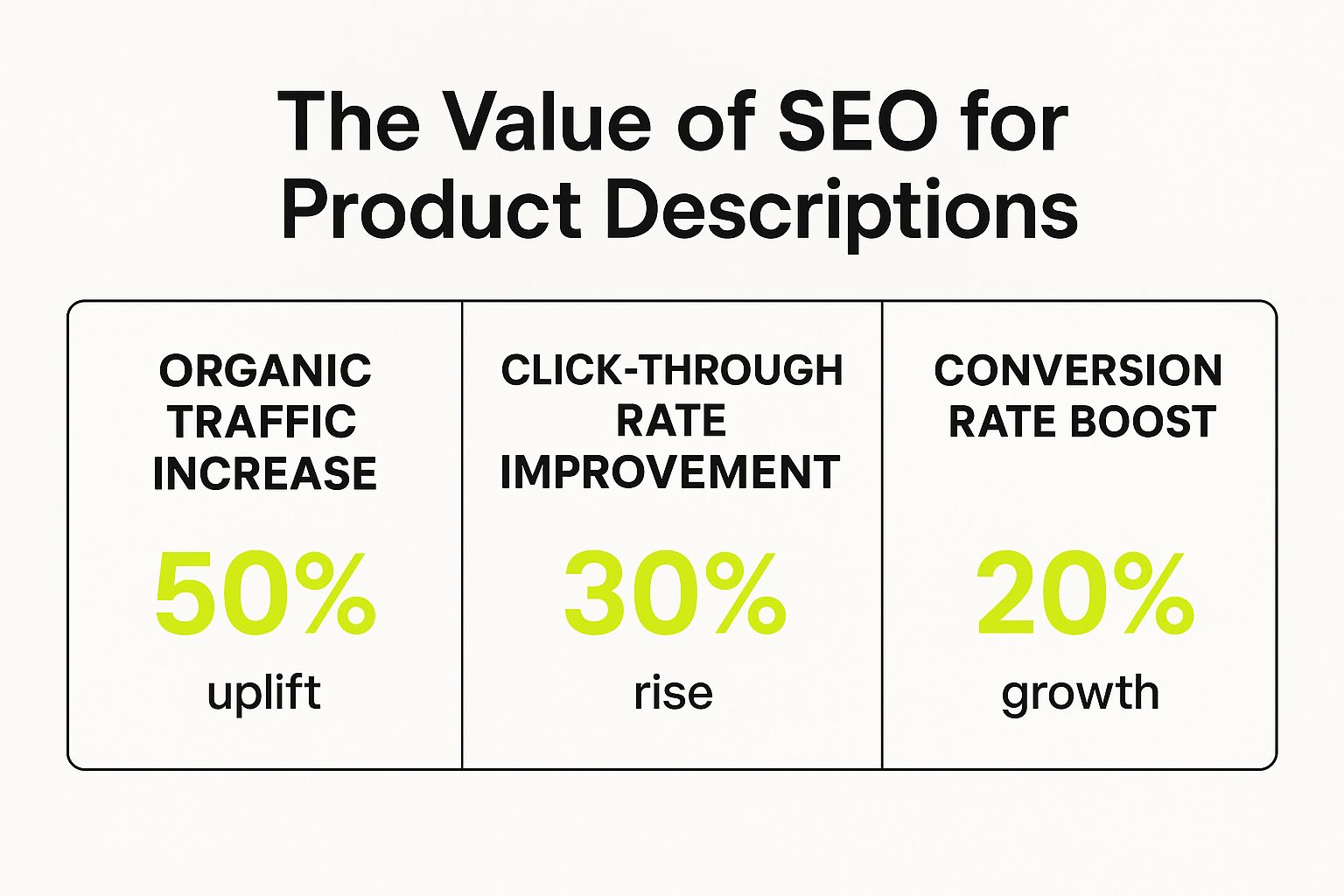
These metrics demonstrate the potential of SEO for product descriptions. Even small improvements can have a significant impact across your entire sales funnel. A 50% increase in organic traffic, along with a 30% rise in click-through rates and a 20% boost in conversions, shows how SEO-optimized descriptions can lead to tangible business growth. Product descriptions should be treated as strategically crafted marketing assets.
From Specifications to Sales Tools
Think of your product descriptions as miniature sales pitches. They highlight the unique benefits of your products and answer customer questions. This requires a shift in perspective. Move beyond simply listing technical specifications and embrace a customer-centric approach.
For example, instead of stating the dimensions of a bag, describe how much it can hold. Explain how easily it fits under an airplane seat. This practical information helps buyers envision using the product.
Strong SEO practices, such as using relevant keywords, help search engines understand your product and its target audience. This increases its visibility in relevant search results, leading to higher click-through rates and increased sales.
Optimizing descriptions with target keywords can substantially boost click-through rates. Studies show that URLs with target keywords have a 45% higher click-through rate. Longer, more specific keywords (10-15 words) get 1.76 times more clicks than single-word terms. Content over 3,000 words generally performs better in terms of traffic, shares, and backlinks. Find more statistics here: https://www.sixthcitymarketing.com/seo-facts-and-statistics/
Compelling, keyword-rich product descriptions transform product pages into powerful conversion engines. This improves search rankings and enhances the user experience, making it easier for customers to find and purchase products. Ultimately, this leads to a more profitable e-commerce business.
Finding Your Product's Perfect Keyword Ecosystem

Don't just cram keywords into your product descriptions. Think bigger. You need a strategic keyword ecosystem. This ecosystem should include a variety of search terms reflecting how customers search. This means knowing the difference between informational searches ("what is cold brew coffee?") and high-intent searches like "buy cold brew maker online." E-commerce SEO specialists succeeding in competitive fields grasp this critical difference.
Balancing Broad and Specific Keywords
A good keyword ecosystem balances broad terms with long-tail keywords focusing on specific product details. For instance, if you sell "organic cotton baby blankets," the broad term is "baby blankets." But long-tail keywords such as "organic cotton baby blanket with satin trim" attract buyers actively searching for those features. This nuanced approach ensures your product shows up in more relevant searches. For more about keyword strategy, check out ecommerce SEO best practices.
Uncovering Keyword Opportunities
Several tools and techniques can help you discover valuable keywords. Keyword research tools specifically for product SEO offer insights into search volume, competition, and related terms. Analyzing competitor product descriptions can also reveal keyword gaps and opportunities to stand out. Optimizing your website structure can also have a big impact on SEO. Here's a resource on how to master your site structure.
Organizing Your Keywords
After identifying your keywords, organize them into a scalable system. This system should work across your product catalog. A simple spreadsheet or a dedicated keyword management tool can help track and categorize your keywords. This keeps your SEO efforts consistent and efficient, especially with a large inventory.
Keyword Selection Framework
The following table helps you choose and use different keyword types in your product descriptions. It compares keyword types, their search volume, competition, and best uses.
| Keyword Type | Search Volume Characteristics | Competition Level | Best Uses in Product Descriptions | Example |
|---|---|---|---|---|
| Broad/Generic | High search volume | High competition | Use sparingly in titles and headings; good for category pages. | "Coffee Maker" |
| Long-Tail | Lower search volume | Lower competition | Ideal for body text; targets specific customer needs. | "Automatic Cold Brew Coffee Maker with Glass Carafe" |
| Product-Specific | Moderate search volume | Moderate competition | Use in titles, descriptions, and meta descriptions. | "12-cup Programmable Coffee Maker" |
| Brand-Specific | Varies depending on brand recognition | Low to moderate competition | Use when your brand is a significant search term. | "E-commerce Dev Group Shopify Design Services" |
| Synonym/Related | Varies | Varies | Expand reach by using related terms in body text. | "Coffee Machine," "Coffee Brewer" |
A strong keyword ecosystem doesn't just optimize for search engines. It creates a better experience for customers. This means greater visibility, higher click-through rates, and more conversions—driving sales and revenue for your business.
Crafting Product Content That Ranks and Converts

Great product descriptions do more than just satisfy search engines; they transform browsers into buyers. This involves balancing SEO requirements with engaging writing, a key differentiator for successful e-commerce brands. It's about attracting visibility and driving sales. Your product content needs to work for both search engines and people.
Turning Mediocre Descriptions into Compelling Content
Think "before and after." A mediocre product description simply lists features. A compelling one tells a story. It answers unspoken customer questions and shows how the product improves their life. This approach maintains keyword integrity while addressing real customer needs.
For example, instead of "stainless steel water bottle," describe its durability, 24-hour cold temperature retention, and sleek design. You might find this interesting: How to master your internal linking structure.
Frameworks for Keyword Integration
Naturally incorporating primary and secondary keywords is crucial for SEO for product descriptions. Keyword stuffing, however, hurts readability and user experience. Use a framework that strategically places keywords instead.
- Title: Include your primary keyword.
- First Paragraph: Introduce the product and its key benefit, using a secondary keyword.
- Body: Expand on benefits, addressing pain points, and using related keywords.
- Bullet Points: Highlight key features, naturally incorporating keywords.
This structure makes your content informative and SEO-friendly.
HTML Formatting: Enhancing Visibility and User Experience
HTML formatting impacts both search visibility and user experience. Search engines use HTML tags to understand content structure. Users appreciate well-formatted content that's easy to read. Optimizing your HTML is essential for conversions.
- Headers (H1-H6): Organize content and incorporate relevant keywords using headers.
- Bullet Points: Enhance readability by making key features easily digestible.
- Schema Markup: This structured data helps search engines understand content and display rich snippets, potentially boosting click-through rates.
These HTML elements improve how search engines and users interact with your product pages.
Example of Optimization
Let's say you're selling a "waterproof Bluetooth speaker." An optimized description might look like this:
Title: Waterproof Bluetooth Speaker: Enjoy Music Anywhere
Description: Take your music anywhere with our new waterproof Bluetooth speaker. This durable, portable speaker delivers crystal-clear audio, even when wet. It's perfect for pool parties, beach trips, or even singing in the shower. The long-lasting battery ensures the party never stops.
- Waterproof and dustproof design for worry-free outdoor use.
- Crystal-clear audio with powerful bass.
- Long-lasting battery for hours of playtime.
- Bluetooth 5.0 for seamless connectivity.
Optimizing product descriptions is essential for e-commerce success. By focusing on both SEO and user experience, you'll create content that ranks high and converts browsers into buyers.
Mobile-First Optimization for Product Pages
Most customers today shop on their mobile devices. This means your product pages need to be designed for smaller screens and faster interactions. Simply shrinking down your desktop content won't work. This section explores the key aspects of mobile-first optimization for product descriptions, balancing a smooth user experience with effective SEO.
Prioritizing Content for Smaller Screens
Mobile users need information quickly. Put the most important details, like the product title, price, and a clear call to action, at the very top of the page. Consider what information a user needs immediately to make a purchase and make that information readily available.
Enhancing Scannability on Mobile
Mobile screens require easily digestible content. Break up long paragraphs into shorter sentences. Use bullet points to highlight key features and benefits. This improves scannability, allowing users to quickly find what they need. Writing effective product descriptions is a vital part of SEO. Learn more about writing irresistible product descriptions. Focus on making information accessible and easy to understand.
Maintaining Keyword Relevance Across Devices
While keeping things concise on mobile is essential, don't sacrifice keyword relevance. Incorporate your main and supporting keywords naturally within the product title, headings, and body text. Limited space doesn't mean you can't use targeted keywords within your product copy. This is crucial for strong SEO performance on mobile.
Optimizing for Mobile-Specific Behaviors
Mobile users often use voice search and visual search. Optimize your descriptions for these behaviors. Use conversational language, mirroring how people speak when using voice search. For visual search, use high-quality images that accurately represent the product. Mobile optimization is critical. 92.3% of users access the internet via mobile devices, highlighting the importance of easy-to-read descriptions on smaller screens. Interestingly, 95% of the keyword database receives fewer than 10 searches per month, suggesting that focusing on long-tail keywords can be a smarter strategy. As search trends shift towards voice and visual search, businesses need to adapt. Explore this topic further: Find more detailed statistics here.
Example of Mobile Optimization
Consider selling a "portable Bluetooth speaker." A mobile-optimized description might look like this:
Title: Portable Bluetooth Speaker – Loud, Clear Sound On the Go
Description: Enjoy powerful audio anywhere with our portable Bluetooth speaker. Perfect for outdoor adventures, it’s rugged and water-resistant.
- Crystal-clear audio
- Water-resistant design
- Long-lasting battery
- Bluetooth 5.0 connectivity
By adapting your product description SEO strategy for the mobile-first world, you can ensure your products reach customers where they are—on their smartphones. This optimized approach improves the customer journey and can lead to higher engagement and conversions.
Leveraging AI to Scale Your Product Content Strategy

More and more e-commerce businesses are using Artificial Intelligence (AI) to create effective product descriptions efficiently. AI tools can significantly impact your product content strategy, allowing you to produce large volumes of content without losing your brand's unique voice. The key is finding the right balance between AI's efficiency and human creativity.
This field is constantly evolving, and the latest statistics highlight the growing importance of AI in content creation and SEO for product descriptions. By 2025, 19% of the top 20 Google search results were AI-generated, a dramatic increase from just 2.3% in 2020. Plus, 91% of digital marketers have already integrated AI into their content strategies. Using AI for product descriptions can significantly streamline content production while ensuring your content aligns with SEO best practices. For more insights into AI's role in content creation, check out these statistics: Learn more about AI in content creation.
Using AI for First Drafts and Quality Improvement
AI is excellent for generating initial product descriptions quickly. Simply input basic product information, and the AI can create a starting point, often incorporating relevant keywords. This frees up your human writers to focus on adding the persuasive language, brand-specific details, and emotional appeal that resonate with customers. AI can also improve the quality of existing descriptions. By analyzing your content, it can suggest improvements to readability and keyword density. This approach combines the speed and efficiency of AI with the nuance and creativity of human writers. You might also find this helpful: How to master your sitemap structure.
SEO Enhancement Across Your Catalog with AI
AI tools can analyze your entire product catalog to find areas for SEO improvement. They can identify and suggest relevant keywords, detect duplicate content issues, and even analyze what your competitors are doing. For instance, AI can identify which long-tail keywords are driving traffic to your competitors and then suggest how you can integrate those keywords into your own product descriptions. This strategic approach allows you to target the right keywords across your entire product range, ensuring consistent SEO best practices.
To help illustrate the strengths and weaknesses of different AI tools for product description SEO, let's take a look at the following comparison:
AI Tools Performance Comparison for Product Description SEO
Evaluation of popular AI content tools specifically for product description creation and optimization
| Tool Name | Best Features for Product Descriptions | SEO Capabilities | Learning Curve | Cost Range | Best For |
|---|---|---|---|---|---|
| (Example Tool 1) | Bulk generation, keyword integration | Keyword analysis, competitor analysis | Easy | $X – $Y | Large catalogs |
| (Example Tool 2) | Brand voice customization, long-form descriptions | Content optimization, readability analysis | Moderate | $A – $B | Brand-focused businesses |
| (Example Tool 3) | Multilingual support, image tagging | International SEO, image optimization | Moderate | $C – $D | Global brands |
This table provides a general overview, and specific features and pricing may vary. It's important to research each tool thoroughly to determine the best fit for your needs. Choosing the right AI tool can significantly impact your content creation workflow and SEO results.
Balancing AI and Human Expertise
While AI is a powerful tool, human input remains crucial. AI can handle the technical aspects of SEO for product descriptions, but it can't replicate the creative writing and brand voice that connects with customers on an emotional level. Humans excel at crafting compelling narratives, highlighting unique product benefits, and tailoring the message to resonate with specific target audiences.
Maintaining Brand Consistency with AI Assistance
When using AI, maintaining a consistent brand voice is paramount. This means training the AI on your existing product descriptions and providing detailed style guides. Regular quality control checks are also essential to catch any inconsistencies or errors. Develop a clear process for human review and editing of AI-generated content to maintain brand integrity.
Quality Control and Conversion Potential
Finally, focus on practical quality control measures. Regularly review AI-generated content to ensure it meets your brand standards and effectively conveys your product's value. Track your results, paying attention to key metrics like click-through rates and conversion rates to understand how AI is impacting your SEO for product descriptions. This data-driven approach allows you to fine-tune your strategy and maximize your return on investment.
Measuring Success: The Metrics That Actually Matter
Traffic to your product pages is a good start, but it doesn't mean much if it doesn't lead to sales. This means looking beyond superficial metrics and focusing on Key Performance Indicators (KPIs) that directly impact revenue growth. Understanding how successful e-commerce businesses measure their achievements can help refine your SEO for product descriptions strategy for maximum results.
Connecting SEO Efforts to Real Sales Data
The core principle is linking your organic search performance with your actual sales figures. This involves setting up tracking systems to monitor how changes in your product descriptions influence your key metrics. For example, if you adjust the description for a specific product, you should be able to monitor how that change affects organic traffic, Click-Through Rate (CTR), and most importantly, Conversion Rate for that product. This detailed tracking helps identify which content updates drive the best outcomes.
Key Performance Indicators (KPIs) to Track
Here are the most critical metrics to monitor when evaluating the success of your product description SEO:
-
Organic Search Traffic: While not the only indicator of success, a consistent rise in organic traffic to your product pages suggests your SEO strategy is working.
-
Click-Through Rate (CTR): This metric indicates how appealing your product titles and descriptions are in search results. A higher CTR signifies your content effectively attracts users to click and explore further.
-
Conversion Rate: This is the ultimate measure of success, showing the percentage of product page visitors who actually purchase.
-
Bounce Rate: A high bounce rate could suggest your product descriptions aren't meeting expectations or the page isn't user-friendly, especially on mobile.
-
Average Order Value (AOV): Well-crafted descriptions can influence how much customers spend per order, particularly if they highlight related products or upsells.
A/B Testing for Continuous Improvement
A/B testing is essential for ongoing optimization. By creating two slightly different versions of a product description and tracking their performance, you can determine which version performs better in terms of CTR and conversions. This data-driven method lets you continually refine content and improve results. You might experiment with different keyword placements, calls to action, or the overall tone of the description.
Setting Realistic Benchmarks
Establish realistic benchmarks for your KPIs based on your specific industry, product type, and competition. Comparing your performance to industry averages helps understand your position and identify areas for improvement. Your targets should align with your business goals and projected growth.
Measuring Beyond the Immediate Sale
While immediate sales are the primary focus, consider long-term metrics as well. Customer reviews and social media shares can indicate how well your descriptions resonate with your audience. These factors contribute to long-term brand building and customer loyalty, ultimately driving future sales.
Ready to improve your Shopify store's sales performance? E-commerce Dev Group offers expert Shopify design, development, and support services to help you optimize product descriptions and achieve significant business growth. Visit us today at https://scaleshopify.com to learn more.
