

So, you want to write a newsletter. It really comes down to a few key things: figuring out your audience and your "why," creating content people actually want to read, crafting subject lines they can't ignore, and then keeping an eye on your results. If you can nail these, you'll have a newsletter that people look forward to, not just another email clogging up their inbox.
Find Your Niche and Define Your Purpose

Before you even think about writing, you need a plan. Seriously. The newsletters that stick around aren't trying to be everything to everyone. They have a specific audience and a clear purpose. This is the bedrock of a newsletter that lasts versus one that flames out after a few issues.
Think about it. A generic "business tips" newsletter is just noise. But what about a newsletter for "first-time Shopify merchants struggling with inventory management"? Now that carves out a specific space and grabs the attention of the right people.
Identify Your Ideal Reader
Who are you actually talking to? Get specific. "Small business owners" is way too broad. Think about their industry, their biggest headaches, and what’s keeping them up at night. The better you understand their problems, the more your content will hit home.
Having a crystal-clear picture of your reader becomes your guidepost for every single content decision. This clarity is absolutely crucial when you’re learning how to write a newsletter that feels like it was written just for them.
Set Clear and Measurable Goals
Your newsletter needs a job. What's the main thing you want it to accomplish? Don't try to do it all at once. Pick one primary goal, and let that shape your content and your calls to action.
A few common goals you could focus on:
- Driving Sales: This is all about promoting products, announcing sales, or sharing exclusive offers.
- Building Community: You want to create a space where your subscribers feel like they belong and can interact with each other.
- Establishing Authority: Your aim is to become the go-to expert in your field by sharing valuable insights.
- Increasing Website Traffic: The goal here is simple: get people to click through to your blog posts, new products, or landing pages.
Before you start writing, it’s helpful to map out these core elements. Think of this as your newsletter’s business plan.
Core Components of a Newsletter Strategy
| Component | Key Question to Answer | Example |
|---|---|---|
| Audience | Who is my ideal subscriber? | "New e-commerce store owners using Shopify." |
| Purpose/Goal | What is the #1 thing I want my newsletter to do? | "Drive traffic to our latest blog posts about e-commerce growth." |
| Value Prop | Why should someone give me their email address? | "Weekly, actionable tips to grow a Shopify store from 0 to 100 orders." |
| Frequency | How often can I realistically send quality content? | "Every Tuesday morning." |
Getting these things straight from the get-go will save you a ton of headaches down the road and make your content planning so much easier.
It's no secret that email is a big deal. The global email marketing market was valued at $11.5 billion in 2023 and is expected to balloon to $46.1 billion by 2033. That’s huge. It shows that while people are willing to subscribe, they’ll hit that "unsubscribe" button in a heartbeat if the content isn't genuinely useful.
Your newsletter's "why" is its most powerful asset. It's the reason people subscribe, the reason they stay, and the reason they'll eventually trust you enough to become a customer or a brand advocate. Define it before you do anything else.
Create Content That Builds a Loyal Audience
Alright, you've got your strategy sketched out. Now for the fun part—and arguably the most important—creating content that actually gets people excited to see your name pop up in their inbox. This is where you transform from just another email to a trusted voice.
Think about it this way: your content is a promise. If you told people they’d get "weekly tips for first-time Shopify merchants," then every single email better deliver on that. Consistency isn’t just about hitting "send" every Tuesday; it's about consistently delivering the value your audience signed up for.
Brainstorming Ideas That Actually Resonate
Feeling the pressure to come up with brilliant ideas every week? Don't. Your audience is giving you hints all the time. You just need to know where to look.
Spend some time lurking where your audience hangs out. What questions are they asking on social media? What are they complaining about on Reddit or in Facebook groups? Every single question is a neon sign pointing to a pain point, and every pain point is a potential newsletter topic.
The best newsletter content doesn't just inform; it solves a specific, nagging problem for a specific person. If you frame every piece of content as a solution, you’ll never run out of valuable things to say.
Ultimately, building that loyal following comes down to learning how to write compelling content that makes your readers feel seen and understood. That’s what turns a casual skimmer into a die-hard fan.
Structuring Your Content for Easy Reading
Let's be real: nobody wants to squint at a giant wall of text on their phone. How you structure your newsletter is just as critical as the words you choose. You have to make it scannable.
Here are a few simple formats that work wonders:
- The Deep Dive: Focus the entire newsletter on one meaty topic. This is perfect for detailed tutorials, insightful case studies, or a personal story that needs room to unfold.
- The Curated Roundup: Act as a filter for your audience. Share a handful of the best articles, tools, or resources you've discovered, but add your own short take on why each one is worth their time.
- The Quick Win: Offer one simple, powerful tip your readers can use right away. This format is fantastic for building a reputation as someone who delivers immediate, tangible value.
No matter which format you pick, always start with a killer hook. Your first sentence has to grab them and make it clear why they should invest the next few minutes with you.
Finding Your Authentic Voice
Your personality is your secret weapon. People don't just subscribe for information; they subscribe for you. Don't hide behind stiff, corporate-speak.
Write like you talk. Imagine you're writing to a single friend over coffee. That conversational, one-to-one feeling is what builds a genuine connection that no algorithm can touch.
The sheer scale of email is staggering. By 2027, the world is projected to have 4.89 billion email users. And creators are jumping on this opportunity. Platforms like beehiiv saw their email volume skyrocket from 402 million to 15.6 billion in just one year. This isn't just a trend; it's a massive shift toward creators building direct relationships with their audiences.
Write Subject Lines That Get Your Emails Opened
Let's be honest: your subject line is the single most important sentence in your entire newsletter. If it doesn't stand out in a jam-packed inbox, all that incredible content you poured your heart into will never see the light of day. It's your one and only first impression.
The goal here isn't to dupe people with cheap clickbait. It’s about crafting something so genuinely compelling that opening your email feels like the natural next step. In the long run, authenticity always beats flashy, empty promises.
Spark Curiosity and Show Your Value
Think of your subject line as the teaser trailer for your newsletter. You want to hint at the awesome stuff inside without giving away the whole plot. The sweet spot is a blend of genuine curiosity and a clear benefit for the reader.
So, instead of a snooze-worthy subject like "This Week's Newsletter," get specific. If you’re sharing productivity hacks, a subject like "My 5-minute trick for a focused afternoon" immediately promises a real, tangible outcome.
A subject line’s job is to make a promise that the content of the email fulfills. When you get that alignment right, your open rates will climb, and more importantly, your reader's trust in you will grow.
Numbers are also your best friend here. They make your claims feel more concrete and believable. For example, "How I grew my audience by 25% with one simple change" is way more persuasive than a vague "How to grow your audience."
Master the Art of Personalization
Personalization is so much more than just dropping in a {{firstName}} tag. Real personalization shows your subscribers you actually get them—their interests, their struggles, their needs. In fact, subject lines with this kind of thoughtful personalization can boost open rates by a whopping 26%.
Imagine you run an e-commerce shop. If you know a customer was browsing a specific product category, you could send an email with the subject: "Still thinking about those hiking boots? Here's what you need to know." It’s a simple touch that proves you’re paying attention.
Of course, this all hinges on having good data. As you learn how to write a newsletter, make a point to segment your audience based on their behavior, past purchases, or stated interests.
Need a few proven formulas to get you started?
- The Question: "Are you making this common email mistake?" This makes people pause and reflect.
- The How-To: "How to finally find your next great business idea." This directly promises a solution.
- The Scarcity: "Just 24 hours left for our biggest sale." This creates a little healthy urgency.
But remember, getting the open is just the first hurdle. To truly understand if your message is hitting home, you need to look beyond open rates. Measuring your Click to Open Rate (CTOR) gives you a much clearer picture of how engaging your content really is. It tells you if the promise you made in your subject line actually paid off once they got inside.
Design Your Newsletter for Readability and Impact
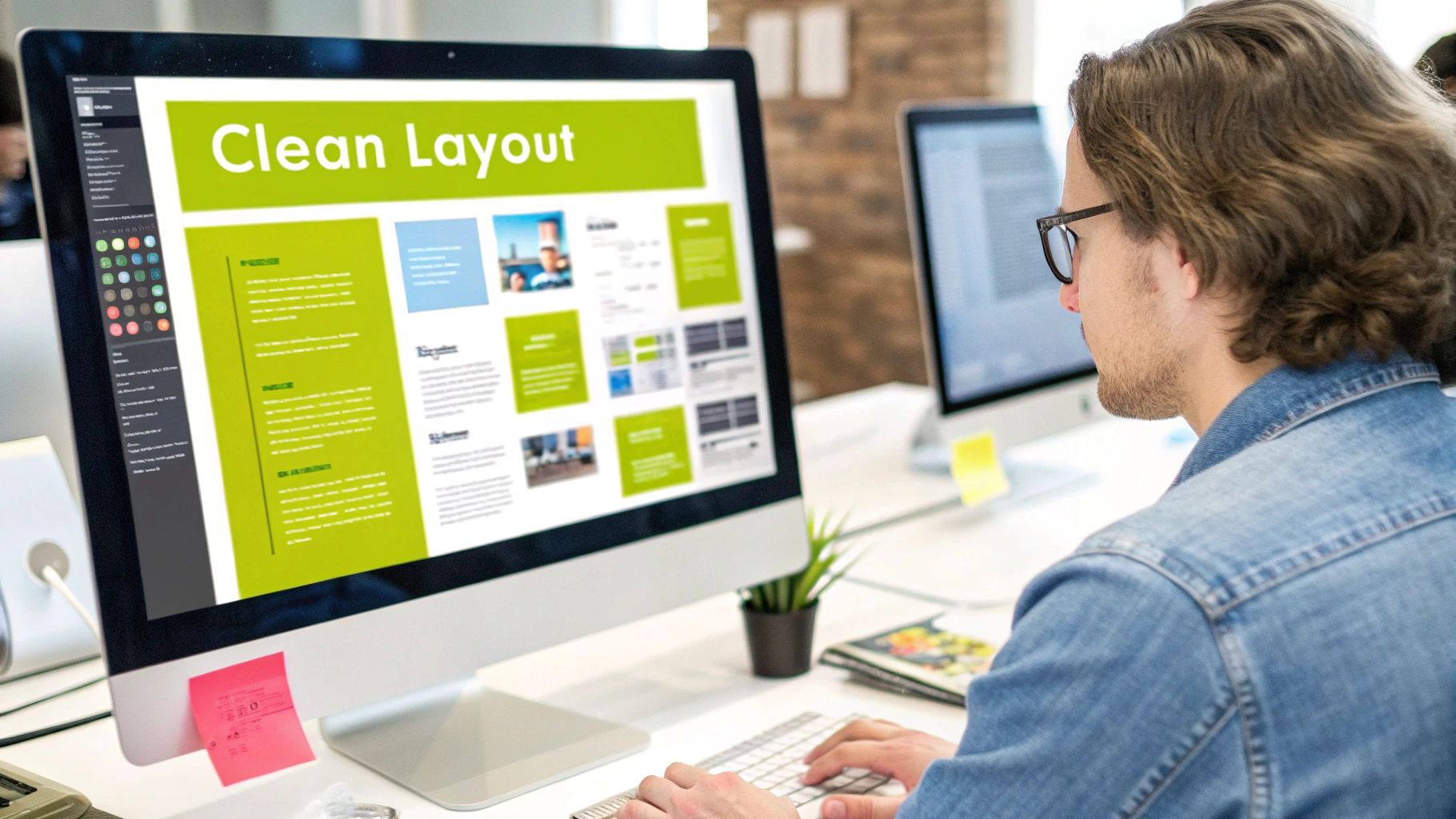
Even the most brilliant writing will fall flat if it's trapped in a clunky, hard-to-read design. The layout of your newsletter isn't just about aesthetics; it’s about making your message easy to absorb. A clean, scannable format respects your reader's time and ensures your hard work gets noticed.
The truth is, people don't read emails word-for-word—they scan. This is especially true on mobile, which is now the primary way most of us check our inboxes.
Prioritize a Mobile-First Layout
Thinking "mobile-first" isn't just a suggestion anymore; it's a requirement. Nearly 60% of all emails are opened on a mobile device, so a design that isn’t responsive is a design that’s broken from the start.
On top of that, you’re working with a tiny window of opportunity. Most people spend an average of just 10 seconds reading an email from a brand. Your layout has to get to the point, fast. This means centering your design choices on clarity and speed—think single-column layouts, large fonts, and buttons that are easy to tap with a thumb.
Don’t make your readers pinch and zoom. A great mobile design feels effortless, letting your content flow naturally on any screen size. This one consideration can dramatically improve your engagement rates.
Embrace White Space and Scannable Formatting
A crowded design is an overwhelming one. White space, which is simply the empty area around your text and images, is one of the most powerful tools in your design arsenal. It gives your content room to breathe and helps guide the reader's eye from one element to the next.
To make your content easy to scan, break up those big walls of text with a few simple tricks:
- Clear Headings: Use bold, descriptive headings and subheadings to signal what each section is about. This lets readers jump right to the information they care about most.
- Bulleted Lists: Lists, just like this one, are perfect for breaking down ideas, highlighting key features, or summarizing takeaways in a digestible way.
- Strategic Images: A well-placed image or GIF can do wonders. It breaks up the text, adds visual interest, and can reinforce your message in a split second.
Mastering these foundational email design best practices is the key to creating a polished newsletter that people actually enjoy reading. At the end of the day, a functional design respects your reader’s time and makes your content shine.
Choose Your Tools and Grow Your Subscriber List
With your strategy mapped out and your content ideas brewing, it’s time to tackle the tech side of things. All the brilliant writing in the world won’t do much good without a solid system to send your newsletters and a growing list of people who actually want to read them. This is where your Email Service Provider (ESP) comes in.
Think of an ESP as your newsletter's mission control. It's the platform you'll use to manage subscribers, design your emails, and send them out. More importantly, it gives you the data you need to see what’s hitting the mark and what’s falling flat.
Selecting the Right Email Platform
Choosing an ESP really boils down to your specific needs right now.
If you're just starting out, platforms like Mailchimp or ConvertKit are fantastic. They have clean, intuitive interfaces and free plans that are perfect for getting your feet wet. They handle all the basics, so you can just focus on creating great content.
Once you’ve got some momentum, you might find you need more horsepower. Established businesses or creators often require sophisticated automation and segmentation. Tools like Klaviyo or ActiveCampaign offer the ability to build complex email sequences and tag subscribers based on their actions, letting you send incredibly personalized content. This level of detail is a game-changer if your newsletter is a key part of your sales funnel.
My two cents: Don't get paralyzed trying to pick the "perfect" platform for the next five years. Your first ESP doesn't have to be your forever ESP. Start with something simple that fits your budget and current needs. You can always migrate to a more powerful tool as your list—and your ambitions—grow.
Here's a quick look at how features stack up between platforms built for beginners versus those designed for more advanced users.
Email Platform Feature Comparison
Picking the right tool depends on balancing ease of use with the powerful features you'll need as you grow. This table breaks down what you can generally expect from different types of platforms.
| Feature | Beginner-Friendly Platform | Advanced Platform |
|---|---|---|
| User Interface | Simple, drag-and-drop editors. Minimal learning curve. | More complex, feature-rich interface. May require some training. |
| Automation | Basic welcome series and simple automated emails. | Complex, multi-branching workflows based on user behavior. |
| Segmentation | List-based or simple tag-based segmentation. | Deep segmentation using purchase history, site activity, etc. |
| Analytics | Core metrics: open rates, click-through rates, unsubscribes. | In-depth reporting, revenue attribution, A/B testing. |
| Pricing | Often has a free tier for a limited number of subscribers. | Tiered pricing based on list size and feature access; no free plan. |
| Integrations | Connects with major platforms and tools. | Extensive integrations, especially with e-commerce and CRM systems. |
Ultimately, the best platform is the one that lets you execute your strategy without getting in your way. Start simple and scale up when you're ready.
Smart Strategies for List Growth
Now for the other crucial piece of the puzzle: growing your subscriber list. The goal here isn't just about getting a bigger number—it’s about attracting the right people who are genuinely interested in what you have to say. The best way to do that is by offering something of real value in exchange for their email address.
A lead magnet is the classic tool for this. It's a free, valuable resource you give away to entice sign-ups.
Some lead magnets that work really well are:
- A simple, one-page PDF checklist.
- An exclusive video tutorial that solves a common frustration.
- A free template or worksheet they can use immediately.
- A multi-day email course that drips out helpful content.
Your website is the prime real estate for capturing these subscribers. Make sure you have clear, simple sign-up forms in high-traffic areas like your blog's sidebar, at the end of every post, and in your site's footer. Don't make people jump through hoops—a name and email are all you need to get the conversation started.
Thinking about what keeps subscribers engaged is just as important as getting them on the list in the first place. For example, the length of your newsletter can have a huge impact.
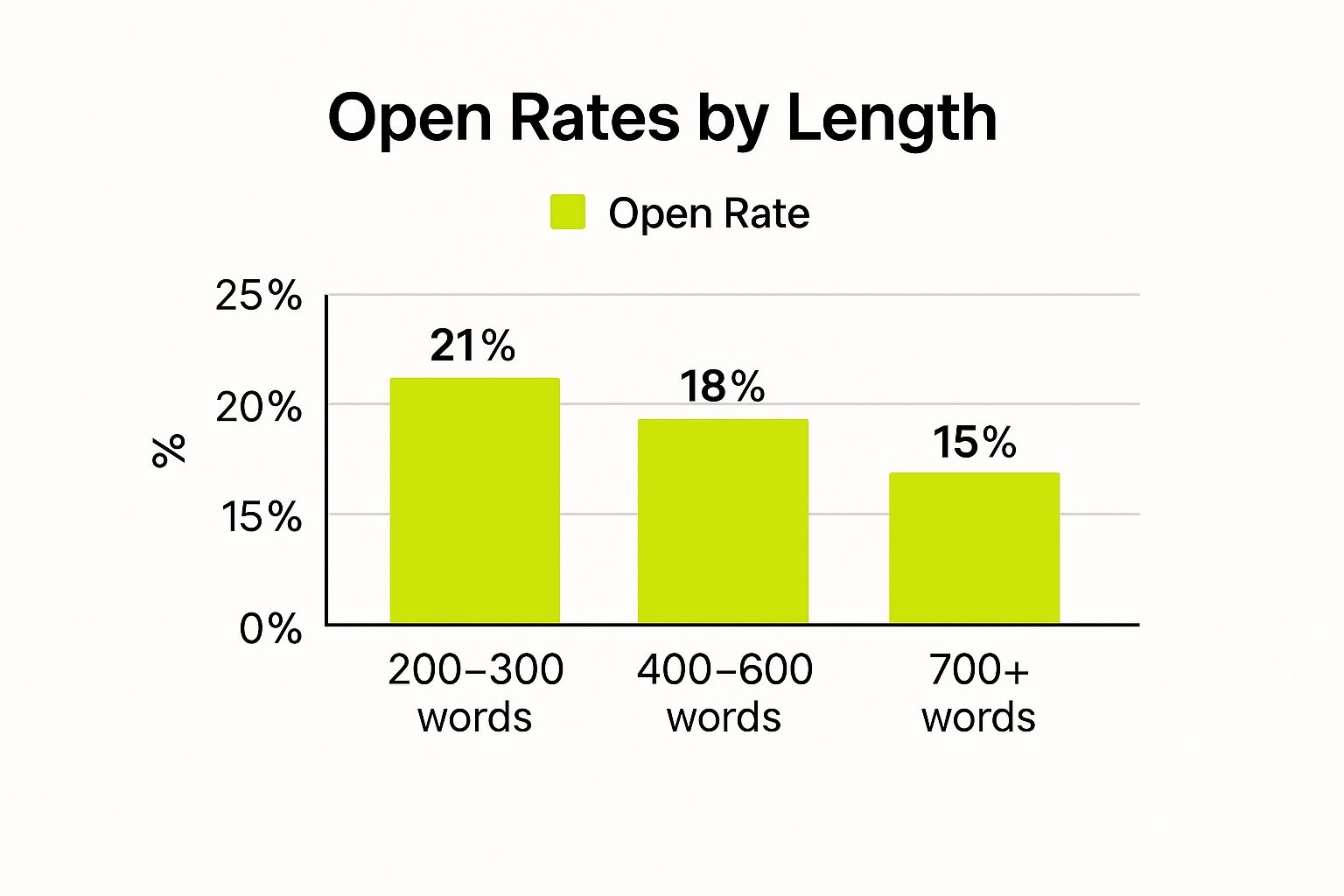
As you can see, the data suggests that shorter, punchier emails often get better engagement. It's a good reminder to get straight to the point and deliver value quickly.
For anyone running a Shopify store, building an engaged email list is a direct line to more repeat business. It’s how you turn a one-time buyer into a loyal fan. We dig into more tactics like this in our guide on how to increase Shopify sales.
Common Questions About Writing a Newsletter
Even with the best game plan, you’re going to have questions once you start building your newsletter. It’s just part of the process.
Let’s tackle some of the most common hurdles people run into. Here are some quick, straightforward answers to keep you on track.
https://www.youtube.com/embed/8OnOtCim8Oc
How Often Should I Send My Newsletter?
The golden rule here is consistency over intensity.
It’s way better to send one fantastic newsletter every month like clockwork than to blast out weekly emails for a month and then go silent for two. An inconsistent schedule just confuses your readers and kills your engagement.
Start with a pace you know you can handle. For most people, that’s bi-weekly or monthly. You can always ramp it up later if you find your groove and your audience is asking for more.
What Is a Good Open Rate?
Open rates can seem like a vanity metric, but they're a decent pulse check for your newsletter's health. What’s considered “good” really depends on your industry, but a solid benchmark to aim for is somewhere between 20% and 30%.
But don't get obsessed with that number.
If you have a smaller list of die-hard fans, an open rate of 40% or higher is totally achievable. The key is to track your own average and focus on nudging it upward with better subject lines and content that truly resonates.
Don't just chase opens. Focus on creating value that earns them. A subscriber who opens every email because they trust you is infinitely more valuable than ten who open out of fleeting curiosity.
How Long Should a Newsletter Be?
There's no magic word count. The right length is all about your audience and what you’re trying to deliver.
Some of the most popular newsletters out there are just a few hundred words—one single, powerful idea. Others are deep dives that feel more like essays.
My advice? Be as long as you need to be to deliver on the promise of your subject line, and not a single word longer. Respect your reader’s time. If you can make your point in 300 words, don't pad it out to 800.
Can I Make Money with a Newsletter?
Absolutely. Making money from your newsletter is a very realistic goal, but it usually happens after you’ve built an audience that trusts you. You can't just start selling on day one. Your first priority should be to provide incredible value for free.
Once you’ve built that foundation, here are a few ways to monetize:
- Affiliate Marketing: Recommend products or services you actually use and love. You'll earn a commission when people buy through your link.
- Selling Your Own Products: This is the most direct path. Offer your own courses, digital downloads, or services to your subscribers. For store owners, this is a great way to improve things like eCommerce onsite search by seeing which products get the most clicks.
- Paid Subscriptions: Offer exclusive, premium content to paying subscribers. This model works best when you have a loyal, established audience.
- Sponsorships: Once you have a decent-sized list, brands will pay to get in front of your audience.
Building a great newsletter is a marathon, not a sprint. If you focus on quality, stay consistent, and build a genuine connection with your readers, you'll create something that serves both your audience and your business for years to come.
Ready to build an eCommerce store that not only looks incredible but also drives sales? The experts at E-commerce Dev Group specialize in custom Shopify design, development, and optimization. Let us help you build the store of your dreams.
