


Writing a newsletter that people actually want to read comes down to four things: defining your foundation, crafting valuable content, designing it for easy reading, and then, finally, growing your audience. Get this right, and you're not just sending another email. You're building a direct line to your people, far away from the whims of social media algorithms.
Building Your Newsletter Foundation
Before you even think about a catchy subject line, there's some essential groundwork to do. A great newsletter isn't just about a clever name or a pretty template; it's built on a rock-solid strategic foundation.
This initial planning is all about answering the "why." Why should someone let you into their already-crowded inbox? Nailing this down is the difference between an email that gets instantly deleted and one that people look forward to opening. Without this blueprint, you're just guessing.
Define Your Core Purpose and Audience
First things first: what's the one big goal for this newsletter? Are you trying to drive traffic to your blog? Sell products? Position yourself as an expert in your niche? Or maybe you just want to build a tight-knit community. Whatever it is, be specific. This single goal will be your north star for every piece of content you create.
Once you have your goal, you need to get crystal clear on who you're writing for. And I mean really clear. Forget basic demographics. Dig deeper and ask yourself:
- What are their biggest struggles, either professionally or personally?
- What podcasts, blogs, or other newsletters are already in their rotation?
- What unique angle or value can I bring that they can't find anywhere else?
For instance, if you're writing for Shopify store owners, don't just talk about "e-commerce." Get into the nitty-gritty. Talk about real problems they face, like tackling cart abandonment, boosting conversion rates, or the finer points of Shopify theme customization. Content that solves specific problems is instantly more valuable.
The true magic of a newsletter is the direct connection you build with your subscribers. There's no algorithm deciding who sees your work. It's a healthier, more sustainable way to grow a loyal audience.
This simple flow chart really breaks down how to get your foundation in place.
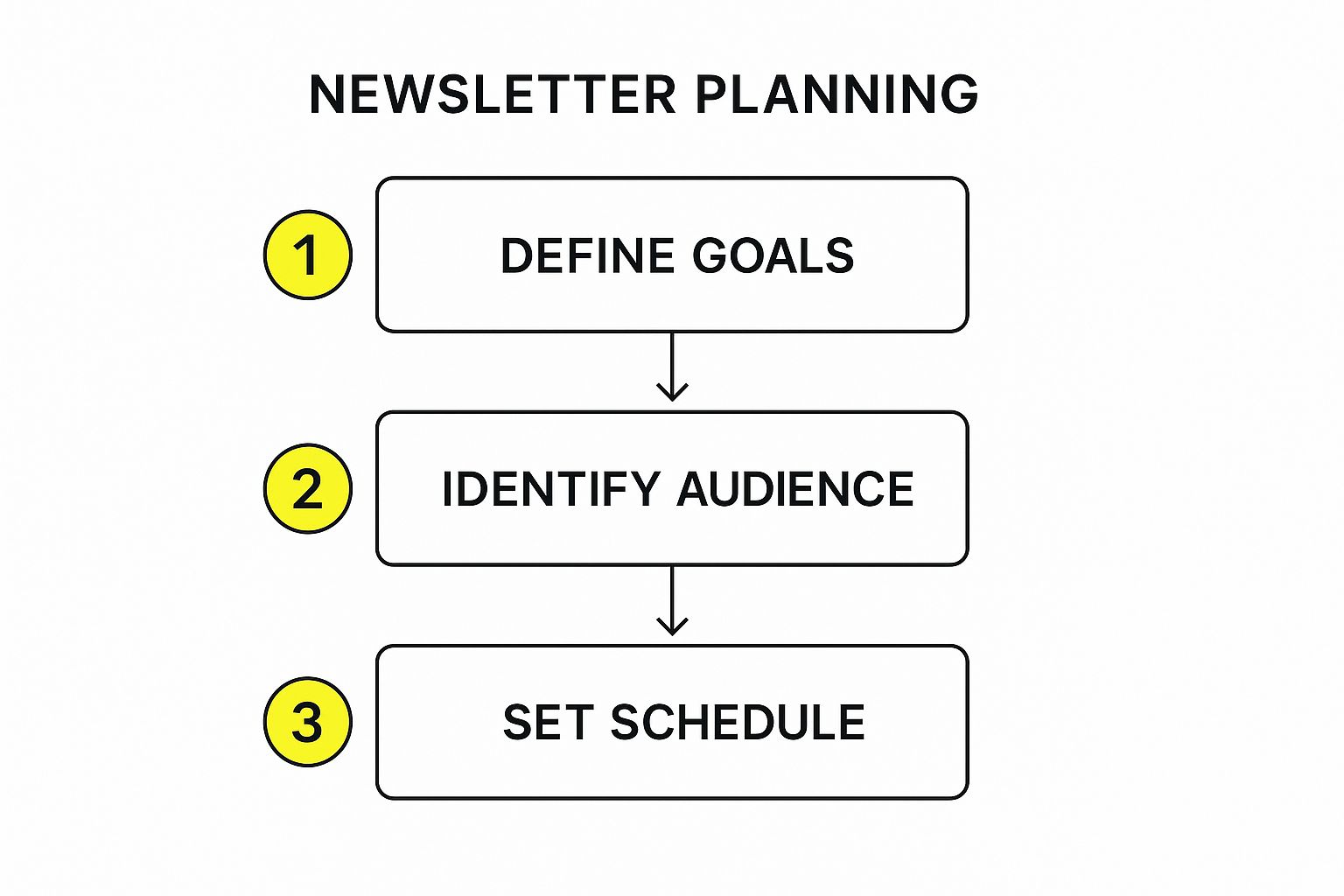
As you can see, moving logically from your goals to your audience and then to your schedule creates a workflow you can actually stick with.
Before you dive in, it helps to formalize these foundational elements. This simple checklist will ensure you have a clear strategy from day one.
Newsletter Foundation Checklist
Use this checklist to define the core strategic elements before launching your newsletter.
| Element | Key Question to Answer | Example |
|---|---|---|
| Primary Goal | What's the #1 outcome I want from this newsletter? | Drive qualified traffic to my new blog posts. |
| Target Audience | Who is my ideal reader, and what are their specific pain points? | Early-stage SaaS founders struggling with user acquisition. |
| Unique Value | What can I offer that they can't get elsewhere? | Actionable, no-fluff growth tactics from my own startup experience. |
| Tone of Voice | How do I want to sound? | Casual, expert, and slightly irreverent—like a knowledgeable friend. |
| Publishing Cadence | What schedule can I realistically maintain for a year? | Bi-weekly on Tuesday mornings. |
Taking just 30 minutes to fill this out will save you hours of confusion down the road and keep your content focused and effective.
Set a Realistic Schedule and Choose Your Platform
Consistency is everything. I've seen so many newsletters fizzle out because the creator aimed too high and burned out. It's far better to send a high-quality monthly newsletter than a rushed, sloppy weekly one. Pick a schedule you can genuinely commit to for the long haul—whether that’s weekly, bi-weekly, or monthly.
There's a reason email is still king. With an expected 4.89 billion email users worldwide, newsletters give you a direct channel to a massive audience. That's a level of reach and control you just don't get on other platforms. You can explore more on the state of email newsletters with beehiiv if you want to nerd out on the data. The bottom line? Owning your audience list is one of the smartest moves you can make.
Crafting Content That Connects

With your foundation in place, it’s time to get to the good stuff: the content. This is where you shift from being just another email in a crowded inbox to a welcome guest. The secret isn't some magic formula, but simply a commitment to being genuinely useful, time and time again.
Your real goal is to create something people actually want to read. Whether you're teaching, entertaining, or sharing a fresh perspective, every single email should remind them why they signed up. A big part of that is sounding like a real person, not a faceless brand.
Find Your Authentic Voice
The newsletters that truly stick are the ones that feel human. Think about your favorite writers—they have a distinct personality that comes through in their words. Are you the witty, informal friend? The sharp, data-driven analyst? Or the warm, encouraging mentor?
There's no single "right" voice, but it absolutely has to be genuine to you and what your audience expects. If you're selling quirky cat toys on Shopify, a stiff, corporate tone is going to fall completely flat. On the other hand, if you're giving advice on high-stakes B2B sales, you’ll want to be professional, yet still approachable and human.
Your voice is your unique fingerprint. It's the reason someone chooses to read your take on a topic when there are thousands of others available. Don't be afraid to let your personality show; it’s your greatest asset in building a real connection.
Authenticity is the bedrock of trust. When your readers feel like they know the person behind the newsletter, they're far more likely to open, read, click, and eventually, buy from you.
Structure Your Content For Scanners
Let's be honest: people don't read emails word-for-word. They scan. Your job is to make your newsletter incredibly easy to digest, even for someone scrolling on their phone while waiting for their morning coffee.
Here are a few content formats I've seen work exceptionally well time and again:
- The Personal Story: Pull back the curtain and share a real challenge you overcame, a lesson you learned the hard way, or a recent win. People connect with stories, not just stats.
- Curated Links: Be the expert filter for your audience. Find the most interesting articles, tools, or resources in your niche and, most importantly, explain why they matter. You save them time and build your authority.
- The Deep Dive: Pick one specific topic and go all in. This could be a detailed tutorial, a fascinating case study, or a sharp analysis of a new trend. This format screams expertise and delivers massive value.
Mixing these formats up keeps things interesting. To help structure your messages and guide subscribers effectively, you can get a head start with proven lead nurturing email templates. They provide a solid framework for crafting emails that get results.
Get Personal and Prompt Action
Today's best newsletters go way beyond just dropping in a subscriber's first name. Real connection comes from sending content that feels like it was written just for them. This move toward hyper-personalization is no longer a "nice-to-have"—it's essential for cutting through the noise.
In fact, newsletters that dynamically change based on a reader's interests and behavior can see open rates jump by up to 29% and click-through rates by 41%.
Finally, every newsletter needs a point. What's the one thing you want your reader to do after reading? Your call-to-action (CTA) should be crystal clear and singular. Don't overwhelm them with a dozen different links. Whether it's "Read the full blog post," "Check out the new collection," or simply "Reply and let me know," guide them toward the single most important next step.
Designing for Readability and Impact
Your newsletter's design is the frame that holds your content. You could write the most compelling copy in the world, but if it’s trapped in a dense, uninviting wall of text, no one will stick around to read it. The good news? You don’t need to be a professional designer to create an effective layout that keeps subscribers scrolling.
The real secret is to focus on clarity and scannability. This is more important than ever, especially when you consider that nearly 60% of emails are now opened on a mobile device. That’s why a clean, single-column layout is almost always your best bet. It’s a bulletproof way to ensure your newsletter looks great and is easy to follow on any screen, from a desktop monitor to a phone. Think less like a cluttered magazine and more like a focused, well-organized document.
Embrace Simplicity and Whitespace
Some of the most powerful design tools at your disposal are also the simplest: clear headings, short paragraphs, and plenty of whitespace. When used together, these elements create a natural visual path that guides your reader’s eye right where you want it to go. Instead of feeling overwhelmed, they get a calm, focused reading experience.
Here’s how to put these foundational elements to work:
- Bold Headings: Break up your text with descriptive headings. This lets skimmers jump straight to the sections that matter most to them.
- Short Paragraphs: Aim for just one to three sentences per paragraph. This isn't just a suggestion; it’s a must for readability on small screens.
- Bulleted Lists: Whenever you're listing features, steps, or key takeaways, use a list. It makes the information feel much more digestible.
A great design doesn’t shout; it directs. Its main job is to make your content effortless to consume. By using whitespace and clear structure, you reduce friction and keep your reader engaged from the subject line to the final call-to-action.
Use Visuals and CTAs with Purpose
Images and GIFs are fantastic for adding personality and breaking up long blocks of text, but they need to be used strategically. Every visual should have a job, whether it's illustrating a point or simply making your message more engaging. Be careful not to go overboard—loading an email with huge images can kill its loading speed, a major issue we cover in our guide to https://scaleshopify.com/shopify-performance-optimization/. Always, always compress your images first.
And when it comes to your call-to-action (CTA) button, it needs to be the most obvious thing on the page. Use a bold, contrasting color that pops, and pair it with clear, direct text like "Read the Full Story" or "Shop the Collection." Don't make your readers guess what you want them to do. For more great examples of how the pros handle this, checking out a guide on best practice email design is well worth your time.
Writing Subject Lines That Get Opened
Your subject line is the gatekeeper to your entire newsletter. All the time and energy you poured into the content inside means nothing if nobody clicks open. It's the one thing standing between your message and the trash folder.
Think of it as the headline for your email. In an inbox overflowing with promotions, notifications, and other noise, it has to do some heavy lifting to get noticed. In fact, studies show that 33% of email recipients open an email based on the subject line alone. This first impression is everything.
Spark Curiosity and Show Them What's Inside
One of the best ways to get that click is to create a "curiosity gap." You're essentially teasing a benefit or a compelling piece of info without giving it all away. The goal is to make your reader's brain itch with the need to know more.
So, instead of a forgettable subject line like "This Week's Newsletter," you could try something like, "The 5-minute habit that doubled my productivity." See the difference? One is generic, the other promises a specific, valuable secret that feels almost impossible to ignore.
Another proven tactic is to just come right out and state the benefit. What will the reader get by opening your email? A subject line like "Your guide to planning a weekend trip on a budget" is crystal clear and speaks directly to a need.
A great subject line makes a promise that your newsletter content must then deliver. It's a blend of art and science—creativity backed by a clear understanding of what motivates your specific audience to act.
Don't Forget Your Subject Line's Sidekick: Preview Text
That little snippet of text next to the subject line in your inbox? That's the preview text, and most people waste it. By default, it just pulls in the first few words of your email, which can look messy and unprofessional.
You need to use this space strategically. Think of it as the supporting actor to your subject line's lead role. If your subject is, "A story you won't believe," your preview text could add, "It all started with a simple mistake…" Together, they build a tiny narrative that hooks the reader.
Personalization is another powerful tool, but it's more than just dropping in a first name. You can get much smarter, personalizing based on past purchases, location, or browsing history. A subject line is your best shot at getting someone's attention. To get even better at it, check out these effective subject line best practices and see what the pros are doing.
Finally, you have to test. What works for my audience might fall flat with yours. A/B testing is your best friend here. Pit two different subject lines against each other with a small part of your list and see which one wins. Test curiosity vs. a direct benefit. Try a short, punchy line against a longer, more descriptive one. The data doesn't lie, and it will give you the blueprint for what your readers actually want to click.
Watching Your Newsletter Grow and Making Sense of the Numbers
Alright, so you've put in the work and created a brilliant newsletter. That's a huge win, but it's really only half the job done. Now it's time to shift gears from content creator to promoter and analyst. This is where you transform a great idea into a publication that actually makes an impact.
Your first move? Create a single, clear destination for people to subscribe. I’m talking about a dedicated landing page that sells the value of your newsletter in a few powerful sentences. This isn't just a sign-up form; it's your pitch. Be crystal clear about what subscribers get and why they can't afford to miss it.
Getting People to Sign Up
With your landing page live, your main job is to get eyes on it. Don't be shy about starting small and tapping into the network you already have.
- Lean on Social Media: Drop your landing page link into all your social media bios. Then, craft posts that tease the value inside your newsletter. Instead of just saying, "subscribe to my newsletter," pull out a juicy tidbit from the latest issue and tell people they can get more insights like it by signing up.
- Encourage Sharing: Add a simple "share with a friend" link in every email. I've found that the best growth often comes from your current readers who already love what you're doing. Make it dead simple for them to become your biggest cheerleaders.
- Offer a Little Something Extra: Think about creating a small, genuinely useful freebie—like a checklist, a resource guide, or a short e-book. People get it instantly when they subscribe, and it can give your sign-up rate a serious boost.
If you’re running a store, this is also a prime opportunity to weave your newsletter into your sales strategy. You could offer exclusive subscriber-only discounts, which pulls double duty by growing your list and driving sales. Businesses looking to level up here often find that robust Shopify Plus solutions can provide the technical muscle needed for these kinds of integrated campaigns.
Measuring your newsletter's performance isn't about vanity metrics or stroking your ego. It's about listening to what your audience is telling you through their actions. The data shows you what they love, what they ignore, and how you can serve them better.
What the Numbers Are Telling You
As subscribers start trickling in, you need to get a handle on how your content is landing. It's easy to get lost in a sea of metrics, so my advice is to focus on the handful that truly reveal how engaged your readers are.
Just look at how newsletters have evolved. Back in the day, you'd be lucky to see a 10-15% open rate. By 2020, industry averages had climbed to 20-25%, with click-through rates hitting the 2-5% mark. These figures prove that newsletters have become incredibly powerful engagement channels, especially when you start personalizing subject lines. If you're a data nerd like me, you can discover more insights in the 2025 Global Overview Report to see where things are headed.
Here are the key metrics I always keep an eye on:
| Metric | What It's Really Telling You | How to Improve It |
|---|---|---|
| Open Rate | Did your subject line grab them? Do they trust you enough to open? | Experiment with different subject line styles—try sparking curiosity versus stating a clear benefit. Play with your send times. |
| Click-Through Rate (CTR) | Is your content compelling enough to make people act? | Sharpen your calls-to-action (CTAs). Make sure the content inside delivers on the promise you made in the subject line. |
| Unsubscribe Rate | Are you sending too often? Is the content not what they signed up for? | Go back to your content plan. A consistently low unsubscribe rate is a sign of a healthy, happy list. |
By checking in on these numbers regularly, you can stop guessing what your audience wants and start making smart, data-driven decisions. That’s how you build a newsletter that only gets stronger with every single send.
Answering Your Top Newsletter Questions
Even the most seasoned creators hit roadblocks. As you get into the swing of things, you'll naturally start asking questions about how to make your newsletter even better. Let's tackle some of the most common ones I hear from people just starting out.
How Often Should I Send My Newsletter?
This is a classic. The simple answer? Consistency is more important than frequency. Seriously. Sending one great newsletter a month is infinitely better than four sloppy, rushed ones. Your readers will notice and appreciate the effort.
Pick a schedule you know you can keep for the long haul—think a year out. Whether it's weekly, bi-weekly, or monthly doesn't matter as much as your ability to show up when you say you will. Once you have a steady rhythm, you can always ask your audience what they think. A quick poll can tell you if they're hungry for more.
What Is a Good Open Rate for a Newsletter?
It’s easy to get hung up on benchmarks, but they're not the whole story. While the industry average hovers somewhere between 20% and 30%, that number can swing wildly based on your specific audience and topic.
Instead of obsessing over a generic number, focus on your own data.
The only metric that truly matters is your own progress. If your open rate is ticking up month after month and you’re seeing a solid click-through rate (anything from 2-5% is great), you're on the right track. Genuine engagement from your people is way more valuable than hitting some industry-wide average.
Remember, a smaller, highly engaged list will always be more powerful than a massive, indifferent one. Keep delivering real value, and the right numbers will take care of themselves.
How Do I Get My First 100 Subscribers?
Getting those first 100 subscribers often feels like the hardest climb, but it’s totally doable. The trick is not to overthink it. Start small, with the people you already know.
Here’s a practical game plan to get you going:
- Go Direct: Before anything else, reach out to your personal network. I’m talking about friends, family, and professional contacts you genuinely believe will benefit from your content. Send them a personal note—not a mass email—explaining what you’re building and why, and ask if they’d be one of your first readers.
- Use Your Existing Platforms: Post your newsletter’s landing page on your social channels, like LinkedIn or X. But don't just drop a link. Tell the story behind it. Why did you start it? What problem are you trying to solve for people? A little context goes a long way.
- Offer a Small Freebie: Create a simple, valuable piece of content that you can give away in exchange for an email. It doesn’t have to be a 50-page ebook. Think a one-page checklist, a quick "how-to" guide, or a curated list of your favorite resources. This small act of goodwill can give your sign-ups a real boost and get you to that 100-subscriber milestone much faster.
The goal here is to get one subscriber at a time by clearly showing the value they'll get in return.
Ready to build an e-commerce brand that not only looks incredible but also performs flawlessly? At E-commerce Dev Group, we specialize in custom Shopify design, development, and optimization that drives growth. Let's build your success story together.
