

Link building for an ecommerce store is all about getting other reputable websites to link back to your shop. Think of these links as powerful votes of confidence. When another site links to you, they're telling search engines like Google that your store is a trustworthy, authoritative source. This directly helps your product and category pages climb the search rankings.
Why Quality Links Are Your Store's Biggest Advantage
Before we jump into the "how-to," it's crucial to understand why this isn't just another task on your SEO checklist. Every high-quality backlink is like a personal recommendation. When a well-regarded blog, an industry publication, or an influencer points to one of your product pages, they're essentially vouching for you to their audience—and, more importantly, to Google.
This process is what builds your store’s Domain Authority (DA). It’s a score that predicts how well your site will rank. A higher DA means your product pages, category pages, and blog posts have a much better shot at hitting the first page of Google, driving organic traffic right where you want it.
The Real Impact on Traffic and Sales
This isn't just theory; the connection between backlinks and traffic is solid. The ecommerce world is crowded, and a smart link-building strategy is one of the best ways to stand out. Consider this: over 66% of web pages have zero backlinks. That's a huge opportunity for any store willing to put in the work. As our complete guide on link building for ecommerce websites explains, visibility is the first step to making a sale.
Key Takeaway: We've seen that sites managing to get more than 30 quality backlinks can pull in an average of 10,501 organic search visits every month. This shows a direct, tangible link between the effort you put in and the traffic you get out.
And this isn't just random traffic. It's qualified buyers actively looking for the kinds of products you sell. Plus, the credibility that comes from a high-authority site's endorsement can boost customer trust and improve your conversion rates. It’s no surprise that 67.5% of SEO pros agree that backlinks are a massive factor in search rankings.
Anatomy of a Powerful Ecommerce Backlink
To really succeed, you need to know what a "good" link actually looks like. Not all backlinks are created equal. This table breaks down the core components that determine a backlink's value, helping you quickly assess potential opportunities.
| Attribute | Why It Matters for Your Store | What to Look For |
|---|---|---|
| Relevance | A link from a related site sends a strong signal to Google that your store is a key player in your niche. It drives targeted traffic. | Look for blogs, publications, or influencers in your industry. A link from a home decor blog to your furniture store is golden. |
| Authority | Links from trusted, high-authority sites (like major news outlets or top industry blogs) pass more "link equity" or "link juice." | Use tools like Ahrefs or Moz to check a site's Domain Authority (DA) or Domain Rating (DR). Aim for sites with a higher score than yours. |
| Natural Placement | The link should feel organic and add value to the reader, not look forced or paid for. Google can spot manipulative links. | The link should appear within the body of the content, surrounded by relevant text. Anchor text should be natural, like your brand name or a product name. |
| Traffic | A link on a high-traffic page has a better chance of sending real, referral visitors to your store, leading to potential sales. | Check the estimated monthly traffic of the linking page or domain. A link that actually gets clicked is far more valuable. |
Focusing on these attributes ensures you're building a backlink profile that not only boosts your rankings but also drives real business results.
Quality Over Quantity Always Wins
It’s easy to get caught up in chasing a high number of backlinks, but trust me, the quality of those links is what really moves the needle. A single, relevant link from a trusted source in your niche is worth more than hundreds of spammy, low-quality links from irrelevant websites.
Google's algorithms are smart. They can easily tell the difference between a genuine endorsement and a lazy attempt to cheat the system.
A quality-first approach means earning links that are:
- Relevant: The linking site talks about the same things you do.
- Authoritative: The site is a trusted, well-known name in its field.
- Natural: The link makes sense where it’s placed and helps the reader.
Starting with this mindset ensures your efforts build a strong foundation for sustainable growth. It's the path to more traffic, higher authority, and ultimately, more sales for your store.
Creating Assets People Actually Want to Link To
https://www.youtube.com/embed/t_97x5ffYCY
Let's start with a hard truth about link building for an ecommerce website. You have to answer one simple question before you even think about outreach: "Why would anyone actually link to my site?"
If the answer is "to see my products," you've already lost.
The reality is, nobody is going to link to your product pages or a generic blog post unless you give them a compelling reason. You can't just passively hope for links to appear; you have to create something so genuinely useful, interesting, or entertaining that other websites feel compelled to share it.
This is where you need to move beyond the basics. It’s about creating true "link magnets"—resources that solve real problems for your audience. A solid ecommerce content strategy is your roadmap here, ensuring every piece you create is designed not just to sell, but to earn authority and attract links.
Go Beyond Standard Blog Posts
A blog is a great start, but let's be honest: not all content is created equal. A simple "5 Ways to Use Our Product" article isn't going to get you very far. You have to think bigger and create the definitive resources in your niche.
Imagine a home goods store. Instead of a basic post, they could build an "Ultimate Guide to Maximizing Small Apartment Space," full of interactive floor plans, DIY storage hacks, and expert tips. Or what about a makeup brand that creates a "Find Your Perfect Foundation Shade" quiz that goes viral?
These are linkable assets. They provide real value.
Here are a few content ideas that consistently pull in high-quality backlinks:
- Ultimate Buyer's Guides: Don't just list a few options. Go deep. If you sell coffee gear, create a massive guide comparing 10 different brewing methods, complete with videos, detailed taste notes, and cost-per-cup breakdowns.
- Original Research & Data: People love to cite data. Survey your customers or analyze your own sales trends to find a unique angle. Package it up into a sharp-looking report or infographic, and you've got something news sites and industry blogs will jump on.
- Interactive Tools & Calculators: This is link-building gold because tools are incredibly useful and shareable. A furniture store could build a "Room Layout Planner." A fitness brand could offer a "Home Gym Cost Calculator." They solve a problem instantly.
To put this in perspective, think about the competition. Studies show that getting a top-3 Google ranking often requires an ecommerce site to have around 780 backlinks. That number should make it crystal clear: creating powerful, link-worthy assets isn't just a nice-to-have. It’s an absolute necessity.
How to Find Your Unique Linkable Asset Ideas
The best ideas usually come from the intersection of what you know (your product expertise) and what your customers are struggling with. You don't need to reinvent the wheel—just listen.
What questions does your customer service team get asked over and over again? What are people debating in Reddit communities or Facebook groups related to your industry? Answering one of those questions with a truly exhaustive resource is a guaranteed path to earning links.
Let's say you sell baking supplies and see beginners constantly asking about the difference between baking soda and baking powder. Don't just write a 300-word post. Go all out and create the definitive resource:
- A detailed article explaining the science behind each leavening agent.
- A short video showing the side-by-side results in a batch of cookies.
- A downloadable "Baking Cheatsheet" PDF for their kitchen.
See the difference? You’ve turned a simple question into a multi-format, high-value asset that food bloggers and recipe sites would be happy to reference.
Showcasing Your Expertise Through Content
At the end of the day, your content needs to solve a problem better than anyone else online. Your linkable assets are your chance to prove your brand is the go-to expert.
Here’s how that can look in practice:
| Content Approach | Example in Action | Why It Earns Links |
|---|---|---|
| The Myth-Busting Guide | A skincare brand publishes "5 Sunscreen Myths Debunked by Dermatologists," citing scientific studies. | It cuts through the noise on a confusing topic with authority, making it a perfect source for wellness and beauty blogs to cite. |
| The "How It's Made" Story | An ethical fashion brand creates a visual journey showing how their jacket is made, from recycled plastic bottle to final product. | The story is unique, transparent, and compelling. Sustainability and fashion influencers will be eager to share it. |
| The Expert Roundup | A pet supply store interviews 10 professional dog trainers on the single most important command to teach a new puppy. | It borrows authority from multiple experts, creating a super-credible resource that other pet-focused sites will want to link to. |
By building this kind of content consistently, you'll start to shift your strategy. Instead of chasing every single backlink, you'll be creating a powerful engine that naturally attracts them. That’s the foundation of a link-building strategy that actually works for ecommerce.
How to Do Outreach Without Sounding Like a Robot
You've poured your heart and soul into creating an amazing piece of content—a truly linkable asset. Great. Now comes the hard part, the step where most e-commerce link-building campaigns completely fall apart: the outreach.
Let's be honest. Sending a generic, copy-pasted email is the quickest way to land in the trash folder. If you want to succeed, your outreach needs to feel human. It needs to be personal and built on a genuine give-and-take.
Forget about blasting the same template to a list of a hundred websites. That’s a dead-end strategy that feels robotic and just screams, "I want something from you." Your actual goal is to start a real conversation with a real person, showing them you’ve actually looked at their work and have something that will benefit their audience.
Finding the Right Person to Contact
Before you write a single word of your email, you need to put on your detective hat.
Pitching a generic info@ or contact@ address is practically a guarantee of failure. Your mission is to find the specific person who manages the content you’re interested in. This is usually an editor, a content manager, or the author who wrote the article.
Spend a few minutes on their site. Check the "About Us" or "Team" page. If you're referencing a specific blog post, the author's name is often right there in the byline. A quick search for that name on LinkedIn or even Twitter can often turn up their role or a direct email address.
This small bit of upfront work makes all the difference. An email addressed to "Jane" is infinitely more powerful than one sent "To Whom It May Concern." It immediately shows you're not just another spammer.
Choosing Your Outreach Approach
Deciding how to approach someone depends entirely on the context. Are you fixing a broken link, offering a better resource, or just trying to get on their radar? Each scenario calls for a slightly different touch.
I've put together a quick table to help you match your strategy to the situation.
| Strategy | Best Use Case | Pros | Cons |
|---|---|---|---|
| Broken Link Building | You find a dead link on their site that your content can replace. | High success rate; you're solving a problem for them. | Can be time-consuming to find relevant broken links. |
| Resource Page Links | Your guide or tool is a perfect fit for their existing "Resources" or "Links" page. | Straightforward pitch; easy for them to add if it's a fit. | Very competitive; many others are pitching for the same spots. |
| Ego Bait / Mention | You've featured their brand, an expert from their team, or their work in your content. | Flattering and creates an immediate connection. | Requires creating content specifically mentioning them first. |
Think of these as different tools in your toolbox. You wouldn't use a hammer to turn a screw, and you shouldn't use a broken-link pitch when a simple resource mention would work better.
The Psychology of a Great Pitch
A winning pitch doesn't beg for a link. It offers a clear, compelling reason why adding your link makes their page better. The person on the other end is always thinking one thing: "What's in it for me?"
Your entire message should be built to answer that question.
Here's how to think about it:
- Show, Don't Just Tell: Don’t just say, "I have a great guide." Explain why it's a fantastic resource for their specific audience.
- Make it Easy: The less work they have to do, the higher your chances. Suggest the exact spot where your link would fit perfectly.
- Be Genuinely Helpful: You're not asking for a favor. You're offering an upgrade to their existing content.
A personalized approach is everything. While studies show personalized emails can deliver 6x higher transaction rates, the same logic holds true for outreach. A message that proves you understand their work is far more likely to get a yes than a generic blast.
Crafting the perfect outreach email is a skill. It's part art, part science. To sharpen your skills, it’s worth checking out these tips to get a higher reply rate to your cold emails and seeing how you can apply those lessons.
Persistent Follow-Ups That Don’t Annoy
Let's face it, people are busy. Your first email will probably get buried. That’s why a polite and persistent follow-up is so crucial. But there's a very fine line between being persistent and being annoying.
A good follow-up is not a repeat of your first email. Instead, try these moves:
- The Gentle Nudge: Wait 3-5 business days, then reply to your original email with a friendly, simple message. "Hey, just wanted to quickly follow up on this to make sure it didn't get buried. Let me know what you think!"
- The Value-Add: Offer something new. Maybe you found another relevant statistic or have a different resource they might like. This reinforces that you're trying to be helpful, not just take something.
- The Final Check-In: If you still hear nothing after a second follow-up, send one last, brief email. Be respectful, thank them for their time, and let them know you won't bother them again about it.
Remember, the goal isn't to bully someone into giving you a link. It's to build a relationship. Even a "no" this time can leave the door open for the future if you handle it professionally. Weaving this outreach-first mindset into your content creation is a pillar of a successful ecommerce content strategy.
Actionable Link Building Strategies for Ecommerce
Alright, you've built some killer linkable assets. Now it's time to actually put them to work and start earning those valuable backlinks. These aren't just theoretical ideas; these are the exact strategies I've seen work time and time again for ecommerce stores, as long as you execute them with a bit of precision and a genuine human touch.
Think of it as a simple workflow: you brainstorm content that people will want to link to, you create that high-quality content, and then you use it as your "hook" when you reach out. It's a natural progression.
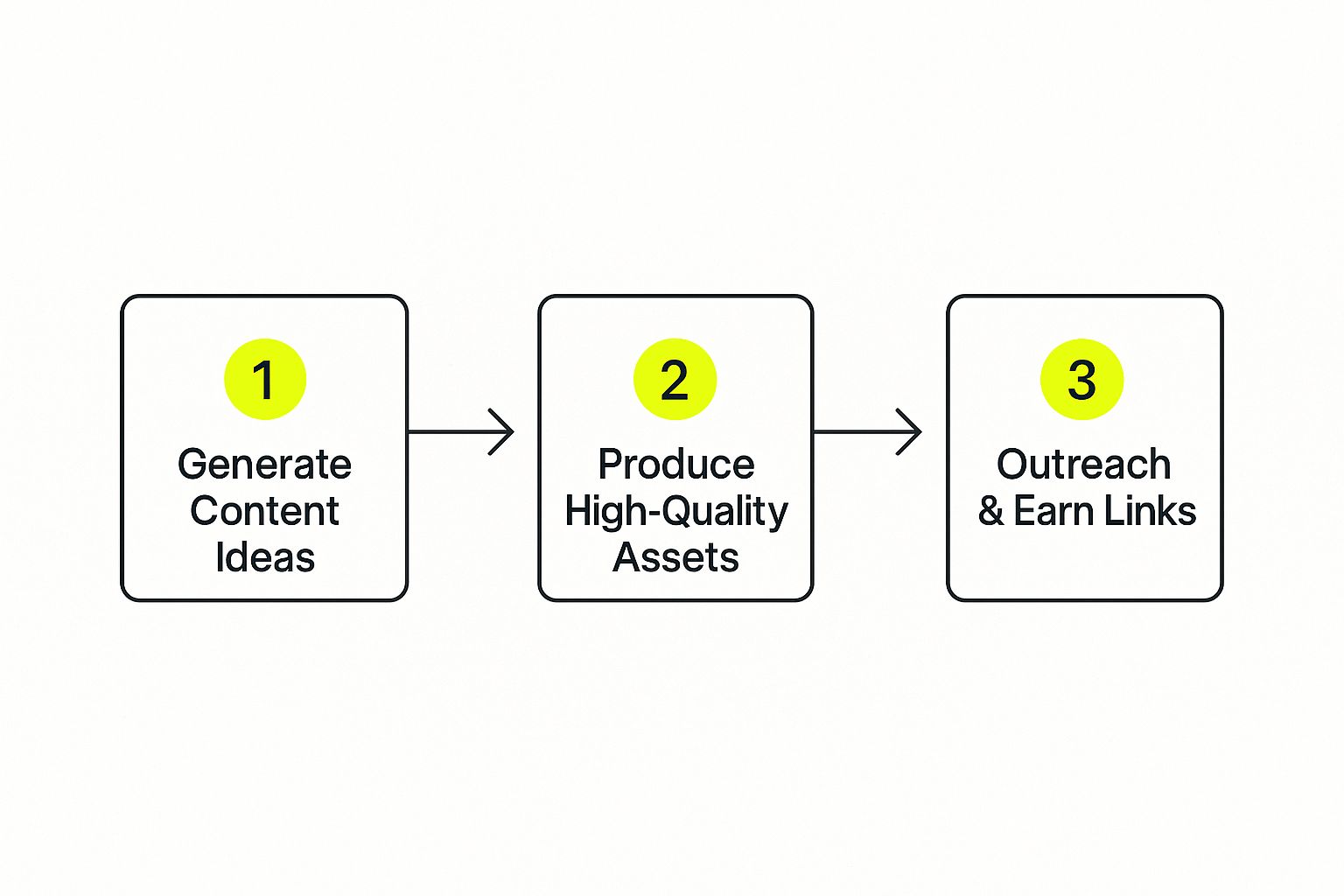
The whole process shows that link building isn't just about cold-emailing people and begging for links. The real work starts way before that, with creating something so valuable that the "ask" feels more like a helpful suggestion.
Reclaim Unlinked Brand Mentions
This is probably the easiest win you can get, yet so many online stores completely miss it. Unlinked brand mentions are exactly what they sound like: a blog, news site, or even a forum post mentions your brand, one of your products, or maybe even you as the founder, but they forget to link back to your website.
First, you have to find them. You can easily set up alerts using tools like Ahrefs, SEMrush, or even the free Google Alerts. Every time you get a ping, you've got a warm lead. The outreach is incredibly simple because you're not asking for a favor out of the blue. You're just offering a quick, helpful edit.
Here’s a simple outreach script:
"Hi [Name], I saw your fantastic article on [Topic] and was so excited to see you mentioned our [Product Name]. Thanks so much for the shout-out! I was just wondering if you'd be open to adding a link to our product page so your readers can find it easily. Here’s the link for your convenience: [Your Link]. Either way, thanks again for the feature!"
Master Broken Link Building
This one is a classic for a reason—it just plain works. The basic idea is to find a dead link (404 error) on a quality website in your niche. Then, you reach out to the site owner, point out the broken link, and offer your own relevant content as the perfect replacement. See what you did there? You're not just asking for a link; you're helping them fix their site. It's a win-win.
For an ecommerce store, this is a golden opportunity. Start by searching for resource pages or blog posts related to what you sell. If you sell hiking gear, for instance, you'd look for posts like "Best Hiking Resources" or "Ultimate Backpacking Checklist." Use a tool like Ahrefs' Broken Link Checker to quickly scan those pages for dead links.
Once you find one, your next move is to make sure you have a piece of content on your site that’s a fantastic substitute. Then, your outreach email is a friendly heads-up about their broken link, with your superior alternative offered as a helpful solution.
Pursue Strategic Guest Posting
Guest posting is when you write an article for another website in your niche. When done right, it’s a powerful way to get your brand in front of a new audience and earn a high-quality backlink. The key here is to be strategic.
Don't just blast out articles to any site that will take them. Focus on high-authority blogs and online publications that your ideal customers actually read and trust. The goal is to provide genuine value with your content, not just to sneak a link in. Honestly, your guest post should be just as good—if not better—than the content you publish on your own blog.
To really get this right for long-term SEO, it's essential to understand how to build backlinks naturally. Guest posting is a perfect example of this principle in action.
Pro Tip: When you write a guest post, resist the urge to only link back to your homepage. Instead, link to a specific, high-value resource on your site, like one of those ultimate guides or handy tools we talked about earlier. It gives more value to the reader and sends traffic directly to your best linkable assets.
Leverage Influencer and Partner Collaborations
Never underestimate the power of your professional relationships. Teaming up with influencers, complementary brands, and other partners can result in some of the most authentic and powerful backlinks you can get.
Here are a few ways to approach this:
- Product Reviews: Send your products to relevant influencers for their honest take. A genuine review, even if the product was a gift, carries significant weight and usually comes with a natural backlink.
- Partnership Announcements: If you team up with a non-competing brand for a contest or a product bundle, create a co-branded landing page and maybe a press release. You and your partner can both link to this central hub.
- Local Business Collaborations: Work with local businesses on events or promotions. This can land you backlinks from local news outlets, event calendars, and community blogs—all of which are fantastic for local SEO.
Each of these strategies requires a slightly different approach, but they all share a common thread. The most successful link building for an ecommerce website is always rooted in providing real value and building genuine relationships. It's about becoming a go-to resource, not just another retailer.
Measuring What Matters and Proving ROI
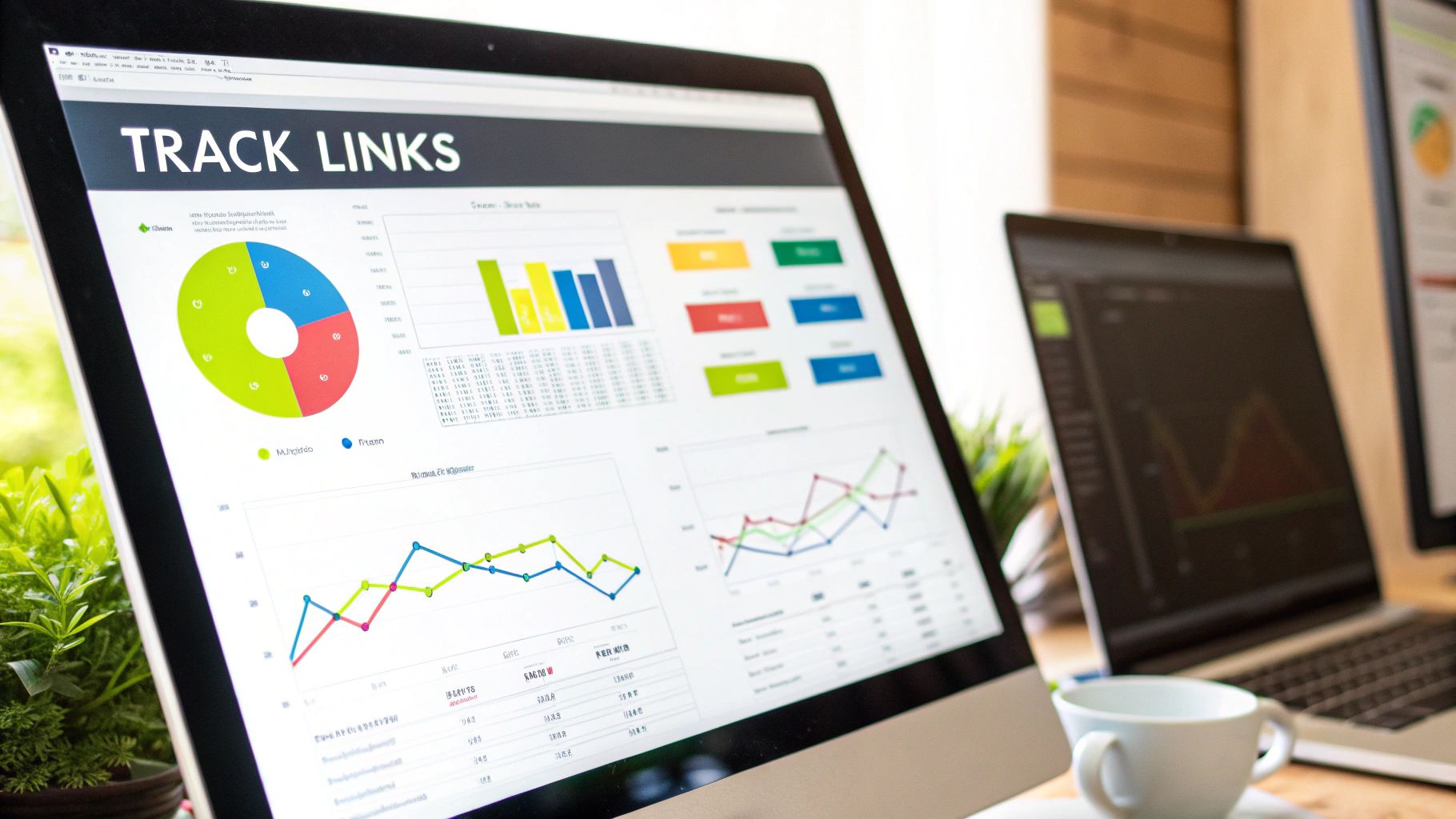
Running a brilliant link-building campaign for your Shopify store is only half the job. If you can’t show that all your hard work is actually moving the needle on what matters—traffic, sales, and revenue—you’ll have a tough time justifying the budget and effort. This is where tracking and measurement become your best friends.
The whole point is to connect the dots. You need to show how that new backlink from a high-authority blog directly led to a bump in sales for one of your product lines. When you can do that, you've won.
Key Metrics That Actually Tell a Story
Forget about vanity metrics like the total number of backlinks. A hundred spammy links are worthless compared to a single powerful link from a respected site in your niche. Instead, let's focus on the Key Performance Indicators (KPIs) that really show growth.
Here’s what you should be obsessed with:
- New Referring Domains: This is your holy grail. It tracks the number of unique websites linking to you. Getting links from 10 new, relevant sites is infinitely more valuable than getting 10 more links from a site that already knows you exist.
- Backlink Authority Score: Keep an eye on the quality of your incoming links using tools like Ahrefs (Domain Rating) or Moz (Domain Authority). You want to see the average authority of your link profile steadily climbing.
- Organic Keyword Rankings: Are your key product and category pages climbing the ranks for the keywords that people actually use to buy? This is a direct sign your strategy is paying off.
- Organic Traffic to Key Pages: Better links should mean more organic traffic. Pay close attention to the pages that make you money—are they getting more visitors from search?
Tracking these metrics helps you build a clear narrative. You can show exactly how your link-building efforts are making your store stronger and more visible in search results.
Creating Your ROI Dashboard
You don’t need some crazy-complex system to track all this. A simple dashboard that pulls data from Google Analytics and a backlink tool like Ahrefs is usually all it takes. This setup lets you clearly see the cause-and-effect relationship between your work and the results.
One quick pro-tip: Before you even start a campaign, make sure your house is in order. A thorough Shopify SEO audit ensures there are no technical gremlins holding you back. This way, every new backlink you earn can deliver its full power.
This dashboard becomes your single source of truth. It answers the most important question: Is my outreach driving links that, in turn, drive traffic and sales? With the right setup, the answer will be crystal clear.
Making the Case for the Link-Building Budget
Talking about budgets can be awkward, but data makes it a whole lot easier. Yes, a solid link building ecommerce website strategy is a significant investment, but the returns can be massive.
Think about it this way: some reports show that digital marketers often put around 28% of their total marketing budget into link building. And it’s not just small change—nearly half of all SEO pros (46%) spend over $10,000 every year just to get quality links.
The best part? It works. A whopping 78% of marketers say their link-building investments deliver a good return, proving it's a critical part of organic growth. You can dig into more stats on link building investments at Sixth City Marketing.
When you frame the discussion this way—connecting specific actions to clear business outcomes like more traffic and revenue—the budget conversation changes entirely. It’s no longer an expense. It's a strategic investment in the long-term profitability and authority of your store.
Got Link Building Questions? Let's Get Them Answered
If you're new to link building for your ecommerce store, you probably have a lot of questions spinning around in your head. It's totally normal. Things can get confusing fast, from trying to figure out how many links you actually need to decoding all the industry jargon.
Let’s cut through the noise and tackle some of the most common questions I hear from store owners. These aren't just abstract theories; this is the practical, foundational knowledge you need to build a strategy that actually works.
How Many Backlinks Does My Ecommerce Store Really Need?
This is easily the most common question, but there's no magic number. Honestly, anyone who gives you a specific number is guessing. The real answer is that quality and relevance will always crush sheer quantity.
Instead of getting hung up on a target, a much better approach is to focus on consistently earning high-authority links every single month. A great goal to set is to outpace your top three competitors. If you can acquire more high-quality backlinks than they do each month, you're not just growing—you're actively closing the authority gap between you and them.
To give you some perspective, highly competitive ecommerce niches often demand hundreds of top-tier links to even think about snagging those top Google rankings. This just goes to show that consistency and patience are your most valuable assets.
Is It Ever Okay to Buy Backlinks for My Store?
Let me be crystal clear on this one: No. Never.
Buying backlinks is a direct violation of Google's guidelines and one of the fastest ways to torpedo your store's SEO. I know it seems like a tempting shortcut, especially when you're eager for results, but the risk is just not worth it.
Here’s what you’re gambling with:
- A manual action penalty from Google, which is a nightmare to recover from.
- A sudden, painful drop in your keyword rankings.
- Worst-case scenario? Your entire store gets de-indexed and vanishes from search results.
Take the money you might have spent on a shady link package and invest it in creating the valuable, link-worthy content we've talked about. Real content and genuine outreach are what Google rewards in the long run.
What’s the Difference Between Nofollow and Dofollow Links?
Getting a handle on this is crucial for knowing which links are actually helping your SEO. The difference is pretty straightforward.
-
Dofollow Link: Think of this as the standard, default backlink. It acts like a vote of confidence, passing authority (what we call "link juice") from the linking website to your store. These are the links that directly boost your search engine rankings.
-
Nofollow Link: This link has a special
rel="nofollow"tag that basically tells search engines, "Don't count this as a vote." You'll see these everywhere—on social media posts, in forum signatures, and in blog comment sections.
Now, while dofollow links are obviously the goal for pure ranking power, nofollow links aren't useless. A nofollow link from a huge site like Forbes or a viral social media post can send a ton of valuable referral traffic your way, leading to real sales. A truly natural backlink profile will always have a healthy mix of both.
How Long Does It Take to Actually See Results from Link Building?
Link building is a marathon, not a sprint. It requires patience. While you might see a trickle of referral traffic from a new link right away, the real impact on your organic rankings takes time to build up.
Generally, you should expect to see significant, measurable results from a steady link-building campaign within 3 to 12 months. Google has to find the new links, figure out how authoritative they are, and then re-calculate your store's position in the search results. Stick with it—patience is the key to winning this game.
Ready to stop guessing and start building a powerful backlink profile that drives real growth? The experts at E-commerce Dev Group specialize in creating and executing data-driven SEO and link-building strategies for Shopify stores. Let us help you build the authority you need to dominate your market. Schedule your free consultation today!
