

In a crowded market, a great product isn't enough to guarantee success. You need a smart, effective online strategy to connect with customers and drive sales. Digital marketing can often feel overwhelming, with countless channels and complex tools, but it doesn’t have to be. This guide is designed to cut through the noise, providing a clear roadmap with actionable digital marketing tips for small business owners. We'll move beyond generic advice and focus on specific, high-impact tactics you can implement directly on your Shopify store.
This playbook breaks down 10 powerful strategies that deliver real results without requiring a massive budget. We will cover everything from mastering your local presence with a Google Business Profile to building a loyal following through targeted email and social media campaigns. You will also learn how to leverage customer reviews, create compelling video content, and use simple automation to save time and scale your efforts. Each tip is designed to be practical and easy to follow, helping you attract more of the right customers, build lasting relationships, and achieve sustainable growth. Let's dive in.
1. Optimize Your Google Business Profile
Your Google Business Profile (GBP) is often the first interaction a potential customer has with your business. This free tool is a cornerstone of local SEO, allowing you to manage how your business appears on Google Search and Maps. Think of it as your digital storefront on the world's largest search engine; it’s where customers find your hours, phone number, and directions. A fully optimized profile can dramatically increase your visibility and drive real-world traffic, making it one of the most effective digital marketing tips for small business owners to implement.
Many local businesses see a significant impact from GBP. A local cafe, for example, might see a 40% rise in foot traffic, while a home service provider could generate the majority of their leads directly from their profile. This is because a complete and active profile builds trust and makes it easy for customers to take the next step.
How to Get Started
To maximize your GBP's potential, focus on providing a complete and engaging experience for searchers.
- Complete Every Section: Aim for 100% profile completion. Fill out your services, add attributes like "outdoor seating," and select the most specific business category possible.
- Add High-Quality Photos: Regularly upload new, high-resolution photos of your products, storefront, and team. Aim for at least one new photo each week.
- Encourage and Respond to Reviews: Positive reviews are a powerful ranking signal. A crucial part of optimizing is learning how to get more Google reviews. Always respond to all reviews, both positive and negative, within 24-48 hours.
- Use Google Posts: Share weekly updates, offers, and news using the Google Posts feature to keep your profile fresh and engaging.
2. Create Valuable Content Marketing
Content marketing is about creating and sharing valuable, relevant content to attract and retain a specific audience. Instead of directly selling, you provide useful information that solves your customers' problems, establishing your business as a trusted expert. For a small business, this could be blog posts, videos, or guides that answer common questions, building a relationship with potential customers long before they are ready to buy. This approach positions you as an authority and nurtures leads over time.

The impact of this strategy can be transformative. Marcus Sheridan famously saved his company, River Pools, by creating blog content that answered every customer question he could think of. This "They Ask, You Answer" approach is now a popular framework. Similarly, a local accounting firm can attract new clients by publishing guides on navigating tax season, providing value upfront to build trust.
How to Get Started
Effective content marketing starts with understanding what your audience wants to know and delivering it consistently.
- Answer Customer Questions: Begin by listing your customers' most frequently asked questions. Each question can become a blog post, video, or social media update.
- Focus on Quality, Not Quantity: It's better to publish one deeply researched, helpful article per month than four shallow, mediocre ones.
- Create a Content Calendar: Plan your content in advance to maintain a consistent publishing schedule. This keeps your audience engaged and signals to search engines that your site is active.
- Repurpose Your Content: Turn a successful blog post into an infographic, a video script, or a series of social media tips. This maximizes the reach of your best ideas without starting from scratch.
3. Leverage Email Marketing and List Building
Email marketing consistently delivers one of the highest returns on investment in digital marketing, generating an average of $42 for every $1 spent. For a small business, building an email list means creating a direct line of communication with your most engaged customers. Unlike social media algorithms you can't control, your email list is an asset you own, allowing for personalized, targeted messaging that builds lasting relationships and drives sales. This is a must-have digital marketing tip for small business owners looking to foster loyalty.
The impact of a well-managed email list is substantial. E-commerce stores often recover 10-15% of abandoned carts with automated email sequences, while a local service business might generate 40% of its revenue from targeted nurture campaigns. A dedicated email strategy nurtures leads, encourages repeat business, and provides a reliable sales channel that is less susceptible to external market shifts.
How to Get Started
Building and nurturing an email list is about providing value and building trust over time.
- Offer a Valuable Lead Magnet: Encourage sign-ups by offering something in return, like a discount code, a free guide, or an exclusive checklist. Make the offer irresistible.
- Segment Your Audience: Don't send the same message to everyone. Group your subscribers based on their purchase history, interests, or how they signed up to send more relevant, personalized content.
- Focus on Value First: Follow the 80/20 rule. Eighty percent of your emails should provide value like tips, advice, or entertainment, while only 20% should be promotional. Learning how to write an effective newsletter is key to this balance.
- Maintain a Consistent Schedule: Whether you send emails weekly or bi-weekly, consistency keeps your brand top-of-mind and your audience engaged. A/B test different send times to see what works best.
4. Master Social Media Marketing on 1-2 Platforms
Trying to be active on every social media platform is a recipe for burnout and mediocre results. Instead of spreading your resources thin, a more effective strategy is to master one or two channels where your target audience is most active. This approach allows for deeper community engagement, higher-quality content, and better ROI. This is a powerful digital marketing tip for small businesses because it prioritizes quality and connection over sheer quantity, which is key when time and budget are limited.

This focused strategy yields impressive results. A local bakery, for instance, can build a loyal following on Instagram with mouth-watering food photography and behind-the-scenes Stories. Similarly, a B2B consulting firm can generate high-quality leads by establishing thought leadership on LinkedIn. The goal is to become an integral part of the community on your chosen platform, not just another brand broadcasting advertisements.
How to Get Started
To effectively master your chosen platforms, you must focus on authenticity, consistency, and providing genuine value.
- Choose Platforms Wisely: Go where your customers are, not where the latest trend is. A boutique selling handmade jewelry will likely thrive on a visual platform like Instagram or Pinterest, while a business law firm would find more traction on LinkedIn.
- Apply the 80/20 Rule: Dedicate 80% of your content to providing value, entertainment, or education and only 20% to direct promotion. This builds trust and keeps your audience engaged.
- Engage Authentically: Respond to all comments and direct messages promptly, ideally within a few hours. Use platform-specific features like polls, Q&As, and live video to foster a two-way conversation.
- Create a Content Calendar: Plan your posts in advance to ensure consistency, but remain flexible enough to jump on timely trends or share user-generated content (with permission).
5. Implement Search Engine Optimization (SEO)
Search Engine Optimization (SEO) is the process of improving your website to rank higher on search engines like Google. For a small business, this means getting found by customers actively looking for your products or services. Unlike paid ads, SEO builds sustainable, long-term visibility that continuously drives organic traffic without a constant ad budget, making it one of the most cost-effective digital marketing tips for small business owners. It's about being the answer when your ideal customer asks a question.
Effective SEO can transform a business. A local plumber ranking for "emergency plumber in [city]" might generate over 50 calls a month, while a small e-commerce shop can compete with giants by targeting niche, long-tail keywords. Many service-based businesses find that 60-80% of their leads come directly from organic search, proving its power to generate high-quality, high-intent leads.
How to Get Started
Focus on foundational SEO practices that deliver the biggest impact for local and small businesses first.
- Prioritize Local SEO: Start by targeting customers in your immediate area. This is less competitive and highly valuable. Focus on getting listed in relevant local directories like Yelp and industry-specific sites.
- Target Long-Tail Keywords: Instead of broad terms like "shoes," target specific phrases like "waterproof trail running shoes for women." These have lower competition and attract more qualified buyers.
- Ensure Technical Health: Your website must be mobile-friendly and load in under three seconds. These are critical ranking factors that also improve user experience.
- Optimize On-Page Elements: Write clear title tags and meta descriptions that entice users to click. Use header tags (H1, H2) to structure your content logically, helping both users and search engines understand your pages.
6. Use Targeted Paid Advertising Strategically
While organic strategies build long-term value, paid advertising on platforms like Google, Facebook, and Instagram offers immediate visibility and results. It allows small businesses to reach highly specific audiences based on demographics, interests, and search intent. Think of it as a direct line to your ideal customers, bypassing the slower process of organic growth. A strategic paid ad campaign is one of the most powerful digital marketing tips for small business owners looking to generate leads and sales quickly.
Many small businesses see incredible returns with modest budgets. A local service business, for instance, can generate a $5-10 return for every $1 spent on targeted Google Ads, while an e-commerce store might use Facebook retargeting to recover 20% of abandoned carts. This immediate feedback loop allows you to test offers, refine messaging, and drive measurable growth.
The infographic below visualizes typical budget tiers for small businesses starting with paid ads.
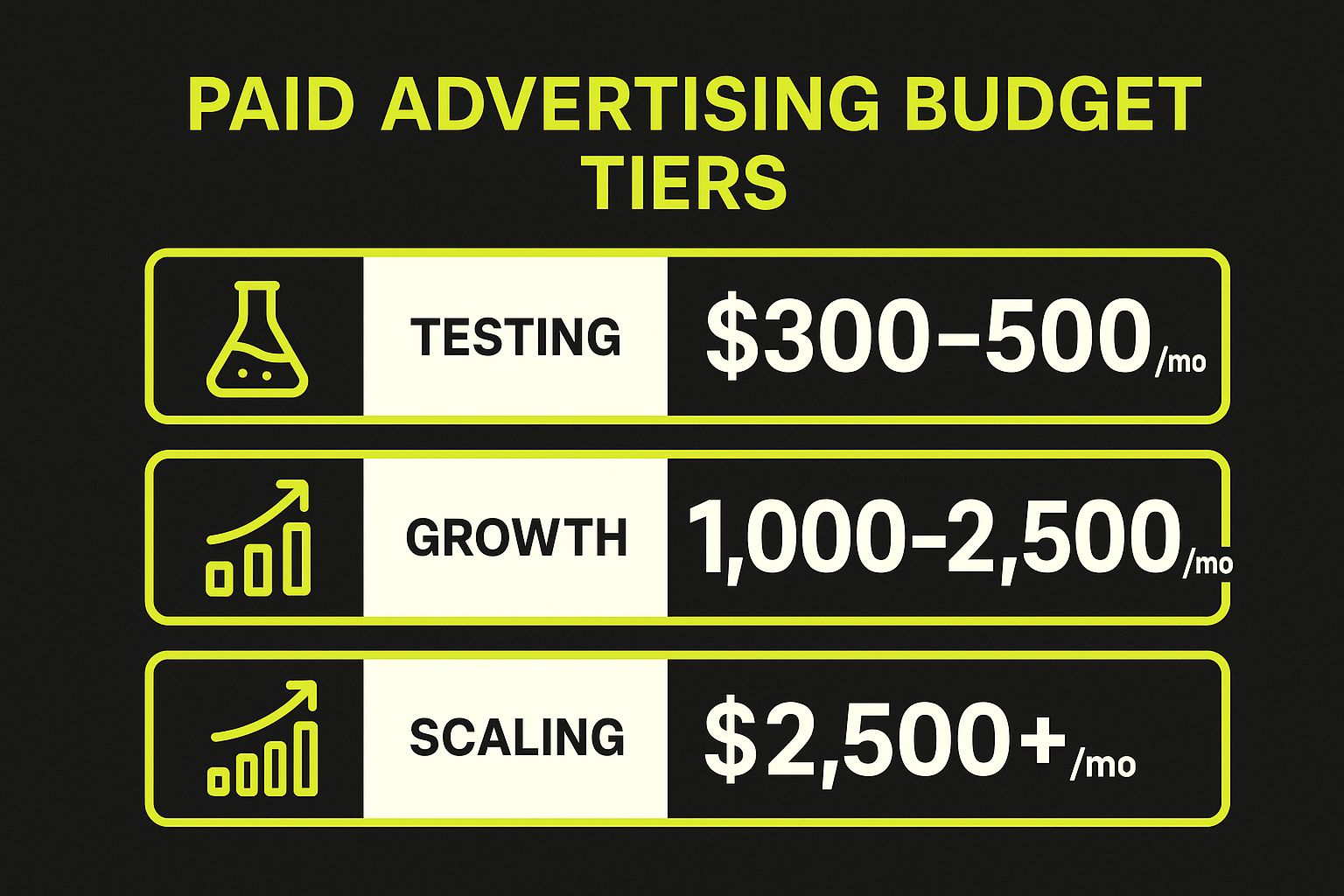
These tiers show how a business can start small to validate its strategy before committing larger funds for growth and scaling.
How to Get Started
Success in paid advertising comes from disciplined testing and a focus on conversions, not just clicks.
- Start Small and Test: Begin with a small daily budget ($10–$20) to test ad copy, visuals, and audiences. Don't scale until you find a profitable combination.
- Focus on One Platform: Master one platform, like Google Ads or Facebook Ads, before diversifying your spend. Each has its own learning curve.
- Use Retargeting First: Target users who have already visited your site. These ads often have 10x higher conversion rates and are a cost-effective starting point.
- Create Dedicated Landing Pages: Never send ad traffic to your homepage. Create specific, high-converting landing pages that match the ad's message and call to action. Learn more about effective PPC for e-commerce.
7. Encourage and Leverage Customer Reviews
Online reviews are the modern-day equivalent of word-of-mouth marketing, directly influencing 93% of consumers' purchasing decisions. They are a powerful trust signal that can significantly impact your local search rankings, conversion rates, and overall brand reputation. A proactive strategy for generating and managing reviews is one of the most effective digital marketing tips for small business owners looking to build credibility and drive sales.
The impact is tangible. E-commerce products with customer reviews can see conversion rates increase by over 200% compared to those without. Similarly, local service businesses often find that having 50+ positive Google reviews is the key to securing a top-three spot in local search results. This social proof validates your business and gives new customers the confidence to choose you over a competitor.
How to Get Started
Building a strong review portfolio requires a consistent and polite approach. Make it a seamless part of your customer experience.
- Time Your Request: Ask for a review immediately after a positive interaction or successful purchase, ideally within 24 hours while the experience is fresh.
- Make It Easy: Remove all friction. Provide customers with a direct link to your preferred review platform (like your Google Business Profile) via a personalized email or text message.
- Respond to All Reviews: Acknowledge every review, both positive and negative, within 24-48 hours. Thank positive reviewers and professionally address criticism on negative ones, offering to resolve the issue offline.
- Showcase Your Best Reviews: Leverage your hard-earned praise. Feature top reviews prominently on your website’s homepage, product pages, and share them across your social media channels.
8. Create Video Marketing Content
Video has become the dominant format for digital engagement, with viewers retaining 95% of a message when watching a video compared to just 10% when reading it in text. For small businesses, this doesn't mean you need a Hollywood budget. Authenticity often outperforms high production value, making smartphone videos a powerful and accessible tool. This approach is one of the most versatile digital marketing tips for small business owners, as video works across all platforms and stages of the customer journey, from building awareness to driving conversions.
The impact of video is undeniable. A local contractor might generate three times more inquiries by sharing simple before-and-after project videos. Similarly, a small Shopify retailer could see an 80% increase in product conversions just by adding short demo videos to their product pages. These results show that video builds trust and helps customers visualize a product or service in action, making them more confident in their purchasing decisions.
How to Get Started
You can start creating effective video content with just the phone in your pocket. Focus on creating authentic, valuable content that connects with your audience.
- Start Simple and Stay Short: Use your smartphone to record. Aim for 15-60 seconds for social media platforms like Instagram Reels or TikTok, and 1-3 minutes for YouTube.
- Hook Viewers Immediately: Grab attention within the first three seconds to stop them from scrolling. Clearly state what the video is about or present a compelling visual.
- Design for Silent Viewing: A high percentage of social media videos are watched without sound. Always add captions to ensure your message gets across.
- Include a Clear Call-to-Action: End every video by telling viewers what to do next, whether it’s "Shop Now," "Learn More," or "Follow for More Tips."
9. Build Strategic Partnerships and Collaborations
Strategic partnerships involve collaborating with complementary, non-competing businesses to cross-promote to each other's audiences. This digital marketing tip for small business owners amplifies reach without a hefty ad spend and builds credibility through association. For Shopify merchants, partnerships can provide access to established audiences and shared resources that would be difficult to achieve independently, making it a powerful growth lever.
This approach creates a win-win scenario. For instance, a beauty salon and a local clothing boutique could run a joint fashion event, or a gym could partner with a nutritionist for a co-branded wellness challenge. These collaborations introduce your brand to a relevant, engaged audience that already trusts your partner, significantly shortening the customer's path to purchase. A well-chosen partnership can feel less like an advertisement and more like a trusted recommendation.
How to Get Started
To build effective partnerships, focus on mutual value and authentic alignment between brands.
- Identify Aligned Partners: Look for businesses that serve your target demographic but don’t directly compete. Their values and brand image should complement your own.
- Create a Win-Win Offer: Propose a collaboration where both parties benefit equally. This could be a joint giveaway, co-hosted webinar, or a bundled product offer.
- Outline Clear Expectations: Create a simple written agreement detailing responsibilities, timelines, and how you will track success (e.g., using unique discount codes).
- Make It Easy to Collaborate: Provide your partners with ready-to-share content like images, ad copy, and email templates to streamline the cross-promotion process.
10. Implement Marketing Automation and CRM Systems
Marketing automation and Customer Relationship Management (CRM) systems help small businesses operate more efficiently by automating repetitive tasks, nurturing leads systematically, and maintaining organized customer data. These tools level the playing field, allowing you to provide personalized experiences at scale that were once only possible for large enterprises. Think of it as giving your business a digital assistant that works 24/7 to manage customer relationships and follow up on leads.
The impact is significant. E-commerce stores often recover 15-20% of lost sales through automated abandoned cart emails. Similarly, a service business using automated follow-ups can see a 30% increase in conversions by simply staying top-of-mind. This strategy is a key digital marketing tip for small businesses looking to save time while boosting revenue.
How to Get Started
Start with simple, high-impact automations before building complex workflows. The goal is to solve your biggest pain points first. For a comprehensive guide on integrating and scaling, explore powerful AI marketing automation strategies.
- Create a Welcome Email Sequence: This is often the highest-ROI automation. Set up a series of 3-5 emails to welcome new subscribers, introduce your brand, and offer a special discount.
- Set Up Abandoned Cart Emails: For e-commerce businesses, this is non-negotiable. An automated reminder can recapture a significant portion of would-be lost sales.
- Automate Appointment Reminders: Service-based businesses can reduce no-shows and administrative work by sending automated email or SMS reminders before an appointment.
- Use a CRM to Track Interactions: Centralize all customer data, from purchase history to support tickets. This allows for highly personalized marketing and better customer service.
Top 10 Digital Marketing Tips Comparison
| Strategy | Implementation Complexity 🔄 | Resource Requirements ⚡ | Expected Outcomes 📊 | Ideal Use Cases 💡 | Key Advantages ⭐ |
|---|---|---|---|---|---|
| Optimize Your Google Business Profile | Low (2-4 hours setup, ongoing maintenance) | Minimal (free tool, regular updates) | Increased local visibility, 7x more clicks | Local businesses aiming for nearby customers | Free, builds trust via reviews, easy to manage |
| Create Valuable Content Marketing | Medium-High (consistent content creation) | Moderate (time, creativity, skills) | Long-term organic traffic, 3x more leads | Businesses establishing authority and long-term growth | Compounds over time, supports SEO, nurtures customers |
| Leverage Email Marketing and List Building | Medium (list building & content creation) | Moderate (tools, consistent emails) | Highest ROI ($42 per $1), direct engagement | Businesses wanting personalized, direct communication | Own your audience, measurable results, cost-effective |
| Master Social Media Marketing on 1-2 Platforms | Medium-High (time-intensive, consistent posting) | Moderate (content creation, engagement) | Brand awareness, community building, direct connection | Businesses targeting active social audiences | Free organic reach, humanizes brand, real-time feedback |
| Implement Search Engine Optimization (SEO) | High (technical & ongoing optimization) | Moderate-High (expertise, tools) | Sustainable high-intent traffic, competitive edge | Businesses seeking long-term organic visibility | No ad costs, credibility boost, supports other tactics |
| Use Targeted Paid Advertising Strategically | Medium (learning curve, campaign setup) | Budget required ($300+/month) | Immediate targeted traffic, measurable ROI | Businesses needing fast results, testing offers | Fast results, flexible budgets, precise targeting |
| Encourage and Leverage Customer Reviews | Low-Medium (process setup, steady management) | Low (time, management tools) | Improved local SEO, trust, 15-30% higher conversions | Businesses reliant on reputation and local trust | Builds credibility, free marketing, improves rankings |
| Create Video Marketing Content | Medium-High (production & consistency) | Moderate (equipment, editing skills) | High engagement, 86% more conversions on landing pages | Businesses wanting strong engagement and trust | Highest engagement, versatile, boosts SEO and conversion |
| Build Strategic Partnerships and Collaborations | Medium (coordination and agreements) | Low-Moderate (time, outreach) | Access to new audiences, shared resources | Businesses seeking mutual growth without ads | Cost-effective reach, credibility by association |
| Implement Marketing Automation and CRM Systems | High (initial setup and learning curve) | Moderate-High (tools, maintenance) | Time savings, 50% more sales-ready leads, consistent nurturing | Businesses wanting scalable, efficient lead management | Saves time, improves conversions, organized customer data |
Your Next Move: Turning Tips into Triumphs
You now have a comprehensive playbook filled with powerful digital marketing tips for small business success. We've navigated the essentials, from optimizing your local presence with a Google Business Profile to fostering long-term loyalty through strategic email marketing and building authentic connections with video content. We've covered the technical power of SEO, the targeted precision of paid ads, and the undeniable social proof that comes from genuine customer reviews. The path forward is no longer a mystery; it's a series of clear, actionable steps.
However, the greatest challenge isn't knowing what to do; it's overcoming the paralysis of trying to do everything at once. The true secret to digital marketing success lies in focused, consistent action.
Prioritize and Execute
Don't look at the ten strategies in this article as a daunting checklist. Instead, view them as a menu of opportunities. Your first task is to choose just one or two that resonate most with your immediate business goals and where your customers spend their time.
- Is your goal immediate, localized traffic? Pour your energy into your Google Business Profile and gathering customer reviews.
- Need to build brand authority and a long-term asset? Commit to a content marketing and SEO strategy.
- Want to drive direct sales and nurture leads? Double down on building your email list and implementing targeted social media ads.
Select your starting point, dedicate your resources to mastering it, and set clear metrics to track your progress. Measure your return on investment, understand what works, and only then, once you have built momentum, should you layer on the next strategy. This incremental approach prevents burnout and ensures each new tactic is built upon a solid, successful foundation.
From Strategy to Sustainable Growth
Implementing these digital marketing tips is about more than just generating clicks or making a few extra sales. It’s about building a resilient, adaptable brand that can thrive in a competitive online marketplace. Each piece of content you create, every email you send, and every customer review you earn contributes to a powerful digital ecosystem that works for you around the clock.
This journey transforms your Shopify store from a simple online catalog into a dynamic, customer-centric hub. You're not just selling products; you're building a community, solving problems, and creating a brand that people trust and want to connect with. The key is to start now. Take that first small, deliberate step today, and you'll be amazed at the significant impact it makes tomorrow.
Feeling overwhelmed by the technical side of SEO, site speed, or advanced Shopify customizations? The expert team at E-commerce Dev Group specializes in handling the complex development and optimization tasks that power digital marketing success. Let us manage the backend, so you can focus on growing your business. Explore our Shopify solutions and see how we can help you scale.
