

When you're running an online store, getting your products in front of the right people is everything. That's where PPC for e-commerce comes in. Think of it as paying for a shortcut directly to customers who are already looking for what you sell. Instead of waiting for them to find you, you put your store right at the top of their search results.
Why PPC Is Your E-commerce Growth Engine
Sure, building up your organic search presence is crucial for long-term health, but that's a marathon, not a sprint. SEO can take months to show real results. PPC, on the other hand, gives you that instant visibility you need to start making sales today. You can launch a campaign in the morning and see new traffic rolling in by the afternoon.
This speed isn't just about quick wins. It’s also an incredible tool for testing the waters. Got a new product idea? Instead of stocking up on tons of inventory and crossing your fingers, you can run a small, targeted PPC campaign to gauge real-world interest first.
Drive High-Intent Traffic and Predictable Revenue
The real magic of PPC is its laser-focused targeting. You can zero in on shoppers based on the exact keywords they're typing into Google, their hobbies, and even websites they've visited before.
Picture this: someone searches for "women's leather hiking boots size 8." A well-crafted Google Shopping ad can put your exact product front and center at the very moment they’re ready to buy. It doesn't get much more targeted than that.
This precision is what makes PPC a reliable source of revenue. The numbers back it up, too—businesses typically see an average return of $2 in revenue for every $1 spent on Google Ads. This solid ROI comes from smart targeting, clear performance data, and the ability to control your budget down to the penny.
Recapture Lost Sales and Scale Your Efforts
Let's be real: most people don't buy on their first visit to a new store. They browse, they compare, they get distracted. This is where retargeting comes in and saves the day. By showing ads to people who have already visited your site or ditched their cart, you give them a gentle reminder to come back and finish what they started.
For anyone serious about using paid ads, exploring different PPC for E-commerce strategies is a must to stay ahead of the curve.
By combining new customer acquisition with smart retargeting, you create a powerful cycle. You bring in fresh traffic, and anyone who slips away gets a friendly nudge to return. This approach squeezes the maximum value out of every single dollar you spend on ads.
This turns your advertising from a simple cost into a growth machine you can scale. As you dial in your campaigns, you can start layering in other powerful tools. For example, integrating your PPC efforts with automated follow-ups is a core part of building an effective Shopify marketing automation system that turns more visitors into loyal customers.
Building Your Campaign Foundation
Before you ever spend a dime on ads, the real work begins. A winning e-commerce PPC campaign is built on smart decisions made right at the start. This prep work is what separates the campaigns that print money from those that just burn through it.
It all starts with understanding paid search and its basic mechanics. The first order of business? Keyword research. But we're not just looking for any old keywords; we're hunting for phrases that scream "I'm ready to buy."
Find Keywords That Convert
You have to get into your customer's mindset. There’s a world of difference between someone searching for "running shoes" and someone typing in "buy brooks adrenaline gts 22 women's size 9." The first person is browsing; the second is on a mission.
These high-intent, transactional keywords are your bread and butter. You can unearth these gems and check their search volume using tools like the Google Keyword Planner.
Image Credit: Ahrefs
What you're seeing here is a goldmine. The planner shows you monthly search volumes and how much competition you're up against, helping you find the sweet spot between high traffic and low competition.
Know Your Customer and Your Numbers
Great keywords are only half the battle. You need to know exactly who you're talking to. Don't just settle for basic demographics. Build out detailed customer personas. What are their hobbies? What influencers do they follow? Where do they hang out online?
This deep understanding is what lets you tap into the powerful audience targeting features on platforms like Google Ads and Facebook Ads, putting your products in front of the people most likely to buy.
Once you know your keywords and your audience, you can finally set a realistic budget. Think of your initial budget as an investment in data, not just sales. You're buying crucial insights into what works and what doesn't. And the competition is fierce—projections show PPC spending will rocket to $351.55 billion in 2025. That kind of money flooding the market means your strategy has to be lean and effective.
Pro Tip: Your budget shouldn't be a shot in the dark. Figure out the maximum you're willing to pay for a new customer. This is your target Cost Per Acquisition (CPA), and it should guide your spending from day one.
Lastly, you need to define what success looks like. Establish your Key Performance Indicators (KPIs) before you launch. Clicks and impressions are vanity metrics; these are the numbers that actually matter for an e-commerce store:
- Return on Ad Spend (ROAS): This is your north star. For every dollar you put in, how much revenue do you get back?
- Cost Per Acquisition (CPA): How much does it cost, on average, to win a new customer with your ads?
- Conversion Rate: What percentage of people who click your ad actually end up buying something?
Keeping a close eye on these KPIs ensures every dollar you spend is working hard for your business and contributing directly to your bottom line.
Creating E-commerce Ads That Actually Convert
Alright, you’ve laid the strategic groundwork. Now comes the fun part: building the ads that will stop scrollers in their tracks and get them to buy. The way you structure your campaigns is your blueprint for success. It dictates how you manage your budget, who you target, and ultimately, how you measure what’s working.
I see so many newcomers make the same mistake: they lump all their products into one massive campaign. That’s a recipe for chaos. The pros know that smart segmentation is everything. You need to carve up your campaigns logically to keep control.
Think of it like this: if you run a clothing store, you wouldn't just throw everything on one rack. You’d have separate campaigns for "Men's Outerwear," "Women's Footwear," and maybe a quick, high-impact campaign for a "Summer Clearance Sale." This separation is crucial because it lets you put your money exactly where it will have the biggest impact.
Writing Ad Copy That Sells
Your ad copy is the digital equivalent of a compelling window display. You have just a few seconds to grab someone's attention and give them a reason to click. Generic, bland descriptions simply won't do the job. Your copy needs to be a short, sharp sales pitch that connects directly with what your shopper wants.
To make your ads pop, focus on what makes your product the absolute best choice for them.
- Your Secret Sauce: What's your unique selling point? Is it the handmade quality? The eco-friendly materials? Maybe a lifetime warranty? Lead with that.
- Price & Promos: Be upfront with the price. If you have a killer deal like "20% Off" or "Free Shipping," don't bury it—make it the headline.
- A Clear Nudge: Tell people exactly what you want them to do. Use direct, active language like "Shop Now," "Buy Today," or "Explore the Collection."
This image is a great visual cheat-sheet for the key ingredients of persuasive ad copy.
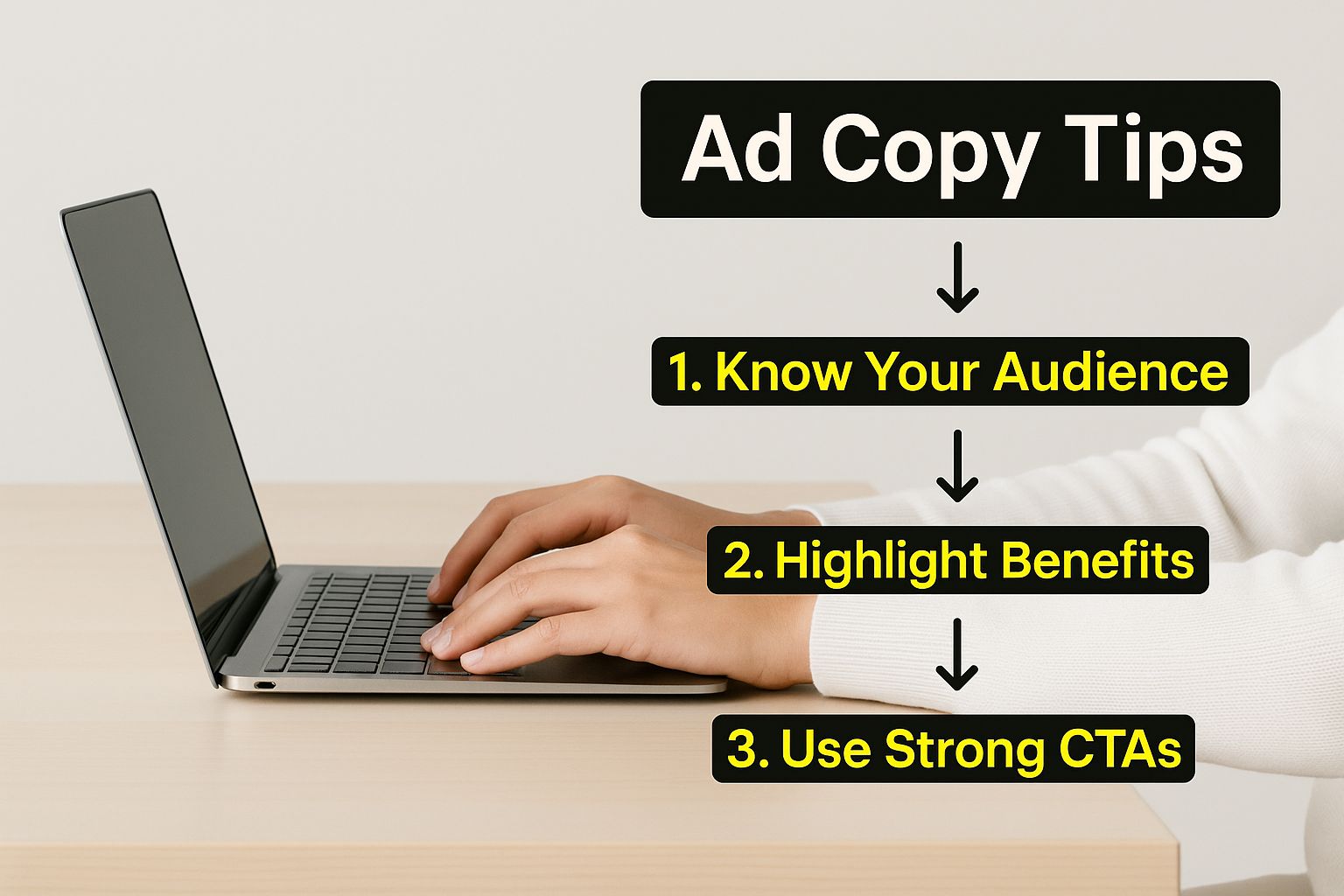
It really drives home the idea that the best ads are a blend of creative flair and clear, actionable information.
In the trenches of e-commerce PPC, I’ve learned one thing: clarity always beats cleverness. A customer searching for a "waterproof hiking jacket" cares way more about the GORE-TEX material and the 5-star reviews than a witty pun.
The Power Couple: Visuals and Landing Pages
On visual-heavy platforms like Google Shopping and Facebook Ads, your product image is doing most of the talking. A blurry, poorly lit photo is an immediate deal-breaker. You need crisp, high-resolution images that show your product from multiple angles, ideally being used in the real world. Selling a dress? Show it on a model. Selling a lamp? Show it in a beautifully styled room.
Then there's the landing page—the final, make-or-break step. Sending traffic from a super-specific ad for "Men's Black Leather Loafers" to your generic homepage is like throwing your ad budget into a bonfire. The landing page must deliver on the ad's promise.
The click should take them directly to the product page for those black leather loafers. This consistency, or "ad scent," is non-negotiable. For a deeper dive into getting your pages right for both ads and search engines, check out our guide on Shopify SEO best practices. A well-optimized page doesn't just help your PPC—it gives your organic traffic a lift, too.
For e-commerce stores, a few Google Ads campaign types are absolute workhorses. Understanding where each one shines is key to building a profitable strategy.
Essential Google Ads Campaign Types for E-commerce
| Campaign Type | Best For | Key Feature |
|---|---|---|
| Standard Shopping | Granular control over individual products and bids. | Manual bidding and negative keywords give you precise control. |
| Performance Max | Reaching customers across all of Google's channels from a single campaign. | Uses machine learning to automate targeting, bidding, and ad creation. |
| Search | Capturing high-intent buyers actively searching for your products. | Keyword targeting allows you to match your ads to specific queries. |
| Demand Gen | Driving awareness and consideration on visually-rich platforms like YouTube and Discover. | Focuses on engaging, creative-first ad formats to build interest. |
These campaign types form the backbone of most successful e-commerce ad accounts. Starting with the right one for your goal is half the battle.
Your Final Pre-Flight Check
Before you press that big, tempting "launch" button, pause. Run through this quick checklist to catch any simple, yet costly, mistakes. This five-minute check can be the difference between a great start and a frustrating waste of money.
- Do all your links work? Seriously, click them. Make sure they go to the right landing page.
- Is your targeting on point? Double-check your audience, location, and device settings.
- Any typos in your copy? Read your headlines and descriptions one last time.
- Is the budget set correctly? Confirm your daily or lifetime budget to avoid any nasty surprises.
- Is conversion tracking live? If your tracking pixel isn't firing, you're flying blind. You can't measure your Return on Ad Spend (ROAS) without it.
Taking a few moments to nail down these details gives your campaign the best possible shot at delivering profitable results from day one.
Winning the Mobile Shopping Game
If your e-commerce PPC strategy treats mobile as an afterthought, you're already falling behind. The modern customer journey doesn't just start on a phone—it very often ends there, too. Ignoring this means you're just handing sales over to competitors who get that the small screen is now the main stage.
This isn't just some passing trend; it’s a massive shift in how people shop. Think about this: by 2025, mobile devices are projected to drive a whopping 73% of all e-commerce sales worldwide. That single number should tell you everything you need to know about why a mobile-first mindset is essential for growth. You can dig into more numbers like this with these PPC statistics on Cropink.com.
Design for Thumbs, Not Cursors
Optimizing for mobile is about so much more than just having a "responsive" website that shrinks to fit a screen. You have to design the entire experience for someone holding a phone, probably with one hand.
This starts with lightning-fast landing pages. A few extra seconds of load time is more than enough to make a potential customer give up and hit the back button. Your navigation also needs to be incredibly simple. Can someone find a product and check out using only their thumb? That means big, easy-to-tap buttons, clean menus, and checkout forms that don't make you want to throw your phone across the room.
Pro Tip: Try buying something from your own mobile site. Seriously. Go through the entire checkout process. If you get stuck or frustrated at any point, you can bet your customers are abandoning their carts right there.
Crafting Ads for the Small Screen
The ad copy and images that look great on a desktop monitor can completely fail on a mobile device. You have way less space to work with, so every single word and pixel has to count.
Keep your ad copy short, punchy, and get straight to the point. Forget long, winding sentences and focus on powerful, benefit-driven phrases. What's the one thing that will make someone stop their endless scrolling? Lead with that.
Your product images need to pop, even as tiny thumbnails. Use high-contrast photos that clearly show off your product without needing a zoom. That beautiful, detailed lifestyle shot might look fantastic on a 27-inch screen, but it can easily turn into an unrecognizable smudge on a 6-inch phone. Always, always preview your ads on an actual mobile device before they go live.
Here are a few mobile-specific tactics you can put to work right away:
- Use Call Extensions: If you sell high-ticket items or products that benefit from a quick chat, make it dead simple for people to call you. A tap-to-call button in your ad is a fantastic, low-friction way to connect with serious buyers.
- Lean into Location Targeting: Got brick-and-mortar stores? Use location extensions in your ads and bid more for users who are physically near your shops. You can turn an online search into immediate foot traffic.
- Adjust Bids for Mobile: Dive into your campaign data and segment it by device. If you find that your mobile conversion rate is outperforming desktop, don't hesitate to increase your bids for mobile users to capture even more of that valuable traffic.
Turning Ad Data into Real Profit
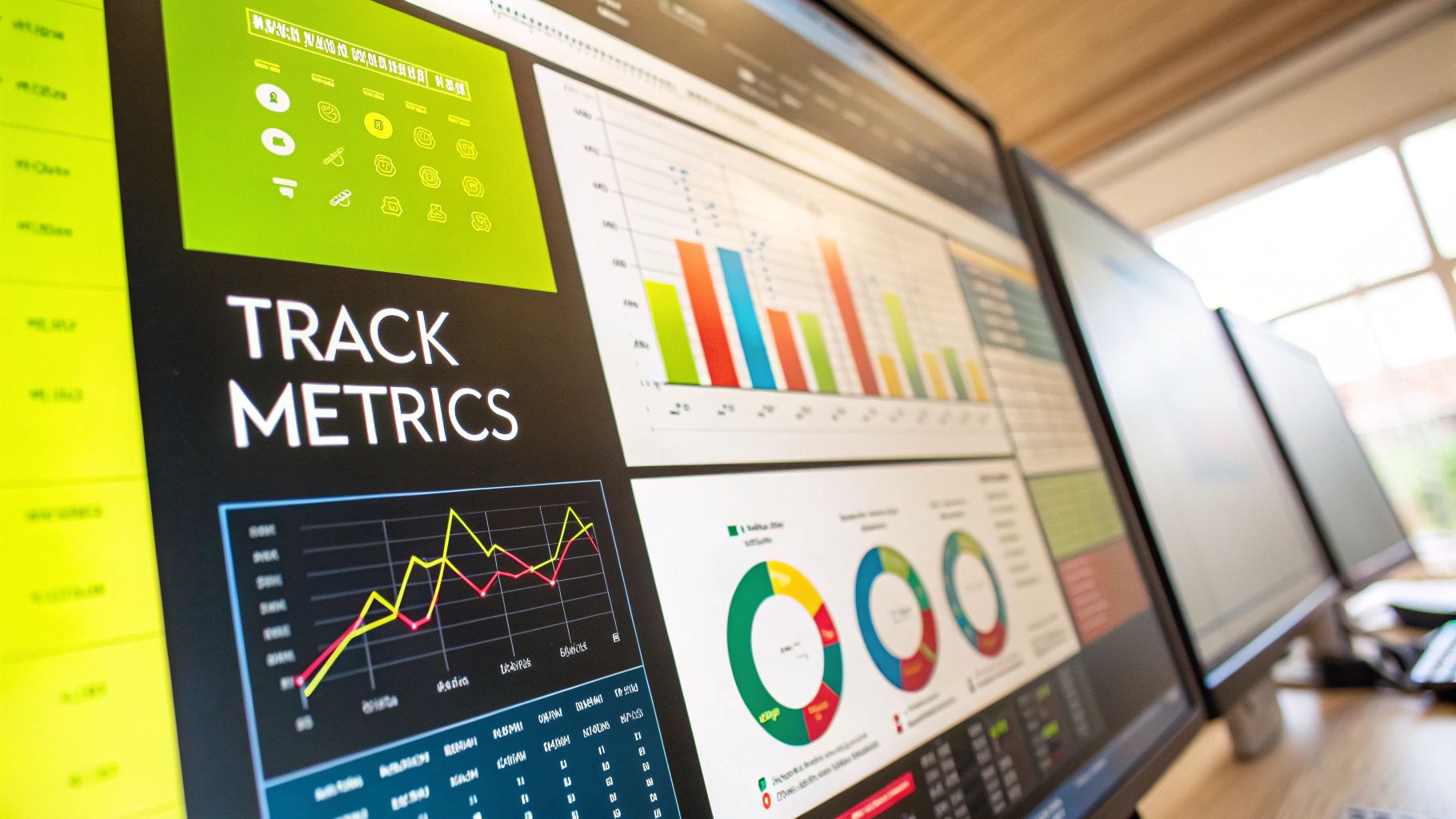
Getting your ad campaigns live is just the first step. The real work—and where the profit is truly made—is what happens next. Winning at PPPC for e-commerce isn’t a "set it and forget it" game. It's an ongoing loop of digging into your data, questioning your assumptions, and making smart, calculated adjustments.
This is the part where you take all those raw clicks and impressions and turn them into a clear story about your customers. By spending time in Google Analytics and your ad platform dashboards, you start to see exactly what’s resonating and what’s just burning through your budget. Those KPIs you set up earlier? They’re your roadmap now.
Decoding Your Campaign Performance
First things first, you need to learn how to read the story your data is telling. It's easy to get lost in the sea of metrics, so focus on the ones that actually tie back to your bottom line. The absolute foundation here is understanding how to calculate Return on Ad Spend (ROAS), which shows you precisely how much revenue each ad dollar is bringing in.
Once you have a firm grip on ROAS, you can dig deeper. Is one campaign blowing the others out of the water? Are specific products the real money-makers? This initial dive helps you quickly spot your winners and losers, which is crucial for figuring out where to focus your energy.
Continuous Testing for Maximum Impact
The best advertisers I know never assume they’ve perfected their campaigns. They are in a constant state of testing, always trying to find a new edge or a better way to connect with their audience. This means running structured A/B tests on your ad copy, your images, and your calls to action.
Think of it like a friendly competition between your ads. For example, you could test an ad with a product on a clean white background against one showing it being used in a real-life setting. Or, you could pit a headline that screams a discount ("25% Off Today Only!") against one that highlights a key benefit ("Finally, a Jacket That's Truly Waterproof").
A small tweak can make a massive difference. I once worked with a client who doubled their ad’s click-through rate just by swapping out the main image. Without that simple test, they would have left a ton of money on the table, wrongly assuming their original creative was "good enough."
This testing mindset shouldn't stop at the ad itself. Your landing page is just as critical. A smooth, convincing landing page experience is a huge part of effective https://scaleshopify.com/2024/12/05/shopify-store-optimization/, making sure the traffic you paid for has the best possible shot at converting. Test different layouts, button colors, and product descriptions to find what gets you more sales.
Refining Your Targeting and Bids
Some of the most powerful insights hide in plain sight, especially in places like the search term report in Google Ads. This report shows you the exact search queries people used right before clicking your ad. It’s an absolute goldmine for two critical tasks:
- Finding Negative Keywords: You’ll inevitably find you’re paying for clicks from irrelevant searches. If you sell high-end "leather boots," you don't want to waste money on clicks from people searching for "cheap pleather boots." By adding "cheap" and "pleather" to your negative keyword list, you instantly cut that wasted spend.
- Discovering New Keywords: The report can also uncover new, high-converting long-tail keywords you hadn't even thought of. These are often fantastic ideas for building out new, highly targeted ad groups.
This data-first approach lets you adjust your bids with confidence. When you see a specific keyword, device, or audience delivering a fantastic ROAS, you can confidently bid more to capture more of that profitable traffic. This is how you stop guessing and start making data-backed decisions that grow your business.
Common Questions About E-commerce PPC
Even with a solid plan, I get it—diving into paid advertising can feel like a big leap. Store owners often run into the same roadblocks and have the same questions when they're just starting out. Let's tackle some of the most common ones I hear all the time.
How Much Should I Spend on PPC for My E-commerce Store?
There’s no magic number here. A smart way to begin is by setting aside an amount you're comfortable experimenting with. Think of it as your "learning budget." For many, this is around 5-10% of their total marketing budget.
This initial spend isn't about instant sales; it's an investment in data. The real win isn't about hitting a certain spend, but about achieving a positive Return on Ad Spend (ROAS). Once you see that for every $1 you put in, you get $4 back in revenue, you can start scaling your budget confidently. Profitability is the proof that your strategy is working.
Which Is Better for E-commerce: Google Ads or Facebook Ads?
This is a classic question, but it's not really an "either/or" situation. The right platform truly depends on what you want to accomplish right now. Each one plays a distinct, valuable role in a smart PPC strategy.
-
Google Ads is all about capturing intent. People are on Google actively searching for something they need. Running Search and Shopping ads puts your products right in front of shoppers who are ready to buy. It's direct and powerful.
-
Facebook Ads, on the other hand, is brilliant for creating demand. It lets you introduce your brand to people who fit your ideal customer profile but might not even know they need your product yet. It’s all about discovery.
Most successful e-commerce stores don’t pick one over the other—they use both together. They use Google to catch the fish that are already biting and Facebook to find new ponds full of future customers.
How Long Does It Take for PPC to Work?
You'll see traffic and clicks almost immediately—sometimes within hours of launching a campaign. But getting consistent, profitable results is a different ballgame.
Give yourself at least 1-3 months for the initial testing and learning phase. This period is absolutely critical. It’s when you gather the data you need to understand what’s actually working. You’ll figure out which keywords lead to sales, which audiences convert, and what ad copy connects with people. This is the foundation for long-term, sustainable growth.
Ready to build a PPC strategy that drives real revenue? The experts at E-commerce Dev Group specialize in creating and optimizing high-performance Shopify stores that turn clicks into loyal customers. Let's scale your brand together. https://scaleshopify.com
