

Subscription-based pricing is pretty straightforward: instead of a one-time purchase, your customers pay a recurring fee to get access to your products or services. Think monthly or yearly. This simple switch changes the game entirely, moving the focus from single sales to building long-term customer relationships and creating a steady, predictable income stream.
Why Subscriptions Are Reshaping Ecommerce

There’s a major shift happening in the world of ecommerce. We're moving beyond the old-school model of one-off sales and into an age built on continuous relationships. This new "relationship economy" is being driven by subscription pricing models, which are quickly becoming a go-to strategy for smart, sustainable growth.
So, what’s behind this change? For customers, it’s all about convenience, predictability, and getting consistent value. Imagine a coffee enthusiast getting their favorite beans delivered like clockwork every month, or a busy parent receiving a curated box of kids' activities without even thinking about it. Subscriptions just make life easier.
For Shopify merchants, the perks are even bigger. Subscriptions provide a stable, predictable cash flow, which makes everything from forecasting revenue to managing inventory much simpler. It's a huge leap from the unpredictable highs and lows of traditional retail.
The Power of Predictable Revenue
The real magic of subscriptions is in the connections you build. When someone subscribes, they're not just buying a product; they're committing to your brand for the long haul. This changes the entire dynamic from a simple transaction to more of a partnership, which is the perfect foundation for building fierce brand loyalty.
This move to recurring revenue isn't just some passing trend—it's a massive economic shift. By focusing on relationships over transactions, businesses are finding they can seriously boost their financial stability and growth potential.
The numbers back this up. The global subscription economy, currently valued around USD 492.34 billion, is expected to skyrocket to USD 1,512.14 billion by 2033. This isn't just a small change; it's a fundamental rewiring of consumer habits and business strategy.
At the end of the day, this model helps you create what every business truly wants: customers for life. Nailing your subscription strategy is a powerful way to improve your ecommerce customer retention and build a much more resilient business. To make it all work seamlessly, it's essential to explore top recurring payment solutions that can handle the billing and grow with you.
Exploring Core Subscription Pricing Models
So, you're sold on the idea of predictable revenue. That's the easy part. The real work begins when you have to pick the right engine to power your subscription business.
You'll find that not all subscription models are built the same. Each one is a different tool designed for a specific job—whether that's serving a niche audience or a broad market. Picking the right one isn't just a small detail; it’s fundamental to your long-term success.
Think of these models as different ways to package up the value you provide. Some are incredibly simple, while others are more flexible. Let's walk through the most common ones, skipping the confusing jargon, to figure out which one clicks with what you’re selling.
Flat-Rate Pricing: Keeping It Simple
The flat-rate model is the most straightforward approach you can take. It’s exactly what it sounds like: one price, one product, all-in. Think Netflix. You pay a single fee, and you get access to everything. No confusing tiers, no hidden limits—just simple, predictable access.
Its biggest advantage is clarity. Customers instantly understand the deal, which removes a huge amount of friction from the buying process. For you, the business owner, it makes everything from marketing to financial forecasting a whole lot easier.
A great example is the project management tool Basecamp. They famously offer a single monthly price that includes unlimited users and projects. This works because they’re laser-focused on a specific problem for a well-defined audience.
Tiered Pricing: Something for Everyone
Tiered pricing is built for businesses that cater to a wide range of customers with different needs and budgets. You simply create several subscription plans, or "tiers," each with its own set of features and a matching price tag. It's just like your cell phone plan—the more you pay, the more data and perks you get.
This model is a powerhouse because it lets you connect with different customer segments. A small startup might be perfectly happy with a basic plan, while a large corporation will gladly pay a premium for advanced features. Even better, it gives customers a clear path to upgrade as their business grows, which is a fantastic way to increase customer lifetime value.
The infographic below shows how these common models often stack up, moving from the simple flat-rate to more dynamic options.
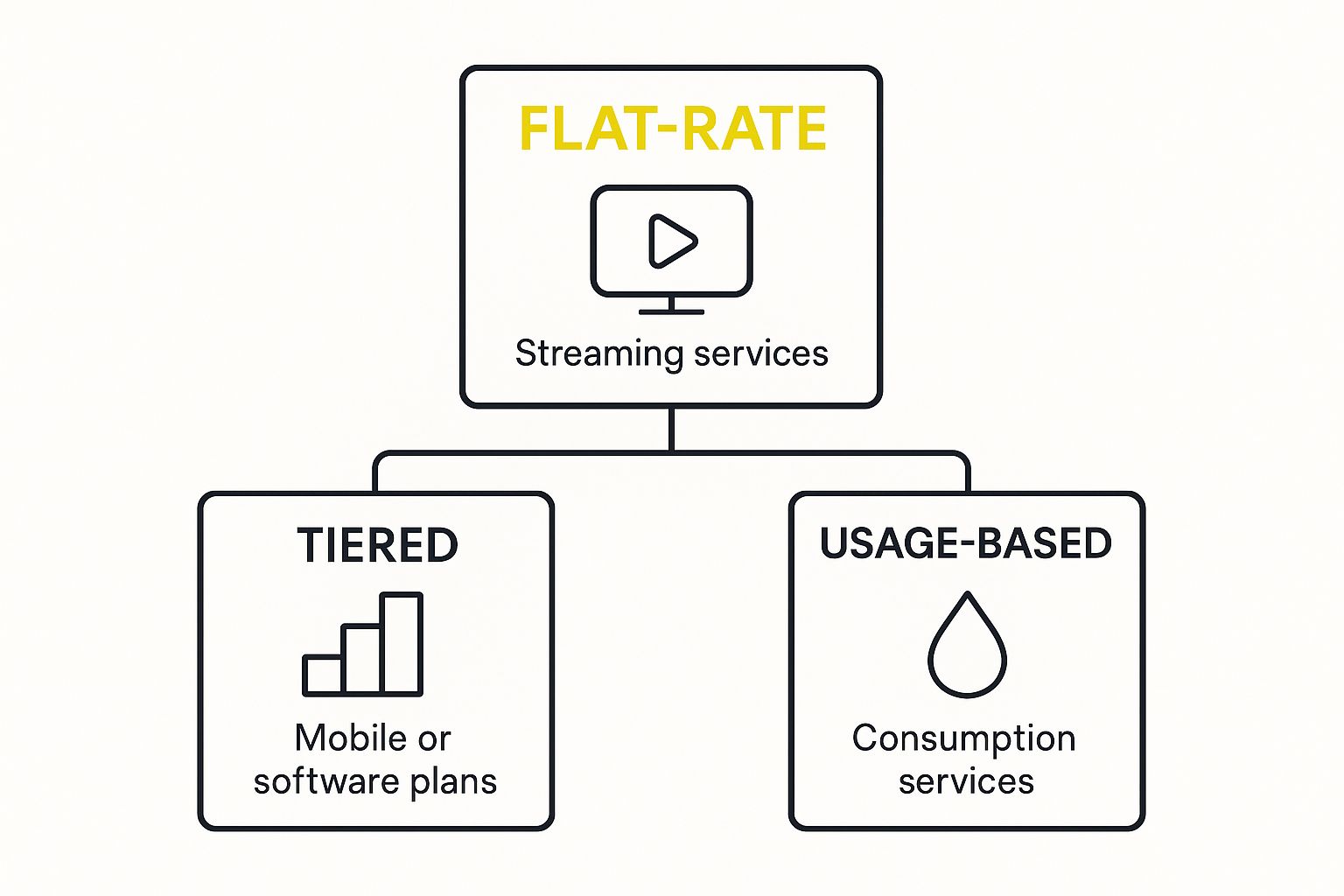
As you can see, each model offers a different level of customization. The key is finding the right balance between simplicity for the customer and flexibility for your business.
Usage-Based Pricing: Pay for What You Use
With usage-based pricing (also called "pay-as-you-go"), the cost is tied directly to how much a customer uses your product. It’s the same principle as your electricity bill—you only pay for what you actually consume. This model is quickly gaining fans because it feels incredibly fair and transparent, which can build a lot of customer trust.
This approach works best when consumption is easy to measure, like API calls, data storage, or even physical products like coffee pods. A prime example is Amazon Web Services (AWS), which bills clients for the exact amount of server space and computing power they use. A popular variation you'll often see, particularly in software, is the Freemium model, which can act as a gateway into a paid tiered or usage-based plan.
Key Takeaway: The best model always aligns your price with the value your customers get. Whether that’s unlimited access, a specific feature set, or direct usage, your pricing should feel like a fair exchange for the problem you solve.
Comparing Core Subscription Pricing Models
To make things even clearer, here’s a quick rundown of these models side-by-side. This table can help you zero in on the best fit for your products and customers.
| Model Type | Best For | Key Benefit | Main Challenge |
|---|---|---|---|
| Flat-Rate | Businesses with a single, focused product offering and a clear audience. | Simplicity and predictability. | Leaves money on the table; one size fits none. |
| Tiered | Companies serving diverse customer segments with varying needs. | Maximizes market capture. | Can confuse customers if tiers are unclear. |
| Usage-Based | Services where consumption is easily measured (e.g., data, API calls). | Perceived as fair; low barrier to entry. | Revenue can be unpredictable and hard to forecast. |
Ultimately, the goal is to find the structure that makes the most sense for what you sell and how your customers want to buy it. Each model has its strengths, but the right one will feel like a natural fit for your business.
The Rise of Usage-Based Subscriptions
Out of all the ways to structure a subscription, the "pay-for-what-you-use" model is really catching on with both businesses and customers. This approach, often called usage-based pricing, directly ties the cost to the actual value a customer gets. It just feels fair, and that sense of fairness builds a ton of trust.
Think of it like this: it’s a coffee subscription that only charges you for the pods you actually use, or a cloud storage plan that bills you based on the exact gigabytes you fill up. The logic is simple and totally transparent. It gets rid of that all-too-common feeling of paying for a bunch of features or capacity you never touch.
This flexibility isn't just a nice-to-have for customers; it's a powerful way to keep them around. When people feel their costs are directly linked to what they're getting, they're much less likely to hit the cancel button. The model meets them where they are, letting them scale usage up or down without feeling trapped in a plan that’s too big or expensive for their needs.
Why Fairness Drives Growth
At its heart, the appeal of usage-based subscriptions is all about aligning cost with value. Customers really appreciate the honesty, and it makes them feel like they're in a real partnership with the brand. That good feeling often turns into stronger loyalty and a higher lifetime value.
The numbers back this up, too. People are clearly choosing usage-based pricing over flat recurring fees because it’s tied to what they actually consume. And this isn’t just about warm fuzzies; it has a real impact on revenue. Companies earning over 25% of their revenue from usage-based models grew by 21% year-over-year, which is miles ahead of those sticking to fixed pricing. You can dig deeper into subscription economy trends at Cashfree.com.
A big reason for this growth is that it lowers the barrier to entry. A small business can start with minimal costs because their usage is low, and then let their subscription grow naturally as their own business expands.
Real-World Examples in Action
So, what does this look like in the wild? Here are a few common scenarios:
- Software as a Service (SaaS): A marketing automation tool might charge you per email sent or for every active contact you have. This way, a tiny startup and a massive corporation can use the exact same powerful software, but at a price that makes sense for their size.
- Ecommerce Consumables: Imagine a Shopify store selling premium art supplies. They could offer a paint tube subscription that only bills the customer when a smart sensor detects a tube is almost empty and ships a new one.
- API Services: Companies that provide data through an API, like a weather service or a live stock ticker, almost always charge per API call. It's a pure pay-as-you-go system where the cost perfectly reflects how useful the service is to the client.
The ultimate advantage of the usage-based model is its inherent scalability. It grows alongside your customer, ensuring that your revenue increases in direct proportion to the value you deliver, creating a true win-win scenario.
How to Choose the Right Subscription Model

There's no magic formula for picking the right subscription model. The best approach is rooted in common sense: match what you sell and who you sell it to with a pricing structure that just clicks. To get there, you need to ask a few honest questions about your business.
The real goal here is to make sure your pricing feels fair and directly connected to the value customers get from you. When you nail this alignment, your subscription feels less like a sales tactic and more like a smart, natural solution for your audience.
Start with Your Product and Customer Value
First things first, take a hard look at what you’re actually selling. Is it a physical product that people use up and reorder? A digital tool with different levels of features? Or maybe exclusive access to members-only content? The very nature of your product is your biggest clue.
Next, put yourself in your customer’s shoes. What’s in it for them? Do they love the convenience of never running out of their favorite coffee or vitamins? Or do they get more value from a tool that can grow with them, unlocking new features as their needs get more complex? Understanding this will guide you toward a model that feels intuitive to your buyers.
A classic mistake is to copy a popular subscription model without asking if it fits your own business. If your customers are all about convenience and replenishment, a "Subscribe and Save" model is a no-brainer. But if they care more about features and capabilities, a tiered model makes a lot more sense.
Think of it like building a bridge. Your product is on one side, your customer's needs are on the other, and the right subscription model connects them perfectly.
Key Questions to Guide Your Decision
To cut through the noise and find the right path, let these three questions be your guide. Your answers will bring a lot of clarity and help you choose a model with confidence.
1. What is the core nature of my product?
- Consumable: If you sell things people use up and reorder—like skincare, pet food, or cleaning supplies—a simple replenishment or "Subscribe and Save" model is your strongest bet. The value is obvious and immediate.
- Service/Digital: For software, digital services, or access-based products, tiered pricing is often the way to go. It lets you create different packages for different types of users, from beginners to power users.
- Curated Experience: Selling curated boxes or memberships? A flat-rate model keeps things simple and predictable for everyone, which is exactly what these customers want.
2. How do my customers perceive value?
- Do they want predictability and savings? A flat-rate or subscribe-and-save model delivers exactly that.
- Do they want flexibility and to pay only for what they use? A usage-based model is the perfect fit, but it requires solid tracking on your end.
- Do they value growth and scalability? Tiered pricing is fantastic for this, as it lets them start small and upgrade as their business or needs grow.
3. Can I easily measure consumption or access?
- This is the big one for usage-based models and even some tiered ones. You absolutely must have a reliable way to track key metrics, whether it's data consumed, reports downloaded, or features used.
- Without accurate tracking, these models can quickly become a headache, leading to billing errors and unhappy customers. Be honest about your technical capabilities here.
Working through these questions will give you the insight you need to land on a model that truly works for your business. And once you've made your choice, remember to keep an eye on your key ecommerce performance metrics to make sure it's delivering the results you expect.
The Psychology Behind Successful Subscriptions
A great subscription model isn’t just about automated billing. It works because it taps into some basic, powerful aspects of human psychology. At its heart, a successful subscription makes the customer's life easier, reduces the feeling of risk, and delivers a steady stream of value that makes them feel smart for signing up.
If you can grasp these subtle forces, you can build an offer that doesn't just get people in the door but keeps them around for good. It’s less about the features and more about making your subscription feel like an easy, indispensable part of their routine.
Lowering Commitment to Combat Fatigue
We all feel it—the dread of signing up for yet another recurring payment. "Subscription fatigue" is a genuine problem for customers who are tired of being locked into long, expensive contracts. This is where you can use flexibility as your secret weapon. By offering shorter, more manageable plans, you dramatically lower the barrier to entry and make the decision to buy feel much less risky.
The data backs this up. A recent analysis of $1.9 billion in transactions found that weekly subscription plans now make up a whopping 47% of total subscription revenue. That’s a big jump from 42% just a year prior. Meanwhile, monthly plans are starting to dip, which tells us customers are actively looking for lower-commitment options. You can discover more insights about subscription trends on Adapty.io.
When you offer weekly or flexible monthly plans, you're meeting your customers where they are. The decision to sign up feels smaller and less intimidating, which can do wonders for your conversion rates.
The Power of Ownership and Perceived Value
Have you ever noticed how quickly you get attached to something during a free trial? That's another psychological principle at play. When a customer uses your product for a week or two, it starts to feel like theirs. This creates a sense of ownership, making the idea of losing it feel like a real loss. Psychologists call this loss aversion, and it's a powerful motivator.
Premium tiers also play on our psychology by appealing to our desire for the "best" available option. You can even use a high-priced tier to make your mid-tier plan look like an absolute bargain. This classic strategy, known as the decoy effect, subtly frames your most popular plan as the smartest, most logical choice.
Key Takeaway: A successful subscription makes customers feel in control, smart, and invested. By reducing commitment anxiety and building a sense of ownership, you create a foundation for lasting loyalty.
Thinking about these psychological drivers helps you build smarter pricing that doesn't just pad your bottom line but actually strengthens your customer relationships. This is a crucial piece of any successful Shopify loyalty integration strategy, as it helps turn casual buyers into true brand advocates.
Got Questions About Subscriptions? We’ve Got Answers.
As you get ready to launch, you're bound to have some practical questions. Diving into subscriptions can feel like a lot at first, but with the right guidance, you can make decisions confidently. We’ve pulled together the most common questions we hear and answered them in plain English.
Think of this as your final checklist—a quick reference to clear up any lingering doubts before you hit "go live."
What’s the Best Model for a Brand-New Shopify Store?
When you’re just starting out on Shopify, your best friend is simplicity. The goal is to make your offer so clear and compelling that a customer gets it in seconds. Don't try to be everything to everyone right out of the gate.
The best model really just depends on what you're selling:
- Selling Consumables? If you offer products people use up and reorder—like coffee, skincare, or vitamins—the "Subscribe and Save" model is a no-brainer. The value is immediate and easy for customers to understand.
- Selling Curated Boxes? If your brand is all about discovery and delight, like a monthly snack box or a book club, stick with a simple "Flat-Rate" model. One price, one awesome experience. No confusion.
The main takeaway here is to start with one strong, simple offer. Pay close attention to what your first customers are saying and doing. Once you get a real feel for what they love, then you can start thinking about adding more tiers or other options.
How Do I Change Prices on My Existing Subscribers?
This is a tricky one. Changing prices for your most loyal customers requires a delicate touch. How you communicate the change is just as important as the price increase itself. Get this wrong, and you risk losing the trust you've worked so hard to build.
First, always give plenty of warning. A heads-up of 30 to 60 days is a good rule of thumb. When you make the announcement, be transparent about why the price is going up. Maybe you're sourcing better ingredients, adding new features, or improving the overall experience. Frame it around the extra value they're getting.
One of the best ways to soften the blow and show you appreciate your early adopters is to "grandfather" them in. This means letting your oldest customers keep their original price, either for a limited time or forever. It’s a powerful gesture that says, "We value you," and it can dramatically reduce cancellations.
What Are the Most Important Metrics to Watch?
To really know if your subscription business is healthy, you need to track the right numbers. It's easy to get buried in data, so focus on the few metrics that truly tell the story of your business.
Here are the non-negotiables:
- Monthly Recurring Revenue (MRR): This is the pulse of your business. It’s the predictable revenue you can count on coming in every single month.
- Customer Churn Rate: Simply put, this is the percentage of subscribers who cancel. Keeping this number as low as possible is the key to sustainable growth.
- Customer Lifetime Value (CLTV): This is an estimate of the total amount of money you can expect to earn from a single customer over their entire time with you.
- Customer Acquisition Cost (CAC): This is how much you have to spend in marketing and sales to sign up one new subscriber.
At the end of the day, a healthy subscription business has a CLTV that is much higher than its CAC. If you can achieve that while keeping your churn rate low and your MRR growing, you've found the winning formula.
Ready to build a high-converting Shopify store that supports your subscription goals? The experts at E-commerce Dev Group specialize in creating custom solutions that drive growth and customer loyalty. Learn more about how we can help you succeed.
