

Most marketers keep their email and SEO efforts in separate silos. This is a huge missed opportunity.
When you get them working together, you create a powerful growth loop. Your SEO brings in fresh eyes, and your email strategy captures, nurtures, and brings those people back again and again. This sends all the right signals back to the search engines.
Why Email and SEO Are a Perfect Match
It’s easy to think of email marketing and SEO as completely different jobs. One is about discovery, the other is about relationships. But that's precisely why they work so well together.
SEO is fantastic at pulling in new visitors who are actively looking for what you offer. Email marketing then takes over, turning that first-time visitor into a loyal subscriber and, eventually, a customer. It's a classic one-two punch.
When you get this right, you'll see a few things happen:
- You build an owned audience. Instead of just hoping Google sends you traffic, you have a direct line to people who want to hear from you.
- You get reliable, repeat traffic. An email is a perfect way to bring people back to your site, boosting your page views and time-on-site metrics.
- Your content gets an instant boost. Hit publish on a new blog post? Send it to your email list. That initial wave of traffic can give it the momentum it needs to start ranking.
- You send positive user signals. When people click from your emails and spend time on your content, it shows search engines that your site is valuable.
The Synergy at a Glance
This quick table breaks down how specific actions in one channel directly help the other.
Key Synergies Between Email and SEO
| SEO Action | Email Marketing Benefit | Email Marketing Action | SEO Benefit |
|---|---|---|---|
| Create high-value blog posts to attract organic traffic. | Provides compelling content to share with subscribers, keeping them engaged. | Promote new blog posts to the email list. | Drives an initial surge of traffic and social shares, signaling relevance to search engines. |
| Optimize landing pages with clear calls-to-action (CTAs). | Increases email opt-in rates, growing your subscriber list faster. | Segment your list to send targeted, relevant content. | Increases click-through rates and on-page engagement, which are positive user signals for SEO. |
| Conduct keyword research to understand user intent. | Gives you topic ideas for newsletters that you know your audience is interested in. | Ask subscribers for feedback or to leave reviews. | Generates fresh, user-generated content and social proof, which can improve local SEO and trust. |
This table is really just the tip of the iceberg, but it shows how interconnected these two channels truly are.
A Look at the Numbers
This isn't just theory; the data backs it up. Organic search is still a beast, driving around 53% of all website traffic.
At the same time, the number of global email users is expected to reach 4.6 billion in 2025. That’s a massive audience ready to be nurtured once your SEO brings them to your door.
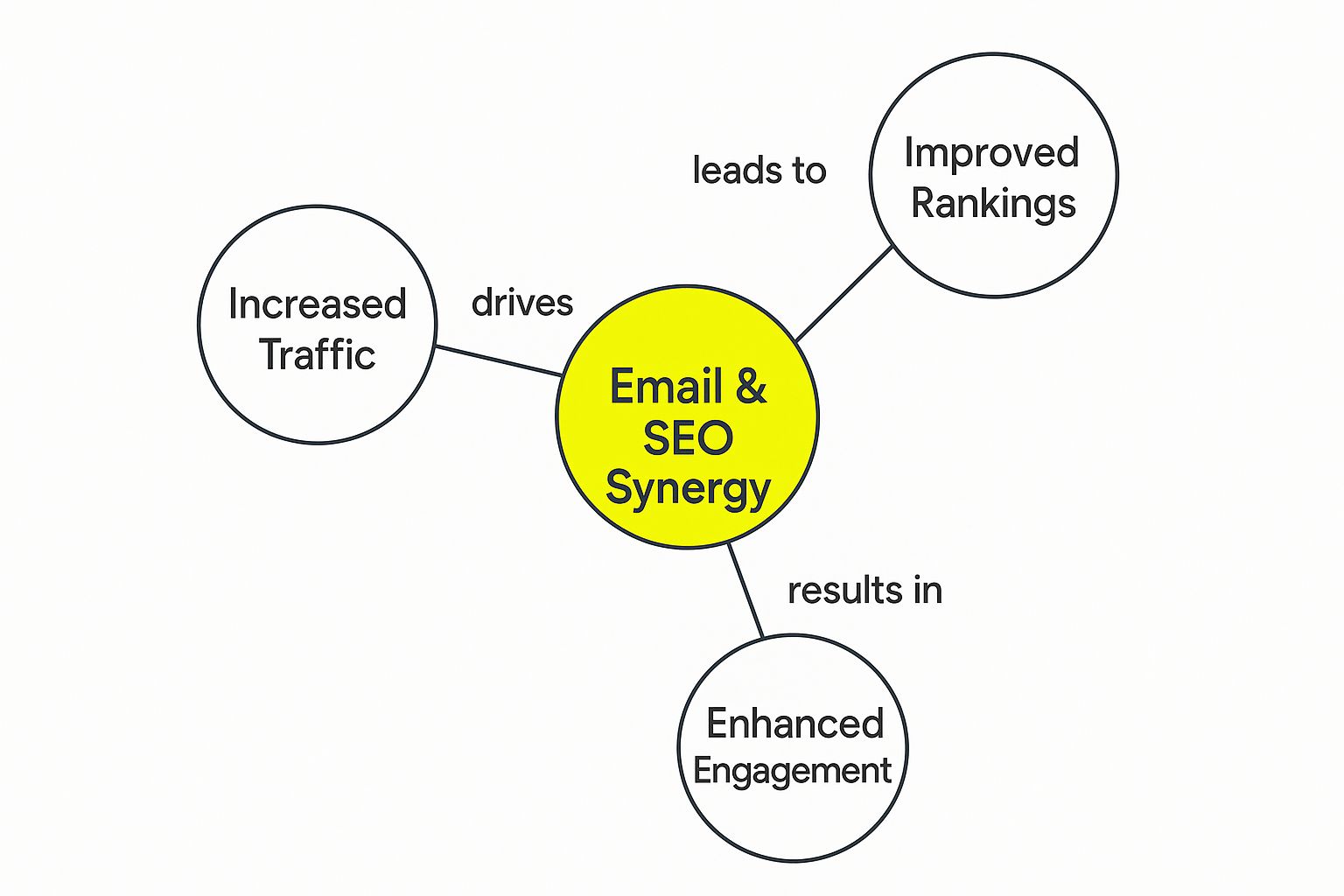
The Big Idea: Don't choose between email and SEO. Make them work together. SEO fills the top of your funnel, and email marketing turns those leads into a loyal community.
Before we get into the "how-to," it helps to have a solid grasp of what makes email so effective on its own. If you need a refresher, this is a great resource on the core advantages of email marketing. Understanding the strengths of each will make it much clearer how they fit together.
Let SEO Data Shape Your Email Content

Stop guessing what to write in your next newsletter. Seriously. The most effective email campaigns aren't born from creative genius alone; they're built on a foundation of data. They feel personal and timely because they directly address the problems your audience is trying to solve right now.
And where do people go to solve problems? They search.
This is where the magic happens when email marketing and SEO work together. Your SEO data is a direct line into your customers' minds, revealing their questions, frustrations, and goals in their own words. It's time to listen.
Uncover Content Gold with Keyword Research
Keyword research isn't just for climbing the Google ranks. It's an incredible tool for understanding what your audience actually needs. Using tools like Semrush, Ahrefs, or even the free Google Keyword Planner, you can see precisely what people are searching for in your niche.
Pay close attention to long-tail keywords. These are longer, more specific phrases that often reveal a person's exact intent. They're not just searching for a topic; they're asking a question.
- Informational Keywords: Think "how to reduce cart abandonment on Shopify." This is a clear cry for help.
- Navigational Keywords: When someone searches for a "Brand X case study," they're looking for proof and specific results.
- Transactional Keywords: A search like "Shopify Plus developer pricing" means someone is getting ready to open their wallet.
When you analyze these queries, you stop creating content you think people want and start delivering content you know they're actively looking for.
By identifying the specific language your audience uses to describe their problems, you can craft email subject lines and content that resonate on a much deeper level. It’s the difference between shouting into a crowd and having a one-on-one conversation.
Transform Keywords into Compelling Emails
Okay, so you've got a list of juicy keywords and questions. Now what? The fun part is turning that raw data into email content that people are excited to open.
A single high-intent keyword can be the seed for an entire email series. Let's say your research uncovers a popular search for "how to set up an abandoned cart email sequence." Instead of just pointing them to a blog post, you could create a value-packed email drip campaign.
Example Email Drip Campaign:
- Email 1 Subject: Your First Step to Recovering Lost Sales
- Content: A simple introduction to what abandoned cart emails are, why they're so critical, and one quick tip to get started.
- Email 2 Subject: The #1 Mistake in Abandoned Cart Emails
- Content: Dive into a common pitfall, like bad timing or a weak subject line, and offer a clear fix.
- Email 3 Subject: Steal This High-Converting Template
- Content: Provide a fill-in-the-blank template and explain the psychology behind why it converts so well.
This approach does more than just give information; it builds trust and positions you as an authority. You can even track engagement to see which topics resonate most. For a closer look at user behavior, our guide on how to analyze website traffic has some fantastic insights.
Find and Answer Your Audience's Questions
Beyond traditional keyword tools, don't forget about the goldmines that are AnswerThePublic or the "People Also Ask" section on Google. These tools are fantastic for finding the exact questions people are typing into their search bars.
Let's say your core topic is "Shopify theme customization." You'll quickly find questions like:
- Can I edit Shopify theme code myself?
- How do I add custom fonts to my Shopify store?
- What are the best apps for Shopify theme design?
Each one of these is a perfect newsletter topic. By answering these specific questions, you become the go-to resource in your industry, building a loyal following that hangs on your every word. This is how you perfectly align your email marketing and SEO—by creating content that both people and search engines will love.
Turn Blog Traffic into Loyal Subscribers
Getting people to your blog with great SEO is a huge win, but it’s really just the starting line. When a visitor reads one article and then disappears, you've lost a massive opportunity. The real magic happens when you can turn that fleeting search traffic into a dedicated audience you can talk to again and again. This is where email marketing and SEO become a powerful duo.
Your best-performing blog posts are more than just traffic magnets; they are prime real estate for growing your email list. You’ve already done the hard work of creating fantastic content that solves a real problem. Now it's time to invite those readers to stick around.
Turn Your Best Content into Subscriber Magnets
Not all blog posts are created equal. Dive into your analytics and you'll quickly see which articles consistently pull in the most organic traffic. These are your proven winners—the pages where people are already hooked on what you have to say. These are the perfect spots to place your email signup forms.
Forget the generic "subscribe to our newsletter" pop-up. Instead, offer something that's a direct extension of the content they're already devouring. We call this a content upgrade.
- Reading a "how-to" guide? Offer them a downloadable PDF checklist that summarizes every step.
- Looking at a data-heavy post? Give them a simple spreadsheet or a template they can copy and use themselves.
- Finished a long-form article? Offer an exclusive case study or a bonus video that goes even deeper on the topic.
This approach works so well because it feels like a fair trade. You're not just begging for their email; you're offering something genuinely useful that makes their life easier right now.
The goal is to make subscribing a total no-brainer. If someone just spent 10 minutes reading your epic guide on Shopify theme customization, an offer for a "Free Theme Customization Cheat Sheet" feels like the most natural and helpful next step imaginable.
Build Trust from the First Email
The moment someone subscribes, the clock is ticking. You have a small window to make a fantastic first impression and prove that giving you their email was the right call. A simple, automated welcome email sequence is your best tool for nurturing this brand-new relationship.
Don't just send one "thanks for subscribing" email and call it a day. Create a short, automated series that delivers incredible value from the get-go.
- The Welcome & Delivery: Get that content upgrade to them immediately. Keep this first email super focused—just a quick hello and a clear link to their download.
- The Best-Of: A day or two later, follow up with a handpicked list of your most popular and helpful blog posts. This is a great way to introduce them to more of your awesome content and bring them back to your site.
- The Personal Connection: Finally, share a bit about your brand's story. What do you stand for? What's a valuable lesson you've learned? This helps build a real human connection that goes beyond just churning out content.
This initial sequence really sets the tone for everything that follows. For more hands-on advice on crafting emails people actually look forward to opening, our article on how to write a compelling newsletter is packed with tips.
Repurpose and Engage Your List
One of the smartest ways to connect email marketing and SEO is to repurpose your best content. That 3,000-word behemoth of a guide that’s climbing the Google rankings? It’s also the perfect raw material for a multi-part email series.
Slice that big guide into smaller, bite-sized emails. For instance, you could transform a pillar post on "The Ultimate Guide to Shopify SEO" into a 5-day email course:
- Day 1: On-Page SEO Essentials
- Day 2: Technical SEO Quick Wins
- Day 3: Keyword Research for Products
- Day 4: Building Backlinks for Your Store
- Day 5: Measuring Your SEO Success
This strategy is brilliant because it drives repeat traffic back to your site, reinforces you as the go-to expert, and keeps your brand top-of-mind. When you send these emails to specific segments of your list, the results get even better—segmented campaigns are known to generate 30% more opens and 50% higher click-through rates. By capturing and nurturing the audience your SEO brings in, you create a powerful growth engine that practically runs itself.
Use Your Email List to Improve SEO Rankings

It’s easy to think of email and SEO as two totally separate channels. Email is for sales and nurturing, while SEO is for getting new traffic, right? But what if I told you your email list is one of the most powerful—and most overlooked—tools you have for SEO?
Think about it. You have a built-in audience just waiting to hear from you. They're ready to engage with your content the moment you send it, and that’s a signal search engines absolutely love.
When you publish a new blog post, don't just sit back and wait for Google to discover it. Give it an immediate jolt of life by sending it straight to your email subscribers. That initial surge of traffic shows search engines that your content is valuable and relevant right out of the gate, which can help it start ranking much faster.
Drive Engagement Signals That Matter
Search engines are smart. They're watching how people interact with your site. If someone clicks a search result, lands on your page, and immediately bounces, Google takes that as a sign of a poor user experience. But when visitors stick around? That tells Google you've got high-quality content.
This is where your email subscribers are your secret weapon. They’re your most loyal fans, so they're far more likely to actually read what you wrote, click on other links, and even share your work.
This kind of behavior directly improves key SEO metrics:
- Time on Page: An engaged subscriber who reads your article from top to bottom is a huge boost to your average time on page.
- Bounce Rate: When they click internal links to explore other content, it helps lower the bounce rate for that page.
- Social Shares: Your biggest fans are often the first to share your content on social media, creating social signals that drive even more traffic.
All these positive signals tell search engines that your content is a great answer to a search query, which is exactly what you need for better rankings.
Build High-Quality Backlinks Through Outreach
Your email list can also be a goldmine for building high-quality backlinks, a true cornerstone of any solid SEO strategy. I'm not talking about spamming your entire list, but rather strategic, personalized outreach.
The first step is to segment your subscribers. Pull out the influential bloggers, industry partners, or even just loyal customers who have their own websites.
When you publish something truly link-worthy—like an original research report or an in-depth guide—send a targeted email to this specific group. A quick, personal note explaining why you think their audience would find it valuable can work wonders.
A simple, personalized email to a small, relevant group of subscribers is far more likely to result in a quality backlink than a generic blast to thousands. This tactic turns your subscribers into your biggest brand advocates.
This approach perfectly blends the relationship-building strength of email with the authority-building power of SEO.
Nurture Repeat Visits and Boost Site Authority
A one-time traffic spike is nice, but demonstrating sustained interest in your website is even better. This is where your newsletter really shines, as it's the perfect tool for driving repeat visits.
By consistently sharing valuable content, you're training your subscribers to come back to your site again and again. Each return visit reinforces to search engines that your domain is a trusted resource. Over time, this helps build your site's overall authority, making it easier for all of your content to rank.
To see how these email activities translate into SEO wins, let's break it down.
Email Actions and Their Potential SEO Impact
| Email Action | Primary SEO Impact | Why It Works |
|---|---|---|
| Sending new content to your list | Increased Traffic & Faster Indexing | Creates an immediate traffic surge, signaling to search engines that the content is fresh and relevant. |
| Promoting long-form guides | Better Engagement Signals (Time on Page) | Subscribers are more likely to spend time reading in-depth content, boosting on-page metrics. |
| Personalized outreach for links | High-Quality Backlinks | Taps into existing relationships to earn valuable, authoritative links from relevant websites. |
| Running a regular newsletter | Increased Site Authority & Repeat Visits | Trains your audience to return, showing Google that your site is a trusted resource worth visiting often. |
| Asking for shares in your email | Social Signals & Referral Traffic | Encourages subscribers to share your content on social media, expanding its reach and driving traffic. |
As you can see, the connection is direct and powerful. Each email you send is an opportunity to strengthen your SEO foundation.
In a world where 347 billion emails are sent daily, email marketing remains a powerhouse, generating an average ROI of $42 for every $1 spent. You can explore more of these email marketing statistics at Inboxally. Putting this channel to work for your SEO isn't just a clever trick; it's how you build a sustainable, long-term advantage.
Integrate AI into Your Workflow

Let's be real: artificial intelligence isn't some far-off idea anymore. It's a powerful tool sitting right in our marketing toolbox, ready to supercharge your email marketing and SEO strategy. AI is brilliant at chewing through massive datasets, spotting patterns, and handling the repetitive stuff that eats up our time. This frees you up to think bigger.
Think of AI as your smartest assistant, one who gets both what people search for and what your subscribers actually want to read. It's the key to connecting the dots between the keywords that drive traffic and the email content that builds a loyal audience.
AI-Powered Content Ideation and Creation
One of the quickest wins with AI is brainstorming content. Generative AI tools like ChatGPT can take a dry list of SEO keywords and spin it into gold—or at least into compelling content angles. Instead of just staring at a spreadsheet, you can use AI to sketch out an entire content plan.
For instance, try feeding a tool a handful of long-tail keywords around "Shopify shipping strategies." From there, you can prompt it to whip up five unique newsletter topics based on those keywords, complete with catchy subject lines and opening hooks for each one.
Suddenly, a simple keyword becomes a fully-fledged content idea for your next email campaign. By using AI as a creative partner, you’re making sure your emails are perfectly aligned with what your audience is already looking for. For a deeper dive into practical ways to use AI for content strategy, these AI content analysis playbooks are a great resource.
And this isn't just theory. In 2025, a whopping 70% of marketers in the US are already using generative AI to improve their email campaigns. Writing email copy is the top use case for 34% of them. The numbers don't lie: AI-assisted campaigns are seeing a 13% jump in click-through rates and an incredible 41% revenue lift over traditional campaigns. Discover more stats on the impact of AI in email marketing.
Smarter Segmentation and Personalization
Beyond just writing content, AI is completely changing the game for personalization. Modern email platforms now use AI to analyze subscriber behavior—everything from past purchases and email opens to what they clicked on your website—to build dynamic segments on the fly.
This lets you graduate from basic segments like "new subscribers" to incredibly specific groups, like "people who viewed product X but didn't buy" or "subscribers who read three of our blog posts on SEO."
AI doesn't just sort your lists; it predicts what people will do next. It can even figure out the best time to send an email to each individual subscriber, making sure your message hits their inbox when they’re most likely to open it.
This kind of automation creates an experience that feels genuinely relevant to your audience. The content they get is directly tied to their most recent interactions with your brand, whether that started with a Google search or a click in a previous email. For Shopify store owners, this is especially powerful. You can learn more about how to put these tools to work in our guide on leveraging Shopify marketing automation.
Creating a Cohesive Customer Journey
At the end of the day, the goal of weaving email marketing and SEO together is to build a smooth, seamless journey for your customers. AI is the glue that holds these two channels together, analyzing data from both sides to map out the complete customer path.
Here’s how it works in practice:
- From Search to Nurture: AI can see the exact keyword that brought someone to your site. When they subscribe, an AI-powered system can automatically drop them into an email sequence designed around that original search intent.
- Finding Your 'Golden' Topics: By tracking which blog posts generate the most email signups and which email topics get the best engagement, AI can pinpoint your most valuable content themes. This tells you exactly where to focus your future SEO and content efforts.
- Predicting the Future: Advanced AI tools can even predict which subscribers might be about to leave or which ones are ready to buy. This allows you to be proactive, sending targeted campaigns to retain valuable customers or give warm leads that final nudge they need.
When you use AI to track user behavior across both search and email, you stop treating them as separate channels. Instead, you build a smart, responsive marketing engine where each part makes the other stronger, leading to better results and a much happier audience.
Common Questions About Email and SEO Integration
Whenever you start blending two big strategies like email marketing and SEO, it's natural for questions to pop up. You're shifting from running siloed campaigns to creating a single, powerful growth machine. Let's dig into some of the most common things marketers wonder about when they first start connecting these two worlds.
It's easy to get bogged down in the "what-ifs." Will one hurt the other? Where should I spend my time first? The good news is, when you do it right, these strategies don't just get along—they make each other stronger.
Does Email Traffic Directly Impact SEO Rankings?
This is the big one, and the short answer is no, but the real answer is much more interesting. Google doesn't peek into your Mailchimp account and use your open rates as a direct ranking factor. However, the traffic your emails send to your website creates powerful indirect signals that absolutely move the needle on your SEO.
Think about what happens when you email your list about a new blog post. You get an immediate wave of traffic from people who already know and trust you. They're your ideal audience. They're more likely to stick around, read the whole thing, and maybe even click on another link.
This behavior tells search engines that your content is a hit:
- Increased Time on Page: This signals that your content is genuinely engaging and valuable.
- Lower Bounce Rate: It shows that people found what they were looking for and decided to explore your site further.
- Initial Engagement: That first traffic spike can help Google discover and index your new content faster.
So, while the email itself isn't a ranking signal, the high-quality traffic it generates acts as a massive vote of confidence for your content.
It’s like giving your content a VIP premiere. Your email list is the enthusiastic first audience, and their positive reaction creates the buzz that gets everyone else—including Google—to sit up and take notice. This is the heart of a solid email marketing and SEO integration.
Can I Use the Same Content for Both Channels?
You bet, but you have to be smart about it. Don't just copy and paste an entire blog post into a newsletter. The magic is in repurposing. Your top-performing SEO content is a goldmine for your email campaigns, but it needs to be repackaged for the inbox.
Let's say you have a huge 2,500-word guide on "Shopify Conversion Rate Optimization." Instead of sending that beast in one email, break it down into a bite-sized, 4-part email series:
- Email 1: "3 Quick Wins for Your Product Pages"
- Email 2: "The #1 Mistake in Shopify Checkouts"
- Email 3: "Steal Our Highest-Converting Homepage CTA"
- Email 4: "Putting It All Together: A CRO Checklist"
This approach works because it respects how people use each channel. Someone searching on Google is often ready for a deep dive. Someone checking their email on their phone wants quick, actionable insights. By repurposing, you get more mileage out of your best work and serve both audiences exactly what they want.
How Can I Personalize Emails Without Being Creepy?
Personalization is a game-changer for engagement, but there’s a fine line between being helpful and being invasive. Thankfully, modern tools are getting incredibly good at delivering relevant content based on a user's behavior, not just their personal data.
AI-driven personalization is particularly effective. These systems often look at past email interactions (44%) and combine that with basic profile info like a name or company (68%) to craft messages that feel truly relevant. Confidence in this technology is soaring, with 50.7% of marketers now convinced that AI delivers better results than older methods. You can see more stats on AI's role in email personalization here.
So, instead of just dropping in a subscriber's first name, think about behavioral personalization. If someone subscribed to your list after landing on a blog post about a "technical SEO checklist," the next email you send them should probably be about… technical SEO.
That’s not creepy—it's just great service. You’re simply continuing the conversation they started, which is the best way to build trust and show you know your stuff.
At E-commerce Dev Group, we live and breathe this stuff. We build high-performance Shopify stores that are fine-tuned for both search engines and the people who use them. If you're ready to build a seamless path from a Google search to a happy customer, let's talk about how we can elevate your Shopify experience.
