


So, you’re thinking about starting an ecommerce business. It’s a big thought, but honestly, it’s more doable today than ever before. Whether you're dreaming of selling handmade goods or dropshipping the newest gadgets, the basic roadmap is surprisingly similar for everyone.
It all starts with a good idea and a clear plan.
Your Starting Point for Ecommerce Success
The online marketplace is absolutely buzzing with activity. To put it in perspective, global e-commerce sales are expected to skyrocket to $6.88 trillion by 2025. That’s a huge jump from $3.53 trillion back in 2018. This explosion has led to around 28 million online stores operating worldwide, which just goes to show how many people are successfully carving out their own space online.
Don't let those big numbers intimidate you. At its core, launching an online store boils down to a few key phases. Thinking about it this way helps turn a massive project into a series of smaller, more manageable tasks.
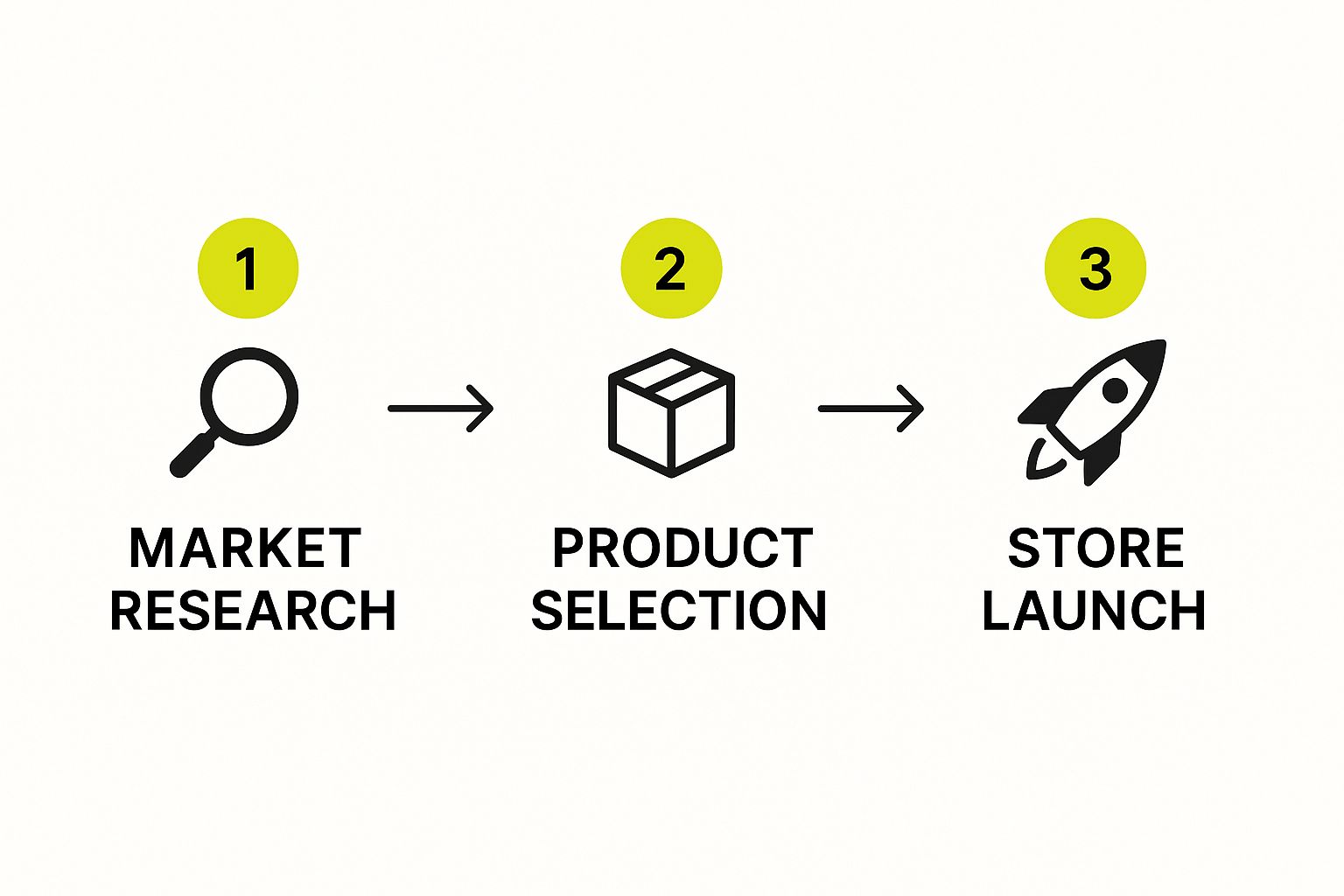
This process is a logical flow. Each step builds on the one before it, which is why getting the foundation right is so important. I’ve seen so many entrepreneurs rush past the research phase only to end up with a product nobody wants, and that's a tough spot to be in.
To give you a clearer picture, here’s a quick breakdown of the journey ahead.
Key Stages of Launching Your Ecommerce Business
This table summarizes the core phases you'll navigate as you build your business from the ground up.
| Phase | Key Objective | Example Action |
|---|---|---|
| 1. Research & Planning | Find a viable idea and understand your target market. | Analyze competitor pricing and identify a gap in the market. |
| 2. Product Sourcing | Secure a reliable way to get the products you plan to sell. | Partner with a dropshipping supplier or a local manufacturer. |
| 3. Store Setup & Design | Build a functional and attractive online storefront. | Customize a Shopify theme and write compelling product descriptions. |
| 4. Launch & Marketing | Drive traffic to your new store and generate your first sales. | Run a targeted Facebook ad campaign for your launch week. |
Seeing it laid out like this makes the whole process feel much less daunting, doesn't it? It’s all about taking it one phase at a time.
What to Expect in This Guide
Think of this guide as your personal playbook. We're going to walk through each of these stages together, covering everything you need to know to get from idea to your very first sale.
Here's a little of what we'll cover:
- Finding Your Niche: How to pinpoint a profitable corner of the market that you can actually connect with.
- Choosing a Platform: Deciding on the right home for your store, whether that’s Shopify, BigCommerce, or something else. Our https://scaleshopify.com/2025/07/05/ecommerce-platform-comparison/ offers a deep dive.
- Getting Set Up: The nuts and bolts of running a store, like setting up payment gateways and figuring out shipping.
- Your First Marketing Push: Simple, effective ways to get your first customers in the door without a massive budget.
Here's a piece of advice I always give new founders: Don't wait for the "perfect" idea. Start with a good one, launch it, and listen to what your first customers have to say. Your business will evolve, and that's not just okay—it's the whole point.
If you already know you want to build on one of the most popular platforms out there, this guide on how to start an ecommerce business on Shopify is a fantastic, detailed resource.
Our goal here is to give you the practical knowledge and the confidence to just get started. Let’s do this.
Find Your Niche and Craft a Lean Business Plan

Every great online store begins with a sharp, focused idea. The classic mistake I see new entrepreneurs make is trying to sell everything to everyone. It just doesn’t work. The real secret to getting early traction is finding a specific audience with a specific need—that’s your niche.
Think about the difference. A generic "pet supply store" is forgettable. But a store that sells "eco-friendly, durable toys for large-breed dogs"? Now that is powerful. You immediately know who it's for and what makes it special.
Your perfect niche often lies at the intersection of what you're passionate about, what you know, and what people will actually pay for. Starting an ecommerce business is a marathon, and choosing a niche you genuinely care about will give you the motivation to power through the tough spots.
Validating Your Big Idea
Before you spend a single dime on a website or inventory, you need to play detective. Market validation is simply about confirming that real people out there want to buy what you plan to sell. This doesn't have to be complicated or expensive.
Start by digging into online communities where your potential customers already are. Dive into Reddit threads, Facebook Groups, and niche forums. What problems are people constantly complaining about? What products do they wish existed? These places are goldmines for raw, unfiltered customer insights.
Once you have a better feel for the audience, you can test the waters:
- Keyword Research: Use a tool like Google Keyword Planner to see how many people are searching for terms related to your idea. A high search volume with low competition is a fantastic sign.
- Trend Analysis: Check out Google Trends. Is interest in your niche growing, stable, or fading? You want to catch a rising wave, not a dying one.
- Competitor Scoping: Find a few potential competitors. Seeing a little competition is actually a good thing—it proves there's a market. The key is to figure out their game plan by learning how to perform a detailed ecommerce competitive analysis to spot their strengths and, more importantly, their weaknesses.
Don't run from a product with a few competitors. If there's zero competition, it usually means there's no market. Your job is to find a unique angle or serve the customer better than anyone else.
Building Your Lean Business Plan
Forget those 50-page business plans you see in movies. For an ecommerce startup, you need a lean, practical blueprint that guides your decisions, not something that gathers dust on a shelf. This should be a living document you can tweak as you learn.
This lean plan is all about answering a few core questions with absolute clarity. This will be your North Star as you start making real decisions about your store, marketing, and money.
Here’s what you absolutely need to include:
- Your Mission: In one or two sentences, why does your business exist? Something like, "To provide sustainable and stylish yoga gear for conscious consumers."
- Your Target Customer: Get specific. Who are they? What do they care about? Sketch out a simple persona. "Meet Sarah, a 32-year-old urban professional who values sustainability and wellness."
- Your Product Sourcing: How will you actually get your products? Are you dropshipping from a supplier, manufacturing them yourself, or buying wholesale?
- Your Financials (The Back-of-the-Napkin Version): Start simple. Estimate your startup costs (platform fees, domain name, a small ad budget) and set a realistic revenue goal for your first year.
This simple framework forces you to think through the most critical parts of your business. It takes your idea from a "what if" to a "how-to," creating a clear path forward as you learn how to start an ecommerce business. This is the foundation everything else gets built on.
Alright, you've done your homework and have a plan. Now for the fun part: building the actual digital home for your brand.
Think of your online store as more than just a place to list products. It’s the very first—and often only—interaction people will have with your business. A clean, professional, and easy-to-use website creates instant trust, which is everything when you're asking someone to pull out their credit card.
The foundation of it all is the ecommerce platform you choose. This single decision affects your store's design, its features, and how you'll manage everything day-to-day. It’s like picking the right chassis for a car; you need something strong, scalable, and built for what you intend to do.
Choosing Your Ecommerce Platform
The good news? You've got some fantastic options, and you don't need to be a coding wizard to get a beautiful store online. The trick is to match a platform's strengths with your business goals, how tech-savvy you are, and your budget.
When you're first figuring out how to start an ecommerce business, these three platforms will almost always come up:
- Shopify: This is the go-to for most beginners, and for good reason. It’s an all-in-one platform known for its incredibly user-friendly setup, gorgeous themes, and a massive app store that lets you add almost any feature imaginable. If you want to get up and running fast without technical headaches, Shopify is tough to beat. For a deep dive, check out our guide on setting up a Shopify store.
- BigCommerce: A major competitor to Shopify, BigCommerce also handles all the hosting for you. Its big selling point is the sheer number of features it includes right out of the box, often reducing the need for paid apps. This can be a huge advantage for businesses that know they'll need advanced functionality as they grow.
- WooCommerce: This one works a little differently. WooCommerce is a free plugin that transforms a self-hosted WordPress site into a powerful online store. It offers unmatched flexibility and customization, but it puts you in the driver's seat. You'll be responsible for arranging your own web hosting, security, and updates.
From my experience, if you're just starting out, a hosted platform like Shopify or BigCommerce is the smarter path. They take care of all the technical heavy lifting (security, hosting, uptime) so you can put 100% of your energy into marketing and selling.
Once your platform is picked out, it’s time to claim your domain name. This is your address on the web (like YourBrand.com), so make it count. It should be memorable, easy to spell, and clearly related to your brand. My advice? Keep it short and try to avoid using hyphens or numbers.
Comparing Top Ecommerce Platforms
Feeling a little stuck on which platform to pick? It’s a big decision, so let’s break down the key differences to help you see which one aligns best with your vision.
| Platform | Best For | Pricing Model | Key Feature |
|---|---|---|---|
| Shopify | Beginners and businesses focused on quick, easy setup. | Monthly Subscription + Fees | Massive app store for endless customization. |
| BigCommerce | Growing businesses that need robust, built-in features. | Monthly Subscription (No Tx Fees) | Powerful native features without needing apps. |
| WooCommerce | Tech-savvy owners who want total control over their WordPress site. | Free Plugin (Hosting is separate) | Unmatched flexibility and open-source customization. |
Ultimately, there's no single "best" platform—only the best one for you. Shopify is often the path of least resistance to getting your first sale, while WooCommerce offers ultimate freedom if you're willing to manage the tech.
Designing a Store That Converts
Your store’s design isn't just about looking good; it's about making money. In fact, a staggering 75% of consumers admit they judge a company's credibility based purely on its website design. A messy, slow, or confusing site will send potential customers straight to your competitors.
Aim for a clean and intuitive experience. Can visitors easily find what they're looking for? Is your "Add to Cart" button impossible to miss? Is the checkout process ridiculously simple? Stick to a consistent color palette and branding that fits your niche. You're not just selling products; you're selling an entire brand experience.
Crafting Compelling Product Pages
Think of your product pages as your digital salespeople. This is where you make your final pitch, and every single element has to work together to convince a visitor to click "buy." Two things here are absolutely non-negotiable.
First, high-quality product photography. Online shoppers can't touch or hold your products, so your photos have to do all the heavy lifting. Show your items from every angle, show them in use, and include close-ups of important details. A blurry, poorly lit photo screams "amateur" and erodes trust in a heartbeat.
Second, you need persuasive product descriptions. Don't just list the technical specs—tell a story. Focus on the benefits. How is this product going to make your customer's life better, easier, or more fun? Use bullet points to highlight the most important details and write in a voice that connects with your ideal customer.
The move to online shopping isn't slowing down. Global retail ecommerce sales are projected to smash $6.42 trillion by 2025. While that represents a massive opportunity, it also means the competition is fierce. A polished, professional, and trustworthy storefront is what will help you stand out and grab your piece of the pie.
Sorting Out Your Operations and Legal Essentials
Your store looks great, but now it’s time to hook up the engine. This is all the behind-the-scenes work that actually makes your business run—from getting paid to getting products to your customers. Nailing these details right from the start saves you from massive headaches down the road and builds a business that’s meant to last.
First things first: you need a secure way to take people's money. That's where payment gateways enter the picture.
Getting Paid and Getting Products Out the Door
Payment gateways are the services that securely process credit card payments for you. Think of them as the digital equivalent of a credit card terminal in a physical shop. They connect your store to your customer's bank, making sure every transaction is safe and sound. For anyone starting an ecommerce business, this is a non-negotiable.
You'll come across a few big names pretty quickly:
- Stripe: A favorite for a reason. It’s powerful, integrates with just about everything, and has a super clean interface.
- PayPal: Everyone knows PayPal. Just having it as an option can actually boost sales because people trust the name.
- Shopify Payments: If you're building on Shopify, this is a no-brainer. It's built right in, the rates are competitive, and everything lives on one dashboard.
Setting up a payment gateway is usually a pretty straightforward process, but you can't afford to be casual about security. You absolutely need robust fraud prevention for ecommerce from day one. Fraudulent chargebacks are a silent killer for new businesses and can drain your profits before you even get going.
Next up, how will you get your awesome products into your customers' hands? Your shipping and fulfillment strategy is a huge piece of the puzzle, directly affecting customer happiness and how much money you actually keep.
There are a few ways to tackle this:
- Do It Yourself: You store the inventory, you pack the boxes, you ship the orders. This gives you total control over the experience but can quickly become a full-time job on its own.
- Dropshipping: You never touch the product. A supplier holds all the inventory and ships orders directly to your customers for you. It’s low-risk and hands-off, but your profit margins will be thinner.
- Third-Party Logistics (3PL): You buy your inventory and ship it to a specialized warehouse. They handle all the storage, packing, and shipping for you. It's the perfect middle ground when you've outgrown your garage but aren't ready for your own warehouse.
My advice? Don't overcomplicate it at the start. If you're selling handmade goods, doing it yourself is the obvious choice. If you're sourcing products from a manufacturer, dropshipping is a fantastic way to see if people will actually buy your stuff without sinking cash into inventory.
Tackling the Legal Stuff
Alright, let's talk about the part everyone wants to ignore: the legal paperwork. It’s not the most glamorous part of being an entrepreneur, but getting your legal and tax ducks in a row is absolutely critical. Skipping these steps can land you in serious hot water.
Your first big decision is choosing a business structure. This defines how you're taxed and whether your personal assets are protected if things go south.
| Business Structure | Key Characteristic | Best For |
|---|---|---|
| Sole Proprietorship | You and the business are the same legal entity. Simple and cheap. | Side hustles or anyone testing an idea with minimal risk. |
| LLC | Separates your personal assets from business debts. | Most serious ecommerce businesses that want liability protection. |
A sole proprietorship is the easiest way to get started, but it means your house, car, and savings are on the line if the business gets sued. An LLC (Limited Liability Company) creates a protective wall between your personal and business finances, which is why it's the go-to for most online stores that plan to grow.
Finally, you have to get a handle on your tax obligations. This means collecting sales tax where required and paying income tax on your profits. Ecommerce tax laws can get confusing fast, as they change from state to state.
This is one area where spending a little money now saves you a fortune later. Talk to an accountant. Seriously. They'll help you understand your obligations and set up your finances the right way from the very beginning.
Marketing Your Store and Getting Your First Customers
Alright, your beautiful online store is live. Now for the real fun—and the biggest challenge: getting people to actually visit it. A great product and a slick website don't mean much if nobody knows you exist. It’s time to roll up your sleeves and get the word out.
The goal here isn't to become a marketing wizard overnight. It’s about being smart and focusing on a few practical, budget-friendly strategies to drive that first wave of traffic. The most important thing is generating those crucial first sales. My advice? Don't try to do everything at once. Pick one or two channels you can really focus on and do them well.
Building an Audience on Social Media
For a new brand, social media is more than just a place to post product pictures—it’s where you build a community. First, you need to figure out where your ideal customers hang out online. Are they scrolling through the visual world of Instagram and TikTok, or are they active in community-focused Facebook Groups?
Once you know where they are, start creating content that genuinely helps or entertains them. Don't just sell. For example, if you sell sustainable yoga mats, share quick morning yoga routines, post tips for eco-friendly living, or give a behind-the-scenes look at how your mats are made. This approach builds trust and gives people a reason to follow you long before they’re even thinking about buying.
Your early followers are your most valuable asset. Engage with every single comment and message. Ask for their opinions. When you make people feel seen and heard, they stop being passive followers and become your biggest advocates.
This connection is more critical than ever. In 2025, with over 2.77 billion people shopping online globally, the market is incredibly crowded. Think about this: a staggering 99% of shoppers look at reviews before making a purchase. That stat really underscores the immense power of social proof and community trust. You can dive deeper into these ecommerce statistics and what they mean for new businesses.
Driving Free Traffic with SEO Fundamentals
Search Engine Optimization (SEO) is how you get your store to show up when people search on Google. It's definitely a long-term game, but the effort you put in now will pay off for months and years to come with a steady stream of free, highly motivated customers.
You don’t need to be an expert to get started. Just focus on a few core areas:
- Keyword Research: Get inside your customer's head. What search terms are they typing into Google? Are they looking for "hand-poured soy candles" or something broader like "long-lasting scented candles"? Weave these phrases naturally into your product titles, descriptions, and blog posts.
- On-Page SEO: This is just a fancy way of saying you need to make your website easy for Google to understand. For instance, give your product images descriptive file names like
blue-wool-sweater.jpginstead of the genericIMG_1234.jpg. Also, take the time to write unique meta descriptions for your most important pages. - Content Creation: Start a simple blog on your store. Writing helpful articles related to what you sell (e.g., "5 Ways to Style a Chunky Knit Sweater") establishes you as an expert and gives Google more reasons to send people your way.
Every product description you fine-tune with the right keywords and every helpful blog post you publish is another signal to Google that your site is a valuable resource.
Running Your First Paid Ad Campaigns
While SEO builds your traffic over time, sometimes you just need to get eyeballs on your products right now. This is where paid advertising comes in, especially on platforms like Instagram and Facebook.
The key is to start small and test everything. You don't need a massive budget; even $5-$10 a day is enough to start gathering useful data. The real magic of these platforms is their detailed targeting. You can show your ads to people based on their interests, age, location, and even their online shopping habits.
Here’s a simple game plan for your first campaign:
- Pick a Goal: Do you want website traffic or direct sales? I’d suggest starting with a "traffic" objective just to get your first visitors in the door.
- Define Your Audience: Target a small, highly specific group that perfectly matches your ideal customer profile.
- Create Your Ad: Use your absolute best product photo or a short, eye-catching video. Write a clear, simple caption that highlights the #1 benefit of your product.
- Analyze and Adjust: After a few days, check your results. Which ad got the most clicks? Which audience responded best? Use that info to make your next ad even better.
Don't get discouraged if your first ad isn't a runaway success. Paid advertising is all about learning. Every campaign, whether it works or not, gives you valuable insights into what your customers actually respond to, which will help you make much smarter marketing decisions as you grow.
Questions Everyone Asks Before Starting an Ecommerce Store
Diving into ecommerce is exciting, but let's be honest—it also brings up a ton of questions. You’ve got a great idea and the drive to make it happen, but the nitty-gritty details can feel like a huge hurdle.
Let's walk through the questions I hear most often from new entrepreneurs. Getting these answers sorted out will give you the clarity and confidence to actually start building.
So, How Much Does It Really Cost to Start?
This is always the first question, and the true answer is: it completely depends. Your startup costs are tied directly to your business model and how big you want to go from day one. The good news? You don't need a fortune to get off the ground.
Starting lean is almost always the smartest move. For instance, you could launch a basic dropshipping store for less than $100. That would cover your first month on an ecommerce platform like Shopify and the cost of a custom domain name. Simple.
Now, if you plan on holding your own inventory, the initial investment obviously goes up. You’ll need to account for:
- Your first product order: Buying that initial batch of inventory from a supplier.
- Professional photos: Don't skimp here. High-quality product photography is non-negotiable and will be one of your most important upfront costs.
- Storage and supplies: Even if it’s just some shelves in your garage and a stack of shipping boxes.
For a business managing its own stock, a starting budget in the $2,000 to $10,000+ range is more realistic. The key is to start small, prove your product sells, and then reinvest your profits to fuel growth.
What's the Easiest Ecommerce Business to Start?
If you're looking for the path of least resistance, a few models stand out because they slash your risk and upfront cash needs.
Dropshipping is hands-down the most popular starting point. You partner with a supplier who holds all the inventory and ships products directly to your customers when an order comes in. You never touch a single box, which removes a massive layer of operational headaches.
Selling digital products is another fantastic, low-friction option. Think e-books, online courses, or design templates. With no inventory and no shipping, the profit margins can be incredible. You create it once and can sell it forever.
A personal favorite for creative entrepreneurs is the print-on-demand model. You can sell t-shirts, mugs, posters—you name it—with your own custom designs. When a customer buys something, a third-party partner prints and ships it for you. Zero inventory risk.
How Long Until I Make My First Sale?
This can be anywhere from a few hours to a few months. It all comes down to your niche, how much people want your product, and—most importantly—how you market your store from the moment you launch.
Some founders get that first sale notification within hours by telling friends, family, and their existing social media followers. If you're ready to run a small, targeted ad campaign right away, you could see sales within the first 24-48 hours.
On the flip side, if you're relying on "free" organic marketing like SEO and content, you need to be patient. It can easily take a few weeks, or even a couple of months, for Google to start noticing you. A good, realistic goal for a new store with a solid launch plan is to aim for that first sale within 30 days.
Do I Actually Need a Business License to Sell Online?
Yes, in most places you'll need to make things official. The exact requirements change dramatically depending on your country, state, or even city, but this is a step you can't afford to skip.
At a bare minimum, you'll probably need to register your business name. You might also need specific permits depending on what you're selling (food products, for example, have much stricter rules). It's on you to research the local laws to make sure you're operating legally and handling things like sales tax correctly.
Seriously, talk to a local business authority or a legal professional. Getting your legal house in order from the start will save you from massive headaches and potential fines down the road.
Ready to build a Shopify store that not only looks professional but is engineered to convert? The experts at E-commerce Dev Group specialize in custom design, development, and optimization to help your business thrive. Get a partner that understands how to build for growth by visiting https://scaleshopify.com.
