


Let's be real—most buyer personas are useless. They end up as forgotten PDFs because they're built on flimsy guesswork instead of solid customer data. We've all seen them: generic sketches like "Marketing Mary" or "Startup Steve" that are too vague to give your team any real direction.
It's time to stop creating fictional characters and start building strategic tools.
Effective personas dig deep into your customer data to uncover what truly drives them—their motivations, their biggest challenges, and their buying habits. When you get this right, you can tailor your entire marketing strategy to what they actually want.
Why Your Old Buyer Personas Are Failing You

The problem with most personas is that they're based on intuition, not information. They feel more like creative writing exercises than business assets.
To build something that actually works for your e-commerce store, you need to combine the "what" (quantitative data like purchase history and site analytics) with the "why" (qualitative insights from surveys, interviews, and reviews). This blend creates a three-dimensional view of your customer that can guide everything from ad copy to product development.
If you’re ready to move beyond the fluff and master this process, check out our complete guide to how to create buyer personas.
From Vague Ideas to Actionable Insights
So, what's the difference between an old-school archetype and a modern, data-driven persona? It's the difference between guessing and knowing. One is a list of assumptions; the other is a roadmap built on evidence.
Here’s a quick breakdown:
| Attribute | Traditional Archetype | Data-Driven Persona |
|---|---|---|
| Foundation | Assumptions & stereotypes | Real customer data & analytics |
| Focus | Broad demographics (e.g., age, gender) | Specific behaviors & motivations |
| Creation | Internal brainstorming | Surveys, interviews, data analysis |
| Outcome | Generic, often ignored document | Actionable tool for decision-making |
| Impact | Minimal effect on strategy | Drives targeted marketing & higher ROI |
Building personas based on data isn't just a "nice-to-have." It’s a fundamental shift that reduces bias and gives you a far more accurate picture of who you're selling to.
A well-crafted buyer persona isn’t just a fictional character. It’s an evidence-based composite of your ideal customer, grounded in real data and designed to guide every strategic decision your business makes.
What This Means for Your Shopify Store
When you switch from vague ideas to data-backed insights, you can start making smarter, more profitable decisions. Instead of throwing marketing dollars at the wall and hoping something sticks, you'll know exactly who to target and what to say.
Here's what you can expect:
- Smarter Ad Targeting: Stop wasting money on ads that don't connect. You can speak directly to the specific pain points and desires of your best customers.
- Higher Conversion Rates: When your website copy, product descriptions, and email campaigns truly resonate with customer needs, conversions will follow.
- A Clearer Path to Growth: Once you understand who your most valuable customers are, you can go out and find more people just like them.
By the end of this guide, you’ll have a practical framework for building rich, data-driven personas that your entire team can actually use to drive real growth.
Where to Find Actionable Customer Data

Creating buyer personas that actually work starts with real data. Forget the guesswork. The most valuable insights are usually hiding in plain sight, tucked away in the tools you already use every day. This is where you stop theorizing and start gathering the raw materials to build profiles of actual human beings.
The whole point is to blend hard numbers with human stories. You need to combine quantitative data (the what) with qualitative feedback (the why) to get a complete picture. You might discover, for instance, that customers from a certain city almost always read your "About Us" page before buying. That’s a golden nugget for your marketing strategy.
Your goal is simple: build a foundation of evidence for every decision you make.
Tap Into Your Existing Data Goldmine
Before you even think about new research tools, look at the data you already have. Your Shopify dashboard, Google Analytics, and CRM are packed with information about who your customers are and how they behave on your site.
This first step is all about understanding the "what". What are they buying? Which pages do they linger on? How did they find you?
Here's where to start digging:
- Shopify Analytics: Get comfortable in your store's reports. Look for your best-selling products, average order value (AOV), and customer lifetime value (CLV). You can also pinpoint where your customers live and which marketing channels bring in the most cash.
- Customer Purchase History: Start grouping customers by what they've bought. Do you have a segment that only buys a specific product category? Or a group of loyal fans who snap up every new arrival? These are the first hints of distinct audience segments.
- CRM Data: If you use a CRM, it’s a goldmine of customer interactions. Scan notes from support calls and emails. Are there common questions, frustrations, or specific needs that keep popping up?
Insights like these show you which channels are delivering your most engaged visitors. This tells you where your ideal customers are actually spending their time online and is the perfect starting point for understanding their journey.
Uncover the 'Why' with Proactive Research
Analytics show you what people do, but they rarely explain why. To build personas with real depth, you need to collect qualitative data—the thoughts, feelings, and motivations behind the clicks.
Don't worry, this doesn't have to be complicated or expensive. Sometimes, just asking is the most powerful thing you can do.
"The most dangerous number is one. Hearing a single customer's perspective is valuable, but hearing from five, ten, or twenty reveals patterns you can’t ignore. That's where true understanding begins."
Here are a few practical ways to get those answers:
- Simple Customer Surveys: Use a tool like Google Forms or SurveyMonkey to create a short, focused survey. Keep it to 5-7 questions max. Ask about their goals, their challenges, and what finally pushed them to buy. A small 10% discount for their time can work wonders for your response rate.
- Informal Customer Interviews: Find a handful of your best customers—the repeat buyers who seem to genuinely love your brand. Shoot them an email and ask for 15 minutes of their time. The key is to keep it conversational. Your goal is to listen, not to talk.
- Analyze Customer Support Tickets: Your support inbox is a direct line to your customers' pain points. Read through recent tickets. What recurring issues or questions do you see? Pay attention to the exact language they use to describe their problems.
These conversations help you understand the context around their purchase and see how your products actually fit into their lives. For a deeper dive into this process, check out our guide on creating an effective eCommerce customer journey map.
Listen to Unfiltered Customer Voices
Often, the most honest feedback isn't given to you directly. It's out there in public forums where customers are speaking their minds freely. This is where you can learn the exact words and phrases your audience uses—pure gold for writing copy that connects.
Make it a habit to monitor these channels:
- Product Reviews: Read every single review on your site and on any third-party platforms. What specific features do people rave about? What complaints come up again and again?
- Social Media Comments: Pay close attention to the comments on your organic posts and your ads. Are people asking for more information? Are they sharing photos of how they use your products?
- Online Communities: Find the subreddits, Facebook groups, or online forums where your target audience congregates. What are they talking about? What problems are they trying to solve that your products could help with?
When you combine the hard data from your analytics with these real-world, qualitative insights, a complete, three-dimensional picture of your customer begins to emerge. This holistic view is the bedrock of any powerful buyer persona that can truly guide your business.
Finding Patterns in Your Customer Data
You've done the hard work of gathering customer data from Shopify, surveys, and maybe even a few interviews. Now you're staring at a mountain of information. The real magic isn't in collecting the data; it's in connecting the dots. Raw data is just noise. Your job is to find the music in it.
This is where you move from isolated facts to the core insights that will breathe life into your buyer personas. You’re looking for the shared "why" behind the "what." Instead of just grouping people by age, you might uncover a group of 'Time-Strapped Professionals Seeking Convenience' or 'Ethical Shoppers Prioritizing Sustainability.' Now those are labels you can actually build a marketing strategy around.
This image shows a great high-level view of this process—taking all that raw info and distilling it into clear, actionable groups.
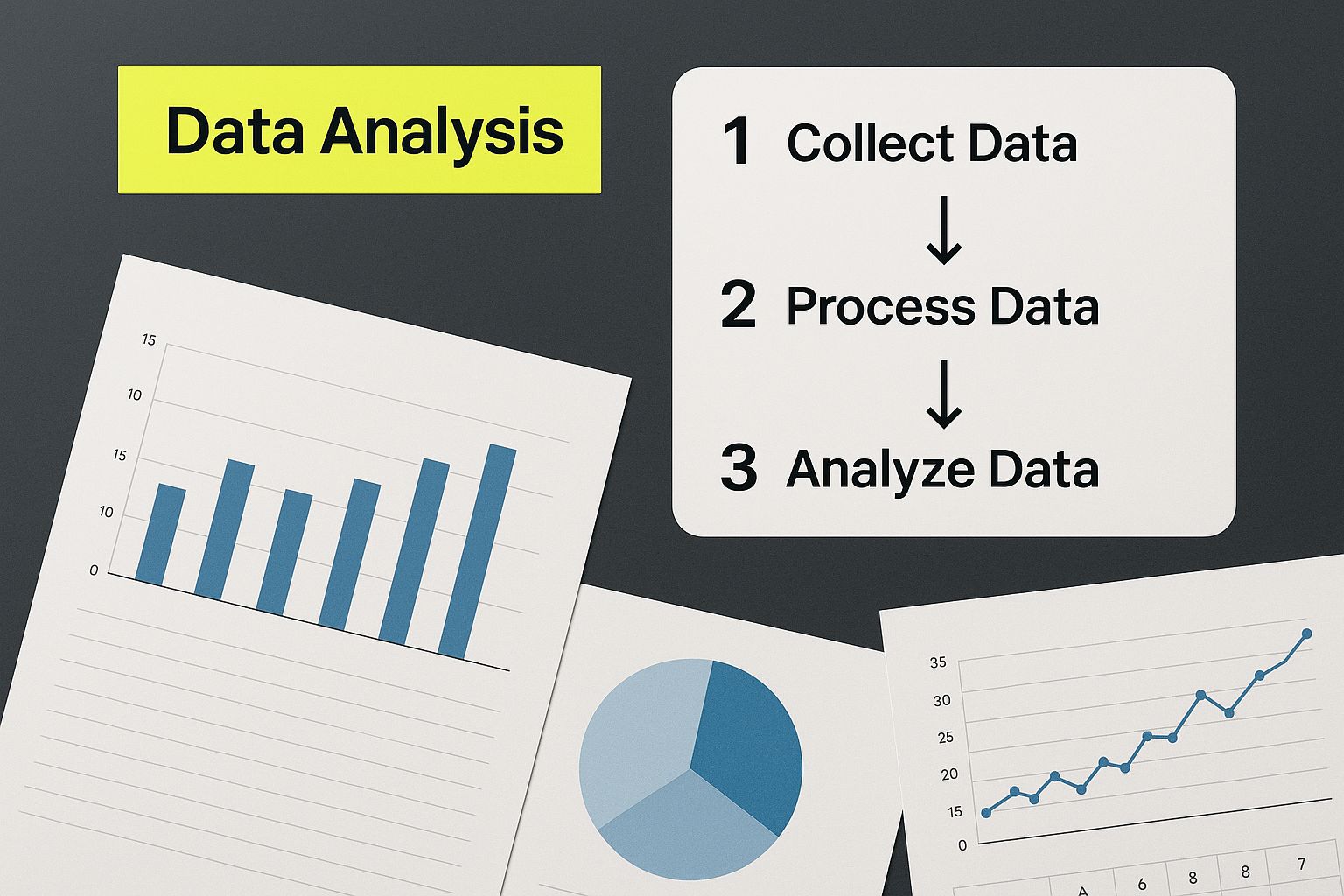
As you can see, it’s a funnel. You start broad and get more and more focused, turning scattered data points into meaningful segments that represent your real customers.
Organizing Your Research for Clarity
Let’s get practical. The easiest place to start is a simple spreadsheet. Set up columns for each key piece of information you’ve collected—things like purchase history, survey answers, key quotes from interviews, and on-site behavior. Each row can represent a single customer.
As you fill this out, resist the urge to just copy and paste. Summarize. Categorize. Instead of pasting a full product review, pull out the key takeaway, like "Loves our eco-friendly packaging" or "Frustrated by shipping time."
This simple act forces you to start thinking critically about what the data is actually telling you.
Identifying Key Audience Segments
With your data all in one place, you can start the treasure hunt. Begin by sorting your sheet by different columns. What happens when you sort by "Motivation"? You might suddenly see that 40% of your highest-spending customers all mention "saving time" as their main reason for choosing you. That’s a huge clue.
Look for the connections that aren't immediately obvious:
- Do customers who complain about price also tend to be first-time buyers?
- Do people who follow you on Instagram and buy your newest products share a similar job title?
- Are there common words or phrases used by customers who leave 5-star reviews?
These connections are the building blocks of your personas. You aren't just looking for one data point; you're searching for a whole cluster of attributes and behaviors that stick together.
The real breakthrough happens when you stop focusing on what people are (demographics) and start focusing on what they do (behaviors) and what they want (motivations). This shift turns a persona from a document into a strategic tool.
From Clusters to Core Personas
As you spot these connections, you'll see distinct groups start to emerge from the noise. The goal is to identify 2-4 core personas that represent the most significant chunks of your audience. Give each one a descriptive name to make it feel real.
For example, you might end up with:
- The Conscious Consumer: This person consistently brings up sustainability, reads your 'About Us' page, and is willing to pay a premium for ethically made products.
- The Deal Seeker: This segment uses a discount code on almost every purchase, has a lower average order value, and is the first to open your sale announcement emails.
- The Gift Giver: This group's buying activity spikes around holidays. They often use the gift-wrapping option, and their browsing history is all over the map as they search for the perfect item.
These aren't just guesses; they are concrete segments built from the real data you collected. This is how you ensure your personas reflect who your customers actually are, not who you think they are. For a more technical look at finding patterns in huge datasets, a guide on Python programming for data analysis can be a great resource.
By finding these patterns, you’ve brought order to the chaos. These segments are now ready to be fleshed out into the detailed persona profiles that will guide your entire e-commerce strategy.
How to Build a Compelling Persona Profile
You’ve done the hard work of gathering the data and spotting the patterns. Now for the fun part: turning all those raw insights into a living, breathing document that your team will actually want to use. This is where you graduate from spreadsheets to storytelling.
The goal here isn't to create a dry, corporate report. It's to build a profile so real your team feels like they know this person. A great persona gives you a gut-level understanding of who you’re talking to, whether you're writing a product description, designing an ad, or answering a support ticket.
First, Give Your Persona a Name and a Face
This might sound like a small thing, but it’s a powerful psychological trick. Give your persona a name and find a stock photo that brings them to life. This simple act instantly makes abstract data feel human and relatable.
Instead of a generic label like "High-Value Shopper," you now have "Sustainable Sarah." That little change helps everyone visualize a real person, not just a faceless market segment. Pick a photo that matches the demographic data you’ve collected—think about their age, general style, and the kind of environment they'd be in. It's a tiny detail that makes a massive difference.
Craft Their Story
With a name and face in place, you can start building out the core of the profile. This is where you translate your research into a narrative. Think of it as a one-page bio that highlights exactly what your business needs to know to connect with them.
Make sure you include these key sections:
- Demographics: Nail down the basics—age, income, location, job title. Just the facts, keep it brief.
- A "Day in the Life" Scenario: Write a short paragraph describing their typical day. This is brilliant for adding context and showing where your brand might fit into their routine.
- Goals & Motivations: What is this person really trying to achieve? What gets them out of bed in the morning? This should go way beyond just your product and tap into their bigger life aspirations.
- Challenges & Pain Points: What’s getting in their way? What frustrations keep them up at night? This is your chance to pinpoint the exact problems your Shopify store solves.
- Watering Holes: Where do they hang out, both online and off? List the specific social media platforms, blogs, podcasts, or influencers they follow and trust.
This structure helps you build a complete picture, moving from the broad strokes of their demographics to the nitty-gritty of their daily struggles.
A persona profile should be a mirror, not a crystal ball. It reflects the reality of your existing customers, grounding your strategy in evidence rather than assumptions.
Go Deep on Goals and Pain Points
If you only have time to focus on two things, make it the Goals and Pain Points sections. These are the absolute heart of the persona. They directly feed your marketing messages, your content ideas, and even your product development. They are the bridge between who your customer is and why they should give a damn about you.
For example, let's say you sell sustainable home goods. A persona's goal probably isn't just "decorate my apartment." It’s more likely something like, "create a non-toxic, safe space for my family" or "reduce my household's carbon footprint without sacrificing style."
Their pain points would be just as specific:
- "I have a hard time finding brands that are actually transparent about their sourcing and materials."
- "So many eco-friendly products are just plain ugly and don't fit my home's aesthetic."
- "I'm totally overwhelmed by 'greenwashing' and have no idea which brands to trust."
See how much more powerful that is? A generic pain point like "products are too expensive" is useless. But an insight like, "I feel guilty spending more on eco-friendly products, even though I know it's the right thing to do," is pure gold. You can build an entire campaign around that feeling.
Putting It All Together
Your final persona document needs to be clean, scannable, and easy on the eyes. Nobody is going to read a dense wall of text. Use headings, bullet points, and maybe even a few icons to make the information pop.
To help you get started, here’s a quick look at the essential information every persona needs to be truly effective for a Shopify store.
Essential Components of a Buyer Persona Profile
This table breaks down the core elements of a persona profile, explaining what each part tells you and how to think about it.
| Component | What It Tells You | Example Question to Answer |
|---|---|---|
| Name & Photo | Creates a human connection and makes the persona memorable. | Does this image feel like someone who would use our products? |
| Demographics | Provides a basic, factual foundation for the persona. | What is their age, location, and occupation? |
| Goals | Explains their primary motivations and what they want to achieve. | What is their ultimate objective, and how can we help? |
| Pain Points | Reveals the specific frustrations and challenges they face. | What is the biggest obstacle we can remove for them? |
| Watering Holes | Shows where they get information and who they trust. | Which social platforms or blogs influence their buying decisions? |
| Key Quotes | Captures their voice using real words from your research. | What's a direct quote that sums up their main frustration? |
Once you have this document polished and ready, it becomes your North Star. It’s a constant reminder that ensures everyone in your company is focused on the same customer, speaking their language, and solving their most pressing problems.
Okay, You've Built Your Personas. Now What?
Creating those buyer personas probably felt like a huge win. And it is! But let's be real—a beautifully designed persona profile is worthless if it's just collecting dust in a Google Drive folder. The real magic happens when you bring these profiles to life.
This is where all that research starts to make you money. When you know exactly who you’re talking to, every decision gets easier. Writing an email, designing a new product, even handling a customer complaint—it all becomes clearer and far more effective. You stop shouting into the void and start having meaningful conversations with people you genuinely understand.
Let's Sharpen Your Marketing Messages
This is the most obvious—and immediate—place to put your personas to work. Generic, one-size-fits-all marketing just doesn't cut it anymore. When you craft your copy for a specific persona, you can speak directly to their worries, their goals, and their motivations.
Picture this: you sell sustainable home goods. How you talk to "Ethical Shopper Emma" is going to be wildly different from how you approach "Budget-Conscious Ben."
- For Emma: Her email subject line might be something like, "Just Dropped: Our Most Eco-Friendly Kitchen Collection Yet." The email itself would lean into the recycled materials, ethical sourcing, and your commitment to carbon-neutral shipping.
- For Ben: His subject line needs to hit a different note. Think: "High-End Style, Not-So-High-End Price: 20% Off Best-Sellers." The email would focus on value, durability, and how he can get a premium look without breaking the bank.
See the difference? It stops feeling like an ad and starts feeling like a genuinely helpful recommendation. This isn't just theory; the data backs it up.
We've seen firsthand how powerful this is. According to industry research, marketing that uses personas can make a website 2 to 5 times more effective for targeted users. For email, persona-driven campaigns can double open rates and increase click-through rates by up to 5x. If you want to dig into the numbers, these buyer persona statistics on delve.ai are eye-opening.
The takeaway is simple: when your marketing is guided by well-defined personas, you get better engagement and, ultimately, more sales.
Let Personas Guide Your Content and Products
Your buyer personas are the ultimate cheat sheet for your content strategy. No more guessing what to write about. Now, you can create blog posts, social media updates, and videos that answer the exact questions your ideal customers are asking.
Let's say one of your key personas is "Time-Strapped Parent Pam." You know she's juggling a million things. Your content should be her lifeline.
- A blog post like "5-Minute Home Organization Hacks That Actually Work."
- An Instagram Reel showing a quick shelf styling tutorial.
- A downloadable checklist for a manageable weekly cleaning routine.
But don't stop at content. Personas are a goldmine for product development. By truly listening to your customers' frustrations and desires, you can spot huge opportunities. If "Ethical Shopper Emma" keeps asking about plastic-free bathroom options, that’s your cue. Your product team should immediately start exploring shampoo bars and bamboo toothbrushes.
Understanding who you're selling to is the bedrock of a solid marketing plan. To see how this piece of the puzzle fits into the bigger picture, check out our guide on building a comprehensive Shopify marketing strategy.
Get the Whole Team on Board
For your personas to truly work, they can't just be a "marketing thing." They need to be woven into the DNA of your entire company.
- Sales & Customer Support: Your support team can use personas to anticipate common issues and provide more empathetic, helpful service. Knowing they’re chatting with "Budget-Conscious Ben" helps them frame solutions around value and affordability.
- Web Design & UX: Your web developers can use personas to build a better user experience. "Time-Strapped Pam" needs a lightning-fast checkout with minimal clicks. "Ethical Emma," on the other hand, will probably spend time on your "Our Story" page, so it needs to be compelling.
When everyone—from the product developers to the customer support reps—shares the same deep understanding of the customer, you create a seamless and consistent brand experience. This alignment is what turns one-time buyers into loyal fans and drives real, sustainable growth for your Shopify store.
A Few Lingering Questions About Buyer Personas
Even with a solid plan, a few practical questions always come up when teams start building out their buyer personas. Let's tackle the most common ones I hear, so you can make sure your hard work pays off in the long run.
Think of this as the final check-in before you put your new customer profiles to work.
How Many Personas Do I Actually Need?
This is, without a doubt, the most common question. The answer? Almost always fewer than you think. It’s so easy to get carried away and create a dozen different personas for every tiny customer segment, but that just creates noise and becomes impossible to manage.
For most Shopify stores, starting with two to four core personas is the sweet spot. That's usually enough to cover the most important segments of your audience without overwhelming your marketing and product teams. The goal here is clarity, not complexity.
Focus on creating profiles for distinct groups that genuinely need different messaging or product features. If two of your potential personas share most of the same goals and frustrations, you're probably better off merging them into one stronger, more comprehensive profile.
How Often Should I Update My Personas?
Your buyer personas aren't a "set it and forget it" project. Markets shift, new trends pop up, and your customers' behaviors will definitely change over time. Because of this, you need to treat them as living documents.
As a general rule, plan on doing a major review and refresh once a year. That said, you should also revisit them after any major business event, like:
- Launching a significant new product line.
- Expanding into a new country or demographic.
- Noticing a big, unexplained shift in your sales data or customer feedback.
I tell my clients to think of their personas like a garden. A quick check-in every quarter can help you spot new trends (the weeds!), while the annual deep dive ensures they stay accurate and useful for your long-term goals.
This keeps your customer understanding sharp and prevents your strategy from getting stale.
What’s the Single Biggest Mistake to Avoid?
Easy. The biggest pitfall is creating personas based entirely on internal assumptions instead of real data. When you skip the research and just brainstorm what you think your customers are like, you're basically just writing fiction.
This is why so many personas end up gathering dust on a server somewhere. They don't reflect reality, so they can't possibly guide an effective strategy. Every single detail—from their goals to their pain points—has to be rooted in your surveys, interviews, and analytics. While you're digging into that data, it’s also a great time to make sure you can spot unusual activity and prevent eCommerce fraud by truly understanding what normal customer behavior looks like.
Always, always trust the data over your gut. Grounding your personas in solid evidence is the only way to build a tool that your team will actually trust and use to drive real growth.
Ready to build a Shopify store that truly connects with your ideal customers? The experts at E-commerce Dev Group specialize in creating data-driven strategies that turn insights into sales. Get in touch today to see how we can help you grow.
