


Think of an ecommerce customer journey map as a visual story. It chronicles every single interaction a customer has with your brand, from the moment they first see a social media ad to the follow-up email they receive after a purchase. It's a strategic blueprint that helps you understand what your customers are actually doing, thinking, and feeling at every turn.
Why an Ecommerce Customer Journey Map Is Essential

Let's get past the textbook definition. A journey map is your guide to how real people shop today. The path to purchase is no longer a straight line; it's more like a tangled web of touchpoints across social media, email, your website, and countless other channels.
Your business is already sitting on piles of data from all these places—your CRM, Google Analytics, social media insights, customer support logs. The problem is, this information is usually siloed. An ecommerce customer journey map is the tool that weaves all these scattered data points into a single, understandable story. It turns raw data into a human narrative.
More Than Just a Diagram
It's easy to look at a journey map and see just another diagram for a PowerPoint slide. That's a huge mistake. When done right, it's a powerful business driver that turns insights into real-world results. By truly understanding the winding path your customers take, you can pinpoint exactly where to invest your time and money for the biggest impact.
The results are tangible and measurable. A staggering 87% of retailers who use journey mapping report a higher ROI from their sales and marketing. This isn't just about making more sales; it's about spending smarter. You can dig deeper into these retail mapping statistics to see the full impact.
A journey map gives you a customer's-eye view of your business. It stops you from making decisions based on internal assumptions and forces you to confront the reality of what it’s like to shop with you.
Finding Hidden Money and Savings
A great journey map does more than just fine-tune your marketing—it shines a spotlight on opportunities to improve operations and boost revenue. When you identify friction points, you can smooth out your processes, which often means a lighter load for your support team.
Here's how that plays out:
- Lower Service Costs: Businesses with well-defined journey maps can slash customer service costs by 15-20%. By fixing common problems you discover on the map, you prevent support tickets from ever being created.
- Higher Cross-Sell Revenue: When you know the customer's mindset at each stage, you can serve up the perfect offer at the perfect time. This has led to a 56% increase in cross-sell and upsell revenue for companies who get it right.
- Cheaper Customer Acquisition: Optimizing the experience keeps your current customers happy and coming back. Since it costs far more to attract a new customer than to retain an existing one, this directly helps your bottom line.
In the end, creating a journey map is an investment in your brand's future. It's the foundation for building a personal, efficient, and memorable experience that turns casual shoppers into lifelong fans. You stop guessing what customers want and start knowing.
Gathering the Right Data for Your Map
Let's be honest: a customer journey map built on guesswork is just a pretty picture for the office wall. An effective map, the kind that actually drives results, is rooted in solid data, not internal assumptions.
To build something that truly reflects reality, you need to combine two kinds of information. First, the quantitative data that tells you what your customers are doing. Second, the equally important qualitative data that reveals why they're doing it. Blending these two is the only way to get the full story of your customer's experience—their actions, thoughts, and feelings at every step.
Start with the Numbers: Uncovering the "What"
Quantitative data is the foundation of your map. These are the hard numbers that show how people are actually behaving on your site. Don't start guessing; start by pulling real evidence from the platforms you already use.
You likely have a wealth of this data at your fingertips:
- Website Analytics: Tools like Google Analytics are your first stop. Look at where your traffic is coming from, which pages have high bounce rates, and what the most common paths are from the homepage to a product page.
- Sales Data: Your ecommerce platform, whether it's Shopify or another, is a goldmine. Dig into purchase history, average order value (AOV), and customer lifetime value (CLV). This tells you what's working commercially.
- Behavioral Analytics: This is where it gets really interesting. Heatmap and session recording tools literally show you where users click, how far they scroll, and where they hesitate. This visual proof is incredible for spotting friction points you'd otherwise miss.
A critical part of this process is performing a thorough consumer behavior analysis to translate all these raw numbers into clear, understandable patterns.
The modern shopping journey is rarely a straight line. People bounce between channels, research on their phones, and buy on their laptops later. To map this messy, non-linear reality, you need to bring your data together. You can't have browsing history in one system, purchase data in another, and support tickets in a third. You'll be left with a fractured view and tons of missed opportunities.
Dig Deeper: Sourcing the "Why"
While numbers show you what happened, qualitative insights tell you the story behind the data. This is how you uncover the emotional side of the experience—the frustrations, delights, and "aha!" moments that analytics charts simply can't capture.
Getting this information means you have to do one thing: listen to your customers. It's about understanding their motivations and expectations in their own words.
I can't stress this enough: never underestimate the power of a simple conversation. I've found that a 15-minute chat with a recent customer can reveal more actionable insights than hours spent staring at a dashboard.
Here are the best places to find this qualitative gold:
- Surveys and Polls: After a purchase or even when a user abandons a cart, use simple polls to ask direct questions. "What almost stopped you from buying today?" is a fantastic one.
- Product Reviews: Your product pages are overflowing with feedback. What specific features do people rave about? What complaints pop up over and over again?
- Support Tickets & Chat Logs: Your customer service team is on the front lines every day. Read through chat transcripts and support emails to find recurring issues, common questions, and points of confusion.
- User Interviews: For the deepest dive, set up a few one-on-one video calls with customers. Ask them to share their screen and walk you through how they found and purchased their last item. You'll be amazed at what you see.
Putting It All Together for a Complete Picture
The real magic happens when you connect the dots between the quantitative "what" and the qualitative "why." Fragmented data leads to a fragmented understanding. Your goal is to create a unified view.
Here's what that looks like in practice:
| The "What" (Quantitative Data) | The "Why" (Qualitative Insight) | The Conclusion for Your Map |
|---|---|---|
| Analytics shows a 60% drop-off on the shipping page. | Surveys reveal customers are shocked by unexpected shipping costs. | The checkout stage is a major pain point. The root cause is a lack of pricing transparency earlier in the journey. |
| Heatmaps show almost no clicks on the "Size Guide" link. | Reviews frequently mention that "the clothes didn't fit as expected." | There's a missed opportunity in the consideration stage. The size guide is either not visible enough or not helpful. |
| Sales data shows very few repeat purchases from first-time buyers. | Support tickets show lots of confusion about the returns policy. | The post-purchase experience is weak. We need to focus on a "Loyalty" stage and make policies crystal clear. |
By weaving these different data streams together, you move beyond just observing behavior. You start building a journey map that explains the crucial moments that make or break a sale, giving you a clear roadmap for improvement.
How to Map Customer Touchpoints and Actions
Once you have your customer data in hand, it’s time for the fun part: building the actual map. This is where you take all those numbers and interview notes and turn them into a visual story of your customer's experience. You're going to plot out every single interaction someone has with your brand, from the very first time they hear about you to the moment they become a loyal fan.
A touchpoint is simply any time a customer interacts with your business. It could be something direct, like visiting your website, or more indirect, like seeing an influencer post about your product on Instagram. Your job is to brainstorm and list every single one you can think of, no matter how small it seems.
Visualizing The Entire Customer Path
Think of this like drawing a map for a road trip before you leave. You need to know every turn, every planned stop, and even the potential detours. I find it easiest to start by listing touchpoints under the main journey stages: Awareness, Consideration, Purchase, and Loyalty.
For example, let's imagine a customer buying a new pair of running shoes. Their journey might look something like this:
- Awareness: They see a targeted Facebook ad for "trail running shoes."
- Consideration: They watch a YouTube review comparing your shoe to a competitor's.
- Purchase: They add the shoes to their cart on your Shopify store and go through checkout.
- Loyalty: They get a follow-up email with a guide on "how to break in your new running shoes."
Different channels play different roles here. For instance, understanding the advantages of email marketing can really help you nail those post-purchase interactions and build loyalty.
Mapping Actions, Thoughts, and Emotions
A good map lists touchpoints. A great map, however, gets inside the customer's head. It captures what they are doing, thinking, and feeling at each point in the journey. This is what breathes life into the data.
Let's stick with our running shoe example. Here's how you can add that crucial context:
| Stage | Action (Doing) | Thoughts (Thinking) | Feelings (Emotional State) |
|---|---|---|---|
| Consideration | Reads a blog post: "Top 5 Trail Running Shoes." | "I need something with good grip. Is this brand trustworthy?" | Curious, Cautious, Overwhelmed by choices |
| Purchase | Adds shoe to cart, proceeds to checkout. | "Okay, this looks right. Oh, I have to create an account?" | Excited, a little Annoyed, Determined |
| Loyalty | Opens the "Your Order Has Shipped" email. | "Great, it's on its way. I hope it fits." | Anticipation, Relief |
When you start mapping these internal states, you begin to see your brand exactly as your customers do. You uncover their real motivations and anxieties, which is where you'll find the best opportunities to improve.
The most insightful maps are built by constantly asking "And then what happens?" Don't just assume the path. Follow the clues from your data and customer feedback to reveal the journey they actually take, not the one you think they take.
This image below captures that final moment of the purchase—a critical touchpoint where the customer feels a sense of accomplishment and relief.
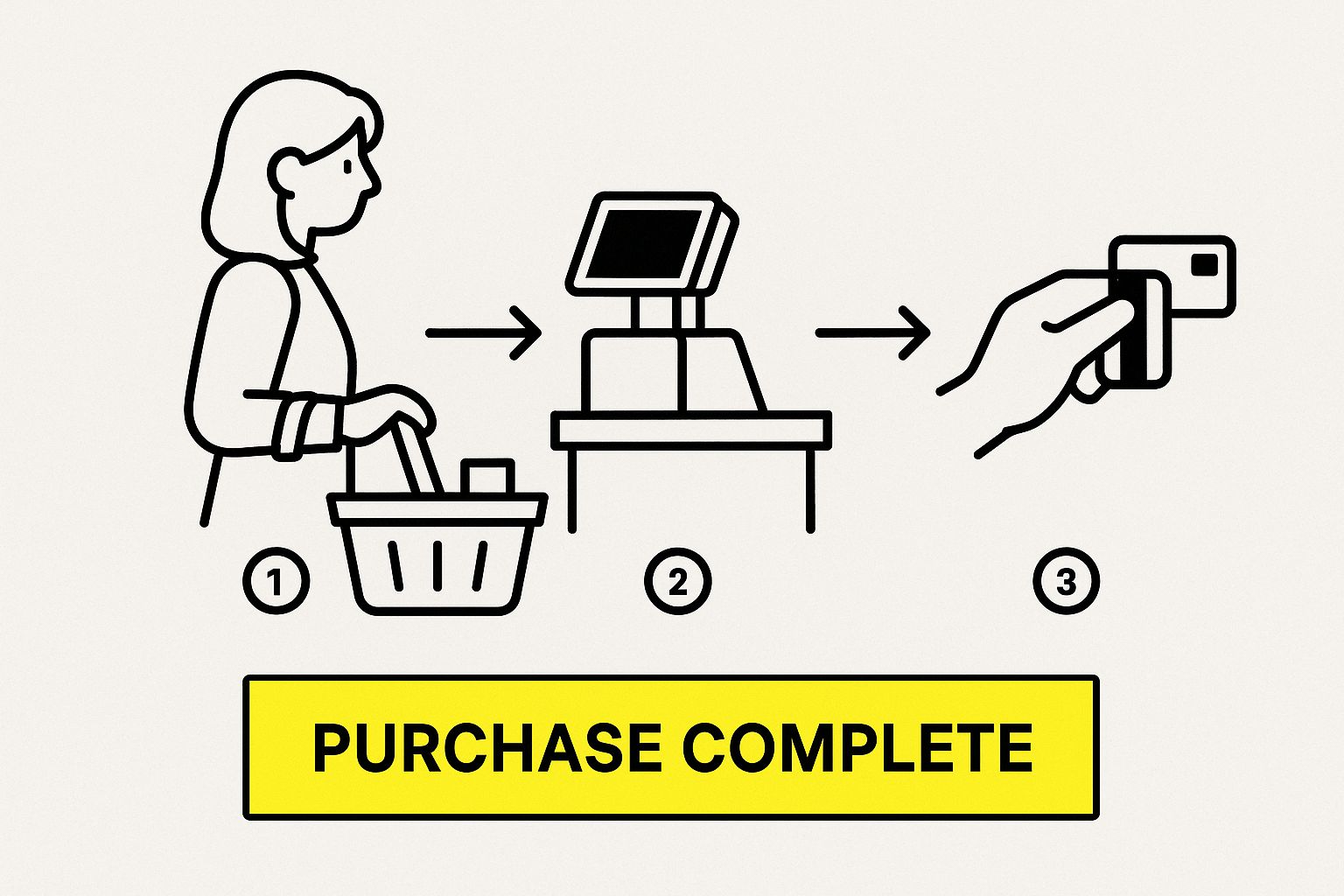
It's so important to have this "Purchase Complete" moment on your map. It’s the pivot point that shifts the customer from the acquisition phase into the post-purchase experience, where true loyalty is built.
By carefully plotting these interactions, actions, and feelings, you’re no longer looking at abstract data. You have a practical blueprint that shows you exactly where your experience is strong and, more importantly, where it’s letting customers down. Now, you’re ready to move from mapping to analysis and start pinpointing those game-changing opportunities for growth.
Finding Pain Points and Growth Opportunities
You've put in the work, gathered the data, and laid out all the touchpoints. Great. Now you have a customer journey map, but let’s be honest—right now, it's just a document. The real magic happens when you stop creating and start analyzing. This is the moment you transform that map from a pretty diagram into a powerful tool for growth.
Think of yourself as a detective. Your mission is to find the hidden friction points that are costing you sales and, just as importantly, to spot those game-changing opportunities that build loyalty.
From Friction to Flow
First up, let's hunt down the pain points. These are any moments of confusion, frustration, or hesitation that make a customer pause or, even worse, leave for good. By stepping into your customer's shoes and looking at the map from their perspective, you can see exactly where the experience starts to crumble.
Don't just stare at the individual touchpoints. The real trouble often lurks in the gaps between them. A smooth handoff from one stage to the next is crucial.
Start by asking some tough questions as you walk through your map:
- Where are people getting stuck? Look for those analytics drop-off points that line up with the "sad face" emojis on your map. A high exit rate on the shipping page combined with customer complaints about high costs? That’s a classic, textbook-sized red flag.
- Is our messaging consistent? Does that amazing promise you made in your Instagram ad actually match what they see on the landing page? If not, you’re creating confusion and breaking trust right from the start.
- What questions are we not answering? If your support team is constantly fielding questions about your return policy, it means that information is buried or unclear during the critical consideration and purchase stages.
A massive source of friction for almost every ecommerce store is the checkout process. Unexpected costs, forcing someone to create an account, or a clunky layout are notorious conversion killers. If you see a steep drop-off here, you need to investigate immediately. For a much deeper dive into fixing these common checkout issues, check out our guide on the top reasons for cart abandonment on Shopify.
Identifying Areas for Improvement
Fixing what's broken is only half the battle. Your map is also a treasure trove of growth opportunities—chances to go beyond just meeting expectations and actually delight your customers. This is what turns one-time buyers into lifelong fans.
Look for the "aha!" moments, those positive peaks in the customer's emotional journey. How can you make them even better? If customers constantly rave about your unboxing experience, that's your cue to double down. Maybe you add a handwritten thank-you note or a small, unexpected gift.
Your goal isn't just to eliminate the bad stuff, but to amplify the good. A journey map shows you where a small investment in delight can create a huge impact on customer loyalty.
Think about smart moments for upselling or cross-selling. For example, if a customer is buying a new camera, they're probably excited but also a little overwhelmed. This is a perfect opportunity to offer a "starter kit" bundle with a memory card and a case. You're not just increasing the Average Order Value (AOV); you're genuinely helping the customer, turning a simple transaction into a supportive experience.
To help you get started, here’s a quick-glance table of common issues and how you might begin to fix them.
Common Ecommerce Pain Points and Potential Solutions
This table breaks down some of the most frequent customer frustrations I've seen across different journey stages and offers a starting point for actionable solutions.
| Journey Stage | Common Pain Point | Example Solution |
|---|---|---|
| Awareness | Inconsistent messaging between ads and site | Align ad copy and visuals with the landing page to create a seamless, trustworthy experience. |
| Consideration | Product information is unclear or incomplete | Add detailed descriptions, high-quality images from all angles, customer reviews, and a Q&A section. |
| Purchase | Surprise shipping costs revealed at checkout | Display shipping costs upfront on the product page or use a banner for free shipping thresholds. |
| Post-Purchase | Vague or no shipping/delivery updates | Implement automated email or SMS notifications for order confirmation, shipping, and delivery status. |
| Loyalty | Feeling like a one-time transaction | Create a post-purchase follow-up sequence with tips, community invites, or a loyalty program offer. |
Think of this as a diagnostic tool. See if any of these resonate with what your own map is telling you.
This strategic focus is exactly why so many CX leaders are obsessed with journey mapping. With customer acquisition costs being up to five times more than retention, building a smooth, enjoyable experience isn't a luxury—it's a necessity. This is especially true when you consider that 60% of consumers admit they'd switch brands after just one bad experience. It's no wonder that 62% of CX leaders are planning to boost their investment in journey mapping, as highlighted in recent industry insights from Pathmonk.
By systematically analyzing your map for both problems and potential wins, you create a clear, prioritized action plan. Your map transforms from a static diagram into a dynamic blueprint for constant improvement and real, sustainable growth.
Choosing The Right Journey Mapping Tools

Let's get one thing straight: you don't need a fancy, expensive software suite to create a powerful customer journey map. The best tool is always the one your team will actually use. Your choice really boils down to your budget, how complex your customer’s path is, and the way your team likes to work together.
Honestly, your first map is probably going to be a bit messy, and that's perfectly fine. Sometimes, starting with the simplest, low-tech options is the best way to get ideas out without getting bogged down learning a new program.
Low-Fidelity Tools For Fast Collaboration
The simplest tools are often the most effective, especially for getting started. These are my go-to's for quick brainstorming sessions or when you just need to get a rough draft mapped out.
- Whiteboards and Sticky Notes: The absolute classic. There's a certain energy you get from physically moving sticky notes around a board. You can color-code everything—actions, thoughts, pain points—which makes the whole process incredibly visual and collaborative. It just works.
- Spreadsheets (Google Sheets / Excel): Don’t sleep on a good old-fashioned spreadsheet. You can easily set up rows for your journey stages and create columns for everything else: actions, feelings, opportunities, you name it. It’s free, everyone knows how to use it, and it’s brilliant for keeping data organized.
The goal with these low-fi methods is speed and collaboration, not perfection. You want to get your initial ideas down and make sure everyone has a chance to contribute.
A journey map on a whiteboard that gives you one real, actionable insight is a thousand times more valuable than a beautiful diagram made with expensive software that just gathers dust.
Digital Platforms For Scalable Mapping
Once your understanding of the customer journey gets deeper or your team gets bigger, you’ll probably want a more permanent, shareable solution. This is where dedicated digital tools come in. They offer handy templates, advanced features, and let you create a polished, living document that you can easily update and share.
This is how you build a more permanent, detailed ecommerce customer journey map that can evolve with your business.
Here are a few popular options I've seen work well:
| Tool Category | Popular Examples | Best For |
|---|---|---|
| Digital Whiteboards | Miro, Mural | Remote teams who need a flexible, infinite canvas to brainstorm and build out visually rich maps. |
| Diagramming Software | Lucidchart, UXPressia | Teams looking for structured templates and a more formal approach, with specific features for personas and touchpoints. |
| Project Management | Notion, Asana | Integrating your journey map directly into your team's existing workflow, turning opportunities into tasks. |
Many of these platforms come with pre-built journey mapping templates. Using one can be a great way to start, since it makes sure you don’t forget any key components. Just remember to tweak it to fit your specific business and customers.
What To Look For In A Journey Map Template
Whether you’re using a template or building from scratch, a good map needs clear sections for the core parts of the customer experience. A solid structure makes the map comprehensive and, more importantly, easy for anyone to understand at a glance.
Make sure your template has a place to capture:
- Journey Stages: The main phases like Awareness, Consideration, Purchase, and Loyalty.
- Customer Actions: The specific things a customer does at each stage (e.g., "Clicks a Facebook ad," "Adds item to cart").
- Thoughts & Feelings: What’s going through their mind? (e.g., "Is this really worth the price?" or "I can't wait for this to arrive!").
- Pain Points: Any moment of friction, confusion, or frustration.
- Opportunities: All your ideas for making things better or adding moments of delight.
At the end of the day, the tool is just a vehicle. The real value is in the process of building the map and the conversations it ignites. Focusing on creating a smooth path from discovery to purchase is a huge part of effective Shopify store optimization, and your journey map is the blueprint that will guide every one of those efforts.
Putting Your Map to Work (And Keeping It Relevant)
Let's be honest: a customer journey map gathering digital dust in a shared folder is worthless. Its true value comes alive when you turn those hard-won insights into actual, concrete changes. This is the moment your analysis becomes a better experience for your customers and a healthier bottom line for your business.
So where do you start? Your map probably unearthed a laundry list of pain points and opportunities. Trying to fix everything at once is a surefire path to getting nowhere fast. The key is to prioritize. I’ve always found a simple "impact vs. effort" matrix works wonders here. Just plot each finding based on how much it will improve the customer experience (impact) and how much time or money it will take to fix (effort). This gives you a crystal-clear visual of the low-hanging fruit—the high-impact, low-effort wins you should jump on immediately.
Get It Done: Assigning Tasks and Owning Outcomes
With your priorities locked in, it's time to assign ownership. An idea without a clear owner is just wishful thinking. Every single action item that comes out of your journey map needs two things: a person responsible for it and a deadline.
This is a team sport, not a solo mission. It usually breaks down something like this:
- Marketing Team: They might take the lead on fixing inconsistent messaging between your social media ads and your product pages.
- Web/UX Team: They're the natural fit to tackle that clunky, confusing checkout flow you discovered.
- Support Team: They can create a new FAQ or help desk article to proactively answer that common post-purchase question you keep seeing.
This creates real accountability. It ensures the insights from your map don't just die in a meeting room. Strong store operations and clear task delegation are everything here, something we cover in our guide on mastering Shopify store management. When everyone knows what they're responsible for, you start seeing real progress.
Your Map is a Living, Breathing Thing
This might be the most important part: your customer journey map is not a one-and-done project. It’s a living document that has to change as your customers and your business change. Customer habits shift, new tech pops up, and your own products will evolve.
A journey map is a snapshot in time. To keep it relevant, you must treat it like a dynamic tool that requires regular maintenance, not a static artifact to be archived.
Set a recurring calendar reminder to review your map. For most ecommerce stores, doing this quarterly is a good rhythm. In these check-ins, you'll look at new data and ask tough questions. Are the pain points we found 3 months ago still the biggest issues? Have new problems surfaced? This keeps your strategy grounded in what your customers are actually experiencing right now.
Once you get comfortable with this process, you can start looking at more advanced plays. For example, you can begin exploring customer journey orchestration to personalize customer experiences on the fly based on their behavior. By committing to action and constant iteration, your map transforms from a simple document into a strategic powerhouse that drives real, sustainable growth.
A Few Common Questions About Journey Mapping
When you're new to journey mapping, a few questions always pop up. Let's tackle some of the most common ones I hear from ecommerce owners so you can get started without a hitch.
How Often Should I Update My Map?
I usually tell people to revisit their journey maps every 6 to 12 months. The world of ecommerce changes fast, and your customers' habits change right along with it. A map from last year might already be missing crucial details.
You'll also want to pull it out anytime you make a big move in your business. Think about things like:
- Launching a major new product line.
- Expanding into a new country or targeting a totally different audience.
- Seeing a sudden, weird drop-off in your conversion rates or a spike in support tickets you can't explain.
Treat your map like a living, breathing guide for your business. It's not a "set it and forget it" project.
What Is The Biggest Mistake To Avoid?
The absolute biggest mistake I see is creating a map based on what you think your customers do. It's so easy to fall into this trap because we're so close to our own business, but internal assumptions are where great maps go to die.
An ecommerce customer journey map built on guesswork is just a collection of opinions. One built on data is a strategic tool for growth.
You have to ground your map in reality. That means digging into your analytics, sending out surveys, reading through support chats, and—most importantly—actually talking to your customers. This is the only way to understand what people really do, think, and feel when they interact with your brand.
Can I Have More Than One Journey Map?
Yes, and you probably should! In fact, the most effective brands have several. The experience of a first-time visitor drawn in by a TikTok ad is completely different from a long-time loyal customer who buys every new product you release.
For example, a new customer's journey is all about building awareness and trust. But for a loyal customer, the map might focus on the post-purchase experience, how they engage with your rewards program, and what turns them into brand advocates.
My advice? Start with the journey for your most important customer segment. Nail that one first, then build out others as you get more comfortable with the process.
Ready to build an online store that truly understands your customers' journey? The team at E-commerce Dev Group specializes in designing and optimizing Shopify stores that turn insights into conversions. Contact us today to see how our expert development can elevate your customer experience.
