


The Evolving Landscape of Ecommerce Fraud
The digital marketplace offers incredible opportunities for businesses. However, it also presents a growing challenge: ecommerce fraud. As online businesses grow, fraud tactics become more sophisticated, impacting profits across all industries. Fraudsters constantly search for new vulnerabilities, often bypassing standard security measures.
This requires a new approach to preventing ecommerce fraud. We must move beyond traditional methods to combat these ever-changing threats.
The Growing Cost of Ecommerce Fraud
The financial impact of ecommerce fraud is significant and keeps rising. The growth of eCommerce has created substantial challenges in fraud prevention. In 2024, global eCommerce fraud losses exceeded $44.3 billion. This number is projected to reach a staggering $107 billion by 2029, a 141% increase.
This alarming trend highlights the urgent need for robust fraud prevention strategies. For a deeper dive into these statistics, check out this resource: Learn more about eCommerce fraud statistics
The table below, "Ecommerce Fraud Growth Statistics", provides a clear overview of the increasing financial impact of fraud. It shows the year-over-year growth of global fraud losses, emphasizing the escalating threat this poses to businesses.
| Year | Global Fraud Losses | YoY Increase |
|---|---|---|
| 2024 | $44.3 Billion | – |
| 2029 (Projected) | $107 Billion | 141% |
These figures demonstrate the rapid acceleration of ecommerce fraud losses. Businesses must take proactive steps to mitigate these risks and protect their revenue.
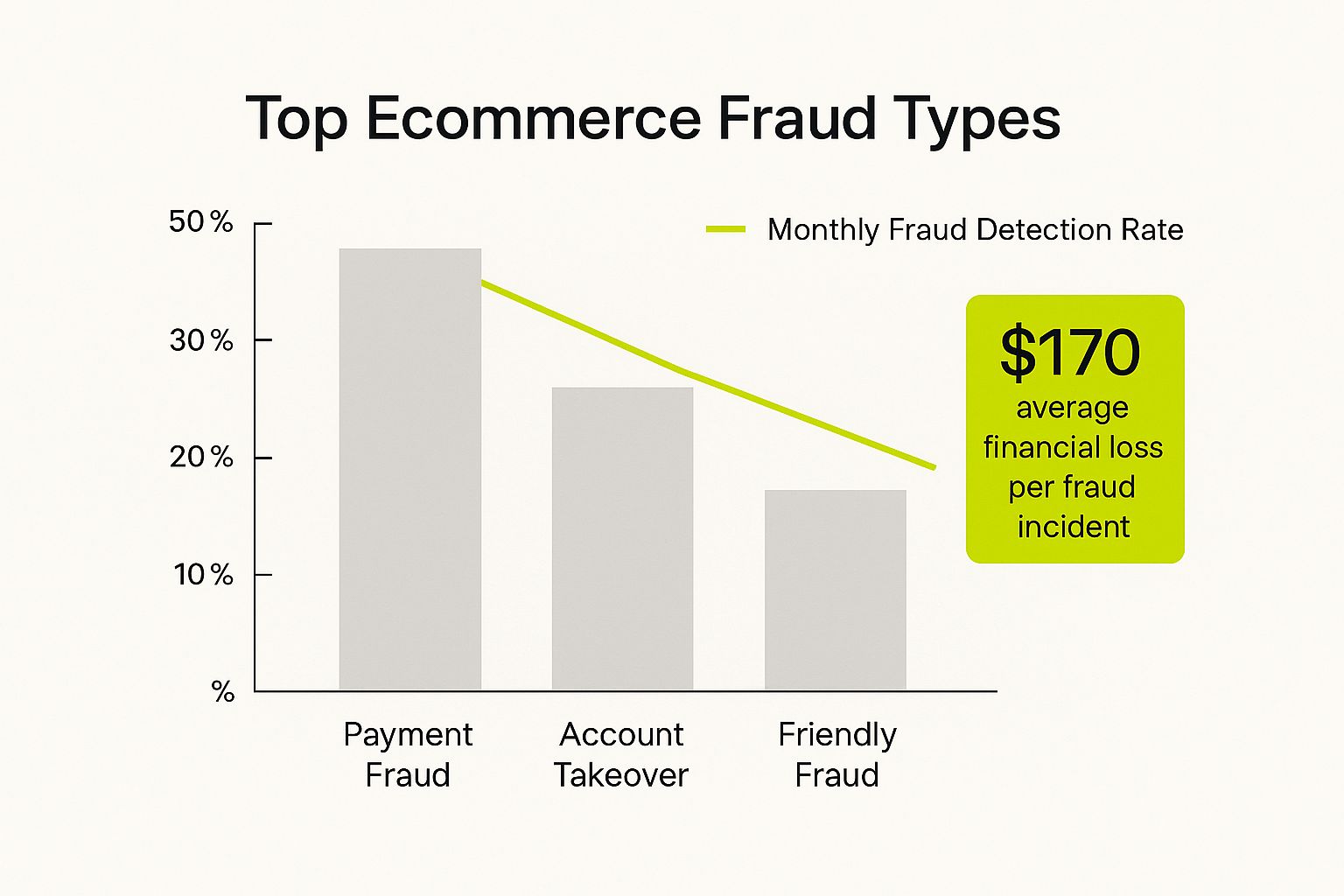
The infographic above illustrates the distribution of the top three ecommerce fraud types. It also shows the monthly fraud detection rate and the average financial loss per incident. The data reveals that despite improvements in detection, the increasing frequency and severity of fraud still lead to significant financial losses.
Emerging Fraud Tactics
Fraudsters are using increasingly complex techniques. Account takeover (ATO), where criminals gain unauthorized access to customer accounts, is a serious and growing threat. New account fraud (NAF) is another concerning tactic. This involves creating fake accounts using stolen or synthetic identities to take advantage of promotions or make illegal purchases.
These tactics often involve AI and bots to automate attacks and bypass traditional security. For instance, fraudsters might use bots to rapidly test stolen login details on various ecommerce websites, resulting in numerous ATO incidents.
Beyond Traditional Security
The evolution of fraud requires a more proactive and comprehensive approach to security. Basic fraud rules and manual reviews are no longer effective enough. Businesses need to adopt advanced technologies, such as machine learning and behavioral biometrics, to spot suspicious activity and stop fraud in real time.
This requires implementing solutions that can analyze large datasets, detect anomalies, and adapt to new threats. This shift is essential for protecting both businesses and customers in the constantly changing landscape of ecommerce fraud.
Authentication That Works Without Frustrating Customers
Strong authentication is essential for preventing ecommerce fraud. But it shouldn’t come at the cost of driving customers away. The key is finding a balance between robust security and a smooth, positive shopping experience. This means implementing security measures that deter fraudsters without creating unnecessary hurdles for legitimate customers. This section explores how successful merchants achieve this delicate balance.
Striking the Right Balance: Security vs. Convenience
Many businesses struggle to find the right mix of security and a user-friendly experience. Too much security, like requiring multiple authentication steps for every purchase, can lead to cart abandonment. Too little, and your business is vulnerable to fraud. The ideal approach is risk-based authentication. This method adapts the security level based on the perceived risk of each individual transaction.
For example, a small purchase from a returning customer with a long, established history might only require a simple password. On the other hand, a large order from a new customer using a different shipping address could trigger additional verification steps. This targeted approach focuses security efforts where they're needed most, minimizing disruptions for trusted customers.
Effective Authentication Methods
Several authentication methods can help prevent ecommerce fraud. Multi-factor authentication (MFA) is a powerful tool that adds layers of security beyond a simple password. This might include sending a one-time code to the customer's phone or email address. Some businesses use biometric verification, such as fingerprint scanning. Device intelligence can also play a role, analyzing factors like the customer's device type, location, and browsing history to assess risk.
- Multi-Factor Authentication (MFA): Requires multiple verification factors, significantly bolstering security.
- Biometric Verification: Uses unique biological traits for authentication, offering a high level of security.
- Device Intelligence: Uses device information to identify suspicious activity and assess risk.
When implemented strategically, these methods can greatly enhance security without complicating the checkout process.
Real-World Examples and Implementation
Many businesses successfully implement strong authentication without impacting conversions. One approach is to offer different authentication options, letting customers choose their preferred method. Another is to clearly explain why security measures are in place, reassuring customers that their information is protected.
| Method | Pros | Cons |
|---|---|---|
| Multi-Factor Authentication | Enhanced Security | Potential User Friction |
| Biometric Verification | High Security, User Convenience | Not Universally Available |
| Device Intelligence | Passive Risk Assessment | Privacy Concerns |
By analyzing these examples and carefully weighing the pros and cons of each method, businesses can develop a robust authentication strategy. This strategy should effectively prevent ecommerce fraud while maintaining a positive customer experience. This ultimately protects both the business’s bottom line and its valuable customer relationships.
Harnessing AI and Data Analytics to Outsmart Fraudsters

Today's fraud prevention landscape demands more than simple rules. Businesses need intelligent systems that can adapt and learn as fraud tactics change. This means using the power of Artificial Intelligence (AI) and data analytics to find subtle patterns and anomalies that humans might miss.
Identifying Key Data Points for Fraud Detection
AI and data analytics are great at sifting through large amounts of data to find suspicious activity. But which data points are the most useful? While each business is different, some data points consistently signal potential fraud.
- IP address and geolocation: Does the location match the billing and shipping addresses? A mismatch could be a red flag.
- Transaction velocity: Are there many purchases from a single account in a short time? This could indicate fraudulent activity.
- Device fingerprints: Is the device used for the purchase consistent with the customer’s past behavior? A sudden change could be suspicious.
- Email address analysis: Is the email address linked to known fraud attempts? This is a crucial check.
- Behavioral biometrics: How does the customer interact with the website? Unusual typing speed, mouse movements, or scrolling can be warning signs.
Analyzing these data points helps create a complete picture of each transaction, allowing businesses to flag potential fraud more accurately.
Building Effective Risk Scoring Models
These data points are used to build risk scoring models. These models assign a risk score to each transaction. This helps businesses prioritize investigations. A good risk scoring model considers many factors, weighting them based on how well they predict fraud. For example, a mismatch between billing and shipping addresses might be more important than a new IP address.
Creating these models, however, is challenging. Many merchants struggle to use data and technology effectively to improve the accuracy of their AI/ML tools. In fact, 80% of merchants report difficulties in this area. Learn more about these statistics. This highlights the need for simpler and more effective tools.
Implementing Machine Learning for Fraud Prevention
Machine learning improves risk scoring by automatically learning and adapting to new fraud patterns. This means the system constantly improves its accuracy without needing manual updates.
One approach is supervised learning, where the algorithm is trained on past transactions labeled as fraudulent or legitimate. The algorithm learns to identify the signs of fraudulent transactions, allowing it to predict fraud in future transactions. This allows for proactive fraud prevention. Another method is anomaly detection, where the system identifies unusual activity that deviates from normal behavior. This helps catch new and evolving fraud tactics.
Overcoming Implementation Challenges
Implementing AI and machine learning for fraud prevention can be complex. Challenges include data quality problems, integrating new systems with existing infrastructure, and balancing automated decisions with human oversight. However, addressing these challenges proactively, and using practical implementation strategies, can significantly improve fraud prevention. A key part of this is continuous improvement and refinement of the system. This ongoing adaptation is critical for staying ahead of evolving ecommerce fraud tactics and achieving long-term success.
Building Payment Security That Doesn't Kill Conversions

Payment security is essential for any successful ecommerce business. But it's a delicate balancing act. You need to protect transactions without making checkout so difficult that customers abandon their purchases. This section explores how to achieve both robust security and a smooth customer experience.
Essential Security Protocols For Ecommerce
There are several key security protocols that businesses can use to protect themselves and their customers. These include PCI DSS compliance, tokenization, and advanced verification methods.
-
PCI DSS Compliance: The Payment Card Industry Data Security Standard (PCI DSS) sets requirements for handling sensitive card data. Compliance is crucial for preventing fraud, maintaining customer trust, and avoiding penalties.
-
Tokenization: This process replaces sensitive card data with unique tokens. If a breach occurs, the real card data remains safe. Tokenization significantly reduces the risks of storing sensitive information.
-
Address Verification System (AVS) and Card Verification Value (CVV): These tools add extra security layers by verifying the customer's address and card details. AVS checks the provided billing address against the one on file with the card issuer. CVV requires the customer to enter the security code on their card.
Implementing these protocols is a significant step towards secure online transactions.
Implementing 3D Secure 2.0 For Enhanced Security
3D Secure 2.0 (3DS2) is a powerful security protocol designed to reduce fraud and improve authentication for online card payments. It adds an extra security layer by requiring customers to authenticate their identity with their card issuer during checkout. 3DS2 offers a smoother customer experience than its predecessor, with less friction.
However, implementing 3DS2 can be technically challenging. Businesses need to plan carefully to ensure a smooth transition and a positive customer experience.
Let's look at a comparison of different payment security measures:
The following table, "Payment Security Measures Comparison," compares different payment security protocols and their effectiveness in preventing various types of fraud.
| Security Measure | Fraud Types Prevented | Implementation Difficulty | Customer Impact |
|---|---|---|---|
| PCI DSS | Data breaches, unauthorized access | Moderate | Minimal |
| Tokenization | Card-not-present fraud, account takeover | Moderate | Minimal |
| AVS | Address discrepancies, fraudulent orders | Easy | Low |
| CVV | Unauthorized card use, stolen card fraud | Easy | Low |
| 3DS2 | Phishing, unauthorized transactions | Moderate | Low |
This table highlights the strengths and weaknesses of each security measure, helping businesses choose the best combination for their needs. By carefully considering these factors, businesses can implement robust security without negatively impacting the customer experience.
Training Customer Service Teams For Security
Your customer service team plays a crucial role in addressing security concerns and building trust. They need specific training to handle security inquiries effectively. This includes understanding common fraud scenarios, identifying suspicious activity, and responding appropriately.
Training should cover best practices for verifying customer identity and handling compromised accounts. Clear communication protocols are also essential. Customers need reassurance, explanations of security measures, and support if they experience fraud.
A well-trained customer service team enhances the overall security of your ecommerce platform. They can build customer confidence and improve the overall experience, playing a proactive role in fraud prevention.
Crafting a Multi-Layered Fraud Defense Strategy
Preventing ecommerce fraud isn't a simple fix; it demands a robust, multi-layered approach. Savvy merchants know a single solution just won't cut it. They build comprehensive protection systems designed specifically for their business models and risk profiles.
Assessing Your Vulnerabilities and Defining KPIs
Building a multi-layered defense starts with understanding your weaknesses. Conduct a thorough risk assessment to pinpoint vulnerabilities in your ecommerce platform. Ask yourself key questions: Where are the weak spots in your checkout process? Are there gaps in your authentication system? Which departments are most susceptible to social engineering tactics?
Knowing your vulnerabilities allows you to establish Key Performance Indicators (KPIs) to gauge the effectiveness of your fraud prevention efforts. These KPIs should be SMART: Specific, Measurable, Achievable, Relevant, and Time-bound. Consider metrics like fraud loss rate, chargeback rate, and false positive rate. These measurable metrics offer concrete data to evaluate the success of your strategy.
Developing and Coordinating Fraud Prevention Policies
A strong fraud prevention strategy requires well-defined policies and procedures. These should cover every aspect of fraud prevention, from account creation and payment processing to returns and refunds. Clearly defined roles and responsibilities across departments are also essential.
Interdepartmental coordination is crucial. Security, customer service, marketing, and fulfillment teams must work together seamlessly. This unified approach ensures consistent implementation of fraud prevention measures, minimizing gaps and maximizing efficiency. For instance, customer service representatives should be trained to spot suspicious order patterns, and the fulfillment team should be alerted to unusual shipping requests.
Regular Strategy Reviews and Adaptations
Ecommerce fraud is a constantly evolving landscape. New threats emerge regularly, demanding constant vigilance and adaptation. Regular strategy reviews are crucial for staying ahead of these threats. These reviews should evaluate the effectiveness of existing policies and procedures, identify areas for improvement, and incorporate new technologies and best practices.
This continuous adaptation requires monitoring industry trends, staying informed about emerging fraud tactics, and regularly testing your security systems. It's much like updating software: regular updates are essential to patch vulnerabilities and maintain optimal performance. Likewise, regular reviews and adjustments keep your fraud prevention strategy effective against the latest threats.
Turning Your Team Into Fraud Prevention Specialists
Your employees are your greatest asset, but also a potential vulnerability when it comes to e-commerce fraud. Investing in training is key. This section explores how to empower your team to become fraud detection experts, avoiding confusing technical terms.
Role-Specific Training For Maximum Impact
Smart merchants know the power of role-specific training. This means adapting the training to each team's specific tasks. Customer service representatives, fulfillment teams, and marketing personnel all have unique roles in preventing e-commerce fraud. They need tailored knowledge to spot warning signs relevant to their positions.
For instance, customer service representatives need to recognize suspicious account activity and handle sensitive data securely. Fulfillment teams should be trained to spot odd shipping requests or discrepancies between orders and delivery details. By focusing on real-world examples and providing actionable steps, businesses can give their teams the skills to make a real impact.
Building Effective Escalation Protocols
Clear escalation protocols are essential. When an employee suspects fraud, they need to know exactly how to respond. A well-defined process ensures a swift response and minimizes potential losses. This includes direct lines of communication, assigned contact people, and written procedures for handling various types of fraud.
For example, if a customer service representative encounters someone trying to use a stolen credit card, they need clear instructions on whom to contact and how to record the incident. This makes the response process more efficient and allows for faster action against fraudulent activity.
Practical Simulation Exercises and a Security-Conscious Culture
Simulation exercises provide hands-on experience. By recreating realistic fraud scenarios, you can help your team learn how to react effectively under pressure. These exercises could involve simulated phishing attacks, suspicious customer interactions, or unusual transaction activity.
Cultivating a security-conscious culture is equally crucial. This involves regular communication, awareness campaigns, and continuous training to reinforce best practices. This creates an environment where security is everyone's responsibility. Like a healthy immune system protects the body, a security-conscious culture protects a business. It's a continuous, company-wide effort to safeguard against threats. Combining these methods helps create a proactive and alert workforce ready to detect and prevent fraud.
Communication Templates For Consistent Responses
Providing communication templates ensures consistent, professional responses when fraud is suspected. These could include scripts for customer service representatives, email notifications for customers, and internal forms for recording incidents. This guarantees all team members handle sensitive situations appropriately and efficiently. This approach maintains a professional image, streamlines communication, and speeds up response times, ultimately building customer trust and bolstering your fraud prevention strategy.
By implementing these strategies, your business can significantly enhance its fraud prevention capabilities. Empowering your team protects your business and builds customer confidence, fostering a secure and trustworthy online experience for everyone.
Balancing Protection and Profit: The Conversion Equation
Ecommerce fraud prevention isn't just about stopping fraudsters. It's about doing so without driving away legitimate customers. This requires a strategic approach that minimizes false positives while maximizing security. Let's explore how successful merchants achieve this delicate balance.
Dynamic Risk Models: Applying Friction Where It Matters
One effective strategy is using dynamic risk models. These models assess the risk of each transaction individually. This allows businesses to apply security measures proportionally. Low-risk transactions, like a small purchase from a repeat customer, proceed smoothly. Higher-risk transactions, like a large order from a new customer with a different shipping address, might require extra verification. This targeted approach focuses resources where they're most needed, protecting against fraud without inconveniencing loyal customers.
Imagine a customer who regularly buys pet food online. Their purchase history and consistent shipping address would categorize them as low-risk. Their next pet food order could proceed with minimal authentication, like a simple password. However, if that same customer suddenly orders a diamond necklace with expedited shipping to a different address, the system flags this as unusual behavior. Additional verification, such as multi-factor authentication, would be required. This adaptive approach ensures a smooth experience for routine purchases while adding crucial security for unusual activity.
Measuring the True Cost of Fraud Prevention
It’s important to look beyond the immediate financial losses from fraud. The real cost includes hidden expenses like reduced customer lifetime value due to lost sales. Operational overhead from managing complex security systems also contributes. A customer who abandons their cart due to cumbersome security measures might not return, resulting in long-term revenue loss.
Businesses need clear metrics to evaluate the impact of their fraud prevention strategies. Track cart abandonment rates related to security measures. Measure the time customers spend on authentication. Calculate the operational costs of fraud prevention systems. This data provides valuable insights, enabling decisions that optimize both protection and profit.
The Psychology of Security: Building Trust, Not Suspicion
Effective fraud prevention considers the psychological impact on customers. While security is crucial, overly aggressive measures can erode trust and breed suspicion. This can damage brand perception and decrease customer loyalty.
Instead of focusing solely on restrictions, build confidence by clearly communicating security measures. Explaining why certain information is requested during checkout reassures customers that their data is protected. This builds trust, strengthening the customer relationship. Think of a security guard at a store entrance. Their presence provides a sense of safety without making customers feel scrutinized.
Boost Your Shopify Store's Security and Conversions With E-commerce Dev Group
Want robust fraud prevention without sacrificing your Shopify store's conversion rate? E-commerce Dev Group can help. Our Shopify experts can design and implement a tailored security strategy that protects your business and enhances your customers' shopping experience. Learn more about how E-commerce Dev Group can help you prevent fraud and boost conversions
