

The ecommerce landscape is more competitive than ever, and simply having a great product isn't enough to guarantee success. Sustainable growth requires a multi-faceted approach, combining smart marketing, customer-centric optimization, and data-driven decisions. Whether you're a budding Shopify merchant or an established online brand, finding the right ecommerce growth strategies is the key to unlocking your next level of success and scaling your operations effectively. This isn't about finding a single "magic bullet" but about building a powerful, interconnected system that drives consistent, predictable revenue.
This guide breaks down 10 proven, actionable tactics you can implement to achieve that growth. We move beyond generic advice to provide a comprehensive playbook filled with practical steps and real-world applications. Forget vague theories; this is a roundup of concrete strategies designed for immediate impact.
You will learn how to:
- Maximize conversions on your existing traffic.
- Build unshakable customer loyalty that fuels repeat purchases.
- Leverage data to make smarter, more profitable decisions.
- Expand your reach across new channels and marketplaces.
Each strategy is designed to work in synergy, creating a robust framework for scaling your business. We will cover everything from fine-tuning your website with Conversion Rate Optimization (CRO) and implementing advanced personalization to mastering email automation, social commerce, and sophisticated paid advertising. By focusing on these core pillars, you can build a resilient and thriving online business prepared for the challenges of 2025 and beyond. Let's dive into the strategies that will transform your store's potential into tangible performance.
1. Conversion Rate Optimization (CRO)
Conversion Rate Optimization, or CRO, is a foundational ecommerce growth strategy focused on maximizing the value of your existing traffic. It's the systematic process of improving your website to increase the percentage of visitors who make a purchase. Instead of spending more on ads to attract new visitors, CRO helps you convert more of the visitors you already have into paying customers.
This approach involves analyzing user behavior, identifying points of friction in the customer journey, and methodically testing changes. A small increase in your conversion rate, from 1% to 2% for example, literally doubles your revenue from the same amount of traffic, making it one of the most high-impact strategies available.

How to Implement CRO Effectively
CRO is a data-driven process, not a guessing game. By combining analytics with user behavior insights, you can make informed decisions that drive tangible growth. Start by digging into your analytics to identify pages with high traffic but low conversion rates, as these offer the biggest opportunities for improvement.
Next, use tools like heatmaps and session recordings to understand why users are dropping off. Are they confused by the navigation? Is a button not prominent enough? This qualitative data provides crucial context to your quantitative analytics.
Finally, form a hypothesis and test one change at a time using A/B testing software. This ensures you can attribute any performance lift directly to your change. For a deeper dive into improving the most critical part of your funnel, you can explore our detailed guide on optimizing your Shopify checkout process.
2. Personalization and Dynamic Content
Personalization is an ecommerce growth strategy that tailors the shopping experience to individual users based on their behavior, preferences, and past interactions. Instead of a one-size-fits-all approach, dynamic content adapts in real-time to show relevant product recommendations, offers, and messaging to each visitor. This makes customers feel understood and valued, significantly boosting engagement and sales.
This strategy moves beyond simply using a customer's first name in an email. It leverages data to create a unique journey for every user, much like how Amazon shows "Customers who viewed this also bought" or Netflix curates a homepage based on your viewing history. By presenting the right content at the right time, you reduce friction and guide customers toward a purchase more effectively.

How to Implement Personalization Effectively
Implementing a successful personalization strategy requires a commitment to collecting and using data responsibly. The goal is to create a more helpful and relevant shopping experience, not an intrusive one. Start by collecting first-party data through account creations, quizzes, and on-site behavior tracking.
Next, segment your audience into meaningful groups based on criteria like purchase history, browsing behavior (e.g., viewed a specific category), or demographic information. Use this segmentation to power dynamic content on your homepage, product pages, and in your email campaigns. For example, show a returning customer products related to their last purchase.
Finally, leverage technology to automate and scale your efforts. Shopify Plus apps and other platforms use machine learning to identify patterns and predict user preferences, enabling you to deliver hyper-relevant experiences without manual oversight. For more inspiration, you can find a variety of powerful website personalization examples to guide your strategy.
3. Email Marketing and Automation
Email marketing continues to deliver one of the highest returns on investment among all digital marketing channels. This powerful ecommerce growth strategy involves building a direct line of communication with your audience to nurture leads and drive repeat purchases. By leveraging automation, you can send highly targeted, timely messages based on specific customer actions without constant manual effort.
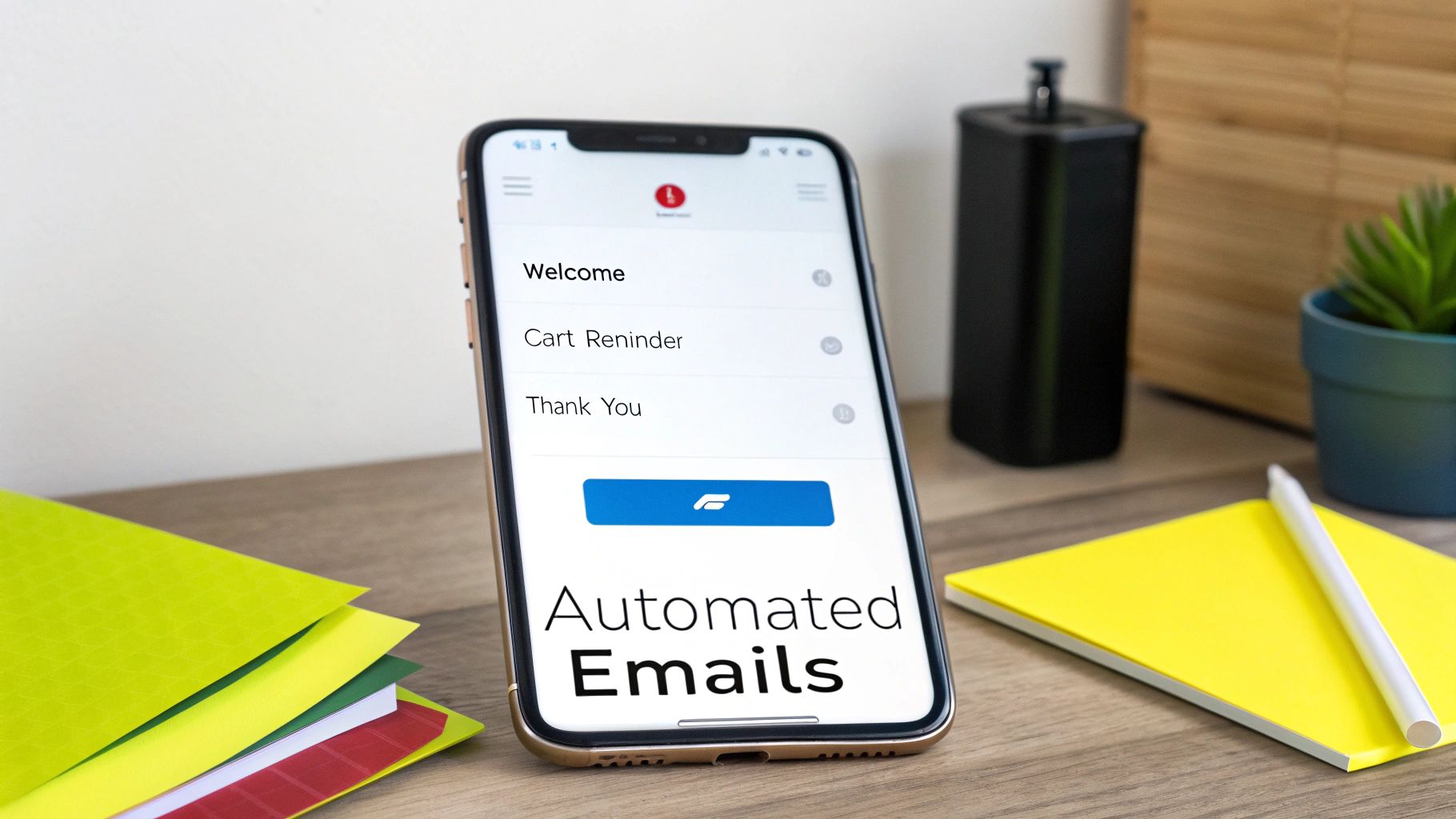
Automated email sequences, such as welcome series, abandoned cart reminders, and post-purchase follow-ups, engage customers at crucial moments in their journey. This personalized approach builds stronger customer relationships and significantly boosts lifetime value, making it an indispensable tool for sustainable growth.
How to Implement Email Marketing and Automation
Effective email marketing is about sending the right message to the right person at the right time. Start by segmenting your audience based on their purchase history, browsing behavior, and engagement level. This allows for hyper-personalized content that resonates far more than generic blasts.
Next, prioritize setting up key automated flows. An abandoned cart series, typically 3-4 emails sent over a few days, can recover a significant percentage of otherwise lost sales. A welcome series for new subscribers should introduce your brand and offer an initial incentive to convert. Post-purchase emails can include thank you messages, product care tips, cross-sell offers, and requests for reviews, turning one-time buyers into loyal advocates.
Finally, continuously test and refine your strategy. Experiment with different subject lines, send times, and content to see what your audience responds to best. Platforms like Klaviyo and Mailchimp provide the tools to build these automations and analyze their performance. For a comprehensive look at setting this up on your store, see our guide to Shopify marketing automation.
4. Social Commerce and Influencer Partnerships
Social commerce is a powerful ecommerce growth strategy that blurs the lines between social media and online shopping. It integrates the entire shopping experience directly into platforms like Instagram, TikTok, and Facebook, allowing users to discover, browse, and purchase products without ever leaving the app. This creates a seamless and impulse-driven path to purchase.
This strategy is often amplified through influencer partnerships, which leverage the credibility of trusted creators to introduce products to highly engaged and niche audiences. Brands like Fashion Nova and Gymshark have built empires by cultivating communities of influencers, turning authentic recommendations into a primary sales channel. The combination of in-app shopping and trusted voices makes this a potent method for modern brands.
How to Implement Social Commerce and Influencer Partnerships Effectively
Success in this area relies on authenticity and strategic alignment. Start by setting up native shopping features on your key social platforms, such as Instagram Shopping or TikTok Shop. This enables product tagging in your posts and stories, making your content instantly shoppable and reducing friction in the buying process.
When it comes to influencers, prioritize long-term, authentic relationships over one-off sponsored posts. Focus on micro-influencers (10k-100k followers), as they often have higher engagement rates and a more dedicated following that trusts their recommendations. Provide them with unique discount codes or affiliate links to track ROI accurately and incentivize performance.
Finally, build a community around your brand by encouraging user-generated content (UGC) with a branded hashtag. Hosting live shopping events on platforms like Instagram Live can also create a sense of urgency and direct engagement, driving sales in real-time. For more insights on leveraging social proof, our guide on gathering and using customer testimonials offers valuable tactics.
5. Content Marketing and SEO
Content Marketing and SEO are powerful, long-term ecommerce growth strategies that work in tandem to drive organic traffic and build brand authority. This approach involves creating valuable and relevant content, such as blog posts, guides, and videos, that attracts and educates your target audience. By optimizing this content for search engines, you can capture high-intent traffic from users actively looking for solutions your products provide.
Unlike paid advertising, which stops working the moment you turn it off, content marketing is an asset that appreciates over time. A well-ranking blog post can generate qualified leads and sales for years, establishing your brand as a trusted resource in your industry. This strategy builds a sustainable marketing channel that reduces your reliance on costly ads and drives consistent, high-quality traffic.
How to Implement Content Marketing and SEO
A successful content and SEO strategy begins with understanding your customer's problems and questions. Use keyword research tools to identify topics with commercial intent and search volume, focusing on what your audience is actively searching for before they make a purchase.
Next, build your content around a "pillar and cluster" model. Create a comprehensive pillar page (a long-form guide) on a broad topic, then surround it with shorter "cluster" articles that dive into more specific subtopics, all linking back to the main pillar. This structure signals your expertise to search engines and helps users find related information easily. As search engines evolve, integrating a modern AI SEO strategy becomes crucial for staying visible and relevant in the competitive e-commerce landscape.
Finally, prioritize Google's E-E-A-T (Experience, Expertise, Authoritativeness, and Trustworthiness) principles. Demonstrate your expertise, showcase real product experience, and build high-quality backlinks from reputable sites. Regularly refreshing and updating your existing content ensures it remains accurate and continues to rank well over time.
6. Customer Retention, Loyalty Programs, and Customer Service
Focusing on customer retention is one of the most cost-effective ecommerce growth strategies available. It is significantly cheaper to encourage an existing customer to make a repeat purchase than it is to acquire a new one. This strategy revolves around building long-term relationships through exceptional service, loyalty programs, and creating a community around your brand.
By prioritizing the post-purchase experience, you increase Customer Lifetime Value (CLV) and turn one-time buyers into loyal brand advocates. Programs like Sephora's Beauty Insider and Starbucks Rewards have mastered this, creating ecosystems where customers feel valued and are continuously incentivized to return. Excellent customer service, as demonstrated by Zappos, can single-handedly build a billion-dollar brand by fostering trust and satisfaction.
How to Implement Retention Strategies Effectively
Start by creating a loyalty program that is simple to understand and join. The best programs, like Ulta's Ultamate Rewards, offer immediate value and clear, tiered benefits that motivate customers to spend more to unlock exclusive perks. Your program should reward profitable behaviors, such as repeat purchases, referrals, and social media engagement, not just transactions.
Next, make stellar customer service a non-negotiable part of your brand. Train your support team to be empathetic problem-solvers and empower them to resolve issues quickly. Implement tools like live chat for instant support and make it easy for customers to leave reviews. Actively managing feedback, both positive and negative, shows that you listen and care, building immense trust.
Finally, integrate social proof throughout your site. Prominently display customer reviews and ratings on product pages, as Amazon does with its verified purchase reviews. This not only builds credibility but also provides valuable insights for product development. A strong retention strategy turns your customer base into your most powerful marketing asset.
7. Paid Advertising and Retargeting
Paid advertising is one of the most direct ecommerce growth strategies, allowing you to place your products in front of high-intent audiences almost instantly. Platforms like Google, Meta (Facebook and Instagram), and TikTok offer powerful tools to target specific demographics, interests, and behaviors, accelerating traffic and sales far faster than organic methods.
This approach is two-fold. First, you run acquisition campaigns to attract new customers who are actively searching for products like yours or fit the profile of your ideal buyer. Second, you implement retargeting to re-engage users who have visited your site but left without making a purchase. By showing them personalized ads of the products they viewed, you remind them of their interest and significantly increase the chance of conversion.
How to Implement Paid Advertising Effectively
A profitable paid advertising strategy is built on precision, not just budget. Success hinges on accurate tracking, audience segmentation, and continuous testing. Before you spend a dollar, define your break-even Return On Ad Spend (ROAS) to ensure your campaigns are set up for profitability from the start.
Begin by installing tracking pixels, like the Meta Pixel and Google Ads tag, to monitor conversions accurately. Segment your audiences based on their journey stage, creating different campaigns for brand awareness versus direct conversion. For example, a new visitor might see a general brand ad, while someone who abandoned their cart sees a dynamic product ad featuring the exact item they left behind.
Always test multiple ad creatives, headlines, and calls to action to identify what resonates most with your audience. As you find winning combinations, scale your budget gradually to maintain efficiency and avoid audience fatigue. Consistently monitoring your Customer Acquisition Cost (CAC) against your Customer Lifetime Value (CLV) is the key to building a sustainable and scalable paid media engine.
8. Marketplace Expansion and Multi-Channel Selling
Marketplace expansion is one of the most direct ecommerce growth strategies for reaching new customers where they already shop. This approach involves listing and selling your products on third-party platforms like Amazon, eBay, Walmart, or Etsy in addition to your own Shopify store. By diversifying your sales channels, you tap into massive, pre-existing audiences and build brand visibility far beyond your website's reach.
This multi-channel strategy transforms your business from a single storefront into a distributed retail network. Instead of relying solely on your own marketing efforts to drive traffic, you leverage the immense discovery power and built-in trust of established marketplaces. This allows you to meet customers on their preferred platforms, significantly increasing your potential sales volume and de-risking your revenue by not depending on a single channel.
How to Implement Multi-Channel Selling Effectively
A successful multi-channel strategy requires careful planning and robust tools to manage complexity. The goal is to maximize reach without creating logistical nightmares. Start by identifying one or two marketplaces that best align with your target customer demographics and product category; don't try to be everywhere at once. For example, a handmade craft business would prioritize Etsy, while an electronics brand would focus on Amazon or Best Buy.
Next, it is crucial to use an inventory management system to synchronize stock levels across all channels in real time. Tools like Sellbrite, Linnworks, or native Shopify integrations prevent overselling and ensure a consistent customer experience. You must also optimize your product listings for each platform’s specific algorithm and customer expectations, tailoring titles, descriptions, and images accordingly.
Finally, treat each channel as its own unique business unit. Monitor profitability separately for each marketplace, accounting for their distinct fees and advertising costs. This data will reveal which channels provide the best return and where you should double down on your efforts. For Shopify merchants looking to seamlessly integrate with a major player, a great starting point is exploring the official Shopify and Amazon integration.
9. Product Development and Innovation
Product development and innovation is an essential ecommerce growth strategy centered on evolving your product line to meet changing customer demands and stay ahead of the competition. It’s about more than just launching new items; it involves improving existing products, creating strategic bundles, and rethinking formats or packaging to create new value.
This proactive approach ensures your brand remains relevant and exciting. Companies like Dollar Shave Club disrupted an entire industry not with a new razor, but with a new business model and customer experience. Similarly, Allbirds carved out a niche by innovating with sustainable materials. Continuous innovation fuels long-term growth by giving customers new reasons to buy from you and not your competitors.
How to Implement Product Innovation Effectively
Effective product development starts with listening to your customers and the market. Instead of guessing what people want, use data and feedback to guide your decisions. This minimizes risk and ensures your new offerings will resonate with your target audience, making it a reliable pillar in your set of ecommerce growth strategies.
Begin by surveying your existing customers to identify their pain points and unmet needs. What problems can your products solve better? Analyze competitor reviews to find weaknesses and opportunities in their offerings. This research forms the foundation for new product concepts.
Once you have an idea, test it before committing to a full-scale launch. You can run a "coming soon" landing page to gauge interest or offer a limited pre-order to validate demand. For existing products, consider creating strategic bundles that pair complementary items at a slight discount to increase average order value. Also, think about launching seasonal variations or limited editions to create urgency and keep your catalog feeling fresh and dynamic.
10. Analytics, Data-Driven Decision Making, and Attribution
Making decisions based on gut feelings is a recipe for stalled growth. Data-driven decision making is an ecommerce growth strategy centered on using customer behavior, sales trends, and marketing performance data to guide every business choice. It moves you from "what we think works" to "what we know works," turning raw numbers into actionable insights.
This approach relies on robust analytics and proper attribution modeling. Analytics tells you what happened, while attribution helps you understand why it happened and which marketing efforts deserve credit. By analyzing the entire customer journey, you can allocate your budget more effectively, identify friction points in your funnel, and uncover new opportunities for expansion. For instance, Amazon uses analytics to inform everything from product recommendations to supply chain logistics, creating a highly optimized customer experience.
How to Implement a Data-Driven Strategy
Start by establishing a solid data foundation. This means implementing comprehensive tracking from day one, using tools like Google Analytics and setting up UTM parameters for all your campaigns. This ensures the data you collect is clean, accurate, and organized, which is essential for making sound business decisions.
Next, define the Key Performance Indicators (KPIs) that truly matter to your business. Focus on a core set of metrics like Customer Acquisition Cost (CAC), Lifetime Value (LTV), and Average Order Value (AOV). Create a simple dashboard that displays your top 5-10 metrics, allowing you to monitor performance at a glance and react quickly to trends.
Finally, go beyond simply tracking last-click sales. Implement multi-touch attribution to understand how different channels work together to drive conversions. To truly optimize your marketing spend and understand what drives sales, delve deeper into understanding marketing attribution models. This knowledge allows you to credit all contributing touchpoints, from the first blog post a customer read to the final retargeting ad they clicked.
10 Ecommerce Growth Strategies Compared
| Strategy | Implementation Complexity 🔄 | Resource Requirements ⚡ | Expected Outcomes 📊 | Ideal Use Cases 💡 | Key Advantages ⭐ |
|---|---|---|---|---|---|
| Conversion Rate Optimization (CRO) | Medium–High 🔄: iterative A/B/multivariate testing & stats | Moderate ⚡: testing tools, analytics, sufficient traffic | Measurable CR uplift and incremental revenue 📊 | High-traffic pages, checkout flows, landing pages | Maximizes revenue from existing traffic; strong ROI ⭐ |
| Personalization & Dynamic Content | High 🔄: data pipelines, ML models, segmentation | High ⚡: first‑party data, personalization platforms, engineers | Higher AOV, engagement, repeat purchases 📊 | Catalog sites, logged‑in users, repeat buyers | Delivers highly relevant experiences; boosts retention ⭐ |
| Email Marketing & Automation | Low–Medium 🔄: workflow setup and sequencing | Low ⚡: ESP, content creation, basic automation | Very high ROI; cart recovery and lifecycle revenue 📊 | Abandoned carts, welcome series, post‑purchase flows | Scalable direct channel with excellent ROI ⭐ |
| Social Commerce & Influencer Partnerships | Medium 🔄: campaign & creator management | Medium–High ⚡: influencer fees, content production | Increased awareness, social sales, viral reach 📊 | DTC brands targeting younger audiences, launches | Authentic reach and social proof; high engagement ⭐ |
| Content Marketing & SEO | Medium–High 🔄: ongoing content + technical SEO | Medium ⚡: writers, SEO tools, consistent effort | Sustainable organic traffic and authority over time 📊 | Long‑term brand building, complex purchase journeys | Cost‑effective long‑term traffic and credibility ⭐ |
| Customer Retention, Loyalty & Customer Service | Medium 🔄: program design, CRM & support integration | Medium ⚡: loyalty platform, support staff, rewards | Higher CLV, repeat purchases, reduced churn 📊 | Subscription models, repeat‑purchase businesses | Increases LTV and predictable recurring revenue ⭐ |
| Paid Advertising & Retargeting | Medium 🔄: campaign setup, bidding & optimization | High ⚡: ad spend, creative production, analysts | Immediate traffic and scalable sales; measurable ROI 📊 | Rapid scaling, product launches, seasonal promos | Fast results and precise ROI tracking ⭐ |
| Marketplace Expansion & Multi‑Channel Selling | Medium–High 🔄: channel rules, inventory sync | Medium ⚡: listing ops, marketplace fees, tools | Expanded reach and diversified revenue streams 📊 | Brands seeking wider distribution across platforms | Leverages marketplace traffic; reduces single‑channel risk ⭐ |
| Product Development & Innovation | High 🔄: R&D, validation, go‑to‑market planning | High ⚡: development, tooling, inventory investment | New revenue streams, differentiation, premium pricing 📊 | Brands aiming to differentiate or enter new categories | Drives product‑led growth and pricing power ⭐ |
| Analytics, Data‑Driven Decision Making & Attribution | High 🔄: tracking, attribution models, dashboards | Medium–High ⚡: analytics platform, data engineers, analysts | Clearer ROI, optimized budgets, better forecasting 📊 | Scaling businesses needing cross‑channel optimization | Eliminates guesswork; improves budget allocation and impact ⭐ |
Turning Strategy into Sustainable Growth
Navigating the landscape of ecommerce growth strategies can feel overwhelming. We've explored a wide range of powerful tactics, from the granular details of Conversion Rate Optimization (CRO) to the broad horizons of marketplace expansion. The journey from a promising online store to a dominant market player isn't paved with a single "magic bullet" solution. Instead, it’s built through the intelligent, integrated application of the very strategies we've discussed.
The common thread connecting personalization, content marketing, paid advertising, and customer retention is a deep, unwavering focus on the customer. Each strategy, at its core, is a different method for understanding, engaging, and delighting the people who buy from you. This is the fundamental shift that transforms one-time buyers into loyal brand advocates and turns marketing expenses into high-return investments.
From Ideas to Impact: Your Action Plan
Reading about these concepts is the first step, but action is what generates revenue. The most successful brands don't implement all ten strategies at once. They build a cohesive, interconnected growth engine where each component amplifies the others. Think of it less as a checklist and more as a strategic blueprint tailored to your unique business.
So, where do you begin? Start by diagnosing your biggest bottleneck.
- Is traffic high but sales are low? Your immediate focus should be on Conversion Rate Optimization and improving the on-site experience.
- Are you acquiring new customers but losing them after one purchase? Dive deep into Customer Retention, loyalty programs, and automated email marketing.
- Is your brand invisible in a crowded market? Prioritize Content Marketing, SEO, and strategic social commerce to build authority and reach.
By identifying the most significant friction point in your customer journey, you can channel your resources into the ecommerce growth strategies that will deliver the most immediate and substantial impact. This focused approach prevents you from spreading your efforts too thin and allows you to build momentum one win at a time.
The Power of an Integrated Growth Ecosystem
As you master one area, you'll find it naturally enhances the others. A successful SEO strategy, for instance, drives qualified traffic to your site. A highly optimized conversion funnel then turns that traffic into customers. A robust email automation and retention program then nurtures those customers, increasing their lifetime value and encouraging repeat purchases. This is how a sustainable growth flywheel is built.
Key Takeaway: The goal is not just to execute individual tactics but to create a system where each strategy supports and elevates the next, creating a cycle of continuous improvement and scalable growth.
This requires a commitment to a data-driven culture. Your analytics platform is your command center. It tells you what’s working, what isn’t, and where the next big opportunity lies. Every A/B test, every new ad campaign, and every personalized email sequence should be measured and analyzed. This iterative process of implementing, measuring, and refining is what separates fleeting success from long-term market leadership. Mastering these ecommerce growth strategies is a marathon, not a sprint, but the rewards are a resilient, profitable, and beloved brand.
Bringing sophisticated ecommerce growth strategies to life often requires deep technical expertise. From custom Shopify Plus functionality to seamless third-party integrations and performance optimization, the right development partner can be your most significant competitive advantage. If you're ready to transform your strategic vision into a high-performing reality, the team at E-commerce Dev Group is here to help you build, optimize, and scale.
