

The choice between Shopify and Amazon really boils down to one simple question: do you want to build your own, independent brand from the ground up, or sell your products in the world's biggest marketplace?
It’s the classic dilemma: build your own storefront vs. renting a booth in a crowded, high-traffic mall. The right path for you hinges entirely on whether you value total brand control more than instant access to a massive customer base.
Shopify vs Amazon Core Differences Explained
Picking between Shopify and Amazon isn't just about choosing a place to list your products. It's a foundational business decision that will define how you find customers, shape your brand, and manage your finances for years to come. This choice sets the stage for everything from your marketing budget to your long-term growth potential.
Your decision should be guided by a few critical questions:
- Brand Control: How important is it for you to control the entire look, feel, and customer experience of your store?
- Customer Access: Are you prepared to build an audience from scratch, or would you rather tap into a ready-made pool of millions of active shoppers?
- Fee Structure: Do you prefer a predictable monthly subscription fee or a model where you pay referral fees on every sale?
- Scalability: What are your ambitions? Are you looking to build a niche brand or expand into a massive operation?
To give you a quick snapshot, let's break down the fundamental differences between these two e-commerce giants.
Shopify vs Amazon Key Differences at a Glance
This table offers a clear, at-a-glance comparison to help frame your thinking. It highlights the core business models and what each platform prioritizes, making it easier to see where your own goals align.
| Feature | Shopify | Amazon |
|---|---|---|
| Core Model | E-commerce Platform | Online Marketplace |
| Primary Goal | Build your own branded store | Sell products on a shared platform |
| Customer Data | You own all customer data | Amazon owns the customer relationship |
| Branding | Complete control over design & experience | Limited branding within a set template |
| Traffic Source | You must generate your own traffic | Built-in traffic from millions of shoppers |
| Competition | You compete against other websites | You compete directly on the product page |
As you can see, the two platforms serve very different strategic purposes. One gives you the keys to your own kingdom, while the other gives you a prime spot in the busiest market in town.
Understanding Their Roles in the Market
The global e-commerce market is enormous, expected to hit $6.42 trillion in 2025, and both Shopify and Amazon are major players. Shopify empowers independent businesses, holding 10.32% of the e-commerce platform market and supporting nearly 5 million online stores.
Amazon, on the other hand, is a retail behemoth. It commands a staggering 37.6% of all U.S. retail e-commerce sales, making it the undisputed leader in the country.
The Shopify dashboard itself tells a story. It’s a command center designed to give you, the merchant, all the tools needed to manage every aspect of your business—from sales and orders to marketing campaigns.

This setup reinforces Shopify's core philosophy: you are the business owner, and this is your headquarters. For a closer look at how it stacks up against other options, see our detailed ecommerce platform comparison.
The core decision is simple: Do you want to build a destination (Shopify) or sell at a destination (Amazon)? Your answer dictates your entire approach to online retail.
Of course, it doesn't have to be a strict "either/or" choice. Many savvy sellers use a hybrid approach. A Shopify Amazon Integration allows you to use both platforms strategically. You can build your brand hub on Shopify while simultaneously tapping into Amazon’s huge audience as a powerful sales channel.
Comparing Brand Ownership and Customer Experience
When you get past the features and fees, the biggest difference between Shopify and Amazon comes down to one thing: ownership. Are you building your own digital home, or are you renting a shelf in someone else's superstore? This isn't just a small detail—it dictates the entire future of your brand and how you connect with the people who buy your products.
Shopify is all about giving you the keys to your own kingdom. It provides the tools to build a branded online store that is 100% yours. Think of it as your own piece of digital real estate. You call the shots on everything, from the logo and color palette to the product page layouts and the voice of your blog.
This complete control means you can create a customer experience that’s truly unique. Imagine you're running a sustainable clothing brand. With Shopify, you can design your site to tell that story, with pages dedicated to your ethical sourcing and blog posts about eco-friendly fabrics. You can build an email list and foster a real community around your mission. Every click reinforces your brand identity, building a loyalty that goes way beyond just the price tag.
Building a Brand Home on Shopify
On Shopify, your brand is the main event. You don’t have to worry about a competitor’s product showing up right next to yours. More importantly, you're not constrained by marketplace rules on how to present your items. This freedom extends to customer data, which is hands-down your most valuable asset.
When someone buys from your Shopify store, you get their name, email, and purchase history. This direct relationship is pure gold for growing your business. It lets you:
- Launch targeted email campaigns: Send personalized deals, announce new products, and share content with people who actually want to hear from you.
- Run effective retargeting ads: Reconnect with shoppers who browsed your site but left without buying, reaching them on platforms like Facebook and Google.
- Create a loyal following: Understand what your customers love and communicate with them directly to encourage repeat business.
You simply don't get this direct line to your customers on Amazon.
Selling on Amazon’s Marketplace
Selling on Amazon is a completely different ballgame. You’re operating inside a massive, structured, and fiercely competitive marketplace. You’re a third-party seller, and your products are listed right alongside countless others—often on the very same page. You gain access to a gigantic audience, but you give up nearly all control over your brand.
The Amazon Seller Central dashboard is your command center, but it’s built for one thing: operating efficiently within Amazon’s ecosystem. It's not a tool for creative brand building.

As you can see, the focus is on logistics, inventory management, and performance metrics—not brand expression. Your product listings are forced into rigid templates, and your ability to tell a compelling brand story is confined to a few images and text fields.
Shopify lets you build a brand home; Amazon offers you a shelf in their department store.
On Amazon, the customer belongs to Amazon. It's their customer, not yours. You’re strictly prohibited from marketing directly to the people who buy your products on the platform. You can’t add them to your email list or try to lure them over to your own website. This makes building any kind of long-term brand loyalty or encouraging repeat business outside of Amazon almost impossible. Your success often hinges on winning the coveted Buy Box, which is decided by price, shipping speed, and seller ratings—not how much someone loves your brand.
Ultimately, the choice is clear on this point. Shopify is for entrepreneurs who want to build an independent, lasting brand and own every customer relationship. Amazon is for sellers who want to tap into a huge market immediately and are comfortable playing by the rules of a much larger retail machine, where the game is won on logistics and price.
Analyzing Platform Fees and True Business Costs
When you’re trying to decide between Shopify and Amazon, looking at the monthly subscription price is like judging a car by its paint job. It tells you almost nothing about the real cost of ownership. To get the full picture, you have to dig into the entire fee structure and understand where your money is actually going.
These "hidden" costs—from transaction fees to fulfillment charges—are what really determine your profit margins. Let's break down what you can expect to pay on each platform.

Unpacking Shopify’s Cost Structure
Shopify's pricing feels pretty straightforward at first. You pay a set monthly fee, and that's that, right? Not exactly. The true cost comes from a few different places, and you need to account for all of them to budget properly.
Here are the three main expenses you'll run into:
- Subscription Plans: This is your predictable, fixed monthly cost. It’s the foundation of your expenses, with different tiers available as your business grows.
- Transaction Fees: If you opt out of Shopify Payments, the platform charges a fee on every sale, which can be anywhere from 0.5% to 2.0% depending on your plan. Keep in mind, this is in addition to what your payment processor will charge you.
- App Costs: Your store will almost certainly need a few apps for things like email marketing, customer reviews, or subscription management. These costs can easily pile up, adding $50 to $300+ to your monthly bill.
To get a clearer sense of how these pieces fit together, our guide on how much is a Shopify store breaks it down in much more detail.
Demystifying Amazon's Complex Fees
If Shopify's costs are a predictable monthly bill, Amazon's are a complex, shifting puzzle. Their fee structure is highly variable, making it a real challenge to forecast your expenses from one month to the next. Everything is tied directly to your sales, inventory, and advertising.
With Amazon, you trade a simple monthly fee for a labyrinth of variable costs. Your true expense isn't just the referral fee; it's the sum of fulfillment, storage, advertising, and category-specific charges that fluctuate with every sale.
Here’s a look at the major fees you’ll need to anticipate:
- Seller Plan: You have two choices: the Individual plan ($0.99 per item sold) or the Professional plan ($39.99 per month). Any serious seller is going to need the Professional plan.
- Referral Fees: This is Amazon’s cut of every sale you make. It’s usually between 8% and 15%, but for certain product categories, it can climb as high as 45%.
- Fulfillment by Amazon (FBA) Fees: Using FBA means you're paying Amazon to store, pick, pack, and ship your products. These fees are calculated based on your product's size and weight, plus how long it sits in their warehouse.
- Advertising Costs: Let's be honest, you can't just list a product on Amazon and expect it to sell. You’ll need to invest in Amazon PPC (Pay-Per-Click) advertising just to get seen, and this can become a major expense.
No matter which platform you choose, shipping will be a huge part of your budget. Learning about the best shipping methods for Shopify stores can give you insights that apply to your logistics strategy everywhere.
Hypothetical Cost Breakdown for a $10,000/Month Business
To really see how these different fee structures impact the bottom line, let’s run the numbers for a business doing $10,000 in monthly revenue. The table below gives a side-by-side estimate of the costs on each platform.
| Cost Item | Shopify (Estimated) | Amazon FBA (Estimated) |
|---|---|---|
| Monthly Subscription | $105 (Shopify Plan) | $39.99 (Professional Plan) |
| Transaction Fees | $270 (2.7% via Shopify Payments) | $0 |
| Referral/Commission Fees | $0 | $1,500 (Avg. 15%) |
| App & Theme Costs | $150 | $0 |
| Fulfillment Costs | Varies (Handled In-House/3PL) | $2,500 (Avg. 25% for FBA) |
| Advertising Spend | $1,000 (External Marketing) | $1,000 (Amazon PPC) |
| Total Estimated Cost | $1,525 | $5,039.99 |
| Profit Margin (Before COGS) | 84.75% | 49.60% |
The difference is stark. On Shopify, you're responsible for bringing in your own customers, which requires a marketing budget. But in exchange, you keep a much larger slice of your revenue. Amazon brings the traffic to you, but they charge a hefty premium for it, taking a much bigger chunk of every sale. It’s the classic trade-off between control and convenience.
Where Do Your Customers Come From? Marketing and Control
When you boil it down, the Shopify vs. Amazon choice really hinges on one big question: How will you find your customers?
Think of it this way. Shopify gives you a megaphone and an empty plot of land. It’s up to you to build something amazing and shout loud enough for people to come and visit. Amazon, on the other hand, gives you a small booth in the world's busiest shopping mall, already packed with millions of people holding their wallets.
Your entire marketing playbook will be dictated by which path you take. With Shopify, you’re the master of your own destiny, building a traffic engine from the ground up. On Amazon, you’re a player in a massive, established game, competing for attention.
Shopify: Building Your Own Brand and Audience
When you first launch a Shopify store, your visitor count is zero. That's a sobering thought, isn't it? It’s entirely on you to bring people to your digital doorstep, which means you need a real, multi-channel marketing strategy. This is both the toughest part of using Shopify and its biggest long-term strength.
You're responsible for every single eyeball on your site. That means getting your hands dirty with:
- Search Engine Optimization (SEO): Writing blog posts, fine-tuning product pages, and building links so you show up on Google when someone searches for what you sell.
- Content Marketing: Creating helpful guides, cool videos, or insightful articles that draw in your ideal customers.
- Paid Advertising: Putting money behind campaigns on Google Ads, Facebook, and Instagram to pull targeted traffic straight to your store.
- Social Media Marketing: Actually building a community around your brand, not just posting product pictures.
This is a marathon, not a sprint. It takes time, consistent effort, and a budget for tools and ads. But here’s the payoff: every customer you earn is your customer. You have their email, you can build a direct relationship, and you can market to them for years.
Amazon: Tapping into an Ocean of Buyers
Amazon offers a massive shortcut. It has a built-in audience of over 310 million active customers around the globe. These aren't just window shoppers; they're on Amazon with a mission to buy something right now. The conversion rates are unreal.
Instead of building an audience from scratch, your job shifts to fighting for attention inside Amazon's world. Success isn't about driving external traffic; it's about mastering Amazon's internal game.
On Amazon, you don't have to find customers—they're already there. Your main job is to convince Amazon's algorithm that your product is the best answer to a shopper's search.
This means your marketing focus gets incredibly narrow:
- Playing the A9 Algorithm Game: Amazon's search engine is king. You need to strategically pack keywords into your titles, bullet points, and descriptions just to get seen.
- Mastering Amazon PPC: Running Sponsored Product ads is pretty much non-negotiable. You’re paying to jump to the front of the line and get your products seen by active buyers.
- Winning the Buy Box: A staggering 82% of Amazon sales go through the "Buy Box." Getting that coveted spot depends on sharp pricing, fast shipping (which is why FBA is so popular), and keeping your seller ratings pristine.
The sheer scale of these platforms tells the story. By June 2025, Shopify was powering around 5.8 million live stores globally, with each one fending for its own traffic. In that same period, Amazon grabbed 43% of all visits to the top 20 e-commerce sites worldwide. That's the power of a centralized marketplace. You can dive deeper into these e-commerce platform statistics.
Making the Strategic Trade-Off
So, what’s the right move? It’s a classic trade-off.
Shopify requires a ton of upfront hustle to build an audience. But the reward is true brand ownership, your own customer data, and much healthier profit margins down the road. You’re building a real, sustainable asset.
Amazon gives you instant access to a massive pool of buyers, which can mean fast sales right out of the gate. But that speed comes at a price. You're renting space on their platform, you never truly own the customer relationship, and you're surrounded by competitors on every single page. The Shopify vs. Amazon choice here is really about long-term brand building versus short-term sales velocity.
How to Choose the Right Platform for Your Goals
Figuring out whether to go with Shopify or Amazon isn't about crowning one platform as "the best." It's about matching a platform's strengths to your specific business, your goals, and the resources you have on hand. There's no one-size-fits-all answer here, so let's look at a few common scenarios to help you make the right call.
Ultimately, the choice comes down to a fundamental question: are you trying to build a brand or just sell a lot of products? One path is about creating a long-term asset, while the other is about tapping into a massive, ready-made market right away.
Choose Shopify for Building an Independent Brand
If you dream of building a direct-to-consumer (DTC) brand that has its own story, community, and loyal following, then Shopify is hands-down the way to go. It gives you the canvas you need to create more than just a place to sell things.
Shopify is probably the right fit for you if you're:
- A Niche Product Creator: Selling things like handcrafted leather goods, artisanal coffee, or a unique line of apparel? Shopify gives you total control to show customers exactly what makes your products stand out.
- A Content-Driven Business: If your strategy involves a blog, videos, or building a social media following to connect with your audience, Shopify’s built-in content tools are a must-have.
- Focused on Long-Term Enterprise Value: Building a brand on your own website means you own the customer list and the data. That direct relationship is an invaluable asset you can one day sell.
The bottom line is this: Shopify is your best bet when your main goal is to build an audience and own that relationship. You control the story, the data, and the entire customer experience from beginning to end.
Choose Amazon for Rapid Sales and Market Reach
For sellers who are more focused on speed, sales volume, and efficiency, Amazon is an absolute powerhouse. It's the perfect place for standardized products where people are mostly shopping based on price and convenience.
This platform is the clear winner if you:
- Sell Commodity or Standardized Products: If you're selling items people are already searching for, like phone cases or popular supplements, Amazon puts you right in front of them at the moment they're ready to buy.
- Prioritize a Hands-Off Logistics Model: Fulfillment by Amazon (FBA) is a game-changer. You can offload all the storage, packing, and shipping, freeing you up to focus on sourcing great products.
- Want to Test a Product with Minimal Upfront Marketing: Amazon's huge built-in audience lets you see if a product has legs without having to spend a ton of time and money building a marketing funnel from scratch.
This decision tree gives you a simple visual for the core strategic choice: are you building your own audience or finding one that's already there?
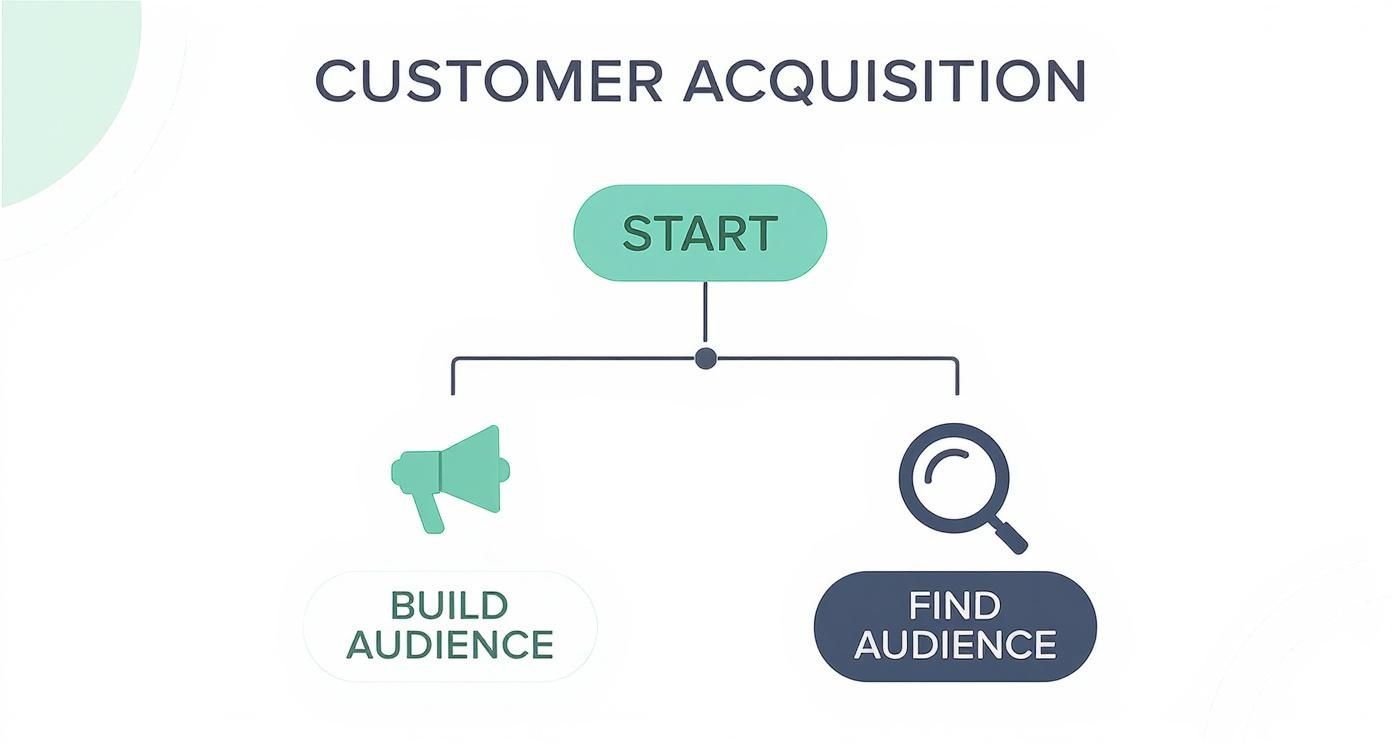
As you can see, your customer acquisition strategy is really the key factor that should drive your decision.
The Hybrid Strategy Combining Both Platforms
For many established brands, the smartest move isn't picking one over the other—it's using them together. In this hybrid model, your Shopify store acts as your brand's home base. It’s your official website, your blog, and your primary channel for direct sales. Amazon then becomes a powerful, high-volume sales channel to reach a different audience.
This lets you control your brand narrative and own your customer data on Shopify, all while tapping into Amazon's massive market to find new customers. For anyone ready to take this on, our guide on linking Shopify to Amazon breaks down the practical steps for getting these two platforms to work together.
The numbers really tell the story of their different, yet dominant, roles in e-commerce. As of 2025, Shopify powers millions of independent stores and holds around 10.32% of the global e-commerce platform market. Amazon, on the other hand, accounts for a staggering 37.6% of the entire U.S. retail e-commerce market, which just goes to show its incredible scale. You can dig deeper into the market share of Shopify and Amazon on redstagfulfillment.com.
Frequently Asked Questions
Even after a deep dive, some specific questions always pop up when it's decision time. This is where we get into the nitty-gritty, tackling the most common questions I hear from merchants weighing their options between Shopify and Amazon. Think of this as the final piece of the puzzle to help you move forward with confidence.
We'll cover how these two giants can work together, which one is actually better for someone just starting out, and the crucial difference in data ownership that could define your business's future.
Can I Use Shopify and Amazon Together?
Absolutely. In fact, many of the smartest brands don’t see it as an "either/or" choice. Instead of a Shopify vs. Amazon showdown, they use a multi-channel strategy to get the best of both worlds.
Here’s a simple way to think about how it works:
- Shopify is Your Home Base: Your Shopify store is the heart of your brand. It's where you define your look and feel, connect with customers through content, and build your own email list. You own the entire experience, from the first click to the final thank you page.
- Amazon is Your Sales Channel: Think of Amazon as a massive, bustling marketplace where you can set up a stall. By listing your products there, you tap into its huge audience of shoppers who are ready to buy right now. It's an incredible tool for customer acquisition.
This hybrid approach lets you build a real, long-term brand asset on Shopify while using Amazon's sheer scale to drive immediate sales. It's like building your own kingdom while also running a highly profitable outpost in the world's biggest market.
Which Platform Is Truly Better for Beginners?
This is a tricky one because "beginner" can mean a couple of different things. It really boils down to what you're more worried about: building a website or finding your first customer.
Let's look at it from both angles.
For Ease of Setup, Shopify Wins
If your biggest hurdle is just getting a beautiful, functional store online without any coding, Shopify is your best bet. Its interface is incredibly intuitive. With drag-and-drop themes and a guided setup process, you can create a professional-looking site in a single weekend. It just works.
For Making Your First Sale, Amazon Wins
If the thought of launching to absolute silence terrifies you, then Amazon has a massive head start. The platform comes with a built-in audience of millions of shoppers who are actively searching for products. You don't have to master SEO or build a social media following from scratch to get your first sale; your main job is to get your product in front of the traffic that's already there.
Key Insight: Shopify makes it easier to build a store. Amazon makes it easier to find a customer. Your choice as a beginner depends on which of those two challenges feels more daunting to you right now.
Who Actually Owns the Customer Data?
This is one of the most critical differences between the two platforms, and it’s something too many sellers overlook. The answer directly affects your ability to build lasting relationships with the people who buy from you.
On Shopify, you own 100% of your customer data. When someone buys from you, you get their name, email, shipping info, and purchase history. This data is pure gold. It lets you:
- Build a targeted email list for sales and new product announcements.
- Run effective retargeting ad campaigns on platforms like Facebook and Google.
- Analyze buying habits to figure out what to create next.
- Foster a direct relationship that encourages customers to come back again and again.
On Amazon, the customer belongs to Amazon. You're basically a third-party seller operating on their turf. Amazon’s rules are very strict about marketing to their customers or trying to lead them away from the platform. You make the sale, but you don't build the relationship. This makes creating genuine brand loyalty almost impossible.
What Are the Biggest Risks of Selling Only on Amazon?
While the reach of Amazon is undeniable, putting all your eggs in that one basket is risky. Relying completely on a single platform can leave your business vulnerable in ways an independent Shopify store just isn't.
Here are the biggest risks to be aware of:
- Account Suspension: Amazon is famous for its strict—and sometimes confusing—policy enforcement. An unexpected account suspension can happen for countless reasons, instantly cutting off your entire income stream with little warning or a clear way to fix it.
- Brutal Competition: You are always just one click away from your competition. On every product page, Amazon displays similar items, often at lower prices, making it a constant battle to win the sale and keep the customer's attention.
- Zero Control: You're playing in Amazon's sandbox, which means you have to follow their rules. They can change fees, alter search algorithms, and update policies whenever they want. You have no choice but to adapt or get left behind.
- The Race to the Bottom: The hyper-competitive marketplace often forces sellers into price wars. This can slowly but surely eat away at your profit margins, making it tough to build a financially stable business over the long haul.
Building on your own platform with Shopify gives you back that control, letting you steer your own ship and secure your business's future.
Ready to build an e-commerce brand you truly own? At E-commerce Dev Group, we specialize in creating high-performing Shopify stores that give you full control over your brand, customers, and future. From custom design to performance optimization, we provide the expertise you need to build a powerful and profitable online presence. Explore our Shopify development services today!
