

When we talk about SEO for lead generation, we're really talking about a specific strategy: using search engines like Google to pull in prospects who are already looking for what you sell. It's about targeting the exact phrases people use when they need to solve a problem or are ready to buy. This turns your website from a simple online brochure into a machine that consistently finds potential customers for you.
Building a Foundation for High-Quality Leads
Before you even think about keywords, you need a rock-solid understanding of who your ideal leads are and what keeps them up at night. This is where so many SEO strategies go off the rails—they jump straight to keyword tools without first understanding the human on the other side of the screen.
Effective SEO for lead generation always starts with digging deep into your audience, not just making educated guesses.
The idea is to go way beyond a generic customer avatar. You need a detailed picture of your ideal prospect. What are their biggest professional headaches? What goals are they trying to hit? And, most importantly, what specific problems does your product or service actually solve for them?
Think about it: what are they typing into Google when they're truly fed up with their current situation? Figuring that out is the secret to building a strategy that actually connects with people.
Mapping the Customer Journey
Once you know who you're trying to reach, the next step is to figure out how they make a purchasing decision. This isn't a straight line from A to B. The real customer journey has twists and turns, and you need different kinds of content and messaging for each stage.
By mapping this journey, you can sync your SEO work with your sales funnel, making sure you're providing the right information at the exact moment a prospect needs it. We usually break this down into three core stages:
- Awareness Stage: Here, the person knows they have a problem but might not have a name for it or know that solutions even exist. They're looking for broad, educational content.
- Consideration Stage: Now, they've clearly defined their problem and are actively researching and comparing different options, products, or companies.
- Decision Stage: At this point, they're ready to buy. They're just looking for that final piece of validation—things like case studies, pricing details, or a free trial.
By connecting specific search terms to each stage of this journey, you create a content plan that guides people from their first curious search all the way to becoming a customer. This is how you attract genuinely qualified leads instead of just random website visitors.
Why This Foundation Matters for Revenue
Putting in this initial effort isn't just about following best practices; it directly impacts your revenue. When your SEO strategy is built on a deep understanding of your ideal customer, the leads you bring in are far more qualified and much easier for your sales team to convert.
The numbers don't lie.
For B2B companies, organic search is responsible for generating a massive 53% of all inbound leads. Even more impressive, SEO drives 44.6% of B2B revenue, which is more than double any other marketing channel. This proves that SEO doesn't just bring in traffic—it brings in high-value leads that become paying customers. You can dig into more B2B SEO stats on beomniscient.com to see the full picture.
This foundational work is what makes sure your efforts tap directly into that revenue-generating power.
Finding Keywords That Actually Convert
Let's be honest: traffic numbers are nice, but they don't pay the bills. When it comes to SEO for your Shopify store, the real win is attracting visitors who are ready to buy, not just browse. This means we need to stop chasing massive search volumes and start targeting keywords that signal a customer is ready to pull out their credit card.
The secret is to shift your thinking. Instead of just asking, "What are people searching for?" you need to get inside your customer's head and ask, "What problem is keeping them up at night that my product can solve?" This simple change in perspective is the key to uncovering the long-tail keywords that drive real revenue.
Uncovering High-Intent Keywords
High-intent keywords are the phrases people type into Google when they’re past the initial research phase and are narrowing down their options. These aren't one-word searches; they’re specific questions, comparisons, or problem-focused queries that show someone is serious. Learning how to choose keywords for SEO that capture this intent is the foundation of a lead generation machine.
Here's how it plays out in the real world:
- Low Intent: "running shoes" (Just looking, could be anyone)
- High Intent: "best running shoes for flat feet" (They have a specific problem)
- "Buy Now" Intent: "brooks adrenaline gts 23 vs hoka arahi 7" (They're comparing models and are close to a decision)
Sure, you'll get less traffic from these longer, more specific phrases. But the people who do land on your site are the ones who matter—the ones far more likely to become customers.
This chart really drives the point home. It shows how chasing high search volume is often a fool's errand for lead gen.
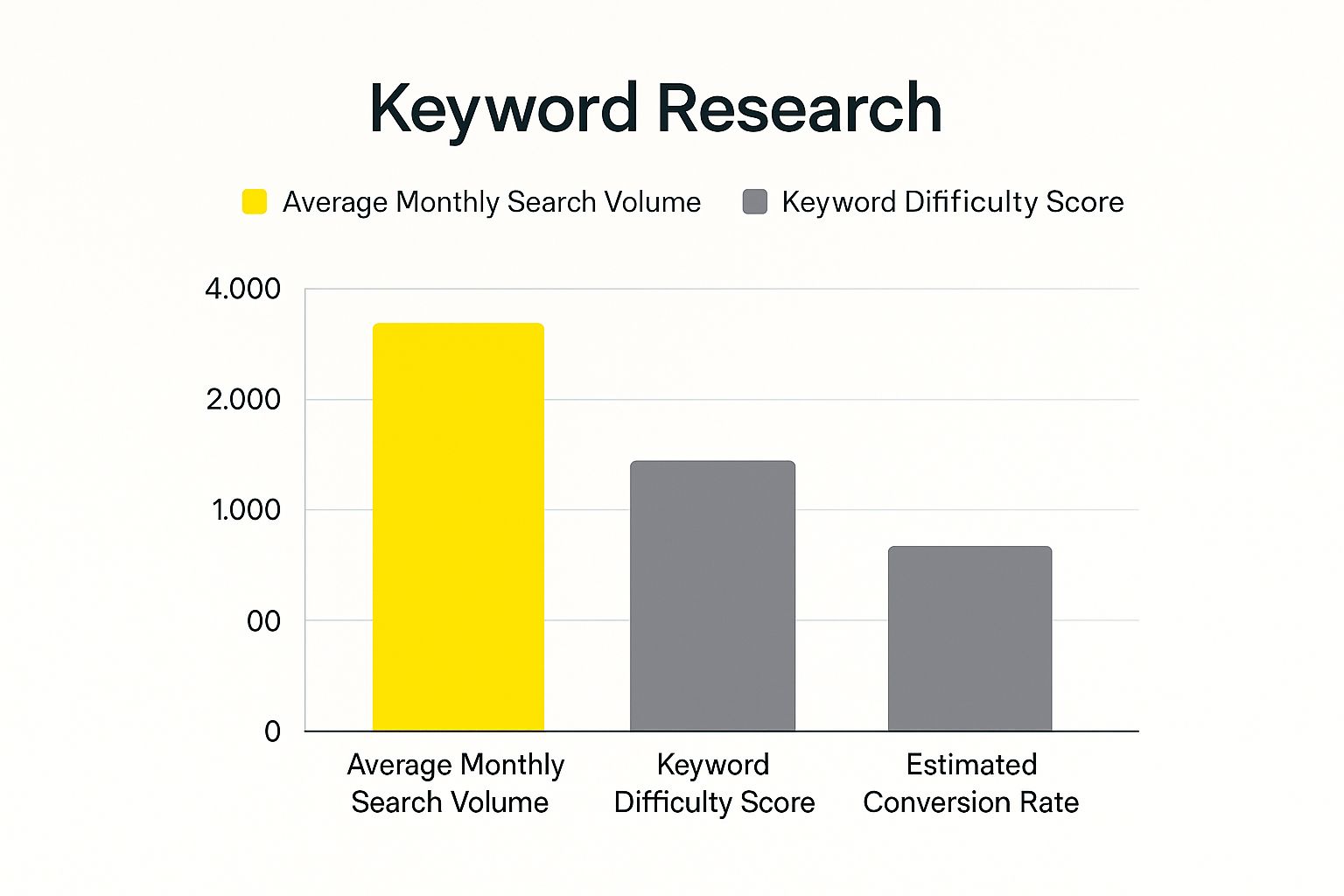
As you can see, the keywords with lower search volume and difficulty often pack a much bigger punch when it comes to conversion rates. That's where the money is.
Matching Keyword Intent to Content
To really nail this, you need to align the type of keyword with the type of content you create. This simple table breaks down how to match what someone is searching for with the perfect content format to turn them into a lead.
| Search Intent | Keyword Example | Best Content Format | Lead Gen Goal |
|---|---|---|---|
| Informational | "how to clean suede shoes" | Blog Post, How-To Guide | Capture email with a downloadable checklist |
| Commercial | "best waterproof hiking boots" | Comparison Page, "Best of" List | Drive clicks to product pages |
| Transactional | "buy nike pegasus 41 size 11" | Product Page | Direct Sale |
| Navigational | "zappos customer service" | Contact/About Page | Build trust, facilitate support |
By mapping out your content this way, you create a natural journey for the user, guiding them from a simple question all the way to a purchase.
Analyzing Your Competitors for Gaps
One of my favorite shortcuts for finding these goldmine keywords is to spy on the competition. See what's working for them, but more importantly, see what they're missing. A quick analysis of their top pages can reveal keyword gaps you can swoop in and own.
Don’t just copy your competitors. Your goal is to find the questions they aren't answering. That's where you'll find an underserved audience and a golden opportunity to create content that solves a problem no one else is addressing properly.
For instance, maybe a competitor has a popular blog post on "5 ways to organize your pantry." You could create a killer landing page for your food storage containers that directly solves that problem better than their simple article.
To really get an edge, you'll want to use the right tools for the job. Our guide to the best SEO keyword research tools can help you automate this process and find those hidden gems much faster.
Creating Content That Attracts and Qualifies

Once you’ve nailed down your keywords, your content becomes the real engine for your SEO lead gen strategy. We're not talking about just churning out generic blog posts here. The goal is to build strategic assets, each one engineered to solve a specific problem and gently guide potential customers toward becoming a lead.
Think of every piece of content you create as a specialist on your sales team. A detailed "how-to" guide is perfect for someone just starting to research a problem. On the other hand, a sharp "vs." article comparing your product to a competitor’s is exactly what someone needs when they're ready to make a decision.
This is where I see so many businesses stumble. They create content to inform, but they forget to qualify. Your content has to be built with a clear next step in mind, creating a smooth path from reading to taking action.
Crafting High-Performance Content Assets
To pull in qualified leads, you need to think beyond the standard blog post. Certain content formats are just naturally better at capturing someone's contact info because they solve a high-value problem. These are the real workhorses of your lead generation machine.
You want to create assets so valuable that your ideal customer would happily trade their email address to get their hands on them.
- In-Depth Guides: Go deep on a topic. For instance, if you sell skincare on Shopify, "The Ultimate Guide to Building a Skincare Routine for Acne-Prone Skin" is a massive value-add.
- Comparison Articles: Put your product head-to-head with competitors. An article like "[Your Software] vs. [Competitor Software]: An Honest Review" targets buyers who are actively weighing their options and are close to purchasing.
- Case Studies: Nothing builds trust like social proof. Show exactly how a real customer solved a painful problem using your product. Break down the challenge they faced, the solution you provided, and the measurable results they got.
These content types don't just attract random traffic; they attract people with serious intent. They aren't just browsing—they're actively looking for answers.
Integrating Lead Magnets Naturally
A lead magnet is the critical bridge between your awesome content and your email list. It’s that free, valuable resource you offer in exchange for an email. The trick is making the offer feel like a helpful, logical next step, not an annoying sales pitch.
The best lead magnets feel hyper-relevant to what the person is already reading. If someone’s deep into your skincare routine guide, offering a downloadable "Printable Skincare Routine Checklist" is a no-brainer. It's a low-friction, high-value conversion.
Forget the generic "Subscribe to Our Newsletter" pop-up. Match your lead magnet to the content. For that comparison article, offer a "Feature Comparison Chart PDF." For the case study, maybe an "Exclusive Webinar with the Featured Customer." This contextual approach makes a huge difference in conversion rates.
Optimizing On-Page SEO for Conversions
Finally, you need to structure your content for both search engines and human beings. Good on-page SEO gets you discovered, and a smart, clean layout guides your visitors right to your lead magnet.
- Compelling Headings: Use clear, benefit-driven H2s and H3s that directly answer user questions.
- Internal Linking: Weave in links to relevant product pages, other case studies, or related blog posts. This keeps people on your site longer and shows Google your authority.
- Clear Calls-to-Action (CTAs): Don't make people hunt for your lead magnet. Use bright buttons and highlighted text to make it incredibly obvious what you want them to do next.
Remember, content marketing is proven to be three times more efficient at generating leads than old-school outbound marketing. The data is pretty clear: companies that publish at least 16 blogs per month can generate up to 4.5 times more leads. As these lead generation statistics on explodingtopics.com show, there's a direct link between consistent, quality content and real business growth. That's why every single piece you publish needs to be engineered to attract and qualify.
Turning Your Website into a Conversion Engine
Getting traffic to your website is a great start, but it's only half the job. The real trick to generating leads with SEO is converting those visitors once they arrive. A site that ranks well but doesn't convert is like a beautiful storefront with a locked door—people can look, but they can't buy.
This is where you need to focus on what happens on your website. It’s all about making smart, targeted tweaks that encourage visitors to take that next step, whether that's filling out a form, downloading a resource, or booking a call.
Optimizing Your Landing Pages for Action
Think of your landing pages as your best salespeople. Every single element, from the headline down to the button, has to work in harmony to nudge the user toward one specific goal. It all starts with a headline that grabs their attention by speaking directly to a problem they're trying to solve.
For example, a headline like "Sell More on Shopify" is decent, but it's not a showstopper. Now, consider something like "Double Your Shopify Sales in 90 Days." That’s a headline that makes a bold promise and creates a real sense of possibility.
Next up is the lead capture form. The golden rule here is to keep it dead simple.
Ask for the absolute bare minimum you need to get the conversation started. Every extra field you add creates friction and can tank your conversion rate. If an email is all you need, just ask for the email.
The Non-Negotiables: Trust and Speed
In the world of e-commerce, two things are absolutely critical for turning a visitor into a lead: how fast your site loads and how much they trust you. If your page takes more than a couple of seconds to appear, you're bleeding potential leads. In fact, studies show a one-second delay can cause a 7% drop in conversions.
Just as important are the little signals that tell visitors your business is legitimate and their information is safe.
- Customer Reviews & Testimonials: Nothing builds confidence like seeing that other people have had a great experience. This kind of social proof is incredibly powerful.
- Security Badges: Logos from trusted names like McAfee or Norton instantly tell visitors you take their security seriously.
- Clear Contact Info: A visible phone number and physical address show that there are real people behind the website, which goes a long way.
These elements might seem minor, but they make a massive difference in whether someone feels comfortable giving you their details. A professional, fast, and secure site is a site that converts. If you want to really dig into this, our guide on conversion rate optimization strategies covers even more advanced tactics.
Continuously Improve with A/B Testing
Here’s the thing: a high-converting website is never truly "done." The secret to long-term success is a commitment to constant testing and refinement. This is where A/B testing comes in, allowing you to compare two different versions of a page to see which one gets better results.
You can test just about anything:
- Headlines and subheadings
- The color, size, and text of your call-to-action button
- Different images or videos
- The number of fields in your forms
By making small, data-backed changes over time, you can systematically improve your conversion rates. This ensures that all the hard work you put into SEO pays off with tangible business growth.
Building Authority with Strategic Off-Page SEO
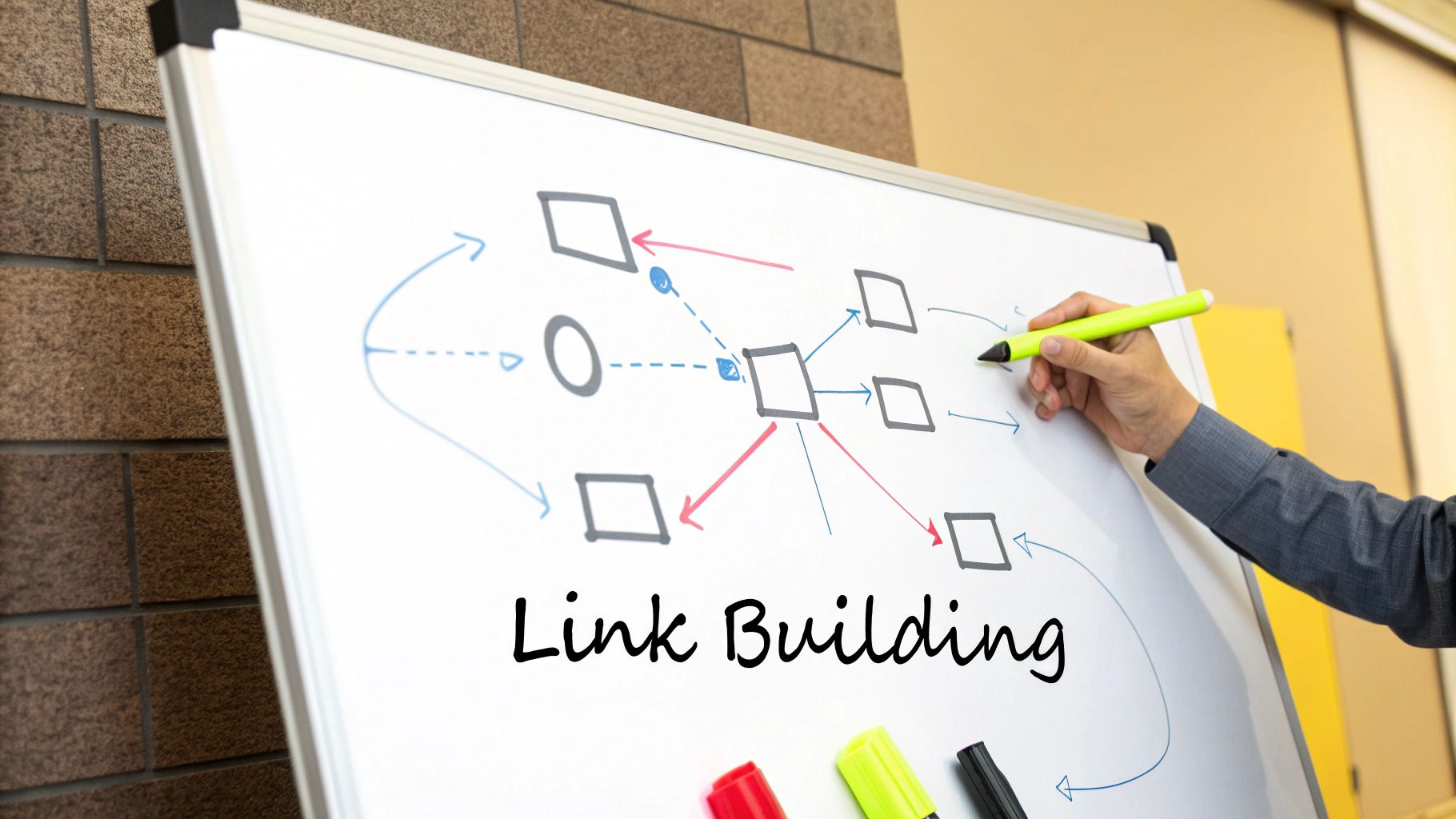
Up until now, we’ve been dialing in the optimizations on your own website. It’s time to look beyond your domain and start building influence and trust out on the web. This is the world of off-page SEO, and it’s an absolutely critical piece of any serious seo for lead gen strategy.
Think of it like this: when another well-respected, high-authority website links to your store, they’re essentially giving you a public vote of confidence. Google notices these "votes" and sees them as powerful trust signals, which in turn boosts your credibility and helps you rank for those valuable, competitive keywords.
These backlinks do more than just help with rankings, though. They also become a source of referral traffic, sending pre-qualified leads directly to your store from places your ideal customers already know and trust. This isn't just about climbing the search results; it's about building a solid reputation that naturally attracts business.
Earning High-Quality Backlinks
Let's get one thing straight: forget the old-school, shady tactics like buying links or spamming blog comments. That stuff doesn't work anymore. Modern, sustainable off-page SEO is all about earning links by creating genuine value.
It's a game of quality over quantity. A single, powerful link from an industry-leading blog can be worth more than a hundred links from irrelevant, low-quality directories.
Here are a few proven methods I’ve seen work wonders for e-commerce brands:
- Guest Posting: Find a blog your target audience reads religiously and write a genuinely helpful article for them. This positions you as an expert and gives you a natural opportunity to link back to a relevant page or product on your site.
- Creating Shareable Assets: Build something people can't help but share. This could be an original data study, a killer infographic, or a free tool that solves a common pain point for your customers. When you create something truly useful, other sites will naturally want to link to it.
- Digital PR: This is all about getting your products or brand story featured in online publications. It's like traditional PR but for the digital age, where the goal is to earn both media coverage and a valuable backlink.
The common thread here is relationship-building. You’re not just cold-emailing someone asking for a link. You’re building real connections with editors, bloggers, and creators in your space by offering them something valuable first.
How to Spot Authoritative Websites
Not all links are created equal. To get the most bang for your buck, you have to focus on earning links from websites that Google already sees as authorities. A great place to start learning what this looks like in practice is by exploring the Top 9 Most Effective Off-Page SEO Strategies to see how the pros do it.
When you're vetting a potential site for a guest post or collaboration, keep an eye out for these signals:
- Relevance: Is the site's content a good fit for your industry and audience? A link from a major fashion blog is a massive win if you sell clothing, but pretty much useless if you sell power tools.
- Traffic: Use an SEO tool to see if the site gets real, consistent organic traffic. This is a clear sign that Google already trusts its content and sends people there.
- Engagement: Take a look at their posts. Are people commenting? Are they sharing the articles on social media? An active, engaged audience is a fantastic sign of a healthy, authoritative site.
This strategic approach to building connections is the foundation of off-page success. For a much deeper dive specifically for online stores, check out our complete guide on link building for ecommerce websites—it’s packed with even more actionable steps.
Measuring the SEO Metrics That Actually Matter
An SEO strategy without measurement is just guesswork. You can't just launch a bunch of content and hope for the best. The real wins come when you start tracking your performance and connecting your SEO efforts to actual business results, like leads and sales. This is how you stop guessing and start making decisions that reliably grow your lead flow.
If you aren't tracking, you're flying blind. You have no idea which articles are your true lead-gen workhorses, which keywords are bringing in ready-to-buy prospects, or where you're losing people in your funnel. The whole point is to create a constant feedback loop to keep refining your approach.
Laying the Measurement Foundation
First things first, you need to teach your analytics tools what a "lead" actually is for your business. This means setting up conversion goals. Inside a tool like Google Analytics 4 (GA4), it's a pretty simple process where you define the specific actions a user takes that you consider valuable.
For a Shopify store that's all about generating leads, these conversions might be things like:
- A potential customer filling out your "Request a Quote" form.
- Someone downloading a free guide in exchange for their email.
- A prospect scheduling a product demo.
- A visitor signing up for your newsletter.
Once you configure these as conversion events in your analytics, you can finally see exactly which pages, keywords, and traffic sources are bringing you real leads.
This is hands-down the most critical step in measuring lead gen SEO. Without it, all you can see is traffic and rankings. Those are just vanity metrics—they don't tell you a thing about revenue. Conversion tracking is what ties your hard work directly to your bottom line.
Finding Your Lead Generation Champions
After your conversion tracking has been running for a bit and has gathered some data, you can start digging for gold. Jump into your analytics and look for the pages that are bringing in the most conversions, not just the most traffic. It's common to find that a small handful of pages are doing most of the heavy lifting and generating the majority of your leads.
These are what I call your "lead generation champions." You might find that a detailed case study or a specific comparison article, even with less overall traffic than a broad blog post, is generating 10x the number of qualified leads. Now that's a powerful insight.
This kind of data gives you a crystal-clear roadmap for what to do next.
- Lean into what's working. Create more content just like your top performers. If that comparison post is a lead magnet, then maybe it's time to build out a whole series comparing your product against different competitors.
- Tune up the underperformers. Look for pages that get good traffic but have a lousy conversion rate. Could you add a more compelling call-to-action? What if you embedded a lead form directly on the page? Sometimes a simple layout tweak is all it takes to guide users toward the next step.
- Uncover new opportunities. Analyze the specific keywords that are driving your conversions. This often reveals high-intent search terms you weren't even thinking about, giving you a fresh batch of ideas for content that attracts serious buyers.
This is the data-driven feedback loop that turns a one-off campaign into a predictable engine for organic leads. It ensures every piece of content you create and every optimization you make is actually contributing to growing your business.
Burning Questions About SEO for Lead Gen
When you start diving into SEO specifically to get more leads, a few questions always pop up. It's totally normal. Let's break down some of the most common ones I hear from e-commerce store owners.
Getting these answers straight helps you set the right expectations from the get-go.
How Long Until I Actually See New Leads From SEO?
This is the big one, right? Everyone wants to know the timeline. While we all wish it were instant, a smart SEO strategy built for lead generation usually needs about 4 to 6 months to really start delivering consistent, noticeable results.
Why so long? Because you're playing the long game. You're building genuine authority in your niche, creating content that actually helps people, and earning trust signals like backlinks. Search engines need time to see all this, process it, and reward you with better rankings for the keywords that matter. Patience isn't just a virtue here; it's a core part of the strategy.
Is "Traffic SEO" the Same as "Lead Gen SEO"?
Good question. They sound similar, but the focus is completely different. It all boils down to the intent of the person searching.
- SEO for traffic is a numbers game. You might target broad, high-volume keywords like "skincare tips" just to get as many eyeballs as possible on your site.
- SEO for lead gen is about quality over quantity. Here, you're targeting specific, long-tail keywords that show someone is much closer to making a decision. Think "best vitamin C serum for sensitive skin."
The whole point isn't just to get clicks. It's to attract the right people—those who are actively looking for what you sell and are far more likely to hand over their email address. You might see less overall traffic, but the people who do show up will be much more valuable.
Can I Get Leads If I Don't Have a Blog?
You can, but you're making it harder on yourself. A blog is hands-down one of the best tools for attracting potential customers at every stage of their buying journey.
That said, it's not the only way. You can still generate leads by creating other types of valuable content.
For instance, you could focus on:
- Creating detailed, downloadable PDF guides.
- Hosting webinars that teach your audience how to solve a specific problem.
- Building a free tool or calculator that's useful in your industry.
- Super-optimizing your product and service pages for keywords with strong buying intent.
But a blog just makes it so much easier to consistently go after a wide range of informational keywords. It’s the perfect way to keep the top of your sales funnel full of new prospects.
Ready to turn your Shopify store into a lead-generating machine with a data-driven SEO strategy? The experts at E-commerce Dev Group specialize in building customized solutions that drive qualified traffic and boost conversions. Learn how we can help you scale at https://scaleshopify.com.
