

When you hear "Shopify theme customization," you might think of simply swapping out colors or fonts in the standard editor. But professional services go so much deeper. They're about taking a generic, off-the-shelf template and turning it into a unique, high-performing storefront that is built specifically for your brand and your customers.
What Are Shopify Theme Customization Services Anyway?
Let's start with a simple analogy. Think of your Shopify theme as the basic architectural blueprint for your online store. It's a solid foundation, for sure. Before you dive into making changes, it helps to understand what a Shopify theme is and the role it plays. The problem is, thousands of other businesses are using that same blueprint.
Hiring a customization service is like bringing in a team of expert interior designers, architects, and contractors. They take that standard blueprint and completely overhaul it, creating a space that feels uniquely yours.
Going Beyond the Basic Editor
True customization isn't about clicking buttons in the theme settings. It's about diving into the code—the Liquid, CSS, and JavaScript files that power your theme. This is where the real magic happens, allowing for powerful changes that are impossible with the built-in tools.
Professionals can build custom features from the ground up, smooth out the customer's path to purchase, and design an experience that makes your brand unforgettable. It's what separates a quick DIY job from a professionally engineered store designed to convert. We cover the hands-on details in our guide on customizing Shopify themes.
This infographic gives a great visual breakdown of what these services actually cover.
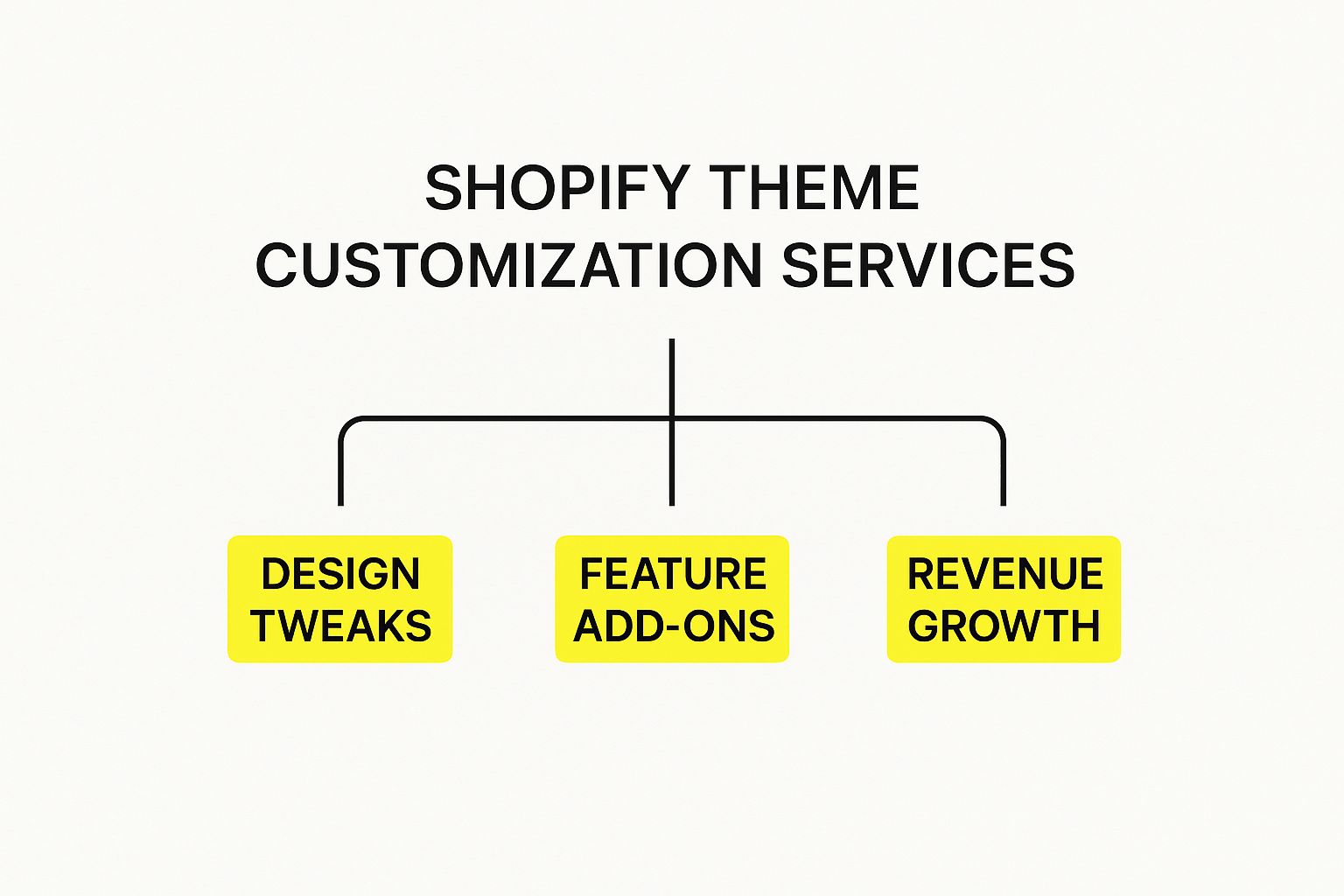
As you can see, the scope ranges from small design tweaks to complex features that have a real impact on your bottom line.
Why a Unique Storefront Matters
With over 4.8 million other merchants on Shopify, blending in is not an option. You have to stand out. Interestingly, 23.1% of all Shopify stores use the 'Trademark' theme, partly because it offers solid ground for deep customization. This just goes to show how many businesses are actively trying to break away from the generic look.
A customized theme does more than just look good—it builds brand trust, improves user experience, and directly impacts your conversion rates. It’s an investment in creating a store that not only functions perfectly but also connects with your target audience on a deeper level.
Ultimately, these services close the gap between what your theme can do and what your business needs it to do. It’s about building a store that solves customer problems and creates a visual identity your competitors can’t copy.
Why a Custom Theme Is Your Competitive Edge

In a sea of online stores, your Shopify theme does more than just display products. It's your digital handshake, your 24/7 salesperson, and the voice of your brand. Using a standard, off-the-shelf theme is like showing up to a big event in a generic rental suit. Sure, it gets the job done, but it doesn’t exactly turn heads or make a lasting impression.
This is where Shopify theme customization services come in. It’s the difference between a cookie-cutter template and a tailored experience, giving you the power to build a truly memorable brand, a frustration-free shopping journey, and a high-octane sales machine.
Craft a Memorable Brand Identity
Your brand is what sets you apart from everyone else selling similar stuff. A custom theme lets you weave your unique identity into every corner of your store, going way beyond just slapping on a logo and picking a few colors.
A professional will make sure every detail—from the fonts and button styles to the page layouts and animations—screams your brand. This kind of consistency builds trust and recognition. When customers feel that genuine connection, they remember you and come back. It’s all about creating a space that feels like you.
Design a Frictionless User Experience
Think about the last time you bailed on an online purchase. Was the site a confusing mess? Slow? Hard to navigate? A clunky user experience (UX) is a one-way ticket to lost sales. Standard themes are built for the masses, which means they rarely fit the specific needs of your audience.
Customization lets you map out a shopping journey designed for how your customers actually browse and buy. This might mean building:
- Intuitive Navigation: Smartly designed menus that help shoppers find what they need in just a few clicks.
- Streamlined Checkout: A modified checkout process that cuts out annoying, unnecessary steps to reduce cart abandonment.
- Logical Product Discovery: Advanced filtering and sorting that makes exploring your products a joy, not a chore.
When you remove roadblocks and guide people smoothly from browsing to buying, you create a great experience that keeps them around and encourages them to hit "complete purchase."
A tailored user experience isn't just a "nice-to-have" feature; it's a fundamental requirement for e-commerce success. It shows customers you respect their time and have designed your store with their needs in mind.
This thoughtful design has a real impact. Stores with modern, well-built themes can see conversion rates up to 40% higher than those with clunky designs. And by focusing on a mobile-first design—something any good pro will do—you could boost sales by around 65%, tapping into the massive wave of mobile shoppers.
Implement Strategic Conversion-Boosting Features
A great design builds trust, but smart features are what close the sale. Shopify theme customization services let you add powerful functionality that directly juices your conversion rate. This is where you can leapfrog competitors stuck with their theme's default settings.
For instance, an expert can build in features like:
- Custom Product Builders: Let customers personalize items by choosing colors, materials, or adding engravings.
- "Quick Add to Cart" Functionality: Allow shoppers to add products to their cart right from collection pages.
- Integrated Wishlists and Reviews: Add social proof and re-engagement tools that bring people back to buy.
These aren't just flashy gadgets; they're tactical tools designed to solve customer problems and make buying easy. To get a better handle on this, it's worth understanding what makes a Shopify theme high-converting. And for a deeper dive into squeezing more sales out of your store, check out our guide on Shopify conversion optimization.
Optimize for Speed and SEO
Finally, none of this matters if your store is slow or invisible to Google. A beautiful shop that takes forever to load is a money pit. Many standard themes come bloated with extra code and scripts that drag down performance.
Professional customization focuses on optimizing your theme’s code for lightning-fast page speeds. A zippy site not only makes for happy customers but is also a huge ranking factor for search engines. A developer will clean up the code, shrink image sizes, and ensure your site is built to fly. This technical SEO work helps you climb the search rankings, bringing in more free traffic and giving you an edge that keeps paying off.
What a Customization Service Actually Delivers
When you pay for Shopify theme customization services, you’re getting a lot more than just a prettier website. You're hiring a team to make tangible improvements that fix real business problems and boost your store's performance from the inside out. It's about turning vague ideas into concrete results.
Think of it like this: a standard theme is a model home—it has the basic rooms and layout. A customization service is the architect and interior designer who comes in to knock down a wall, build custom shelving, and install the perfect lighting.
Let's break down exactly what these experts deliver.
Custom Layout and Section Adjustments
One of the first things you'll notice is the unique page layouts. Standard themes give you a set menu of sections for your homepage or product pages, and they can feel pretty rigid. A customization service throws that menu out the window.
They can build brand new sections from scratch that are designed specifically for your products and sales strategy. Imagine a homepage with an interactive "Shop the Look" gallery or a product page with clean, custom tabs for specs, shipping info, and FAQs. These aren't just cosmetic tweaks; they’re structural changes that help customers find what they need and guide them toward making a purchase.
New Feature and Functionality Integration
This is where customization really makes a difference. Your business has specific needs that a generic theme just can't meet. A development partner can build and integrate features that give you a serious competitive edge.
Often, this means creating functions that make the shopping experience smoother and more engaging. Some of the most common requests include:
- Advanced Search and Filtering: Building powerful filters so customers can sort by size, color, price, or any other attribute unique to your products.
- Mega Menus: Designing complex navigation that shows off product categories, best-sellers, and promotions all in one place.
- Custom Product Options: Letting customers build their own product bundles or add personalizations like custom text and image uploads.
- Quick View and Add-to-Cart: Allowing shoppers to see product details and add them to the cart without ever leaving the collection page.
These aren't just fancy bells and whistles. They are practical tools that solve customer frustrations and clear the path to checkout.
A professional customization service doesn't just add features for the sake of it. They analyze your business goals and customer behavior to implement functionality that will have the most significant impact on your user experience and conversion rates.
Third-Party App Styling and Integration
Almost every Shopify store uses apps for reviews, loyalty programs, or subscriptions. The problem? These apps often stick out like a sore thumb, with clashing fonts, colors, and buttons. This kind of visual mismatch can make a brand feel less trustworthy and create a clunky experience for the user.
A huge part of a customization service is making these apps look and feel like they belong. Developers will use CSS and JavaScript to make the app widgets match your theme’s design perfectly. The result is a seamless, professional storefront where every single element reinforces your brand.
Mobile Responsiveness and Cross-Browser Testing
In this day and age, a perfect mobile experience isn't a bonus—it's a requirement. Most modern themes are "responsive," but true optimization goes way beyond just shrinking a site to fit a small screen.
A customization expert will painstakingly test and tweak every element for mobile users. This means rethinking the navigation, making sure buttons are easy to tap, and confirming that all the custom features work flawlessly on an iPhone, an Android tablet, and everything in between. They run rigorous tests across all major browsers to ensure every single visitor has a great experience, no matter how they shop. This quiet, behind-the-scenes work is absolutely crucial for winning over mobile shoppers.
How to Budget for Theme Customization
Figuring out the cost of Shopify theme customization services is a huge step in planning your store's future. The investment can range from a few hundred dollars to tens of thousands, but it’s not a mystery. Once you understand how agencies and developers price their work, you can set a realistic budget and choose the right partner with confidence.
Think of it like renovating a house. You could hire a handyman for a few hours to patch some drywall, or you could bring in a general contractor to build a brand-new kitchen on a fixed budget. Both make sense in different situations, and the same logic applies to your e-commerce store.
Common Pricing Models Explained
When you start reaching out for quotes, you'll run into three main pricing structures. Each one is designed for different kinds of projects, from tiny tweaks to massive overhauls.
-
Hourly Rates: This is your pay-as-you-go option, perfect for small, well-defined jobs. Need a quick bug fix, a minor layout adjustment, or a color change your theme editor can't handle? Paying by the hour is usually the smartest move. Rates typically fall between $50 and $200+ per hour, depending on the developer’s skill and where they’re located.
-
Fixed-Price Packages: When you have a project with a crystal-clear scope, a fixed price is the way to go. This could be anything from a full homepage redesign to building a custom product configurator. This model gives you budget certainty because the total cost is locked in before any work begins.
-
Monthly Retainers: If you're looking for a long-term partner for ongoing improvements, a monthly retainer is your best bet. This is ideal for growing brands that want a dedicated expert for continuous optimization, new feature development, and performance tuning. A retainer basically puts a pro on your team, ready to help when you need them.
Key Factors That Influence the Cost
The final price of your customization project isn't just a number pulled out of thin air. It’s a reflection of the time, skill, and effort required to get the job done right.
It's crucial to see a quote as more than just a price. A higher number often means you're getting deeper expertise and a more robust solution that’s built to deliver a real return on your investment.
To give you a clearer picture, let's break down the main variables that determine the cost of a project.
| Cost Factor | Description | Impact on Price |
|---|---|---|
| Project Complexity | How much custom work is needed? A small CSS tweak is simple, while a unique "build-a-box" feature is complex. | High. This is the biggest driver of cost. |
| Developer Experience | Are you hiring a junior dev or a seasoned Shopify Plus expert with 10+ years of experience? | High. Senior experts charge more but are often more efficient and produce higher-quality work. |
| Base Theme | Is your starting theme a well-coded premium theme or a free one with limitations? | Medium. A solid theme foundation can reduce development time and save you money. |
| App Integrations | How many third-party apps need to be styled to match your theme's design seamlessly? | Medium. Each integration requires custom coding to make it look native to your site. |
Understanding these cost drivers helps you see exactly what you’re paying for.
By getting a handle on these pricing models and cost factors, you can talk to developers with clarity, ask the right questions, and invest in a service that will truly help your business grow.
Choosing the Right Shopify Customization Partner

Finding the right expert for your Shopify theme customization services is a lot like picking a co-pilot for your business. The right one will not only bring your vision to life but also help you navigate turbulence, offer strategic advice, and make sure you land smoothly. A poor choice, on the other hand, can send your project into a tailspin of missed deadlines, bloated budgets, and a final product that just doesn't fly.
Let's be honest, making the right hire is probably the most important step in this whole process. You need a solid game plan for vetting potential partners to make sure they have the technical chops, business sense, and communication style that gels with your goals.
Define Your Project Needs First
Before you even think about looking for a developer, you need to know exactly what you want to build. Going into consultations without a plan is like walking into a grocery store hungry without a list—you’ll grab a bunch of stuff you don’t need and completely forget the essentials.
So, start by sketching out your requirements. What’s the core problem you're trying to fix? Are you trying to clean up your mobile navigation, add a fancy product builder, or completely tear down and rebuild your homepage?
Put together a simple project brief that covers:
- Your Core Goals: What’s the business outcome you’re after? (e.g., "Boost conversion rate by 15%," or "Slash cart abandonment.")
- Must-Have Features: A non-negotiable list of functions your site needs.
- Inspiration: A couple of links (2-3) to websites you love, with a quick note on what you admire about their design or user flow.
- Your Budget and Timeline: Be upfront and realistic about your investment and deadline.
Having this document ready to go makes it so much easier to explain your vision. It also helps potential partners give you a proposal that’s actually relevant and accurate.
Evaluate Their Portfolio and Expertise
Once you start the search, a provider's portfolio is your first real look at what they can do. Don't just scroll through the pretty pictures; you need to dig a little deeper. A truly strong portfolio shows off more than just slick designs.
Look for proof that they actually understand e-commerce strategy. Do their past projects clearly improve the user experience? Do they solve real-world business problems, or are they just giving sites a fresh coat of paint? It's also a huge plus if they have experience in your specific industry—that kind of niche knowledge can be a game-changer.
The best partners don’t just show you screenshots; they share case studies. They’ll walk you through the client's initial problem, the solution they built, and the real results they delivered. That’s how you spot strategic thinking, not just coding skills.
If you look at what themes the top Shopify stores are using, you’ll see a clear pattern. The 'Out of the Sandbox' theme family, for example, holds a massive 32% market share among the top one million Shopify sites. Why? Because it’s powerful and flexible. A great partner will have tons of experience with these top-tier themes and know how to push them to their limits. You can read more about these trends in the top Shopify theme statistics on sumtracker.com.
Ask the Right Questions During Consultation
That first call or meeting is your chance to really interview a potential partner. This is where you get past the polished portfolio and see how they think, communicate, and work. Come prepared with a list of questions so you don’t forget anything important.
Here are a few questions you should absolutely ask:
- What does your development process look like? A pro will have a clear, structured workflow for discovery, design mockups, development, testing, and launch.
- How will we communicate during the project? Will you get a dedicated project manager? Do they use a tool like Asana or Trello to keep things organized? Communication is everything.
- Who will actually be working on my site? Are you talking to a salesperson, or is this the developer who will be in the code?
- How do you handle testing and quality assurance? You need to be confident your site will work flawlessly across all major browsers and devices before it goes live.
- What happens after launch? Do you offer support? Ask if they have a warranty period for fixing bugs or if they offer ongoing support retainers.
These questions will give you a much better feel for their professionalism and help you decide if they're the right fit. For an even more detailed checklist, check out our guide on how to hire a Shopify expert developer.
Got Questions About Theme Customization? We’ve Got Answers.
Thinking about hiring someone to customize your Shopify theme? It’s a big step, and you probably have a lot of questions. That’s smart. Getting clear answers upfront is the best way to make sure your project goes smoothly.
We’ve been doing this for a long time, and we hear the same questions pop up again and again. Let's walk through the most common ones so you can move forward with confidence.
Can We Just Start with a Free Shopify Theme?
You bet. In fact, it’s a really common strategy. Starting with a free theme from Shopify, like Dawn, is often a great move. They're built by the Shopify team, so you know they’re solid, fast, and always compatible with the latest Shopify features. It gives your developer a clean, reliable foundation to work with.
The catch? Free themes are intentionally simple. They don't come loaded with the fancy features or complex layouts you might see in a premium theme. This just means your developer might need to build more functionality from the ground up, which can sometimes add to the project's cost.
The best first step is always a conversation. Talk to a potential developer about what you want to achieve. They'll help you figure out if a free theme is the most efficient starting point or if a premium theme already has most of what you need built-in.
How Long is This Going to Take?
This is the classic "it depends" question, but I can give you some real-world context. The timeline for any customization project comes down to one thing: complexity. A few simple CSS tweaks to change colors and fonts might just take a day or two.
But if you're talking about a full-blown redesign with custom-built features, unique page layouts, and new app integrations, you're likely looking at a timeline of four to twelve weeks, sometimes more. Any professional developer worth their salt will give you a detailed project schedule with clear milestones before they write a single line of code.
Here's a rough guide to help you set expectations:
- Small Tweaks (1-2 weeks): Think minor style changes, fixing a few bugs, or getting a third-party app to match your branding.
- Medium Projects (3-6 weeks): This could be a complete homepage overhaul, building out a few custom product page sections, or adding a feature like advanced search filters.
- Large-Scale Overhauls (8+ weeks): We're talking a full site redesign from the ground up, creating complex tools like a product customizer, and a deep dive into performance optimization.
Wait, Will All This Custom Code Slow Down My Site?
It’s a great question to ask. Everyone knows that a slow site kills conversions and hurts your SEO. But here's the good news: when customization is done right, it should actually make your store faster, not slower.
That's a huge part of what you're paying for—an expert who knows how to optimize for performance. A professional Shopify developer will:
- Write clean, lightweight code and avoid bloated scripts.
- Properly size and compress all images and other files so they load in a flash.
- Limit the use of performance-hogging apps and find more efficient solutions.
- Use modern development techniques to make sure the site renders as quickly as possible.
It's the sloppy, DIY code snippets or work from inexperienced developers that typically bogs a site down. Hiring a pro is your best insurance against a slow store.
What Happens When the Theme I Used Gets an Update?
This is a fantastic question and one that many store owners don't think about until it's too late. When you customize a theme, you're creating your own special version of it. You can't just click the "update" button in Shopify anymore, because that would wipe out all the custom work you paid for.
So, when the original theme developer releases an update with bug fixes, security patches, or cool new features, the process is manual. Your developer has to carefully review the update, identify the new code, and then merge it into your customized theme without breaking anything.
This is exactly why building a long-term relationship with a developer or agency is so important. They can handle these updates for you, often as part of a monthly support plan, keeping your site secure, modern, and running perfectly long after the initial project is finished.
Ready to turn your Shopify store into a finely-tuned machine that converts? At E-commerce Dev Group, we live and breathe custom Shopify development. We build beautiful themes that are engineered to perform. Get in touch with us today and let's talk about your vision.
