


Think of social media marketing as more than just a marketing channel. For an ecommerce business, it’s about using platforms like Instagram, TikTok, and Facebook to sell products, sure, but it's also about building a genuine brand and driving real sales. It’s your chance to meet customers where they already spend their time and turn your brand's social feed into an interactive, digital storefront. For online retailers, this isn't just a "nice-to-have" anymore; it's absolutely essential.
Why Social Media Is Your New Digital Storefront

Let's change how we look at social media. It's not just a bulletin board for company news or the occasional flash sale. For today's ecommerce brands, platforms like Instagram, TikTok, and Pinterest are the new main street. This is where people discover products, check out new collections, and actually start to feel a connection with a brand.
The way people shop has completely changed. They don't just head straight to a website when they need something. Inspiration strikes while they're scrolling, and they often look for social proof before making a purchase. This creates a powerful, direct line between having an authentic social presence and seeing your sales numbers go up.
From Broadcasting to Building a Community
Marketing used to be a one-way street. Brands would just shout their messages out into the world and hope someone was listening. Social media marketing for ecommerce flipped that model on its head. Now, it's a two-way conversation.
It's all about building a community, not just racking up a high follower count. When you actually engage with people in real-time, reply to their comments, and share content they've created, you're building something much more powerful than ad clicks: you're building trust.
And that trust? It leads directly to sales. A strong, active social media presence serves as powerful social proof. It shows new visitors that you’re a legitimate business that people like and are happy to buy from.
The real goal is to make your social feed feel less like a series of ads and more like a recommendation from a good friend. That’s the sweet spot where real engagement turns casual browsers into loyal customers.
Meeting Customers Where They Hang Out
The opportunity here is massive. As of 2025, a mind-boggling 63.9% of the entire world's population is on social media. For an ecommerce store, that means your potential customers are all gathered in one place, just waiting to find you.
In fact, an incredible 82% of buyers use social media to research products before they buy. It's a non-negotiable part of their shopping journey.
This gives you a direct line to your audience. You can get instant feedback, figure out what they're struggling with, and adjust your products to better fit what they actually want. By creating content that’s genuinely entertaining, helpful, or inspiring, you can slide your brand right into their daily routine.
For anyone running an online store, learning how to effectively add social media to Shopify is the first step. Because at the end of the day, your social profile isn't just supporting your store—for a growing number of people, it is the store.
Choosing Social Platforms That Actually Drive Sales
It’s tempting to try and be everywhere at once, but spreading your brand thin across every social media platform is a fast track to burnout, not sales. The real secret to effective social media marketing for ecommerce isn't about having a presence on every app; it's about being in the right places—where your ideal customers hang out, ready to engage and buy.
Your platform choice needs to be a strategic decision, not a shot in the dark. It all boils down to two simple questions: What are you selling, and who are you selling it to? The answers will light up the path to the platforms that will give you the best return on your time and money.
Align Your Product With the Right Platform
The type of product you sell is a huge clue to where you'll find your audience. Visually stunning products like fashion, home decor, and beauty naturally shine on platforms built around aesthetics. On the other hand, products with more complex features need a space that allows for deeper explanations.
Think about it: a boutique selling handmade leather bags will feel right at home on Instagram, where gorgeous photos and Reels can show off the craftsmanship. But a company selling smart home gadgets would probably get more traction on YouTube, using in-depth tutorials and reviews to explain how everything works.
This breakdown can help you make a smarter choice based on audience age, product type, and even your monthly ad budget.
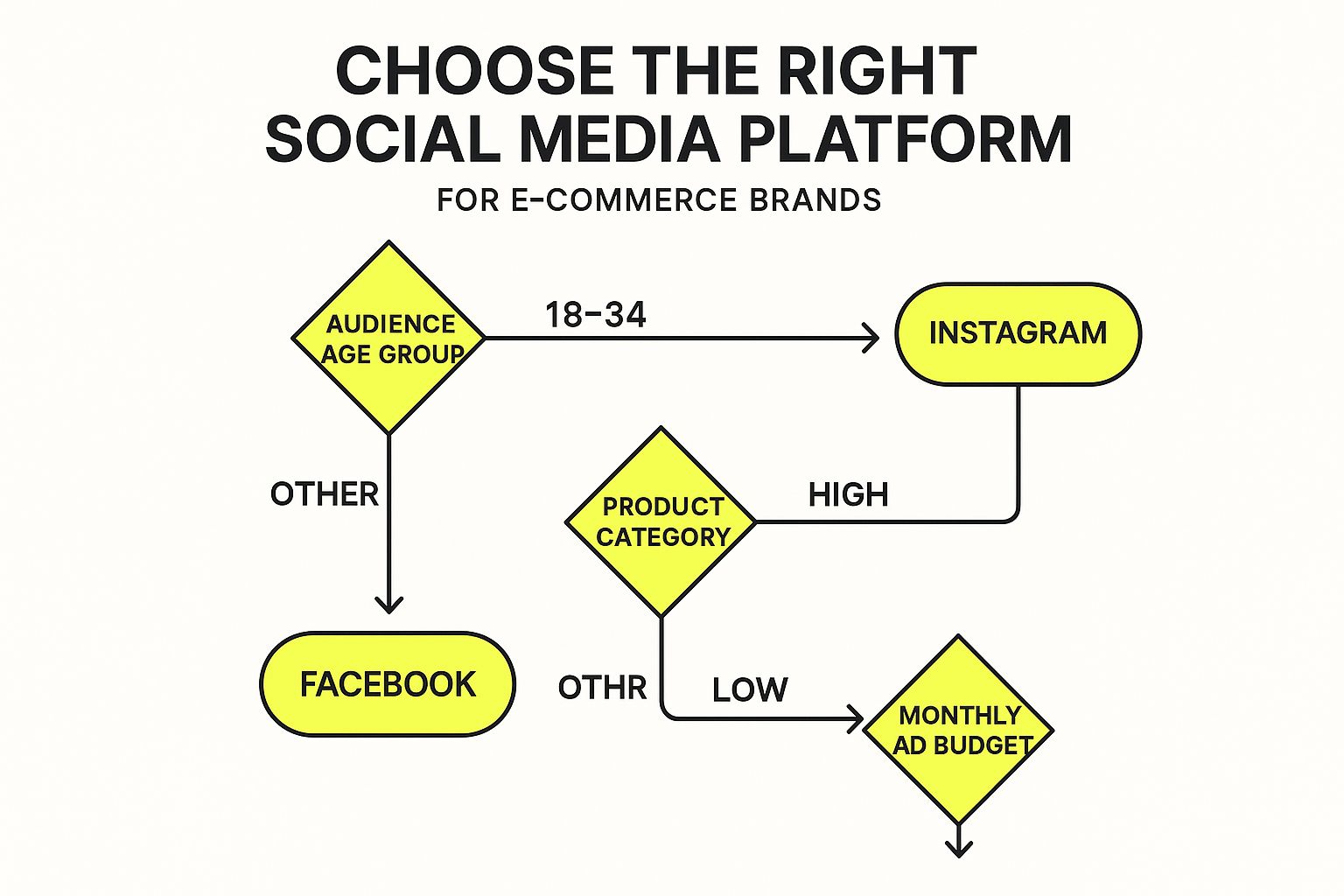
As you can see, a brand targeting Gen Z with a new clothing line and a smaller budget should be all-in on TikTok. Meanwhile, a business selling high-end electronics to Millennials with more to spend on ads would be wise to focus on Instagram and YouTube.
To help clarify this, let's look at a quick comparison of the top platforms.
Platform Selection Matrix for Ecommerce Brands
This table provides a high-level overview to help you match your brand's needs with the right platform's strengths.
| Platform | Primary Audience | Ideal Product Category | Key Ecommerce Strength |
|---|---|---|---|
| Millennials & Gen Z (18-34) | Fashion, Beauty, Home Decor, Food, Travel | Visual storytelling, influencer marketing, seamless in-app shopping | |
| Millennial Women, Homeowners | DIY, Home Goods, Recipes, Wedding, Fashion | High-intent audience actively planning purchases | |
| TikTok | Gen Z & Young Millennials | Gadgets, Cosmetics, Apparel, Unique Items | Massive organic reach through viral trends and user-generated content |
| Gen X & Baby Boomers (35+) | Broad Range, Community-Driven Products | Powerful ad targeting, large user base, diverse content formats | |
| YouTube | Broad (18-49) | Electronics, Software, Hobbies, Education | In-depth product reviews, tutorials, and long-form storytelling |
Choosing the right platform is about finding the intersection of where your audience is and where your product looks its best.
A Closer Look at the Top Ecommerce Platforms
Once you have a general idea, it’s time to dig into what makes each major player unique. They all offer a different environment and user-base.
Instagram: The Visual Commerce Powerhouse
Instagram is still a monster for ecommerce, especially for any brand that looks good on camera. It’s grown from a simple photo-sharing app into a full-blown shopping mall, with features like Instagram Shops, product tagging, and shoppable Reels making it incredibly easy for users to go from discovery to checkout.
The stats don't lie. Instagram has around 2 billion users, and a staggering 62.3% of them use the app just to research brands and products. Even better, 80% of users say Instagram helps them decide whether to buy something. That’s a massive amount of influence. For a deeper dive, check out these compelling social media marketing statistics.
For an ecommerce brand, your Instagram feed is your digital catalog and your Stories are your daily specials. It's the perfect place to build a lifestyle around your products, not just display them.
Pinterest: The Product Discovery Engine
Think of Pinterest less as a social network and more as a visual search engine. People, or "Pinners," come to the platform actively looking for inspiration—for their home, their wedding, their next meal. They are in a prime mindset to discover new products. This makes it a goldmine for categories like home goods, recipes, and DIY projects.
Creating beautiful Pins that link directly to your product pages can drive a ton of high-intent traffic to your store. For those willing to invest in a paid strategy, the results can be fantastic. If you're ready to get started, you can check out our ultimate guide to Pinterest ads for Shopify.
TikTok: The Engine of Viral Trends
The algorithm on TikTok is legendary for its ability to make content go viral, giving brands an incredible shot at massive organic reach. The catch? Polished, corporate content usually falls flat. Here, it’s all about authenticity, creativity, and jumping on trends.
This platform is a natural fit for products that can be shown off in short, punchy videos. Think makeup tutorials, clever gadgets in action, or clothing try-on hauls. The trick is to entertain first and sell second. Let your product’s personality shine through.
Choosing your platforms wisely is the bedrock of a solid social media strategy. Resist the urge to chase follower counts on every new app. Instead, pour your energy into one or two channels where your target audience lives and your products can be showcased best. That focused approach will build a stronger community and, ultimately, drive more sales.
Crafting Content That Turns Followers Into Customers

Likes and shares are great for the ego, but they don't pay the bills. When it comes to social media marketing for ecommerce, the real goal is turning those engaged followers into actual, paying customers. This means moving past random posts and building a smart content strategy that gently guides people from discovery all the way to checkout.
Think of your content as more than just filler for your feed. It’s your chance to build trust, answer questions before they’re even asked, and make your product feel like a must-have. You need a mix of posts that educate, entertain, and inspire—all while subtly showing why your brand is the obvious choice.
The Three Pillars of Ecommerce Content
To build a social media presence that actually works, I always recommend focusing on three core content pillars. When used together, they create a compelling brand story that connects with your audience and makes them want to click "buy."
- User-Generated Content (UGC): This is the new word-of-mouth, and it’s pure gold. When you feature photos and videos from real customers using your products, it provides powerful social proof. It's one thing for you to say your product is great; it's another thing entirely for a potential buyer to see someone just like them already loving it.
- Lifestyle Content: Stop just showing your product; show the life your customer gets with your product. Lifestyle shots help people picture your items in their own lives. A skincare brand might post a shot of a serene morning routine, or a camping gear company could share incredible photos from a mountain adventure.
- Behind-the-Scenes (BTS) Content: This is where you get to be human. Show the people behind the brand, the messy-but-exciting process of developing a new product, or even just a funny moment from the office. This kind of transparency builds a genuine connection that faceless corporate giants just can't match.
Balancing these three pillars makes your feed feel authentic and valuable, not like you're just screaming "buy my stuff!" all day.
Planning Your Content for Maximum Impact
A content calendar is your absolute best friend here. It keeps you consistent, prevents the last-minute panic of figuring out what to post, and ensures your feed tells a cohesive story. The key is to aim for a mix that gives value first and sells second.
A solid approach is the 80/20 rule: make sure 80% of your content is valuable, engaging, and non-promotional. The other 20% can be your direct calls-to-action, like a "Shop Now" post or a big sale announcement.
Your content calendar isn't just a schedule; it's a strategic plan. It ensures you're nurturing your audience with valuable content most of the time, so when you do ask for the sale, they're ready and willing to listen.
If you’re stuck for ideas, check out these 10 social media content ideas to boost engagement to get the creativity flowing. For a bigger picture, mapping out a full ecommerce content strategy provides the blueprint you need for long-term success.
Leveraging Video to Capture Attention
Let's be clear: video isn't optional anymore. It's essential. Short-form video, in particular, is king on platforms like TikTok and Instagram Reels, and the numbers back it up.
By 2025, global spending on social media marketing is projected to hit a staggering $276.7 billion, which is about 30% of all digital ad spending. What's driving this? A huge part is video. In fact, 78% of consumers say they prefer to learn about new products through short videos.
This doesn't mean you need a Hollywood budget. In my experience, authentic, lo-fi videos often perform better. Here are a few simple video ideas that ecommerce brands can run with:
- Product Demos: Show your product in action. How does it work? What problem does it fix? Keep it quick, clear, and compelling.
- How-To and Tutorials: Offer real value by teaching your audience something. If you sell kitchenware, share a 30-second recipe. It’s simple but incredibly effective.
- "Pack an Order with Me" Videos: This behind-the-scenes format is weirdly addictive. It gives customers a peek into your process and builds anticipation for their own package arriving.
Using Interactive Stories for Engagement and Sales
Instagram and Facebook Stories are perfect for more casual, of-the-moment content. Their built-in interactive features are a goldmine for engaging your audience and getting instant feedback.
Use features like polls, quizzes, and question stickers to get a conversation going. A clothing brand, for example, could use a poll to let followers vote on which of two new t-shirt designs they like best. You get a nice engagement boost and some free market research at the same time.
Your most powerful sales tool in Stories is the "link sticker." Use it to send people directly to product pages, new blog posts, or your latest collection. You can also create a little urgency by announcing a flash sale that's only accessible through that Story link.
By crafting content that serves your audience across these different formats, you build a relationship based on trust. Once that foundation is solid, turning followers into loyal, repeat customers becomes a natural, consistent part of your business.
Using Social Commerce And Ads To Boost Revenue
Creating eye-catching posts is only half the journey. Next, you need to turn those double taps into real sales—fast. That’s where social commerce tools and paid campaigns step into the spotlight.
You want to collapse the gap between discovery and checkout. Make buying a product as simple as a couple of taps, all inside the app your audience already loves.
Turning Your Feed Into A Storefront
At its core, social commerce brings the checkout counter to your audience’s thumb. It feels like moving your online store right under their fingertip.
You can plug into features from the biggest platforms:
- Instagram Shopping (Instagram Shopping Guide): Tag products in feed posts, Reels, and Stories. Shoppers tap a tag and land on a detailed product page without leaving the app.
- Facebook Shops (Facebook Shops Guide): Offer a single shop space that works on both Facebook and Instagram. Customers explore your catalog in one place and can complete orders instantly.
| Feature | Instagram Shopping | Facebook Shops |
|---|---|---|
| Placement | Feed, Reels, Stories | Facebook & Instagram |
| Setup Time | Under 30 minutes | About 20 minutes |
| Catalog View | Collection layouts | Unified storefront |
Imagine a small furniture label posting a styled sofa shot. Each cushion, throw, and side table is tagged. One tap sends an intrigued shopper straight to checkout.
When your posts are shoppable, you catch potential buyers in the moment. You’re not just showcasing—you’re creating a seamless path to purchase.
Demystifying Paid Social Advertising
Organic posts help you build a tribe, but ads fuel real growth. Paying to appear in front of your ideal shopper is more than clicking “boost.” It’s about precision, not spray-and-pray.
A focused ad campaign can deliver strong ROAS, but only with a clear plan. Generic messaging gets lost—so your visuals and copy must stop the scroll.
Smart Targeting Strategies That Actually Work
Ads shine when they speak to the right people at the right time. Move past age and location filters—dig deeper.
-
Retarget Abandoned Carts
Someone dropped items in their cart. A well-timed reminder ad—complete with a gentle discount—can lure them back. -
Build Lookalike Audiences
Start with a seed list of your top customers. The platform then finds a new crowd with matching habits and interests. It’s like cloning your best buyer.
These tactics focus your spend on warm leads who already know your brand or resemble those who do.
Designing Ads That Convert
You have roughly 2 seconds to grab attention. Static images can work, but short videos often win the day.
-
UGC Ads
Real customers unboxing or raving about your product. Authentic voices build faster trust than slick studio shots. -
Problem/Solution Ads
Lead with a familiar pain point, then introduce your product as the fix. This simple arc hooks viewers and clearly shows value.
Keep your copy tight and your call-to-action clear. Phrases like “Shop Now” or “Get 25% Off” guide people toward the next step.
Ultimately, success comes down to tracking what moves the needle. You need proof that your content and ads contribute to the bottom line. For a deeper dive into measuring impact, check out mastering social media marketing ROI.
By weaving seamless commerce features and pointed ad campaigns together, you turn followers into customers—and keep that engine humming month after month.
Building a Community of Loyal Brand Advocates

A one-time sale is good, but what you're really after is the customer who comes back again and again—and brings their friends. So many ecommerce brands get laser-focused on the next sale that they completely miss the massive opportunity in front of them: building a real community.
When you shift your mindset from just getting customers to creating brand advocates, everything changes. It’s about making people feel like they’re part of a club, not just a line item in your sales report. This isn't just feel-good fluff; it's a core pillar of any solid social media marketing for ecommerce plan.
Be Human in Your Engagement
Think of your comment section and DMs as your brand’s virtual living room. This is where you get to have real, one-on-one conversations that build relationships that actually last. When you respond to comments, inject some personality. Ditch the generic "Thanks!" and show there's a real person behind the logo.
Every DM is a golden opportunity. When someone slides in with a question, you have a chance to create a memorable, positive experience. Make them feel seen and heard. That kind of personal attention is what flips a passive follower into a die-hard fan.
Building a community is less about managing a crowd and more about making individual connections at scale. Each interaction is a chance to make someone’s day and create a positive brand memory.
Once you nail that human-to-human connection, you can start inviting your community to be a more active part of your brand's story.
Get People Talking with User-Generated Content
User-generated content (UGC) is the holy grail of social proof. It’s raw, it's real, and it’s way more convincing than any slick ad you could ever run. The thing is, you can't just cross your fingers and hope people start posting about your products. You have to give them a little nudge.
Here are a few simple ways I've seen work time and again:
- Launch a Branded Hashtag: Come up with something simple and catchy for your customers to use when they post. Make a point to feature the best posts on your own feed—it shows you're listening and makes people feel special.
- Host a Photo Contest: Nothing gets people moving like a good prize. A contest for the best photo featuring your product can create a huge wave of amazing, authentic content in a very short time.
- Just Ask! Seriously, sometimes it's that easy. A simple call-to-action like, "Show us how you're styling our new jacket! Tag us for a chance to be featured," can be incredibly effective.
When your followers see you celebrating other customers, it creates a powerful cycle. The featured customer feels recognized, and potential buyers see real people loving what you sell. That’s how you build trust.
Find Your Hidden Champions
Before you go shelling out big bucks for a major influencer, take a look at who's already in your corner. You likely have micro-influencers—people with smaller but fiercely loyal followings—who are already posting about you because they genuinely love your stuff. An endorsement from them feels like a recommendation from a friend, not a sponsored post.
Comb through your tagged photos and comments to find these people. Send them a friendly message, offer them some free product, and don't ask for anything in return. More often than not, they'll be so excited that a brand they admire noticed them that they’ll create fantastic content for you anyway.
It’s a more genuine, budget-friendly way to get the word out. You’re not just buying reach; you’re investing in your most passionate customers and, in turn, building a community that actively helps you grow.
Got Questions About Social Media for Your Store?
Jumping into social media for your e-commerce brand can feel a bit overwhelming. You know you need to be there, but figuring out the how and how much can be tricky. Let’s clear up some of the most common questions I hear from store owners.
Think of this as your go-to cheat sheet for the practical stuff—the questions that pop up when you're actually trying to make this work.
How Much Should My Ecommerce Store Spend On Social Media Marketing?
There’s no one-size-fits-all answer here, but a good rule of thumb is to start with 10-20% of your total marketing budget. If you're new to the game, don't spread that money across five different platforms. Pick one, maybe two, and really focus on figuring out what resonates with your audience there. It's much better to dominate one channel than to be invisible on five.
For more established brands, you can definitely afford to experiment more with content and ads across the board. The key, no matter your size, is to be laser-focused on your Return on Ad Spend (ROAS). Let the numbers tell you where to invest more and where to cut back. And don’t forget to earmark a bit of that budget for good scheduling and analytics tools—they’ll save you a ton of headaches and time.
Your social media budget isn't a fixed expense; it's a fluid investment. Start small, find what works, and then pour gas on the fire by scaling the channels that are actually ringing the cash register.
Which Social Media Metrics Should I Actually Care About?
It’s so easy to get caught up in vanity metrics. A huge follower count might feel good, but it doesn't pay the bills. For an e-commerce business, you have to tie everything back to revenue.
Here are the metrics that really move the needle:
- Conversion Rate: This is the big one. Out of everyone who clicked your ad or link, how many actually bought something?
- Click-Through Rate (CTR): Are people actually clicking? This tells you if your creative and copy are grabbing attention or just getting scrolled past.
- Return on Ad Spend (ROAS): For every dollar you put into ads, how many are you getting back? This is your ultimate profitability gauge.
And when you look at engagement, go deeper than likes. Saves and shares are far more powerful. A share is a personal endorsement to a friend. A save means someone found your content so useful they want to refer back to it. Both are incredibly strong signals that you’re providing real value.
How Should I Deal With Negative Comments Or Reviews?
That sinking feeling when you see a negative comment? We’ve all been there. But honestly, this is a golden opportunity to show off your customer service. The number one rule is to respond, and respond quickly. Don't leave it hanging.
A public response is crucial. Start with empathy—a simple "I'm so sorry you had that experience" goes a long way. Then, immediately offer to take the conversation private. "Could you DM us your order number so we can look into this for you?" This shows everyone reading that you’re proactive and you care.
Whatever you do, don't delete the comment (unless it's spammy or abusive, of course). When you handle a complaint with grace, you can turn a frustrated customer into a loyal fan. And everyone else watching sees that you're a brand that can be trusted.
Ready to turn your social media presence into a powerful sales engine? The team at E-commerce Dev Group specializes in creating stunning, high-converting Shopify stores designed for growth. Explore our Shopify design and development services and let's build a store that your customers will love.
