

In the fast-paced world of e-commerce, staying on top of your stock is the difference between thriving and failing. Mismanaging inventory leads directly to lost sales from stockouts, tied-up capital in overstocked items, and unhappy customers. For Shopify merchants, mastering inventory isn't just an operational task; it's a core strategic advantage that fuels growth and profitability.
This guide cuts through the noise to deliver proven, actionable inventory management best practices designed to give you precise control over your products. We'll explore 9 powerful techniques, from classic principles like ABC analysis and the First In, First Out (FIFO) method to modern necessities like real-time tracking and demand forecasting. Each point provides the practical steps needed to optimize your stock levels, boost your bottom line, and scale your business effectively.
Rather than offering generic advice, this article provides a clear roadmap for implementation. For those looking to dive deeper into improving stock control and boosting profits, explore these invaluable small business inventory management tips. By applying these targeted strategies, you can transform your inventory from a liability into one of your most powerful assets.
1. ABC Analysis (80/20 Rule)
Not all inventory is created equal. ABC analysis is an inventory categorization technique that applies the Pareto principle, also known as the 80/20 rule, to your stock. This method involves segmenting products into three distinct categories (A, B, and C) based on their consumption value, which is the total value of an item consumed over a specific period. This prioritization is a cornerstone of effective inventory management best practices.
By sorting your items, you can focus your time, money, and resources where they have the most impact. Instead of treating every product with the same level of scrutiny, you can allocate your attention strategically. For example, industry giants like Amazon and Toyota use sophisticated ABC analysis to optimize warehouse layouts and maintain lean manufacturing systems, ensuring their most critical products receive the most attention.
How to Implement ABC Analysis
Implementing this system is straightforward. Start by calculating the annual consumption value for each product (Annual Demand x Item Cost). Then, rank your products from highest to lowest value and group them into these three classes:
- A-Items: The top 20% of your items that account for roughly 80% of your revenue. These are your most valuable products.
- B-Items: The next 30% of items, representing about 15% of your revenue.
- C-Items: The remaining 50% of items, which only make up 5% of your revenue.
This infographic visualizes the typical breakdown of SKUs and their corresponding value in an ABC analysis hierarchy.
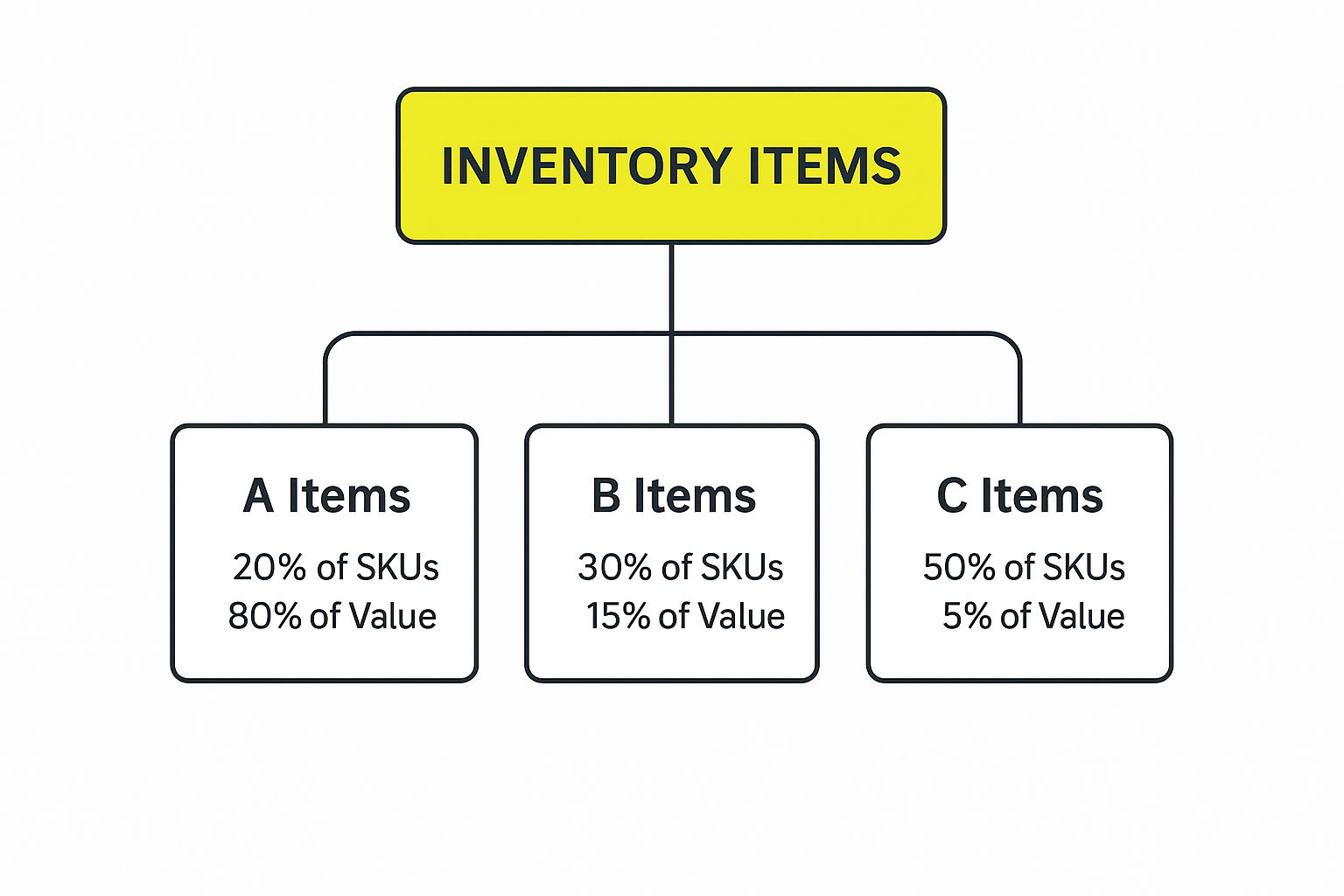
As the diagram shows, a small portion of your inventory (A-Items) is responsible for the vast majority of your revenue, highlighting where your management focus should be.
2. Just-in-Time (JIT) Inventory
Just-in-Time (JIT) inventory is a lean strategy that aligns raw material orders from suppliers directly with production schedules. Companies receive goods only as they are needed, which significantly reduces inventory holding costs, minimizes waste, and increases overall efficiency. This approach eliminates the financial burden of overproduction and storing excess stock, making it a powerful tool in your inventory management best practices toolkit.
The JIT model was famously pioneered by Toyota to revolutionize automotive manufacturing. By receiving parts exactly when needed on the assembly line, they cut down on massive warehousing expenses and improved quality control. Other examples include Dell's build-to-order model, where computers are assembled only after a customer places an order, and McDonald's, which receives fresh ingredients daily to minimize spoilage and ensure product quality.

How to Implement JIT Inventory
Successfully adopting a JIT system requires precision, reliability, and strong partnerships. It is a high-reward strategy but demands a robust operational framework to mitigate risks like stockouts from supply chain disruptions. You can learn more about Just-in-Time (JIT) Inventory and how it compares to other models.
To get started, focus on these core actions:
- Develop Strong Supplier Partnerships: Your suppliers are critical to JIT success. Work with reliable partners who can guarantee timely deliveries and consistent quality.
- Implement Robust Demand Forecasting: Accurate forecasting is non-negotiable. Use historical data and predictive analytics to anticipate customer demand precisely.
- Create Contingency Plans: Have backup suppliers and safety stock for critical components to protect your business from unexpected disruptions.
- Start with a Pilot Program: Test JIT with a specific product line before rolling it out company-wide to identify and resolve potential issues.
3. Economic Order Quantity (EOQ)
Balancing the costs of ordering too much or too little inventory is a constant challenge. The Economic Order Quantity (EOQ) model is a classic formula designed to find that perfect balance. It calculates the ideal order size a company should purchase to minimize the total costs associated with ordering and holding stock. This calculation is a fundamental component of effective inventory management best practices.
By determining your EOQ, you can reduce both your carrying costs (like storage and insurance) and your ordering costs (like shipping and processing fees). This prevents you from tying up excess cash in slow-moving stock or, conversely, running out of popular items and losing sales. For example, consumer goods giant Procter & Gamble uses EOQ to manage its vast non-promotional inventory, while pharmaceutical companies use modified versions to handle drug supplies with strict expiration dates.
How to Implement Economic Order Quantity
The EOQ formula considers your annual demand, the cost per order, and the cost of holding inventory. While the formula itself can seem complex, inventory management software often automates this calculation. The goal is to find the sweet spot where ordering costs and holding costs are at their lowest combined point.
To effectively use the EOQ model, consider these practical steps:
- Review Regularly: Demand and costs change. Revisit your EOQ calculations at least monthly or quarterly to ensure they remain accurate.
- Adjust for Seasonality: The standard EOQ formula assumes constant demand. You must adjust your calculations to account for predictable seasonal peaks and troughs.
- Factor in Discounts: A supplier might offer a discount for a larger order. Compare the savings from the discount against the increased holding cost to see if it makes financial sense to order more than your EOQ.
- Use as a Guideline: Treat the EOQ number as a strong starting point, not an unbreakable rule. Always factor in real-world context like supplier reliability and market volatility.
4. Real-Time Inventory Tracking
Manual inventory counts and periodic updates are relics of the past. Real-time inventory tracking utilizes technology like barcode scanners, RFID, and integrated software to monitor stock levels continuously and automatically. This approach provides instant visibility into every product's movement, location, and quantity across all your sales channels and warehouses, which is essential for modern inventory management best practices.
By eliminating manual data entry and guesswork, you can prevent stockouts, reduce carrying costs, and improve order accuracy. For instance, global retailers like Zara leverage RFID tags to gain a real-time view of their entire stock, enabling them to fulfill online orders from the nearest store and replenish shelves with incredible speed. This level of accuracy is a game-changer for customer satisfaction and operational efficiency. Learn more about how real-time inventory sync improves Shopify stores on scaleshopify.com.

How to Implement Real-Time Inventory Tracking
Adopting a real-time system involves integrating technology with your existing operations. The goal is to create a seamless flow of information from your warehouse floor to your e-commerce dashboard.
- Start with High-Value Items: If a full rollout is too ambitious, begin by implementing tracking for your A-Items from your ABC analysis.
- Ensure Proper Staff Training: Your team must be comfortable using the new hardware and software to ensure data accuracy.
- Integrate with Existing Systems: Your tracking system should sync flawlessly with your Shopify store, POS, and accounting software to create a single source of truth.
- Perform Regular Maintenance: Keep your hardware and software updated to prevent system failures and security vulnerabilities.
5. Safety Stock Optimization
Unexpected delays and demand spikes can quickly lead to stockouts, lost sales, and unhappy customers. Safety stock optimization is the practice of holding additional inventory beyond your forecasted demand to act as a buffer against these uncertainties. This calculated surplus ensures you can continue fulfilling orders even when supply chains are disrupted or sales suddenly surge, making it a critical component of any robust set of inventory management best practices.
By calculating the optimal amount of buffer stock, you can protect your service levels without overinvesting in inventory that ties up capital and increases holding costs. For example, a company like Apple maintains safety stock for key components ahead of a new iPhone launch to mitigate any potential supply chain hiccups. Similarly, Unilever adjusts its safety stock for popular products during major promotional periods to handle the anticipated, yet unpredictable, increase in demand.
How to Implement Safety Stock Optimization
Implementing safety stock requires a data-driven approach rather than guesswork. The goal is to find the sweet spot between preventing stockouts and minimizing carrying costs. Start by analyzing historical sales data and supplier lead times to inform your calculations.
- Use a Formula: A common formula is (Maximum Daily Usage × Maximum Lead Time) – (Average Daily Usage × Average Lead Time). This accounts for variability in both demand and supply.
- Review Regularly: Market conditions change. Re-evaluate and adjust your safety stock levels quarterly or in response to significant shifts in demand patterns or supplier performance.
- Factor in Supplier Reliability: If a supplier has a history of inconsistent delivery times, a higher safety stock level for their products is warranted. Conversely, a highly reliable supplier may require less buffer.
- Balance Costs and Service: Determine your desired service level, which is the probability of not having a stockout. A higher service level (e.g., 99%) requires more safety stock and higher costs, so find a balance that aligns with your business goals and customer expectations. You can learn more about how to set up alerts for low stock levels on Shopify.
6. Regular Cycle Counting
Relying on a single annual physical count can lead to significant inventory inaccuracies and major operational disruptions. Regular cycle counting is a proactive auditing method where you count small, designated subsets of your inventory on a continuous, rotating basis. This systematic approach ensures inventory records are consistently accurate without halting business operations, making it one of the most effective inventory management best practices.
This method provides a constant stream of data, allowing you to catch discrepancies early and maintain a precise understanding of your stock levels year-round. For instance, retail giant Best Buy implemented a daily cycle counting program to improve its in-store stock accuracy, which is crucial for supporting its online order fulfillment. This continuous verification minimizes stockouts, reduces carrying costs, and improves overall supply chain efficiency.
How to Implement Regular Cycle Counting
Adopting cycle counting involves integrating a routine of small, frequent counts into your daily or weekly schedule. This approach is far less disruptive than a full-scale annual audit and provides more reliable data.
- Count High-Value Items More Frequently: Use your ABC analysis to prioritize. A-Items, being the most valuable, should be counted more often (e.g., monthly or quarterly), while C-Items can be counted less frequently (e.g., semi-annually).
- Investigate and Correct Discrepancies Immediately: Don't let errors pile up. When a count reveals a discrepancy, investigate the root cause right away. This could be due to theft, damage, or a receiving error. Correcting the issue prevents it from recurring.
- Use Mobile Counting Technology: Equip your team with barcode scanners or mobile apps integrated with your inventory management system. This speeds up the counting process and drastically reduces human error compared to manual pen-and-paper methods.
- Train Dedicated Counting Teams: Assign specific, well-trained staff to perform cycle counts. A dedicated team becomes more efficient and accurate over time, ensuring the integrity of your inventory data.
7. Demand Forecasting and Planning
Waiting for orders to come in before you plan your inventory is a recipe for disaster. Demand forecasting and planning is a proactive process that uses historical sales data, market trends, and statistical analysis to predict future customer demand. This foresight allows businesses to make smarter decisions about purchasing, production, and stock levels, making it a critical component of modern inventory management best practices.
By anticipating what customers will want, you can significantly reduce the risks of stockouts and costly overstock. For example, consumer electronics giant Samsung uses sophisticated demand forecasting to manage the launch of new products, ensuring they have enough inventory to meet initial hype without creating excess that will quickly become outdated. This strategic planning prevents lost sales and protects profit margins.
How to Implement Demand Forecasting and Planning
Effective forecasting combines quantitative data with qualitative insights. Start by analyzing past sales records to identify patterns and seasonality, then enrich this data with current market intelligence.
- Use Multiple Methods: Combine different forecasting models, such as moving averages for stable products and exponential smoothing for items with trends, to get a more accurate picture.
- Include Qualitative Factors: Don't just rely on numbers. Incorporate insights from your sales and marketing teams about upcoming promotions, competitor activities, and shifts in consumer behavior.
- Monitor Forecast Accuracy: Regularly compare your forecasts against actual sales. This helps you understand your forecast accuracy and refine your models over time for better results.
- Collaborate Across Teams: Ensure open communication between inventory, sales, and marketing departments. A shared understanding of demand drivers leads to a more unified and effective inventory strategy.
8. Supplier Relationship Management
Your inventory doesn't just appear on the shelves; it comes from your suppliers. Supplier Relationship Management (SRM) is the strategic practice of nurturing strong, collaborative partnerships with your vendors. This approach goes beyond transactional purchasing to create mutually beneficial relationships that ensure reliable delivery, high-quality products, and favorable terms, making it a critical component of modern inventory management best practices.
Strong supplier relationships act as a buffer against supply chain disruptions and stockouts. For instance, Apple cultivates deep, exclusive partnerships with its component manufacturers, giving it priority access to new technology and production capacity. Similarly, Walmart's vendor-managed inventory programs involve deep collaboration, allowing suppliers to manage stock levels directly in Walmart's distribution centers, which enhances efficiency and reduces holding costs.
How to Implement Supplier Relationship Management
Building a robust SRM program involves clear communication, performance tracking, and mutual investment. To further optimize your supply chain and ensure timely inventory, exploring effective vendor management strategies is crucial. Here are some actionable steps to get started:
- Develop Supplier Scorecards: Regularly evaluate suppliers on key metrics like on-time delivery, quality, and cost. This data-driven approach helps identify top performers and areas for improvement.
- Maintain Multiple Suppliers: For critical items, avoid single-source dependency. Having backup suppliers provides a safety net against unexpected disruptions.
- Invest in Supplier Development: Collaborate with key partners to help them improve their processes. This can lead to better quality, lower costs, and increased innovation for your business.
- Establish Clear Communication: Create dedicated channels and regular check-ins to discuss forecasts, performance, and potential issues before they escalate.
9. First In, First Out (FIFO) Method
The First In, First Out (FIFO) method is a fundamental principle where the first products to enter your warehouse are the first ones to be sold and shipped. This chronological approach is crucial for businesses dealing with perishable goods, items with expiration dates, or products susceptible to obsolescence due to changing trends or technology. Adhering to FIFO is a key component of robust inventory management best practices.
By ensuring older stock is used first, you minimize waste, spoilage, and the financial losses associated with dead stock. For example, Whole Foods strictly uses FIFO to manage its fresh produce, rotating stock to present the oldest items first and reduce spoilage. Similarly, pharmaceutical companies like CVS Pharmacy rely on FIFO to manage medications, ensuring that products are sold well before their expiration dates, which is critical for both safety and compliance.
How to Implement the FIFO Method
Putting FIFO into practice requires organized warehouse processes and clear communication. The primary goal is to make the oldest stock the most accessible for picking and packing, preventing newer stock from being used prematurely.
- Organize Your Warehouse: Arrange shelving and storage so that new stock is added from the back and old stock is picked from the front. This physical flow prevents older items from being trapped behind newer ones.
- Implement Clear Labeling: Use a clear date-coding or batch-numbering system on all incoming inventory. This allows warehouse staff to quickly identify the oldest units.
- Use Technology: Leverage your inventory management software to track products by their arrival date or expiration date. Set up alerts for stock that is approaching its "sell by" date.
- Train Your Staff: Ensure your entire team understands the importance of FIFO and is trained on the proper procedures for stocking shelves and picking orders. Regular audits can confirm compliance.
Inventory Management Best Practices Comparison
| Inventory Strategy | Implementation Complexity 🔄 | Resource Requirements ⚡ | Expected Outcomes 📊 | Ideal Use Cases 💡 | Key Advantages ⭐ |
|---|---|---|---|---|---|
| ABC Analysis (80/20 Rule) | Low to Medium 🔄 | Moderate ⚡ | Prioritized inventory control 📊 | Retail, manufacturing, healthcare, e-commerce 💡 | Optimizes resource allocation ⭐ |
| Just-in-Time (JIT) Inventory | High 🔄 | High ⚡ (supplier reliability needed) | Reduced carrying costs, waste elimination 📊 | Manufacturing with reliable suppliers 💡 | Minimizes inventory, improves quality ⭐ |
| Economic Order Quantity (EOQ) | Medium 🔄 | Moderate ⚡ | Minimized total inventory costs 📊 | Stable demand, non-perishable goods 💡 | Systematic, cost-effective ordering ⭐ |
| Real-Time Inventory Tracking | High 🔄 | High ⚡ (technology and training) | Instant stock visibility, reduced errors 📊 | Multi-location retail, warehouses 💡 | Eliminates counting errors, better service ⭐ |
| Safety Stock Optimization | Medium 🔄 | Moderate ⚡ | Reduced stockouts, demand variability buffer 📊 | Seasonal & uncertain demand environments 💡 | Prevents stockouts, balances costs ⭐ |
| Regular Cycle Counting | Medium 🔄 | Moderate ⚡ | Continuous accuracy, less disruption 📊 | Warehousing, retail with varied SKUs 💡 | Maintains inventory accuracy year-round ⭐ |
| Demand Forecasting and Planning | High 🔄 | High ⚡ (data, analytics tools) | Improved service, reduced excess 📊 | Seasonal, trend-sensitive businesses 💡 | Supports strategic planning, reduces investment ⭐ |
| Supplier Relationship Management | High 🔄 | High ⚡ (relationship and communication) | Reliable supply, quality improvement 📊 | Manufacturing, retail, complex supply chains 💡 | Improves reliability, reduces costs ⭐ |
| First In, First Out (FIFO) Method | Low to Medium 🔄 | Moderate ⚡ (tracking systems) | Reduced spoilage, freshness maintained 📊 | Perishables: food, pharma, cosmetics 💡 | Prevents obsolescence, regulatory compliant ⭐ |
From Theory to Action: Implementing Your New Inventory Strategy
Navigating the world of e-commerce inventory management can feel overwhelming, but it doesn't have to be a source of constant stress. The journey from tangled spreadsheets and stockout panics to a streamlined, automated system is built on the consistent application of proven strategies. By now, you've seen how powerful a well-rounded approach can be.
We've explored a comprehensive toolkit of inventory management best practices, each designed to solve specific challenges. From using ABC analysis to focus your energy on high-value products to implementing the FIFO method to prevent spoilage, these aren't just abstract theories. They are practical, actionable frameworks that reduce carrying costs, improve cash flow, and ultimately enhance customer satisfaction.
Turning Knowledge into Operational Excellence
The key takeaway is that you don't need to implement everything at once. True mastery comes from incremental, strategic improvements. Start by identifying your single biggest inventory-related headache.
- Losing track of stock levels? Begin with real-time inventory tracking and regular cycle counting.
- Struggling with cash flow tied up in inventory? Explore Just-in-Time (JIT) principles or calculate your Economic Order Quantity (EOQ).
- Frequently facing unexpected stockouts? It's time to master demand forecasting and calculate your optimal safety stock.
Think of these best practices as interconnected gears. Optimizing one area, like your supplier relationships, makes it easier to implement another, like a JIT system. The goal is to build a resilient operational backbone that supports your Shopify store's growth, rather than holding it back.
Your Path Forward
Your inventory is more than just a list of products; it's the physical manifestation of your brand's promise to your customers. Managing it effectively ensures you can deliver on that promise every time an order is placed. The transition from reactive problem-solving to proactive strategy is what separates good businesses from great ones.
By adopting these inventory management best practices, you are not just organizing your warehouse. You are building a more profitable, scalable, and competitive e-commerce business. Start with one or two strategies that resonate most with your current challenges, measure the impact, and build from there. Your future success depends on the operational foundation you lay today.
Ready to build a high-performance inventory system that scales with your ambition? The experts at E-commerce Dev Group specialize in custom Shopify Plus solutions, integrating advanced inventory tools and optimizing your store's backend for maximum efficiency. Visit E-commerce Dev Group to learn how we can help you turn operational excellence into your greatest competitive advantage.
