

In the fast-paced world of e-commerce, the products you sell are just one part of the puzzle. The real competitive edge often lies in what happens behind the scenes: how you manage your stock. Effective inventory management strategies are no longer a 'nice-to-have'—they are the engine that drives profitability, customer satisfaction, and sustainable growth.
Poor control leads to tied-up capital in unsold goods, stockouts that result in missed sales, and unhappy customers who face backorders and shipping delays. Conversely, mastering your inventory means lower carrying costs, improved cash flow, and the agility to respond to market shifts instantly. It's about having the right product, in the right quantity, at the right time, without overcommitting your resources. This precision is especially critical when selling across multiple platforms, where maintaining accurate stock levels is vital. Advanced solutions like Shopify inventory synchronization can significantly enhance stock visibility and control, preventing overselling and ensuring data consistency.
This guide moves beyond generic advice to explore nine powerful inventory management strategies specifically tailored for modern e-commerce and Shopify merchants. We will provide actionable, in-depth blueprints for each approach, covering everything from Just-in-Time (JIT) and ABC Analysis to Demand Forecasting and Cross-Docking. Our goal is to equip you with the knowledge to choose and implement the right techniques to transform your operations and scale your business effectively.
1. Just-in-Time (JIT) Inventory
Just-in-Time (JIT) is a lean inventory management strategy where you receive goods from suppliers precisely when they are needed, either for production or to fulfill a customer order. Instead of holding large volumes of stock in a warehouse, the JIT model synchronizes your ordering process directly with your sales or production schedules. This approach dramatically reduces inventory holding costs, minimizes waste from expired or obsolete products, and improves your overall return on investment.

The core principle is to eliminate excess. By pulling items through the supply chain based on actual demand rather than pushing them based on forecasts, you operate a more agile and cost-effective business. This is one of the most powerful inventory management strategies for businesses that can master its complexities.
When to Use This Strategy
JIT is ideal for e-commerce stores with predictable demand, reliable supplier relationships, and products that don't experience extreme seasonal spikes. It’s particularly effective for businesses selling customizable or made-to-order products, like Dell's build-to-order computer model, or fast-fashion retailers like Zara that need to respond quickly to changing trends without being saddled with outdated styles.
Key Insight: The success of JIT hinges entirely on the precision of your supply chain. It requires a deep, trust-based relationship with suppliers who can guarantee on-time deliveries and consistent quality.
Actionable Implementation Tips
Ready to reduce your carrying costs? Here’s how to start implementing a JIT system for your Shopify store:
- Vet Your Suppliers: Begin by identifying your most dependable suppliers. Analyze their historical performance on delivery times, order accuracy, and quality. A strong JIT system is built on a foundation of reliable partners.
- Implement Demand Forecasting: Use inventory management software with robust forecasting tools. Analyze past sales data, market trends, and upcoming promotions to predict demand as accurately as possible. Shopify's native analytics or third-party apps can provide these insights.
- Start Small and Scale: Don't overhaul your entire inventory system at once. Test the JIT model with a few non-critical, high-turnover products first. This allows you to refine processes and troubleshoot issues before applying the strategy to your core product line.
- Establish Clear Communication: Set up dedicated communication channels with your JIT suppliers. Ensure they have visibility into your inventory levels and sales data to anticipate your needs proactively.
2. ABC Analysis (Pareto Analysis)
ABC analysis is a powerful inventory categorization technique based on the Pareto Principle, which states that roughly 80% of consequences come from 20% of the causes. In inventory terms, this means a small percentage of your products (Category A) accounts for the largest portion of your revenue or consumption value. This method involves sorting all inventory items into three distinct categories: A, B, and C, to prioritize management efforts.
The goal is to apply more rigorous control to high-value "A" items, moderate control to "B" items, and simpler, more automated control to low-value "C" items. This tiered approach is one of the most effective inventory management strategies because it ensures you focus your limited time, money, and resources on the products that matter most to your bottom line. Major retailers like Walmart and Amazon use this principle to manage their vast and diverse inventories efficiently.
The bar chart below visualizes the typical distribution of items versus their value in an ABC analysis.
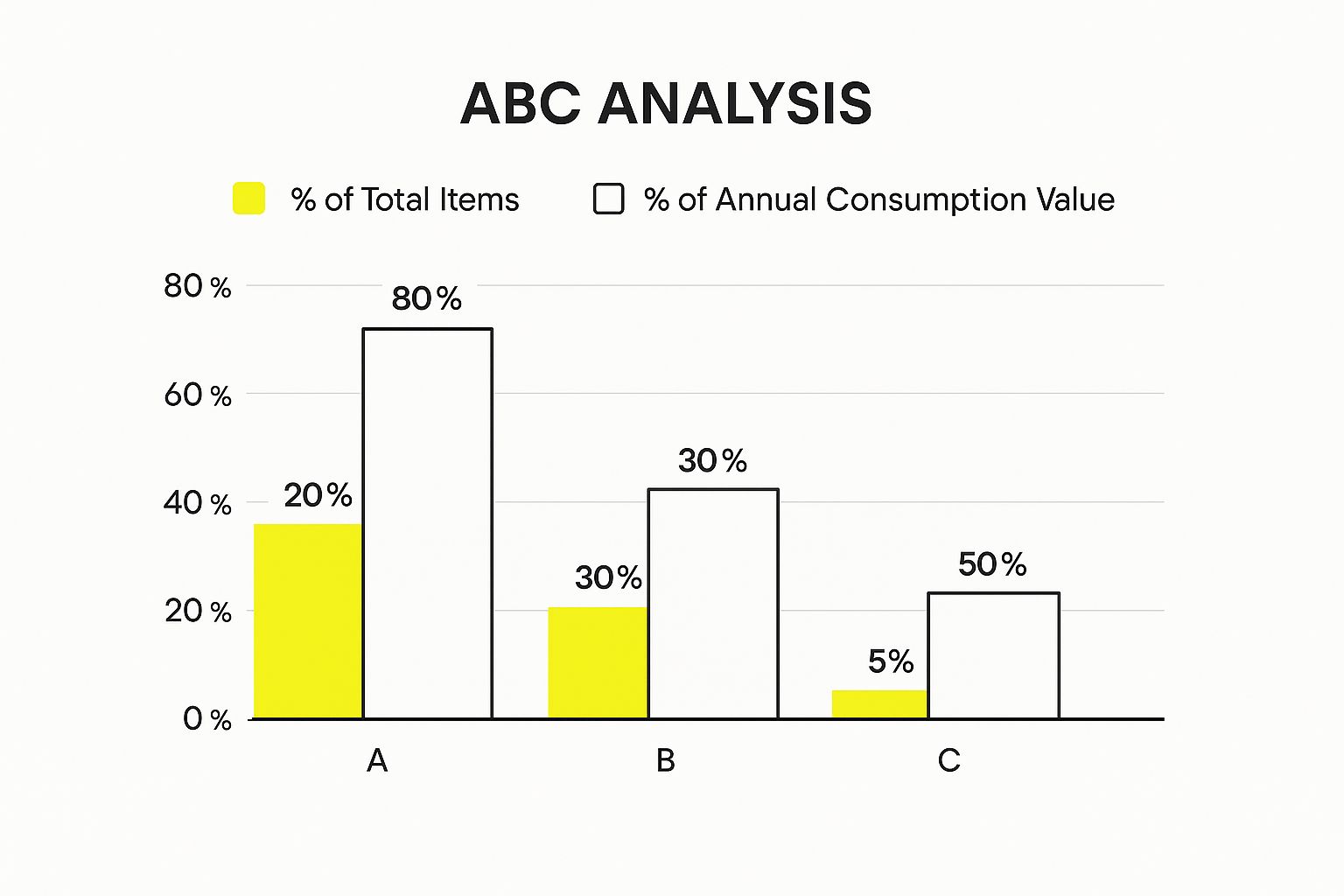
This chart clearly illustrates how Category A items, despite being the smallest group, represent the majority of inventory value, highlighting their critical importance.
When to Use This Strategy
ABC analysis is invaluable for businesses with a diverse range of SKUs where the value or sales velocity varies significantly between products. It's perfect for e-commerce stores that need to optimize stock levels, improve cash flow, and reduce carrying costs. If you find yourself spending equal time managing a fast-selling, high-margin product and a slow-moving, low-margin one, this strategy will bring immediate clarity and efficiency to your operations.
Key Insight: ABC analysis shifts your focus from managing all items equally to managing them strategically. It empowers you to allocate resources proportionally to each item's contribution to your business's success.
Actionable Implementation Tips
Ready to optimize your inventory control? Here’s how to implement ABC analysis for your Shopify store:
- Calculate Annual Consumption Value: For each product, multiply its annual demand (number of units sold per year) by its cost per unit. This gives you the annual consumption value, which is the primary metric for categorization.
- Set Your Category Thresholds: Sort your products from highest to lowest consumption value. Typically, Category A includes the top 10-20% of items that account for 70-80% of value. Category B is the next 20-30% of items making up 15-25% of value, and Category C is the remaining 50-70% of items contributing only 5% of value.
- Apply Differentiated Control Policies: Treat each category differently. For 'A' items, use tight inventory control, frequent reviews, and prioritized security. For 'C' items, you can use simpler controls, order in larger quantities, and maintain higher safety stock levels without significant financial risk.
- Review and Re-categorize Regularly: Customer demand and product costs change over time. Re-evaluate and re-classify your inventory at least quarterly or bi-annually to ensure your classifications remain accurate and your strategy stays effective.
3. Economic Order Quantity (EOQ)
Economic Order Quantity (EOQ) is a classic formula-based inventory management strategy that helps you determine the ideal amount of product to order at one time. Its goal is to find the perfect balance between two competing costs: the cost of ordering inventory (like processing fees and shipping) and the cost of holding inventory (like storage space, insurance, and spoilage). By calculating this "sweet spot," you can minimize your total inventory expenses.
This model, developed by Ford W. Harris in 1913, provides a mathematical answer to the question, "How much should I order?" It prevents you from ordering too frequently, which racks up administrative costs, or ordering too much at once, which inflates your holding costs. EOQ is one of the foundational inventory management strategies for achieving cost efficiency in your supply chain.
When to Use This Strategy
EOQ is most effective for businesses with relatively stable demand and predictable costs for their products. It works well for staple goods that are consistently sold throughout the year. For instance, a retail chain like Target might use it to manage inventory for household essentials, or an office supply company could use it to decide on bulk purchasing for items like copy paper and pens. It's a powerful tool when you need a data-driven baseline for your purchasing decisions.
Key Insight: EOQ provides a scientific starting point, not a rigid rule. The real value comes from using the calculated quantity as a benchmark and then adjusting it based on real-world factors like supplier discounts, seasonality, or marketing promotions.
Actionable Implementation Tips
Looking to optimize your order sizes? Here’s how to apply the EOQ model to your e-commerce operations:
- Calculate Your Core Variables: To use the EOQ formula, you need three key pieces of data: annual demand for a product, the cost per order (ordering cost), and the cost of holding one unit in inventory for a year (carrying cost). Gather this information for your top-selling products first.
- Use an EOQ Calculator: You don't need to do the complex math by hand. Many inventory management software platforms have built-in EOQ calculators. You can also find simple online tools to plug in your variables and get your optimal order quantity.
- Integrate Quantity Discount Analysis: Your suppliers may offer price breaks for larger orders. Compare the savings from a bulk discount against the increased holding costs predicted by the EOQ model to see if placing a larger, non-EOQ order is actually more profitable.
- Set Automated Reorder Points: Use your EOQ result to establish an automatic reorder point in your inventory system. When stock levels drop to a predetermined threshold, your system can automatically trigger a new purchase order for the optimal quantity, ensuring you never run out of stock.
4. Vendor Managed Inventory (VMI)
Vendor Managed Inventory (VMI) is a highly collaborative partnership where you hand over the responsibility of managing your inventory levels to your supplier. Instead of placing purchase orders yourself, your vendor monitors your stock levels, typically through shared real-time data, and automatically replenishes products based on pre-agreed minimums and maximums. This proactive approach ensures you never run out of stock on key items while minimizing your internal management overhead.
The core principle behind VMI is trust and data transparency. By giving suppliers direct insight into your demand data, they can optimize their own production and shipping schedules, leading to a more efficient and responsive supply chain for both parties. This is one of the more advanced inventory management strategies, transforming the traditional buyer-supplier relationship into a symbiotic partnership.
When to Use This Strategy
VMI is an excellent strategy for e-commerce businesses that have established, long-term relationships with key suppliers and sell high-volume, predictable products. It’s particularly powerful for staple or non-perishable goods where consistent availability is critical. Major retailers like Walmart use VMI with partners like Procter & Gamble to ensure shelves are always stocked with essentials, while industrial suppliers use it to manage on-site materials for their clients without interruption.
Key Insight: VMI shifts the focus from transactional ordering to strategic partnership. Its success depends on establishing clear service level agreements (SLAs) and investing in technology that enables seamless data sharing between you and your vendor.
Actionable Implementation Tips
Ready to build a more resilient supply chain? Here’s how to get started with a VMI partnership for your Shopify store:
- Establish Clear Performance Metrics: Before handing over control, define what success looks like. Set clear key performance indicators (KPIs) and SLAs for stock availability, inventory turnover, and fulfillment rates. These metrics will govern the relationship and ensure accountability.
- Invest in Data Sharing Systems: A robust VMI partnership runs on data. Use an inventory or order management software solution that can integrate with your supplier’s systems, providing them with real-time visibility into your sales and stock levels.
- Start with a Pilot Program: Don't transition all your key products at once. Select a trusted supplier and a few non-critical items to test the VMI model. This allows you to work out communication kinks and refine the process in a low-risk environment.
- Maintain Oversight and Audits: Trust your vendor, but verify their performance. Schedule regular audits of physical inventory and review performance against your agreed-upon SLAs. This ensures the partnership remains beneficial and operates as intended.
5. Safety Stock Optimization
Safety Stock Optimization is a strategic approach to inventory management that involves holding a calculated amount of extra inventory to protect against unexpected fluctuations in supply and demand. This buffer stock acts as a crucial insurance policy against stockouts, which can lead to lost sales and customer dissatisfaction. The goal is to find the perfect balance: holding enough safety stock to mitigate risk without tying up excessive capital in warehouse shelves.
This method moves beyond simple guesswork by using data to determine how much "just in case" inventory you truly need. By optimizing your safety stock, you ensure high service levels and protect your business from supply chain disruptions, all while keeping carrying costs under control. It’s one of the most fundamental inventory management strategies for building a resilient e-commerce operation.
When to Use This Strategy
Safety stock is essential for nearly every business that holds inventory, but it is particularly critical for stores selling popular, high-demand products where a stockout would mean significant revenue loss. It’s also vital for businesses that face long or unpredictable supplier lead times or experience volatile demand. For instance, a retailer preparing for a seasonal rush or an electronics store selling a popular gadget would rely heavily on optimized safety stock to navigate uncertainty.
Key Insight: Effective safety stock isn't about over-ordering; it’s a data-driven calculation that balances the cost of holding extra inventory against the cost of a stockout. The optimal level is a moving target that must be regularly reviewed.
Actionable Implementation Tips
Ready to build a buffer against uncertainty? Here’s how to optimize your safety stock for your Shopify store:
- Use a Statistical Formula: Calculate your safety stock using a standard formula, such as: (Maximum Daily Sales x Maximum Lead Time) – (Average Daily Sales x Average Lead Time). This provides a data-backed starting point instead of relying on intuition.
- Segment Your Products: Not all products carry the same risk. Apply different safety stock levels to different product categories based on their sales velocity, value, and supply chain reliability. High-value, fast-moving items (your "A" products) deserve a more robust safety buffer.
- Regularly Review and Adjust: Market conditions, supplier performance, and demand patterns change. Review and recalculate your safety stock levels quarterly or bi-annually to ensure they remain aligned with current business realities. This process is greatly simplified when you have accurate, up-to-date data. For more details, you can learn more about how real-time inventory sync improves Shopify stores.
- Set Service Level Targets: Decide on your desired service level (e.g., you want to be in stock 95% of the time a customer places an order). This target will directly influence how much safety stock you need to carry; a higher service level requires a larger buffer.
6. Consignment Inventory
Consignment inventory is a unique arrangement where a supplier (the consignor) places goods at a retailer's location (the consignee), but retains ownership of the products until they are sold to the end customer. This model effectively transfers the financial risk of holding inventory from the retailer to the supplier. For an e-commerce store, this means you can stock and sell products without paying for them upfront, only paying the supplier after a sale is made.
This approach is one of the most capital-efficient inventory management strategies available, as it frees up cash that would otherwise be tied up in unsold stock. It allows retailers to offer a wider product variety without the associated financial burden, minimizing losses from slow-moving or obsolete items. The supplier benefits from increased market presence and sales channels, creating a mutually beneficial partnership.
When to Use This Strategy
Consignment is an excellent strategy for high-end or specialty goods where the cost of inventory is substantial, such as luxury watches, designer clothing, or expensive art. It's also effective for testing new products or market demand without a large initial investment. For Shopify merchants, it works well when partnering with emerging artists or independent brands who need market access but lack the capital for large production runs. Retail consignment shops, both online and brick-and-mortar, are classic examples of this model in action.
Key Insight: A successful consignment relationship is built on a rock-solid legal agreement. The contract must explicitly detail ownership terms, payment schedules, and procedures for handling returns or damaged goods to prevent future disputes.
Actionable Implementation Tips
Interested in a low-risk way to expand your product catalog? Here’s how to establish a consignment model for your store:
- Draft a Clear Consignment Agreement: Work with a legal professional to create a comprehensive contract. This document should define the consignment period, the revenue split (e.g., 60/40), payment terms after a sale, and who is responsible for shipping costs and insurance.
- Implement Robust Tracking: Use inventory management software that can differentiate between owned stock and consignment stock. Apps like
Stocky(for Shopify Plus) or other inventory solutions can help you tag and track consignment items separately to ensure accurate accounting and timely payments to your suppliers. - Establish Return and Damage Policies: Clearly outline the process for customer returns. Define who bears the cost of a returned or damaged item. For instance, is the item returned to your stock or directly to the supplier? This prevents confusion and protects your business relationship.
- Set Up Regular Reconciliation: Schedule regular audits and reporting with your consignment partners. Provide them with transparent sales reports and process payments promptly as agreed. This builds trust and encourages long-term collaboration.
7. Kanban System
The Kanban system is a visual inventory management strategy that uses cards, bins, or other signals to manage workflow and control the movement of goods. Originating from Toyota's lean manufacturing system, Kanban is a pull-based model where inventory is only replenished when a visual signal indicates a need. This approach prevents overproduction and overstocking by aligning your inventory directly with actual consumption.
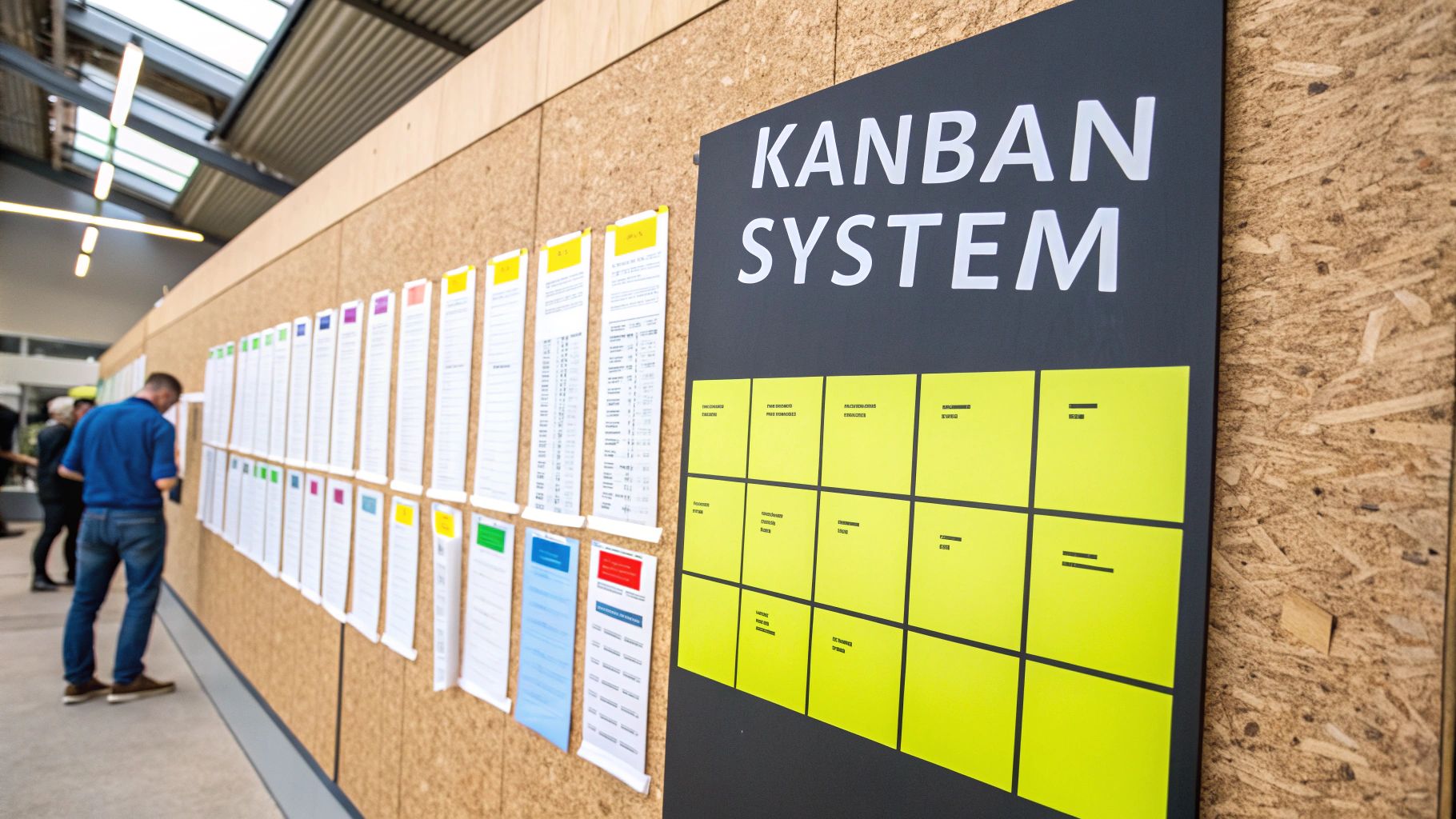
Its core principle is to visualize the workflow, limit work-in-progress (WIP), and maximize efficiency. When a product is sold or a component is used, its corresponding Kanban "card" is moved to signal that a replenishment order should be placed. This creates a self-regulating system that maintains optimal stock levels without complex forecasting.
When to Use This Strategy
Kanban is extremely effective for e-commerce businesses that manage their own assembly or fulfillment processes, particularly those with a stable, repeatable workflow. It's also ideal for managing consumable supplies used in production or packing, like shipping boxes or product components. A real-world example is how supermarkets use Kanban to restock shelves: when an item is taken, the empty space acts as a visual signal for replenishment.
Key Insight: Kanban thrives on simplicity and visibility. Its power lies in making inventory needs immediately obvious to your entire team, reducing the chances of stockouts or human error in the reordering process.
Actionable Implementation Tips
Ready to bring visual order to your inventory? Here’s how you can implement a Kanban system in your Shopify business:
- Create Visual Boards: Start with a physical or digital board to track inventory movement. Use columns like "To Do" (to order), "In Progress" (ordered), and "Done" (in stock). Use cards or sticky notes for each product or component.
- Set WIP Limits: Determine the maximum number of items that should be in any stage of your process at one time. This prevents bottlenecks and overstocking. For example, limit the "In Progress" column to what your suppliers can reliably deliver in a given period.
- Train Your Team: Ensure everyone involved, from warehouse staff to procurement managers, understands how the Kanban signals work. The system's success depends on consistent team-wide participation and adherence to the visual cues.
- Start with a Two-Bin System: A simple way to start is the two-bin method. Use one bin for active stock and a second for reserve. When the first bin is empty, that's the signal to reorder, and you start using stock from the second bin.
8. Demand Forecasting and Planning
Demand Forecasting and Planning is a foundational strategy that uses historical data, market analysis, and predictive analytics to anticipate future customer demand. Rather than reacting to sales as they happen, this approach allows you to proactively stock the right products in the right quantities at the right time. It is the engine that drives nearly all other inventory management strategies, from ordering and production schedules to marketing campaigns.
The goal is to align your inventory with expected sales, minimizing both stockouts and overstock situations. By understanding future demand, you can make smarter purchasing decisions, optimize cash flow, and improve customer satisfaction. This strategy turns inventory management from a guessing game into a data-driven science.
When to Use This Strategy
This strategy is essential for virtually every e-commerce business, but it's especially critical for those with seasonal products, items subject to trends, or long supplier lead times. Grocery chains use it to manage perishable goods, while fashion giants like Zara leverage it to predict the next big trend. Tech companies like Apple also rely heavily on demand planning for major product launches to avoid costly inventory imbalances.
Key Insight: Demand forecasting is not a one-time task; it's a continuous cycle of prediction, measurement, and refinement. The most successful businesses are those that constantly work to improve their forecast accuracy.
Actionable Implementation Tips
Ready to make more accurate inventory decisions? Here’s how to integrate demand forecasting into your Shopify operations:
- Combine Forecasting Methods: Don't rely on a single data point. Blend quantitative methods (like analyzing past sales data from Shopify Analytics) with qualitative insights (like feedback from your sales and marketing teams about upcoming promotions). Understanding the customer journey can also provide valuable qualitative insights into future buying behavior.
- Measure Forecast Accuracy: Regularly compare your forecasts against actual sales. Use metrics like Mean Absolute Deviation (MAD) to track your accuracy and identify areas for improvement. For more guidance, you might find this practical guide on how to improve forecast accuracy to be a helpful resource.
- Involve Key Teams: Create a Sales and Operations Planning (S&OP) process. Hold regular meetings with your marketing, sales, and operations teams to share information and align your inventory plans with business-wide goals.
- Leverage Technology: Use inventory management software with built-in machine learning capabilities. These tools can analyze complex patterns, seasonality, and market trends far more effectively than manual spreadsheets, leading to more reliable forecasts.
9. Cross-Docking
Cross-Docking is a logistics strategy that nearly eliminates the need for traditional warehousing. Instead of storing incoming products, this system involves unloading materials from an inbound truck and immediately loading them onto an outbound truck or vehicle for delivery. This "dock-to-dock" transfer minimizes handling, reduces storage time to mere hours (or even minutes), and accelerates the entire fulfillment process.

The primary goal is to create a seamless, continuous flow of goods from supplier to customer. For high-volume e-commerce merchants, this can drastically cut down on inventory holding costs, labor associated with put-away and picking, and the risk of inventory obsolescence. It's one of the most effective inventory management strategies for businesses focused on speed and efficiency.
When to Use This Strategy
Cross-docking is perfect for retailers that handle large volumes of pre-sold, high-demand products that don't require quality inspections or repackaging. Think of retail giants like Walmart, which use it to distribute products to stores, or transportation hubs like FedEx, which sort and reroute packages. It's also highly effective for distributing perishable goods like fresh produce to grocery stores or supplying automotive parts to dealerships where speed is critical.
Key Insight: Cross-docking transforms your warehouse from a storage unit into a high-speed sorting hub. Its success relies on precise coordination, real-time data, and strong supplier collaboration to ensure goods arrive ready for immediate dispatch.
Actionable Implementation Tips
Looking to speed up your fulfillment cycle? Here’s how to introduce cross-docking into your operations:
- Invest in a Warehouse Management System (WMS): A robust WMS is non-negotiable. You need a system that can provide real-time visibility of inbound shipments and outbound orders to coordinate the seamless transfer of goods.
- Establish Strong Supplier Partnerships: Work closely with suppliers to ensure products arrive pre-sorted, pre-labeled, and ready for immediate shipment. This requires clear communication and alignment on packaging and shipping standards.
- Design Your Facility for Flow: If possible, configure your warehouse layout to facilitate cross-docking. This typically means creating a long, thin building with inbound docks on one side and outbound docks on the other to minimize internal travel distance.
- Start with Predictable Products: Begin by testing cross-docking with your highest-volume, most predictable products. This allows you to perfect the process and work out any logistical kinks before expanding the strategy to more complex inventory.
Inventory Management Strategies Comparison
| Inventory Strategy | Implementation Complexity 🔄 | Resource Requirements ⚡ | Expected Outcomes 📊 | Ideal Use Cases 💡 | Key Advantages ⭐ |
|---|---|---|---|---|---|
| Just-in-Time (JIT) Inventory | High – demands sophisticated planning | High – relies on reliable suppliers | Reduced inventory costs, improved cash flow | Manufacturing with predictable demand and strong supplier networks | Low inventory, better quality focus, cash flow boost |
| ABC Analysis (Pareto) | Low to Medium – simple categorization | Low – mainly data analysis | Efficient resource allocation, prioritized management | Businesses needing inventory prioritization based on consumption value | Clear focus on high-value items, cost-effective |
| Economic Order Quantity (EOQ) | Medium – requires accurate data | Medium – demand, ordering, holding costs | Minimized total inventory costs | Stable demand environments needing cost optimization | Mathematical precision, balances ordering & holding |
| Vendor Managed Inventory (VMI) | Medium to High – collaboration needed | High – data sharing and trust required | Reduced buyer carrying costs, improved availability | Partnerships with strong vendor relationships | Lower inventory burden, enhanced supplier relations |
| Safety Stock Optimization | Medium – statistical calculations | Medium – data and monitoring systems | Improved service levels, stockout risk reduction | Businesses facing demand/supply uncertainties | Better customer service, risk protection |
| Consignment Inventory | Medium – contract and tracking needed | Medium to High – supplier manages stock | Improved cash flow, reduced buyer risk | High-value, low-turnover items, cash-constrained buyers | No upfront inventory cost, risk transfer to supplier |
| Kanban System | Medium – requires cultural change | Low to Medium – visual management tools | Reduced inventory, faster demand response | Production lines, workflow-focused operations | Visual control, work-in-progress limits, flow efficiency |
| Demand Forecasting & Planning | High – complex analytics required | High – data, teams, software | Better inventory optimization, reduced obsolescence | All industries needing proactive inventory and sales planning | Data-driven decisions, improved planning |
| Cross-Docking | High – precise timing and IT systems | High – coordination & infrastructure | Reduced holding costs, faster deliveries | Fast-moving, perishable goods, predictable demand | Rapid throughput, lower storage & handling costs |
Choosing and Implementing Your Optimal Strategy
Navigating the landscape of inventory management strategies can feel overwhelming, but the journey to operational excellence begins with a single, crucial understanding: there is no universal "best" strategy. The most powerful approach is not a rigid, off-the-shelf solution but a dynamic, customized system built specifically for your Shopify store. We've explored a wide range of powerful techniques, from the lean efficiency of Just-in-Time (JIT) to the predictive power of Demand Forecasting. The key now is to move from understanding these concepts to implementing a tailored blend that drives profitability and customer satisfaction.
Your first step is an honest assessment of your current operations. Where are the friction points?
- Are you consistently overstocked on certain products? This ties up valuable capital and increases holding costs. ABC Analysis can help you prioritize your inventory, focusing your attention on the high-value "A" items.
- Do you suffer from frequent stockouts of popular items? This leads to lost sales and frustrated customers. Implementing Safety Stock Optimization for your bestsellers and improving Demand Forecasting can create a crucial buffer.
- Is your warehouse a bottleneck? If order fulfillment is slow and chaotic, a Kanban system can provide visual cues to streamline workflows, while Cross-Docking can get fast-moving products to customers with minimal handling.
Building Your Hybrid Strategy
The true power of modern inventory management lies in combining strategies to cover your unique vulnerabilities and capitalize on your strengths. A successful Shopify merchant might not choose just one method but will instead create a hybrid model.
For example, you could use ABC Analysis as your foundational framework.
- Category A (High-Value Items): These products represent your biggest revenue drivers. For these, you might apply meticulous Demand Forecasting and maintain carefully calculated Safety Stock to prevent any possibility of a stockout.
- Category B (Mid-Value Items): These are important but less critical. You could use the Economic Order Quantity (EOQ) formula to determine the most cost-effective reordering schedule, balancing holding costs and ordering costs.
- Category C (Low-Value Items): For these slow-moving or low-margin products, a Just-in-Time (JIT) approach might be perfect, reducing the capital tied up in stock that doesn’t turn over quickly.
This layered approach allows you to apply the right level of control and investment where it matters most, creating a highly efficient and responsive system.
The Role of Technology and Physical Space
Executing any of these strategies effectively in an e-commerce environment is nearly impossible without the right technology. Your Shopify store is the hub, but it needs to be supported by a robust inventory management system (IMS) or enterprise resource planning (ERP) software. These tools automate tracking, centralize data, and provide the insights needed to make informed decisions for your chosen inventory management strategies.
Furthermore, a sophisticated strategy is only as good as its physical execution. Disorganized stock, inefficient layouts, and poor receiving processes will undermine even the best-laid plans. For effective implementation, consider the physical aspects of your operations, including suitable effective warehouse storage solutions that can maximize space and streamline picking and packing processes.
Ultimately, mastering inventory is a journey of continuous improvement. Start by identifying your single biggest inventory challenge and select one or two strategies from this guide to address it. Measure the impact, gather data, and refine your approach. A proactive, data-driven, and well-organized inventory plan is more than just an operational task; it's a strategic investment in your brand's scalability, profitability, and long-term success.
Ready to transform your inventory management from a challenge into a competitive advantage? The expert developers at E-commerce Dev Group specialize in creating custom Shopify solutions and seamless app integrations to power your growth. Contact E-commerce Dev Group today to build a rock-solid inventory system tailored to your unique business needs.
