


Before you even think about posting a job ad or browsing portfolios, the first—and most important—step is to get brutally honest about what your business actually needs. This isn't about vague wishes; it's about translating your current business frustrations into a clear, actionable project scope.
Nailing this down from the start is the secret to finding the right talent and avoiding those painful, costly miscommunications down the road.
Clarifying Your Project Needs and Goals
So, where do you begin? Not on a freelancer marketplace. The real work starts with a hard look at your store’s specific challenges and goals. Are you bleeding sales because your site is painfully slow? Or maybe you need a custom product builder that your off-the-shelf theme just can't handle.
You need to think in terms of tangible outcomes. For example, a growing fashion brand might need a "Shop the Look" feature to bump up their average order value. A subscription box company, on the other hand, needs an expert who can untangle the complexities of a recurring billing integration. For many, a core goal is to improve your Shopify conversion rate.
This whole process follows a logical flow.
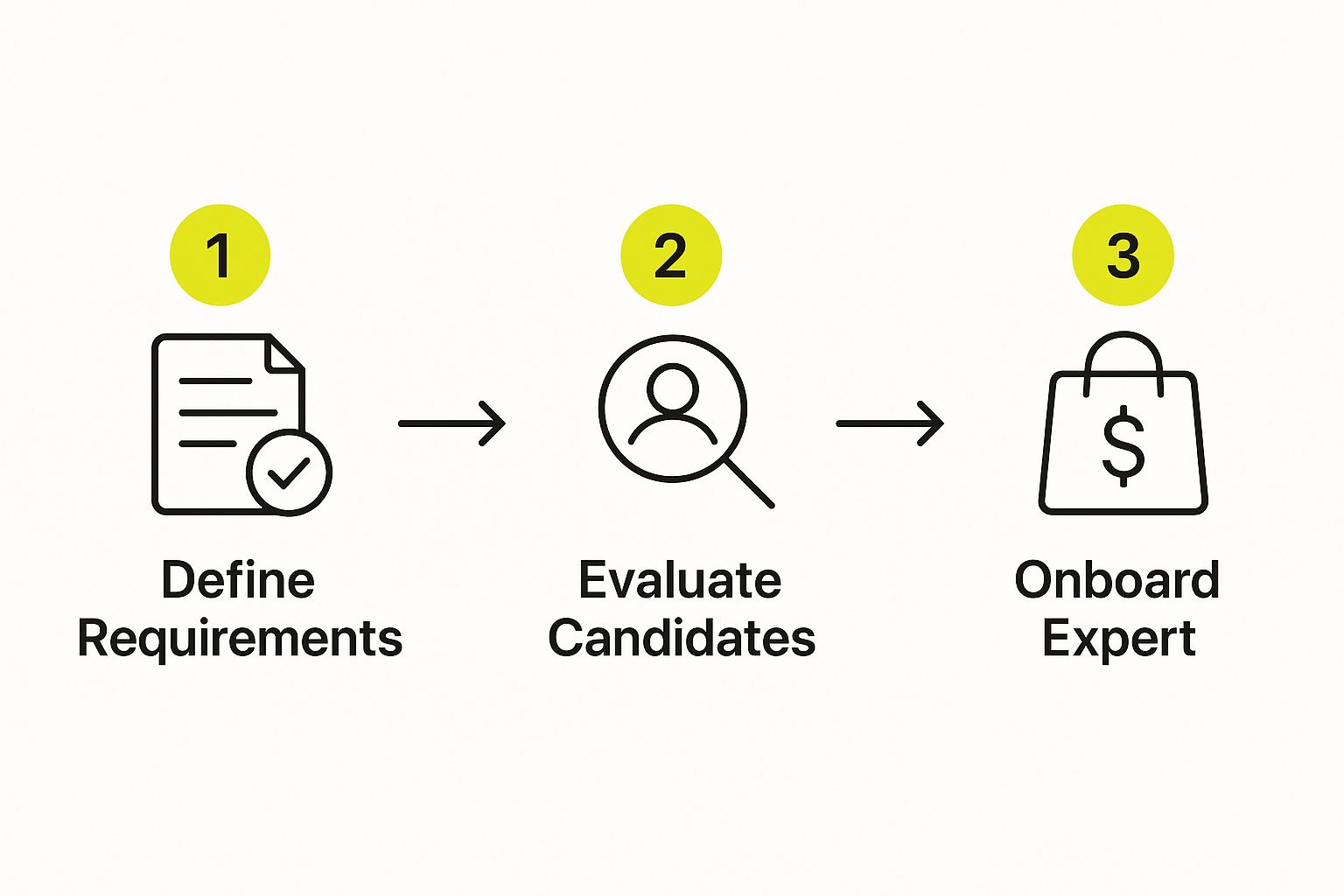
As you can see, a great hire doesn't happen by accident. It starts with you, long before you ever talk to a candidate.
From Vague Ideas to a Solid Brief
A request like "make my site better" is a recipe for disaster. You'll get vague proposals and even vaguer results. To attract real professionals, you need to create a detailed project brief that spells everything out.
- Pain Points: What’s broken? Be specific. Are you dealing with a sky-high cart abandonment rate, a clunky mobile experience, or hours wasted on manual inventory updates?
- Desired Features: Describe exactly what you want to add. If you’ve seen it on another website, grab a screenshot or a link. Examples are golden.
- Success Metrics: How will you know if the project was a success? Define it upfront. Is it a 15% increase in conversions, a 50% drop in page load time, or a seamless site migration with zero downtime?
Getting this clarity is non-negotiable, especially in today's market. With over 5.3 million active Shopify stores out there, the competition for top-tier talent is fierce. A sharp, detailed brief is your best weapon for cutting through the noise.
By defining the finish line before the race starts, you empower potential experts to provide accurate quotes and realistic timelines, setting the foundation for a successful partnership.
This initial phase is a critical part of the entire process. For a closer look at how to structure this kind of work, our guide on https://scaleshopify.com/2025/06/29/ecommerce-project-management/ is a great resource.
Matching Your Business Need to the Right Expert
Not all Shopify experts are created equal. The table below can help you quickly identify the type of professional your project requires based on what you're trying to achieve.
| Your Business Need | Expert Type Required | Common Project Example |
|---|---|---|
| Fixing bugs or making small theme tweaks | Shopify Developer | Updating CSS to change button colors or fixing a broken menu link. |
| Building a new store from scratch | Shopify Designer & Developer | Creating a completely custom theme and site structure for a new brand. |
| Increasing sales and traffic | Marketing & SEO Specialist | Running Google Ads campaigns, optimizing product pages for search. |
| Integrating third-party systems | App & Integration Specialist | Connecting your Shopify store to an external inventory management system. |
| Designing a new brand identity | Brand & UI/UX Designer | Creating a new logo, color palette, and user-friendly site layout. |
Using this as a guide ensures you’re looking for the right skills, which saves everyone time and helps you get a much better project outcome.
Alright, you’ve got your project requirements mapped out. So, where do you actually find the Shopify pros who can make it happen?
Start with the Official Shopify Experts Marketplace
Your first stop should always be the official Shopify Experts Marketplace. Think of it as Shopify’s own little black book. Everyone on this platform has been vetted by Shopify, so you know you're dealing with legitimate, experienced talent.
This is the place to find top-tier agencies and freelancers who live and breathe Shopify. The trade-off? Quality comes at a premium, so expect to see higher price points here. But for mission-critical projects, the peace of mind is often worth it.
You can filter experts by the service you need, their location, and even the languages they speak, making it easy to narrow down the options.

Because it's directly integrated with Shopify, you're guaranteed to find professionals who know the platform inside and out.
Looking Beyond the Marketplace
While the official marketplace is an incredible resource, it’s not the only game in town. Casting a wider net can uncover hidden gems and give you more flexibility on budget.
Here are a few other places I’ve had success finding great talent:
- Top-Tier Freelance Hubs: Platforms like Upwork and Toptal are full of skilled Shopify developers. The secret is to dig deep. Don't just glance at their profile. Scrutinize their job success scores, read every single client review, and look for past projects that mirror what you’re trying to build.
- Niche E-commerce Job Boards: There are job boards dedicated solely to e-commerce. Posting there means you're reaching a self-selected group of specialists who are actively looking for roles in this space.
- Developer Hangouts: Don't underestimate places like GitHub or even specific Shopify-focused groups on LinkedIn. You can often find developers who are genuinely passionate about their work and deeply engaged in the community.
No matter where you look, the single most important factor is your project brief. A clear, detailed brief acts like a magnet for serious professionals and helps weed out those who aren't a good fit.
If you're dealing with a highly complex build or extensive customizations, you'll need someone with a very specific skill set. In that case, it's worth diving deeper into what sets apart the very best top Shopify Plus developers.
Remember, the goal isn't just to find any Shopify expert. It's to find the right one for your team, your project, and your budget. Exploring a few different channels gives you the best shot at making that perfect match.
How to Properly Vet and Interview Candidates
Alright, you’ve posted your project brief and have a shortlist of promising candidates. Now for the hard part. When you’re hiring a Shopify expert, you have to look past the slick portfolios and dig into how they actually solve problems. A gorgeous storefront doesn't mean much if it's built on a wobbly foundation of bad code.
Don’t just glance at their past work; ask them to walk you through a project that was a real beast. What was the specific technical challenge? How did they break it down and tackle it? What was the final outcome for the client? This tells you way more about their thinking process than a simple gallery of finished websites ever could.

This kind of detailed vetting is non-negotiable. Shopify is a massive platform, holding down around 30% of the entire e-commerce market share in the U.S. That means there's a huge pool of developers out there, and their skill levels are all over the map.
Asking the Right Questions
The quality of your hire comes down to the quality of your questions. You need to move beyond generic stuff and throw them some real-world technical and situational curveballs. That's how you uncover genuine expertise.
Here are a few questions I've found to be incredibly revealing:
- For Problem-Solving: "Let's say a client calls in a panic. Their mobile conversion rate just tanked by 50% overnight. Talk me through your exact process for diagnosing and fixing this."
- For Technical Skills: "Tell me about a time you had to integrate a third-party API that didn't have a ready-made Shopify App. What were the steps you took?"
- For SEO Know-How: "A client's organic traffic has been totally flat for six months. What are the first three things you'd dig into on their Shopify store?"
These questions don't have simple yes or no answers. They force a candidate to show their work. To keep everything consistent and fair, it's a great idea to use effective interview evaluation forms.
The goal isn't to trip them up; it's to understand how they think. The best pros are methodical problem-solvers who can explain their strategy clearly before they even touch the code.
And last but not least, always check their references. I can't stress this enough. Talking to two or three of their past clients is the single best way to get honest insight into their reliability, communication, and whether they actually deliver what they promise. If you want to dive deeper into what separates the good from the great, check out our guide on what makes https://scaleshopify.com/2024/11/11/shopify-certified-developers/ truly stand out.
Talking Money: Pricing Models and Contracts
Let's get into the part that often feels a bit tricky: the money and the paperwork. Sorting out pricing and contracts upfront is one of the most important things you can do. It prevents those awkward conversations and surprise bills down the road, making sure you and your Shopify expert are perfectly aligned before a single line of code is written.
You'll generally run into three common ways experts structure their fees. There's no single "best" one; the right choice really boils down to the kind of work you need done.

Picking the Right Payment Structure
-
Hourly Rate: This is your go-to for smaller, less predictable jobs. Think bug fixes, quick theme adjustments, or troubleshooting a mysterious glitch. The big plus is flexibility, but you need to keep a close eye on the timesheet to make sure costs don't spiral.
-
Fixed-Price Project: Have a project with a crystal-clear beginning and end? This is the model for you. It's perfect for things like a full store setup, migrating from another platform, or building a specific feature. You get the peace of mind of knowing the total cost before you start.
-
Monthly Retainer: This one is all about the long game. If you need someone in your corner for ongoing support—like regular site maintenance, SEO improvements, or conversion rate optimization—a retainer makes a ton of sense. It builds a lasting partnership.
No matter which path you take, the contract is your best friend. A handshake and a promise are nice, but they won't protect you. Get everything down in writing. Always.
What Your Contract Absolutely Must Include
A good contract doesn't need to be complicated, but it does need to be clear. It’s the rulebook for your project, laying out the expectations for both sides.
Make sure your agreement spells out these essentials in plain English:
- Scope of Work: What, exactly, is being delivered? Be specific.
- Payment Terms: How and when will payments be made? A common structure is 50% upfront and 50% on completion.
- Timeline and Deadlines: Clear dates for milestones and the final delivery.
- Ownership of Work: A simple clause stating that you own the intellectual property (IP) of the final, delivered work.
Nailing these details from the start is your best defense against scope creep and misunderstandings.
Setting Your Shopify Expert Up for Success
You’ve found the right person and the contract is signed. Now, the real work begins. The first few days of any new partnership are make-or-break, and a solid onboarding process can mean the difference between immediate momentum and weeks of frustrating back-and-forth.
Think of it as getting your house ready for a guest. You wouldn't just point them to a room; you'd show them where everything is. Your first move should be to pull together all the essential assets and information your expert will need to hit the ground running.
Creating a Seamless Handoff
The goal here is to remove as many roadblocks as possible. Start by granting them secure collaborator access to your Shopify admin. This is a non-negotiable first step for security—never, ever share your personal login details.
Once they're in, make sure they have everything else they need to get started:
-
Establish a Communication Cadence: Figure out how you'll talk. Will you use Slack for quick daily questions? A weekly Zoom call for progress updates? Get this on the calendar right away.
-
Share the Backstory: Hand over any project plans, customer personas, or past performance data you have. Giving them this context saves everyone time and helps them understand the why behind the project.
Getting this right is more important than ever. With the global e-commerce market expected to reach $4.80 trillion, every operational detail matters, from offering localized payment methods to fine-tuning the customer journey. If you're expanding internationally, it's worth taking a deeper dive into the tools available—you can discover additional insights about Shopify Markets to get a head start.
A great onboarding experience does more than just kick off a project. It sets a collaborative tone, clarifies expectations, and shows your new expert that you are invested in a successful partnership.
Got Questions About Hiring a Shopify Expert?
Even with the best plan, you're bound to have some questions when it comes to bringing on a Shopify expert. Let's walk through the ones I hear most often from store owners.
Getting these details sorted out early—thinking about cost, team size, and security—is what separates a smooth project from a stressful one.
What’s the Real Cost of a Shopify Expert?
This is the big one, and the honest answer is: it's all over the map. The price tag really depends on who you hire, where they’re located, and how complex your project is.
A junior freelancer might charge around $50 an hour, while a senior consultant or a top-tier agency developer could easily be $200 an hour or more. If you're looking at a full store build from scratch, that could range from a few thousand dollars to $25,000+ for a complex, enterprise-level site with tons of custom features.
Should I Hire a Freelancer or a Shopify Agency?
This really comes down to the size and scope of your project. There's no single right answer, as each serves a different need.
- Freelancers are fantastic for specific, targeted tasks. Need a theme tweaked, an app installed, or a stubborn bug squashed? A freelancer is agile, focused, and usually more budget-friendly for smaller jobs.
- An agency gives you a whole team: developers, designers, project managers, and maybe even marketers. This is the way to go for big, multifaceted projects like a full site migration, a complete rebrand, or if you need ongoing strategy and support.
The trick is to match the resource to the job. You wouldn't hire a whole construction crew to hang a picture, and you wouldn't ask a single handyman to build a skyscraper.
What Are the Biggest Red Flags I Should Look Out For?
Knowing what to avoid is just as important as knowing what to look for. I've learned to be cautious of a few things over the years.
A vague portfolio with no real-world examples or case studies is a major red flag. If they can't show you what they've done, how can you trust what they'll do? Slow or poor communication right from the start is another one. If they're hard to get a hold of now, imagine what it'll be like when they're deep into your project.
Also, if they hesitate to provide client references, you should probably walk away. And finally, be skeptical of anyone who makes guarantees that sound too good to be true, like promising a #1 ranking on Google. No one can guarantee that.
How Can I Give an Expert Access to My Store Securely?
This is a really important security point. Under no circumstances should you ever share your own login details.
Shopify has a feature built specifically for this called "collaborator access." It's the only way you should do it. It lets you give an expert access only to the parts of your store they need, like your theme code or apps, without handing over the keys to the kingdom. They won't see your financial data or have owner-level control. Always, always use collaborator access.
Ready to stop searching and start building a better Shopify store? The team at E-commerce Dev Group has the proven expertise to bring your vision to life with rock-solid development and strategic guidance. Let's discuss your project today.
