

If you want to write product descriptions that actually sell, you have to get inside your customer's head. This isn't about guessing what they want; it's about listening to the exact words they use. Forget the spec sheet for a moment and focus on their real-world problems.
Go Beyond Features and Speak to Your Customer

Generic demographics like "women, ages 25-40" are useless here. You need to dig deeper to find the actual language your audience uses when they're frustrated, searching for a solution, or raving about a product they love.
Find Your Customer’s Voice
So, where do you find this goldmine of customer language? It’s usually hiding in plain sight.
- Comb through customer reviews. Look for patterns in what people complain about or what they absolutely love. Are they constantly mentioning "flimsy material" or "a lifesaver on busy mornings"?
- Dive into your support tickets. These are raw, unfiltered cries for help. You'll find the precise phrasing people use when they're stuck or what they wish your product could do.
- Monitor social media comments and forums. See how people are talking about the problems your product solves. They're not using marketing-speak; they're using real, everyday language.
This research helps you build a buyer persona that feels less like a marketing document and more like a real person you're having a conversation with. You'll start to see themes emerge, too—maybe your customers are driven by a need for convenience, a desire for status, or just a little more peace of mind.
Nail Your Value Proposition
Once you understand the problem, you can position your product as the perfect solution. A strong value proposition isn't about what your product is; it's about what it does for the customer. It shifts the focus from dry features to the tangible outcomes people actually pay for.
Try to distill it down:
- Start with a single sentence that captures the main benefit, using the language you uncovered.
- Follow up with a quick phrase that shows how your product fits into their life.
For instance, instead of saying a posture-correcting chair has "ergonomic lumbar support and adjustable armrests," you might say: "Finally, you can get through your workday without that nagging back pain." See the difference? One is a list of parts; the other is a promise of relief.
“Customers don't buy features. They buy a better version of themselves.”
This isn't a one-and-done task. Your core message will likely need a few tweaks. Test different angles and word choices based on feedback and see what truly connects with people.
Use Their Words, Not Yours
The most powerful thing you can do is mirror your customer's language. If you see dozens of reviews mentioning "effortless setup," you better believe "effortless setup" should be in your product description.
Using their exact terms does two things: it makes your copy feel incredibly authentic, and it naturally improves your SEO because you're using the same keywords they're typing into Google. Just be careful to avoid jargon that might confuse someone new to your brand.
This approach makes your brand feel more human and shows your target audience you're listening.
Here are a few simple ways to put this into practice:
- Kick off your description by calling out a frustration you know they have.
- Address the reader directly with words like “you” and “your.”
- Show a little empathy with phrases like, “We get it, life gets hectic.”
When you ground your copy in your customer's reality, every description feels like it was written just for them. That personal connection is what drives people to click "add to cart."
Key Takeaway: Speaking your customer's language builds trust and rapport far more effectively than a list of features ever could.
Now that you know how to tap into your customer's mindset, you're ready to structure that insight for maximum impact. Getting this foundation right is everything. Focus on them first, and the sales will follow.
How to Structure Your Product Descriptions for Maximum Impact
Let's face it: online shoppers have the attention span of a goldfish. If your product page looks like a novel, they're gone. You've lost the sale before they even knew what you were selling. The secret isn't just what you say, but how you lay it all out to guide people straight to that "Add to Cart" button.
Think of your page structure as a silent salesperson. It doesn't shout, but it expertly points out the most important details, making the decision to buy feel easy and obvious. A great layout respects your customer's time and makes the information they need effortless to find.
It all starts with a simple translation: take your product's raw features, turn them into real-world benefits for your customer, and then present them in a way that makes sense.
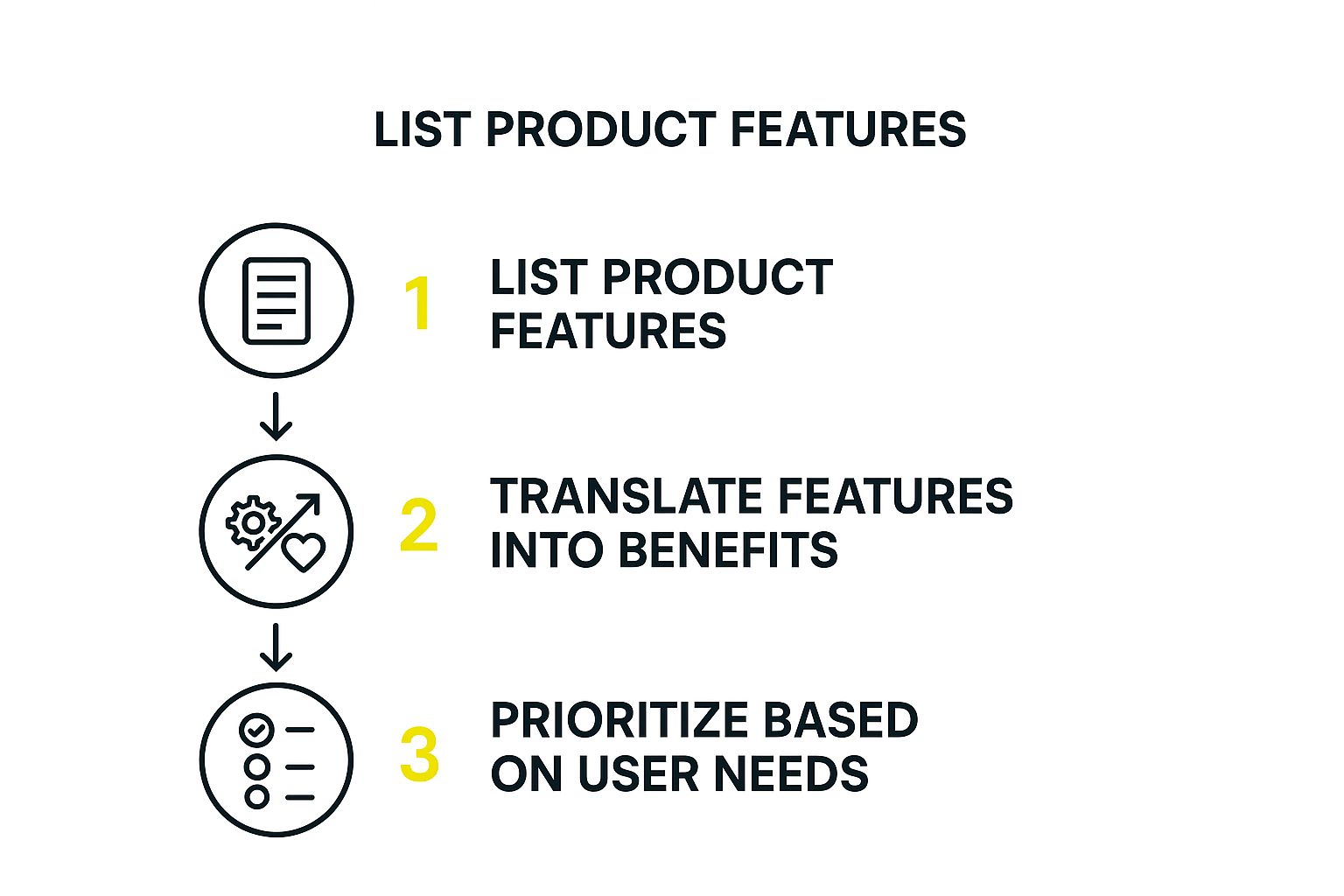
As you can see, the path from a dry spec sheet to compelling copy is about understanding what your audience truly cares about and then organizing your page around those desires.
Nail the Headline First
Your headline has one job: get them to read the next sentence. That's it. It needs to be punchy, clear, and focused on a key benefit. This is not the place to be overly clever or vague.
For example, instead of a boring title like "Premium Leather Wallet," try something that instantly connects with a pain point or a desire, like "The Last Wallet You'll Ever Need to Buy." Right away, you've framed the product as a smart, long-term solution, not just another accessory.
Break It Up with Subheadings and Bullets
Once you've hooked them, use subheadings to carve your description into logical, bite-sized sections. These act like signposts, helping shoppers jump directly to the information that matters most to them.
Underneath those subheadings, make bullet points your best friend. They are designed for speed and clarity. In fact, research from the CXL Institute shows that people read bulleted text for longer than they read paragraphs, especially when it comes to tech products where scannable specs are a must.
Pro Tip: Don't just list features in your bullet points. Frame each one as a benefit. Instead of "• 5000mAh battery," try writing "• All-Day Power: Go from your morning meeting to a late dinner without ever hunting for an outlet." See the difference?
Match the Format to the Product
The best layout isn't a one-size-fits-all template. A complex piece of tech and a handmade scarf appeal to customers in very different ways, and your formatting should reflect that.
Choosing the right format helps communicate your product's value more effectively. Here's a quick comparison to guide you.
Product Description Format Comparison
| Format Type | Best For | Key Advantage |
|---|---|---|
| Bulleted List | Tech, tools, anything with lots of features | Perfect for quick scanning of specs and benefits. Gets right to the point. |
| Short Paragraph | Apparel, home decor, artisanal goods | Creates an emotional connection and tells a mini-story about the product. |
| Table | Comparison items, supplements, parts | Presents data clearly for easy side-by-side evaluation and decision-making. |
So, a drone description will work best with a minimalist, bullet-heavy layout highlighting flight time, camera resolution, and range. On the other hand, a hand-poured candle needs a short, evocative paragraph that describes the scent and sets a cozy mood.
By tailoring the structure to the product, you ensure your page is persuasive, not overwhelming, for every type of shopper.
Write Copy That Actually Connects With People

The technical specs tell a shopper what your product is, but a great story is what convinces them to click "buy." Good copy goes way beyond a list of features; it builds a real connection and shows someone why your product is the one they absolutely need.
This connection starts with a consistent brand voice. Are you the witty, clever friend? The trusted, seasoned expert? Or the inspiring, aspirational mentor? Nailing this down makes every word feel authentic and helps build a brand people remember. If you're looking to build out your brand's presence, our guide on https://scaleshopify.com/2024/12/06/shopify-seo-best-practices/ has some great insights that go hand-in-hand with good copywriting.
Turn Dry Features Into Desirable Benefits
One of the most common mistakes I see is product descriptions that just list features. Here’s the thing: nobody buys a drill because they want a drill. They buy it because they want a hole. Your job is to connect that feature (the drill bit) to the benefit (the perfectly hung family portrait).
Let’s take a simple portable power bank as an example.
- Before (Feature-focused): "This power bank has a 10,000mAh lithium-polymer battery and dual USB-A outputs."
- After (Benefit-focused): "Never get that dreaded low-battery warning again. With enough juice to charge your phone three full times, you can navigate a new city, capture every memory, and stay connected on any adventure."
See the difference? The second version tells a little story. It taps into a real-world anxiety (a dead phone) and paints a picture of freedom and reliability. That’s how you sell.
A great product description doesn't just describe the item; it describes the experience the customer will have with it. It puts them right in the middle of the story.
Use Sensory Language to Spark Their Imagination
Words can paint a powerful picture. When you use sensory language, you help customers imagine what it’s like to hold, use, or experience your product. This is crucial for online shopping, where they can't physically touch the item.
Instead of just saying a blanket is "soft," describe it as "buttery-soft" or "like wrapping yourself in a cloud." A coffee isn’t just "strong"; it has a "rich, smoky aroma with hints of dark chocolate." These words trigger the senses and make the product feel tangible and much more desirable.
- For a leather journal: Talk about the "supple feel of the full-grain leather" and the "crisp sound of turning each page."
- For a scented candle: Describe how the "warm, spicy notes of cinnamon and clove fill the room, creating a cozy sanctuary."
This approach turns a passive browser into someone who is actively imagining your product in their life. Writing copy like this has become big business—the global market for content writing services is expected to reach USD 35.63 billion by 2032. It just goes to show how critical this skill is in e-commerce.
For a little creative fuel, check out these viral ad copy examples to see how others pull it off.
Integrate SEO Without Sounding Like a Robot
You could write the most compelling product description in the world, but if no one can find it, it might as well be invisible. This is where SEO comes into play. The good news? You don't have to sacrifice your brand's personality to please the search engine gods. The real trick is weaving in your keywords so smoothly that customers never even notice they're there.
It all starts with thinking like your customer. What words and phrases are they actually typing into Google when they’re looking for something you sell? Figuring that out is the foundation for writing product descriptions that not only convert but also rank.
Finding Your Keywords
Before you can place keywords, you have to find them. And no, you don't need to spend a fortune on fancy tools right out of the gate.
- Google Autocomplete: Just start typing your product category into Google’s search bar. Pay close attention to the suggestions that appear—those are real searches from real people.
- "People Also Ask" Box: This section on the search results page is an absolute goldmine. It's packed with long-tail keywords, which are longer, more specific phrases that signal a customer is closer to buying.
- Your Competitors' Pages: Take a look at the product pages of your biggest competitors. What terms are they using in their main headlines and subheadings? It's a great way to get a feel for the landscape.
Your goal here is to identify one primary keyword for each product page, along with two or three secondary, related phrases. For instance, if your primary keyword is "waterproof hiking boots," a secondary one might be "lightweight trail boots for men."
Strategic Keyword Placement
Once you have your list, it's time to place them where they’ll make the biggest impact—without sounding clunky or forced.
Sprinkle your keywords naturally into these high-visibility spots:
- Page Title (Meta Title): This is the main blue link people see in search results. Your primary keyword should absolutely be here.
- Product Headline (H1 Tag): The big, bold headline on the product page itself.
- Body Copy: Aim to include your primary keyword and a secondary one within the main description, but only where it makes sense.
- Image Alt Text: This text helps visually impaired users and search engines understand your images. If a keyword fits the description of the photo naturally, include it.
The golden rule of SEO has always been to write for humans first, search engines second. If a sentence feels awkward because you crammed a keyword in, rewrite it. Authenticity always wins.
To get the full picture, it's always smart to stay current on the latest search engine optimization best practices.
Also, a quick but critical warning: never, ever just copy and paste the manufacturer's description. This creates duplicate content, which search engines hate. You must write unique descriptions for every single product. For a deeper look into this, check out our complete guide on https://scaleshopify.com/2025/05/09/seo-for-product-descriptions/. It’s a non-negotiable for good search performance.
Test and Refine Your Copy for Better Conversions
Here’s a hard truth: your product descriptions are never truly “done.” The best ones are living documents, constantly evolving based on what real customers do on your site. This ongoing cycle of testing and refining is what separates good copy from great copy—the kind that turns casual browsers into loyal customers.
Think of yourself as a scientist. Your lab is your product page, and your goal is to find out what really makes your audience tick. The best way to do this? A/B testing. You simply create two different versions of a description, show them to different groups of people, and let the numbers tell you which one works better.
What to Test on Your Product Pages
You don't need to overhaul the entire page to see a difference. I've seen tiny tweaks lead to surprisingly big bumps in sales.
The trick is to test one thing at a time so you know exactly what caused the change. Here are a few ideas to get you started:
- Headlines: Try a benefit-focused headline versus one that’s more creative or curiosity-driven.
- Calls-to-Action (CTAs): Does "Buy Now" outperform "Add to Cart"? You won't know until you test.
- Formatting: Maybe your customers prefer scannable bullet points over a descriptive paragraph. Or maybe not. Let the data decide.
- Tone of Voice: See how a fun, casual tone stacks up against a more direct, professional one.
You don't need to be a developer to do this. Most e-commerce platforms have built-in tools or apps that make running these tests pretty straightforward. The whole point is to stop guessing and start making data-driven decisions. This process is a fundamental part of any solid https://scaleshopify.com/2025/06/22/shopify-conversion-rate-optimization/ strategy.
Your first draft is never your final draft. The market gives you feedback with every click and every purchase—or lack thereof. Listen to it.
Use Customer Feedback as a Content Goldmine
Beyond running formal tests, your customers are handing you conversion gold every single day. Their reviews, questions, and support emails offer a direct look into their heads, showing you exactly what’s clear, what’s confusing, and what gets them excited.
Go mine your reviews and FAQs. Are multiple people asking about the same feature or how to use the product? That's your cue to make that information clearer and more visible in the description. Do customers keep mentioning a benefit you hadn't even thought of? That’s a powerful new angle to weave into your copy.
Once you have a new draft, running it through a professional editing framework helps polish your message for maximum impact. This is more important than ever. The demand for great copy is exploding, with the content writing market expected to nearly double to USD 38.6 billion by 2033 because businesses know it directly drives sales.
When you pair disciplined A/B testing with the real-world insights you get from customers, you create a powerful feedback loop. Your product pages stop being static sales pitches and become dynamic assets that grow and improve right alongside your audience.
Common Product Description Questions
Even with the best strategy, you're bound to hit a few snags when you're deep in the writing process. Let's tackle some of the most common questions that come up when you’re figuring out how to write product descriptions that actually work.
How Long Should a Product Description Be?
Honestly, there's no single right answer. A simple white t-shirt probably only needs 50-100 words. The real story is told through high-quality photos and a quick list of materials. The visuals do most of the heavy lifting.
But what about something complex, like a professional-grade camera? For that, you might need 300+ words. A serious photographer is going to have a ton of questions about sensor size, lens compatibility, and video formats before they even think about clicking "add to cart."
The goal isn't to hit an arbitrary word count. It's to give the customer every last piece of information they need to feel 100% confident in their decision. Always choose clarity over brevity.
Can I Use AI to Write Product Descriptions?
You bet. AI writing tools can be a lifesaver for getting past writer's block or quickly spinning up a few different versions of copy to test. Think of it as a very capable assistant, not a replacement for your own expertise.
The key is to never, ever just copy and paste what an AI gives you. You have to put your own spin on it. Always review and edit the output to:
- Inject your brand's unique voice. This is what makes you different.
- Fact-check everything. AI can and does make up technical specs.
- Weave in the human element. Add the stories and emotional hooks that build a genuine connection.
That final human touch is what turns a bland, generic description into one that feels authentic and builds real trust with your customers.
What Are the Biggest Mistakes to Avoid?
I see the same handful of conversion-killing mistakes on e-commerce sites all the time. Just by sidestepping these common blunders, you’ll be way ahead of most of your competitors.
Here are the big ones to watch out for:
- Just Listing Features, Not Benefits: Nobody buys a "lithium-ion battery." They buy the freedom to use their device all day without scrambling for a charger. You have to translate every feature into an answer for the customer's question: "What's in it for me?"
- Using Vague, Boring Language: Phrases like "excellent quality" are just noise. They don’t mean anything. Instead, use sensory words and paint a picture that helps the shopper imagine holding and using your product.
- Copying the Manufacturer's Description: This is an absolute killer for SEO. It flags your page as duplicate content, which can bury you in search results. Always write your own.
- Forgetting About Keywords: If you're not using the same words your customers are typing into Google, they'll simply never find your product. It’s as simple as that.
- Building a "Wall of Text": Huge blocks of text are a nightmare to read on a screen. Break things up. Use headlines, short paragraphs, and bullet points to make your descriptions easy to scan and digest.
Fixing these basic mistakes is one of the fastest ways to give your product pages an immediate lift.
Ready to build a Shopify store with product pages that not only look great but also drive sales? The team at E-commerce Dev Group specializes in creating high-converting e-commerce experiences. Learn more about building a high-converting store.
