


Why Shopify International Shipping Changes Everything
Here's the thing: most merchants think Shopify international shipping is just about sending products overseas. It's so much bigger than that. It's like unlocking a secret level in your business, transforming a local shop into a global powerhouse. I've chatted with tons of successful international merchants, and they all say the same thing: Shopify's international features were key to reaching markets they never thought possible.
Why are so many businesses ditching complicated logistics providers for Shopify? Because Shopify gives you a simple, all-in-one approach to global commerce. I've personally seen merchants go from selling only locally to making six figures internationally, all thanks to Shopify. It's truly inspiring, and honestly, most businesses can do it.
One of the biggest myths is that international shipping is a huge headache. It used to be! But modern tools, especially within Shopify, have blown those barriers away. Those old roadblocks that kept small businesses stuck in local markets? Gone. This means even tiny startups can compete on a global scale.
Shopify’s international shipping isn't just about discounted rates. It's a powerful platform that makes cross-border sales smooth and easy. You can create shipping zones and pick carriers that fit your needs. This flexibility lets you customize your shipping strategy for different regions, making sure delivery is efficient and your customers are happy.
And with the global ecommerce market expected to hit $4.8 trillion in 2025, Shopify’s role in making international sales happen is huge. The platform’s tools help you handle complex logistics, making it easier to tap into the growing demand for international ecommerce. Want to learn more? Check out this helpful resource on Shopify international shipping. Discover more insights. Also, for Shopify merchants going global, consider how QR codes can help different parts of your business. eCommerce businesses. This kind of advantage is within reach, and the next sections will show you how to grab it.
Unlocking Hidden Savings Through Smart Carrier Selection
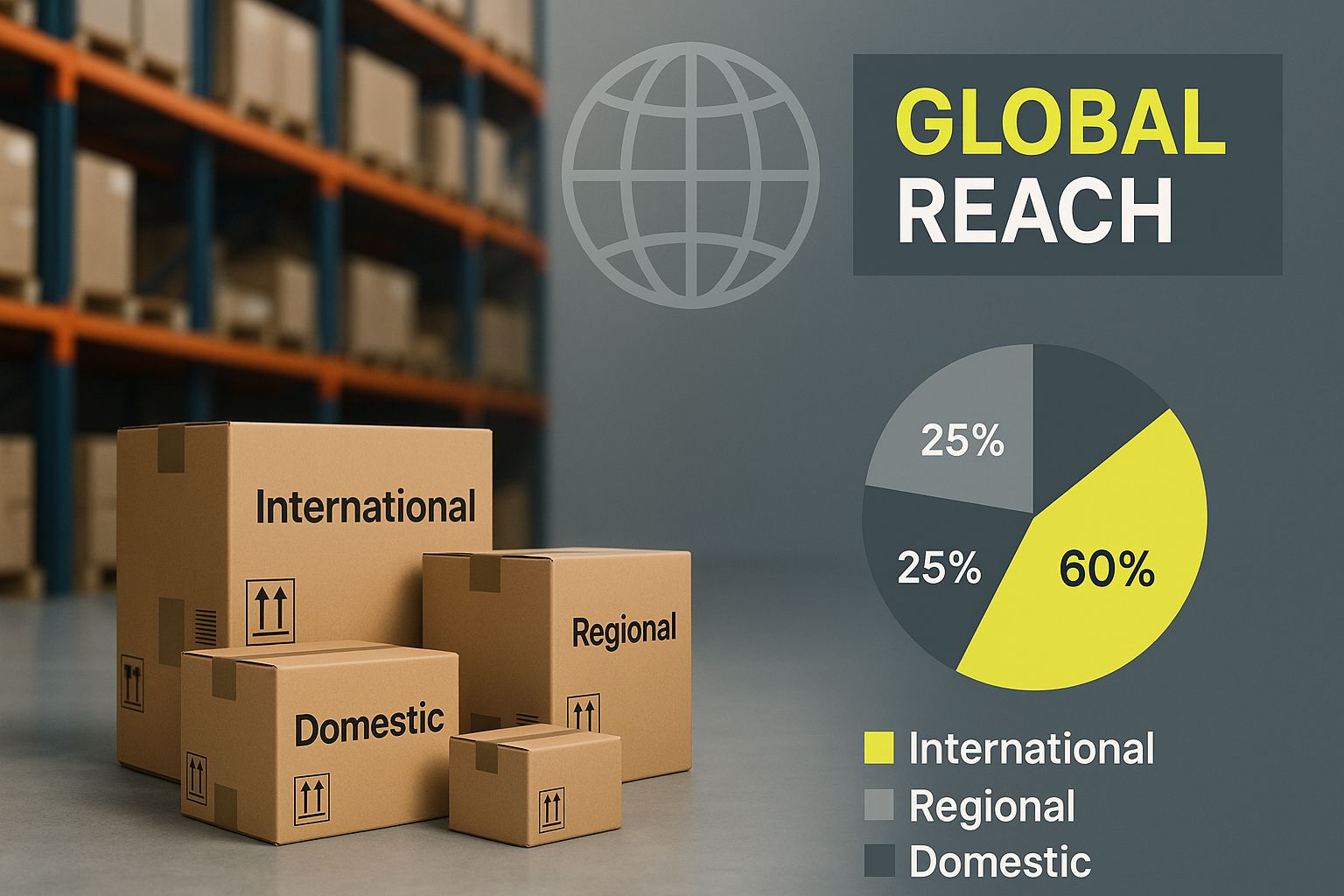
That infographic gives you a visual of the power of global reach—products ready to ship worldwide. It's all about making the right choices to get your goods to your international customers efficiently and affordably.
This is the core of successful Shopify international shipping, but it's also where many merchants leave money on the table. Shopify has negotiated some great discounts with major carriers like DHL Express and UPS, but knowing which carrier is best for your situation is key.
I learned this lesson firsthand working with a client selling fragile ceramics. They went with the cheapest carrier, thinking they were saving money. The problem? The increased rate of damaged and lost packages wiped out those initial savings. Lesson learned: cheapest isn't always best.
Choosing the Right Carrier for International Shipping
Going global with your business presents unique shipping challenges. For a comprehensive look at international shipping with Shopify, check out this helpful resource: Shopify International Shipping. Price is important, sure, but it’s not everything. Think about delivery reliability and the quality of tracking.
Reliable deliveries and detailed tracking build customer confidence, and that translates to more sales. Nobody wants to be left wondering where their order is!
Shopify has made it easier than ever to expand internationally, offering discounted rates of up to 88% with major carriers like USPS, UPS, DHL Express, Canada Post, and Sendle (as of 2025, for businesses in the US, Canada, and Australia). You can find out more about these discounts here: Learn more about discounted shipping rates. This is a big deal for your bottom line!
Don’t just stick with the familiar names. Explore other carriers too. You might find a lesser-known carrier that’s a perfect match for your specific products and niche.
Optimizing Your Shipping Strategy
Savvy online sellers constantly analyze carrier performance metrics like on-time delivery rates and customer satisfaction scores. They’re always tweaking and optimizing. This isn’t a “set it and forget it” kind of thing.
As your shipping volume grows, you’ll even be able to negotiate better rates directly with carriers. This gives you a real competitive edge and helps boost your profits.
To help you compare some popular carriers, I’ve put together this table:
Shopify Carrier Discount Comparison
Comparison of discount rates and coverage areas for major international shipping carriers available through Shopify
| Carrier | Maximum Discount | Coverage Areas | Best For |
|---|---|---|---|
| USPS | Varies | Domestic & International | Smaller businesses, lightweight packages |
| UPS | Up to 88% | Extensive International Coverage | Larger businesses, heavier packages, express shipping |
| DHL Express | Up to 88% | Extensive International Coverage | International shipping, express delivery, time-sensitive shipments |
| Canada Post | Varies | Domestic & International | Canadian businesses, shipping within Canada and internationally |
| Sendle | Varies | Domestic & International | Small to medium businesses, affordable rates |
This table gives you a quick overview of some key carriers. Remember that discounts and coverage can vary, so it’s always best to check directly with the carrier and Shopify for the most up-to-date information. Choosing the right carrier can significantly impact your shipping costs and customer satisfaction.
Building Shipping Zones That Actually Make Sense
Most merchants treat Shopify international shipping zones like a paint-by-numbers project. But the sellers who really nail international shipping? They think strategically. They're not just looking at a map; they're considering customer behavior, shipping costs, and the specific challenges and opportunities of each market.
I once worked with a jewelry brand shipping to all of Europe as one massive zone. Their shipping costs were through the roof, and conversions were dismal. We revamped their zones, splitting Europe into three tiers based on shipping costs and customer demand. The result? European conversions jumped 34%. They offered better rates to their most valuable customers and stayed profitable.
Strategic Zone Examples
Here’s another real-world scenario: A tech accessories store treated Australia and New Zealand the same, even though shipping to New Zealand was way more expensive. Just by separating them into different zones, they could offer competitive New Zealand rates without sacrificing their Australian profits. This seemingly small tweak made a big difference to sales in both countries.
Think about how your zones appear to customers. Nobody wants a dropdown menu with 200 countries. Group similar countries into logical regions. This makes checkout smoother and less daunting for international shoppers.
Handling Shipping Zone Edge Cases
What about those tricky situations, like remote islands or territories? Don’t let them throw a wrench in your plans. Think about a separate "remote areas" zone with adjusted pricing. You can even use a third-party app to automate these calculations. This keeps unexpected costs from impacting your profit margins and gives customers in those areas transparent pricing.
Here are some practical tips to fine-tune your Shopify shipping zones:
- Analyze your sales data: Where are your international customers located? Which countries bring in the most revenue?
- Research shipping costs: Use Shopify’s built-in tools and carrier calculators to compare rates for different regions.
- Consider market dynamics: Are there any cultural factors that impact shipping expectations in certain countries?
- Test and iterate: Don’t be afraid to try different zone configurations. Monitor your results and tweak your strategy as needed.
By being strategic with your Shopify international shipping zones, you can create a better customer experience, boost conversions, and maximize your profits. It’s all about working smarter, not harder.
Pricing Strategies That Convert Without Killing Margins

Setting international shipping rates can feel like walking a tightrope. You want to attract international customers with enticing prices, but you also need to protect your profit margins. It's a tricky balancing act, but getting it right can significantly boost your global sales.
I once worked with a home goods retailer who saw their average international order value increase by a whopping 45% simply by tweaking how they presented shipping. They incorporated shipping into the product price for specific items, making it seem like customers were getting a sweeter deal. This subtle psychological nudge, known as price anchoring, can have a surprising impact on buyer behavior.
Dynamic Pricing and Free Shipping Thresholds
Dynamic pricing tools, like offering free shipping thresholds, can also be incredibly effective. For example, setting a free shipping threshold at $150 encourages customers to add extra items to their cart to qualify. This bumps up your average order value, creating a win-win for you and your customer.
But here's the catch: dimensional weight. Those unexpected charges can seriously dent your margins, especially when shipping larger products. This is where real-time carrier calculations within Shopify become essential. Accurate shipping costs displayed at checkout prevent sticker shock for both you and your customer. Speaking of which, unexpected shipping costs are a major contributor to cart abandonment. You might find this article insightful: 10 Reasons for Cart Abandonment on Shopify.
Calculating Rates for International Shipping
When figuring out your international shipping rates, remember to account for the often-overlooked costs like returns, customer service, and currency fluctuations. These hidden expenses can quietly erode your profits if you’re not careful.
A straightforward formula is to add your carrier rate to your handling fees, then include a percentage for returns and customer service. Here’s a simple example: Carrier Rate + Handling Fee + (10% of total cost for returns/customer service) = Total Shipping Cost. You can adjust that percentage based on your own historical data and the types of products you sell.
When it comes to carriers, it's interesting to see how much the Shopify ecosystem relies on major logistics companies. As of January 2025, USPS dominated, serving almost 264,000 Shopify stores globally. UPS and FedEx trailed behind with about 201,464 and 152,146 stores, respectively. You can find more detailed statistics here: Discover more insights. This heavy reliance on US-based carriers highlights the significance of the American market in worldwide Shopify shipping.
Different product categories and market maturity levels call for different rate strategies. A luxury brand might choose to absorb shipping costs to maintain a premium image, while a new business entering a competitive market might offer lower rates to gain traction. The key is to find the sweet spot that aligns with your specific business goals.
To help you visualize different approaches, I've put together a handy framework:
International Shipping Rate Strategy Matrix
Framework for setting competitive shipping rates across different markets and product categories
| Market Type | Rate Strategy | Customer Expectation | Profit Impact |
|---|---|---|---|
| Emerging Market | Competitive/Low Rates | Value for Money | Lower Initial Margins |
| Mature Market | Standard Rates/Free Shipping Thresholds | Convenience | Moderate Margins |
| Luxury Market | Absorbed Shipping/Premium Shipping Options | Exclusivity | Higher Margins (Potentially Offset by Absorbed Costs) |
This matrix illustrates how different strategies can align with customer expectations and influence your profit margins. While emerging markets might prioritize low rates, luxury markets are more receptive to premium shipping options or even absorbed shipping costs. Consider where your target market falls on this spectrum when crafting your international shipping strategy.
Mastering Duties And Taxes Without The Headaches
Let's be honest, duties and taxes can be a real pain when it comes to international shipping on Shopify. It can feel overwhelming, like you need to be a global trade expert. But trust me, it doesn't have to be that complicated. I've worked with plenty of successful international sellers, and their secret isn't a fancy degree – it's just being smart about it.
I remember one fashion retailer who actually boosted customer trust by being completely transparent about duties. They simply added a clear explanation at checkout, showing exactly how the costs were calculated. This straightforward approach removed the fear of hidden fees and actually improved their international conversions. Who knew honesty could be so profitable?
DDP vs. DDU: Which Approach Is Right for You?
One of the biggest decisions you'll face is choosing between DDP (Delivered Duty Paid) and DDU (Delivered Duty Unpaid). With DDP, you collect the duties and taxes upfront at checkout, making the experience seamless for your customers. They get their package, no surprises. With DDU, however, the customer pays these costs upon delivery, which can lead to unexpected charges and potential delays. No one likes those "surprise fees" waiting for them. Understanding your costs, like those associated with SMS Marketing Pricing, is vital when figuring out pricing strategies that convert.
In my experience, DDP tends to work best for higher-value items or in markets where customers are particularly sensitive to extra charges. DDU can be a good fit for lower-value products where the duty amounts are relatively small. It really depends on your specific products and target markets.
Utilizing Shopify’s Tools and Third-Party Solutions
Luckily, Shopify offers built-in tools like the duties calculator to help you estimate these costs. You can even choose to incorporate duties into your product prices or display them separately at checkout. For some businesses, especially those with more complex customs requirements, third-party duty solutions might offer more advanced features. Thinking about data localization? Check out these Shopify solutions for data localization compliance.
Communicating Duties and Taxes Effectively
How you present these additional costs is absolutely key. Something as simple as this on your checkout page can work wonders: "Import duties and taxes will be calculated at checkout. This ensures a smooth delivery with no surprise fees upon arrival." Clear, concise, and reassuring.
I've even seen some businesses absorb some of the duty costs as a marketing tactic, especially when entering a new market. It can be a really powerful incentive. By understanding the specifics of each market and being upfront about the costs, you can transform duties and taxes from a major headache into a real competitive advantage.
Creating International Experiences That Build Trust

Shipping internationally with Shopify isn't just about moving a box across borders; it's about cultivating trust with customers who speak different languages, live in different cultures, and operate in different time zones. It's about making the whole experience feel personal and local, even if your warehouse is an ocean away.
I was talking with the founder of a skincare company recently—she ships to 15 countries!—and she shared a simple but powerful secret: personalized shipping communication. She translates her shipping confirmation emails, and even includes a little welcome message specific to each region. That small touch goes a long way in building customer loyalty and creating a truly global brand feel.
Proactive Tracking and Communication
Another game-changer? Proactive tracking updates. Let's be honest, delays happen, especially with international shipping. But instead of letting those delays stress out your customers, use them to build confidence.
For example, if a package gets held up in customs, send a quick email explaining the situation and giving a new delivery estimate. That kind of proactive communication shows you're on it, and that you care. It can actually turn a potential negative into a positive, demonstrating your commitment to customer service.
Cross-Cultural Communication Strategies
Don't underestimate the power of cultural nuances. In some cultures, it's actually considered rude to address a customer by their first name right off the bat. In others, formal language is the norm in all business communication. Do your homework on cultural norms, and adjust your communication style accordingly. It makes all the difference.
Setting Realistic Delivery Expectations
One of the biggest pitfalls I see is overpromising on delivery times. It's tempting to advertise blazing-fast shipping, but unrealistic expectations just lead to disappointment. Be honest and upfront about delivery times, and build in some buffer for potential hiccups. Under-promising and over-delivering is always a winning strategy.
Handling International Returns and Exchanges
Returns are just part of e-commerce, and international orders are no different. A clear, straightforward return policy is absolutely essential. Even consider offering prepaid return labels for international customers. Yes, it might cost you a bit more upfront, but it dramatically improves the customer experience and simplifies those tricky cross-border returns.
By focusing on these key areas, you can transform your Shopify international shipping from a cost of doing business to a real driver of customer loyalty and global growth. It’s not just about logistics, it’s about crafting a truly international experience that resonates with customers everywhere. It’s about turning a transaction into the start of a relationship.
Tracking Success And Scaling Your Global Operations
Your international shipping strategy isn’t a “set it and forget it” kind of deal. It needs to be a living, breathing thing that adapts and evolves as your business does. This means going beyond simply keeping an eye on delivery times and basic costs. You need to think bigger, more strategically. How can you spot those areas ripe for improvement before they turn into major headaches?
I’ve worked with merchants scaling from tiny startups to massive enterprises, and the successful ones bake this proactive approach right into their Shopify international shipping strategy. They’re constantly analyzing, tweaking, and optimizing. It’s a continuous process.
Key Metrics for Monitoring International Shipping Success
So, how do you actually do this? Here’s a practical framework you can steal:
-
Quarterly Shipping Audits: Set a reminder in your calendar to review your shipping costs, delivery times, and – this is crucial – customer feedback every three months. What trends are emerging? Any recurring issues popping up? Maybe your shipping costs to Australia have suddenly gone through the roof. Or perhaps you’re noticing a bunch of negative reviews about slow delivery to France. These are the red flags you need to pay attention to.
-
Carrier Performance Reviews: Your chosen carriers might be consistently delivering, but don't just assume they are. Actually track their performance metrics. Things like on-time delivery rates, lost package rates, and customer satisfaction scores. This will help you spot any dips in service quality so you can address them quickly… or even switch carriers if necessary.
-
Rate Optimization Testing: This is where the fun begins! Continuously test different rate structures and shipping options. Maybe offering free shipping over $100 drastically increases your average order value. Or perhaps a tiered shipping approach, with faster (and pricier) options alongside slower, more economical choices, better suits your customers. Experiment! Track the results! See what works best. Want to dig even deeper? Check out how to track sales by location in Shopify. Knowing where your sales are coming from can inform your shipping strategy.
Scaling Your Operations Without Disruption
As your international sales climb, your shipping volume will too. This is fantastic! But it also comes with its own set of challenges. How do you implement changes without throwing your existing operations into chaos?
-
Phased Rollouts: Don’t try to change everything at once. It’s tempting, I know, but resist the urge! Introduce changes gradually, focusing on one zone or market at a time. This lets you monitor the impact of each tweak and make adjustments before rolling it out globally. Think of it as a controlled experiment.
-
Automate Wherever Possible: Shopify has some great built-in automation features, and there are tons of third-party apps that can help you streamline tasks like label printing, customs documentation, and tracking updates. Automating these tedious processes frees you up to focus on the bigger picture.
-
Build Strong Relationships with Carriers: As your shipping volume increases, your bargaining power does too. Nurture those relationships with your carrier representatives. You’d be surprised what kind of discounted rates and customized solutions you can negotiate when you have a good rapport.
By putting these processes in place, you’ll create a Shopify international shipping strategy that scales smoothly and efficiently alongside your business. It’s about building a system that supports your global ambitions, not one that holds you back.
Ready to take your Shopify store to the next level? E-commerce Dev Group offers expert Shopify design, development, and support to help you scale your business. Visit E-commerce Dev Group today!
