


Winning SERP features isn't some dark art. It’s a straightforward process: figure out which features already show up for your keywords, spot the content and code gaps on your own pages, and then fix them. That’s the entire framework. It turns a messy, complex goal into a clear plan for getting more eyes on your products.
Why SERP Features Are a Game-Changer for E-commerce
Ranking #1 isn't what it used to be. The classic "10 blue links" are a relic. Today's search results are a dynamic mix of eye-catching elements called SERP features, and for an online store, they're pure gold. These aren't just fancy decorations; they're powerful tools that can supercharge your visibility, build trust, and boost your click-through rate before a shopper even visits your site.
Just think about it. You've seen the Product Carousels, the bright yellow review stars, and the helpful FAQ dropdowns. They give shoppers answers and information right there on the results page, grabbing their attention and building instant credibility. When you own those spots, your products get seen first, and they look a lot more compelling than a standard text link.
SERP Features Are Everywhere
At this point, targeting these features isn't optional—it's essential. The modern search results page is packed with them. In fact, data shows that approximately 99% of Google's first page results have at least one SERP feature, whether it's a featured snippet, a People Also Ask box, or an AI overview.
That single statistic tells you everything you need to know. If you ignore these opportunities, you're fighting for an ever-shrinking slice of the page. You can see just how much features dominate the click landscape in this detailed report on Google's CTR.
This chart from Semrush Sensor gives you a clear picture of how common different features are. It’s not just one or two—it’s a whole ecosystem.

As you can see, things like Reviews, Image Packs, and Videos aren't rare anomalies. They are a standard, expected part of the search experience now.
Key Takeaway: An SEO strategy that only chases traditional rankings is a strategy that's leaving money on the table. The real goal is to own as much prime real estate on page one as possible, and SERP features are how you get there.
High-Impact SERP Features for E-commerce
To really understand their value, let's look at the most important SERP features for online stores. Each one offers a unique way to stand out and attract ready-to-buy customers.
| SERP Feature | What It Is | Why It Matters for Sales |
|---|---|---|
| Product Rich Results | Displays price, availability, and star ratings directly in the search results. | Grabs the attention of high-intent buyers by providing key purchasing info upfront, leading to more qualified clicks. |
| Review Snippets | Adds yellow stars and review counts to your search listing. | Builds immediate social proof and trust, making shoppers more likely to choose your product over a competitor's. |
| Image Packs | A horizontal row or block of images that appear for visual searches. | Essential for products like clothing, furniture, or decor. It lets you showcase your product visually before the click. |
| Featured Snippets | A box at the top of the results that directly answers a user's question. | Positions your brand as an expert, builds trust, and captures valuable top-of-funnel traffic looking for information. |
| Shopping Ads | Paid product listings (carousels) that appear at the top of the SERP. | While paid, they offer prime visibility and attract users who are explicitly in "buy mode." |
| People Also Ask (PAA) | A series of dropdown questions related to the original query. | Securing a spot here answers customer questions, establishes authority, and can drive highly targeted traffic. |
Each of these features acts as a direct line to potential customers, meeting them where they are with the information they need most.
For example, think about how these translate into actual sales:
- Product Rich Results with price and availability can be the final nudge a high-intent buyer needs to click on your link.
- Image Packs are perfect for capturing shoppers who are still browsing for inspiration, like someone searching for "modern farmhouse coffee table."
- Featured Snippets that answer a question like "what is the best material for outdoor furniture?" can position your brand as the go-to expert.
Building a SERP feature strategy is a core part of modern SEO. For anyone running on Shopify, this work fits perfectly alongside other optimizations. You can learn more in our complete guide on Shopify SEO best practices.
Find Your Best Opportunities by Mapping Keywords to SERP Features
Before you even think about touching your site's code or firing up a new tool, the smartest move you can make is to get inside the searcher's head. You need to understand the 'why' behind their query.
Google’s main job is to give people what they want, and the SERP features it shows are giant clues about a user's intent. By mapping your keywords to what the searcher is actually trying to do, you can pinpoint which features are up for grabs and focus your energy where it will actually pay off.
Start with Search Intent
First things first, let's get your keywords sorted. Grab your existing keyword list—or the one you're planning to target—and open a simple spreadsheet. We're going to bucket these terms into three core categories based on where the customer is in their journey.
This isn’t about fancy software; it’s about strategy.
- Informational Intent: The searcher is in research mode. They're looking for answers, how-to guides, and general information. Think "how to clean leather boots" or "what is the best material for a yoga mat?"
- Commercial Intent: They've moved past basic research and are now actively comparing options. These queries often include words like "best," "review," or "vs." A classic example is "best waterproof hiking boots."
- Transactional Intent: The wallet is out. They're ready to buy and are looking for a place to do it. These searches are specific, like "buy timberland boots size 10" or "nike running shoes sale."
Sorting your keywords this way immediately starts to reveal which SERP features are most likely to show up for each group.
My Two Cents: Don't just guess the intent. Open an incognito window and actually search for a few keywords from each bucket. The results don't lie. If you see blog posts and guides, it's informational. If you see product grids and review sites, it's commercial. This reality check is invaluable.
Connect Intent to the Right SERP Features
With your keywords properly segmented, you can now draw a straight line from intent to opportunity. This is how you build a practical roadmap for what to optimize.
For Informational Keywords
These queries are all about getting quick, clear answers. Your content needs to be structured to deliver just that.
- Featured Snippets: The holy grail "position zero." You’ll see these pop for "what is," "how to," and other question-based searches.
- People Also Ask (PAA): Google literally tells you what other questions people have. Building out an FAQ on your page is the most direct way to get in here.
- Video Carousels: How-to videos, product demos, and visual guides are absolute gold for these types of searches.
For Commercial Keywords
When a shopper is comparing products, they're looking for trust signals and details. This is where e-commerce sites can really shine.
- Product Carousels & Popular Products: These visual grids are perfect for your "best of" and category-level keywords.
- Review Snippets: Those little yellow stars are conversion magnets. They build immediate trust and can seriously boost your click-through rate.
- Image Packs: Shoppers are visual. High-quality product shots and lifestyle photos are critical for catching the eye of someone comparing their options.
A Quick Example from the Trenches
Let's say you run a home goods store, and a keyword on your radar is "best air purifier for allergies."
Right away, you know this has commercial intent. The person isn't asking what an air purifier does; they're trying to figure out which one to buy.
A quick Google search for that term will likely show a SERP packed with:
- Shopping Ads right at the top.
- An AI Overview that pulls top picks from around the web.
- Organic results plastered with Review Snippets (star ratings).
- A Popular Products grid showing off different models and their prices.
This tells you everything you need to know. Just writing another blog post and hoping for the best is a losing strategy here. To even have a chance, you need to get your products into the Google Shopping feed, start a campaign to get more customer reviews for those star ratings, and ensure your product pages have the right schema markup to be eligible for these rich results.
That simple analysis transforms a generic keyword into a clear, actionable game plan.
Using SEO Tools to Pinpoint Your Best Opportunities
While mapping out keyword intent is a great strategic first step, let's be realistic: manually checking every single search result for opportunities just isn't going to work. It's a recipe for burnout.
To do this efficiently, you have to bring in the big guns. Specialized SEO tools like Ahrefs and Semrush completely change the game, turning a tedious manual slog into a data-driven, automated workflow. Instead of randomly spot-checking keywords, these platforms let you monitor your entire keyword universe, flagging exactly where different SERP features pop up and—more importantly—who currently owns them. This is where the real, actionable insights live.
How to Set Up a Feature-Focused Rank Tracker
Your first move is to get a rank tracking project set up that specifically keeps an eye on SERP features. Don't just track your classic "blue link" ranking position. You need to see every Featured Snippet, Image Pack, and Video Carousel that appears for your most important keywords.
Here’s a simple way to get started:
- Tag Keywords by Intent: Remember those informational, commercial, and transactional tags we talked about? Apply them here. This lets you filter your reports later to see if you're winning the right features for the right kind of search.
- Add Your Top Competitors: Don't just track your own domain. Add two or three of your biggest rivals to the project. This gives you a side-by-side comparison and shows you exactly where they're eating your lunch on the SERP.
- Turn on SERP Feature Tracking: This is the most important part. Dive into your tool's project settings and make sure every single SERP feature tracking option is enabled.
Once it's configured, the tool will start crunching the numbers, eventually giving you a complete picture of the SERP landscape for the keywords that actually move the needle for your store.
Filtering for the Low-Hanging Fruit
After letting the tool collect data for a few days, it’s time to start digging for gold. The real magic isn't just in the data itself, but in how you filter it to uncover your best, most immediate opportunities. What you're hunting for are keywords where you already have a strong organic presence but are missing out on a valuable SERP feature.
This view from Ahrefs' Site Explorer gives you a great starting point for seeing which SERP features your site already owns.
This dashboard is a nice high-level overview, but the real work begins when you start filtering this data to find the gaps.
Your main goal is to create a filtered report using these three specific conditions:
- You rank on page one, but not in the top spot (positions 2-10).
- A specific SERP feature is present (e.g., "Featured Snippet" or "People Also Ask").
- You do not own that feature. This is the secret sauce.
This combination of filters instantly reveals your "striking distance" opportunities. These are the keywords where Google already considers your page relevant and authoritative enough for page one. That makes it so much easier to nudge the algorithm into giving you the SERP feature with just a few smart on-page tweaks.
Pro Tip: I almost always start by filtering for Featured Snippets. They often deliver the biggest and quickest wins. If you're already ranking on page one, you're realistically just one small content adjustment away from leaping to "position zero."
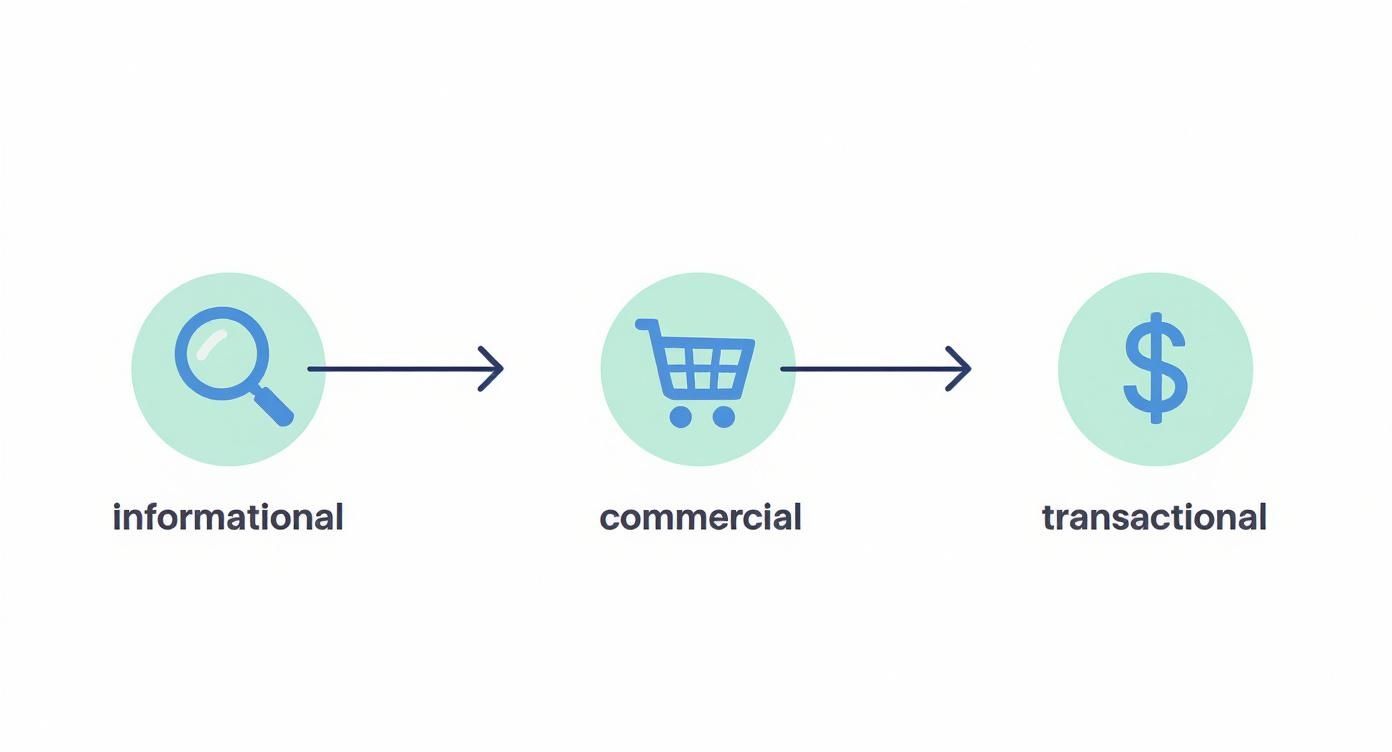
This infographic shows how a searcher's intent directly influences the kind of content they want, which in turn dictates the SERP features Google decides to show.
Getting a feel for this flow—from someone just looking for information to someone ready to buy—helps you prioritize which features to go after first based on what you’re trying to achieve.
And this isn't just a hunch; the data backs it up. One click-through rate report found that a whopping 99.58% of top 10 SERPs have featured snippets. Grabbing one can instantly take you from the bottom of page one to the very top.
Creating Your Prioritized Hit List
Once you’ve got that perfectly filtered view, export the data into a spreadsheet. This is now your working document—your roadmap for what to optimize next. I like to add a few columns like "Target Feature," "Current Rank," "Monthly Search Volume," and "Priority Score."
You can use a simple scoring matrix to decide what to tackle first. This helps take the guesswork out of the process.
A Simple Framework for Prioritizing Opportunities
Use this matrix to score your SERP feature targets based on their potential impact, helping you decide where to focus your efforts first.
| Prioritization Factor | Weight (1-5) | How to Assess It |
|---|---|---|
| Search Volume | 5 | How many people are searching for this term each month? (Higher is better) |
| Keyword Relevance | 5 | How closely does this keyword align with a core product or category? |
| Current Ranking | 4 | Are you already on page 1? (Rank 2-5 is a higher priority than rank 10) |
| Competitive Weakness | 3 | Is the current feature holder a weak domain or a poor result? |
| Ease of Implementation | 2 | Can you win this with a simple content tweak vs. a full page overhaul? |
This list, scored and sorted, becomes your action plan. You’re no longer guessing what might work; you're making calculated moves based on where you have the highest probability of a big win. For a deeper look at the tools that power this entire workflow, check out our comprehensive guide on SEO keyword research tools.
By repeating this process every quarter, you create a sustainable system for constantly finding and capturing new SERP real estate.
Optimizing Your Content and Schema to Win Snippets
Spotting a SERP feature opportunity is only half the battle. Now for the fun part: actually adjusting your on-page content and code to capture it. This isn't about massive overhauls. It's about making smart, targeted tweaks that signal to Google, "Hey, this page has the best answer."
To claim these coveted spots, you really need to attack it from two angles. First, you have to structure your page content for absolute clarity. Second, you need to implement the right structured data—the technical language that helps search engines understand what your content is all about.

Just look at all the properties you can use for Product schema, from aggregateRating to offers. This is what directly powers rich results. By implementing this code correctly, you're not just hoping Google figures it out; you're handing it a detailed blueprint of your page's content.
Structure Content to Answer Questions Directly
Google loves clarity. If you want to win Featured Snippets and People Also Ask (PAA) boxes, your content has to provide direct, concise answers. Think of your page as a mini Q&A session.
Start by figuring out the single most important question your page answers. For a product page, it might be "What are the key features of this hiking boot?" For a blog post, maybe it's "How do you waterproof leather shoes?"
Once you have the question, structure your content to answer it right away.
- Use the Question in a Heading: Put the target question in an H2 or H3 tag. This acts as a giant signpost for search engine crawlers.
- Provide a Snippet-Sized Answer: Write a short, clear paragraph (around 40-60 words) directly below the heading that answers the question.
- Elaborate with Lists: Break down steps, features, or benefits using bulleted or numbered lists. This formatting is incredibly easy for Google to parse and often gets pulled directly into snippets.
Real-World Example: Let's say you're targeting the Featured Snippet for "how to clean suede sneakers." Your page should have an H2 that literally says, "How to Clean Suede Sneakers." The very next paragraph should be a concise summary of the process, followed by a numbered list detailing each step. It’s often that straightforward.
Implement the Right Schema Markup
While clean content structure helps you compete for informational snippets, schema markup is your ticket to unlocking commercial rich results like product ratings, prices, and availability. Schema is just a vocabulary of code you add to your site to help search engines give users more informative results.
For any e-commerce store, this technical layer is non-negotiable. It's what turns a standard blue link into a rich, engaging result with star ratings and pricing. In fact, research shows that 72% of top-ranking pages use structured data to stay eligible for these enhanced SERP displays. For a closer look, you can explore more insights on the role of schema in modern SEO.
Here are the three most critical types you need to get right:
Product Schema
This is the bread and butter for any online store. It lets you specify crucial details like:
name: The name of your product.image: A URL for a high-quality product photo.description: A compelling product description.offers: This is where you put theprice,priceCurrency, andavailability(e.g., InStock).aggregateRating: This property houses theratingValueandreviewCount, which generates those all-important star ratings in the SERPs.
Review Schema
If you have customer reviews on your product pages—and you should—Review schema is essential. It marks up individual reviews, including the reviewer's name, the review text, and their rating. Paired with aggregateRating, it sends powerful trust signals to both Google and your potential customers.
FAQPage Schema
This schema is a goldmine for any page with a question-and-answer format, like a product page with an FAQ section. By marking up your Q&As with FAQPage schema, you become eligible for those interactive FAQ dropdowns in the search results. This lets you take up more SERP real estate and answer user questions before they even click.
Tools That Make Schema Simple
Let's be honest, if you're not a developer, the idea of adding code to your site can be intimidating. The good news is you don't have to do it by hand.
For platforms like Shopify, excellent apps handle the heavy lifting. Tools like Yoast SEO for WordPress or "Smart SEO" for Shopify can automatically generate much of the necessary schema markup for your products and pages.
If you're on Shopify and want to really get into the weeds, our ultimate guide to Shopify schema markup is a great place to start. These tools make the whole process of finding and capturing SERP feature opportunities much more accessible.
Adapting Your Strategy for AI Overviews
Google's AI Overviews are here, and they've completely changed the game. This isn't some far-off concept anymore; it's live and directly impacting how customers find your products. Ignoring this shift simply isn't an option for any e-commerce brand that wants to stay competitive.
Instead of the classic "10 blue links," AI Overviews pull information from various websites to cook up a direct, conversational answer right at the top of the search results. This changes everything about how people use Google and what it means to "rank." Your new goal isn't just to be on the first page—it's to become a trusted source cited within these AI-generated summaries. To get there, you need a solid grasp of the evolving ChatGPT ranking factors that influence what AI models trust and feature.
Becoming a Citable Source for AI
The growth of AI Overviews has been explosive. Google went from showing them on about 6.5% of searches in January to over 13% by March. For broader, problem-solving types of queries, they now pop up almost a third of the time. You can see more on this trend in these updated SEO statistics.
So, how do you get your site featured? It all comes down to demonstrating undeniable E-E-A-T (Experience, Expertise, Authoritativeness, Trustworthiness). AI models are built to find and cite the most authoritative sources, which means the old playbook of just stuffing keywords into a page is officially dead.
Your content has to provide real, unique value. Here’s what that looks like in practice:
- Original Data and Research: Got a unique case study or some survey results from your customers? Publish it. This kind of proprietary data makes you a primary source that an AI is far more likely to lean on.
- Clear, Factual Language: Write directly and without the fluff. AI digests clear, well-supported facts, not marketing jargon. Get straight to the point.
- Logical Structure: Use clear, descriptive headings (like H2s and H3s) to organize your content. This gives AI models a roadmap to understand the hierarchy and flow of your information, making it easier to parse.
Key Insight: Start thinking of your content less like a webpage for a human and more like a structured data source for an AI. The clearer and more authoritative your information is, the better your chances of being chosen as a reference.
Practical Steps for AI Overview Optimization
To really nail this, you need to shift your mindset. You're no longer just trying to answer a single search query; you're aiming to become the go-to resource on a topic. It's about building deep topical authority, not just tweaking one-off pages.
Here are a few things you can do right now to get started:
- Prioritize the "Why": Don't just list product features. Explain why they matter. Content that dives deep into the context and demonstrates true subject matter expertise is pure gold for both users and AI.
- Cite Your Sources: Just as you want AI to cite you, make it a habit to link out to other credible, authoritative sources. This is a strong signal to Google that your content is well-researched and part of a larger expert conversation.
- Add Unique Perspectives: Share first-hand experiences, pull in quotes from your in-house experts, and use real-world customer examples. This is the kind of original insight that an AI can't just create on its own, making your content a truly valuable and citable source.
Focusing on these principles helps your e-commerce brand become more than just another link in a list. You become an active contributor to the answers Google gives its users.
How to Measure the Real Impact of Your Efforts

Winning a SERP feature feels good, but that's just the start. The real victory is proving it actually made a difference to your bottom line. You need to connect that new Featured Snippet or Product rich result to a tangible lift in traffic and sales. This is where you close the loop and turn a one-off win into a repeatable strategy.
Your best friend for this is Google Search Console. The Performance report is an absolute goldmine for seeing exactly how these special search appearances are contributing to your traffic. We're not just looking at overall clicks; we're digging in to isolate the impact of specific SERP features.
Isolating Your Wins in GSC
Jump into the Performance report and look for the 'Search appearance' filter. This is your secret weapon. It lets you slice and dice your data to see the clicks, impressions, and click-through rates generated by individual features like Product results, FAQs, or Videos.
This filter is how you answer the most critical question: Did all that work to capture the feature actually bring in more qualified traffic?
For instance, a Featured Snippet win should cause a noticeable jump in your CTR. These snippets show up for roughly 12-13% of all searches. When your page grabs that spot, its CTR can skyrocket to 42.9%, often stealing clicks from the traditional #1 organic result.
Monitoring Gains and Losses
While GSC is fantastic for looking back, your rank tracker is your eye on the present. You need to know the moment you gain or lose a key SERP feature. Set up alerts for your most important keywords so you get a notification right away.
This kind of proactive monitoring means you can react instantly. If you lose a valuable snippet, you can go straight to the SERP, see who took your spot, and figure out how to get it back. When you gain one, you can document what you did right and apply that lesson elsewhere.
This constant feedback turns your optimization work from guesswork into a data-driven process. To really get into the weeds on which KPIs matter most, you'll want to learn how to measure SEO performance from top to bottom.
Got Questions? We've Got Answers
Digging into SERP features often brings up a few common questions. Here are the quick, no-fluff answers we give to e-commerce store owners when they're trying to figure this all out.
"Help! I Just Lost a SERP Feature. What Now?"
First off, take a breath. It happens. SERPs are constantly shifting, so don't panic when you see a feature disappear. The first thing you need to do is go look at that search result.
Who took your spot? Pull up their page and see what they're doing differently. Did they answer the question more directly? Is their content formatted as a list while yours is a paragraph? Check their structured data, too.
More often than not, a small content edit or a quick schema update is all it takes to get it back. This is exactly why ongoing monitoring is a non-negotiable—it lets you spot these changes and react before the loss turns into a long-term problem.
"How Long Does This Actually Take?"
That’s the million-dollar question, and the honest answer is: it depends. If you're trying to snag a Featured Snippet for a page that already ranks in the top five, you could see results surprisingly fast. A simple tweak to your content might be enough to win it within a few days of Google re-crawling your page.
But for something more complex, like a Product Carousel or getting those star-rating Review Snippets to show up, you'll need a bit more patience. These often rely on things like building up a solid base of customer reviews or making sure your product feed is perfectly synced, which can easily take several weeks to get right.
The Bottom Line: Your starting point matters most. Tweaking a page that’s already performing well will always get you faster results than trying to win a feature for a page that's starting from scratch.
"Should I Just Go After Every SERP Feature I See?"
Definitely not. Trying to win every single SERP feature out there is a classic case of spreading yourself too thin. It’s a surefire way to burn out your team and get mediocre results.
The smart move is to be picky. Focus your energy on the features that actually make sense for the keyword's intent and, more importantly, for your business.
A good rule of thumb:
- For informational keywords ("how to clean leather boots"): Go for Featured Snippets and People Also Ask boxes.
- For commercial keywords ("men's waterproof work boots"): Your priority should be Product Rich Results, Review Snippets, and Image Packs.
When you align your efforts with user intent, you’re putting your resources exactly where they’ll make the biggest difference to your traffic and your bottom line.
Ready to turn these opportunities into revenue? The team at E-commerce Dev Group specializes in the technical SEO and schema optimizations that win high-value SERP features for Shopify stores. Let us help you dominate the search results. Learn more about our Shopify SEO services.
