

A customer acquisition cost calculator is a straightforward tool that does one simple, powerful thing: it tells you exactly how much your business spends to land a single new customer.
The math is easy. You just divide your total sales and marketing expenses by the number of new customers you brought in during that same time. This one number reveals the true efficiency of your entire growth strategy.
Why Customer Acquisition Cost Is a Critical Metric

You’ve probably heard the old saying, "You can't improve what you don't measure." When it comes to business growth, this couldn't be more true. Your Customer Acquisition Cost (CAC) is arguably the most important number for understanding how much you're really spending to win over each new buyer.
Obsessing over this metric isn’t just for the finance team—it’s a strategic necessity for anyone serious about long-term success.
Ignoring your CAC is like driving a car without a fuel gauge. Sure, you're moving, but you have no idea when you're about to run out of gas. A high CAC can quietly drain your resources, making every sale less and less profitable until you’re suddenly operating at a loss.
The Rising Costs of Gaining Customers
Let's be honest: getting new customers is harder and more expensive than ever before. Data shows that the average customer acquisition cost has shot up by around 222% between 2013 and 2025. A decade ago, companies lost about $9 per new customer on average; today, that loss has ballooned to $29, thanks to soaring ad prices and a crowded market. You can dig into more of these customer acquisition cost statistics to see just how much the landscape has shifted.
This trend makes knowing your numbers absolutely essential. Without a clear picture, you’re just throwing money at different channels and hoping something sticks.
A healthy, optimized CAC is the engine for sustainable growth. It ensures that for every dollar you spend on marketing and sales, you're getting multiples of that back in long-term revenue.
How CAC Drives Strategic Decisions
Once you know your CAC, you can start making smarter, data-backed decisions across your entire business. It helps you move from guesswork to deliberate, strategic action.
Here’s a look at how it influences key areas:
- Budget Allocation: It shines a light on which marketing channels are actually efficient. This lets you double down on what’s working and pull the plug on campaigns that are just draining your budget.
- Pricing Strategy: Understanding what it costs to get a customer is fundamental to setting prices that ensure you’re profitable on every single sale.
- Profitability Analysis: CAC is a core component of your financial health. It directly impacts your bottom line and your ability to scale the business.
- Investor Confidence: If you're looking for funding, a well-managed CAC is proof of a viable and sustainable business model. It's one of the first things savvy investors look at.
Ultimately, getting a firm handle on your CAC changes your mindset from simply spending money to investing it intelligently. It gives you the clarity needed to build a resilient and profitable brand that can actually compete. And it all starts with one simple calculation.
Breaking Down The CAC Formula
Before you can really put a CAC calculator to good use, it's crucial to get comfortable with the simple formula that powers it. It's not complicated, I promise.
At its heart, the calculation is just this:
Total Marketing & Sales Costs ÷ New Customers Acquired = Customer Acquisition Cost (CAC)
The math is easy. The real trick—and where I see so many businesses go wrong—is in gathering the right numbers to plug in. It’s tempting to just look at your ad spend, but that gives you a skewed, incomplete picture of what it truly costs to win a new customer.
What Goes Into Your Total Marketing And Sales Costs?
To get an accurate CAC, you have to be a bit of a detective and account for every dollar that goes into your acquisition funnel over a specific period. It’s about more than just the obvious stuff.
You need to track down expenses from all over. If you really want to dive deep into all the variables, I’d suggest checking out this a complete guide on how to calculate your Customer Acquisition Cost for a comprehensive look.
To give you a head start, I've put together a table of the most common—and often overlooked—expenses you should be tracking.
Key Expenses for Your CAC Calculation
This table breaks down the typical costs you'll want to include. Leaving any of these out can give you a dangerously optimistic CAC figure.
| Cost Category | Examples | Why It Matters |
|---|---|---|
| Team Compensation | Salaries, commissions, and bonuses for your marketing and sales staff. | Your people are often the biggest investment in your growth engine. Ignoring their compensation throws off the entire calculation. |
| Advertising Spend | Budgets for Google Ads, Facebook Ads, paid influencers, print, etc. | This is the most direct cost of getting in front of potential customers. It's the "gasoline" for your acquisition efforts. |
| Tools & Software | Subscriptions for your CRM, analytics platforms, SEO tools, and email marketing software. | These tools are the essential infrastructure for modern marketing and sales teams. Their monthly or annual fees are a direct cost of doing business. |
| Creative & Content | Fees for freelance writers, designers, video production, and agency retainers. | High-quality content and creative assets aren't free. These costs are directly tied to creating the materials that attract customers. |
Remember, this isn't just about big-ticket items. Think about the software that helps automate your outreach, too. Many store owners find that using Shopify marketing automation tools can streamline their efforts, which directly impacts labor costs and overall efficiency.
Getting a complete picture of these costs is the first and most important step to calculating a CAC you can actually trust.
How Do You Define A "New" Customer?
Now for the other side of the equation: counting your new customers. This sounds simple, but you need a crystal-clear definition that everyone on your team agrees on.
Is a "new customer" someone who makes their very first purchase? Or is it a new lead who signs up for a trial? Maybe it's a brand new subscriber to your service.
Your definition has to match your business model. For an e-commerce shop, it’s almost always that first-time buyer. For a SaaS business, it's the moment someone becomes a paying subscriber. Whatever you decide, be consistent.
Finally, lock in a time frame. Are you calculating CAC monthly? Quarterly? Annually? There’s no single right answer, but sticking to a consistent period is non-negotiable. It’s the only way you’ll be able to spot trends and see if your acquisition strategy is getting more or less efficient over time.
Putting a CAC Calculator to Work
Alright, let's get our hands dirty. Enough with the theory—it's time to walk through how you actually use a customer acquisition cost calculator. We're going to turn a pile of business data into a single, powerful number that tells you a story about your marketing. It’s a lot easier than it sounds once you know where to find the numbers.
Let’s pretend for a moment. You run a small e-commerce brand selling handcrafted leather goods. The first quarter just wrapped up, and you’re keen to figure out your CAC to see if that recent marketing push was actually worth it.
Gathering Your Core Data
First things first, you need to round up all the costs for the quarter. This usually means dipping into a few different systems, which is totally normal for most businesses.
Here's the data you'll need to hunt down:
- Sales & Marketing Salaries: Pop open your payroll software, whether it’s Gusto or ADP. For Q1, let's say your one marketing employee was paid a total of $15,000.
- Advertising Spend: Time to check your ad dashboards. You see $5,000 went to Facebook Ads and another $3,000 to Google Ads. That’s a total ad spend of $8,000.
- Tool & Software Costs: Look at your subscriptions. Your email marketing platform cost $300 for the quarter, and your analytics tool was another $200. So, $500 in software costs.
Add it all up, and you get a total cost of $23,500 for the quarter. Great. Now for the other side of the coin. A quick look at your Shopify dashboard shows you brought in 500 brand-new customers during that same period.
Plugging the Numbers into the Calculator
You've got your data. The rest is easy. You just need to plug these figures into the fields of a CAC calculator.
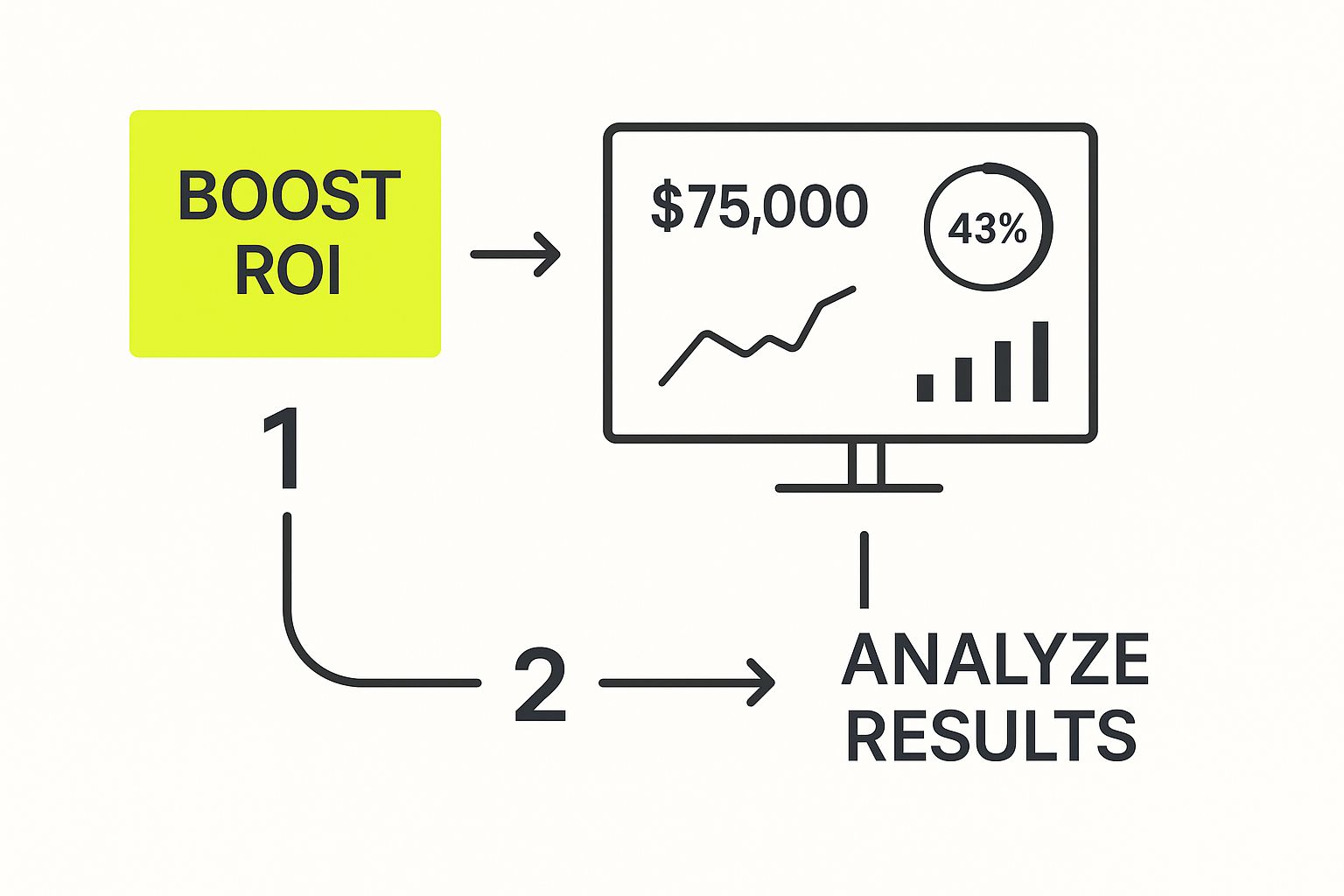
Most online tools are built for simplicity. They don’t require you to be a spreadsheet wizard—just input a few key numbers, and it does the math for you.
The whole point of a good CAC calculator is to make your life easier. It should get you from raw numbers to a clear, understandable metric in a few clicks, so you can make smarter decisions about where your money goes.
Imagine a simple interface where you just enter the data we collected. By plugging in our example numbers—$23,500 in total costs and 500 new customers—the calculator would instantly do the division.
The result? A CAC of $47.
This means that for every new customer you won over in the first quarter, you spent an average of $47. That isn't just a random number; it's your new performance benchmark.
What Your CAC Number Is Actually Telling You
https://www.youtube.com/embed/VQqnT6xV-xk
So, you’ve plugged all your numbers into a customer acquisition cost calculator and a figure is staring back at you. Let's say it’s $47.
Is that good? Bad? Honestly, it depends. A CAC number on its own is just a data point floating in space—it doesn't tell you the full story.
To make sense of it, you need to bring in its most important partner: Customer Lifetime Value (LTV). LTV is the total amount of money you can realistically expect a customer to spend with you over their entire relationship with your brand. Think of it as the other half of the profitability puzzle.
The Power of the LTV to CAC Ratio
When you put these two metrics together, you get the LTV to CAC ratio. This is where the magic happens. It's the truest measure of whether your business model is actually healthy and built to last.
The ratio answers the one question every founder needs to know: "Are we spending our money smartly to bring in customers who will eventually pay us back, and then some?"
Let me break it down. If your CAC is $50, but that customer’s LTV is only $40, you're literally paying to lose money. On the flip side, if that same $50 investment lands you a customer who ends up spending $200 over their lifetime, you've got a fantastic engine for growth. Nailing this balance is fundamental if you want to increase online sales sustainably.
Key Takeaway: For most e-commerce and SaaS businesses, a 3:1 LTV to CAC ratio is the gold standard. It means that for every dollar you put into acquiring a customer, you're getting three dollars back over their lifetime. That’s the sign of a profitable, scalable business.
Finding Your Place with Industry Benchmarks
The other critical piece of context is your industry. Your CAC needs to be viewed through the lens of your specific market, because what’s considered normal can vary wildly. A great CAC for a B2B SaaS company could be a catastrophic one for a direct-to-consumer T-shirt brand.
Sample CAC Benchmarks Across Industries
See how average Customer Acquisition Costs compare in different sectors to add context to your own figures.
| Industry | Average CAC | Common Influencing Factors |
|---|---|---|
| Fintech | $1,450 | High LTV, intense competition, complex sales cycles |
| Insurance | $1,280 | Strong regulatory hurdles, long customer lifespan |
| B2B SaaS | $450 – $700 | Varies by deal size, contract length, market saturation |
| Retail (E-commerce) | $80 – $150 | Product margins, repeat purchase rates, seasonality |
| Travel | $120 | High competition, booking seasonality, brand loyalty |
Note: These are general estimates for 2025 and can fluctuate based on market conditions and acquisition channels.
As you can see, the numbers are all over the place. A look at average customer acquisition costs shows that fintech can hit as high as $1,450, with insurance not far behind at $1,280. Contrast that with referral programs, which can have an average CAC as low as $400, and you see just how much the channel and industry matter.
Knowing where you stand against your competitors helps you set goals that are ambitious but realistic. Instead of chasing some random, low number, you can focus on being more efficient than others in your space. This is how your CAC transforms from a simple metric into a strategic tool that guides your budget, marketing, and growth plans.
Proven Strategies to Lower Your Acquisition Costs
Once you have a firm grip on your customer acquisition cost, the real work begins. Knowing your number is just the first step; the next is to actively and intelligently bring it down. The goal isn't just to spend less, but to spend smarter, ensuring every dollar you invest in growth works as hard as possible.
Lowering your CAC doesn't mean you have to slash your marketing budget. Instead, it’s all about boosting the efficiency of your current spending. Even small improvements in a few key areas can lead to significant savings and a much healthier bottom line.
Refine Your Conversion Funnel
One of the quickest ways to bring down your CAC is by improving your conversion rate. Think about it: if you can convince more visitors to buy, you’re acquiring more customers for the same amount of ad spend. It’s a direct path to better efficiency.
- A/B Test Your Landing Pages: Don't just set your landing pages and forget them. You should constantly be testing elements like headlines, calls-to-action (CTAs), and images. A simple tweak, like changing the color of a "Buy Now" button, can sometimes lift conversion rates by 10% or more.
- Streamline Your Checkout Process: How many steps does it take for a customer to buy from you? Every extra field or page is another chance for them to abandon their cart. Remove unnecessary friction by offering guest checkout, multiple payment options, and a clear, simple layout.
These optimizations make sure the traffic you’re already paying for has the best possible chance to convert, which immediately lowers your cost per acquisition.
Increase Customer Lifetime Value
Another powerful strategy is to focus on increasing the total value each customer brings to your business over time. When your LTV goes up, you can afford a higher CAC while still staying profitable. This requires a shift in mindset from chasing one-time transactions to building long-term relationships.
By focusing on retention, you make every acquisition dollar more valuable. A loyal customer who makes repeat purchases effectively lowers the net cost of acquiring them in the first place.
Consider implementing a loyalty program that rewards repeat purchases. Or you could launch personalized email campaigns with exclusive offers just for existing customers. These tactics encourage people to come back again and again, boosting their LTV and strengthening your entire business model.
Focus on High-Efficiency Channels
Not all marketing channels are created equal. Some are just naturally more cost-effective than others. To really lower your customer acquisition costs, it's crucial to continuously fine-tune your lead generation processes, particularly on the big ad platforms. For a deep dive, check out this guide on optimizing your lead generation efforts through comprehensive Google Ads strategies.
Beyond paid ads, shifting some of your budget and effort toward more sustainable, long-term channels can dramatically reduce your CAC over time. For many Shopify stores, investing in organic traffic is a total game-changer. A great starting point is learning more about Shopify SEO best practices and building a content strategy that attracts customers without paying for every single click.
It's true that organic search, content marketing, and customer referrals require an upfront investment of time, but in the long run, they deliver highly qualified customers at a fraction of the cost of paid ads.
Got Questions About CAC? We've Got Answers
Even with a handy calculator, you're bound to have some questions as you start digging into your customer acquisition cost. That's a good thing. Getting these details right from the start is what separates a vanity metric from a genuinely useful business tool.
How Often Should I Really Be Calculating CAC?
There's no single magic number here—it really depends on the rhythm of your business. But I've found that a tiered approach gives you the best of both worlds: the quick insights and the long-term trends.
- Monthly: Think of this as your tactical check-in. It’s perfect for seeing the immediate ripple effects of a new campaign or a fresh set of ads. Did that new creative work? Your monthly CAC will tell you, letting you pivot fast.
- Quarterly: This is where you zoom out for a more strategic view. A quarterly calculation smooths out any weird spikes or dips from a single month, giving you a more reliable number for planning budgets and allocating resources.
- Annually: Your annual CAC is your benchmark. It's the big-picture number that shows you long-term trends and tells you if your overall acquisition engine is getting more or less efficient over time.
What are the Most Common Mistakes People Make?
The biggest and most common mistake? Forgetting to include all the costs. So many businesses just tally up their direct ad spend and call it a day, which gives them a dangerously low and misleading CAC.
To get the real number, you have to be honest about everything you spend. That means factoring in team salaries, the cost of your software stack (like your CRM or email platform), and any fees for content creation or freelance help.
Another classic error is getting sloppy with your definitions. What's your time period? What exactly counts as a new customer? If you aren't consistent, you can't compare apples to apples over time. And a huge missed opportunity is not breaking down CAC by channel. You could be unknowingly burning cash on an unprofitable channel while your most efficient one is starved for budget.
A high CAC isn't automatically a red flag. What really matters is how it stacks up against the lifetime value (LTV) of the customers you're bringing in. It's all about that LTV-to-CAC ratio.
So, is a High CAC Always a Bad Thing?
Not at all. In fact, sometimes it's a sign of a great business. Context is king.
A high CAC is perfectly fine—and even smart—if the customers you're paying for are incredibly valuable in the long run. Think about a B2B software company. They might happily spend $1,500 to land a new client, knowing that client will pay them $20,000 over the lifetime of their subscription.
The CAC number on its own is just one piece of the puzzle. It doesn't mean much without its partner metric, Lifetime Value (LTV). A healthy business usually has a strong LTV-to-CAC ratio, with 3:1 often seen as a solid benchmark. That's the real proof that your acquisition strategy is sustainable and profitable, no matter what the initial cost looks like.
Ready to take control of your e-commerce growth with data-driven strategies? The experts at E-commerce Dev Group specialize in optimizing Shopify stores for peak performance, from enhancing conversion rates to building powerful marketing funnels that lower your CAC. Let's build a more profitable store together.
