


Alright, let's give this section a more human touch, as if an experienced ecommerce pro is explaining it from the ground up.
At its heart, ecommerce catalog management is how you organize, standardize, and publish all the information about the products you sell. We're talking about everything from SKUs and detailed descriptions to images, videos, and pricing. It's the system that makes sure your digital storefront is clean, accurate, and—most importantly—easy for customers to use.
Think of it as the digital equivalent of merchandising a physical store.
So, What Is Ecommerce Catalog Management, Really?
Imagine walking into a huge department store where nothing is organized. T-shirts are mixed in with kitchen gadgets, and price tags are missing or just plain wrong. You wouldn't stick around for long, would you? That chaotic store is what your website feels like to a customer when your catalog is a mess.
Ecommerce catalog management is the process of bringing order to that chaos. It's much more than just uploading a product name and a price. It’s the entire strategy for managing your product data from the moment you decide to sell something until it's discontinued. This ensures every piece of information a customer sees is consistent and reliable, which is fundamental to building trust.
The True Backbone of Your Online Store
You can have the best marketing in the world, but if your product pages are a disaster, you'll lose sales. That's why solid catalog management is the non-negotiable backbone of any successful online business. It directly shapes the customer experience and your own team's efficiency.
A poorly managed catalog creates friction at every turn—think incorrect stock levels, confusing product options, or prices that don't match what was advertised. These little frustrations add up and send potential buyers straight to your competitors. On the flip side, a well-managed catalog creates a smooth, intuitive path from browsing to buying. It reassures shoppers that the information they see is correct, whether they’re on your website, your app, or a marketplace like Amazon.
This isn't just a "nice-to-have" anymore. As ecommerce grows, so does the need to get this right. The global catalog management market was valued at $2.1 billion in 2023 and is expected to hit around $5.6 billion by 2032. That's a clear signal of how critical this has become. You can explore more data on this trend to see how it’s shaping digital commerce.
A great catalog doesn't just list products; it tells a cohesive story about your brand. It’s your promise to the customer that what they see is exactly what they’ll get, which is the foundation for building real, lasting trust.
Now, let's break down what activities are actually involved. While it sounds complex, it really boils down to a few key jobs that keep your store running smoothly.
Here’s a quick look at the core functions of catalog management:
Core Functions of Catalog Management
| Function | What It Means for Your Store |
|---|---|
| Data Collection & Entry | Gathering all product info—like descriptions, specs, and supplier details—and getting it into your system accurately. |
| Standardization | Making sure all your data follows the same format. For example, all dimensions are in inches and all images are the same size. |
| Categorization & Taxonomy | Organizing products into a logical structure (e.g., Men > Shirts > T-Shirts) so customers can easily find what they’re looking for. |
| Enrichment | Adding rich content like multiple high-res photos, videos, how-to guides, and compelling descriptions to make products more appealing. |
| Publishing & Syndication | Pushing your product information out to all your sales channels, like your Shopify store, social media, and marketplaces. |
Ultimately, mastering these functions isn't just about housekeeping. It’s about creating a better experience for your customers and a more efficient workflow for your team.
Building a High-Performing Product Catalog

Let's move from the "what" to the "how." Creating a top-tier product catalog is really about building a powerful sales engine from scratch. It all starts with clean, consistent, and well-organized product information. Every single piece has to work together, guiding customers on their journey and keeping your backend operations running smoothly.
Think of it like building a house. You don't just start throwing up walls and hope for the best. You need a solid foundation and a logical frame. In the world of ecommerce, your product data is that foundation.
Standardized Product Data: The Foundation
The first and most important layer is your core product data. This isn't just a simple list of things you sell; it's the standardized information that identifies and describes every single item in your inventory.
-
Product Identifiers (SKUs): A Stock Keeping Unit (SKU) is a unique code you assign to each product. Think of it as the internal language your systems speak to track inventory, manage orders, and avoid costly mix-ups. Without clean SKUs, everything from fulfillment to customer support turns into a frustrating, manual chore.
-
Product Titles and Descriptions: These are your digital salespeople. Titles need to be clear, descriptive, and easy for customers (and search engines) to find. Descriptions should answer obvious questions, sell the benefits, and use consistent language. For example, always using "burgundy" instead of randomly switching to "wine red" prevents confusion and helps build customer trust.
-
Attributes and Specifications: These are the nitty-gritty details that power your site's filters and search—things like size, color, material, and dimensions. When your attributes are consistent and complete, you empower shoppers to easily narrow down their options. This dramatically improves their experience and makes them much less likely to leave your site.
To truly get the most out of your catalog, you need to think about how search engines see it. This is where specialized ecommerce SEO services can make a huge difference, ensuring your titles, descriptions, and attributes are perfectly structured to pull in organic traffic.
Compelling Digital Assets: The Visual Appeal
Since online shoppers can't physically touch or hold your products, your digital assets have to do all the heavy lifting. High-quality visuals aren't just a "nice to have"—they're absolutely essential for building confidence and closing the sale. A catalog packed with great media is a catalog that sells.
Make sure your catalog includes:
- High-Resolution Images: Show your products from multiple angles. Include lifestyle shots of the product in use and close-ups that highlight important details.
- Product Videos: A short video can demonstrate how a product works, showcasing its features and benefits far better than a static image ever could.
- 360° Views: For more complex or expensive items, an interactive 360° view lets customers explore the product from every possible angle, just like they would in a store.
"A well-structured catalog is like a well-organized library. When product data is accurately labeled and easy to find, customers can quickly locate what they’re searching for without frustration."
By combining structured data with compelling visuals, you turn a basic product listing into a persuasive and user-friendly experience. It makes your backend more efficient, your storefront more effective, and creates a unified system that drives growth and keeps customers coming back.
The True Business Impact of Smart Catalog Management

Putting effort into your ecommerce catalog isn't just about keeping things neat on the back end. It's a direct investment in your bottom line. When you get strategic about it, your product data transforms from a simple list into a powerful tool that actively grows your business.
The link between an organized catalog and a healthier business is surprisingly direct. When product information is accurate and detailed, customers know exactly what they’re getting. This confidence doesn't just nudge them to click "buy"—it also dramatically cuts down on returns, saving you a ton of money and logistical headaches.
Think about it. When was the last time you ditched your online cart? Chances are, it was because the product details were confusing, missing, or just plain wrong. That's a classic friction point that solid catalog management smooths over completely.
Boost Your Discoverability and SEO
A well-structured catalog is a huge win for your search engine optimization (SEO). Search engines like Google absolutely love organized, consistent, and keyword-rich data. When your product pages are built on a foundation of clean information, they start climbing the search rankings, bringing more organic traffic to your store without you spending a dime.
This visibility means more potential customers find you naturally. Suddenly, every product in your catalog becomes a potential doorway to your brand, turning the whole collection into a magnet for qualified leads. It’s a sustainable way to build a real presence in your market.
Build Customer Trust and Loyalty
At the end of the day, consistency is what builds trust. When customers see reliable, uniform information across all your products and channels, it tells them you’re a professional and credible business. That’s the kind of trust that turns first-time buyers into loyal, repeat customers.
Effective catalog management is fundamental to improving customer engagement. Optimized product information boosts search engine visibility, increases discoverability, and enables effective cross-selling, directly contributing to higher revenue growth.
Ultimately, a strong catalog makes your entire business run better. Your operations get smoother, your marketing gets easier, and your sales grow. This is especially true if you’re ever moving to a new platform; a clean catalog is non-negotiable. If a platform change is on your radar, our guide to a successful Shopify store migration highlights just how critical data organization really is.
Designing Your Catalog Management Workflow
An amazing e-commerce catalog doesn't just happen by magic. It’s the result of a smart, repeatable workflow—think of it as your daily game plan for everything from launching new products to retiring old ones. Without a clear system in place, you’re just asking for trouble: inconsistent data, frustrating delays, and a messy backend that ultimately tanks the customer experience.
When you nail down a solid process, catalog management stops being a reactive headache and becomes one of your biggest strategic advantages. It’s the engine that ensures every single product gets added, polished, and published with the same high standard of quality and accuracy. This is what keeps your digital shelves organized, appealing, and ready for business.
The New Product Onboarding Process
The whole journey kicks off the second a new product officially joins your inventory. This first step is absolutely critical because it’s where you gather all the foundational data from suppliers or your internal teams. If you get sloppy here, you’ll create a domino effect of problems down the road.
A good onboarding workflow should follow a simple, logical sequence:
-
Data Collection: First things first, get all the basic info together. This means the product name, SKU, supplier details, cost, and any specs from the manufacturer. It's crucial to keep this raw data in one central place to avoid messy, conflicting versions later on.
-
Initial Categorization: Next, assign the new product to its main category and subcategory in your store’s structure. Getting this right from the get-go means the product will appear in the right menus and search filters, making it easy for shoppers to find.
-
Asset Gathering: Now, round up all the digital assets you have on hand. This includes any initial product photos, spec sheets, or basic videos the manufacturer sent over. These will be the building blocks for the next stage: making the product shine.
This whole stage is about setting a clean, organized foundation for every item that enters your store.
Data Enrichment and Quality Assurance
With the basics locked in, it’s time for the fun part: enrichment. This is where you transform a boring product listing into a compelling sales pitch. It’s all about adding the great marketing copy, high-quality media, and detailed attributes that persuade a customer to click “buy.”
A great workflow makes sure every product gets the same level of attention. It creates a standard process for writing awesome descriptions, optimizing images, and double-checking data. This consistency is what builds a trustworthy and professional-looking storefront.
To keep things running smoothly, a well-organized system is a must. Interestingly, many of the same principles used to master content workflow management for blogs or social media can be directly applied to your catalog processes.
This simple visual shows just how much automation can help with the publishing workflow.
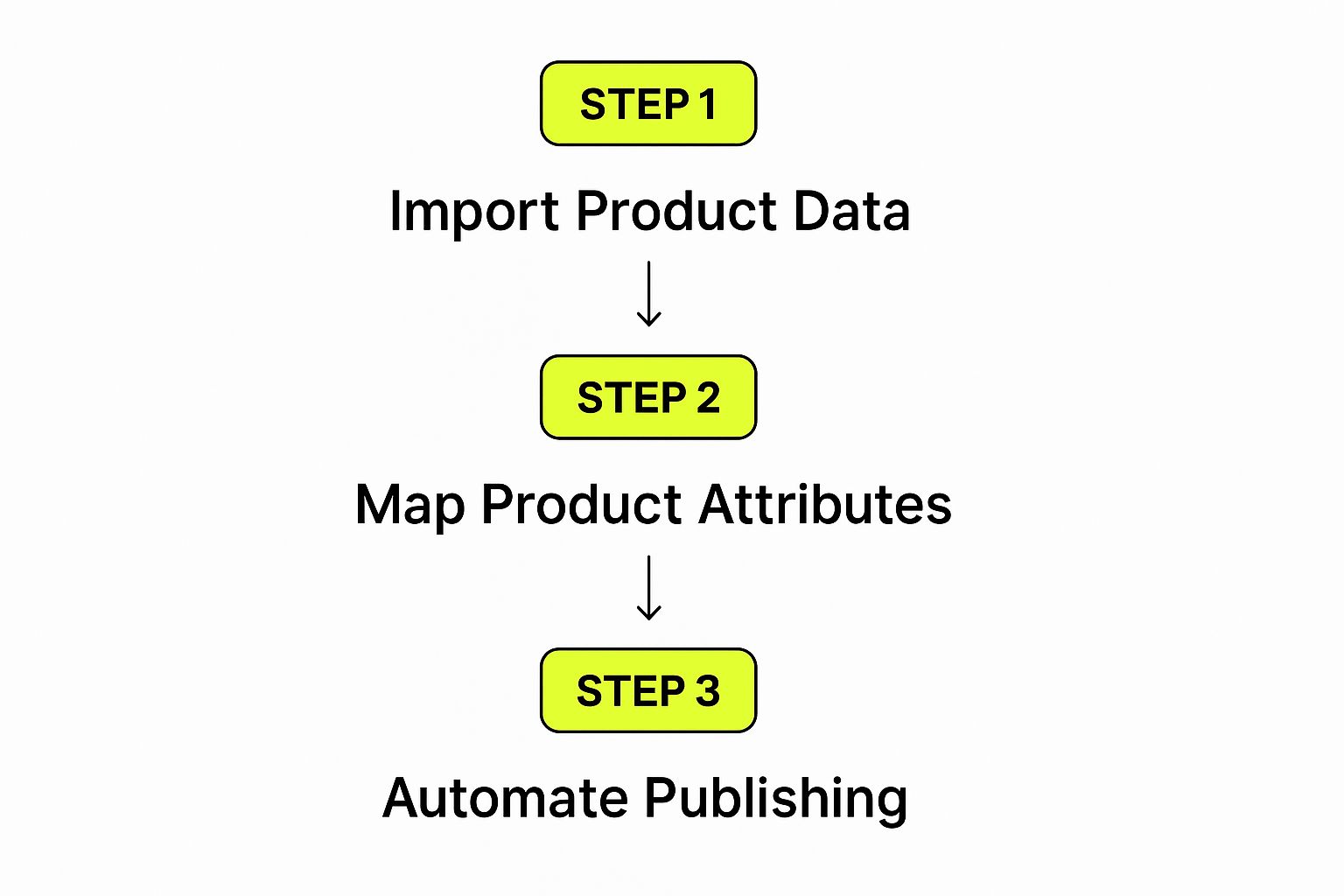
As you can see, a flow that imports data, maps it correctly, and automates publishing creates a much more efficient, hands-off system.
The two main ways to handle this are with manual spreadsheets or dedicated software. Each has its place, depending on the size and complexity of your store.
Manual vs. Automated Catalog Management
| Aspect | Manual Management (Spreadsheets) | Automated Management (PIM/Software) |
|---|---|---|
| Best For | Small businesses with a limited number of SKUs (under 100). | Growing and large businesses with hundreds or thousands of SKUs. |
| Cost | Low initial cost (free or part of existing software suites). | Higher upfront investment in software licenses and implementation. |
| Efficiency | Time-consuming and prone to human error. Difficult to scale. | Highly efficient, with bulk editing and rule-based automation. |
| Consistency | Hard to maintain consistent data across all products and channels. | Enforces data standards, ensuring consistency everywhere. |
| Collaboration | Difficult for teams to work simultaneously without version control issues. | Centralized platform designed for team collaboration. |
For small shops just starting, spreadsheets might be enough. But as you grow, the manual approach quickly becomes a bottleneck, and investing in automation becomes a clear winner for long-term success.
Ongoing Catalog Maintenance
Your product catalog isn't a "set it and forget it" project; it’s a living, breathing part of your business that needs regular care. If you let it go stale, you’ll end up with outdated information, unhappy customers, and lost sales. Ongoing maintenance has to be a regular part of your operations.
Here are a few key tasks to build into your routine:
- Price and Stock Updates: Regularly sync your pricing and inventory levels. This is non-negotiable for preventing overselling or showing customers the wrong price.
- Product Lifecycle Management: Have a clear plan for launching new collections, marking items as "discontinued," or putting seasonal products away until next year.
- Content Refresh: Every so often, go back and review your product descriptions, images, and other details. Keeping content fresh and aligned with your current marketing helps everything perform better.
By creating and actually sticking to these workflows, you build a dependable and powerful system for your ecommerce catalog management. That’s how you keep your store accurate, engaging, and, most importantly, profitable.
Proven Best Practices for Catalog Success

Alright, let's talk about what separates a merely functional catalog from a high-performing one. It comes down to a few core strategies that turn your product data into a real competitive edge. These practices are all about creating consistency, clarity, and an experience that makes people want to buy from you.
The absolute foundation of great ecommerce catalog management is creating a single source of truth (SSoT). Think of it as the one, undisputed master file for every bit of your product information.
When all your data—SKUs, descriptions, pricing, inventory counts—lives in one central place, you kill the risk of conflicting information across your different sales channels. That means a customer sees the same correct price and stock level whether they're on your website, your Instagram Shop, or an Amazon listing. This consistency is how you build trust.
Create and Enforce Data Governance
Once you’ve established your SSoT, you need to protect it with some ground rules. This is where data governance comes in. It’s simply a clear set of standards that dictates who can add, edit, or approve product information. It's not about creating red tape; it's about quality control.
These guidelines should cover everything from how you name your products and what size your images should be to the tone of voice used in descriptions. A simple style guide ensures everyone, from marketing to merchandising, is speaking the same language. This prevents those little inconsistencies that can slowly erode a brand’s professional feel.
A single source of truth isn't just a technical concept; it's a business philosophy. It guarantees that every customer interaction is built on a foundation of accurate, consistent data, which is the ultimate way to build brand credibility.
Optimize for Both Humans and Search Engines
Your product data really has to serve two masters: the people shopping on your site and the search engine bots crawling it. You can't afford to ignore either one.
-
For Humans: Write product descriptions that are clear, persuasive, and focus on the benefits. Use stunning, high-quality photos and videos that answer a customer's questions before they even have to ask. Make your pages easy to scan with clear headings and bullet points.
-
For Search Engines: Weave relevant keywords into your product titles and descriptions, but keep it feeling natural. Use structured data (also known as schema markup) to feed Google specific details like price, stock status, and reviews right in the search results.
Making sure your catalog is visible is non-negotiable, so incorporating essential ecommerce SEO tips into your process is a must. And remember, a fast-loading website is crucial for keeping both users and search engines happy. You can dive deeper into this with our guide to Shopify performance optimization.
Implement Robust Digital Asset Management
Finally, let's talk about your visuals—all those product photos, videos, 360-degree views, and spec sheets. They need their own system for organization. This is what Digital Asset Management (DAM) is all about.
A good DAM process or system ensures all your media is correctly named, tagged, and connected to the right products. This is how you avoid embarrassing mix-ups, like the wrong image showing up for a product or a video link breaking. It also makes your team hyper-efficient when they need to grab the right assets for a marketing campaign, saving tons of time and ensuring you always look polished.
Optimizing Your Catalog on Shopify
As one of the biggest names in ecommerce, Shopify gives you a surprisingly powerful, yet simple, place to build and manage your product catalog. It’s designed to be pretty intuitive right out of the box, helping new stores get a handle on their inventory from the get-go.
At its core, the platform is built for ecommerce catalog management. You can add products, create variants for things like size and color, and write those all-important descriptions without much fuss. One of the best native features is automated collections, which lets you group products together based on rules you set, like tags, price, or brand. It's a simple idea, but it's incredibly effective for keeping your store neat and easy for customers to browse.
Think about it: just add a "Summer Sale" tag to a few products, and poof—they automatically appear in your sale collection.
Mastering Shopify's Native Tools
For organization, Shopify’s tagging system is your best friend. Seriously. You can use tags for just about anything, from filtering products on the back end for your own reference to creating product groups that your customers see.
But here’s the thing: as your business grows, you might start to feel the edges of what the native tools can do. If you're suddenly managing thousands of products with tons of different attributes, relying solely on tags can get messy. It’s easy for mistakes to creep in, and before you know it, you’ve got inconsistent data all over the place.
This is a classic growing pain for many online stores. For anyone with a large or complex inventory, a more dedicated system eventually becomes a necessity, not a luxury.
Take a look at Shopify’s interface for adding a new product. It’s clean and perfect for getting started.
While this screen is great for basic needs, it also shows how manual the process is. When you have hundreds of products to add or update, that manual data entry can really slow you down.
Knowing When to Scale Up
As your catalog gets bigger, the question isn't really "Can Shopify handle this?"—it's "How can I manage all of this without pulling my hair out?"
This is the exact moment when you should start looking at third-party apps and, more specifically, Product Information Management (PIM) systems. These tools are designed to work with your Shopify store to give you one central hub for all your product information. They help automate updates, make sure data is consistent everywhere, and generally make life easier.
Understanding how these different systems connect to your store is a crucial step. Our guide on Shopify app integration is a great resource if you want to dive deeper into that. Bringing in a PIM can turn your catalog management from a tedious, manual task into a smooth, scalable process that prepares your business for whatever growth comes next.
Your Top Catalog Management Questions, Answered
If you're just getting started with ecommerce catalog management, you've probably got a few questions. That's a good thing. Let's walk through some of the most common ones we hear from merchants so you can sidestep a few hurdles and get your processes dialed in.
Catalog Management vs. PIM: What's the Difference?
This one comes up a lot. People often wonder how catalog management is different from Product Information Management (PIM).
Here’s a simple way to think about it: catalog management is your strategy. It's the whole process—how you organize, update, and show off your products everywhere you sell. It’s the game plan.
A PIM system is the tool you use to pull off that strategy. It's the software that acts as a central hub for all your product data, making the whole management process smooth and efficient, especially when you start to scale. So, management is the "what" and "why," and the PIM is the "how."
How Often Should My Catalog Be Updated?
The short answer? Constantly. Your catalog isn't a "set it and forget it" asset; it needs to reflect what's happening in your business right now.
- Instantly: Things like stock levels, price changes, or a new product launch need to be updated the second they happen. This is crucial for avoiding overselling and keeping customers happy.
- Continuously: Other updates, like tweaking product descriptions, adding better photos, or improving your SEO, should be part of a regular routine. This keeps your store feeling fresh and helps it perform better over time.
A static catalog quickly becomes an outdated one. Treat your catalog as a living, breathing part of your business that needs consistent attention to match real-time operations and marketing goals.
Can't I Just Use a Spreadsheet?
Sure, you can. Plenty of small businesses get their start with a simple spreadsheet, and that's perfectly fine for a handful of products. But let's be honest—it’s a temporary solution.
Spreadsheets are notorious for human error, and they become a massive headache as you add more products or start selling on different platforms. Scaling with a spreadsheet is practically impossible.
If you're serious about growing your business, moving to a real catalog management tool or a PIM is a must. It’s the difference between organized efficiency and chaotic data entry, and it directly impacts the professional experience you deliver to your customers.
Ready to move beyond spreadsheets and build a Shopify store that can actually scale? The experts at E-commerce Dev Group specialize in creating robust solutions that grow with your business. Discover our custom development services and build a foundation for lasting success.
