


Think of your Shopify marketing strategy as the blueprint for your store’s success. It's what guides you from simply having products to actually making sales. A good plan involves figuring out who your customers are, deciding where to find them—like on Google or social media—and setting clear goals so you know what you’re aiming for with your time and money.
Building Your Foundational Marketing Strategy
Before you even think about running an ad, you need to get your foundation right. This isn’t the flashy part of marketing, but it’s the most important. A solid strategy makes sure every email you send and every post you publish has a purpose, contributing to real, sustainable growth.
Without this groundwork, you’re just throwing things at the wall and hoping something sticks. Let’s walk through the core pieces that will set your Shopify store up to win.
What Makes You Different? Define Your Unique Selling Proposition
Seriously, what makes your store special? Your unique selling proposition (USP) is the one thing that separates you from a sea of competitors. It's the clear, simple reason a customer should choose you over anyone else.
Maybe you sell handmade leather wallets. Your USP could be a "lifetime guarantee and sustainably sourced materials." Or perhaps it’s "fully customizable designs with free monogramming." Whatever it is, this message needs to be everywhere—from your homepage headline to your Instagram bio. It’s the hook that makes people stop scrolling.
Get to Know Your Ideal Customer
You can't sell to everybody. When you try to be for everyone, you end up being for no one. This is where creating a buyer persona comes in. It’s essentially a detailed profile of your dream customer.
Give this person a name, a job, and some hobbies. Dig deep and ask yourself:
- What problems do they have that my product solves?
- Where do they hang out online? Are they on Instagram, Pinterest, or reading specific blogs?
- What kind of content do they actually enjoy?
- What makes them finally decide to buy something?
Once you understand them this deeply, you can write marketing messages that feel like you’re talking directly to them. That’s how you build a brand that feels personal and trustworthy.
Do Some Smart Competitor Snooping
Knowing your competition is just as critical as knowing your customer. The goal here isn't to copy them—it's to find the gaps they've left wide open for you. Pick 3-5 of your main competitors and take a close look at their playbook.
- Their Products: What are their biggest sellers? Is there anything they don't offer?
- Their Pricing: Are they a budget brand or a premium one? How do you compare?
- Their Marketing: Where are they getting their customers? Are they masters of TikTok, or do they own the top spots on Google?
- Their Reviews: What do people love about them? Even better, what are people complaining about? Those complaints are pure gold for you.
This intel will show you how to stand out. You might find a whole group of customers they’re ignoring or a marketing channel they haven’t even touched.
Key Insight: The best marketing strategies are built on knowing what makes you special and who you’re talking to. Everything else—SEO, ads, social media—is just a vehicle to deliver that core message.
To pull these foundational elements together, here's a quick look at how they form the pillars of a successful strategy.
Key Pillars of a Shopify Marketing Strategy
A successful plan is built on these core components. Focusing on each one ensures you're building a well-rounded strategy that drives consistent growth and sales.
| Marketing Pillar | Objective | Key Actions |
|---|---|---|
| Unique Selling Proposition (USP) | Clearly differentiate your brand from competitors. | Define what makes your products or brand special. Integrate this message across your site and marketing. |
| Buyer Persona | Deeply understand your ideal customer. | Create a detailed profile of your target audience, including their pain points, habits, and motivations. |
| Competitor Analysis | Identify market gaps and opportunities. | Analyze competitors' pricing, products, and marketing to find ways to stand out. |
| Key Performance Indicators (KPIs) | Set measurable goals to track success. | Translate broad objectives into specific metrics like conversion rate, traffic growth, and AOV. |
With these pillars in place, you can move from abstract goals to concrete actions that produce real results.
Translate Goals into Measurable KPIs
A goal without a number attached is just a wish. To build a marketing plan that actually works, you need to turn your big ambitions into specific, measurable Key Performance Indicators (KPIs).
This infographic shows just how much a well-planned strategy can move the needle.
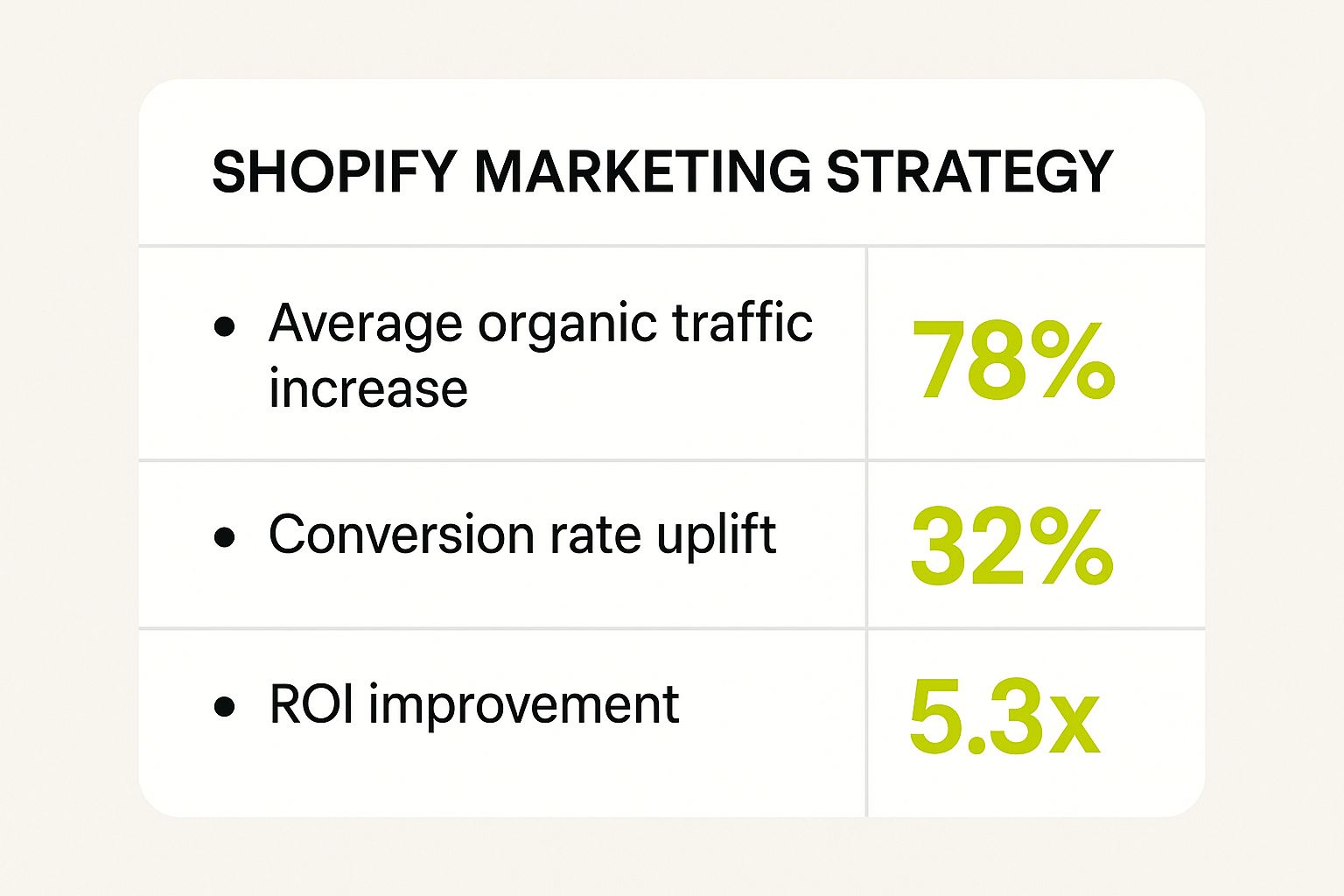
As you can see, these foundational efforts aren't just theory—they lead directly to more traffic, better conversion rates, and a healthier bottom line.
So, instead of saying "I want more sales," your goal becomes "increase our conversion rate from 1.5% to 2.5% in Q3." Instead of "I want to grow my brand," you aim to "increase organic search traffic by 30% in the next six months."
These KPIs give you a finish line to run toward and make it easy to see what’s working. Of course, you'll need the right tools to keep an eye on everything. To get started, check out this list of affordable Shopify marketing tools that will help you track your progress without breaking the bank.
Mastering Shopify SEO and Content Marketing
Think of paid ads like renting your audience. SEO and content marketing, on the other hand, are about owning your traffic. This is the foundation of a truly sustainable Shopify marketing strategy. It's how you show up when your ideal customer types a question into Google, building genuine trust and attracting visitors who are ready to buy—all without paying for every single click.
This isn’t about just jamming keywords into your product descriptions. It’s a smarter, content-first approach that turns your Shopify store from a simple catalog into a go-to resource.

Finding Keywords That Actually Convert
Keyword research is your treasure map. Instead of taking shots in the dark, you need to uncover the exact phrases real people are using when they want to learn about or purchase products like yours. It's crucial to think beyond just your product name.
Let's say you sell high-end blenders. Targeting a broad term like "blender" is a losing battle against retail giants. You have to get more specific.
- Buying Intent Keywords: These are gold. They signal someone is close to making a purchase. Think "best blender for green smoothies" or "Vitamix vs Blendtec comparison."
- Informational Keywords: This is how you catch people earlier in their journey. Phrases like "how to clean a blender" or "are glass blenders better than plastic" are perfect for building initial trust.
- Long-Tail Keywords: My personal favorite. These are longer, super-specific phrases like "quiet blender for morning smoothies." They might have less search volume, but the conversion rates are often much higher because the intent is so clear.
Use a good keyword tool to map these out. Your product and collection pages should target those high-intent buying keywords, while your blog is the perfect home for informational content.
Structuring Your Store for Search Engines
A logically organized store isn't just good for your customers; it's essential for Google. A clean structure helps search engines crawl and understand your site, which is a major factor in how you rank.
I always tell clients to picture their store's structure as a simple pyramid.
- Top: Your Homepage
- Middle: Your Collection pages (e.g., Blenders, Juicers)
- Base: Your individual Product pages
Every page should be just a few clicks away from the homepage. Shopify’s out-of-the-box structure is pretty good for SEO, but a little fine-tuning goes a long way.
A clean URL like
yourstore.com/collections/blenders/quiet-blenderis infinitely better for both users and search engines than a messy, auto-generated one filled with random characters. Keep it logical.
This clear hierarchy also helps what's called "link equity" flow through your site, telling Google which pages are the most important. Strong internal linking is the glue that holds this all together.
Creating Content That Drives Traffic and Sales
Your blog is easily one of the most powerful marketing tools you have. It's your chance to answer customer questions, solve their problems, and establish yourself as an expert in your niche. Forget boring company updates; create content that’s genuinely helpful.
For e-commerce, certain types of content just work. Here are a few proven winners:
- Buying Guides: A detailed guide like "How to Choose the Perfect Blender for Your Kitchen" can attract someone deep in the research phase and naturally lead them to your product pages.
- Comparison Posts: Pit one of your products against a competitor or even compare two of your own models. This helps indecisive shoppers make that final call.
- How-To and Tutorial Posts: Show people how to get the most out of your products. For our blender store example, an article on "5 Healthy Smoothie Recipes for Busy Mornings" is a perfect fit.
Every blog post is a fresh opportunity to rank for new keywords and strategically link back to your products, creating a clear path from discovery to purchase.
On-Page SEO Essentials for Shopify
You've got your keywords and your content plan. Now it's time to handle the on-page details. These are the small, essential tweaks that can have a huge impact.
- Compelling Meta Descriptions: This is your 155-character ad in the Google search results. Don't just list keywords—write a sentence that makes someone need to click.
- Optimized Titles: The main title (H1 tag) on your product and collection pages must include your primary keyword. Aim for descriptive but concise.
- Image Optimization: Slow-loading sites kill conversions, and huge images are almost always the culprit. Always compress your images before uploading them. And use descriptive alt text; it tells Google what the image is about, which helps with image search rankings.
- Internal Linking: When you publish a new blog post, make it a habit to find natural opportunities to link to relevant product or collection pages. Our deep dive into https://scaleshopify.com/2024/12/05/shopify-store-optimization/ covers more of the technical side of this for boosting performance.
If you really want to level up your strategy, it's worth checking out the advice from top Shopify SEO experts who often share more advanced techniques. Getting these SEO fundamentals right creates a powerful compounding effect, driving a steady stream of free, high-quality traffic for years to come.
Using Paid Ads and Social Media to Convert
While SEO and content are your long-game plays, sometimes you just need to make sales now. That's where paid ads and a smart social media game plan come in. Think of them as your direct line to customers, letting you drive targeted traffic, turn curious browsers into happy buyers, and build a real community around your brand.
Paid advertising on platforms like Google, Facebook, and Instagram gives you two things organic marketing can't: speed and precision. A well-tuned ad campaign can bring in results almost overnight, while organic efforts can take months to build momentum. The trick isn't just throwing money at ads; it's about spending it wisely.
Crafting High-Converting Ad Campaigns
The success of your ads really boils down to three things: who you're talking to (targeting), what you're showing them (creative), and what you're offering them (the offer). Nail these three, and you'll see a healthy return on your ad spend (ROAS). Miss the mark, and you're just burning cash.
First up, targeting. Get laser-focused on who your ideal customer is. Facebook and Instagram are incredible for this, letting you build audiences based on hyper-specific demographics, interests, and even online behaviors. You can target people who like your competitors' pages, follow specific influencers in your niche, or live in a certain zip code.
Next is your creative—the images, videos, and words you use. In a world of endless scrolling, your ad has to be a thumb-stopper. It needs to be visually striking and instantly get your message across. To see what works, it's worth checking out different types of top ecommerce video ads that are proven to grab attention and get clicks.
Finally, you need a compelling offer. What do you want someone to do, and what’s in it for them? A discount, free shipping, or a special bundle—whatever it is, it has to be good enough to make them tap "Shop Now."
Key Takeaway: The best ad campaigns aren't seen by the most people; they're seen by the right people. Hyper-specific targeting is your secret to profitability.
The Power of Retargeting
Ever wonder what happens to all those visitors who browse your site, add something to their cart, and then just… disappear? It’s not just you. This happens with over 70% of shopping carts. Retargeting is how you get them back.
By adding a small bit of code (a pixel) to your Shopify store, you can follow these almost-customers across the web, from their Facebook feed to the Google Display Network. You can then serve them ads featuring the exact products they were looking at, giving them a gentle nudge to come back and finish what they started.
A simple, effective retargeting campaign might look like this:
- Ad Creative: An image of the specific product they left in their cart.
- Ad Copy: Something friendly and low-pressure, like, "Still thinking about it?"
- The Hook: A small incentive, like a 10% discount or free shipping, to close the deal.
This tactic works wonders because you're not marketing to cold leads. You're talking to people who have already raised their hands and shown genuine interest in your products.
Building a Community That Sells
Social media is so much more than a billboard for your ads. It's where you build relationships, foster trust, and cultivate a loyal following. When people feel connected to your brand, they don't just buy from you once; they become repeat customers and advocates.
Think about how you can make your products feel more valuable. The most successful Shopify stores do this brilliantly. They'll create urgency with a free shipping countdown timer, ease purchase anxiety with interest-free payment plans, or create desire by highlighting a product's exclusivity. It's a mix of smart psychology and solid marketing that gives shoppers the confidence to click "buy."
Finding the Right Voices for Your Brand
You don’t need a massive budget or a celebrity endorsement to make a splash. Often, partnering with micro-influencers—creators with smaller but fiercely loyal followings (usually 10k-100k)—is far more powerful and budget-friendly. Their audience genuinely trusts their recommendations, so an endorsement feels less like an ad and more like a tip from a friend.
Search for influencers whose followers are a perfect match for your ideal customer. A partnership could be as simple as:
- Sending free products for an honest review.
- Sponsoring an Instagram post or a series of Stories.
- Giving them a unique discount code to share with their audience.
This is social proof in its most authentic form. When potential buyers see real people they admire using and loving what you sell, it builds instant credibility. It’s a non-negotiable part of any modern Shopify marketing plan.
Turning One-Time Buyers into Lifelong Fans with Email & SMS
It's an old saying in e-commerce, but it’s true: getting a new customer costs five times more than keeping one you already have. While the thrill of new sales is great, the real foundation of a profitable Shopify store is turning those first-time buyers into loyal, repeat customers. This is where email and SMS marketing truly shine. These aren't just channels for blasting out sales announcements; they're your direct line for building real relationships with people who’ve already put their trust in your brand.

But first things first: you can't talk to anyone if you don't have their contact info. Your initial goal is simply to build that list. Give shoppers a good reason to hand over their email address or phone number—a 10% discount on their first order or early access to a new collection usually does the trick. A simple, well-timed pop-up on your Shopify store is often the most effective way to do this.
Once they're on your list, you can let automated sequences, or "flows," do the heavy lifting for you.
Your Must-Have Automated Flows
Automation is your secret weapon for creating a consistent, personal experience without being glued to your keyboard 24/7. Instead of sending every single message by hand, you set up smart triggers that send the right message at exactly the right moment.
If you want to get into the nitty-gritty of the setup, our guide on Shopify marketing automation is a great resource for the more technical side of things.
But at a minimum, every Shopify store needs these three flows running in the background:
- The Welcome Series: This is more than just a single email. Think of it as a 3-5 part introduction. The first message delivers that discount you promised. The next few can tell your brand's story, showcase your best-sellers, and sprinkle in some social proof like customer reviews to build trust.
- The Abandoned Cart Reminder: Did you know shoppers abandon almost 70% of online carts? It’s a staggering number. An automated email or text sent a few hours after they leave can claw back a huge chunk of that lost revenue. Often, a friendly "Did you forget something?" and maybe a small nudge like free shipping is all it takes.
- The Post-Purchase Follow-Up: Your job isn’t done when they hit "confirm order." A thank-you email sent immediately builds confidence and confirms their purchase. Then, follow up a week or two later to ask for a product review—this gives you priceless social proof for your store.
These automated flows are like a tireless team working around the clock, making sure no customer ever feels forgotten.
Key Insight: The point of email and SMS isn't just to sell. It's to open a valuable, direct line of communication. Treat your customer's inbox and phone like you'd want yours treated, and they'll reward you with their loyalty.
Don't Talk to Everyone the Same Way: The Power of Segmentation
Sending the exact same email to every person on your list is a fast track to the spam folder. This is where segmentation comes in. It’s simply the practice of splitting your audience into smaller, more specific groups based on who they are and what they've done. This lets you send hyper-relevant messages that feel personal, not generic.
For instance, you could create segments for:
- VIP Customers: Your big spenders or frequent buyers. Treat them like gold with early access to sales or surprise thank-you gifts.
- First-Time Buyers: These folks need a little extra TLC. Send them content that helps them love their first purchase and encourages them to make a second.
- Inactive Subscribers: People who haven't opened an email or bought anything in the last 90 days. A "we miss you" offer can be a great way to win them back.
When marketing feels like a helpful suggestion instead of a random ad, you know you're doing it right.
Getting SMS Marketing Right
SMS is a powerhouse channel, boasting open rates as high as 98%. But with great power comes great responsibility. Texting is far more personal than email, so you need to tread carefully. Always, always get explicit permission before you send someone a text message.
Because it's so immediate, SMS is perfect for high-impact messages that need to be seen now. Think about using it for:
- Shipping and delivery updates
- Flash sale alerts with a ticking clock
- Exclusive discount codes just for your loyal text subscribers
By weaving together the long-term relationship-building of email with the instant punch of SMS, you create a retention machine. This direct connection to your customers is one of the most valuable parts of your entire Shopify marketing plan, capable of turning casual shoppers into your biggest fans.
Taking Your Shopify Store Global
Thinking beyond your home country's borders is one of the most powerful moves you can make to scale your Shopify store. A smart global Shopify marketing strategy doesn't just unlock new sales; it reshapes your business into a brand with international reach.
It might sound daunting, but the right approach breaks it down into manageable pieces. Success really boils down to three things: understanding new markets, making the customer experience feel local, and getting a handle on the logistics of cross-border selling.
Identifying Your Next Big Market
Before you rush into translating your entire site, you need a data-backed way to pick where to go first. Don't just throw a dart at a map. Let your existing store analytics be your guide. Are you already seeing organic traffic from a particular country? That’s a massive clue that demand is already there.
Here’s what I look for:
- Analytics Data: Pop open your Google Analytics and check the session data by country. A high number of visitors from a specific region is a clear signal of untapped interest.
- Market Research: Do some digging. Are products like yours popular but maybe a little underserved in certain markets? A quick search for competitors in a potential country can reveal some surprising gaps.
- Social Media Listening: Pay attention to your comments and DMs. Are people in other countries asking if you ship to them? This is direct, unfiltered feedback you can’t ignore.
Once you have a shortlist, tools like Google's Market Finder can help you get more granular, analyzing search volume and competition for your products in different countries.
Expert Tip: Don't try to launch in ten new countries at once. It's a recipe for chaos. Pick one or two promising markets to pilot your global strategy. This lets you learn, adapt, and perfect your process before you expand further.
Localizing the Shopping Experience
Winning over international customers is all about making them feel like you’re a local shop, not some faceless company an ocean away. Localization is so much more than just translation. It's about tweaking your entire storefront to meet cultural expectations and, most importantly, build trust.
Thankfully, Shopify has made this much easier with tools like Shopify Markets, which lets you manage multiple regional storefronts from a single dashboard.
As you can see, the dashboard simplifies managing different regions by letting you customize currencies, languages, and even which products are available for each specific market.
The opportunity here is immense. Global retail ecommerce is projected to hit $6.56 trillion, and for the first time ever, ecommerce will make up over 20% of all retail sales worldwide. The cross-border B2C market alone is soaring, forecast to grow at a compound annual rate of 21% until 2033. This is why platforms like Shopify Markets exist—to help you capture a piece of that growth by simplifying sales in over 150 countries. It automates key tasks like currency conversion and duty collection, making everything feel local. You can discover more about the future of international ecommerce and learn how to position your store for success.
Mastering International Shipping and Taxes
Logistics are often the biggest headache in global ecommerce, but they don't have to be a deal-breaker. When it comes to shipping and taxes, clarity and transparency are your best friends.
Here are your main priorities:
- Calculate Duties and Taxes Upfront: Nothing kills a sale faster than a surprise bill from customs when the package arrives. Use a Shopify app or an integrated carrier that calculates and collects duties and import taxes right at checkout. It makes for a much smoother—and happier—customer experience.
- Offer Clear Shipping Options: Give customers a choice of shipping speeds and costs. Some will always go for the cheapest option, but others are happy to pay more for faster, tracked delivery. Be upfront about delivery times to manage expectations and cut down on those "where is my order?" emails.
- Streamline Your Customs Forms: Make sure your product information (like HS codes) is accurate to avoid your shipments getting stuck at the border. Many shipping apps can help automate this paperwork for you, saving you a ton of time and trouble.
By tackling these logistical challenges head-on, you remove the biggest points of friction for international buyers. A smooth journey from checkout to delivery is what builds the trust you need to turn a one-time global shopper into a loyal customer for life.
Your Shopify Marketing Questions Answered
https://www.youtube.com/embed/94gHaHKmD4Q
Navigating the world of Shopify marketing can feel like you're constantly running into new questions. As soon as you put one part of your plan in motion, another challenge pops up. This section is all about giving you clear, direct answers to some of the most common questions I hear from store owners, so you can move forward with confidence.
Let's cut through the noise and get straight to the practical advice you need to build, measure, and scale your marketing.
How Much Should I Budget for Shopify Marketing?
This is the million-dollar question, isn't it? While there’s no single magic number, a solid rule of thumb for a new store is to earmark 5% to 15% of your total revenue for marketing. If you’re pushing for serious growth or operate in a crowded market, you’ll want to aim for the higher end of that spectrum.
The real key, though, is to avoid thinking of it as one big pot of money. A much smarter way to handle your budget is to slice it up by channel. For instance, a starting breakdown might look something like this:
- 40% to paid ads for that instant traffic boost.
- 30% to content and SEO for building a long-term, free traffic source.
- 30% to email, SMS, and social media to keep your current customers coming back.
The most important thing? Track your Return on Ad Spend (ROAS) for every single channel. If you discover that every $1 you pour into Google Ads brings in $5 in sales, you have a flashing green light telling you where to put more money. Start small, test relentlessly, and double down on what works.
What Are the Most Important Marketing Metrics to Track?
It’s incredibly easy to get lost in a sea of data. To keep yourself sane and your Shopify marketing focused, you need to zero in on the Key Performance Indicators (KPIs) that actually reflect the health of your business. Forget the vanity metrics and concentrate on what truly moves the needle.
Key Takeaway: The goal isn't to track every metric under the sun. It's to monitor the handful of numbers that give you the clearest picture of your profitability and growth.
Here are the absolute essentials:
-
Conversion Rate: This is the big one—the percentage of visitors who actually buy something. It’s the ultimate report card on how well your website and marketing are convincing people to take action.
-
Average Order Value (AOV): This tells you how much the average customer spends in a single checkout. Figuring out how to bump this number up—with product bundles, smart upsells, or a free shipping threshold—is one of the fastest ways to increase revenue without needing more traffic.
-
Customer Acquisition Cost (CAC): Simply put, this is what it costs you in marketing dollars to get one new customer. For your business to be sustainable, your CAC has to be lower than what that customer is worth to you over time.
-
Customer Lifetime Value (CLV): This is the total revenue you can realistically expect from a single customer throughout their entire relationship with your brand. A high CLV is a fantastic sign that your products are great and your retention marketing is working.
How Long Until I See Results from My Marketing?
Patience is a tough but necessary virtue in e-commerce. The time it takes to see real results varies wildly depending on the channel you're using, and understanding these different timelines is crucial for setting realistic expectations.
Paid advertising, like Google or Facebook ads, can bring in traffic and sales almost immediately—sometimes within days. You get instant feedback, which is great for testing. But the moment you turn off the ads, the traffic disappears. It's like renting an audience.
On the flip side, SEO and content marketing are about building an asset. It can easily take 4-6 months before you start seeing significant organic traffic. During that time, you're earning trust with search engines and creating value for potential customers. The payoff for that patience is a steady, sustainable stream of high-intent traffic that you don't have to pay for with every click.
Email marketing can deliver an instant sales spike from a single campaign, but its real power is realized over the long haul. Building a genuine relationship with your subscribers through consistent, valuable emails is what creates loyalty and predictable, long-term sales.
A truly balanced marketing plan uses paid channels for short-term wins and quick data, while simultaneously investing in the compounding power of SEO and email for long-term, sustainable growth.
Building a high-performing Shopify store that turns visitors into loyal fans takes more than just a great strategy; it demands expert execution. At E-commerce Dev Group, we specialize in designing and developing Shopify experiences that are not only beautiful but also fine-tuned for speed, search engines, and sales. If you're ready to transform your store into a powerful growth engine, explore our custom Shopify solutions.
