


I like to think of a Shopify store as a high-end car. You wouldn't just drive it until the engine seizes up. You'd get regular oil changes, check the tire pressure, and make sure the security system is working. That's exactly what Shopify maintenance services are for your online store—the ongoing, expert care that keeps it running at peak performance.
It’s all about making sure your digital storefront is smooth, secure, and ready for business 24/7.
What Exactly Are Shopify Maintenance Services?

Let's cut through the tech-speak. At its heart, store maintenance isn't just about calling in a panic when things break. It's the proactive work—the constant check-ups and tune-ups—that stops small glitches from snowballing into sales-killing emergencies.
This constant vigilance keeps your store's "engine" running fast, its "security" locked down tight, and the entire "shopping experience" frustration-free for your customers. Without it, you're basically gambling with performance slowdowns, site crashes, and security holes that can send potential buyers straight to your competitors.
From Putting Out Fires to Preventing Them
Too many store owners fall into the trap of reactive maintenance. They only think about their site's health when a customer complains about a checkout error or a product page won't load. This is a stressful, expensive, and risky way to run a business.
Proactive maintenance is about prevention, not just cure. It's the difference between a routine oil change for your car and waiting for the engine to seize on the highway. One is a small, planned cost; the other is a business-stopping catastrophe.
Working with a professional for Shopify maintenance services fundamentally changes your approach. You move from constantly putting out fires to building a solid foundation for growth. It’s about creating a stable, reliable platform you can count on.
The Core Tasks of Shopify Maintenance
So, what does this proactive "upkeep" really look like day-to-day? These services cover a whole range of tasks designed to keep your site in top shape. If you want to dive deeper, you can explore the best Shopify maintenance services and what they offer.
Here are the essentials:
- Regular Updates: This means keeping your Shopify theme, apps, and any other software current. Updates often contain critical security patches and ensure everything plays nicely together.
- Performance Optimization: Someone is always keeping an eye on your site speed and mobile experience, making tweaks to keep things snappy and customers engaged.
- Security Monitoring: This involves actively scanning for malware, vulnerabilities, and any funny business to protect your store and your customers' private data.
- Data Backups: Taking frequent, reliable backups of your entire store is non-negotiable. If the worst happens, you can restore everything and get back online fast.
When all these pieces work together, they create a fast, secure, and trustworthy shopping experience that not only builds confidence but also drives sales.
Why Ongoing Maintenance Is Critical For Growth

When you first launch your Shopify store, "maintenance" probably isn't high on your to-do list. With just a trickle of visitors and a few sales, the site seems to run itself. But as your business starts to pick up steam, that hands-off approach can quickly turn into a major problem. Growth means more than just sales; it means more complexity, more traffic, and a lot more at stake.
Think of it like this: a quiet country road doesn't need much attention. A major city highway, on the other hand, requires constant work to handle thousands of cars every hour. Your growing Shopify store is that highway. Without regular upkeep, you’re headed for a massive traffic jam—or even a complete shutdown right in the middle of a sales rush.
This isn't just a small-time concern. The Shopify ecosystem is enormous. The platform powers around 4.82 million active websites that have together pulled in about $1 trillion in total sales. With stores handling an average of 199 million orders every month, the level of activity is staggering. Your growing store is now part of this high-traffic world.
Handling The Strain Of Scale
Every new customer, product, or app you add puts a little more weight on your store's shoulders. A theme that loaded instantly with ten products might start to drag with a thousand. An app that worked flawlessly on its own could clash with a new one you just installed to manage your growing order volume.
This is exactly where professional Shopify maintenance services stop being a "nice-to-have" and become essential to your growth plan. Their job isn't just to fix things that break; it's to see problems coming and stop them before they start.
An unmaintained, high-growth store is like an engine running without oil. It might work for a while, but a catastrophic failure is inevitable. Proactive maintenance is the oil that ensures your business engine can handle accelerating demand without seizing up.
Keeping your growth momentum alive depends entirely on your store’s ability to perform perfectly under pressure. Regular performance audits, security scans, and smart updates are what give you the confidence to scale.
More Than Just Technical Upkeep
While a solid technical foundation is key, growth is also driven by what your customers see and experience. Beyond the backend fixes, making sure your product visuals are stunning with services like professional Shopify product photography can have a huge impact on your conversion rates and how customers perceive your brand.
A solid maintenance plan takes care of both sides of the coin: the front-end user experience and the back-end stability. This complete approach ensures that as your traffic climbs, your store doesn’t just stay online—it continues to impress and convert, turning all that hard-earned attention into loyal customers.
What's Actually in a Shopify Maintenance Plan?
It’s one thing to know you need store maintenance, but what does that actually mean? A good Shopify maintenance services plan isn't just a vague promise. It's a clear, concrete list of tasks that keep your store protected, fast, and running smoothly.
Think of it like the detailed service report a mechanic gives you for your car. You don't just get a bill; you see a breakdown of the oil change, tire rotation, and fluid checks—everything done to keep it in top shape. The same principle applies here. We’re moving from a frantic, reactive "fix it when it breaks" approach to a calm, proactive "let's prevent it from breaking" strategy.
To get this done, experts use specific tools for monitoring, backups, and security to keep everything humming along.
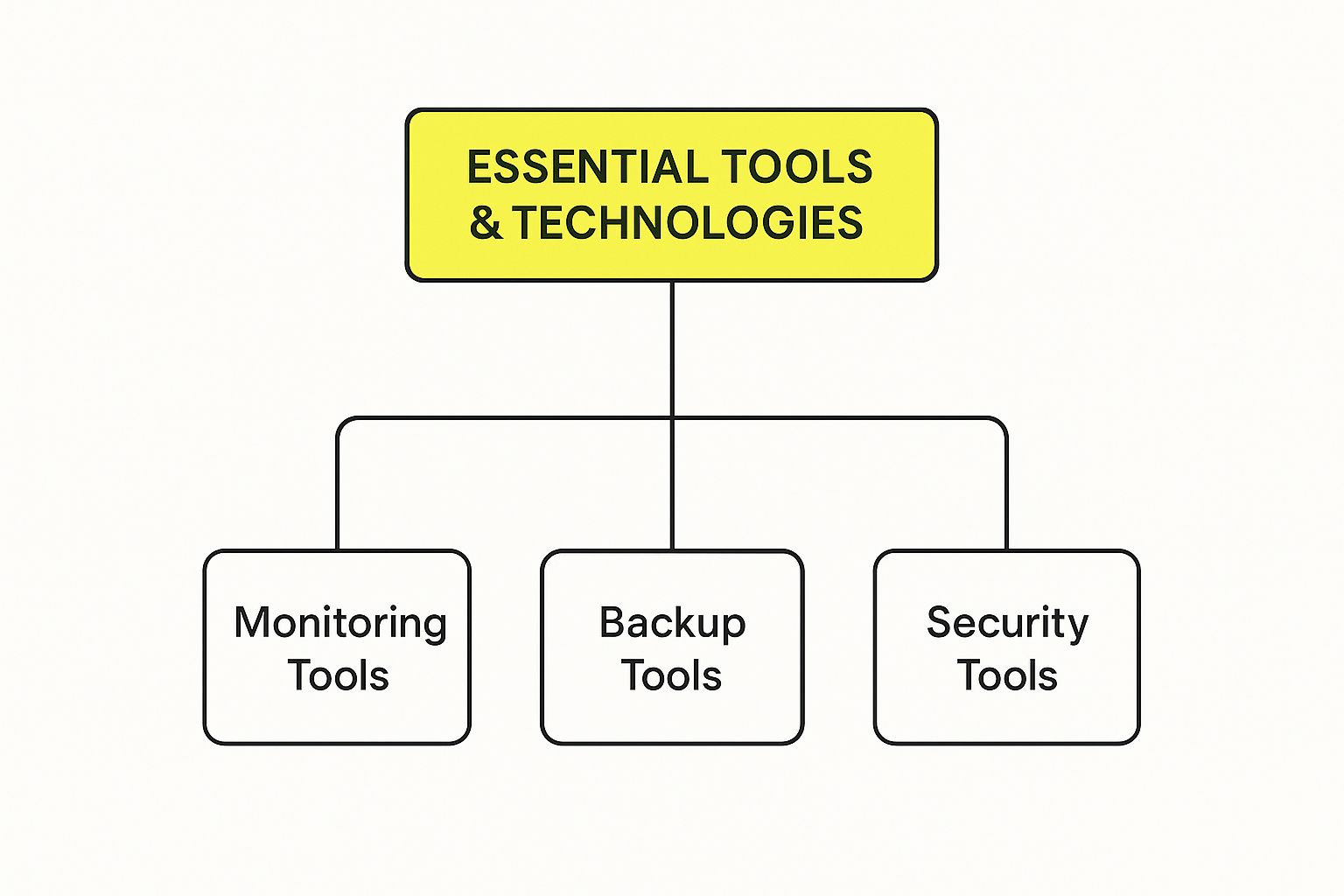
This image illustrates how a solid maintenance plan is really an ecosystem. It’s built on specialized tools for monitoring, backups, and security that all work together to protect your store.
Security and Updates
First and foremost, a maintenance plan has to protect your store and your customers' data. This is a 24/7 job that never stops, and it involves a few key actions.
- Proactive Security Scans: We’re constantly scanning for malware, potential weak spots, and any suspicious activity. It’s like having a digital security guard patrolling your store around the clock, spotting trouble before it can cause any real damage.
- Theme and App Updates: Outdated themes and apps are one of the biggest security holes in a Shopify store. A good maintenance team will carefully test and install updates to patch these vulnerabilities and make sure they don't clash with other parts of your site.
- Automated Data Backups: Daily, automated backups are your ultimate safety net. If the worst happens—a major bug, a server crash, or an attack—having a fresh, complete copy of your store means you can get back online in a hurry with little to no data loss.
Performance and Optimization
A slow, clunky website is a conversion killer. There’s no way around it. That's why a huge part of ongoing maintenance is focused on making sure your site is lightning-fast and works flawlessly for every visitor.
A study found that 40% of users will abandon a website if it takes more than three seconds to load. Speed isn’t just a nice-to-have feature; it’s a must-have for any e-commerce business.
This means we get under the hood of your store. Experts will dig into your theme’s code, compress images so they load instantly, and fine-tune how your store interacts with its server. For a deeper dive into these technical details, our guide on Shopify performance optimization is a great resource.
Data Management and Integrity
Good maintenance goes beyond just the technical stuff. It's also about keeping your business data clean, accurate, and organized. This helps your day-to-day operations run smoothly and makes sure your marketing campaigns are actually reaching the right people.
For instance, regularly cleaning your email list is a classic data management task. It gets rid of inactive subscribers, improves your email deliverability, and stops you from wasting money marketing to dead ends.
Other common tasks include:
- Fixing Broken Links: Hunting down and fixing 404 errors to improve the user experience and your SEO.
- Database Health Checks: Making sure your product and customer data loads quickly.
- Content Audits: Reviewing product descriptions and other site content to keep it fresh and accurate.
The Essential Shopify Maintenance Checklist
To give you a clearer picture, here’s a breakdown of the typical tasks you’d find in a comprehensive maintenance plan, organized by how often they need to be done.
| Task Category | Specific Action | Frequency | Why It's Important |
|---|---|---|---|
| Security | Run malware and vulnerability scans | Daily | Catches threats before they can do damage. |
| Backups | Perform a full site and data backup | Daily | Your ultimate safety net for disaster recovery. |
| Performance | Check for and apply critical app/theme updates | Weekly | Patches security holes and fixes bugs. |
| Data Integrity | Scan for and repair broken links (404s) | Weekly | Improves user experience and SEO. |
| Performance | Monitor site speed and Core Web Vitals | Monthly | Ensures a fast, smooth experience for shoppers. |
| Data Integrity | Review and clean up the customer database | Monthly | Keeps your marketing data accurate and effective. |
| Optimization | Conduct a full theme and code audit | Quarterly | Identifies opportunities to improve speed and functionality. |
| Data Integrity | Perform a content audit (products, blogs) | Quarterly | Keeps your store's information fresh and relevant. |
This checklist shows how a great maintenance plan provides 360-degree care for your Shopify store. By combining these security, performance, and data-focused tasks, you're not just fixing problems—you're actively building a stronger, more resilient business.
The Real-World Impact on Your Business
Let's be clear: smart maintenance isn't just another line item on your expense sheet. It's a direct investment in your store's profitability and, just as importantly, your customer's trust. While things like code audits and security scans might sound like tech jargon, their impact on your bottom line is very real. Investing in professional Shopify maintenance services is what takes a store from just "working" to actually thriving.
Think about it. A store that runs without a hitch makes for a fantastic customer experience. When your pages load in a snap and checking out is effortless, you're building the kind of trust that turns one-time buyers into loyal fans. That repeat business is the lifeblood of any successful ecommerce brand.
Protecting Your Hard-Earned Revenue
The link between a well-maintained site and your revenue is impossible to ignore, especially when you look at how people shop today. A staggering 69% of online sales during big shopping holidays happen on a phone. If your mobile site is slow or buggy, you're not just creating a minor annoyance—you're actively losing money. Consistent mobile optimization, a key part of any good maintenance plan, plugs this massive hole in your revenue bucket.
A healthy store also gives you the breathing room to focus on how to increase sales on Shopify because you're not constantly putting out fires. It ensures every single visitor has the best shot at becoming a customer, no matter what device they're using.
Building Lasting Customer Loyalty and Trust
A smooth, fast, and secure website is the bedrock of customer retention. Shopify stores already do well here, with an impressive 27% of customers returning for another purchase. Professional maintenance helps you hold onto and even grow that number by getting rid of the little frustrations—like slow-loading pages or broken links—that make people click away.
Every dollar you spend on proactive maintenance is a vote for a better customer journey. It tells your audience you respect their time and trust, which is the single best way to build a loyal following that keeps coming back.
This commitment to a quality experience is what separates the big players from everyone else. When you look at the full range of Shopify support and maintenance services, you realize it’s not just about fixing what’s broken. It's about building a place where customers feel confident and happy to spend their money, securing your spot in a crowded market and boosting your profits. The takeaway is simple: maintenance isn't a cost center; it's a powerful engine for growth.
How to Choose the Right Maintenance Partner
Picking a partner for your Shopify maintenance services is a big deal. Think of it like hiring a general contractor for your dream house—you need someone you can trust completely, who knows every stud and wire, and who won't panic when an unexpected problem pops up. The right partner isn't just another vendor; they're an extension of your team, invested in keeping your store running smoothly so you can focus on growth.
It's always tempting to go for the cheapest quote, but that's usually a trap. A low price often means you're sacrificing deep expertise or quick support, which can end up costing you a fortune in lost sales when something inevitably breaks. The real goal is to find a partner who delivers genuine value through a blend of skill, reliability, and proactive care.
Vet Their Shopify Expertise
First things first: your partner needs to live and breathe Shopify. A general-purpose web agency might know their way around the basics, but Shopify is its own beast with a unique ecosystem of themes, apps, and Liquid code. A true specialist just gets it. They know which apps tend to conflict, how to navigate complex theme customizations, and can pinpoint the root cause of an issue in minutes, not hours.
When you're talking to potential partners, ask them point-blank about their experience with stores like yours. Have they worked with businesses in your industry or of a similar size? Their portfolio and past projects will tell you everything you need to know about their real-world, platform-specific knowledge.
Communication and Response Times
When your storefront has a glitch, you need help now. Vague promises about support won't cut it. Before you sign anything, you must get absolute clarity on their communication process and guaranteed response times.
A great maintenance partner operates with total transparency. You should never have to wonder what they're working on or wait days for a response to a critical issue. Their process should give you peace of mind, not more anxiety.
Dig into their emergency support plan. What's the protocol if your site crashes during a Black Friday flash sale? Who do you call, and what's their guaranteed time to start working on a fix? A solid partner will have a clear, documented process for high-stakes situations.
Questions to Ask a Potential Partner
Walking into a sales call armed with the right questions is your best defense. It helps you cut through the marketing fluff and get a real sense of their capabilities. A partner worth their salt will welcome your questions and give you straight, confident answers.
Here’s a checklist to get you started:
- What is your experience specifically with the Shopify platform? Don’t settle for a simple "we've worked with it." Push for details on specific projects or challenges they’ve solved.
- Can you provide case studies or references from clients similar to my business? This is the best way to verify their track record and see if their skills are relevant to your store.
- What are your guaranteed response times for both standard and emergency issues? Get specific numbers and make sure they're written into the service level agreement (SLA).
- How do you handle theme and app updates? The only right answer is: "We test everything on a staging site first." Anything else puts your live store at risk.
- What is included in your standard maintenance package? Ask for a detailed list of every task, from backups and security scans to performance checks, so there are no surprises down the road.
Choosing the right partner is about more than just finding technical skill; it's about finding a reliable ally who will support your vision. This decision touches everything from your daily operations to your long-term success. For a broader look at what’s involved, our complete guide to Shopify store management provides additional insights.
Common Questions About Shopify Maintenance

If you're thinking about Shopify maintenance services, you probably have a few questions. That's a good thing. Getting clear answers is the first step toward making a smart decision for your online store.
Let's walk through some of the most common questions and concerns I hear from business owners. The goal here is to give you the confidence to pick the right path for your business and avoid any nasty surprises down the road.
Can I Handle Shopify Maintenance Myself?
Honestly, it depends. You can definitely handle basic tasks like updating product info or writing a blog post. But true maintenance is a whole different beast. It’s about diving into the technical side of things—running security audits, optimizing theme code, or figuring out why two apps suddenly decided to break your checkout.
Trying to DIY everything can get overwhelming fast. The bigger risk? A small mistake, like a bit of bad code or a missed security patch, could lead to major downtime or a data breach. Those emergencies almost always cost way more in lost sales and frantic fixes than a professional maintenance plan ever would.
How Much Do Shopify Maintenance Services Cost?
This is the big one, and the answer is: it varies. The cost of Shopify maintenance services really depends on your store's size, how complex it is, and the level of support you need. There’s no simple, one-size-fits-all price.
A basic plan that covers the essentials—monitoring, backups, and small updates—might start at a few hundred dollars a month. If you need something more robust, like performance tuning, SEO help, or on-call development support, you could be looking at a few thousand. The trick is to find a plan that actually matches your business goals and budget.
Think of it less as a cost and more as insurance for your revenue. The right plan prevents expensive emergencies and protects the sales your store generates every single day.
How Often Does My Store Need Maintenance?
Good maintenance isn't a one-and-done deal; it's a continuous process. Think of it like tuning an instrument. Different parts need attention at different times to keep everything sounding great.
- Daily: Your site should be monitored for uptime and security threats 24/7. Daily backups are also a must-have.
- Weekly: This is a good time to check for theme and app updates. A pro will always test these in a safe staging environment first to make sure they don't cause new problems.
- Monthly/Quarterly: Deeper dives happen less often. Things like performance audits, code reviews, and SEO check-ups are usually done monthly or quarterly to keep your store healthy for the long haul.
What Happens If I Neglect Store Maintenance?
Ignoring store maintenance is like ignoring the "check engine" light on your car. You might get away with it for a little while, but eventually, you’re going to break down.
Your site speed will slow to a crawl, which kills your search rankings and sends customers running to your competitors. Even worse, you become an easy target for hackers who love to exploit outdated software. A small, preventable issue will eventually snowball into a full-blown crisis that could put your entire business at risk. Proactive care is always the smarter—and safer—choice.
Ready to ensure your Shopify store is always secure, fast, and ready for growth? The experts at E-commerce Dev Group provide comprehensive Shopify maintenance services tailored to your business needs. Discover our maintenance plans and protect your investment today.
