


Understanding Website Speed Optimization Services
Think of website speed optimization services as a professional pit crew for your digital storefront. While a race car driver knows how to handle the track, it’s the pit crew that brings the specialized tools and deep knowledge to tune every part of the car for maximum performance. In the same way, you know your business best, but these specialists know how to make your website perform at its peak. Their work goes far beyond basic tips, offering a detailed overhaul of your site’s technical core to improve user experience and support business growth.
This is much more than just installing a caching plugin and hoping for the best. Professional services use a systematic approach to find and fix performance issues that often go unnoticed. It’s less about a quick patch and more about a strategic adjustment. To get started, it helps to build a clear picture of professional website optimization services and what they involve. They follow a structured process from analysis to implementation, making sure every change creates a real, measurable improvement.
From Diagnosis to Delivery: What’s Included?
Working with a speed optimization provider isn’t a one-time fix; it’s an ongoing relationship focused on performance excellence. The process usually kicks off with a detailed audit, which is like a complete diagnostic checkup for your website. This first step uncovers everything that might be slowing your site down, from bulky code and large images to server-side delays.
The main services you can expect generally cover:
- Comprehensive Audits: Using advanced tools to find the root causes of slow load times, like server response problems, inefficient code, and heavy media files.
- Strategic Implementation: Prioritizing fixes based on what will have the biggest impact. This could involve minifying CSS and JavaScript files, compressing images, and setting up advanced caching.
- Server-Side Enhancements: Tuning the hosting environment, enabling Gzip compression, and reducing the Time to First Byte (TTFB) to ensure the server delivers information quickly.
- Ongoing Monitoring: Keeping a constant watch on performance metrics to prevent new slowdowns and adapt to changing web standards, which keeps your site consistently fast.
Why Partner with a Specialist?
The need for faster websites has made speed more than just a technical number—it's now a key part of business strategy. This change is clear in the market itself; the global industry for website speed tools is valued at around $2 billion in 2025 and is expected to grow at an annual rate of 15% through 2033. This growth shows that businesses are seeing the huge value in getting professional help. You can read more about these market trends and their implications.
When you hire a website speed optimization service, you're not just buying technical fixes. You're getting a partner who is dedicated to your site's long-term health. They turn complex technical information into real business results, ensuring your online presence is not only fast but also effective at turning visitors into happy, loyal customers.
The Essential Components That Drive Speed Success
Achieving a lightning-fast website isn't about one single trick; it's about a coordinated effort across several important areas. Think of professional website speed optimization services like a pit crew for a race car. The crew doesn't just change one tire—they work on the engine, aerodynamics, and fuel all at once to shave off precious seconds. Similarly, a speed expert targets different parts of your website that, when improved together, create a dramatically faster experience for your visitors.
This approach looks past simple fixes to improve the core structure of your site's performance. The goal is to make your website not just look fast, but feel instantly responsive to every user.
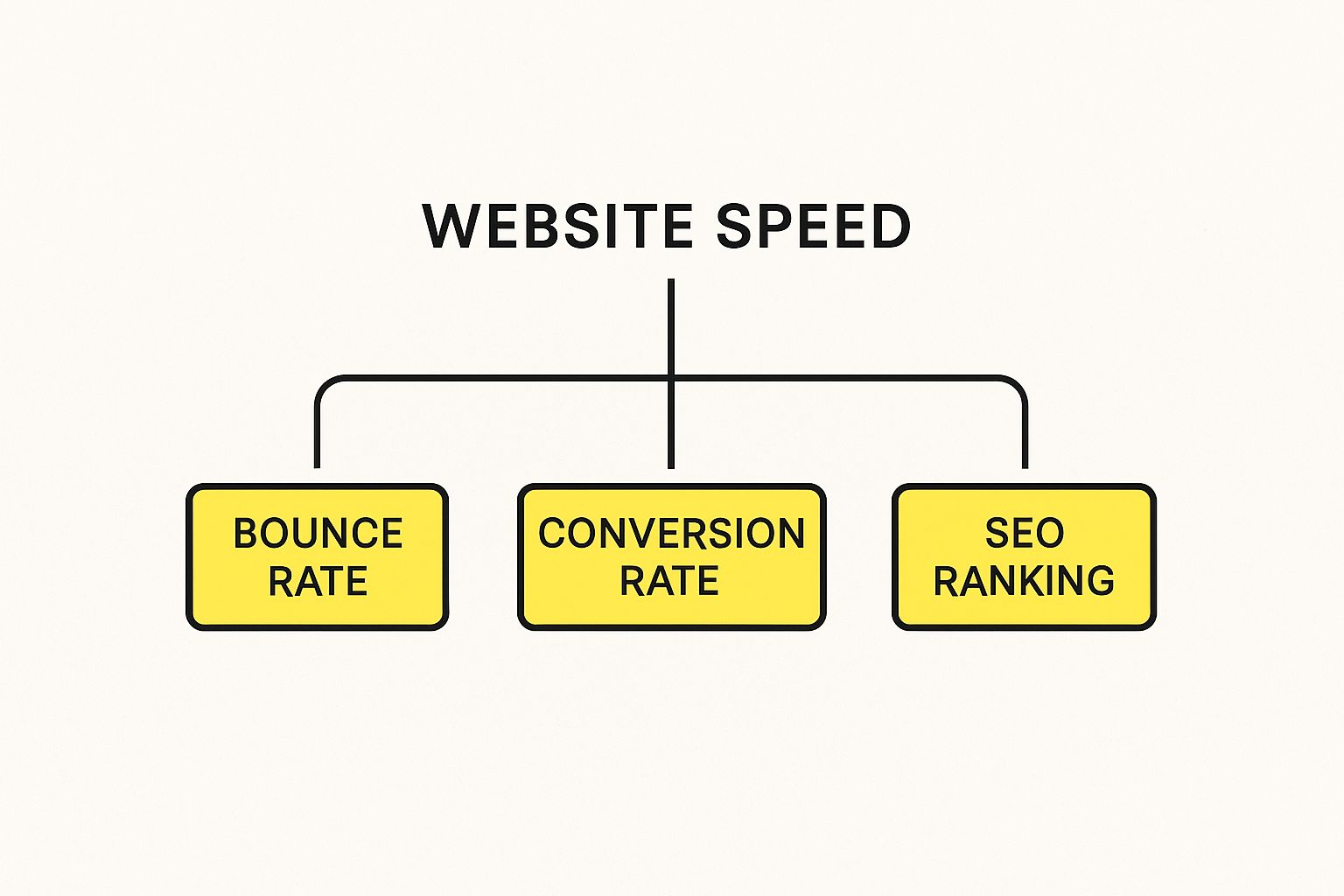
As the diagram shows, speed isn't just a technical detail. It directly influences user behavior and search engine visibility, making it a powerful tool for business growth.
Server and Database Optimization
The path to a faster website begins at its very foundation: the server. Your server is the engine that keeps your entire site running. If it's slow, everything else will be too. Professional services focus on reducing Time to First Byte (TTFB), which is the time it takes for your server to start sending the first piece of information to a user's browser. A TTFB under 200ms is the gold standard.
This is achieved through:
- Hosting Environment Tuning: Making sure your hosting plan can handle your traffic. This often means moving from crowded shared servers to more powerful options like a Virtual Private Server (VPS) or dedicated hosting.
- Database Query Optimization: Making it easier for your website to find and retrieve information. An unoptimized database is like a messy warehouse—it takes ages to find anything. Experts organize and index the database so it can answer requests almost instantly.
Front-End Code and Asset Management
After the server responds, the user’s browser still needs to download and piece together your webpage. This is where front-end optimization is key. Every script, style file, and image adds to the total load time.
- Code Minification and Combination: This technique removes all unnecessary characters (like spaces and comments) from code files and merges multiple files into one. It’s like sending one well-packed box instead of a dozen separate envelopes, significantly reducing the number of trips the browser has to make.
- Image Compression and Modern Formats: Large images are a common cause of slow websites. Optimization means using advanced compression and modern formats like WebP, which provide great quality with a much smaller file size. Effective file size reduction is a cornerstone of speed success. To learn more, this professional's guide to file compression offers valuable insights.
Advanced Caching and Delivery Strategies
Finally, smart delivery systems make sure your site’s files get to the user as quickly as possible, no matter where they are in the world.
- Browser and Server Caching: Caching is like telling a visitor's browser to keep a local copy of your website's static elements (like logos and style sheets). When they visit again, the browser loads these saved files instead of re-downloading them, making return visits feel immediate.
- Content Delivery Network (CDN): A CDN creates copies of your website on servers across the globe. When someone visits your site, the content is sent from the server closest to them. This dramatically reduces the physical distance the data has to travel, cutting down on load times.
To help you understand how these components work together, the table below compares different optimization techniques, their impact, and typical costs.
| Optimization Technique | Impact Level | Implementation Complexity | Typical Speed Improvement | Cost Range |
|---|---|---|---|---|
| Server/Hosting Upgrade | High | Low to Medium | 500ms – 2s | $20 – $500+/month |
| Database Optimization | Medium | Medium to High | 200ms – 1s | $150 – $1,000 one-time |
| Code Minification | Low | Low | 50ms – 200ms | $50 – $250 one-time |
| Image Compression/WebP | High | Medium | 1s – 3s+ | $100 – $600 one-time |
| Browser/Server Caching | High | Low to Medium | 1s – 5s (on repeat visits) | $50 – $300 one-time |
| Content Delivery Network (CDN) | High | Low | 500ms – 1.5s | $0 – $200+/month |
As you can see, a balanced strategy is the most effective. Techniques like implementing a CDN and optimizing images offer a high impact for relatively low complexity, making them great starting points. More complex tasks like database optimization can provide significant gains for sites with heavy traffic or complex features. For platforms like Shopify, where every second counts, these strategies are essential. You can learn more about boosting your store's speed in our guide on Shopify performance optimization.
How Speed Optimization Directly Impacts Your Revenue

While technical fixes like code minification and server response times are important, their real worth is measured in dollars and cents. Faster load times have a direct and positive effect on sales, average order values, and customer lifetime value. Think of your website's speed as an invisible salesperson guiding visitors toward the checkout. A quick, responsive site builds trust and keeps people engaged, but a slow one acts like a roadblock, sending frustrated users straight to your competitors.
Every second, or even millisecond, you trim from your load time creates a ripple effect on your bottom line. This isn't just about preventing user frustration; it's about actively improving the numbers that define business success. The link between speed and revenue is so clear that investing in website speed optimization services is one of the highest-return activities a business can pursue.
The Conversion Rate Connection
The most immediate financial benefit of website speed is seen in the conversion rate. When a page loads instantly, visitors are more likely to stay, look around, and complete a purchase. Every moment of delay adds friction, increasing the chance that a potential customer will give up and leave. This isn't just a theory; it's a measurable fact.
Let's look at a real-world e-commerce example. An online store with 50,000 daily visitors and a 3.5% conversion rate can see huge gains from a small speed boost. By cutting the page load time by just one second, the conversion rate could climb to 3.7%. This slight adjustment increases daily orders from 1,750 to 1,850. If the average order is $50, that single second of improvement boosts daily revenue from $87,500 to $92,500. That adds up to an incredible $1.8 million in extra revenue over a year. You can dive deeper into these powerful e-commerce speed statistics and their financial implications.
Calculating Your Potential Return on Investment (ROI)
To figure out the potential ROI for your own business, you can follow a few simple steps:
- Find Your Data: Pull your average monthly traffic, current conversion rate, and average order value from your analytics platform.
- Estimate Improvement: Decide on a realistic conversion rate increase. A conservative 10-20% lift is common after professional optimization.
- Calculate the Gain:
- New Conversion Rate = Current Rate x (1 + Estimated Improvement %)
- Additional Monthly Orders = (New Conversion Rate – Current Rate) x Monthly Traffic
- Additional Monthly Revenue = Additional Monthly Orders x Average Order Value
This formula gives you a concrete number to compare against the cost of professional services. It's also important to see how website speed fits into your broader online strategy. To get a better perspective, you can explore a comprehensive guide to digital marketing. This context helps you understand how a faster site makes all your other marketing efforts more effective, creating a strong foundation for long-term growth.
The Psychology Behind Speed Expectations
Speed is far more than just a technical number; it's a powerful psychological trigger that shapes a user’s entire view of your brand. In a world of instant downloads and on-demand streaming, our brains have been conditioned to expect immediate results online. A slow website doesn't just cause a minor delay—it creates real frustration and can even feel disrespectful of the user's time. This emotional reaction is the invisible force that decides whether a visitor stays or leaves.
When a page struggles to load, it breaks the user's concentration, creating a negative experience that can be surprisingly strong. Research shows that 80% of users find a slow-loading site more frustrating than one that is temporarily down. Even short delays can increase stress levels by 33%. This isn't just about impatience; it's a violation of modern expectations. Professional website speed optimization services understand this crucial human element, focusing not just on cutting milliseconds but on building a smooth experience that creates trust from the first click.
The Three-Second Rule and Its Consequences
The window to grab a user's attention is incredibly small. Studies consistently show that once a page takes longer than three seconds to load, the psychological cost becomes too high for many visitors. In fact, around 40% of online shoppers will leave an e-commerce site if it takes longer than three seconds, and 83% of people now expect websites to load within that brief period. The rewards for speed are just as significant: sites that load in one second can see conversion rates up to five times higher than those taking ten seconds. You can learn more by exploring these compelling findings on user behavior and website speed.
These numbers highlight a critical truth: speed directly affects a user’s decision-making. A delay suggests inefficiency and a lack of care, feelings that visitors subconsciously apply to your products and services.
How Slow Speeds Damage Brand Perception
The negative effect of a slow website goes far beyond a single lost sale. It can permanently harm your brand's reputation. A sluggish experience creates lasting negative feelings, making users less likely to come back or recommend your site to others.
Here’s how the damage happens:
- Perceived Unreliability: A slow site can feel broken or untrustworthy. Users might worry that if a site can't even load correctly, it definitely can’t be trusted to handle their personal or payment details securely.
- Negative Association Transfer: The frustration felt during a long wait becomes linked to your brand. Even if a user eventually makes a purchase, they might leave with a bad impression, reducing the chance of them becoming a repeat customer.
- Competitive Disadvantage: In any market, users have plenty of other options. A single frustrating experience is all it takes to send them straight to a faster competitor, where they might form a new brand loyalty.
Choosing The Right Speed Optimization Partner

Picking a provider for website speed optimization services is more like finding a strategic partner than hiring a contractor. The right choice can directly boost your revenue and user engagement, but the wrong one often leads to wasted money and technical frustrations. Your aim is to find an expert whose skills, methods, and communication align with your business goals.
The selection process demands a close look beyond flashy sales pitches to gauge real technical skill and a history of success. You need to ensure they have the expertise to navigate the specific complexities of your website, whether it’s a bustling e-commerce store or a media-rich platform. For instance, a partner specializing in Shopify will understand its unique challenges and offer better-suited solutions. If your store is built on Shopify, our guide to effective Shopify store management can highlight the kind of specialized knowledge to look for.
Evaluating Technical Capabilities and Methodology
A quality partner will be open and clear about their process. They won't hide behind buzzwords but will instead explain their diagnostic and implementation plans. When you talk to potential providers, your goal is to understand how they achieve results, not just what they promise.
Here are a few essential questions to guide your evaluation:
- Diagnostic Tools: What tools do you use for your initial audit? What specific metrics do you track beyond a basic score from PageSpeed Insights?
- Optimization Approach: Do you focus on front-end or back-end fixes first? How do you balance automated tools with manual code optimization for the best results?
- Testing and Validation: How do you test changes to prevent breaking the live site? What is your rollback plan if an update causes unexpected problems?
A confident, detailed response is a great sign. A major red flag, however, is a provider who guarantees a perfect score (like "a 100 on PageSpeed Insights") before even looking at your site. These promises often lead to aggressive, quick-fix solutions that can damage user experience or site stability in the long run.
Interpreting Case Studies and Service Models
Case studies and testimonials are useful, but you must read between the lines. Look for results that connect to business goals. Did their work lead to a measurable lift in conversion rates, a drop in bounce rates, or better SEO rankings? These are the outcomes that truly drive your business forward.
Also, think about which service model suits your needs:
- One-Time Optimization: This is great for a major, initial speed overhaul. Think of it as a comprehensive tune-up for your website.
- Ongoing Performance Partnership: This is a monthly retainer model for continuous monitoring and optimization. It's ideal for businesses where peak performance is mission-critical and requires constant attention.
To help you organize your thoughts and compare providers systematically, we've created the evaluation matrix below. It provides a structured way to assess potential partners against the criteria that matter most.
Speed Optimization Service Provider Evaluation Matrix
A comprehensive comparison framework for evaluating different service providers based on key criteria.
| Evaluation Criteria | Essential Features | Questions to Ask | Red Flags | Weight Factor |
|---|---|---|---|---|
| Technical Expertise | Deep knowledge of your specific platform (e.g., Shopify, WordPress, Magento). Proven experience with similar site complexities. | "Can you show me examples of sites like ours that you've optimized?" "What are the common performance bottlenecks you see on [Your Platform]?" | Vague answers; over-reliance on basic plugins without custom work; lack of platform-specific knowledge. | High |
| Proven Results | Case studies with clear business metrics (e.g., conversion rate increase, revenue growth, lower bounce rate). | "What was the direct business impact of your work for Client X?" "Can you walk me through the 'before' and 'after' metrics for a past project?" | Focus only on vanity speed scores; no data-backed results; unverifiable claims. | High |
| Process Transparency | Clear communication, detailed project plans, and regular progress reports. | "What kind of reporting can we expect and how often?" "Who will be our main point of contact?" | Lack of a clear process; no direct access to a project manager; vague communication. | Medium |
| Methodology & Testing | A balanced approach to front-end and back-end optimization. A clear testing protocol and rollback plan. | "How do you test changes before deploying them live?" "What is your policy if an optimization causes a bug or breaks a feature?" | "Guarantees" of a perfect score; no mention of a staging environment or testing; no post-launch support. | Medium |
| Support & Warranty | Post-optimization support to fix any resulting issues. A clearly defined warranty period for the work performed. | "What does your support period cover after the project is complete?" "What is your warranty on the optimizations?" | No mention of a warranty; additional charges for fixing issues caused by their work. | Medium |
This matrix is a powerful tool to move from a gut feeling to a data-informed decision. By weighting each criterion based on your business priorities, you can score each potential partner and identify the one that is truly the best fit for a long-term, successful relationship.
What To Expect During The Optimization Process
Starting a website speed optimization project can feel a bit like a home renovation while you're still living in the house. It's an process that calls for careful planning, step-by-step work, and open communication to keep your business running smoothly. Knowing the typical journey from start to finish helps set clear expectations and leads to a successful outcome. This is a structured partnership, not a quick fix, aimed at delivering lasting performance improvements without causing chaos.
A professional optimization project is methodical, making sure every adjustment is deliberate and has a purpose. It's much more than just running a tool and applying generic suggestions; it’s a specific strategy built around your website and business objectives.
The Discovery and Audit Phase
The process always kicks off with a deep dive into your website's current performance. Think of this as the initial survey and inspection before a renovation begins. Experts will run a detailed audit to find the root causes of slowness, not just the symptoms. This includes:
- Performance Benchmarking: This step establishes a baseline for your current speed using advanced tools. It's not just a single score from PageSpeed Insights but a detailed analysis of Core Web Vitals, Time to First Byte (TTFB), and how resources load across different devices and locations.
- Bottleneck Identification: The team pinpoints the exact elements causing delays. This could be anything from slow database queries and clunky plugins to large images or scripts that block the page from loading.
- Strategic Prioritization: An action plan is created based on impact and effort. Not all fixes are equal. The team will identify the "low-hanging fruit" for quick, significant speed gains, as well as plan for more complex, long-term improvements. For e-commerce stores, a detailed audit is critical. You can learn more about what this involves in our post on conducting comprehensive Shopify store audits.
Implementation and Staging
With a roadmap in place, the implementation work begins. To avoid any disruption to your live site, all changes are first made in a staging environment. This is a private copy of your website where the optimization team can work safely. It’s like building new kitchen cabinets in a workshop before bringing them into your home for installation.
This stage usually involves a series of technical tasks, such as:
- Minifying CSS and JavaScript files to reduce their size.
- Optimizing images and converting them to modern formats like WebP.
- Configuring advanced caching to serve content faster.
- Setting up or tweaking a Content Delivery Network (CDN) to reduce latency.
Each change is carefully tested in the staging area to confirm it improves speed without breaking any part of your website. This careful, isolated approach is a key part of professional website speed optimization services.
Final Testing and Deployment
After all optimizations are implemented and tested on the staging site, it’s time for the final review. You'll get to see the "before and after" comparison, with clear data demonstrating the performance gains. Once you give the green light, the optimized version is carefully pushed to your live website, usually during off-peak hours to minimize any effect on your visitors. The process wraps up with a final check on the live site to make sure everything is working perfectly and the speed improvements are real.
Making Your Speed Optimization Decision
Now that you have a firm grasp of how site speed affects your business—from the technical details to the psychology of your customers and your bottom line—it's time to make a choice. The journey through website speed optimization services shows that performance is more than just a number; it directly influences your revenue and how people perceive your brand. The question is no longer if you should optimize, but how and with whom you should partner.
Think back to the potential return on your investment. Even a modest projection of how much your conversions could increase can build a strong financial argument for taking the next step.
Creating Your Action Plan
To move forward with certainty, it helps to structure your next steps. A clear plan ensures you choose the right partner and sets your project up for success from day one.
- Finalize Your Budget: Based on your ROI calculations, set a realistic budget. Remember to view this as an investment in your business's foundational strength, not just another line-item expense.
- Re-evaluate Your Shortlist of Providers: Use the evaluation criteria from the previous section to compare your top candidates. Pay close attention to their proven results with businesses like yours and their commitment to transparency.
- Prepare Your Team: Get your key stakeholders on board by explaining the upcoming project. Outline the process, give them an idea of the timeline, and highlight the positive outcomes to build internal support and set clear expectations.
Take the Next Step
Selecting the right partner can turn a technical task into a true strategic advantage. If you're ready to see what your Shopify store can really do with a dedicated team of experts delivering measurable results, now is the time to act.
