


Why Your E-Commerce Store Needs an SEO Reality Check
Let's be real for a moment. Your online store is competing with millions of others for your customer's attention. The tough part is that many store owners don't realize what's holding them back. They see traffic stagnating or sales dipping but can't figure out why, which often leads to wasted ad money and a lot of frustration.
The Hidden Costs of Flying Blind
The most damaging problems are usually the ones you can't see. We're talking about minor technical bugs, product pages targeting the wrong keywords, or a confusing site layout that makes search engines and customers turn away. Individually, they seem small, but they add up, dragging down your revenue. Think of it like a slow leak in a tire; you might not notice it day-to-day, but it's constantly hurting your performance and will eventually bring you to a halt.

This diagram shows that SEO isn't a one-off task but a continuous loop of analysis and improvement. If you miss one part of the cycle, like your site's technical health or content quality, the whole system can stall. For e-commerce sites, search engines pay extra close attention to the user's journey from discovering a product to making a purchase.
Why Audits Are a Health Check, Not a One-Time Fix
The most successful e-commerce brands don't treat SEO audits as an emergency fix. They see them as regular health checkups. They know that search algorithms, competitor tactics, and even their own site can change. An online store that was perfectly tuned six months ago could be lagging today because of a Google update or a pile-up of small technical errors.
This proactive mindset is critical when you look at the numbers. Organic SEO is responsible for an incredible 23.6% of all e-commerce orders. That's a huge slice of a global market worth over $4.12 trillion. You can find more eye-opening e-commerce stats in this research. Simply ignoring the health of a channel that drives nearly a quarter of your potential sales is a massive business risk.
Performing a regular audit seo e commerce ensures you're always ready to capture your share of this valuable traffic. It’s about maintaining your store's peak performance, not just fixing things when they break. This ongoing review gives you the insights to invest your time and budget where they’ll have the biggest impact. To get a feel for how deep this process can go, you can explore our approach to thorough Shopify store audits.
Technical Foundation Deep Dive: What's Really Slowing You Down
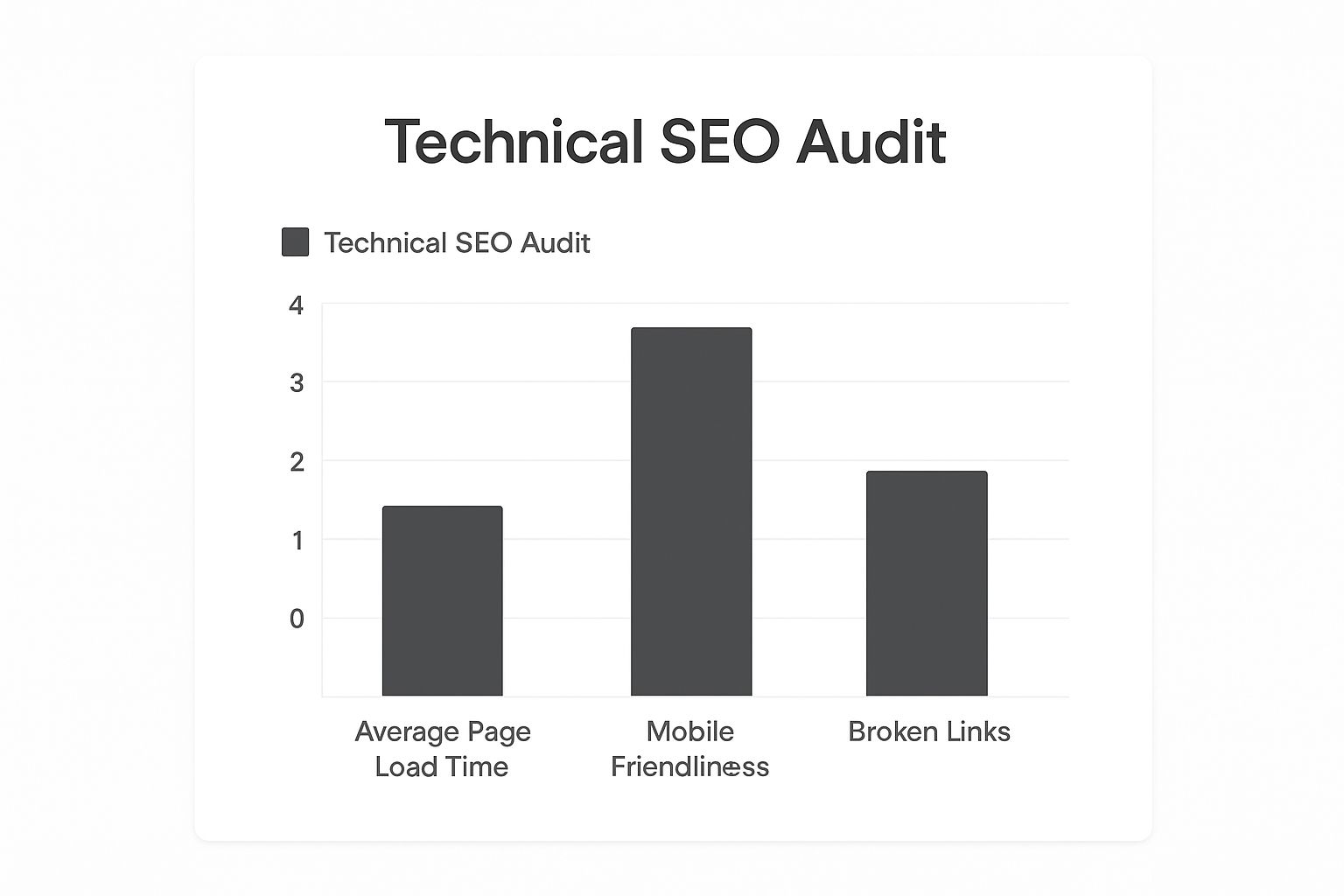
Think of your website’s technical health as the foundation of your entire e-commerce operation. If it's shaky, with cracks like slow loading times or broken pages, everything you build on top—from beautiful design to clever marketing—is at risk. A technical audit seo e commerce isn't about just ticking boxes; it's about finding those hidden issues before they do real damage to your rankings and revenue.
Uncovering Speed Bumps and Crawl Errors
Let's get our hands dirty with some essential tools. Your first stop should always be Google’s own PageSpeed Insights. This gives you a direct look at how Google sees your site's performance, which is a massive ranking factor. You're not just aiming for a high score; you're hunting for specific diagnostics like Time to Interactive and Largest Contentful Paint that tell you how your customers actually experience your store.
Here's a glimpse of what a PageSpeed Insights report provides:
The report conveniently splits mobile and desktop performance, flagging critical problems. The real value is in the "Opportunities" section, which gives you a clear list of fixes, like compressing images or getting rid of unused JavaScript. If you do find major speed issues, our detailed guide on Shopify performance optimization offers more targeted solutions.
Don't be discouraged by a low score. As of 2025, the average eCommerce website only gets a Google Lighthouse performance score of 67/100. Research also found that 90% of the lowest-performing sites had significant user experience problems, proving the direct link between technical health and customer happiness. You can read the full research on e-commerce benchmarks to see how you compare.
To help you prioritize, here’s a quick checklist of the technical elements you should be auditing. We've laid out what to look for, its priority, and the potential impact it could have on your store.
E-Commerce Technical SEO Checklist
Essential technical elements to audit with priority levels and impact assessment
| Technical Element | Priority Level | Potential Impact | Audit Tool |
|---|---|---|---|
| Site Speed (LCP, INP) | High | High (Rankings, User Experience, Conversions) | Google PageSpeed Insights |
| Mobile-Friendliness | High | High (Mobile rankings, User Experience) | Google's Mobile-Friendly Test |
| SSL Certificate (HTTPS) | High | High (Security, Trust, Minor Ranking Factor) | Browser URL Bar |
| Broken Links (404 Errors) | High | Medium (User Experience, Wasted Crawl Budget) | Screaming Frog, Google Search Console |
| Duplicate Content | Medium | Medium (Diluted Rankings, Indexing Issues) | Screaming Frog, Manual Checks |
| Redirect Chains | Medium | Medium (Slower Page Load, Diluted Link Equity) | Screaming Frog |
| XML Sitemap Health | Medium | Medium (Crawl Efficiency, Indexing Coverage) | Google Search Console |
This table serves as a great starting point for your audit. By focusing on the high-priority items first, you can make the most significant improvements to your site's health and performance quickly.
Finding the Skeletons in Your Closet
Beyond just speed, you need to understand how search engines actually crawl your site. This is where a tool like the Screaming Frog SEO Spider becomes your best friend. It essentially acts like a search engine bot, crawling your entire store to flag issues that both users and Google might hit. If you're new to this world, the jargon can feel a bit overwhelming. Starting with the basics can make a huge difference; this Beginner's Guide to Search Engine Optimization is a fantastic resource to build a solid foundation.
Once you run a crawl, you're on the hunt for these silent revenue killers:
- Broken Links (404s): These are dead ends for both shoppers and search bots, sending a strong signal of a poorly maintained site.
- Redirect Chains: Making a bot (or user) jump through multiple hoops to get to a page slows things down and can weaken your link authority.
- Duplicate Content: Multiple URLs showing the same content, often from product variants or tracking parameters, can confuse search engines and split your ranking power.
- Missing Meta Titles/Descriptions: These are your free ad space on Google. Leaving them blank is a massive missed opportunity to attract clicks.
Tackling these technical flaws isn't just an SEO chore; it's a direct investment in your store's usability and the trust you build with customers. A clean, fast, and reliable site is the bedrock of a successful e-commerce business.
Product Page Optimization: Turning Browsers Into Buyers
Your product pages are the final frontier in your SEO efforts; they’re where all your hard-earned traffic converts into actual revenue. After you've sorted out the technical glitches and polished your site architecture, this is where the real action happens. A crucial part of any audit seo e commerce is looking at these pages not just for keywords, but for their power to persuade and sell. It's a blend of art and science.
Crafting Titles and Descriptions That Sell
Think of your product title as the headline on a billboard. It’s the first thing a shopper sees on your page and in the search results. It has to be a perfect mix of searchable keywords and appealing copy. Steer clear of robotic, database-style titles like "Black T-Shirt Cotton Medium."
Instead, give it some personality, like "The Essential Crew – Classic Black Pima Cotton T-Shirt." This version still has the important keywords ("black," "cotton t-shirt") but also injects some brand flavor that makes it more appealing.
The product description is your 24/7 salesperson. Your job isn't just to list specs; it's to tell a story that connects a feature to a real-life benefit.
- Instead of: "Water-resistant coating."
- Try: "Caught in a sudden downpour? Our water-resistant coating keeps you dry and comfortable, so your adventure doesn't have to stop."
This storytelling method holds a visitor's attention, which can lower your bounce rate and show Google you have a high-quality page. These ideas are fundamental to good content, and you can see how they apply elsewhere when you learn to optimize blog posts for SEO, as many of the same rules apply.
Structuring Your Page for People and Bots
A thoughtfully designed page works for both your customers and search engine crawlers. The most vital information should be right there, no scrolling required. Here's a solid example of a standard product page layout.
See the clear visual path? The big product images, a clean title, the price, and a prominent call-to-action button are all placed "above the fold." This setup helps shoppers make a fast decision. For the search engines, adding Product Schema markup is non-negotiable. This special code acts as a cheat sheet for Google, telling it the product's name, price, stock status, and review ratings, which can help you earn those flashy rich snippets in search results.
The Power of User-Generated Content
Never underestimate the SEO magic of customer reviews. They provide a constant stream of fresh, unique content that search engines love. Better yet, customers naturally use the same long-tail keywords that other shoppers are searching for. A simple reviews section can uncover more relevant keyword combinations than you could brainstorm on your own.
This user-generated content also builds trust and provides powerful social proof, which are key ingredients for boosting conversions. Also, have a plan for out-of-stock products. Deleting the page throws away all its hard-earned SEO value. A much smarter move is to keep the page live, clearly mark the item as unavailable, and offer an email notification for when it's back. This preserves your ranking power and captures a potential future sale.
Site Architecture Mastery: Building Your SEO Empire
Your store's site architecture is its foundation. A strong, logical structure acts like a clear map, guiding both shoppers and search engine bots directly to your products. Get it right, and you create a seamless experience. Get it wrong, and you're practically sending frustrated customers to your competitors.
Creating a Logical Hierarchy
It all starts with your URLs. A clean URL like yourstore.com/mens-apparel/shirts/long-sleeve is immediately understandable to a person and tells Google exactly how your pages are related. Now, compare that to a messy URL loaded with random numbers and parameters—it’s confusing for everyone and can drag down your rankings. A logical site hierarchy is a silent workhorse, making navigation intuitive, keeping visitors on your site longer, and lowering bounce rates.
This same logic applies to your category pages. They aren’t just passive landing pages; they are the central hubs that guide shoppers through your product offerings. Optimizing them is about finding the sweet spot between what your customers are looking for, the products you offer, and your business goals. This concept is the heart of information architecture.
This diagram shows the goal perfectly. Your site’s structure needs to live at the intersection of your users' needs, your content (your products), and the context of their shopping journey. When you nail this balance, your store becomes incredibly effective at turning browsers into buyers.
To help visualize this, here's a breakdown of what a strong versus a weak site structure looks like in practice.
Site Architecture Best Practices
Comparison of effective vs ineffective e-commerce site structure approaches
| Element | Best Practice | Common Mistake | SEO Impact |
|---|---|---|---|
| URL Structure | Clean, descriptive, and keyword-rich (e.g., /dresses/summer-dresses) |
Parameter-heavy, cryptic URLs (e.g., /cat?id=123&filter=456) |
Improves crawlability and user understanding; boosts keyword relevance. |
| Navigation | Simple, intuitive main navigation with a clear path to categories and products. | Overly complex mega-menus or hidden navigation. | Reduces bounce rates and improves user experience signals. |
| Click Depth | Important pages (top categories/products) are within 3 clicks of the homepage. | Key pages are buried deep within the site structure (5+ clicks). | Ensures "link equity" flows to important pages, helping them rank higher. |
| Category Pages | Well-organized, provides value, and links to relevant subcategories/products. | Thin content pages or giant, unfiltered product dumps. | Acts as a powerful hub for ranking for broader terms and distributing authority. |
As you can see, a well-planned structure is a critical asset. It directly influences how easily search engines can find and rank your pages, and how effectively users can find what they want to buy.
Leveraging Breadcrumbs and Internal Links
One of the best tools for reinforcing your site structure is breadcrumb navigation. These little trails, usually displayed as Home > Category > Product, serve two critical functions. For users, they show exactly where they are and offer a one-click path back. For SEO, they build a strong internal linking web that funnels authority from your homepage all the way down to individual product pages.
The single biggest architectural headache for most e-commerce stores is faceted navigation—all those filters for size, color, brand, and price. While fantastic for shoppers, they can create an SEO disaster by generating thousands of nearly identical pages with slightly different URLs. Suddenly, one category has hundreds of variations, which confuses Google and dilutes your ranking power. When doing an audit seo e commerce, tackling this is a top priority.
Here’s your game plan for taming faceted navigation:
- Use Canonical Tags: Make sure any filtered URL (like
?color=blue) includes arel="canonical"tag that points back to the main, unfiltered category page. This essentially tells Google, "All these variations are just children of this main page. Please give all the credit to the parent." - Strategic Noindex: For filter combinations that offer little unique value (like sorting by price), apply a
noindextag. This keeps them out of Google's index, preventing them from competing with your more important pages. - Control Crawling: Use your
robots.txtfile to block search bots from crawling parameter-filled URLs that don't offer any SEO value. This saves your crawl budget, ensuring Google spends its time on the pages you actually want to rank.
Ultimately, a well-built site architecture channels shoppers to the product and category pages where they are most likely to convert. With that solid structure in place, your focus can shift to persuasion. You can even use visual platforms to promote your best-structured pages. To learn more about maximizing sales, it's worth understanding strategies like how to sell on Pinterest, as mastering your site's foundation makes every other marketing effort more powerful.
Content Strategy Beyond Product Listings: Building Real Authority
Okay, so your technical SEO is clean and your product pages are looking sharp. That's fantastic, but it's really just the price of entry. If you want to truly stand out and become the go-to brand in your space, you need to think beyond just listing products.
This is where you shift from being a simple seller to becoming an indispensable resource. It's about creating content that helps, educates, and inspires your audience. When people trust your advice, they'll naturally trust your products when it's time to make a purchase.
Creating Content That Builds Trust and Links
The best part? You already have the secret ingredient: your own expertise. Your deep knowledge of your products and your customers' pain points is something your competitors can't easily copy. We're not talking about bland, keyword-stuffed blog posts here. We're talking about creating genuinely helpful content that solves problems.
The goal is to answer your customers' questions so well that they stop searching. Your products become a natural part of the solution, not a pushy sales pitch.
Consider these powerful, link-worthy content formats:
- In-depth buying guides: Don't just compare a few products. Create the definitive guide. For example, a "Complete Cyclist's Guide to Choosing a Bike Helmet" shouldn't just list models. It should explain safety certifications, how to measure for a perfect fit, the pros and cons of different ventilation systems, and why certain materials cost more. You're giving the customer the confidence to make an informed decision.
- Practical how-to articles: Show, don't just tell. If you sell premium kitchen knives, create a video and article on "Mastering a Chef's Knife: Essential Cuts and Techniques." This provides real value while subtly demonstrating the superior balance and sharpness of your product in action.
- Unique educational resources: Build something that becomes a true asset for your industry. A skincare brand could create an interactive "Ingredient Decoder" tool. Imagine customers being able to look up a compound from any product (even a competitor's!) and get a clear, scientific explanation of its benefits. That's how you build real authority.
But how do you find these golden content ideas? You don’t have to guess. Tools like Ahrefs are perfect for this kind of digital detective work. You can see exactly what kind of content is earning links for your competitors.

A quick look at a competitor’s backlink profile can reveal which of their guides or articles are attracting attention from high-authority sites. This gives you a ready-made roadmap for what resonates in your niche.
Smart Outreach and Link Building for E-commerce
So you've published an incredible guide. Job done, right? Not quite. Creating the content is only half the work. Now you need to get it in front of the right people. Think of backlinks from other reputable websites as votes of confidence. The more high-quality votes you get, the more Google sees your store as a trustworthy authority worth ranking.
This is why a thorough e-commerce SEO audit always digs into your backlink strategy—or lack thereof. Your outreach shouldn't feel like spamming a list of random websites. The key is to focus on building real relationships where everyone benefits:
- Genuine influencer partnerships: Forget huge celebrities. Look for micro-influencers who have a smaller but super-engaged audience that perfectly matches your customer profile. An authentic shout-out from them can be far more powerful.
- Collaborations with industry publications: Pitch your expertise to niche blogs or online magazines that your ideal customers already read and trust. Getting featured there positions your brand as a credible voice in the industry.
- Partnerships with complementary brands: Find a business that serves the same audience but isn't a direct competitor. For instance, if you sell premium coffee beans, why not co-create a brewing guide with a company that sells high-end grinders?
This strategic outreach is often called digital PR, and it's a serious game-changer. In fact, research shows that 52% of e-commerce sites use digital PR to build backlinks, and they aren't just looking for any link—they're targeting sites with an average Ahrefs Domain Rating of 46. This shows a clear focus on quality over quantity.
Here’s a startling fact: over 66% of all backlinks on the web are reportedly broken. This means that by building a portfolio of stable, high-quality links, you gain a massive advantage over competitors who are letting their link profiles decay. You can explore more powerful SEO statistics here.
This effort turns a simple piece of content into a long-term asset. It will continue to earn links, drive referral traffic, and boost your search authority for years, building a strong foundation for your brand's online presence.
Analytics That Actually Matter: Tracking Real Business Impact
Creating great content is a huge first step, but how do you actually prove it's helping your business grow? It's easy to get lost in a sea of data, with many store owners focusing on "vanity metrics" that look good on paper but don't actually move the needle. A proper e-commerce SEO audit cuts through that noise, focusing on the numbers that directly affect your bottom line. It’s about tracking revenue, not just rankings.
The foundation for all of this is a properly configured Google Analytics 4 (GA4) account with enhanced e-commerce tracking enabled. This isn't something that works right out of the box; it needs a specific setup to capture the entire customer journey, from their first click on a Google search result to the final purchase confirmation.
When it's set up correctly, you can see not just which pages get traffic, but which ones are actually contributing to sales. This allows you to see exactly which channels, like organic search, are bringing in the most engaged users and driving real conversions, making it much easier to justify your SEO investment.
Moving Past Vanity Metrics
To get genuine insights, you have to look beyond surface-level numbers like keyword rankings. A #1 ranking is practically useless if the keyword it ranks for never leads to a sale. Instead, it's time to dig into metrics that show the long-term value of your efforts.
One powerful method is cohort analysis. This sounds complex, but it's pretty simple: you group together users who first visited your store from organic search during a certain week or month. Then, you track their behavior over time. Do they return to browse? Do they eventually buy something on their second or third visit? This approach shows the true, lasting impact of your SEO, even when a sale doesn't happen on day one.
Another key idea is attribution modeling. Solely relying on "last-click" attribution is like giving all the credit for a championship win to the player who scored the final goal. SEO often plays a crucial role at the very beginning of the customer's journey. By exploring models like "data-driven" or "position-based" attribution in GA4, you get a much fairer and more accurate view of how SEO introduces and nurtures customers who eventually make a purchase.
Strategic Reporting for Growth
Your data should tell a story that leads to smarter business decisions, not just a pile of confusing numbers. The goal is to build simple, actionable dashboards.
- Seasonal Trend Identification: Dive into your analytics to find predictable peaks and valleys in organic traffic for certain product types. If you see a spike for "wool blankets" every October, you can plan your content and promotions months ahead to capture that predictable interest.
- Conversion-Focused Keyword Analysis: Stop looking at just traffic numbers in Google Search Console. Cross-reference your top-clicked keywords with your sales data. You might discover a niche keyword with only 50 clicks a month converts at 10%, making it infinitely more valuable than a high-traffic keyword that has never produced a single sale.
- Competitive Benchmarking: Keep tabs on your main competitors' estimated traffic and best-performing content. The point isn't to copy them, but to spot realistic goals and find gaps in their strategy that you can take advantage of.
Ultimately, this level of analysis changes an audit from a technical to-do list into a strategic growth plan. It ensures every SEO task you undertake is tied to real, measurable business impact.
Your SEO Audit Action Plan: From Insights to Revenue Growth
You've done the hard work, finished your audit, and now you’re staring at pages of data, error lists, and new insights. This is a great starting point, but it's also where many store owners get stuck. A report full of findings is just a document; an action plan is what actually generates revenue. Let's turn that analysis into a strategic roadmap that drives real growth for your business.
Creating Your Prioritized Roadmap
Seeing the long list of tasks can feel like you're standing at the bottom of a mountain. If you try to fix everything at once, you'll burn out and get sloppy results. The real key is to prioritize with ruthless efficiency. I find the best way to do this is by sorting every task based on its potential impact on your business versus the effort required to get it done. This gives you a clear hierarchy of what to tackle first.
| Priority Quadrant | Description & Action | Examples |
|---|---|---|
| Quick Wins (High Impact, Low Effort) | Do these immediately. These are your low-hanging fruit. They deliver noticeable results fast, which builds momentum and makes everyone feel good. | Fixing broken internal links, optimizing key meta titles, compressing oversized hero images. |
| Major Projects (High Impact, High Effort) | Plan and schedule these. These are the game-changers that require serious time, a budget, or getting multiple teams involved. | A complete site architecture overhaul, a large-scale content build-out, or addressing core platform issues. |
| Fill-Ins (Low Impact, Low Effort) | Delegate or automate. Think of these as smaller tasks to chip away at during downtime. They won't move the needle dramatically but are still good practice. | Updating old meta descriptions, adding alt text to non-critical images, cleaning up minor redirects. |
| Time Sinks (Low Impact, High Effort) | Avoid or reconsider. These are tasks that eat up a ton of resources for very little in return. You can often ignore them completely. | Manually disavowing hundreds of low-quality links, trying to rank for a hyper-competitive, low-intent keyword. |
When you sort your list this way, a logical sequence emerges. You start by banking those quick wins, which helps you get the buy-in you need for the bigger, more complex projects. Sometimes, a deep audit seo e commerce reveals that the core platform itself is the biggest problem. In that case, a "Major Project" might be a full platform migration. You can learn more about the complexities of a Shopify store migration if your audit suggests your store is hitting those kinds of limitations.
Speaking the Right Language to Get Buy-In
Your action plan is going to need help from your developer, your content team, and the people holding the purse strings. Simply handing them a list of "SEO tasks" is a surefire way to get ignored. To get the resources you need, you have to frame your requests in a language they understand and care about.
-
For Developers: Don't just say, "fix the redirect chains." Instead, try, "We can reduce server load and improve crawl efficiency so Google can index new products faster." Frame technical fixes in terms of performance, security, and reducing technical debt. They'll appreciate clear reasoning that aligns with their goals of building a clean, efficient website.
-
For Content Teams: Instead of demanding, "write a post with these keywords," propose something more inspiring: "Let's create the definitive buying guide for our top product to attract backlinks and position us as the industry expert." Connect content creation to building brand authority, solving customer problems, and creating long-term assets.
-
For Leadership/Stakeholders: Translate SEO metrics into business outcomes they can't ignore. "Improving visibility for these commercial keywords could increase qualified traffic by 15%, leading to an estimated $50,000 in new revenue next quarter." Always tie your plan directly to revenue, market share, and ROI.
Building Your Monitoring and Iteration System
An audit isn't a one-and-done task; it’s a snapshot in time. SEO is a continuous process, so your action plan needs a system for tracking progress and adapting. This ensures that small, fixable problems don't turn into massive headaches down the road.
Before you start making changes, establish your success metrics. You should have a mix of leading and lagging indicators:
- Leading Indicators: These show early progress, like improvements in organic keyword rankings, higher click-through rates (CTR), and an increase in the number of indexed pages.
- Lagging Indicators: These are the bottom-line results that follow, like growth in organic traffic, higher organic conversion rates, and, most importantly, an increase in revenue attributed to organic search.
Use a simple tracking document or a project board to monitor your tasks. Update it weekly, noting what's done, what's in progress, and where you're hitting roadblocks. Don't forget to celebrate the wins to keep your team motivated. Finally, get your next check-up on the calendar. A full-scale audit might be an annual event, but you should plan for quarterly "mini-audits" to keep your store in peak SEO condition.
Turning audit insights into action requires both expertise and dedicated resources. If you're ready to transform your Shopify store's performance with a rock-solid development partner, the team at E-commerce Dev Group is here to help. Build your high-growth store with us today.
