


Understanding What Really Goes Into Your Costs
Figuring out your wholesale prices isn't as simple as adding a markup to your production costs. It's about understanding every single expense involved in getting your product ready for your wholesale customers. I've seen so many new business owners trip up here, focusing only on the obvious things like materials and labor, and totally forgetting the hidden costs that can eat into profits.
What are these sneaky costs? Well, think about things like storage fees (especially if you're dealing with seasonal inventory). Handling expenses, like packaging and shipping, also play a role. And then there's overhead – things like rent, utilities, and even the marketing you do to reach wholesale clients. These seemingly small amounts can really add up.
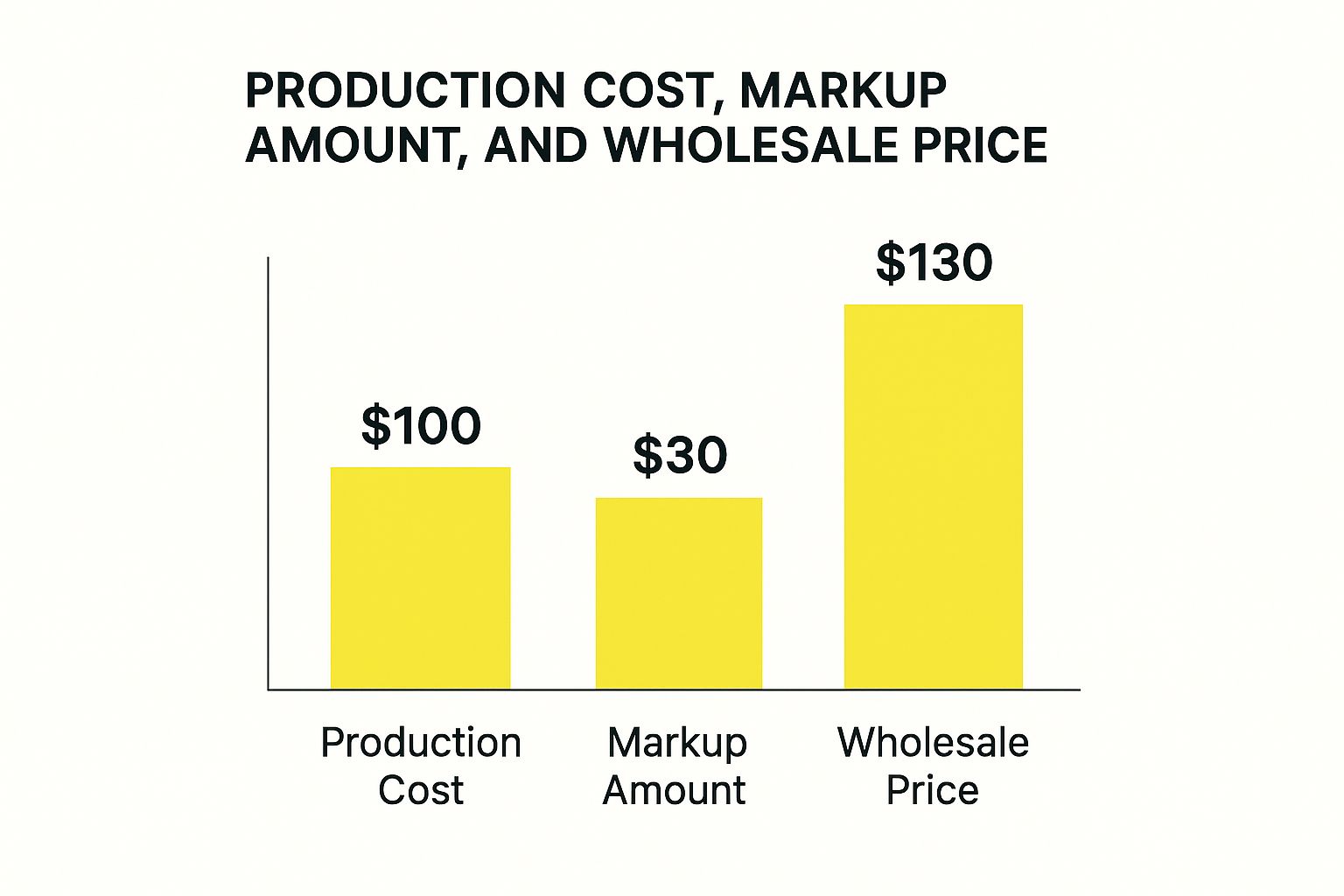
This chart shows a simple wholesale price calculation: $100 production cost, plus a $30 markup, equals a $130 wholesale price. It illustrates the basic idea, but trust me, a thorough cost analysis goes much deeper.
Digging Deeper Into Your Cost Analysis
Let's say you're selling something fragile. Your packaging costs will naturally be higher than someone selling t-shirts. This is why keeping track of every single expense is crucial. One helpful method is absorption pricing, which factors in all your costs—fixed, variable, and overhead—into your wholesale price. This approach, where Wholesale Price = Cost Price + Profit Margin, can often lead to healthier profit margins, sometimes between 15% and 30%, depending on what you're selling. You can learn more about this here: calculating wholesale prices using absorption pricing.
To help you really get a handle on your costs, let's look at a breakdown of typical cost categories:
To help you really get a handle on your costs, I've put together a table outlining the typical categories you'll want to track. This is essential for accurate wholesale pricing and ensures you're not leaving money on the table!
Complete Cost Analysis Breakdown
Essential cost categories to track for accurate wholesale pricing calculations
| Cost Category | Examples | Typical % of Total Cost | Frequency |
|---|---|---|---|
| Direct Materials | Raw materials, components, packaging | 40-60% | Per unit produced |
| Direct Labor | Wages for production staff | 20-30% | Per unit produced/hourly/weekly |
| Manufacturing Overhead | Rent for factory space, utilities, equipment maintenance | 10-15% | Monthly/quarterly/annually |
| Selling & Marketing | Advertising, sales commissions, trade show fees | 5-10% | Monthly/campaign-based |
| Administrative | Salaries for office staff, office supplies, insurance | 5-10% | Monthly/annually |
| Shipping & Handling | Packaging materials, shipping fees | 5-10% | Per order |
| Storage | Warehouse fees, inventory management software | 2-5% | Monthly/annually |
This table gives you a solid starting point. Remember, the percentages can vary depending on your specific business, so it's important to track your own numbers diligently.
Staying on Top of Your Numbers
Finally, remember that your costs aren't static. Market conditions change, material prices go up and down, and your business grows and evolves. Regularly reviewing and adjusting your cost analysis (I recommend at least quarterly, or even monthly when you're starting out) is absolutely key. It's how you set wholesale prices that keep you competitive and profitable. A Shopify store audit can also be helpful here if you're using that platform. This way, you can stay on top of the market and avoid any nasty surprises that hit your bottom line.
Why the Keystone Method Still Works (When Done Right)

Let's talk Keystone method. It's the classic "double your cost" approach to wholesale pricing. While it might seem a little too simple, I've seen it work wonders when used right. The appeal? It's easy! But it's not just doubling a number. Thinking about your costs? Sourcing packaging like wholesale meal prep containers in bulk can make a real difference to your bottom line.
Wholesale pricing involves a bunch of different strategies. Keystone, where retail is double your wholesale price, is one of the most basic. So, a $100 retail item means a $50 wholesale price. Simple, right? But it doesn't consider things like competition or demand. It's historically been big in controlled retail settings, like exclusive brand stores.
But with e-commerce booming, many businesses are moving toward more dynamic pricing. In fact, something like 60% of retailers used some form of dynamic pricing in a 2020 survey. Still, Keystone remains a core concept in wholesale calculations. Want to dig deeper? Check out some additional product pricing strategies.
Knowing When to Use Keystone Pricing
The real trick with Keystone is knowing when it makes sense. For products with predictable costs and steady demand, it’s a quick and dirty way to set profitable prices. But in highly competitive markets or when your costs jump around, you need to consider other factors. And that's where understanding your profit margins comes into play. More on that later!
Setting Profit Margins That Survive Real-World Pressure

So, you've got your costs nailed down and understand Keystone pricing. Great! But now comes the tricky part: setting profit margins that can actually weather the storm of real-world business. Having beautiful margins on a spreadsheet is one thing, but it's a whole different ballgame when a competitor decides to undercut you or a big client wants a bulk discount. This is where many well-intentioned pricing strategies go to die.
I've seen it happen firsthand. I was working with a wholesaler who, on paper, had incredible margins. However, they'd completely freak out anytime a competitor lowered their prices, immediately slashing their own in response. Their profits? Gone. They hadn’t factored any flexibility into their pricing plan.
The Psychology of Profitable Pricing
Creating resilient profit margins begins with understanding how pricing is perceived. Often, higher prices translate to a perception of higher value. This doesn't give you a license to price gouge, of course. But it does mean you shouldn't shy away from charging what your product is truly worth. Think about it: if two products are practically identical, but one is significantly cheaper, you might start to wonder if there's something wrong with the cheaper one. Is the quality lower? Is it less desirable?
This mindset also carries over into negotiations. If you’re confident in your pricing, it’ll show. Customers always try to negotiate, but if you can clearly communicate the value you deliver, you’re much less likely to get sucked into a race to the bottom. By the way, if your Shopify store needs a performance boost, this resource might be helpful: Shopify Performance Optimization.
Balancing Flexibility and Profit Goals
Your goal shouldn't be to create rigid margins, but rather flexible ones. Knowing when to stand your ground and when to bend a little is crucial. Sometimes, accepting a slightly lower margin on a large order can actually boost your overall profit because of the increased volume. Other times, it’s smarter to walk away from a deal that compromises your long-term profitability.
Simply knowing the mechanics of calculating wholesale prices isn't the finish line. It's about building a pricing structure that thrives in the chaotic, ever-changing world of business. This requires a deep understanding of your costs, the dynamics of your market, and the psychology of your customers.
To give you a better sense of standard profit margins, check out this table:
Industry Standard Profit Margins Comparison
Typical wholesale profit margins across different product categories and industries
| Industry | Low Margin % | Average Margin % | High Margin % | Key Factors |
|---|---|---|---|---|
| Clothing | 5% | 15% | 25% | Branding, Fast Fashion vs. Luxury |
| Electronics | 2% | 7% | 12% | Competition, Technological Advancements |
| Food & Beverage | 10% | 25% | 40% | Perishability, Brand Recognition |
| Furniture | 20% | 40% | 60% | Material Costs, Design & Craftsmanship |
| Jewelry | 25% | 50% | 75% | Precious Metals, Brand Prestige |
This table shows how different industries operate with different profit margin expectations. Factors like competition, material costs, and brand recognition all play a significant role in determining what's considered a "good" margin. Notice the higher margins in industries like jewelry and furniture where brand and craftsmanship can heavily influence pricing.
Understanding these industry benchmarks can help you set realistic profit goals and develop a pricing strategy that’s both profitable and competitive.
Staying Competitive Without Destroying Your Profits

Let's be real, competitor pricing is the big, unspoken issue in every pricing conversation. You have to be competitive, but a race to the bottom on price helps no one. I've seen businesses crash and burn doing this, sacrificing profit for a temporary market share boost. It's a bad plan.
Savvy wholesalers know the real trick is to research competitor pricing strategically and respond in a way that doesn't start a destructive price war. This means understanding what your competitors are actually charging, and, even more importantly, why.
Gathering Competitive Intelligence That Matters
Understanding the different ways to maximize your profits is key. Check out these ecommerce pricing strategies for some great ideas. For example, are competitors offering similar products at wildly different price points? This could mean differences in product quality, features, or even their own profit struggles. Also, pay close attention to their value-adds. Are they offering free shipping, extended warranties, or other bonuses? These can justify higher prices even if the core product is similar to yours.
This isn't about blindly copying or undercutting the competition. It's about gathering intel to inform your own pricing decisions. Remember, your competitors might not have it all figured out either.
Matching vs. Differentiating: Knowing the Difference
Once you understand competitive pricing, figuring out when to match prices and when to highlight your value is crucial. This is where many businesses stumble. If you have a superior product with better features or higher quality, don't be afraid to charge more. Clearly communicate that value to your customers, showing them why your product is worth the investment.
For more basic products where there isn't much difference between yours and the competition's, matching competitor pricing might be necessary to stay afloat. But even then, you can still be strategic. Maybe you offer slightly better payment terms or a more personalized customer experience to set yourself apart.
Justifying Premium Pricing With Value
Never underestimate the power of perceived value. I worked with a small business selling handcrafted jewelry. Even though they were competing with mass-produced items, they charged premium prices by showcasing the unique craftsmanship and artistic value of their pieces. They told the story behind their designs, highlighted the high-quality materials, and emphasized the personal touch they put into each piece. Customers were happy to pay more for something special. This is how you win at pricing–focus on value, not just the lowest price. The real key isn't always having the cheapest option. It's about showing customers what they get for their money.
Volume Discounts That Actually Increase Your Profits
Let's be honest, most people think volume discounts mean simply lowering prices for larger orders. But that's not always the smartest move. In fact, it can often shrink your profits rather than boost them. The real secret? Tiered pricing.
Tiered pricing lets you structure discounts in a way that encourages larger orders without sacrificing your margins. I've seen this work wonders for businesses time and time again. Take one of my clients, for example, who sells handcrafted soaps. They were initially offering a flat 10% discount on orders over 50 units. It sounded decent enough, but wasn't really making a difference.
We revamped their discount structure, introducing tiers: 10% off for 50-99 units, 15% off for 100-199, and 20% for 200+. Suddenly, customers were motivated to reach that next discount level, and their average order size jumped significantly.
Structuring Volume Discounts for Maximum Impact
The real trick is to make customers want to buy more. It’s not just about rewarding larger orders, it’s about making them irresistible. This could be through tiered discounts, like we just talked about, or even by bundling products together.
For instance, think about offering a "starter pack" at a slightly higher unit price, and then a "business pack" with a larger quantity at a much better discount. This not only encourages bigger purchases but also positions your product as a smart investment. And don't forget about your overall marketing approach. Solid reseller marketing strategies can really make a difference.
Calculating Break-Even Points on Volume Discounts
One thing you absolutely need to know is your break-even point for each discount tier. This is the minimum quantity you have to sell at each discounted price to cover your costs and actually make a profit. If your discounted prices aren't covering your costs, then your "volume discount" is actually losing you money.
When done right, volume discounts can be a game-changer. High-volume sales, even at a discount, can often bring in more profit than a bunch of smaller, full-priced orders. The key is understanding how to calculate your wholesale prices strategically, encouraging the right customer behavior, and keeping those profit margins healthy.
Fine-Tuning Your Pricing Without Losing Customers
Pricing isn't static. It's a living, breathing part of your business that needs regular attention. Even when you think you've nailed the perfect pricing strategy, the market shifts, your costs change, and customer expectations evolve. The real trick isn't setting your prices, it's knowing how to adjust them without sending your customers running for the hills. I've seen businesses make the mistake of drastic overnight price changes, and honestly, it's rarely pretty. The fallout can damage customer loyalty and create a PR mess you'll be cleaning up for months.
Metrics That Matter: Reading the Signals
So, how do you know if a price adjustment is working? Forget those vanity metrics. They won't tell you the whole story. Instead, zero in on the things that really matter: sales volume, customer feedback, and, naturally, profit. Let's say you raise your prices and suddenly your sales volume takes a nosedive. That's a pretty clear sign something's not right. On the other hand, if a small price increase doesn't affect sales and boosts your profit, you're probably heading in the right direction.
Customer feedback is invaluable. Don't just collect it, actually listen to it. Pay close attention to comments, reviews, and yes, even those direct complaints. Are customers pushing back against the new prices? Or are they unfazed? This qualitative data is just as important as the hard numbers, sometimes even more so.
Testing the Waters: Low-Risk Experimentation
The golden rule of price adjustments? Small changes, gradually implemented. Don’t try to revamp your entire pricing structure all at once. That’s a recipe for disaster. Instead, experiment with a small price bump on a single product or a specific product line. Observe the results. What happens to sales? What kind of feedback are you getting?
A/B testing is another smart approach. Offer different pricing tiers to different customer segments and see which one performs best. This allows you to gather valuable data and make informed decisions without putting your entire customer base at risk.
Rolling Out Changes: Transparency and Communication
When you do decide to make pricing changes, be upfront about it. Explain your reasoning to your customers. Perhaps your material costs have gone up, or maybe you’ve added valuable new features to your product. Honesty builds trust, and customers are far more likely to accept a price increase if they understand the "why" behind it.
I once worked with a furniture wholesaler who had to raise their prices due to the skyrocketing cost of lumber. They sent out a straightforward email to their clients explaining the situation and detailing the specific price adjustments. The response was overwhelmingly positive. Most customers were understanding, and while a few weren't thrilled, the vast majority appreciated the transparency.
Building Flexibility Into Your System
The ideal pricing system is inherently flexible. This means having a solid grasp of your costs, profit margins, and the dynamics of your market. With this knowledge, you can adjust your pricing as needed without panicking. Think of it as having shock absorbers on your car – they smooth out the bumps in the road, and your pricing system should do the same for your business. By understanding how to calculate wholesale prices strategically, you’re not just building a system that can weather market fluctuations, you're building one that can actually thrive in them. Knowing when to adjust prices and how to communicate those changes is just as important as your initial pricing strategy. It's the difference between simply reacting to market pressures and proactively steering your business towards long-term success.
Key Takeaways
Calculating wholesale prices right is the bedrock of a profitable wholesale business. It's more than just slapping on a markup; it's about really understanding your costs, your market, and who your customers are. Here’s what I’ve learned over the years to help you nail your wholesale pricing:
Know Your True Costs
Don't just look at your production costs – factor in absolutely everything. Think storage, handling, overhead, and even those sneaky little hidden costs that can easily slip through the cracks. A thorough cost analysis is like the foundation of your pricing house. Just like you wouldn’t budget for a house by only counting the cost of bricks, you need to account for everything in your wholesale business. Every single expense matters.
Keystone Pricing: A Simple Starting Point
The Keystone method—doubling your cost—is a good starting point, a useful rule of thumb. It's great when your costs are steady and demand is predictable. But let’s be real, markets change, and products face tough competition. So, sometimes you'll need more flexible pricing strategies. You might find some useful info in this article about Shopify Store Migration if you're using that platform.
Profit Margins: Flexibility is Key
Don't just aim for high profit margins, aim for resilient ones. This means understanding how pricing affects customer behavior. Know when to stand firm on your price and when to be a little flexible. Remember, higher prices often signal higher value. But be ready to negotiate and offer discounts, especially for bulk orders. It’s a balancing act.
Competitive Pricing: Don’t Race to the Bottom
Knowing your competitors' prices is important, but don't get dragged into a price war. Instead, focus on value differentiation. What makes your product special? Highlight those benefits to justify a higher price. Sometimes, the best way to compete isn’t being the cheapest, it’s offering the best overall value.
Volume Discounts: A Strategic Advantage
Volume discounts can be a game-changer for your profits if you do them right. Tiered pricing encourages larger orders without totally sacrificing your margins. The key is to calculate your break-even point for each discount level to make sure you're actually making money, not losing it.
Fine-Tuning: Adapt and Adjust
Pricing isn't a set-it-and-forget-it kind of thing. Regularly check your metrics, get feedback from your customers, and tweak things as needed. Small, consistent changes tend to work better than big, drastic overhauls. It’s about constant improvement.
By really understanding these key takeaways, you’ll be well on your way to building a wholesale pricing strategy that's both profitable and sustainable. Need some help with your Shopify store? E-commerce Dev Group offers expert Shopify design, development, and support. Check out their website for more info.
