


Why Most Ecommerce SEO Audits Miss The Mark (And Cost You Sales)
Let's be honest, a lot of ecommerce SEO audits are just surface-level technical checks. They'll flag things like broken links and crawl errors, but they miss the real goldmine: customer behavior. I've chatted with SEO specialists who've audited hundreds of online stores, and they all agree – the biggest wins come from understanding how customers actually shop, not just fixing technical glitches. If you're treating your ecommerce site like any other website, you're leaving money on the table.
Successful online store owners take a different approach. They dive deep into the customer journey, asking questions like: What search terms are actually leading to sales? Where are customers abandoning their carts? Are product descriptions compelling, or are they dull and generic? A revenue-focused ecommerce SEO audit has to answer these questions.
I once audited a clothing store with fantastic technical SEO, but their conversion rates were in the basement. Turns out, their product photos were tiny and blurry – customers couldn't see any details! Just upgrading those images resulted in a 25% sales boost. A standard technical audit would have completely missed that.
Think about the hidden costs of those "quick SEO fixes," too. Sure, patching up a few technical issues might give you a temporary bump, but ignoring the bigger picture can really hurt your long-term growth. It's like fixing a leaky roof without addressing the structural damage underneath – eventually, the whole thing is going to come crashing down. Following best practices is key to avoiding those pitfalls. Here are some proven ecommerce SEO tips to get you started.
The average eCommerce brand ranks for roughly 1,783 keywords, bringing in about 9,625 organic visits each month. Trying to get that kind of visibility with paid ads would cost you close to £11,800 monthly. This really highlights the importance of a thorough ecommerce SEO audit that maximizes organic traffic. Check out more insights here. A proper audit lays the foundation for sustainable growth that compounds over time. You might also be interested in Shopify store audits. This isn't just about checking boxes – it's about understanding the nuances of your customer's experience and building a strategy that actually drives sales.
Building Your Audit Arsenal (Tools That Actually Matter)
Forget those endless lists of SEO tools. Let's talk about the ones that really move the needle for e-commerce SEO audits. I've personally tested dozens, and I've narrowed it down to a core arsenal that gives you actionable insights without drowning you in data.
Essential Free Tools: Google's Power Duo
First up, the free heavy hitters: Google Analytics and Google Search Console. But don’t just set them up and forget them. You need to configure them specifically for e-commerce. In Google Analytics, use advanced segments to uncover gold nuggets about your customer journey. For example, segmenting by product category can show you which categories drive the most organic traffic and conversions, so you can focus your optimization efforts where they matter most. Google Search Console shows you which keywords are bringing people to your product pages and flags any technical gremlins affecting your visibility.
Premium Tools Worth the Investment
Free tools are great, but sometimes you need to bring in the big guns. Ahrefs and SEMrush are my go-to resources for serious keyword research, backlink analysis, and keeping tabs on the competition. They're worth the investment because they offer granular data that can uncover hidden opportunities. I once used Ahrefs to find high-volume, low-competition keywords that boosted a client’s organic traffic significantly in just a few weeks.
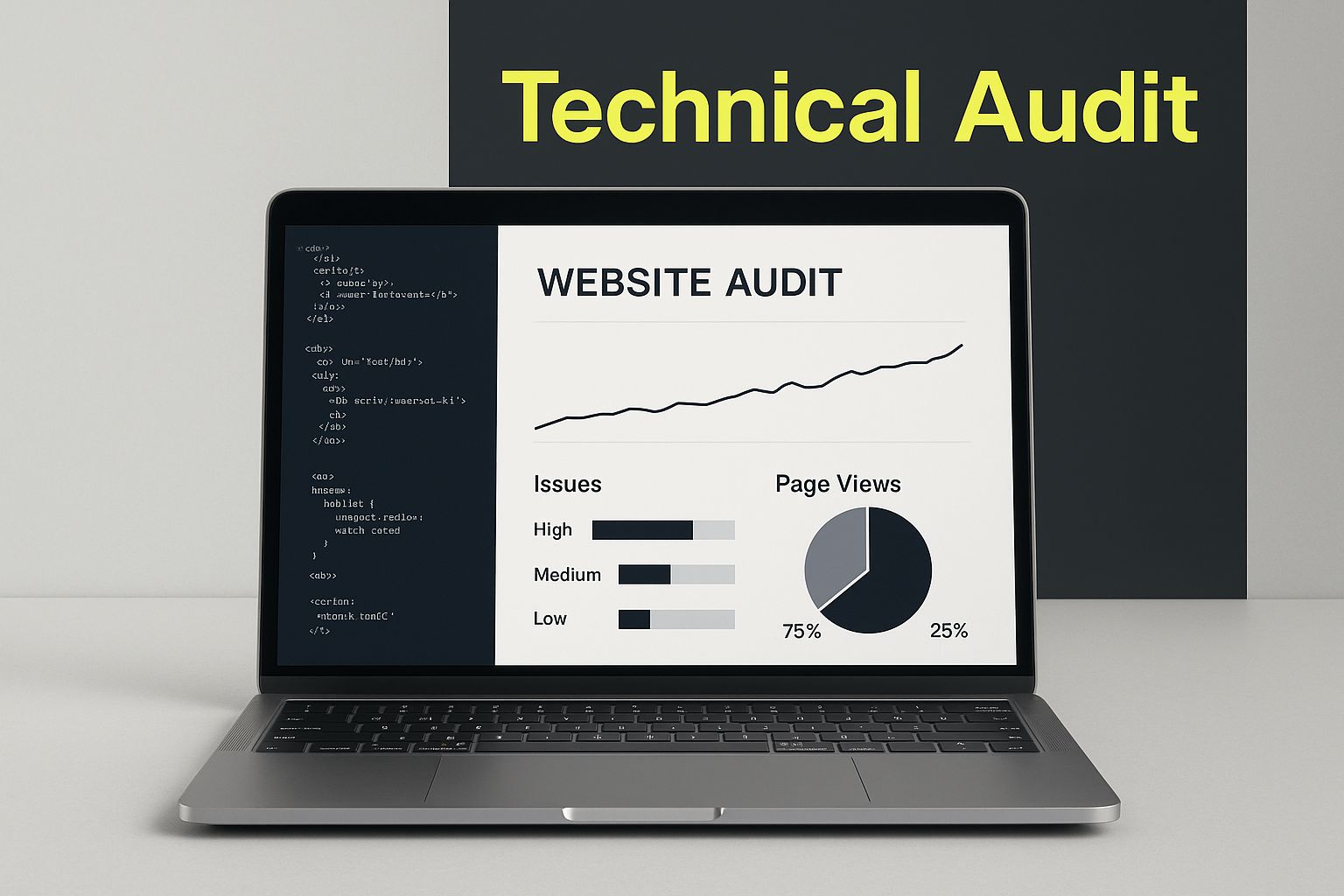
The infographic above gives you a glimpse into a technical SEO audit, showing code snippets and key performance metrics. The takeaway? The level of detail these tools offer is incredible – you can pinpoint exactly what technical issues are holding your e-commerce site back.
Free Alternatives That Pack a Punch
On a tight budget? No problem. Ubersuggest and Screaming Frog SEO Spider (the free version) offer surprisingly powerful features for keyword research and technical audits. Screaming Frog is especially helpful for spotting critical technical errors like broken links and crawl issues. Combining these free tools can give you a solid foundation for your e-commerce SEO audit.
To help you choose the best tools for your needs, I've put together a handy comparison table:
Essential SEO Audit Tools Comparison
Comparison of key features, pricing, and ecommerce-specific capabilities of top SEO audit tools
| Tool Name | Key Features | Ecommerce Focus | Pricing | Best Use Case |
|---|---|---|---|---|
| Google Analytics | Advanced segments, conversion tracking, customer journey analysis | Customizable for ecommerce tracking | Free | Analyzing customer behavior and website performance |
| Google Search Console | Keyword tracking, technical error reporting, sitemap submission | Helps identify issues affecting organic search visibility | Free | Monitoring website health and search performance |
| Ahrefs | Keyword research, backlink analysis, competitor research, rank tracking | Provides data for optimizing product pages and content strategy | Paid (various plans) | In-depth SEO analysis and competitive intelligence |
| SEMrush | Keyword research, competitor analysis, site audit, social media tracking | Offers tools for improving online visibility and marketing campaigns | Paid (various plans) | Comprehensive SEO and digital marketing toolkit |
| Ubersuggest | Keyword research, competitor analysis, backlink analysis | Helps identify keyword opportunities and competitor strategies | Freemium (limited free version) | Budget-friendly keyword research and competitor analysis |
| Screaming Frog SEO Spider | Technical SEO auditing, website crawling, error identification | Can uncover critical technical issues affecting ecommerce sites | Freemium (limited free version) | Identifying and fixing technical SEO problems |
This table gives you a quick overview of each tool's strengths and weaknesses. Choosing the right combination can make your audit process much smoother.
The Strategic Mindset: Beyond Vanity Metrics
The real magic of an e-commerce SEO audit isn’t just about the tools; it’s about how you use them. Don’t get caught up in vanity metrics like page views. Focus on the metrics that directly impact your bottom line – revenue! Prioritize your findings based on your business goals, not on achieving technical perfection. Use spreadsheets and monitoring systems to track your progress and demonstrate the ROI of your efforts. This strategic approach is what separates a good audit from a truly great one. And that sets the stage for tackling the critical technical issues that can either make or break your revenue.
Technical Foundation Reality Check (Where Revenue Dies)
This is where so many e-commerce sites spring a leak, losing revenue without even realizing it. Often, the problems are worse than site owners think. Let's talk about the technical stuff – the things that can really make or break your organic search results, starting with site speed. Optimizing site speed for pages packed with product images and reviews is tough. Customers want high-res photos, in-depth descriptions, and reviews. All of that adds up, and can slow things down. Slow loading times equal lost customers. It's that simple.
Crawling and Indexing: Are Search Engines Seeing Your Products?
Imagine amazing products that search engines can't even find. That's where crawling comes in. Crawlers (like Googlebot) are like digital spiders exploring your site, following links to discover every page. A messy site architecture is like a spiderweb gone wrong – crawlers get lost and miss your best sellers. Then there's indexing. Even if crawlers find your pages, they won't show up in search results unless they're indexed. Indexing is like adding your products to a giant online catalog. No index, no visibility. Fixing crawling and indexing issues is crucial for any e-commerce SEO audit.
Duplicate Content: The Ecommerce Nightmare
Duplicate content is a common e-commerce headache. Think product variations (like different colors or sizes) or overlapping categories. The same content on multiple URLs confuses search engines. They don't know which page to rank. You can't just delete pages, though. Customers still need to find those variations! Canonical tags are the solution. These little bits of code tell search engines which page is the "original," focusing your ranking power and preventing penalties. A good understanding of general SEO is helpful here, so check out guides like this one on e-commerce SEO best practices.
Structured Data and SSL: The Unsung Heroes of Ecommerce SEO
Structured data is like giving search engines a cheat sheet to understand your products. It helps create rich snippets, those enhanced search results with star ratings, prices, and availability. They grab attention and boost clicks. Take a look at Google's structured data documentation:

This shows the types of structured data you can use to make your product listings shine in search results. Then there's SSL – your SSL certificate. This secures connections, building customer trust and improving rankings. An SSL issue is like a "closed" sign on your storefront – it can scare potential customers away.
Mobile Responsiveness and Core Web Vitals: The User Experience Essentials
Mobile responsiveness is essential. If your site doesn't look good and work smoothly on a phone, you're losing sales. I've seen e-commerce sites lose over 50% of their potential customers due to a bad mobile experience. This is directly related to Core Web Vitals. These metrics measure how fast your page loads, how interactive it is, and how visually stable it is. Google uses Core Web Vitals as a ranking factor. A slow, jumpy, or visually distracting site will hurt your rankings. For deeper advice, take a look at this guide on Shopify performance optimization. Addressing these technical foundations is the first step in a successful e-commerce SEO audit. It's about building a solid base for lasting organic growth.
Content Strategy That Converts Browsers Into Buyers
Ecommerce SEO audits can sometimes get lost in technical details. But there's a real growth opportunity waiting to be tapped: content strategy. A technically perfect website is like a fancy car – it can drive, but it needs fuel (content). Content is what moves you from just being findable to actually driving conversions.
Keyword Research: Beyond Product Names
Good keyword research for ecommerce isn't just about product names. It's about understanding the customer journey. What questions are they asking? What are their pain points? I worked with a kitchen appliance store once that was only focusing on keywords like "blender" or "toaster." When we started targeting questions like "best blender for smoothies" or "how to clean a toaster oven," their organic traffic exploded because it addressed real needs.
Think about mapping keywords to the customer journey:
- Awareness: Broad terms like "benefits of organic coffee"
- Consideration: Comparison terms like "best espresso machine under $500"
- Decision: Transactional terms like "buy Breville espresso machine online"
This helps you create content that resonates with potential customers at every stage, gently guiding them towards a purchase. And by the way, AI is playing a bigger role in SEO these days. Something like 65% of businesses have seen SEO improvements by using AI tools for content optimization and trend prediction. Discover more insights.
Optimizing Product and Category Pages
Your product descriptions are your digital storefront. They need to inform and engage. Don't just list features, sell benefits. Tell a story. Show customers how the product will improve their lives. Category pages should also offer more than just product listings. They should provide context and guidance. Think of a clothing store’s "winter coats" category page. Adding a buyer's guide about different coat styles and materials, linking to relevant products, provides value and boosts SEO.
Identifying Content Gaps and Leveraging User-Generated Content
Check out what your competitors are doing – and not doing. This is where you find content gaps. Are they missing a product category? Are there opportunities for informative buying guides? Filling these gaps can make you the go-to expert in your niche. And don’t forget about user-generated content. Customer reviews, testimonials, and social media posts can do wonders for your SEO. It's free, relevant content that builds trust and generates long-tail keywords.
Advanced Content Strategies: Featured Snippets and Content Clusters
Optimizing for featured snippets (those top-of-the-page answers) can boost your visibility. Answer common questions clearly and concisely. Content clusters are another great tactic. These are groups of content around a central topic. For example, a hiking gear store might build a content cluster around "backpacking." A central pillar page on backpacking essentials links to supporting articles like "choosing a backpack," "packing for a backpacking trip," and "best backpacking trails." This makes your site a comprehensive resource, increasing engagement and SEO.
Analyzing Search Intent: Matching Content to Customer Needs
At the end of the day, successful content is about understanding search intent. Why is someone searching for a particular keyword? What are they looking for? "Best running shoes" probably means someone wants reviews and comparisons. "Buy running shoes near me" suggests they're ready to buy now. By analyzing search intent, you can create content that meets the customer exactly where they are in their journey. This transforms passive browsers into active buyers, driving real, sustainable growth.
Let's look at how different types of content contribute to your overall SEO and business goals:
To help illustrate this, I've put together a table summarizing the impact of different content types:
Ecommerce Content Types and SEO Impact
| Content Type | SEO Impact | Conversion Potential | Resource Investment | ROI Timeline |
|---|---|---|---|---|
| Product Descriptions | Drives targeted traffic, improves product ranking | High | Moderate | Short-term |
| Category Pages | Improves site structure, targets broader terms | Medium | Moderate | Mid-term |
| Blog Posts | Attracts organic traffic, builds authority | Low | Low | Long-term |
| Buying Guides | Targets informational keywords, builds trust | Medium | High | Mid-term |
| Customer Reviews | Improves social proof, adds long-tail keywords | High | Low | Short-term |
This table shows how different content types contribute to different aspects of your SEO strategy. Product descriptions are crucial for driving direct sales, while blog posts are more about building long-term brand authority. Finding the right mix for your business is key.
Link Profile Analysis That Actually Moves Rankings
If you're running an e-commerce store, you know link building is crucial for SEO. But it's not just about the number of backlinks. What really separates successful online stores from the rest is strategic link building. Let's dive into how to analyze your backlink profile and uncover what's truly moving the needle (and what's holding you back).
Auditing Your Backlinks: Finding the Toxic Ones
Think of a link audit like a checkup for your website's reputation. Just like hanging out with the wrong crowd can hurt your image, toxic backlinks can seriously damage your domain authority. Tools like Ahrefs or SEMrush give you a complete view of your backlink profile. They help you spot those nasty, low-quality links from spammy sites, link farms, or even competitors trying to sabotage your rankings. Catching these toxic links early is key to keeping your link profile healthy.
I once audited a site with tons of backlinks, but their rankings were in the basement. Turns out, they had hundreds of links from irrelevant, low-quality directories. We cleaned those up, and it was like taking off an anchor – their rankings shot up almost immediately.
Earning High-Quality Links: The Relationship-Building Approach
Okay, so now we know how to find the bad links. Let's talk about building the good ones. In e-commerce, it’s all about relationships. Influencer partnerships are gold. Send free products to relevant influencers in your niche and watch the magic happen. You'll get genuine reviews and backlinks that drive traffic and sales.
Don't forget about your suppliers! Supplier collaborations are often overlooked, but many suppliers are happy to link to retailers who carry their products. These relationships are a natural source of valuable backlinks.
Strategic content marketing is another powerful tool. Create top-notch content, like in-depth buying guides or product reviews, and other websites will naturally link to it. This takes time, but it’s the most sustainable way to build a strong link profile that boosts your entire e-commerce SEO strategy. Remember, building a robust link profile is a marathon, not a sprint.
Advanced Link Cleanup: Disavowing and Direct Outreach
Sometimes, you’ll stumble upon toxic backlinks that are tough to remove. That's where disavowing comes into play. It's basically telling Google to ignore those bad links, protecting your site from penalties. But disavowing should be your last resort. Often, reaching out directly to the website owner and politely asking them to remove the link is the best solution. It might take more effort, but it’s usually more effective.
And let's talk about broken backlinks. They’re a huge problem. Did you know that over 66% of backlinks are broken? That can seriously hurt your rankings. Discover more insights.
Analyzing Competitor Link Profiles and Leveraging Industry Connections
Keep an eye on your competition. Analyzing their backlink profiles can uncover some serious opportunities. Are they getting links from industry publications or blogs that you’re missing out on? Are they using local business networks or industry events for link building? Learning from your competitors can give you a real edge.
Finally, tap into your industry. Participate in industry events, connect with trade publications, and join local business networks. These communities are full of authentic link-building opportunities. This not only builds valuable backlinks, but it also positions your e-commerce store as a trusted authority.
Building a strong link profile is like building a house. You need the right materials (high-quality links) and a solid foundation (clean, relevant links). With a strategic approach, your link profile can be a powerful driver for your e-commerce success.
User Experience Optimization That Drives Revenue
Here's where your e-commerce SEO strategy really takes off: optimizing for search engines and crafting an experience that converts visitors into paying customers. Forget just focusing on the technical SEO stuff; we're talking about understanding how those technical elements affect the people on your site. Let's dive into how to use user behavior data to find SEO opportunities that directly boost your bottom line.
Navigation: Guiding Users (and Crawlers)
Think of your site navigation like a roadmap. It has to be crystal clear for both users and search engine crawlers. If a customer can't find what they need, they're gone. And if crawlers can't easily access your product pages, you won't rank. Good navigation helps everyone. For example, clear category pages, a logical site structure, and breadcrumb navigation all improve user experience and search engine understanding. Don't forget internal linking—strategically linking related products and content—which naturally guides users through your sales funnel, increasing engagement and time on site.
Checkout Optimization: Removing Conversion Barriers
Your checkout process? Absolutely critical. A complicated or buggy checkout is a major roadblock to sales. From an SEO standpoint, this means higher bounce rates and lower conversion rates, which hurt your rankings. A smooth checkout with clear calls to action and minimal distractions reduces cart abandonment and sends positive SEO signals. Consider things like guest checkout options, clear progress indicators, and multiple payment gateways—all contribute to a better user experience and SEO.
Local SEO for E-commerce: Bringing Foot Traffic Online
If you have a physical store, optimizing for local search is key. This connects your online and offline presence. Claiming your Google My Business profile, optimizing for local keywords, and making sure your NAP (Name, Address, Phone Number) information is consistent across the web helps local customers find you—online and on the street.
Mobile Optimization: The Make-or-Break Factor
Mobile optimization isn't optional anymore—it's essential. Over half of all e-commerce traffic is from mobile. If your site isn't mobile-friendly, you're losing a huge chunk of potential customers. Responsive design, fast loading times, and easy-to-use mobile menus are crucial for both user experience and SEO. You might be interested in Shopify store optimization.
Advanced UX Analysis: Heat Maps and Session Recordings
Want to really understand user behavior? Heat maps and session recordings provide amazing insights. Heat maps show where users click, scroll, and hover, highlighting areas of interest and potential problems. Session recordings let you watch actual user sessions, showing exactly how they interact with your site. I once used session recordings to figure out that users couldn't find the size chart on a clothing site. Simply adding a clear size chart link drastically reduced cart abandonment.
Here’s an example of valuable insights from Google Analytics:

This shows how Google Analytics helps you analyze user behavior by revealing which pages customers visit, how long they stay, and where they leave. Identifying patterns helps you pinpoint areas for improvement.
Optimizing Site Search and Filtering: Enhancing Product Discovery
Internal site search and product filtering are essential for e-commerce. If customers can't find products, they won't buy. Optimizing site search with autocomplete suggestions and relevant results improves user experience. Robust filtering options (by size, color, price, etc.) make it easier to find exactly what they want. This not only improves UX but also helps search engines understand your products, improving visibility in search results. This streamlined UX approach directly translates to more conversions and revenue growth.
Turning Audit Insights Into Measurable Growth
An SEO audit for your e-commerce site is a great starting point, but it’s only the beginning. What truly matters is transforming those insights into actual profit. I’ve seen so many businesses get lost in the data, without a real strategy for putting it to work. So let's discuss how to translate your audit findings into a practical roadmap for measurable growth.
Prioritizing for Impact: Revenue First
Effective store owners don’t try to fix everything at once. They prioritize. Review your audit findings and ask yourself: "Which improvements will have the biggest impact on my bottom line? Which are the easiest to implement?" Sometimes, a small adjustment to your product descriptions can have a bigger effect than a complicated technical overhaul.
For example, I once audited a store selling handmade jewelry. Technically, their SEO was solid, but their product descriptions were dull and uninspired. We revamped them, focusing on the story behind each piece and the unique craftsmanship involved. The result? A 30% increase in conversions. That’s what prioritizing for revenue impact can do.
Building Buy-In: Connecting SEO to Business Outcomes
SEO can often feel mysterious to stakeholders. They need to see the direct link between your work and actual business results. Don’t just focus on keyword rankings; talk about the money. Show them how SEO improvements lead to more organic traffic, better conversion rates, and ultimately, increased sales. Create clear, concise reports that highlight the metrics they care about.
Monitoring and Maintenance: Catching Issues Before They Cost You
SEO isn't a one-and-done deal. It’s an ongoing process. Set up monitoring systems to track your progress and catch problems before they become major headaches (and expenses). Think of it like regular car maintenance—it's cheaper to fix a small issue now than to replace the whole engine later. Tools like Google Search Console are fantastic for this; they'll alert you to crawling errors, indexing problems, or security issues impacting your rankings.
Scaling Strategically: Growing Your SEO Efforts
As your business expands, so should your SEO strategy. This might involve hiring an SEO specialist, investing in better tools, or outsourcing specific tasks. Don't hesitate to seek outside expertise. A good SEO agency can be a valuable asset, providing specialized knowledge and resources you may not have internally.
The Feedback Loop: Continuous Improvement
The most effective e-commerce SEO strategies operate on a feedback loop. Use tools like these website feedback tools to understand how changes resonate with your audience. Continuously analyze your data, get customer feedback, and use those insights to refine your strategy. This creates a dynamic system that's always improving, guided by real-world results, not just textbook best practices. This continuous optimization ensures your efforts align with customer behavior and evolving search algorithms, creating a sustainable, adaptable strategy for long-term success.
Ready to take your Shopify store to the next level? E-commerce Dev Group offers expert Shopify design, development, and support services. From store design and performance optimization to app integration and migration, we have the expertise to help you succeed. Learn more and get started today.
