


Understanding Why Most Automation Fails (And How Yours Won't)

This screenshot from Shopify's marketing automation page highlights the platform's focus on streamlining tasks and boosting efficiency. It visually reinforces the idea that smart automation can simplify even the most complex marketing processes. But there's a catch.
Many Shopify store owners fall into the "set it and forget it" automation trap. This often leads to impersonal, generic campaigns that don't connect with customers. In today's competitive e-commerce world, that's a recipe for disaster.
The sheer scale of the Shopify ecosystem underscores the importance of automation. As of 2024, approximately 4.82 million Shopify stores exist globally. In 2023, they processed a staggering 199 million orders per month. This volume necessitates smart tools for managing and scaling online businesses. Discover more insights.
The Problem With "Set It and Forget It"
This hands-off approach ignores the ever-changing nature of customer behavior. Think of a fisherman casting a net. A static net might snag a few fish, but a skilled fisherman continually adjusts the net based on currents and fish movement. Effective Shopify marketing automation requires the same dynamic approach, adapting to customer interactions and data insights. For a deeper dive, check out this article on Shopify Marketing Automation.
Shifting Your Automation Mindset
Successful Shopify stores understand that automation isn't just about saving time; it's about building valuable customer relationships. They use automation to craft personalized experiences that nurture customers at every stage of their journey. This includes understanding customer segments, tailoring messaging, and constantly optimizing workflows. For best practices, take a look at these email marketing automation best practices.
From Crickets to Conversions
Let's look at a real-world example. A Shopify store selling handmade jewelry ditched generic promotional emails for personalized automation. Customers who abandoned their carts received emails showcasing similar items or offering a small discount. New subscribers received a welcome series sharing the brand's story and highlighting the craftsmanship behind their jewelry. The result? A 20% increase in conversion rates within three months.
This story demonstrates the potential of customer-centric automation. By focusing on building relationships and providing real value, these stores transform automation from a mere technical task into a powerful growth engine. In the next section, we'll explore the key components of successful Shopify marketing automation.
The Building Blocks That Create Conversion Magic
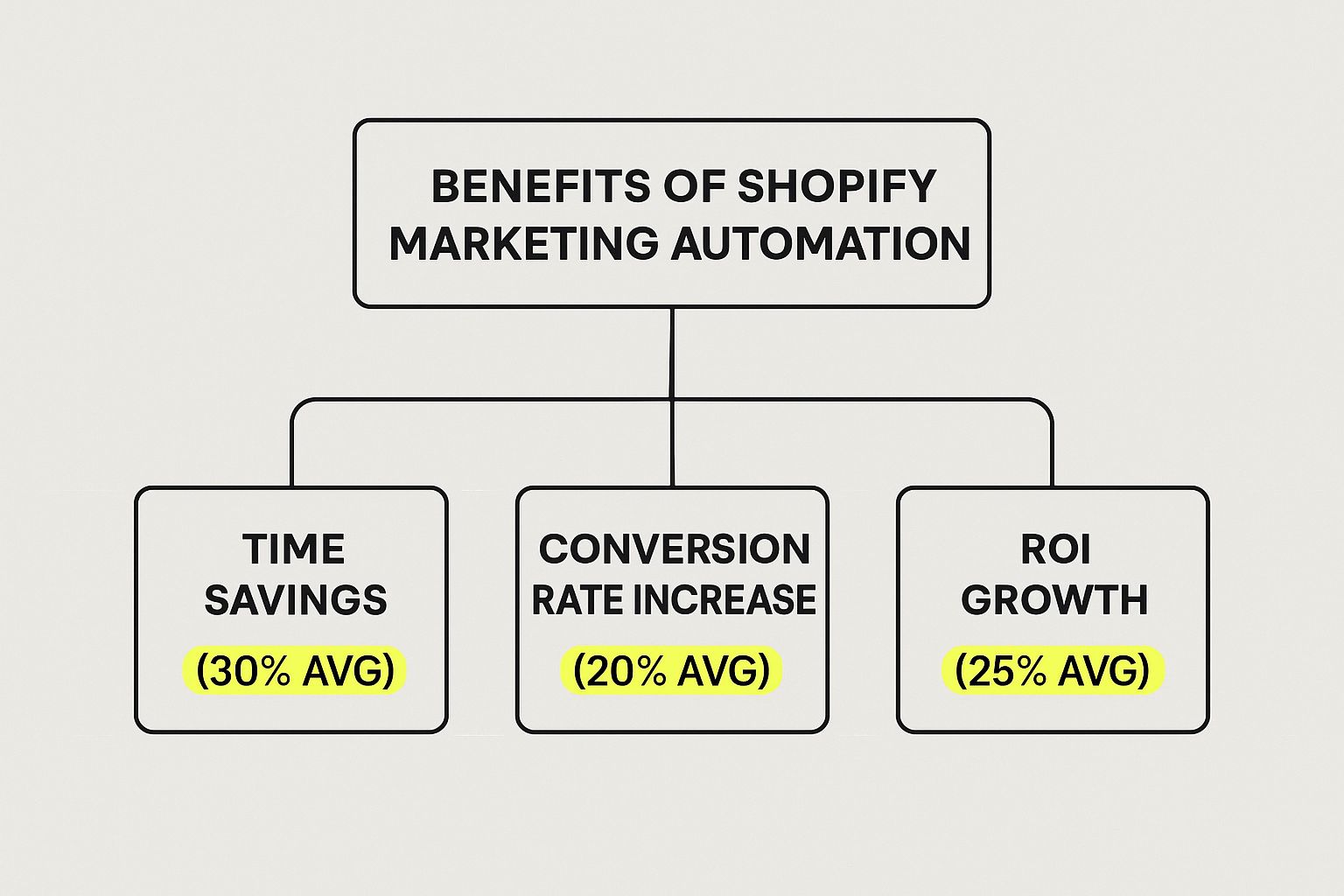
This infographic illustrates how Shopify marketing automation can significantly boost your Time Savings, Conversion Rate, and ROI Growth. These aren't just vanity metrics; they directly impact your bottom line by freeing up time and increasing sales.
Effective Shopify marketing automation relies on several key parts working in harmony. Think of it like constructing a building: you need a solid foundation (customer segmentation), sturdy framing (email workflows), and intelligent wiring (behavioral triggers).
Customer Segmentation: Knowing Your Audience
Customer segmentation is more nuanced than simply dividing customers by demographics. Imagine a bookstore grouping customers solely by age. They'd miss valuable insights like preferred genres or reading frequency.
Effective Shopify marketing automation segments customers based on behavior, purchase history, and brand engagement. This allows for personalized marketing, increasing the chance of a sale. It's like a tailor crafting a custom suit instead of offering a one-size-fits-all approach.
This screenshot from the Shopify blog on customer segmentation highlights how distinct segments need tailored marketing strategies. This targeted approach leads to more effective campaigns.
Email Workflows: Building Strategic Conversations
Instead of sending generic email blasts, imagine having individual conversations with each customer. That's the power of email workflows. Each email builds on the last, guiding customers along a personalized journey.
For example, a welcome series could introduce your brand story, then showcase bestsellers based on the customer's initial browsing. This fosters a sense of connection and relevance.
Behavioral Triggers: Your Automation's Sixth Sense
Behavioral triggers act like sensors, detecting subtle cues from customer actions. Like an experienced salesperson anticipating needs, these triggers identify upsell opportunities, prevent customer churn, and capitalize on buying signals.
For example, a customer repeatedly viewing a specific product could trigger an email showcasing similar items or offering a discount. Think of it as providing helpful suggestions at just the right moment. Integrating chatbot automation can further enhance this responsiveness by offering immediate support and creating a more engaging experience.
By combining customer segmentation, email workflows, and behavioral triggers, you create Shopify marketing automation that feels personal and helpful, driving conversions and building customer loyalty. It's about creating a human connection, not just automating a process.
To help you visualize the core components of Shopify marketing automation, we've compiled this table:
Essential Shopify Marketing Automation Components: Comparison of key automation features and their primary functions
| Component | Primary Function | Customer Impact | Business Benefit |
|---|---|---|---|
| Customer Segmentation | Grouping customers based on shared characteristics (behavior, demographics, purchase history) | More relevant messaging and offers | Increased conversion rates and customer lifetime value |
| Email Workflows | Automating email sequences based on triggers and customer actions | Personalized customer journeys and targeted communication | Improved engagement and sales funnel efficiency |
| Behavioral Triggers | Initiating automated actions based on specific customer behaviors (e.g., abandoned cart, product views) | Timely and relevant interactions | Reduced churn, increased upsells, and improved customer satisfaction |
This table summarizes how each component plays a crucial role in creating a more effective and personalized marketing experience for your customers. This ultimately translates into more conversions and a healthier bottom line for your business.
Creating Seamless Experiences Across Every Touchpoint

This screenshot from Shopify's omnichannel page shows how a single platform can manage different sales channels. Having this central hub is key to simplifying your operations and presenting a consistent brand experience. Connecting these separate channels gives you a more complete picture of your customer.
Your customers interact with your brand in many ways – through email, social media, your website, and maybe even brick-and-mortar stores. This means your Shopify marketing automation needs to be just as adaptable, creating a cohesive experience regardless of where your customer is.
Think of it like a conductor leading an orchestra. Each instrument (channel) plays its own part in creating a harmonious symphony (customer journey).
This interconnectedness is increasingly important in the Shopify world. For instance, roughly 90% of Shopify merchants have linked their online stores to multiple sales channels. During big shopping events like Black Friday and Cyber Monday, Shopify stores collectively generate $4.2 million in sales per minute. This really underscores the need for strong automation to handle this level of activity. Discover more insights.
Synchronizing Your Messaging Across Channels
A core principle of seamless experiences is keeping your message consistent. A customer who abandons their online shopping cart should receive helpful reminders across different touchpoints.
Whether they are checking email, browsing Instagram, or even looking at a competitor's website, your message should feel connected and relevant.
For example, a clothing store could use Shopify marketing automation to send an abandoned cart email, followed by a retargeting ad on Facebook showing the same items. Then, a personalized pop-up could appear when the customer returns to the website, offering a small discount or free shipping. This coordinated strategy keeps the product in front of the customer without being pushy.
Managing Customer Data for a Unified Experience
A successful Shopify marketing automation campaign depends heavily on a well-planned email marketing automation strategy. This is particularly important when handling customer data across various platforms. A unified customer profile is essential for making sure your automation helps, not hinders, the buying process.
Imagine a customer who talks to your brand through both email and live chat. Without a unified profile, your automated system might send generic messages that ignore those previous conversations. But, with integrated data, your automation can personalize messages based on their past interactions, preferences, and what they need. This creates a much more relevant and engaging experience.
Advanced Techniques for Seamless Automation
To take your Shopify marketing automation to the next level, consider cross-channel behavioral triggers and unified customer profiles. These tools let you create automation that feels almost intuitive in its relevance and timing.
For example, a customer browsing a specific product category on your website could trigger a personalized email showcasing related items, a custom social media ad highlighting a relevant promotion, and even a tailored recommendation during their next live chat.
This type of personalization requires a deep understanding of your customer's behavior and preferences. By tracking their activity across all touchpoints, you can create a joined-up customer experience that guides them toward a purchase. This turns scattered interactions into a powerful, unified journey.
It’s about delivering the right information at the right moment, through the right channel. By focusing on these unified experiences, you build stronger relationships with your customers and create sustainable growth for your business.
Making Every Customer Feel Like Your Only Customer
This video perfectly illustrates how personalized marketing can significantly boost customer engagement and ultimately drive sales. By tailoring the shopping experience, you can build stronger relationships with your customers and encourage them to convert.
Imagine strolling into your favorite local coffee shop. The barista knows your name, your usual order, even your preference for oat milk. That feeling of being recognized and valued? That's the power of personalization. And that's where Shopify marketing automation can truly make a difference.
The most successful Shopify stores go far beyond simply adding a customer's first name to an email subject line. They use a wealth of data – browsing history, past purchases, how a customer interacts with their website – to create experiences that feel truly unique to each individual.
Dynamic Content: Tailoring the Experience
This screenshot from the Shopify blog demonstrates how personalized product recommendations can enhance the user experience. By suggesting relevant items based on a customer's past browsing, you can significantly improve engagement and sales.
Think of dynamic content as a chameleon. It adapts based on its environment. Stores use dynamic content to show different product recommendations, adjust the tone of their messaging, and even change the entire website layout based on who’s visiting. A frequent running shoe buyer might see new athletic wear featured prominently on the homepage, while a customer who’s purchased gardening supplies might be shown promotions for outdoor furniture.
AI-Powered Personalization: The Future of Customer Experience
AI-powered personalization takes this even further by adapting to customer behavior in real time. With every click and interaction, the system learns more, refining its recommendations and building an experience that evolves alongside the customer’s changing needs. It’s like having a personal shopper who can anticipate your desires before you even voice them.
Balancing Automation and Authenticity
Personalization is a powerful tool, but it's crucial to use it responsibly. No one wants to feel like they're being followed online. The key is to make sure your personalized messages are helpful and genuine, not intrusive or creepy.
Practical Techniques for Implementing Personalization
How can you strike the right balance? Start by segmenting your audience into distinct groups based on shared characteristics. Then, tailor your messaging to resonate with each group’s particular interests.
For example, new customers might receive a welcome series highlighting your brand story and best-selling items. Loyal customers, on the other hand, could get exclusive previews of upcoming sales or personalized product recommendations based on their purchase history. Tools like those mentioned in this helpful article on affordable Shopify marketing tools can make this process much more manageable.
This level of personalized Shopify marketing automation requires a deep understanding of your customers and a genuine commitment to providing value. By prioritizing their needs and respecting their privacy, you can create automated experiences that build trust and foster long-term loyalty. It's about transforming automation from a simple task into a powerful engine for sustainable business growth.
To illustrate how this works in practice, let’s take a look at the following table:
This table shows examples of how personalization tactics can be applied to different customer segments based on their behavior and needs.
Personalization Tactics By Customer Segment: Comparison of personalization strategies for different customer types
| Customer Type | Personalization Strategy | Automation Trigger | Expected Outcome |
|---|---|---|---|
| New Customer | Welcome email series, product recommendations based on initial browsing | Account creation | Increased engagement and first purchase |
| Repeat Customer | Personalized product recommendations based on past purchases, loyalty program offers | Previous purchase | Higher customer lifetime value, repeat purchases |
| Cart Abandoner | Abandoned cart email with a discount code or free shipping offer, product recommendations for similar items | Adding items to cart without completing purchase | Recovery of lost sales |
| VIP Customer | Exclusive previews of new products, early access to sales, personalized birthday offers | High purchase frequency or spending | Increased customer loyalty and advocacy |
As you can see, understanding the unique characteristics of each customer segment is key. By tailoring your Shopify marketing automation accordingly, you can transform every interaction into a personalized experience that builds genuine connections and drives tangible results.
Tracking What Actually Matters For Your Bottom Line
Open rates and click-through rates can feel like a pat on the back, but they don't always tell the whole story. They're like getting a lot of likes on a social media post – it's nice, but does it translate to actual sales? For Shopify marketing automation, real success comes from revenue attribution. This means understanding exactly which automated actions are directly contributing to your profits. Think of it as connecting the dots between what you're doing and the money you're making.
Instead of focusing on vanity metrics, successful Shopify store owners look at the bigger picture. They track customer lifetime value, automation-driven revenue, and how customers navigate their marketing funnels. This data-driven approach is like having a detailed map of your customer journey. It helps them pinpoint any automation sequences that aren't performing well and identify opportunities for growth.
This screenshot from Shopify Analytics shows a snapshot of important sales data. It’s like the control panel for your store, giving you a quick view of your total sales and online store sessions. Analyzing this data helps you understand the effectiveness of your marketing automation and identify trends that can inform your strategy.
A/B Testing: The Key to Optimization
A/B testing is like running a friendly competition between different versions of your marketing materials. You create two variations of an element – say, an email subject line, a send time, or even a whole workflow – and then see which one performs better.
Imagine testing two email subject lines. One focuses on a discount ("20% Off Your Next Purchase!"), while the other highlights a product benefit ("The Secret to a Perfect Night's Sleep"). By comparing the results – open rates, click-through rates, and ultimately, conversions – you can see which approach resonates more with your audience and drives sales. This constant tweaking and optimizing is what sets high-performing Shopify stores apart. For more optimization tips, check out our guide on Shopify SEO best practices.
Creating Feedback Loops for Continuous Improvement
The best Shopify stores don't just analyze data; they use it to create feedback loops for constant improvement. They watch how customers behave, refine their targeting, adjust message content, and tweak conversion rates based on real-time information. It’s like having a conversation with your customers through their actions.
For example, imagine a clothing store notices that customers often abandon their carts after browsing similar items. They could then set up automated emails showcasing related products or offering a small discount. This proactive approach directly addresses a customer need and encourages them to complete their purchase.
Spotting Warning Signs Before They Impact Your Revenue
Effective Shopify marketing automation requires staying alert. You need to spot any warning signs that indicate your automation needs adjusting before it negatively affects your revenue or customer relationships. Think of it as preventative maintenance for your marketing engine.
One red flag is a sudden drop in conversion rates. This could signal that your messaging isn't connecting with your target audience, your targeting is off, or your workflows are outdated. Another warning sign is a rise in unsubscribe rates or spam complaints. This often means your automation is too frequent, too generic, or simply not valuable to the customer.
By recognizing these warning signs, you can proactively address issues before they become major problems. Regularly review your automation performance, gather customer feedback, and make the necessary adjustments to ensure your automation stays relevant, engaging, and, most importantly, effective. Treat your Shopify marketing automation as a living, breathing system that adapts and improves over time. This ongoing refinement will ensure your automation continues to be a valuable tool for sustainable business growth.
Avoiding The Mistakes That Kill Customer Relationships

This screenshot from a Shopify blog post highlights some common email marketing mistakes. Things like unclear calls to action and neglecting mobile optimization. These seemingly small oversights can have a big impact on how well your campaigns perform.
Even when you have the best intentions, your Shopify marketing automation can work against you if you're not careful. It's a bit like watering plants – too little and they dry up, too much and they drown. Finding that sweet spot is essential for nurturing good customer relationships.
The Perils of Over-Automation
It's easy to fall into the trap of thinking more automation is always better. But bombarding your customers with irrelevant messages is a surefire way to send them running. Imagine getting several emails a day from a store you barely remember visiting. Annoying, right?
This kind of over-automation leads to higher unsubscribe rates and can hurt your brand. Customers might start to see your messages as spam, making it even harder to connect with them later on.
Maintaining the Human Touch
Automation should be a tool to improve human interaction, not replace it. Think of it like a power tool – it makes the job faster and easier, but a skilled craftsperson still needs to guide it.
Personalization is key to maintaining that human touch. Instead of sending generic emails, tailor your messages based on what you know about your customers and what they like. This makes them feel valued and understood.
Breaking the Rules for Exceptional Circumstances
Sometimes, you need to step outside your standard automated workflows. Just like a chef might tweak a recipe depending on the ingredients or oven, you might need to adjust your automation in special situations.
For example, imagine a loyal customer has a problem with their order. A personal apology and a small token of goodwill can be incredibly powerful. It shows you care and helps build a stronger connection.
Managing Automation Frequency and Handling Edge Cases
Finding the right frequency for your automated messages is a balancing act. Too many emails can be overwhelming, but too few might mean missing opportunities. It's like finding the right tempo in a song – too fast and it feels frantic, too slow and it loses its energy.
You also need to think about those unusual situations – the "edge cases" – that don't fit your regular automated processes. What if someone cancels their order right before a shipping confirmation email goes out? These scenarios require careful planning and a flexible automation system.
Maintaining Message Quality as You Scale
As your business expands, maintaining the same level of personalized, high-quality automated communication gets tougher. It's like baking a cake – a small batch is simple, but scaling up requires different tools and techniques.
Invest in resources that help you keep your messages top-notch as you grow. This could mean better customer segmentation, dynamic content creation, and advanced analytics.
By avoiding these common automation pitfalls, you can make sure your Shopify marketing strengthens, rather than weakens, your customer relationships. It's about creating valuable experiences, not just automating tasks. Focusing on this customer-centric approach will lead to long-term success and build a devoted customer base for your brand.
Your Roadmap To Automation Success
This screenshot from the Shopify blog highlights the power of a well-defined marketing strategy. It's a visual cue reminding us that a successful approach requires a clear path forward. Planning ensures your Shopify marketing automation efforts stay focused and deliver results.
Think of it this way: success with Shopify marketing automation isn't about throwing every tool at the wall and seeing what sticks. It's about strategic growth. Imagine building a house. You wouldn't start with the roof, would you? A solid foundation comes first. This section offers a practical roadmap, guiding you from basic automation to advanced, revenue-generating systems. We’ll explore how to prioritize your efforts based on their potential impact and the resources you have at hand.
Building Your Automation Team and Processes
Effective Shopify marketing automation requires structure. Think of a well-oiled machine: each part has a specific job and works in harmony with the others.
Successful store owners organize their teams and processes to support automation goals. This involves establishing clear documentation, regular performance reviews, and strategies for continuous improvement. This structured approach allows for efficient implementation and smooth adjustments as needed.
-
Documentation: Keeping detailed records of your automation workflows is essential. It's like creating a blueprint for your automated systems. Good documentation helps new team members understand the setup and ensures consistency across the board.
-
Performance Reviews: Regular check-ins on your automation performance are crucial for staying on track. Think of it as a health check for your marketing engine. Are things running smoothly? Are there any warning lights flashing?
-
Continuous Improvement: The most effective Shopify marketing automation strategies are dynamic, not static. They evolve based on performance data and customer feedback. This constant refinement keeps your system relevant and effective.
Staying Ahead of the Curve (Without Chasing Every Trend)
It’s easy to get caught up in the buzz surrounding new tools and features. “Shiny object syndrome” can pull your focus away from your core automation goals. Imagine trying to follow multiple recipes at once – you're likely to end up with a culinary disaster.
Savvy store owners stay informed about industry developments without losing sight of their objectives. They prioritize solutions that offer long-term value. This strategic approach maximizes your return on investment.
Building Automation That Grows With Your Business
Your Shopify marketing automation should be an asset that appreciates over time. Picture a tree that grows stronger and taller with each passing year. As your automation gathers more customer data, it can personalize experiences with increasing accuracy, creating a sustainable competitive edge.
This compounding value is the key to long-term success. Your automation becomes a growth engine, fostering stronger customer relationships and solidifying your brand.
By following this structured approach, you ensure your investment in Shopify marketing automation yields tangible results. You’ll build a system that strengthens your business, generates sustainable growth, and deepens your connection with your customers.
Ready to elevate your Shopify store with expert design, development, and support? E-commerce Dev Group provides customized solutions to help you reach your business goals. From store design and app integration to performance optimization and 24/7 support, we’re here to help you succeed. Visit E-commerce Dev Group to learn more.
