


Why Your Store Needs Regular SEO Health Checks

Think of your e-commerce store as you would your car. You wouldn't drive it for thousands of miles without a tune-up, would you? Your online store's SEO needs that same kind of attention. An e-commerce SEO audit is that crucial tune-up, making sure your store runs smoothly and efficiently in the world of search engines. Without regular checks, you're driving blind.
Uncovering Hidden Revenue Leaks
I've chatted with lots of e-commerce entrepreneurs, and a common thread appears: they're often shocked by what a deep SEO audit reveals. Stores that seem to be doing well can be bleeding revenue without even realizing it, and often, the fixes are simple. These hidden issues can range from technical glitches that affect how search engines crawl your site to old content that just isn't connecting with customers. Regular audits find these leaks and turn them into growth opportunities.
For example, I talked to one store owner who was completely stumped by a sudden drop in traffic. Their audit uncovered something small but impactful: broken internal links. Those broken links were messing with the user experience and telling Google that the site was poorly maintained, which hurt their search rankings. A quick fix got their traffic flowing again. A well-structured approach is key. For practical advice, check out our guide on Shopify store audits.
Adapting to Google's Ever-Changing Landscape
Google's algorithm is a moving target, and updates can specifically hit e-commerce sites. What worked in the past might actually be hurting you now. Regular e-commerce SEO audits help you stay up-to-date with these changes, keeping your visibility high and avoiding penalties. They can also help you spot new trends so you can jump on opportunities before your competitors do.
Plus, e-commerce SEO is a competitive field. As of 2025, the average e-commerce brand ranks for about 1,783 keywords, pulling in an estimated 9,625 organic monthly visits. Those visits would cost roughly £11,800 in paid advertising. That really shows the power of organic traffic driven by smart SEO. Want to dig deeper into the numbers? This research on e-commerce SEO statistics offers some great insights.
The Secret of Consistently High-Ranking Stores
The best-performing e-commerce stores know the value of regular SEO health checks. They don't see audits as a chore, but as a smart investment. They’re constantly identifying and fixing technical issues, optimizing their content for what people are actually searching for, and building strong backlinks. This proactive approach is what separates the thriving businesses from the ones just trying to stay afloat.
Regular checks aren’t just about fixing problems, either. They can also highlight areas where you can really shine. By checking out your competitors' SEO strategies, you can find gaps in their content, keyword opportunities, and link-building tactics they're using to grab market share. This information is gold for refining your own SEO roadmap. Regular e-commerce SEO audits give you the tools to boost revenue growth and sharpen your competitive edge.
Setting Up Your Audit Workspace Like The Pros Do
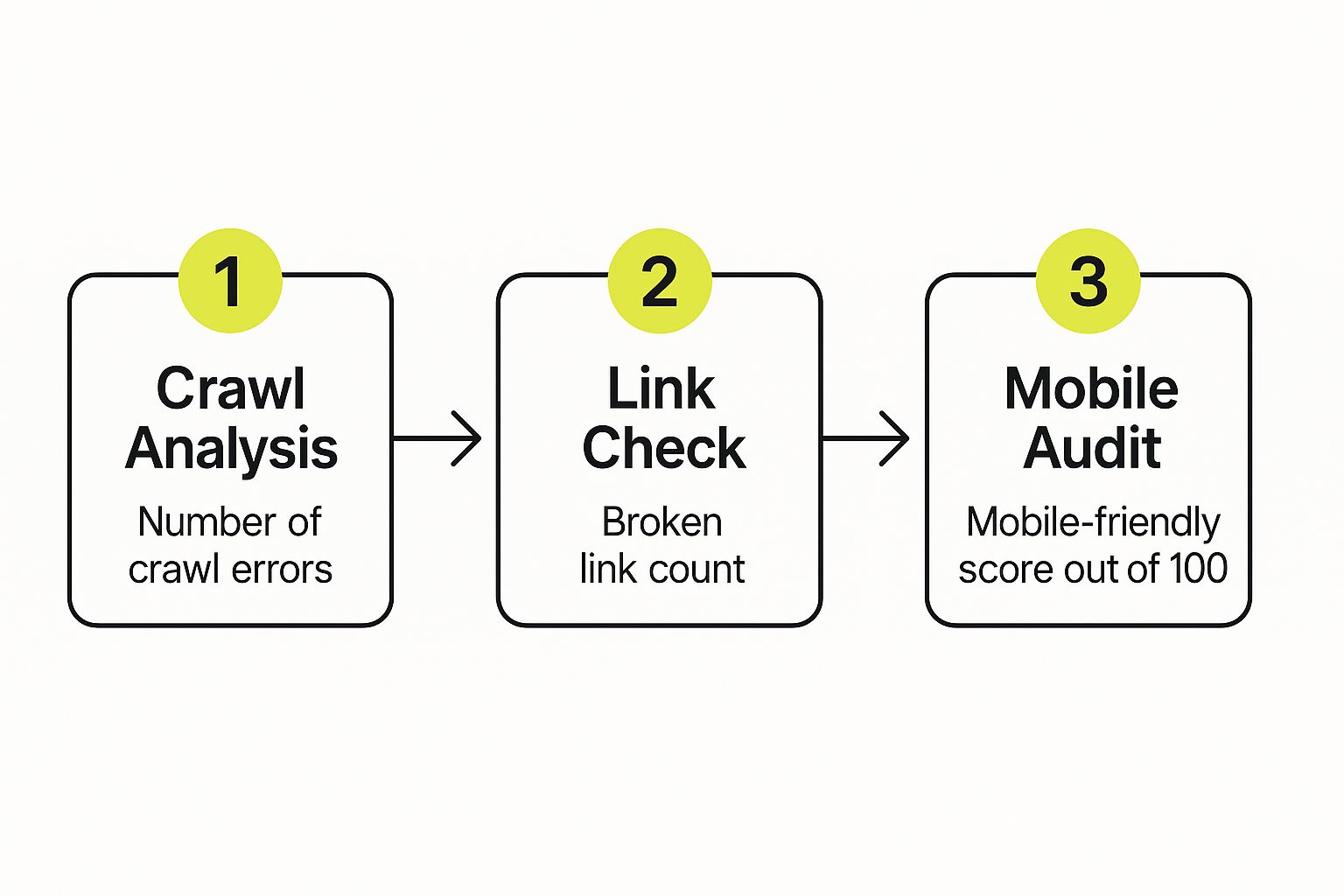
The infographic above gives you a simple visual overview of a three-step initial technical check: crawl analysis, checking for broken links, and a mobile audit. Even at this early stage, these checks can reveal some pretty big issues. For example, a ton of crawl errors points to indexing problems, which means Google can't find your pages. Broken links are annoying for users and mess with your link equity—how search engines measure your site's authority. And a poor mobile score, with Google's mobile-first indexing, can tank your rankings for mobile users, a huge chunk of ecommerce traffic.
Organizing Your Tools and Data
A good ecommerce SEO audit needs more than just good intentions, you need the right tools. It's like building a house—you need more than just a hammer. Start with the free basics: Google Search Console and Google Analytics. These give you fundamental data on keywords, traffic, and how users behave on your site. When I'm kicking off an audit, I sometimes like to get inspiration from other audit checklists, like this social media audit checklist. It helps me think about the process in different ways.
You’ll also want dedicated crawling software like Screaming Frog. This is key for uncovering technical problems across your whole site, especially for those of you with massive product catalogs. For backlinks and checking out the competition, tools like Ahrefs or SEMrush are my go-to. They show you important stuff about your backlink profile, what your competitors are up to, and where the keyword opportunities lie.
To help you choose the right tools, here’s a handy comparison table:
Essential SEO Audit Tools Comparison
A comprehensive comparison of free vs paid tools for different audit components, including their strengths and specific ecommerce features.
| Tool Category | Free Options | Paid Options | Best Use Case | Ecommerce Features |
|---|---|---|---|---|
| Crawl Analysis | Google Search Console | Screaming Frog | Identifying technical SEO issues | Crawling large product catalogs efficiently |
| Analytics & Reporting | Google Analytics | Google Analytics 360, SEMrush, Ahrefs | Tracking key performance indicators and user behavior | Enhanced ecommerce reporting, product performance analysis |
| Backlink Analysis | Google Search Console | Ahrefs, SEMrush, Majestic | Identifying backlink opportunities and toxic links | Competitor backlink analysis, domain authority monitoring |
| Keyword Research | Google Keyword Planner | SEMrush, Ahrefs, Moz Keyword Explorer | Discovering relevant keywords and search volumes | Product-specific keyword research, long-tail keyword identification |
| Mobile Audit | Google's Mobile-Friendly Test | Various page speed testing tools | Checking mobile responsiveness and page speed | Mobile usability testing, AMP validation |
This table summarizes the key tools you'll need for a thorough audit. Remember, you can combine free and paid tools to get the best of both worlds.
Structuring Your Workflow for Maximum Efficiency
With your tools ready, create a clear workflow to avoid drowning in data. Start by recording your baseline metrics. This gives you a starting point to measure your progress. Track key performance indicators (KPIs) that match your business goals. These could be things like organic traffic, conversion rate, average order value, and how well specific product categories are performing. A good workflow is the difference between a messy audit and real, usable results.
Make templates for data collection and analysis. This speeds up future audits and keeps your approach consistent. Trust me, I’ve seen how these templates can save you hours and make comparing results across audits so much easier. By organizing your data and having a structured approach, you turn a potentially huge task into something manageable.
Setting Up Tracking for KPIs
Tracking KPIs properly is essential for a good ecommerce SEO audit. It’s like a financial dashboard for your online store – it tells you what’s working, what’s not, and where you need to tweak things. Focus on metrics that have a direct impact on revenue. Tracking conversions from specific product categories, for instance, shows you what's selling well and what needs work. Don't just look at vanity metrics like overall traffic—dig deeper.
Remember, an audit isn't just about finding problems; it's about finding opportunities. Good tracking lets you focus on fixes that really boost your business. By setting up a solid tracking system early on, you build a foundation for actionable insights and real, lasting improvement. This proactive way of thinking will pay off long after the initial audit is done.
Technical Foundation: What's Actually Breaking Your Rankings

This PageSpeed Insights screenshot gives you a peek at a website's performance. Metrics like First Contentful Paint (FCP) and Largest Contentful Paint (LCP) show how quickly users see content and how long the page feels like it's taking to load. A slow LCP, like in this example, is a big red flag. It means there's room for improvement that can seriously boost user experience, and as a direct result, your SEO.
This is where we get down to brass tacks in your ecommerce SEO audit. We're going beyond the surface and digging into the technical glitches that can seriously impact your search rankings. Forget the usual generic SEO advice—we're talking about the real, practical issues that are secretly holding you back.
Crawl Budget Waste: The Silent Killer of Large Catalogs
One of the biggest issues for ecommerce sites is crawl budget waste. If your site has a massive product catalog, Google's bots might be wasting time crawling pages that don't matter, like old product variations or duplicate content. They should be focused on your key, high-performing product pages – the ones that actually bring in the money! I once audited a store with thousands of products, only to find hundreds of indexed pages for products they'd stopped selling ages ago. Talk about a wasted crawl budget! Their best sellers weren't getting the attention they deserved in search results. Once we cleaned up that mess and reclaimed that wasted crawl budget, their organic traffic saw a significant jump.
Mobile Usability: More Than Just a Responsive Design
Then there’s mobile usability. Sure, most ecommerce platforms offer responsive templates, but that’s not the end of the story. Google doesn't just care if your site looks okay on a phone; it cares about performance. Fast loading times, easy navigation with buttons big enough for thumbs, and a streamlined checkout are essential. Remember, Google’s mobile-first indexing means the mobile version of your site is the main one they use for ranking.
Site Speed: Killing Conversions and Rankings
Site speed is another huge factor. And it’s a double-edged sword. It hurts both your rankings and your conversions. Imagine a potential customer landing on a slow-loading product page. They're gone before they even see your amazing product descriptions. I've seen firsthand how site speed improvements directly lead to higher conversion rates. Sometimes, just by shaving off a couple of seconds of load time, you can see as much as a 10% increase in conversions. Check out our guide on Shopify performance optimization for some actionable tips.
The Ecommerce Twist: Why Technical SEO Is Different for Online Stores
Ecommerce technical SEO has its own unique challenges. Certain issues impact online stores differently than other websites. For example, faceted navigation, which is helpful for users, can create a mountain of duplicate content if it isn't set up correctly. Similarly, having tons of product pages can lead to thin content if those pages aren’t optimized with unique descriptions and good quality images or videos.
Effective SEO strategies significantly influence both traffic and conversions. SEO has a real impact on e-commerce conversion rates, with rates varying from 2.99% to 4.4%, depending on the industry. A good SEO audit means optimizing content, improving site speed, and making sure the user experience (UX) is smooth—and honestly, 90% of the lowest-performing e-commerce websites have UX issues they need to address. You can find more data on ecommerce SEO conversion rates and their impact.
Prioritizing Fixes for Maximum Impact
Don’t get hung up on arbitrary tool scores. Focus on the technical fixes that will have the biggest impact on your business. Which issues are directly affecting your most important product categories? Which fixes will give you the biggest boost in conversions? These are the questions you need to ask during your ecommerce SEO audit. It's not about being perfect, it's about getting the biggest wins. I've seen stores get huge results by focusing on a few key technical improvements, rather than trying to fix absolutely everything at once. A good ecommerce SEO audit is about finding the best opportunities for growth.
Content Audit: Beyond Basic Product Descriptions

Most online store owners think ecommerce SEO audits only involve tweaking product descriptions. Sure, that's part of it, but it's just the tip of the iceberg. Think of your site's content as an ecosystem. Product pages are vital, but they're only one piece of a much larger puzzle. We need to look at how everything works together–from category pages to blog posts–to create a smooth experience for both shoppers and search engines. Before we get too technical, it's helpful to have a solid understanding of ecommerce SEO best practices. Check out this Ecommerce SEO Best Practices guide for a helpful overview.
Evaluating Your Site’s Content Architecture
Ever walked into a brick-and-mortar store so disorganized you couldn’t find anything? That’s how a poorly structured website feels to users and search engine crawlers. A good content audit examines your site’s architecture, checking how easy it is to navigate. Ask yourself: Does my navigation make sense? Can people easily find related products? Does my internal linking make logical sense?
For example, imagine a clothing store. They might have main categories like “Men’s,” “Women’s,” and “Children’s.” Within “Men’s," you'd find subcategories like "Shirts," "Pants," and "Shoes." Each product page (like a specific pair of men's shoes) should then link back to its relevant category ("Shoes") and main category ("Men’s"). This structured approach improves crawlability and helps shoppers find what they’re looking for.
Identifying Keyword Cannibalization Issues
Keyword cannibalization is a common problem in ecommerce. It's like having multiple salespeople all trying to sell the same item to the same customer–confusing, right? It happens when different pages target identical keywords, causing them to compete with each other in search results. I once audited a phone case store where several product pages and a category page all targeted "iPhone 13 case." This internal competition was killing their rankings. Focusing their keyword strategy made a huge difference.
Spotting Content Gaps and Opportunities
Content audits also uncover hidden opportunities. What are your competitors writing about that you're not? What relevant topics or keywords are you missing? These gaps are your chance to attract more qualified traffic. If you sell hiking boots, for example, you might find competitors ranking for terms like “best hiking boots for beginners” or “how to choose hiking boots.” This signals a great opportunity to create informative guides or blog posts.
Auditing Product Pages for Buying Intent
Product pages are your money makers. But are they optimized for actual buying intent? Do they answer the questions your ideal customer is likely to ask? Are they engaging and persuasive? A strong ecommerce content audit examines whether your product pages are doing their job: getting people to buy. One simple trick is looking at user reviews. These often reveal what info customers are searching for but not finding on your product pages.
Evaluating Category Page Potential
Category pages are often untapped SEO goldmines. They can rank for broader keywords and drive tons of traffic. Think of them as the attractive displays that draw customers into a physical store. Are yours well-optimized? Do they provide real value beyond just listing products? Do they have engaging descriptions, high-quality images, and helpful filtering options?
Identifying Content Opportunities Across the Customer Journey
Finally, a content audit looks at how your content guides customers from initial research all the way to checkout. Are you providing helpful information at each stage? For instance, blog posts can attract potential customers in the awareness stage, while comparison charts and product reviews can help those in the consideration stage. This approach builds trust and boosts conversions. A good audit helps you identify these opportunities and craft a truly comprehensive content strategy.
Let's look at some key metrics to track for your ecommerce content. The following table provides benchmarks and potential areas for improvement:
Ecommerce Content Performance Metrics
| Content Type | Primary Metrics | Industry Benchmarks | Red Flags | Quick Wins |
|---|---|---|---|---|
| Product Pages | Conversion Rate, Add-to-Cart Rate, Bounce Rate | Conversion Rate: 1-3%, Add-to-Cart Rate: 5-10% | High bounce rate, low add-to-cart rate | Improve product descriptions, optimize images, add customer reviews |
| Category Pages | Bounce Rate, Time on Page, Click-Through Rate to Product Pages | Bounce Rate: <40%, Time on Page: >60 seconds | High bounce rate, low click-through rate | Improve category descriptions, optimize navigation, add featured products |
| Blog Posts | Organic Traffic, Time on Page, Social Shares | Varies by industry | Low traffic, high bounce rate | Optimize for relevant keywords, promote on social media, improve readability |
By analyzing these metrics, you can pinpoint what's working and what needs tweaking. Remember, content audits aren't a one-and-done deal. They’re an ongoing process to keep your content fresh, relevant, and optimized for both search engines and your audience.
Backlink Health Check: Quality Signals That Actually Matter
Backlinks are like testimonials for your online store. But not all testimonials are equal. A few glowing reviews from industry leaders will do way more for your business than a mountain of generic comments from nobodies. That's why a proper ecommerce SEO audit goes beyond simply counting backlinks. We need to dig into the quality signals that really matter to search engines.
Identifying Toxic Backlinks
Let's start with the bad news: toxic backlinks. These are low-quality links from sketchy sites that can actually hurt your rankings. Think spam directories, link farms, or sites packed with thin, irrelevant content. It's like getting endorsed by someone with a bad reputation – not exactly helpful. Getting rid of these toxic links is crucial. Ahrefs' backlink checker is a great tool for this.
This Ahrefs screenshot gives you a glimpse into a website's backlink profile. "Referring domains" shows how many unique sites are linking to you, but the "DR" (Domain Rating) column is where the quality check happens. A low DR can be a red flag, signaling a potentially toxic link that needs further investigation. Just like a well-maintained car, a healthy backlink profile requires regular checkups.
Why Ecommerce Backlinks Are Different
Ecommerce backlinks are a whole different ballgame. Links from relevant industry blogs, product review sites, and influential social media carry serious weight. A link from a popular fashion blogger is gold for a clothing store, while a link from a random tech site is practically worthless. Understanding these nuances is key for a winning ecommerce backlink strategy. Consider this: Over 66% of backlinks are broken! That's a huge hit to a website's credibility and performance. Fixing those broken links is a quick win. Check out these backlink statistics for more insights. It's also worth noting that the average Domain Rating (DR) is 28 for ecommerce backlinks, while digital PR backlinks tend to have a higher DR of around 46.
Uncovering Link Building Opportunities
An ecommerce SEO audit isn't just about finding the bad stuff. It's also about finding opportunities. Competitor backlink analysis is like gold mining for link prospects. See who's linking to your competitors and ask yourself: Can you do the same? Maybe it's guest blogging, influencer outreach, or sponsoring an industry event. I've seen stores skyrocket their rankings just by reaching out to bloggers who mentioned their products without linking back. It's often that simple.
Analyzing Competitor Backlinks
Keeping an eye on the competition is always a smart move. By analyzing their backlink profiles, you can decode their link building strategies and find realistic link targets that fit your budget. Tools like Ahrefs and SEMrush can reveal your competitors' backlink sources, anchor text, and even the type of content that attracts the most links. I once helped a client snag a killer backlink from a major industry publication just by replicating a content format used by a competitor. It was a total game-changer.
Identifying Realistic Link Targets
Link building shouldn't be a guessing game. Your ecommerce SEO audit should give you a laser-focused list of realistic link targets. These are sites relevant to your niche, with a strong Domain Rating, and a history of linking to other sites. Focus on building genuine relationships with these sites, not just begging for links. Offer valuable content, engage with their community, and be a helpful resource. This approach builds long-term partnerships and earns high-quality backlinks that will keep your rankings healthy for years to come.
Turning Audit Discoveries Into Revenue-Driving Action
Let’s be real, an e-commerce SEO audit is just the first step. A data-packed spreadsheet isn't going to magically boost sales. We need to translate those findings into a concrete, actionable plan that actually drives revenue. This is where the rubber meets the road.
Prioritizing for Impact: Quick Wins vs. Long-Term Growth
In my experience, the best SEO pros know how to balance short-term gains with long-term strategies. They look for those “quick wins” that create immediate momentum while also planning for the bigger, more strategic improvements that build over time. Think of it like tending a garden: you need to both weed and plant seeds. Fixing broken links, for example, is a quick win that can quickly boost crawlability. Revamping your site architecture, on the other hand, is a bigger project but yields significantly higher organic traffic over time. Ideally, you want both.
It’s all about finding the right balance.
Setting Realistic Implementation Timelines
Rome wasn’t built in a day, and neither is a perfect SEO strategy. We can't fix everything overnight, so realistic timelines are essential. Implementing schema markup might only take a few days, but migrating your whole site could take weeks or even months. Consider your resources, team bandwidth, and the complexity of the task. If a migration is on the table, this Shopify store migration information might be useful.
Don’t over-promise and under-deliver.
Communicating With Developers: Bridging the Gap
I’ve found that communicating technical SEO issues to developers can be tricky. The key is to focus on how these issues impact the bottom line, not just abstract SEO concepts. Instead of saying “your LCP is too high,” explain how that slow Largest Contentful Paint leads to a high bounce rate and lost sales. Speaking the same language—the language of business impact—makes a world of difference. Showing developers concrete data like session recordings of frustrated users struggling with slow-loading pages can be incredibly powerful. It really drives the point home.
The ROI of SEO: Focusing on the Fastest Returns
If resources are tight, focus on improvements with the highest return on investment (ROI). Fixing broken internal links, for example, is a quick win with a big impact. This simple fix improves both crawlability and user experience, affecting rankings and conversions. Another area I’ve seen make a big difference is optimizing top-performing product pages. Small changes to title tags, meta descriptions, and product descriptions can have a surprisingly large impact on both rankings and sales. It's about maximizing impact with minimal effort.
Implementation in Phases: Avoiding Overwhelm
Don’t try to do everything at once. It’s much better to break implementation into manageable phases. Phase 1 could focus on quick wins, while Phase 2 tackles more complex technical issues. This phased approach helps your team stay focused and avoids budget overruns. Plus, it makes tracking progress and measuring the impact of each phase much easier. I’ve seen this approach work wonders for stores that felt overwhelmed by the number of issues uncovered in their audit.
Measurable Goals: Tying Improvements to Business Metrics
Every SEO improvement should have measurable goals tied to specific business metrics. Don't just aim for higher rankings; aim for a 10% increase in conversions from a specific keyword within three months, for instance. This keeps your SEO strategy laser-focused on your business objectives.
Accountability: Tracking Progress and Maintaining Momentum
Accountability is key. Assign clear responsibilities and deadlines. Regular progress reports keep everyone on track and ensure that changes are implemented. Ongoing monitoring and tracking also help you identify what's working and what needs adjusting. This continuous optimization is at the heart of long-term SEO success.
Presenting to Stakeholders: Talking Their Language
Stakeholders care about revenue, not rankings. When presenting your audit findings, focus on the business impact. Show how improvements will boost traffic, conversions, and ultimately, revenue. Use clear visuals, avoid technical jargon, and explain the "why" behind your recommendations, backing everything up with data. A clear, concise presentation emphasizing the potential for revenue growth is far more compelling than a technical report.
Measuring Success And Planning Your Next Health Check
After putting in all that effort on your ecommerce SEO audit, you want to make sure those improvements stick around. This isn't a one-and-done deal; think of it as building a system for continuous optimization. It’s like maintaining a healthy diet—you don’t eat clean for a week and then go back to old habits, right? Consistency is key for long-term results.
Establishing Sustainable Monitoring Systems
So, how do you build an SEO monitoring system you’ll actually use? Keep it simple! Don’t create these crazy complex dashboards filled with a million metrics you'll never even look at. Focus on the KPIs that directly impact your bottom line. For example, track organic traffic to your best-selling product categories, not just overall site traffic. This targeted approach gives you much more useful information.
Also, set up automated alerts for critical issues. Google Search Console is great for this. It can alert you to things like crawl errors or security problems. These alerts are your early warning system, catching potential disasters before they turn into major headaches.
Tracking Predictive Metrics
Successful ecommerce SEO audits are forward-looking. Which metrics predict potential problems down the line? Keep a regular eye on your backlink profile. A sudden drop in referring domains could be a red flag. Also, monitor your Core Web Vitals. A decline in page speed can hurt your rankings and your conversions.
I remember working with an online store that saw a slow but steady decrease in mobile page speed after a site redesign. This subtle shift eventually caused a significant drop in mobile rankings. Because they were monitoring regularly, they caught it early and fixed the issue before it became a full-blown crisis.
Recognizing When It’s Time for the Next Audit
Just like your car needs regular tune-ups, your ecommerce site needs periodic SEO audits. How often? Well, it depends on your business and your industry. If you're in a fast-paced, competitive market, you might need to audit every six months. If things are a bit calmer, an annual audit might be sufficient.
Here are a few signs it might be time for another checkup:
- Significant algorithm updates: Google's algorithm is always changing. A major update can totally shake things up in the SEO world.
- Sudden drops in traffic or conversions: These are usually the first signs of a bigger problem.
- Major site changes: A redesign, platform migration, or a big content overhaul can introduce new technical SEO issues.
- New competitors entering the market: New competition can disrupt the keyword landscape and force you to adjust your strategy.
Building a Sustainable SEO Audit Schedule
It's a good idea to align your ecommerce SEO audit schedule with your business cycles. If you have peak seasons, auditing right before them makes sure your site is in top shape to maximize conversions. Auditing after a major sale or promotion can also provide valuable insights into customer behavior and highlight areas for improvement.
Create a simple monitoring dashboard that’s easy to understand and gives you actionable insights. I've seen store owners build dashboards that track keyword rankings for their top products, organic traffic by category, and conversion rates for key landing pages. This focused approach keeps them informed without drowning them in data.
Finally, develop the discipline to actually use your monitoring system and follow through on what your audit reveals. It's easy to get pumped about SEO during the audit itself, but keeping that momentum going is crucial for long-term success. Regularly reviewing your dashboard, blocking off time for implementation, and celebrating small wins along the way helps build that all-important SEO discipline.
Ready to boost your Shopify store's performance? E-commerce Dev Group offers expert Shopify design, development, and support, from store design and performance optimization to migrations and app integrations. Let us help you take your market share to the next level!
