


Understanding Your Starting Point With Industry Benchmarks

Before optimizing your Shopify store, it's important to know where you stand. It's like planning a road trip. You wouldn't hit the road without knowing where you're starting and where you're going. Improving your ecommerce conversion rate works the same way: understand your current performance and set achievable goals. This is where understanding industry benchmarks becomes essential.
Knowing the current benchmarks is key to improving ecommerce conversion rates. As of early 2025, the average ecommerce conversion rate is between 2% and 4%. This range shows how conversion rates vary across different industries. For instance, the electronics and home appliances sector has a higher average conversion rate of 3.6%. Some sectors are simply better at converting visitors into buyers, possibly due to factors like higher average revenue per user or more effective product presentation. You can find more detailed statistics here: Ecommerce Conversion Rate by Industry
Why Benchmarks Matter
Benchmarks provide context. They help you see how your store performs compared to your competitors. They also highlight areas for improvement. For example, a conversion rate significantly below the industry average may signal issues with your website, product offerings, or marketing. However, remember that benchmarks aren't fixed targets.
Decoding the Numbers
The common 2-4% average conversion rate can be misleading. Look at the specifics of each industry. Average order value (AOV) and customer acquisition cost (CAC) play significant roles. A high AOV store might have a lower conversion rate but still earn more revenue than a store with a higher conversion rate and a low AOV. This is because each successful conversion brings in more money.
Beyond the Average
Benchmarks are a starting point, not the finish line. Successful ecommerce businesses aim to surpass the average. They use benchmarks to guide strategic growth, regularly analyzing performance and finding ways to boost conversions.
Setting Realistic Targets
Use industry benchmarks to set achievable goals. Focus on making small, consistent improvements instead of hoping for huge overnight changes. For example, if your conversion rate is 1.5%, aim for 2% next quarter. These small gains add up to major long-term growth.
Identifying Key Areas for Improvement
Compare your performance against benchmarks to pinpoint areas needing improvement. Is your cart abandonment rate high? Are your product pages optimized for conversions? Identifying these weaknesses helps you prioritize optimization efforts for maximum impact. This targeted approach maximizes your return on investment and ensures you're not wasting time on ineffective strategies. This lays the groundwork for implementing targeted optimization strategies, which we'll cover next.
Conquering Cart Abandonment With Proven Recovery Tactics
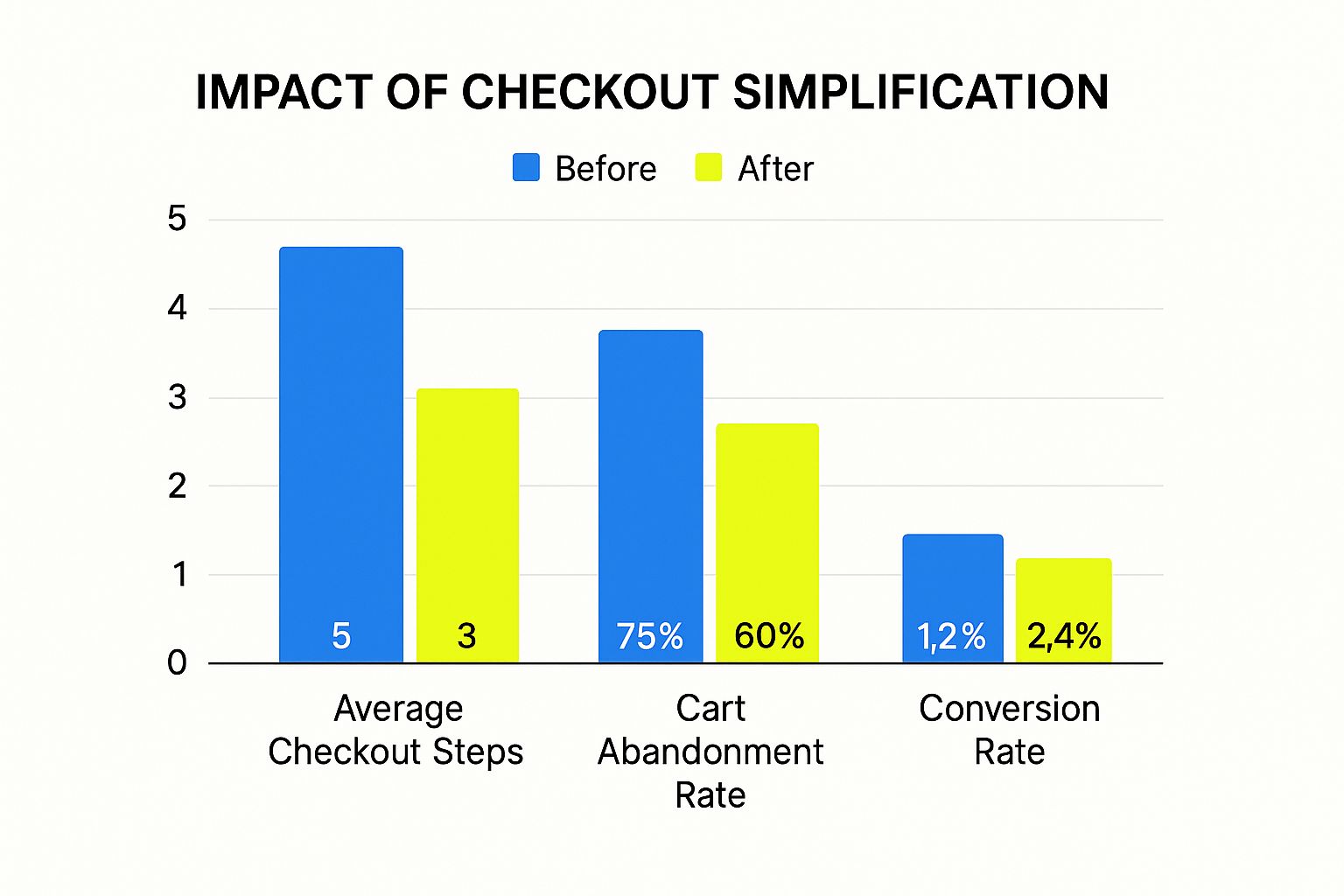
The infographic above shows how simplifying your checkout process can significantly impact three key metrics: average checkout steps, cart abandonment rate, and conversion rate. Reducing the number of steps clearly improves both abandonment and conversions. This means a smoother path to purchase can recover lost sales and boost overall profits.
A major hurdle in improving ecommerce conversion rates is cart abandonment. It's like a leaky bucket: you're driving traffic, but a lot of it disappears before the sale. Plugging this "leak" is essential for maximizing revenue. The challenge is substantial: in 2024, cart abandonment rates reached over 70%. This highlights the difficulty of converting website visits into actual purchases. One of the biggest problems? High extra costs like shipping, taxes, and other fees. For more insights, check out these resources: Global Conversion Rate by Industry and Device and 10 Reasons For Cart Abandonment on Shopify.
Understanding the Psychology of Abandonment
To combat cart abandonment effectively, we need to understand why customers abandon their carts. It's often not about not wanting the product, but rather facing obstacles during checkout.
Some common obstacles include:
-
Unexpected Costs: Hidden fees or surprisingly high shipping costs can be deal-breakers. Transparency about pricing is essential.
-
Complicated Checkout: A long or confusing checkout process can frustrate customers and lead to abandonment. Keep it short and simple.
-
Trust Concerns: Customers must feel secure sharing their payment information. Displaying trust badges and security certifications can help build confidence.
Let's dive into a table summarizing the top reasons for cart abandonment and potential solutions. This table compares common reasons with proven solutions, considering the implementation difficulty for each.
| Abandonment Reason | Percentage of Cases | Proven Solutions | Implementation Difficulty |
|---|---|---|---|
| Unexpected Costs | Varies, but often significant | Display all costs upfront; Offer free shipping thresholds | Easy |
| Complicated Checkout | Can contribute up to 25% of abandonment | Streamlined checkout; Guest checkout options; Progress indicators | Medium |
| Trust Concerns | Can deter up to 18% of shoppers | Display security badges (e.g., SSL certificates); Offer trusted payment gateways (e.g., PayPal, Stripe); Clear privacy policy | Medium |
| Lack of Payment Options | Contributes to around 8% of abandonment | Offer diverse payment methods (e.g., credit cards, digital wallets) | Medium |
| Website Errors/Technical Issues | Can cause up to 13% of abandonment | Regular site maintenance and testing; Optimize site speed | Hard (requires technical expertise) |
This table demonstrates that while some solutions are easy to implement, others require more effort and technical expertise. Prioritizing the solutions based on their impact and implementation difficulty can be a strategic approach to tackling cart abandonment.
Implementing Effective Recovery Tactics
Once you understand the why, you can implement targeted recovery tactics. Here are a few effective strategies:
-
Exit-Intent Pop-ups: Offer a small incentive, like a discount or free shipping, when customers are about to leave.
-
Cart Recovery Emails: Send reminder emails about abandoned carts, offering helpful information or incentives.
-
Checkout Optimization: Simplify the checkout process, offer guest checkout, and clearly display all costs upfront.
Turning Abandonment Into Opportunity
Savvy store owners see cart abandonment as an opportunity. By using behavioral triggers, like exit intent, and progressive disclosure (revealing information step-by-step), they create a more engaging checkout experience. Strategic incentives, like free shipping thresholds or limited-time discounts, can further encourage purchases. Some businesses have cut their abandonment rates in half by implementing these tactics. These successes show that addressing the root causes of abandonment and offering practical solutions can turn potential losses into significant wins.
Capitalizing On Market Growth For Maximum Revenue Impact

The ecommerce world is booming. This creates a massive opportunity for online stores to boost their revenue. Savvy store owners aren't just keeping up; they're actively grabbing a bigger piece of the market. This forward-thinking strategy revolves around ecommerce conversion rate optimization.
Global ecommerce sales are predicted to reach $6.86 trillion in 2025, an 8.37% jump from 2024. This highlights the immense growth potential. With average ecommerce conversion rates between 2.5% and 3%, even small tweaks can mean big profits. More statistics are available here: Ecommerce Statistics. Optimizing conversions is essential for staying competitive and maximizing profits in this expanding market.
Focusing on Fundamentals
Many businesses chase the newest marketing fads. However, successful ecommerce stores stick to the core principles that drive conversions. These fundamentals include:
- Seamless customer experience
- Building trust
- Communicating a clear value proposition
Imagine a customer trying to buy shoes online. A confusing website, slow loading times, and a clunky checkout can easily scare them away. But a store with a user-friendly design, trust badges, and clear product benefits is far more likely to make a sale. This approach focuses on solving customer problems and building strong relationships.
The Power of Compounding Gains
Small improvements might not seem like much at first. But over time, these small wins add up to create substantial advantages. Think of it like compound interest: small, regular gains lead to big returns over the long haul.
One powerful way to boost conversion rates is to tackle cart abandonment. For helpful tips, check out this guide: reduce cart abandonment. Fixing issues like unexpected shipping costs or a complicated checkout process can significantly improve your bottom line. These seemingly minor adjustments can lead to major revenue growth.
Riding the Wave of Growth
By focusing on core principles, you can position your business to ride the wave of market growth. This means winning customers who might otherwise choose your competitors. In the fast-paced world of ecommerce, adapting and optimizing is key to long-term success. This proactive approach, along with a focus on customers, sets businesses up for sustainable growth and higher profits.
Creating User Experiences That Actually Convert Visitors
User experience (UX) is critical for boosting your ecommerce conversion rate. It's not just about making your website look good; it's about making it easy for visitors to buy. Think of it like a brick-and-mortar store: messy aisles and slow checkout lines discourage customers. A confusing website or complicated checkout process will have the same effect online.
The Importance of a Seamless Experience
A seamless UX builds trust and reduces friction. Several key elements contribute to this:
-
Page Load Speed: Slow page loads frustrate customers and increase bounce rates. Ideally, your website should load in under two seconds.
-
Mobile Responsiveness: Most ecommerce traffic comes from mobile devices. A mobile-first design is essential. Your site must be easy to use and work perfectly on all devices.
-
Intuitive Navigation: Visitors should be able to find what they’re looking for without any difficulty. Clear menus, a good search bar, and a logical category structure are essential.
Together, these factors create a positive first impression and invite visitors to explore. A well-designed website encourages engagement, just like a well-organized store with friendly staff.
Building Trust and Encouraging Action
Effective UX also involves psychology. Several elements influence online buying behavior:
-
Trust Signals: Displaying security badges, customer testimonials, and guarantees builds confidence and reduces purchase anxiety.
-
Social Proof: Showing reviews, ratings, and social media shares leverages the influence of other shoppers. The placement of these elements can significantly impact conversion rates.
-
Optimized Product Pages: High-quality product images, detailed descriptions, and clear calls to action encourage shoppers to add items to their cart.
These elements create a persuasive and trustworthy experience. Good UX design subtly guides visitors toward a purchase, much like a helpful salesperson.
Using Data to Drive UX Improvements
UX optimization is an ongoing process. It requires constant analysis and refinement:
-
A/B Testing: Compare different versions of website elements (like headlines or buttons) to see which performs best. This data-driven approach helps you make informed decisions.
-
Heat Maps: Heat maps visualize user behavior by tracking clicks, scrolls, and mouse movements. This reveals what interests visitors and where they encounter problems.
-
Personalized Experiences: Tailor content and offers to individual users. However, it's crucial to respect user privacy. Personalization should be helpful, not intrusive.
By using data, you can continuously refine your UX for maximum conversions. Just as a store manager adjusts displays based on customer traffic, you can use website data to improve the shopping experience and drive sales.
Prioritizing UX Optimizations
Not all UX improvements require the same amount of work. Prioritize changes based on their potential impact and the effort required. The following table provides a simple framework for prioritizing UX optimizations.
To help illustrate this concept, we've put together a prioritization matrix. This table, the "Website Optimization Priority Matrix", offers a comprehensive breakdown of UX optimization tactics, ranked by impact and implementation effort.
| Optimization Tactic | Impact Level | Implementation Time | Required Resources | Expected ROI |
|---|---|---|---|---|
| Streamlining Checkout | High | Medium | Developer/Designer | High |
| Optimizing Product Images | High | Low | Photographer/Designer | High |
| Implementing Live Chat | Medium | Low | Customer Service Rep/Software | Medium |
| A/B Testing Call-to-Action Buttons | Medium | Low | Marketing Team/Software | Medium |
| Redesigning Entire Website | High | High | Developer/Designer/Project Manager | High (Long-Term) |
This framework helps you focus on high-impact changes, maximizing your ROI. Continuous improvement is the key to long-term success in ecommerce. By consistently improving UX, you create an experience that converts visitors and builds customer loyalty.
Designing Elements That Guide Customers To Purchase

Every design element on your ecommerce site influences your conversion rate. Each choice contributes to either success or failure. This section explores design strategies used by successful ecommerce stores to subtly guide visitors toward making a purchase. Think of your website design as a roadmap leading customers to the destination: a completed purchase.
The Psychology of Design
Color psychology, typography, and layout significantly affect buying behavior. Specific colors evoke different emotions. Red, for instance, can create urgency, while blue instills trust.
Clear, easy-to-read fonts improve comprehension and engagement, directly impacting brand perception. This interplay of design elements subconsciously influences how customers interact with your store.
Creating Urgency and Scarcity
Urgency and scarcity tactics, when authentic, can boost conversions. Avoid manipulative tactics. Instead, focus on genuine scarcity, such as limited-edition products or low stock alerts.
Displaying "Only 3 left!" next to a product creates urgency without feeling artificial. This encourages immediate action, prompting purchases before the product sells out.
Leveraging Social Proof
Social proof is a powerful tool. Strategically placed testimonials, reviews, and social media shares can increase conversions. It's like amplified word-of-mouth marketing.
Seeing positive experiences builds trust and encourages potential buyers. This validation reinforces your products' value and reduces purchase hesitation.
Compelling Product Displays
Showcase your products effectively. High-quality images, videos, and compelling product descriptions highlight value and entice customers. Clear visuals help customers visualize owning and using your products.
Imagine buying a sweater online with only a blurry image. Would you feel confident? Detailed visuals lead to higher add-to-cart rates.
The Mobile-First Imperative
Mobile-first design is a necessity. Most ecommerce traffic comes from mobile devices. Optimizing the mobile experience is paramount for improving ecommerce conversion rates.
This means prioritizing fast loading times, intuitive navigation, and thumb-friendly design. Read also: How to Master Mobile Optimization for Shopify Stores. This ensures a smooth experience for mobile shoppers, ultimately driving conversions.
Implementing Design Changes for Impact
You don't need a complete website overhaul. Strategic design changes, even small ones, can produce immediate conversion lifts. Consider A/B testing different call-to-action button colors or simplifying your checkout process.
Even minor adjustments can significantly impact your bottom line. By constantly iterating and testing, you can continually optimize your design for maximum effectiveness.
Advanced Optimization Strategies For Sustained Growth
Moving beyond the basics of conversion rate optimization (CRO) means shifting your perspective. It’s about anticipating what your customers need and personalizing their shopping experience in a way that feels natural, not intrusive. This section explores the strategies that set high-performing ecommerce stores apart from the rest.
Predictive Analytics and AI-Powered Personalization
Successful businesses use predictive analytics to understand customer behavior. This involves analyzing past data to predict future actions. Imagine suggesting products a customer might like based on their browsing history and previous purchases. This isn’t guesswork; it’s data-driven anticipation.
AI-powered personalization takes this a step further. Using AI, stores can deliver truly individual experiences. Think personalized product recommendations and website content tailored to each user's preferences. This deeper level of personalization makes the shopping journey more relevant and engaging.
Segmentation for Scalable Relevance
Segmentation groups customers based on shared characteristics, such as demographics, purchase history, or browsing behavior. This allows you to create targeted campaigns and offers that resonate with specific groups. It’s all about sending the right message, to the right people, at the right time.
For example, sending a discount code for baby products to a new parent is more effective than sending general promotions to everyone. This targeted approach delivers personalized experiences at scale, maximizing the impact of your marketing.
Dynamic Pricing and Loyalty Programs
Dynamic pricing adjusts prices based on real-time factors like demand, competitor pricing, or even time of day. This helps businesses optimize revenue and remain competitive. Consider airline tickets—prices change based on the season and available seats.
Loyalty programs are a powerful tool for sustained growth. A well-designed program encourages repeat purchases and builds customer loyalty, resulting in a higher customer lifetime value—a key metric for ecommerce success. Offering perks like exclusive discounts, early access to sales, or free shipping can greatly improve customer retention.
Behavioral Triggers for Higher Average Order Value
Behavioral triggers initiate specific actions based on customer behavior. For example, you might offer a discount on a related product when a customer adds an item to their cart. This tactic boosts your average order value (AOV) by encouraging additional purchases.
Picture a customer adding a laptop to their cart. A pop-up could suggest a laptop case or wireless mouse at a discount. This approach uses real-time behavior to increase sales.
Building a Culture of Continuous Improvement
The most successful stores don’t just implement these strategies once; they continuously test and refine them. Building robust testing protocols, such as A/B testing various website elements, is essential. This data-driven approach helps pinpoint what works best and drives continuous improvement.
Creating organizational processes that support ongoing optimization is also crucial. This means fostering a culture of experimentation and learning, so your team can adapt to the ever-changing ecommerce landscape. It’s about balancing automation with human insights, implementing advanced tactics without overwhelming your team or your customers. This approach ensures that optimization efforts are sustainable and contribute to long-term growth.
Key Takeaways
Optimizing your ecommerce conversion rate is an ongoing process. This section highlights the key takeaways from this guide, offering a practical roadmap for your optimization efforts. It includes actionable checklists, benchmarks, and clear priorities to help you track and scale your progress. For Shopify users, How to Master Shopify Conversion Rate Optimization offers further insights and specific strategies.
Prioritize the Fundamentals
Before implementing complex tactics, focus on the core principles:
-
Understanding Benchmarks: Know your industry’s average conversion rate and where your business currently stands. This provides valuable context and helps set realistic goals. Aim for small, incremental improvements.
-
Conquering Cart Abandonment: Address the reasons behind cart abandonment. Simplify the checkout process, be transparent about all costs, and provide various payment options. Consider recovery strategies like exit-intent pop-ups and targeted email campaigns.
-
User-Centric Design: Focus on creating a smooth and intuitive user experience (UX). Prioritize fast loading times, mobile responsiveness, and clear navigation. Incorporate elements like trust badges, social proof, and optimized product pages.
Design For Conversions
Every design element impacts your conversion rate. Use design strategically:
-
Guide Customers: Use color psychology, typography, and strategic layout to guide customers toward making a purchase. Employ visuals and product displays that effectively communicate value.
-
Create Urgency (Authentically): Use urgency and scarcity tactics responsibly and avoid manipulative practices. Focus on genuine scarcity and limited-time offers that provide actual value.
-
Mobile-First Approach: Prioritize mobile optimization. With most ecommerce traffic coming from mobile devices, ensure a seamless experience on smaller screens.
Advanced Strategies For Sustained Growth
After mastering the basics, explore advanced strategies:
-
Predictive Analytics and AI: Utilize data to understand customer behavior and personalize the user experience. Targeted recommendations and personalized content can significantly boost conversions.
-
Segmentation and Targeting: Group customers based on shared characteristics and tailor your marketing accordingly. This allows for more relevant messaging and specialized offers.
-
Dynamic Pricing and Loyalty Programs: Optimize pricing based on real-time data and implement loyalty programs to encourage repeat purchases and increase customer lifetime value. For optimizing sales processes, consider the helpful strategies outlined in sales process optimization.
Continuous Improvement and Measurement
Optimization is an ongoing effort. Track your progress and make adjustments:
-
A/B Testing: Continuously A/B test different website elements to identify what performs best for your specific audience.
-
Data Analysis: Regularly analyze website data to identify areas needing improvement and uncover actionable insights.
-
Adaptability: The ecommerce landscape is always evolving. Stay up-to-date on new trends and be ready to adapt your strategies as needed.
By focusing on these key takeaways and implementing them strategically, you can effectively improve your ecommerce conversion rate and achieve sustainable business growth. Ready to take your Shopify store to the next level? E-commerce Dev Group offers expert Shopify design, development, and support services. Visit https://scaleshopify.com to learn more and request a consultation.
